


May 18, 2012

Buying Quality Furniture Can Save You Money In the Long Run

This blog is a way for me to pass along some of the stuff I learn on the journey and the past year has taught me a lot about furniture, furniture buying, and what constitutes quality furniture.  Tying that into our usual discussion of economics and finance, I think it provides a lot of valuable lessons; things I wish I had known when I was younger.  

Imagine you buy a $199.99 oval back chair from Target.  Let’s round up and call it $200 to keep it simple.
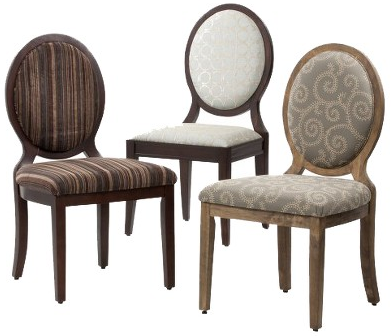
Dining Room Chair Furniture from Target

You paid $200.  You now have a chair.  But ask yourself two questions:

  • “How much, on average, will this chair cost per day?”  
  • “Will I be able to pass this chair on to my children and grandchildren, having it look as good as the day I bought it?”

Those two questions are important.  In the first case, imagine that an inexpensive chair lasts for roughly five years before beginning to wobble or come apart at the joints.  In that case, your cost was roughly 11¢ per day to own the item.  It wasn’t particularly nice.  You didn’t get to customize the fabric or trim.  You certainly won’t be able to pass it on to future generations.  It probably won’t even be held together in another 20 years, let alone a century!

Compare that to a really well made chair a better brand like Henredon, Century, Henkel Harris, or Baker.  If you choose wisely and take care of your investment, your furniture should last for 50 years or longer.  If a problem ever arises, you should always be able to get it repaid.  If you change your home, you can reupholster or refinish the chair to completely change its appearance because it is real wood, constructed by a real craftsman who had real tools.  

Take this Henredon arm chair, which retails for $1,950 in a Class C fabric.  
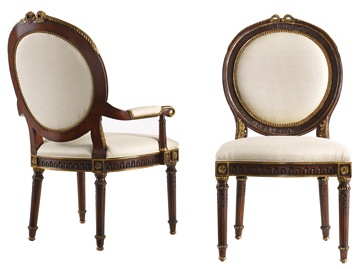
Henredon Fine Chairs and Furniture

If you were to go to one of the factory outlets in North Carolina, you could probably get it for $1,170 or less, saving significantly off retail prices.  In the first 50 years, your cost per day would be 6.4¢.  That is nearly half the price you pay per day for the cheap Target chair.  Add in occasional repair, reupholster, and refinishing, to keep it in pristine shape and changing with your home’s decor over the years, and you might approach somewhere around the same cost-per-day as your cheap Target chair if you have a penchant for more expensive fabrics.  

Think about the math.  The chair with the $1,950 retail price, or $1,170 factory outlet price, is less expensive than the $200 chair from Target, it is nicer, it can be passed down to your children, it can be refinished and reupholstered to change your home’s appearance, and it probably has some value in the event you ever needed to sell it, whereas your Target chair will probably get you a few bucks on Craigslist.  

The lesson: Stop looking at the sticker price and calculate amortized per use or per day cost.  Even if the two were identical, the luxury chairs are a better bargain because, for the same price, you get a vastly superior product. 

Plus, on a purely personal note, picking out the fabrics you want is a lot of fun.  It reminds me of customizing a character on a video game or buying furniture in the Fable II & III franchise.  Seriously, it is a blast.  I actually listened to the Bowerstone Market theme from the Fable II soundtrack as I looked at the fabric choices since it made me feel like I did when I furnished my townhouse before, you know, winning the game and getting crowned King, moving into Fairfax, and being generally awesome.
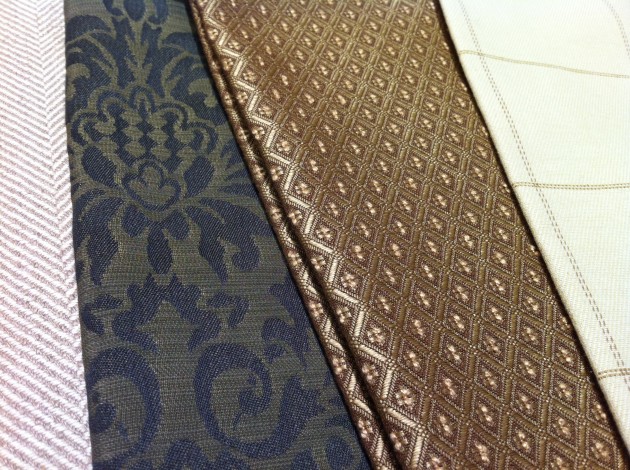
Henredon Upholstery Fabrics

A few of the Henredon upholstery fabrics for the above chairs ...


The Mathematics of Investing in Nice Furniture Was Discussed By Millionaire Next Door Author Dr. Thomas J. Stanley

In one of his bestselling books, The Millionaire Mind, Dr. Thomas J. Stanley observed:

By definition, millionaires tend to be accumulators, a trait they inherited from their parents who were collectors.  Their parents and grandparents held on to things that had value.  So the majority of millionaires have a family legacy of collecting, saving, and preserving.  Waste not, want not is a theme acted out by first-generation millionaires today.  - Page 294

Later, he goes on to apply this to quality furniture:

They deliberately purchase furniture today they can pass on to the younger generation tomorrow.  This, in essence, is their definition of quality furniture.  It will outlive a person’s normal adult life span, will never lose its appeal, and will probably appreciate in value. - Page 294

One of the biggest mistakes a young married couple can make is to try and fill their home with furniture instead of taking a few years to quietly assemble a collection of legacy pieces that will survive long past their lifespan.  If, at 22 years old, you bought only a few good pieces a year, and continued doing this until you were in your early thirties, you would be set for life.

How to Tell Quality Furniture

The best place to start is to educate yourself on the things that constitute quality construction (dove tail joints, wood-on-wood sliders, 8-way hand tie on upholstered goods, etc.) and then start looking at brands such as Maitland Smith, Henkel Harris, Hancock & Moore, Century, Karges, Marge Carson, Stickley, EJ Victor, etc.

To those of you who have written me, met with me in real life, and shared your knowledge about furniture and quality furniture construction, I’m incredibly grateful.  

Related posts:

  1. Every Month, 200 Fresh Roses Are Delivered to My Home (A Lesson on How to Save Money)
  2. Shop Globally to Save Money
  3. The Ramifications of Globalization Through the Eyes of the Domestic Furniture Market
  4. Why I Avoid MDF and Furniture Built with MDF (and Think You Should, Too)
  5. A Memory of Long Ago and a Way to Reflect It In My Life Today
  6. I Think – Maybe – Kraft Foods Is Being Run By a Moron
  7. How I Approached the Financial Side of Buying My First House
  8. My Day In Pictures – Panicked Investors, Candy Run 2, and More Berkshire Hathway – Thursday, August 18th, 2011
  9. It Isn’t Looking Good for Bishop Eddie Long
  10. Mail Bag: I’m Thinking of Buying a House in Florida. What Should I Consider?

  • Gilvus

    From my calculations, if you took the $1750 (the full retail price of the expensive chair minus the full retail price of the Target chair), plopped it into an index fund, and bought a new Target chair (price adjusted for inflation) every five years,  you would have $22,678  of extra inflation-adjusted dollars in hand after 50 years.

    This ignores minimum investments for mutual funds, commission fees, and capital gains taxes. Index fund assumed to compound at 7% after inflation, and the Target chair assumed to scale 3.5% with inflation annually.

    • Joshua Kennon

      If you are comparing the financial value of buying a chair relative to the opportunity cost putting the money to work in a higher returning asset class, your analysis makes sense (unless, of course, you happen to find some furniture maker that turns into the next great collector item and is being sold at Christie’s in 50 years; there are some Stickley pieces that go for $100,000 to $200,000+ at auction).  

      However:

      1. I would never pay full retail price.  I would use $1,170 as a starting base, not the $1,750 retail.

      2. A business owner could, theoretically, buy certain products for his or her company and get a tax-deduction lowering the cost even further.  Imagine that the nicer chair were bought by a dentist for his office and he were in the 35% bracket.  Suddenly, the $1,750 retail chair wouldn’t be $1,170, it would be $761.  That is only 43¢ on the dollar.  Just like buying a stock cheap can improve your returns, the same holds true for furniture.  (Some believe the tax code is unfairly tilted toward business owners in this way, but I have no problem with it because they also get double-taxed on self-employment income on the first $106,800+ or so each year.)

      3. The math comparing chair-to-chair purchases would still be close enough to favor the higher quality chair because the utility I’d gain from having a piece of furniture that had been with me through my entire life, that could be passed on to my kids, and that saved me the inconvenience of at least ten different trips to department stores to replace constantly-breaking-and-wearing-out less-expensive chairs has more value to me than $22,678 in future wealth because I already have enough future wealth that it won’t provide me any additional utility.  

      This is why I’m crazy about the personal opportunity cost approach. It isn’t a precise science, but when you picture your future life, knowing which you’d rather is a useful exercise. It tends to weed out a lot of mistakes, especially if you are rational enough to be willing to live with the consequences of your decisions.

  • Anonymous

    You certainly won’t be able to pass it on to future generations.  It probably won’t even be held together in another 20 years, let alone a century!

    Oh yeah?  Prove it.  

    This sounds like a ridiculous justification for buying overpriced things.  As “Gilvus” notes, there’s a huge opportunity cost to spending 5 times as much on a chair.  Sorry.

    And all the hub-bub about passing furniture down for generations?  Yeah, I’m sure your kids are just dying to get your old junk.  There’s not a single piece of furniture I’d take from my parent’s place, and it’s not because it’s low quality.

    • Joshua Kennon

      Financially, I’m a wild libertarian. I don’t think justification is necessary because, morally, I think someone who earned money honestly should be able to do whatever they want with it. But I don’t follow your logic about future generations becaus if the kids didn’t want the furniture, they could sell it. That happens all of the time, in every area of life. I watched Carl Bark’s family auction off his easel, the one where he created countless legendary Walt Disney paintings, because they didn’t want it. Investors and collectors did.

      Plus, you have to remember “expensive” is a relative term. Purchases should be measured by how much time it takes for the buyer to re-earn the cash necessary to pay for the item. To a guy making $500,000 per year, a $2,000 chair is exactly the same purchase burden as a $200 chair is to a guy making $50,000.

      The whole time I’m writing this comment, all I can think is “Pedo Bear is commenting on my site.”

      • FratMan

        That Pedo Bear comment almost knocked me out of my chair. Completely unexpected, and I’m still laughing.

    • Joshua Kennon

      I should also point out that most of the price, a large percentage of it, is 100% due to paying American workers good wages. The identical item could be bought for half if it were made in China. I don’t consider it wasted money. I think of it as a “vote” for domestic industries.

    • FratMan

      tatsuke,

      I don’t think you’re approaching Josh’s post in the right way. He’s not trying to suggest to you that you should buy $2,000 chairs (and I’m guessing from the tone and content of your comment, you absolutely wouldn’t), but rather, he’s sharing with us his thought process of how he makes his decisions, and that’s the most valuable part of his many posts. Whenever Joshua talks about some of his purchases on the blogs, many people respond as if Joshua is suggesting that “they” should make the same purchasing decisions, which couldn’t be further from the truth. Do I personally think buying expensive furniture is absurd? Yes. I like to buy old beaten down “comfortable” furniture for $50 so I don’t have to worry about treating it a certain way. But Joshua doesn’t write these posts to seek our blessings and endorsements to effectively say, “Yes, I’d spend my money the same way”, but rather, to explain to us why he did it, and that’s what is important. Plus, if Joshua were to look at my expenditures for the past twelve months, he could easily find things in there that would be ridiculous to him–for instance, I’m going to see Bruce Springsteen live 5 times in the next two months, and that will most likely cost me over $1,000 (and the lifelong opportunity costs could be in the hundreds of thousands). Joshua may not think that’s a wise allocation of capital, you may not think it’s a wise allocation of capital, and no one else reading this blog may think it’s wise–but if I take a clear-eyed view of the opportunity costs of these decisions and still decide that it’s worth it, then I’m doing myself a service by living according to my own judgments of personal satisfaction, rather than the value systems of others, and I think that attitude is the first step towards living a satisfying life. 

      • Joshua Kennon

        “Joshua may not think that’s a wise allocation of capital, you may not think it’s a wise allocation of capital, and no one else reading this blog may think it’s wise–but if I take a clear-eyed view of the opportunity costs of these decisions and still decide that it’s worth it, then I’m doing myself a service by living according to my own judgments of personal satisfaction, rather than the value systems of others, and I think that attitude is the first step towards living a satisfying life.”

        - Brilliantly, brilliantly put!  That is exactly the point!

  • Joshua Kennon

    That is so cool!  Well done!  (And +1 for the Playstation controller right next to it – a household after my own heart.)

  • http://www.vulneratusnonvictus.blogspot.com/ Elisabeth

    Buying quality in anything can save you money! 

    This is a much more advanced version of the theory I use for clothes and shoes. I am the only woman I know who doesn’t have dozens and dozens of shoes. I buy quality, classic styles (no, not orthopedic hausfrau clogs), wear them for 4-5 years until they are worn out, and then shop again. Family and friends were appalled by a recent purchase price (the sale price!) for new leather boots this winter… but comparatively, spending half that each year on a new pair is far more expensive, and I wore the 2006 pair until just 2 months ago.
    But as you point out in the comments, it really is a matter of personal taste. People are free to spend their money as they wish. I agree wholeheartedly, and at the end of the day the sum of your choices is your responsibility. For someone who enjoys having multitudes of boots and pumps, I suppose the quantity over quality method makes sense. The opportunity cost to make yourself happy? That is up to you. I tend to agree with you about quality furniture and legacy pieces, but many people are happy to redecorate every 2-3 years, and probably spend the same amount in the long run (while keeping craigslist and, ultimately, landfills, in business). 

    Thanks for the thoughts!

p-Y58mABW--6DvJ