


Finding a List of Stocks for Your Portfolio
Putting Together a List of Stocks for Further Investment Research
One of the most common questions I receive is, “how do you come up with a list of stocks for your portfolio that you then research further?”, or, as Landon Jacobsen put it during a recent message submitted through the contact form:
I know you mentioned in a past post that companies must past your initial tests before you look deeper into them, but where do you typically start this initial discovery process? Do you run metrics in a stock finder at your brokerage or browse through lists on a site like Yahoo! Finance to find companies that meet your standards? How do you go about finding companies that are likely to be undervalued at any given time? Or do you just find companies that you love and wait until they are undervalued? Or maybe a little of both?
This is a fantastic question. Once you have the ability to value individual companies (you know I believe in low-cost, widely-diversified index funds with dividends reinvested in tax-advantaged accounts for those who can’t), coming up with the list of stocks for potential investment is one of the most important things you can do. Your list of stocks for potential investment is the starting point of constructing your portfolio. There are several things I do when creating the very broad list of stocks that I then filter.
1. The “Dream” Stocks
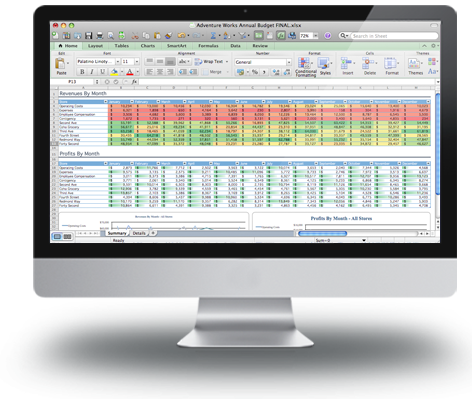
I tend to write my list of stocks on narrow ruled paper until I am ready to refine it further, at which point I create special a master spreadsheet in Microsoft Excel for Mac, with each list of stocks getting its own tab. If I am seriously considering a company’s stock for investment, I will give that company its own spreadsheet and run numbers, scenarios, and valuations on it.
The first companies that make it onto my list of stocks are the “dream” companies that have great characteristics such as little or no debt, high returns on capital, wide economic moats, good management, a history of intelligent and shareholder-friendly capital allocation, natural inflation hedges, etc. Each year, I write down the names of these companies on a list of stocks to monitor and make sure to read the annual report, quarterly releases, and other important documents. I estimate what I think they are worth and set alerts to notify me if any of them falls below my intrinsic value calculation. If I’m lucky, I’m able to add one or two of them every few years.
2. Special Situation Stocks
I monitor news about companies engaging in larger than normal share buybacks, special dividends, spin-offs, break-ups, restructuring, and other sorts of transactions. There are many ways to track these sorts of things but you don’t have to spend a lot (or even much) money thanks to the Internet. There is this site, for example, that publishes updated lists of stocks under categories such as “latest stock buyback announcements” and “top 10 dividend stocks in the electric utilities” sector.
In most cases, I pull the Value Line Investment Survey or another source of research data at the office and try to calculate the total effect on per share intrinsic value that might occur due to the announcement. If it looks promising, I get copies of the annual report, 10K, etc.
3. The Stock Screens
The third way companies make it onto my list of stocks for potential investment is through the use of screeners. There are countless free and paid screeners available. You mentioned Yahoo Finance and that is certainly a decent one. I often put together sub-lists of stocks such as “potential high dividend plays” or “high operating leverage plays”, which I explained in an article called Making Money In Bad Companies over at About.com, a division of The New York Times.
I’ll look for companies with high returns on equity and relatively low p/e ratios, high returns on equity with high p/e ratios and high growth, high return on asset companies with low price to book ratios, and just about any other combination of variables that I think could lead to an interesting discovery. Then, I take the list of stocks and put them into a spreadsheet, pull information on each, and make a quick determination, based upon my experience, about whether a company warrants a closer look. How do I know? Years of looking at financial statements – there are a handful of things I want to identify, such as the ratio of maintenance capital expenditures and working capital to reported net income, that tell me the “quality” of the profits.
4. The Statistical Surveys
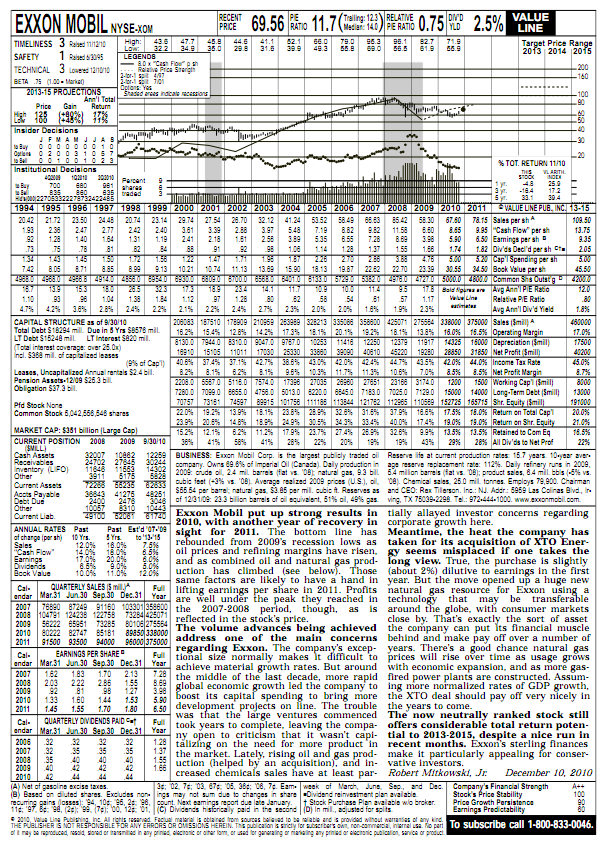
One of my favorite resources is the Value Line Investment Survey and the smaller Value Line Mid Cap and Small Cap survey. Your assets should be large enough they don’t cost more than a fraction of a percent (the subscriptions will run you $1,000 or so a year), but they are a goldmine of information. You can almost always access them for free at a local library, which is what I used to do throughout my childhood, teenage years, and college years. I still remember when I got my own subscription! This is what a typical Value Line sheet looks like. One of the things I like best is it shows the absolute number of shares outstanding each year, so I can see what is happening with the capitalization structure.
Like my heroes before me, I go through thousands of pages of reports from Value Line, Morningstar, S&P, etc. to learn all I can about different companies. I highlight the names of firms I find interesting and keep them on a special list of stocks. You saw me do this in the My Day In Pictures for October 17th, 2010.
Other times, I’ll study the major players in different industries and sectors so that if something happens and, say, I want to own a glass company, I immediately know who they are, their relative market share, and other important factors so I don’t have to start from scratch when reading the annual report. These aren’t formalized anywhere, I just keep the list of stocks in my head.
That is, I try to know what is considered a “good” return on equity, return on assets, debt-to-equity ratio, inventory turnover, receivable turnover, gross profit margin, operating margin, net margin, and more for all different types of businesses – jewelry stores, insurance companies, apartment buildings, construction firms, piano makers, gold mines, pharmaceuticals, consumer products, packaged food, restaurants, banks … the list is endless.
5. Happenstance
Finally, I may hear about a company, see a new company that is full in the mall, read a story about the management, or just otherwise stumble onto it and something intrigues me so I need to learn about it, how it makes its money, the returns it earns for owners, etc. A friend may mention, “Yeah, all of my kids want to shop there” or a story in The Wall Street Journal might catch my attention. A quick look at the financials helps me determine whether or not to add it to the list of stocks for potential investment.
