


The 5 Levels of Building Wealth
Early in life, I developed a theory that there were five levels of building wealth that most self-made men (and women) go through to reach financial independence. The theory began due to my love for Carl Barks Scrooge McDuck comics. When I started reading the Federal Reserve reports of consumer wealth, empirical studies, and other sources of data, and discovered that 90% of those in the United States who are millionaires made the money on their own – that is, they did not inherit it – I started refining my theory. It helped guide me when I lived in a series of small towns throughout my childhood, saving nearly every penny I could from working after school and pouring it into my investments.
Building Wealth Level 1
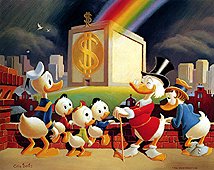
A hard working person gets a job and is paid by the hour. In effect, the person sells his or her time in exchange for a set rate based upon skills, supply, demand, and other considerations. When done, he or she collects a wage and that is it. The person (I’ll use “he” from now on for the sake of simplicity) will never again receive a penny unless he agrees to sell more time to someone else in the future. He is always at the whim of the economy and an employer.
An enormous percentage of millionaires in the United States started here. Economists know this because, depending upon how it is defined, upwards of 90% of high net worth individuals in the United States came from those who inherited little or no money. The only way to ever make a decent living from this level is to increase the rate at which you can charge for your labor. By going to law school, medical school, or business school, someone can demand $100 per hour instead of $9 per hour working at a discount store because their skills are harder to find (rarer) and in demand by the public. The term “wage slave” has been used to describe this level.
Building Wealth Level 2
The hard working man takes some of his savings, built up by spending less than he earned over several years, and starts a new limited liability company to hold his investments. He contributes the money to purchase the materials to build a house. He works on it himself to lower costs or, if he doesn’t know construction, hires someone. He rents the property out to tenants. Whereas at Level 1, he could only hope to make money from the time he spent on the project, he will now begin collecting rental income that will flow into his household’s income statement every month for years, if not decades, into the future barring some unforeseen disaster. That is, he is collecting cash each month even if he doesn’t get out of bed in the morning.
Most people never get to this stage because it is difficult to have the discipline to save money and come up with enough money to get off the ground. It’s a painful, slow process that can cause a lot of burnout, especially if you have no one to guide you and show you how easy it can be. Instead, they give up and stay at Level 1 forever, always worried about hanging on to employment or making enough to cover the monthly bills.
Building Wealth Level 3
The tipping point is reached when the hard working man no longer needs to live off the rental income generated from the property. This means that he is contributing savings from his job as a construction worker plus the after-tax earnings from his rental house to his limited liability company. Before long, he is able to construct or purchase a second property. Suddenly, like a tree planted in a field, the first young oak tree, which began as a sapling, begins to throw off acorns. The wealth is still small, but it’s becoming self-generating and that is the key.
Building Wealth Level 4
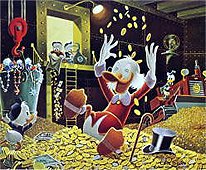
Through years of reinvestment, pouring more money into his investments, and intelligently putting money to work at the highest risk-adjusted rates of return, the small limited liability company our hard working man founded now generates so much money that he can write checks for new properties, hotels, car washes, or whatever else he believes will generate a decent return out of the annual after-tax profit. Should he choose, he could live off the income generated from these investments without ever working another day in his life (that hardly ever happens because, as I told you yesterday, once you get to this stage, business should be fun or you’re doing something very, very wrong).
Financial independence has finally been reached. The hard working man can give shares of the company to his children or grandchildren, or he can donate them to a family foundation, using the dividends each year to support charitable causes that are important to him.
According to the Federal Reserve survey of consumer finances, this represents the top 0.9% of wealth in the United States and typically requires a household income of $400,000 to $600,000 per year (that’s a monthly income ranging from $33,333 to $50,000). I wrote an article about this in 10 Secrets of the Capitalist Class at my Investing for Beginners site at About.com, a division of The New York Times.
Working for the money by selling your labor doesn’t really count, in my opinion. It has to be passive income from assets that you own. Otherwise, you can’t pass it on to your family or support charitable causes after your death.
Building Wealth Level 5
This is simply Level 4 on steroids. By most empirical evidence, it begins at roughly $20 million in net worth, which generates roughly $2 million a year in household income. That’s nearly $167,000 per month. This is the kind of money that you can begin saving up to develop hotels, endow chairs at universities, travel comfortably in private jets, or (as many do) continue to live the same way you always have and continue to expand the investments. Warren Buffett still lives in the same house he bought when he was in his 20’s. Back then, he had a few thousand dollars. Today, he’s worth more than $60 billion.
Building Wealth Summary

As a kid, I’d study wealthy people and classify them by how they generated their money. Even a musician follows the same path as an industrialist. Take Elton John. He is estimated to make $40 million per year by Forbes. Of this, approximately 50% comes from selling his time in the form of concerts. The other 50% comes from his ownership of the song rights on the music he composed. That is, every time someone plays “Bennie and the Jets” on television or in a movie, he gets a check. Every time someone covers one of his songs, he gets a check. Every time it sells on iTunes, he gets a check.
Elton never graduated beyond Stages 1 and 2 but Oprah Winfrey, on the other hand, used her money to buy local cable television businesses. Most people don’t realize that her investment company, Harpo, now owns countless local stations and it’s possible you are paying part of your cable bill directly to Ms. Winfrey. Her money makes money for her now, so even if she never recorded another show, the stream of earnings would keep on rolling into headquarters. That’s why she earned $250 million versus Elton’s $40 million. That’s a big difference.
Charlie Munger said it best when he opined about Berkshire Hathaway, “We want to own businesses that drown us in cash.” Once you get enough of them under your belt, compounding starts to take over and suddenly your businesses generate enough money for you to buy more businesses.
