

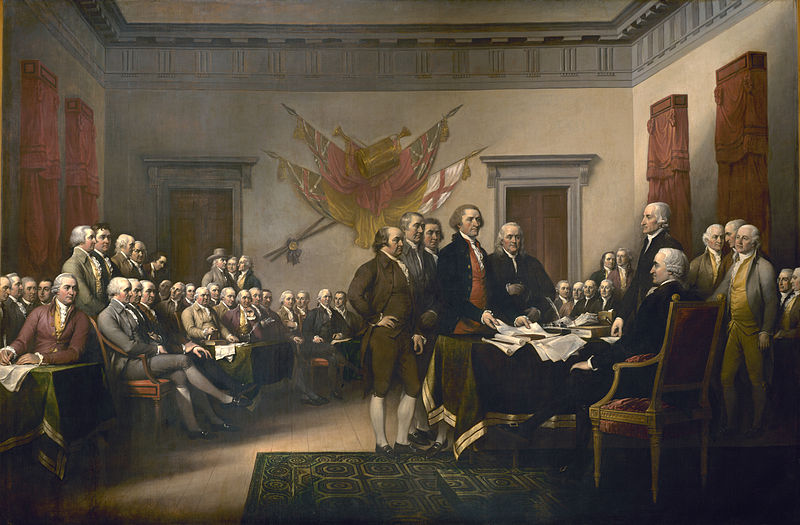
When the United States was founded, life was not paradise as everyone seems to think in some sort of collective delusion. In fact, for all of its faults, America is far superior today to what it was in the past, even with our current fiscal problems. Consider that when the nation was founded:
- Women could not work outside of the home
- Blacks were enslaved and only counted as 3/5ths a person
- To vote required owning property, keeping political power in the hands of the rich
- Catholics could not hold public office
- Being gay was punishable by execution
- GDP per capita was less than 3% of today’s rate, meaning we are at least 30x richer on average. This doesn’t even factor in advancements like air conditioning, automobiles, computers, the Internet, indoor plumbing, etc.
- Children had no workplace protections and were often forced to work in mines and other unsafe conditions for sub-poverty wages
- There were no consumer protections for drinking water quality, food quality, and product safety.
- Life expectancy was around 35 years old
- Most of the nation consisted of small farmers. The average woman gave birth to 6 to 8 children and was responsible for weaving, gardening, and running the house.
- There was virtually no free time compared to today for leisure activities
- 90 out of 100 people did not attend secondary school
It sounds like a veritable nightmare. America was great for its promise. But it has taken us more than 200 years to get there and we still have work to do. It is time to stop thinking that we came from some great political Eden. Life was hard. We’re in a paradise today compared to what our ancestors endured.
[mainbodyad]
Reader Comments (8)
Comments are presented chronologically, with replies indented beneath the comments to which they respond.
W. Hwang
May 29, 2011
Awesome food for thought...now if someone bring up the "founding fathers" into a discussion, I'll always be thinking: what would they have become, had they been born again in modern times?
Rayachidon
September 22, 2011
Why are you comparing it to today's standards? EVERYTHING was a s**thole compared to what we have today. Slavery was always a problem and women didn't always want to go work in coal mines. In these days before factories many kids went into the family businesses or apprenticeships. They definitely free time, since many were self employed or in family businesses you could go do the crops for a while, goof off, go drink a beer while doing your crops, and there would be no problem. I think you comparing it to modern day is like comparing early prototypes to finished products.
welam
July 24, 2012
Replying to Rayachidon
Rayachidon, you obviously have no clue what farming required "back in the day." it was a sun up to sun down proposition. there was no time for goofing off or going to drink a beer. (where would they go? they were likely miles from anything one could remotely call a "town.") I think the overall point Mr. Kennon is making is not so much about technology & leisure time but more a reminder that the opportunities we take for granted today -- education, political and social engagement -- just weren't available to anyone who wasn't a rich white guy.
RedSkyMorning
July 19, 2013
Replying to welam
You obviously have no idea what living in a 17th century London slum would be like either. Drinking was a major past time in colonial America and the major source of revenue for the new American government, so apparently they had sufficient time for it.
RedSkyMorning
July 19, 2013
Colonial America refers to 13 colonies owned by Great Britain, which became the first states. These colonies had differing laws about religious freedom, women and minorities. The American colonies were mostly self governing and some of these places offered great personal freedom. Certainly all blacks weren't slaves, women couldn't work outside the home, and Catholics couldn't hold public office is not true of all the colonies.
America had the highest GDP per capita in the world in 1776 and lowest infant mortality rate-of which we no longer have!!! I doubt the author can cite his statistic on the life expectancy. Nothing seems cited here. Reads like a 4th grade history book.
FratMan
September 5, 2015
What should we make of Charlie Munger's prediction that the next 50-60 years will give us things "far worse" than what we're currently used to?
Ang
September 19, 2015
Replying to FratMan
Question - do you believe he means that standard of living wise things will be worse or is he talking about catastrophic events like the "Really Big One" in the Pacific Northwest and the possibility of nuclear attack?
Gilvus
September 19, 2015
Replying to Ang
I don't think Charlie could overlook something as big as the improved quality of life in today's world. I'm almost certain he means the latter. He's echoing what Nassim Taleb wrote about in The Black Swan and Anti-Fragile - that as society advances, it becomes more fragile and more susceptible to extreme events. In his words: our society is digging deeper and deeper into Extremistan, while Mediocristan is being left behind.
Simplistic example using your PNW example: the last Big One took place around 1700. There were no metropolises back then - no roads, skyscrapers, underground pipes carrying explosive gasses and toxic sludge. A 9-magnitude earthquake back then would've knocked some people over, toppled a few statues and adobe huts, and killed a few people from landslides, heart attacks, etc. A 9-magnitude earthquake today in the PNW will kill tens of thousands, at a minimum, and cause mind-boggling monetary damages. I'm not even going to guess the order of magnitude and any estimates you read are likely to be wildly inaccurate, but it's guaranteed to be in the double-digit exponent territory of dollars.
If you haven't read his books, I'd highly recommend them. He was an options trader early in his career, so his talk about financial markets will resonate with the crowd around these parts.