

The average healthy adult should eat roughly 2,000 calories per day to maintain a recommended weight. In the United States, all else equal, the average male, at 5’8″, should weigh between 140 pounds and 172 pounds. The average female, at 5’4″, should weigh between 114 pounds and 151 pounds.
In study after study, the typical person underestimates the number of calories they eat in a day, often by a significant amount. This propensity to miscalculate creates some unpleasant non-intended consequences. For example, it’s long been known that by putting “low fat” on a package, consumers eat more calories worth of the product in a single setting, meaning it makes them fatter than the real stuff, which they probably would have enjoyed more. Likewise, simply adding fruit to the top of a dessert causes people to reduce their caloric estimation by several hundred calories than the identical dessert without the fruit. That is, a piece of cheesecake was estimated at x calories, but adding peaches or cherries to it caused people to estimate a significant reduction in x despite it having more calories under an intuitive assumption that fruit is healthy.
[mainbodyad]The New York Times decided to create a visual guide to drive the point home, allowing readers to see exactly what 2,000 calories looks like based upon where you eat; to show people food prepared from fresh ingredients at home (as opposed to prepackaged, processed food) is often more filling, tastier, and less calorie intensive than food served at restaurants and quick service locations. You need to go look at it right now because it’s eye-opening. You can click this link.
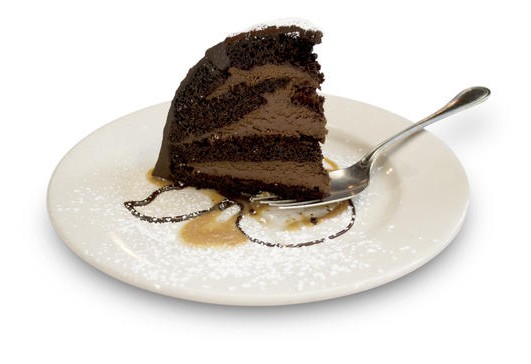
Some of it is ridiculous – who regularly goes to McDonald’s and orders a fried chicken sandwich, french fry, Coke, and McFlurry to the point they’d need to worry about the calorie content of that meal? But the point still stands. What gets me is the ridiculousness of the sit-down places, which are worse than the fast food joints. The Center for Science in the Public Interest posted rankings and images of gut-busting dishes from major restaurant chains. Consider this single piece of Chocolate Zuccotto Cake from Maggiano’s Little Italy. It is equivalent to an entire eight-serving Entenmann’s Chocolate Fudge Cake. This one slice has 1,820 worth of calories (leaving you almost nothing for the rest of the day unless you want to gain weight), 3 days’ worth of saturated fat, and four days’ worth of added sugar according to CSPI. Most consumers have no idea. They don’t understand unless they skip breakfast, lunch, and dinner, they shouldn’t be eating this in most cases.
 Homemade food is different. My own recipe posts can be used as evidence. Consider that calorie bomb of a pie I made a couple of weeks ago. The caramel pecan apple pie with homemade crust, drizzled in butter, cinnamon, sugar, and other goodness? A single slice of it contained only 608 calories and I found that incredibly high. I guarantee it is exponentially better, too. Our cinnamon roll recipe? Not even close. Our pineapple upside down cake? Please. We use food scales and spreadsheets to figure out exactly what a recipe will do to us on a per serving basis, coupling it with the Plan to Eat software and MyFitnessPal.
[mainbodyad]In fact, I find it hard to physically understand how it is even possible to get that many calories in a serving and I believe in the old school methods – butter, heavy cream, lard. Think about the Cheesecake Factory. As you’ll see in that New York Times special, some of their dishes were more than 2,400 calories! The closest I’ve ever come to anything like that was a 1,500+ calorie per serving Italian sausage and cream sauce recipe drizzled over handmade ricotta stuffed ravioli. If you have a small breakfast, with a light lunch, it’s easy to fit into your 2,000 calorie daily allotment. It’s so rich, and so extreme, you won’t want to eat anything else for twelve hours after you’ve had it.
Part of me wonders if it’s related to the inability of most people to make accurate mathematical estimates unless they’ve been trained to the contrary. I was reading something the other day that said most men and women couldn’t answer the question, “What is a million times a billion?” because the brain didn’t evolve to handle large numbers. Or the fact that only half of the graduates of Harvard, Princeton, and MIT could answer the simple logic problem, which we’ve talked about in the past:
A bat and ball cost $1.10.
The bat costs one dollar more than the ball.
How much does the bat cost?
They immediately respond with “$1.00”, which is wrong. Worse, they don’t invert the math and check it, which is the easiest way to verify your math on something like this unless you can do algebra in your head (e.g., If the bat costs $1.00, then the ball would have to cost $0.10 to get to the total of $1.10. That would mean the bat ($1.00) is only $0.90 more than ball ($0.10). Therefore, it cannot be the correct response because the bat has to be $1.00 more than the ball, not $0.90 more than the ball).
Or the fact people think of $299 being distinctly cheaper than $300. They deny it, but it works. That’s why retails keep up the practice.
As it pertains to food, this math deficiency is best illustrated in a program that airs in the United Kingdom called “Secret Eaters”. The episodes are on YouTube. People swear up and down they aren’t exceeding 2,000 calories a day – they try to estimate the numbers in their head – so the show hires surveillance teams to spy on them, dig through their trash, record their kitchens, follow them to work, and then, at the end of the period, bring them to a vault that shows them exactly how much they ate. When they see the actual numbers, the real calorie information and that it inevitably explains why they are the weight they are, a lot of them are in complete disbelief. It’s a mental model extravaganza so watch it if you like studying them.
It makes me realize how much I love math. It is such a wonderful tool for measuring and managing almost any area of your life.
And while we’re on the topic, can I just ask you Brits what is up with the way you name television shows? A related show about morbid obesity is called … wait for it … Fat Doctor. You literally named a show “Fat Doctor”. It’s so ridiculously blunt it cracks me up because I can’t imagine anything ever being called that in the United States. It’d be shut down in a week due to protests. Instead, we’d call it something like, “Body Transformation” or “Life Coach: Weight Edition”. (Not to make light of the serious topic – some of the episodes are heartbreaking. I happened to see it once while I was in the gym and I cannot imagine being unable to get out of your bed or leave your home.)
Maybe that word isn’t a stigmatized in the U.K.? I haven’t heard anyone called fat in the U.S. in probably ten or fifteen years. Then again, you all refer to pension retirement systems as “schemes”, whereas on this side of the pond, that sounds like a plan hatched by Doctor Evil.
If you decide to watch the latter show, be prepared for conflicting emotions. The people who really want it get their life in order, the surgery helps them, and they go on to be happy and fulfilled in many cases. In others, some of the people who are 600, 700, 800+ pounds exhibit a phenomenon known as “learned helplessness”. One woman I watched, who was given only a few years to live, was gifted what amount to a free medical pass for weight reduction surgery if she could just get below a certain threshold, paid for (if I recall correctly) by the British taxpayer. Instead, she had her husband sneak food into her (and he did it!), so she never lost any weight despite being in a controlled life-or-death hospital situation. You can tell the doctors are beyond exasperated. This woman is going to die. They keep telling her she is going to die. Her heart can’t take it much longer. I can’t help but think when you get to that level, it’s a prolonged way to commit suicide.
I’m not sure how someone could do that to their significant other … you know they’re facing the end of their days unless you change, yet you keep giving them the thing causing their death and misery? They are so big they can’t leave and get it without you; can’t go to the park; can’t go out to a restaurant; can’t drive themselves around in some cases. You’re just as, if not more, guilty. What motivates a person to make such a horrific decision, taking part in the destruction of the person they are supposed to love most? I understand not being able to do anything when someone is still self-sufficient – obesity has hit part of my own family hard – but at the point someone relies on you to bring them food because they are bedridden, you can just say “No”. What are they going to do about it? They physically can’t get up, meaning they can’t go shopping for themselves. That’s a game changer.
Reader Comments (27)
Comments are presented chronologically, with replies indented beneath the comments to which they respond.
Emery
December 23, 2014
Are you familiar with the work of Gary Taubes? He argues that counting calories is a worthless exercise.
To paraphrase one of his examples, explaining weight gain by saying you took in more calories than you expended is like explaining that a room got more crowded because more people came in than left: both are vacuously true explanations that tell you nothing about the why.
The common wisdom states that overeating or a sedentary lifestyle is the cause, and getting fat is the effect. Taubes believes that getting fat is the cause, and overeating/sedentary lifestyle is the effect. If this sounds ridiculous at first, think about a young boy growing up: is he getting taller (gaining weight) because he is taking in more calories than he is expending (overeating, by definition), or is he overeating because he is getting taller?
Most people, even those who are obese, go through long periods where they are weight stable. Let’s say you accomplished the ordinary feat of starting and ending a year at the same weight. It takes about 3500 calories to gain 1 pound. If you believe in counting calories, that means each day on average, you managed to balance your intake to within 10 calories of your expenditure. One Wheat Thin contains 13 calories.
Calorie information is more available than ever before. Health club revenues are at all-time highs. I think it is reasonable to say that most people would prefer not to be fat. Yet, obesity is the worst it has ever been. Is it more likely that people are just completely incapable of controlling themselves, or that we are working with the wrong information?
Taubes’ work is well researched and persuasively argued, and it really changed the way I think about the problem.
Joshua Kennon
December 23, 2014
Replying to Emery
I'm familiar with it. I have no comment.
On a slightly related note, I will say I find the statement "health club revenues are at an all time high" in this context to be meaningless because it presupposes that gym revenues are an acceptable proxy for personal fitness commitment. The numbers do not support that upon even a cursory examination. Specifically, the last time I looked at data for the gym industry, something like 70% of all people never used their membership but kept paying for it because they thought they someday would; to not have it represented failure to them so it was an idea, a way to self-identify. This tells us that gym membership is nowhere near an accurate measurement for fitness levels, hours spent on exercise or weight training, or a commitment to personal health. We know this conclusion to be true because the entire capital structure for most franchises is built upon that very premise. In fact, almost all gym chains are physically incapable of accommodating all of their members if they did show up. In some cases, you can plan equipment layouts sufficient to cover only 3% to 5% of your membership at any given time depending upon your geographic location.
To be absolutely blunt about it, that gym revenue is not indicative of a change in the habits of most Americans. They are generated from overweight people signing up in January, then dropping out in February and not actually getting in shape because they don't carry through with the exercise by changing their habits for longer than 6 weeks. The rest of the year, the people who are actually there and have sculpted bodies, account for virtually all of the actual usage but a minority of the memberships and revenue.
Therefore, it is mathematically flawed. It sounds as if it supports the thesis but there's no truth in it.
Rob
December 23, 2014
Replying to Joshua Kennon
So people are paying upfront for a service they do not use, decreasing the wear and tear on the PP&E, and knowingly keep paying although they realize they will never use the service because they feel better about themselves simply for doing so....looks like I need to open a gym.
Ian Francis
December 23, 2014
Replying to Rob
Planet Money just did an interesting piece on this exact phenomenon. (http://www.npr.org/blogs/money/2014/12/17/371463435/episode-590-the-planet-money-workout) I found it amazing that there are this many people who own gym memberships just to have one. There is a part about how gyms keep people who aren't regular users paying, one of which is food (mostly carb-intensive things like pizza). I laughed to my wife yesterday as we entered the gym to find... an entire table full of sub sandwiches and another full of pizza. It is the end of the year, after all, and many people's memberships are coming up in a week or so.
David
December 23, 2014
Replying to Emery
One reason some obese people seem to maintain their weight is because their metabolism actually increases with the weight gain. Yes, contrary to popular belief, fat people usually don't have slower metabolisms, but can actually have "faster" ones. Eventually the higher intake collides with the increased calorie expenditure and weight gain stalls.
Also, there are many compensating factors that aid in weight maintenance that need to be factored in. Whichever way you measure it, a caloric surplus over a decent period of time will lead to weight gain. The factors that contribute to creating that caloric surplus are important to understand, but they do not replace this fundamental truth. I notice that most who preach this "Calorie counting is useless" idea are typically invested in some kind of paleo program. That's fine. But, I promise you that they are not losing weight without a caloric deficit. They simply adjusted their diet to make it easier to create a deficit by increasing their satiety through better food choices.
And, most people would prefer not to be fat in the same way most would prefer to be wealthy - it's hard to change behavior. The problem is that we live in an obesogenic society, which makes it that much harder for the average person to not gain weight. Also, it should be noted that maintaining the same weight past around 30 years of age is not an ordinary feat. Ordinary is gaining around a pound a year.
If you want to be certain that calories do matter - review the studies that are done within a metabolic ward. These are the only 100% reliable studies because there is no room for accidental dishonesty by the participants.
To be fair, though, people would be better off if they focused on creating a diet and lifestyle that promoted satiety and stable blood sugar levels before simply counting calories. And, I don't think you can responsibly tell people to ignore calorie intake.
If you're interested, you may find the following links useful.
http://www.bodyrecomposition.com/fat-loss/the-energy-balance-equation.html/
http://atvb.ahajournals.org/content/26/4/729.full
http://www.bodyrecomposition.com/fat-loss/all-diets-work-the-importance-of-calories.html/
After reviewing the times article it should be factored in that the liquid calories used for the fast food made it a bit less fair. They had diet drinks in the homemade meals and normal soda + shakes in the fast food example.
William Michaels
December 24, 2014
Replying to Emery
I guess I would argue that your "young boy growing up" is not overeating at all. He is eating proportionate to the metabolic demands of an active lifestyle and the needs of the body to grow. That is why he is not getting fat despite "overeating" - because you are simply comparing his eating/intake to a sedentary non-growing adult. As compared to other young growing boys would you still call it overeating? That is the group to compare to as they would have similar metabolic demands.
Obese people stop gaining weight quickly because basal metabolic demands increase with body size. For example, you need more energy to move a big object than a small one. You need 2500 cal to maintain your body weight if you are at an average size. This can easily increase to 4000-6000 cal per day if you are morbidly obese. So it gets tough to keep gaining weight at some point. Maybe this is why we don't often see people over 400 pounds, or maybe they just die earlier.
I think Taubes is saying that what you eat (carbs) might drive you to eat more. I am not sure he is saying that getting fat is making you eat more and that is what is making you fat. If you eat carbs you store fat and also feel hungry at the same time. This drives more eating and more fat storage. But its the carb intake, not the fat itself, that drives this process. Subtle difference but important if you want to change your behaviour.
As a physician I try and get people to lose weight. It is surprising how many of them do not have any idea what an ideal and healthy body weight is for them. When I tell them they laugh and say that they haven't weighed that level since they were 17 years old. They think I'm crazy. They will offer that they could lose 5-10 pounds at most but 60-70 pounds? You are a crazy doctor! I would be skin and bones! Many of us should be around 150-160 pounds. Most of us are over 200 pounds. It is not surprising if you consider that many men gain 1-2 pounds per year starting in their early 20s. By the time you are middle age you can easily have gained 50 pounds without even noticing it. Unless you look at some pictures of yourself when you were 20. Notice a difference? Yes - you are fat. You can put your head in the sand or you can educate yourself about calories and food choices, get some exercise, and show some discipline. Alcohol and soda is a killer. If you drink every day, booze or soda, you will not lose weight (if you have a full-time job and kids).
Sometimes the fat is hidden. I know myself I can gain 15 pounds and not look much different. Some people have a more athletic build and the fat is hidden insider the body cavities - but its there if you gained the weight. I see it when I cut people open as a surgeon - it encases everything and what you see over your abs is just the tip of the iceberg.
We are made as highly efficient biologic systems so we can easily gain weight if we put too much food into our bodies. Sometimes some simple food choices can make a big difference. I am a big believer in weighing yourself everyday and spending time understanding how many calories you take in every day. The simple act of tracking this will likely keep your weight in check. Just like checking your stocks and monthly budget, spending etc. will keep your finances balanced. Its the same concept in many ways.
Health and wealth. You need both.
Paul
December 23, 2014
"who goes to McDonald’s and orders a fried chicken sandwich, french fry, Coke, and McFlurry?" Uhh, I would. Granted, if I got the coke, I probably wouldn't get the shake, and vice versa, but it's not as ridiculous as you make it sound. 5'10, 180 lbs, fairly active.
Joshua Kennon
December 23, 2014
Replying to Paul
If you restricted the McFlurry because you got the Coke, you'd be cutting almost 700 calories off the meal, freeing up 35% of your entire daily allotment. That's almost the equivalent of cutting out another 1.5 Big Macs.
You'd save yourself so many calories you'd be able to go home and have 2-3 slices of Pizza for dinner and still not put on weight.
I would not call that a minor adjustment to my point. Your comment shows some level of personal restraint.
(Personally, i see nothing wrong with the occasional blow out as long as someone is overall healthy. A couple of times a year, Aaron will go have 2,000 calories at McDonald's in one sitting by getting the biggest chocolate shake he can with a couple of double cheeseburgers, but it almost always coincides with a reward for his weight lifting program when the rest of the time it's nothing but protein shakes and skinless chicken breast. There's nothing ridiculous about it because it's not an ordinary thing. He would not need to be made aware of the calories because he's never going to do it more than once every six months, at most.)
I'll confess that maybe my personal opportunity cost is influencing my view of what is normal. If I were going to spend 2,000 calories at a time, using all of my food for the day, I'm going to make it count. I'm going to roast a chicken in white white, lemon and butter, have a side of garlic mashed potatoes, glazed carrots in brown sugar and cinnamon, and finish it off with a buttercake drizzled in caramel. I'm not wasting it on McDonald's. I'm happy with an unsweetened ice tea and a Quarter Pounder, which takes a little more than 1/4th my daily allotment at 520 calories.
dave (nestle)
December 23, 2014
Haha. How do you know Entenmanns? !!!
That is my number one "rant" example when I talk about the food industry or business changes. I "go off" about it all the time. I was just in their outlet store in Totowa last week with a friend(I bought nothing). It's regional(as far as I know) so I failed to mention it before.
innerscorecard
December 23, 2014
And yet once these same individuals (or rather top end of the curve through whatever selection process caused "exceptional individuals" to be chosen to work in finance) make up a publicly traded market, the market happens to be perfectly efficient!
Breathaholic
December 23, 2014
Joshua,
As a veteran of "athletic dude to overweight road-warrior back to athletic dude" battle I would like to add my two cents here.
First on calories, Calories, kcals and Joules: This will not life changing knowledge, but I find it interesting.
1 calorie is an energy required to increase temperature of 1 gram of water from 14.5 to 15.5 Celsius. This is a tiny amount of energy which equals to 4.18J (Joules). Kilo-calories is 1000x calorie is the measure we mean when we actually say Calorie.
Nutritionists, did not use scientific prefix of kcal and started using capitalized Calories, so now we have a confusion. 2000 - 2500 calories would not even feed 20 gram hamster let alone a human being. We need 2,000 to 2,500 kcals of food a day or Calories with capital C.
There is a small book by Vaclav Smil called Energy which is an interesting primer for the subject (Energy not Nutrition) and which also is basis for my little explanation above. (I am neither publisher nor author and have no financial interest of any kind) Actually most everything Smil writes is a good place to start if you are venturing into studying a new field. I really like his work.
Even though food is essentially there to fuel our bodies we have developed whole emotional relationship to it. We humans tend to use it as a way to deal with unpleasant emotions. Not everyone and not always but it is there.
There are few interesting books on the subject, well I am sure there are more, but these are the ones I came across that actually were helpful to me.
Mindless Eating: Why we eat more than we think?
Volumetrics - For folks that can't really stop without overeating you go for low density calorie foods like cabbage in higher volumes.
Happy Holidays to all.
Lynn Borzillo
December 23, 2014
Joshua, great article.
As a health care practitioner, I see first hand the health effects caused by excess calories and weight gain. Both diabetes and obesity rates are climbing to epidemic proportions, and is a serious problem for the physicians who take care of the people who have comorbities of disease and obesity.
What some people don't realize is excess carbohydrate consumption is addictive in nature. Insulin, an important hormone for lowering blood glucose and shuttling it into the cells for use as fuel also locks down fat cells and prevents fat from being used for fuel, a double edged sword. Once insulin lowers blood glucose enough, it stimulates the next eating cycle, usually about every 4 hours. In many people this cycle continues all day up until bedtime. It is this yo-yo of blood glucose that causes excess calorie consumption and weight gain.
I have posted a quiz on my website called, "Are You A Carbhohydrate Addict?" to help people identify if an addiction exists. If it does, one can take active steps to address the problem. Knowledge is power. I hope you will allow me to post my quiz to help others, http://tinyurl.com/ppbrlg9.
Mr.owenr
December 23, 2014
Hmm this post reminds me of how insanely high the opportunity cost of eating in an unhealthy manner (and becoming obese) is. All capitals can be exchanged one for another, but also capitals exchange themselves passively in a positive or negative manner regardless of if you actively want them to or not. The attractive woman on the side of the road with a broken down car who does nothing but stand there has men running to her to give her gas, while the unattractive one doesn't. I was sitting here obese and not giving it a second thought, but secretly it is lowering my financial capital among others (in the form of more health care and less opportunities at work and less ability to do things). I'll keep this post in mind as I go eat the 4 or 5 Christmas dinners in a few days.
David
December 23, 2014
Replying to Mr.owenr
Now imagine the scenario where a women divorces her husband because he became a fat slob. That's one hell of an opportunity cost. Alimony, asset destruction, potential imprisonment...
Joshua Kennon
December 23, 2014
Replying to Mr.owenr
Oh man, you know capital exchanges are one of my favorite topics! You're definitely right that capital exchanges itself passively, positively or negatively, at all times. If you're in shape, you have to maintain it. If you have a really great cash generating asset, it will keep piling up money. As you age, your beauty capital tends to naturally decline. The constantly shifting battlefield makes the game fun, at least.
There is some fascinating work in this discipline - trying to estimate exactly how much financial capital a person gives up in wage earning potential (not even including the outflows for higher food costs, higher healthcare costs, lost quality of life, etc.) based on the degree to which they are overweight. You might enjoy reading it just for the interacting mental models that include signaling theory, social proof, capital exchanges, etc.
Jennifer Shinall at the Law and Economics program for Vanderbilt Law School did a study called Occupational Characteristics and the Obesity Wage Penalty that looked at the opportunity cost to women specifically. She found it begins at 13 pounds overweight and, controlling for other factors, is significant. An overweight woman earns $9,000 less than her normal weight counterpart, while an obese woman is paid $19,000 less than her normal weight counterpart. She did the study because her specialty is employment discrimination law, labor markets, and human resources. (If you can't read the study itself, there is a synopsis here and here.) The paper comes at a time when there is a move to consider obesity a medical condition rather than a lifestyle choice, which would allow the legal profession to sue if these sorts of widespread income differentials were discovered in the same way there shouldn't be systematic underpayment of women, or blacks, or the elderly.
The Journal of Applied Psychology published a study a few years back by Timothy Judge and Daniel Cable at the University of Florida and London Business School, respectively, called When It Comes to Pay, Do the Thin Win? The Effect of Weight on Pay for Men and Women. Referencing other works, such as Greenberg, Eastin, Hofschire, Lachlan, and Brownell (2003, p. 1342), they find that subconscious bias is the root cause as obese people are assumed to be "undisciplined, dishonest, sloppy, ugly, socially unattractive, sexually unskilled, and less likely to do productive work, among other attributes", and here is the kicker, even by other obese people. That tells you how deep it runs.
There's a flipside in that for men, and only men, being too skinny also correlated with wage losses. That study has many other referenced studies in it that are worth reading, too. When you start putting the pieces together, there is only one inescapable conclusion you can reach: Even if he or she were exactly as competent as someone else, and did the exact same work, statistically, as the person in the next cubical, a man or woman who has built their physical and sexual capital up to the level of someone like Navy Seal Josh Bridges (seen here teaching his toddler how to rock climb) or actress Mila Kunis is going to be paid a lot more money for identical work. They're able to extract financial capital as a dividend because 1.) people like looking at them, and 2.) the horns and halo effect means they are ascribed all sorts of positive character traits, whether true or not (hardworking, loyal, competent, above average intelligence).
It's not a necessary component of success by any means - the poster child of self-made billionaires, Oprah Winfrey, has publicly talked about her weight struggle and being so large at one point her dressmaker had to buy two designer dresses, take them apart, and combine them into one so she could wear it to the Academy Awards - but it can make life a heck of a lot easier. Paradoxically, it can also make life harder if you rely on it too much. Someone who is too beautiful early in life, and never has to work for anything, may be screwed by the times their looks go south and they're decades behind the curve ball. Again, it's one of those things that makes the game so fun, everybody's playing with a different hand - a set of potential theoretical "bests" they can achieve.
innerscorecard
December 23, 2014
Replying to Joshua Kennon
"It's simultaneously sad, and encouraging, when you realize how many folks will squander the hand they are dealt."
Fortunately, our society (not just the US...even countries like China in some ways - any place with more or less a market economy really) is fairly forgiving. You can squander a few hands and still grind your way back up.
At least that's what I hope, for my own sake. I've squandered away everything I was blessed with, and yet I may make a comeback...
Paul
December 23, 2014
I totally agree with Joshua's article here. About 2 years ago i started a journey to start more healthy eating by tracking calories as accurately as i possibly could. This was a huge eye opener for me, and to anyone that hasn't done this yet go download lose-it app and begin keeping a daily food diary with this app. You can scan foods as you eat them, but once you do this for a week you will really start seeing what the foods you are eating really "cost" you. I started looking at this like a daily budget, just as if it were actual cash. I did some fairly rudimentary calculations to see what my daily "budget" to maintain my weight and then I carved off a few hundred calories to aid in my weight loss journey. Just so you get an idea I was not fat, i was approximately 198 lbs 5'11" and male. I did workout some but my eating habits were not good. So like that i changed, i started eating huge breakfasts that consisted of eggs, and very few carbs, and just as Josh has indicated here I felt like i made much better decisions around my eating for the day and also felt like i was eating more. Over the course of a year and a half of doing this rigorously (I occasionally had cheat days for special occasions but made sure to log those days to see how overboard i had went.) I was down to around 178lbs (i originally started this with a target of 175lbs) The journey was well worth it and i learned an immense amount by doing this slowly and methodically. I have been able to maintain that weight now for over 2 years and it has changed the way i think about food. I dunno if this is at all helpful for anyone but the article that Josh wrote reminded me of my journey exactly.
dave (nestle)
December 23, 2014
Replying to Paul
My wife is obsessed with this app also, although she recently switched to using the "my fitness pal" one. It's so bad that she will pull out her phone and enter data half way through a meal.(when we are supposed to be having quality time,hehe) She is a gym freak and a runner so she doesn't really need the app, but for some reason she is compelled to watch the data. I guess for reasons like you state above.(and I guess for fear of getting a few years older?) But I'm never leaving her!
Andrew
December 23, 2014
Joshua ... I know that it's impossible for it to happen in this world ... but hypothetically speaking, where would be the best place to have your business interest in if Martial Law was enacted in the United States?
Please share some of your great knowledge. Please? You're one of the greatest investors in the world. Just as a mental exercise? Thank you, Joshua.
Connelly Barnes
December 23, 2014
I guess most of the problem is in habits. I was raised to eat healthy foods in reasonable quantities, and exercise regularly, so I do that.
I always feel sorry for American kids who are being raised to eat unhealthy foods, not exercise, and not develop habits that encourage fitness, like being in beautiful outdoor locations which give a positive mental incentive for being physically fit. My parents, spouse, and I all give each other subtle peer pressure to make sure we eat healthily, exercise, and get outdoors regularly.
I have to avoid even bringing home an unhealthy food because then I will develop a bad habit to keep eating it until it's gone. Case in point: that giant jar of delicious Trader Joe's toffees that I keep eating.
I am always amazed when coming from China back to the U.S. of how often Americans are obese as compared with Chinese. Obviously if a population eats healthy foods in reasonable quantities and exercises regularly, then it will generally consist of people of a healthy weight. But I bet there are a lot of subtle little habits that add up, like higher utilization of public transit in China, higher distances walked, far fewer desserts and confectionary foods, eating with chopsticks instead of giant spoons/forks, …
Kevin
December 23, 2014
I'd like to make some sort of insightful comment on the name of "Fat Doctor" and other such programmes, but I'm not really sure. A lot of these reality documentary kind of programs have similarly blunt names - the TV equivalent of clickbait really. The word itself isn't really considered unacceptable. There's a doctor, the doctor treats fat people. Fat Doctor! I suppose it would be a bit less polite if it was along the lines of: There's a doctor, the doctor is fat. Fat Doctor! But even then, I don't think it'd really get any more than a handful of complaints.
I kind of have the opposite feeling when reading/watching American media. I mean, "fat acceptance movement" is a thing over there! People actually use words like 'triggering'! The mind boggles sometimes, I often find myself having to look terms up just to make sure they really are what they sound like. A lot of these things make it over to the UK in the end. Give it 5 years, and maybe "Fat Doctor" would no longer make it on TV!
You are correct regarding the surgery being paid for by the taxpayer. I believe the idea of the threshold is simply that if she is completely unable to control her weight, there's no point in doing the surgery because she'll just put the weight back on again. But it certainly would be free at the point of delivery if she was able to control her weight.
Paarthurnax
December 23, 2014
Pretty interesting topic, Joshua. Some of it hits home for me, being 6'1", 285lbs, but I fully understand where the issue comes from (soda). As for my solid foods, I eat quite well, but I consume way too much soda. I used to be into weight lifting about a decade ago when I was in high school, looked great. I need to get back on the bandwagon lol.
For me at times though, I look at it similarly to your point you've made repeatedly when it comes to finances - opportunity cost. People often don't realize the potential value lost by buying a new car for example, as opposed to buying an older car and investing the difference. Or drinking a premium coffee brand over a generic, investing the difference. 'There is no right or wrong answer, so long as you make your choice fully aware of the opportunity cost for XYZ' is a lesson you've repeated over the years. And it's a lesson I think about often when things come up in life. There has even been a time when I've debated the opportunity cost of a massive bacon cheeseburger. Continue my pursuit of losing weight, increasing my health and likely live a longer life... or enjoy a few minutes of heart-attacky goodness. I've gone both ways. =P
-Bill
Connelly Barnes
December 27, 2014
Replying to Paarthurnax
@Bill: You might consider an arbitrage operation where you substitute fruit drinks or yogurt drinks or teas for sodas. For equal calories they should be healthier. I'm partial to Florida's Natural Orange Juice with pulp, kefir, smoothies, and milk teas that I make myself with honey and milk.
Andrew
December 27, 2014
Replying to Connelly Barnes
May I ask how old you are? Sorry, I don't mean to be rude just interested.
Emiliano
December 24, 2014
Joshua,
There is an app for the iPhone called Calorific. The app beautifully shows how 200 calories looks like for various types of foods. I have found it helpful with estimating calories without doing any calculations.
urbanexile3d
December 25, 2014
"...the inability of most people to make accurate mathematical estimates unless they've been trained to the contrary."
Have you read "Thinking, Fast and Slow" by Daniel Kahneman? I just read it this past summer and was fascinated by it. The bat/ball example is used in the book, although I found the sections on how the brain is not equipped to handle statistical concepts more fascinating.
Connelly Barnes
December 26, 2014
Replying to urbanexile3d
I loved the Kahneman book, and also liked The Art of Thinking Clearly by Dobelli for all the flack that its first edition got due to plagiarism issues.