

A friend of mine, a nuclear engineer, once explained that he doesn’t bother to contribute to forums or message boards when the topic of nuclear energy is brought up anymore because people are irrational about it, interested in their own confirmation bias rather than learning or having an honest discussion. Almost everyone I know working in a specialized field ends up in this camp at some point or another for their respective sector. Whether it’s a litigation attorney explaining that McDonald’s really was at fault in the famous hot coffee lawsuit or a medical doctor making the mistake of visiting a discussion on vaccines (thanks to that nonsense, California now risks falling below the necessary threshold for something known as “herd immunity”, which limits the disease in a population based on resistance in a sufficient threshold of people), there comes a point at which you say, “This isn’t worth the effort”. This then sets off a race to the bottom as the loudest, rather than the most informed, opinions dominate.
In my own life, it manifests in a near total avoidance of publicly commenting on personal finance or investing blogs. I all but gave up a few years responding to people talking about the bank bailouts (Despite being far from perfect, TARP is now over, it generated $15 billion profit for the taxpayers plus the net savings of not throwing the economy into a depression, and most of the stockholders of the companies who committed the evil were wiped out completely or nearly completely. If you had a block of Wachovia shares, or AIG shares, or Lehman Brothers shares, your family suffered catastrophic, non-recoverable losses and that money is largely gone. You didn’t get bailed out, the institution did.) Take AIG … I don’t know anyone with a lick of common sense who thinks this is an attractive proposition:
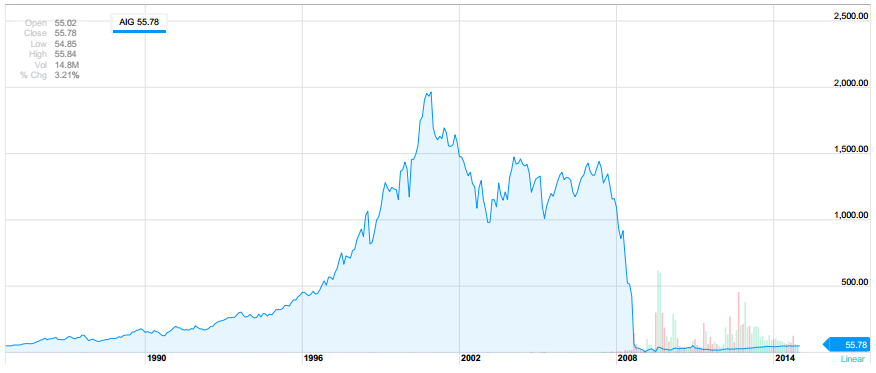
In what delusional world is watching your company go from almost $2,000 a share down to less than $6 a share on a split-adjusted basis, excluding dividends, a bailout? Adding dividends back in, you earned $77.04 in cash along the way and your shares are now back to $55.78, meaning prior to tax adjustments you watched more than 93% of your money get wiped out from the all-time high during the dot-com boom to the low in 2009. The entire financial sector was saved, the taxpayer generated a profit, management was removed, and the owners were slaughtered. What more do these people want? It’s one of the few times Democrats and Republicans managed to work together to actually do something productive, even if it was flawed. The alternative was total devastation.
I still occasionally read financial boards, but I rarely say anything. It’s a losing battle. Take, for example, a post that crossed my Reddit home page yesterday from /r/Frugal. It was called “Every 25 year old needs to see this chart.” A bit of research showed it was an excerpt from a JPMorgan Funds slideshow.
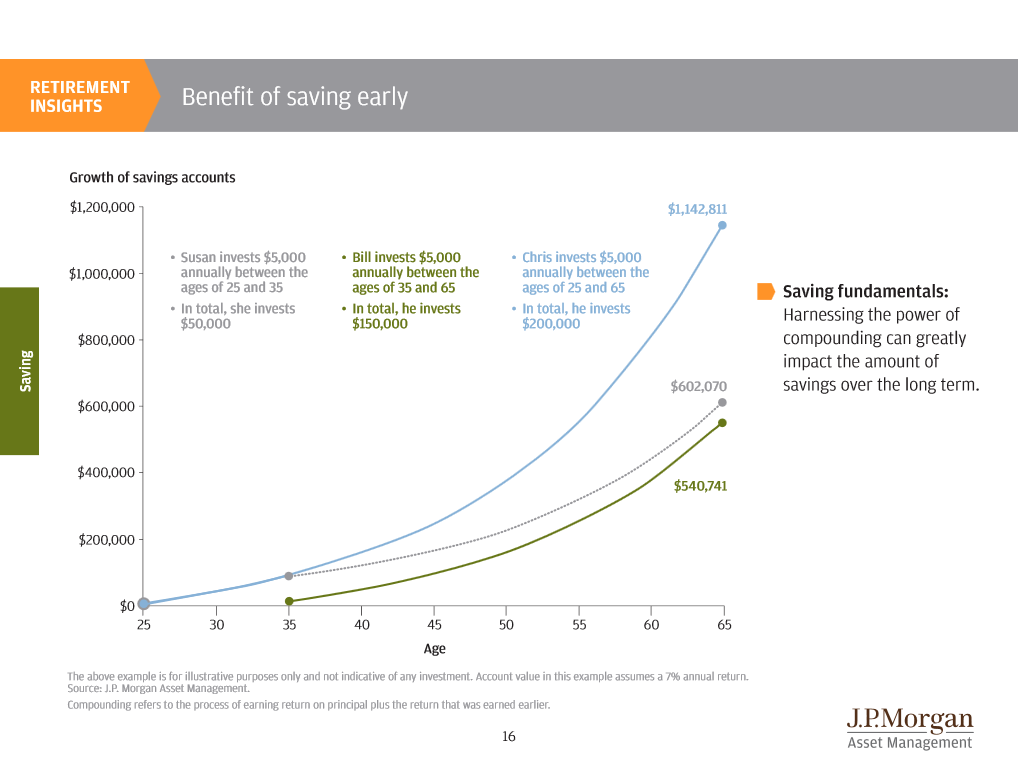
Here is the actual source image from the J.P. Morgan 2014 Guide to Retirement. If you click on it, it will take you to the PDF report from J.P. Morgan
Let’s ignore the fact that one of the (likely) interns made what appears to be an honest mistake and called this “Growth of a savings account” when the fine print assumes it is an investment account; two very different things as the commentators point out in the thread. The underlying concept is what matters: Namely, the earlier you start compounding, the less you have to save to amass money because your money has more time to work for you. Someone who saves a lot less in the first 25 years of his or her career can end up with a lot more money than someone who saves many times as much in the last 25 years. It is the nature of the math. Time will do the heavy lifting. It’s a lucrative lesson. Do a little bit now or do a lot more later. Even if you just put aside an extra $100 a year, that matters.
If I were unaware of it, I’d be grateful someone thought it important enough to share because it gives me another tool in my tool chest in the event I want to some day take advantage of it. Not everyone grows up in a household where these sorts of lessons are taught nor do they have a natural interest in finance, seeking it out on their own.
Gratitude is apparently not the popular response. The top comment with the most up votes? Here you go:
glissader 2087 points 15
Most 25 year olds can’t find a decent job or pay off their student loans, much less invest $5000 a year.
Shove your chart up your ass OP.
Alright. I mean, you know, except it’s not true. Given the student loan comment, we can assume the concern is job prospects for college degree holders. He or she could have pulled Table 505.10. Number, percentage distribution, unemployment rates, and median earnings of 25- to 29-year-old bachelor’s degree holders and percentage of degree holders among all 25- to 29-year-olds, by field of study: 2009 and 2012 from the 2013 edition of the Digest of Education Statistics which provides a breakdown of the data for the 25-to-29 year old age bracket in the United States, including median earnings. It shows that, overall, out of all bachelor degree holders, unemployment stands at only 4.8% and median earnings are $44,530.
You’d think if you graduated with a college degree, knowing how to research something before making a completely non-supported statement would be requisite life skill.
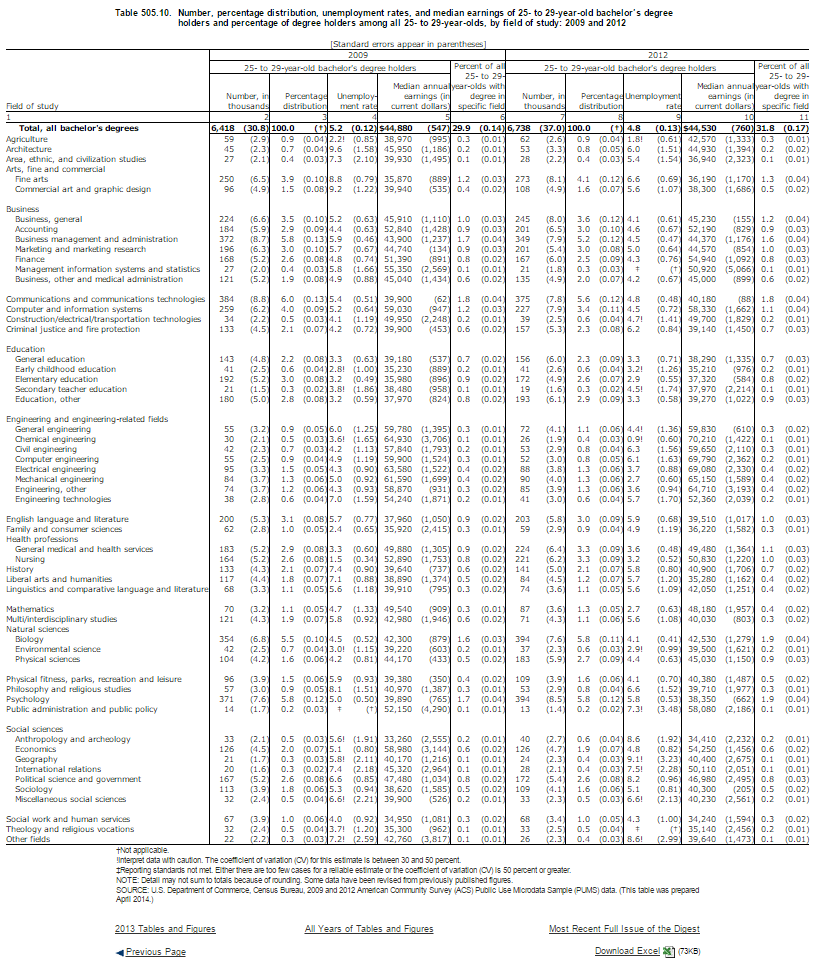
Median College Graduate Earnings By Degree for 25 Year Old to 29 Year Old Demographic from the National Center for Education Statistics, Digest of Education Statistics, 2013 Edition. It even includes convenient Excel download for detailed study of the data.
And the student loan debt? Yes, it’s becoming more of a problem but it’s still very manageable considering that part of the perception is an illusion because about 99% of the information you can find on it talks about average student loan debt, which is meaningless. What matters is median student loan debt, which is half the level the media trots out if you bother to dive into the data set of the New York Federal Reserve Bank. Specifically (emphasis added):
The average outstanding student loan balance per borrower is $23,300. Again, there is substantial heterogeneity in balances of individual borrowers. The median balance of $12,800 is roughly half the average level, which indicates that a small fraction of people have balances significantly higher than the median. About one-quarter of borrowers owe more than $28,000; about 10 percent of borrowers owe more than $54,000. The proportion of borrowers who owe more than $100,000 is 3.1 percent, and 0.45 percent of borrowers, or 167,000 people, owe more than $200,000. The distribution also varies by age group: for example, borrowers between the ages of thirty and thirty-nine have the highest average outstanding student loan balance, at $28,500, followed by borrowers between the ages of forty and forty-nine, whose average outstanding balance is $26,000
When you research it further, you find the 30-39 bracket has the highest debt balances because it is the domain of the professions such as medical school; advanced degrees that will also turn them into the highest earners. But that doesn’t make for a good story.
Neither does the fact that, while median student loan debt is half the rate of average student loan debt, just as importantly, roughly 2 out of 5 college graduates leave school with no student loan debt at all (PDF) because of either scholarships, grants, their parents paying for school, military benefits, or some other largesse. Again, that doesn’t make for a good story.
This Is Not to Say the Student Loan Debt System Isn’t Horribly Unfair … I Believe It Is and Needs To Be Reformed
None of this is to say the current student loan situation is optimal or fair. It’s not. I think it’s disgusting that a group of bank lobbyists were able to rewrite the bankruptcy code so that this particular non-secured debt was somehow sacred, whereas a person can pile up bills on vacations they can’t afford, cosmetic surgery, expensive restaurants, etc., discharging it without problem is no big deal and can be written off much more easily. Nevertheless, why complain about it? It’s not like you were taken by surprise given you were required to read, agree to, and sign the covenant, where everything was explicitly spelled out in black and white. Nobody put a gun to your head or a sword to your throat and made you take the money. You wanted cash that you didn’t have saved. You went to others and agreed to terms that were, in comparison, highly favorable relative to other forms of debt. You agreed to repay it. You don’t get to act put out because it now crimps your lifestyle.
[mainbodyad]To further make the point, this data is for individual people, not households. If you’re married – and we’ve talked about the economic data showing that marriage is the new social class indicator – you’re almost assuredly, statistically, married to another college graduate, accounting for another engine of income inequality between households. That means your double income household has all sorts of economies of scale. College graduates are far more likely than the rest of the population to marry, and the typical age of marriage is between 27 and 29, so that falls squarely within this data set.
Could it be better? Without doubt. In Current Issues in Economics and Finance, Volume 20, Number 1, 2014 Edition, The Federal Reserve Bank of New York published a paper called Are Recent College Graduates Finding Good Jobs? (PDF). Younger college graduates are, as a group, definitely underemployed relative to what they should be earning; numbers higher than the chart above indicates they are taking home now. That doesn’t change the fact that it is still overwhelmingly possible for a vast majority of reasonably intelligent, self-disciplined college graduates, even those with student loans, to save at least $5,000 per year. Do it through something like a 401(k) plan where the matching money and tax credits mean you’d only have to save a fraction of that out of your own pocket and a claim to the contrary reveals itself as utterly absurd.
Given the Large Number of Debt-Free and Low-Debt Households, Why Do So Many Perpetual Debtors Believe Everyone Is Struggling? I Think It’s a By-Product of Stealth Wealth
I don’t expect everyone to drive 10 or 15 year old cars or shop in Army Surplus stores like Aaron and I did when we were piling up our savings – people have different priorities and that’s okay – but if you are going to claim something is impossible, you at least have to make an effort. If you live in the greatest aggregation of wealth in the history of human civilization, have no major medical conditions, were able to put yourself through college at a time when median disposable household income is still near its all-time high, and you can’t manage to reserve some surplus, you have, as my grandmother would say, a character flaw. It’s as if it has become taboo to acknowledge this shortcoming. Financial literacy is a thing. Growing up, she regaled us with stories of the Great Depression; how her family survived without running water or electricity; how to reuse scraps of aluminum foil; how to doggy bag meals to save money; how evil debt was; how you should take advantage of sales, especially on food, when prices were good as there would likely be little warning if the whole system crashed; how you can’t try to emulate your parents’ lifestyle early in life since they’ve had a lot of time to get where they are. You have to live poor as you build your capital base, suffering a little in the beginning so you can enjoy a lifetime of rewards.
Those habits stick with you even when you’re financially independent. I can’t escape it in my own life. Remember the other day when we made Christmas candies? Aaron and I stacked discounts so high it shut down the register and required a manager to intervene to prove it wasn’t fraud. We waited until there was an in-store sale on chocolate, then found unlimited manufacturer rebate coupons that allowed us to get 1 free bag for every 2 bags we purchased. Then, we did it at a store that also gave us 10 to 20 entries in a raffle for $10,000 as a free kicker, which we considered a no-cost, remote-event probability that was an added bonus, offered us a discount on our gas purchases at some of the regional gas stations, and we put it on a cash back card that refunded part of the total. Oh, and the Christmas tins in which we put the candy? We got those for 40% to 50% off, too. In the scheme of things, the transactions may not have mattered but you accumulate little advantages like that everywhere and it starts to amount to something.
I suspect part of the misconception on these people’s part is caused by the stealth wealth phenomenon wherein financially responsible individuals hide in plain sight so their families and friends don’t know they are financially independent. It’s human nature. On another Reddit thread discussing the fact that roughly 1 out of 6 homeowners under the age of 44 own their house outright, with no mortgage debt against it, the top comment was:
Juan_Galt 385 points
With the top response to that being:
aggie972 146 points
Other comments include:
supriseimdrunk 39 points
And …
Underwater_Grilling 4 points
And …
no_tictactoe 6 points
And …
DenverMiner 6 points
And …
DeezNeezuts 5 points
And …
VegasChuleta 3 points
And …
taptriv 3 points
And …
ElGuardo 3 points
And …
leegun 3 points
And …
Orangeyouglad2014 3 points
And …
ItIsAContest 3 points
Despite all of these posts, almost half the comments on the thread are, “I bet they came from inherited money.” Even with so many people outright telling them they are the living embodiment of the data, that they worked hard to pay off their mortgage and hid it from everyone around them, those in debt still want to believe it’s normal to be shackled with liabilities unless you come from rich parents.
Just try and tell them that, when looking at all age groups, 1 out of 3 homeowners don’t have a mortgage; that a majority of Americans don’t carry a credit card balance by either paying what they charge off every month or not putting anything on one at all (it’s true); that 3 out of 10 Americans pay cash for a car, rather than borrow for one, and even more have their existing car paid off; that we now live in a country where 1 in 5 households earns six-figures or more per annum.
The you-must-come-from-rich-parents meme is bizarre to me because it is so prevalent. Consider posts like this one in /r/LostGeneration. It is filled with utterly idiotic, factually false assertions that would take a few seconds to check but people just eat it up because they want to believe it:
- Class lines are being more rigidly drawn. Most of the ultra wealthy in the USA inherited their wealth, this creates dynasties and you are left out. Higher education is also increasing class stratification, instead of offering social mobility. As I’ve already discussed, debt traps you in a life of servitude. Yet the cost of higher education also creates a high bar for entry. A college decree is a ticket to the middle class, but as costs skyrocket only the wealthy can afford to buy that ticket. This creates a positive feedback loop such that only the wealthy can afford social mobility.
Inherited wealth now accounts for the lowest percentage of the rich it has ever been at any time in American history. Looking at an extreme sub-set of the top 1%, the top 0.001%, the Forbes 400 List, you see this. Back when it was started roughly 25% of the people on the rankings inherited their fortune; people like Rockefellers and DuPonts. Today, it’s 7%. There’s no missing digit, it’s seven percent. The other 93% made it themselves, with 8% being total boot strappers like Oprah Winfrey (growing up poor, in the segregated south, the victim of sexual abuse, with no network or connections) and the rest coming from middle class or upper middle class families; two parents in the suburbs going to nice schools.
And, on top of that, even for those who do end up getting rich, 60% of inherited fortunes don’t survive to the 2nd generation, while 90% are gone by the 3rd generation.
This isn’t 18th century Colonial America where wealth took the form of land and inherited slaves. Almost all of it is some guy who started a plumbing supply business, or a software developer, or an author, or an executive, or a real estate developer. They actually think they’re living in some sort of dystopian hell. Which baffles me. Even among the bottom 20%, if you look at standards of living – home sizes, comforts such as heating and air conditioning, access to food and water, entertainment such as Internet, television, iPads, and smart phones, access to limitless, free information for self-education, record low interest rates, the longest peacetime expansion in global history, fewer rapes, murders, assaults, and thefts than at almost any time in the past, longer life expectancy, more free time per week; all of it – and they talk about these halcyon days of yesteryear. Yet give them 30 days as a lower middle class person in the 1970’s and they’d be begging to come back to the present because, despite the decline in real wages for that demographic, they still experience a far higher absolute standard of living. It’s just that everyone else has gotten so much richer. (Case in point: We talk about medical costs being out of control, and it is, but comparisons to the past should include at least some rough hedonic adjustment when you’re thinking about it; e.g., do you know what they did if you had a heart attack in the 1950’s? Put you in a bed with some water and an aspirin.)
The world they think existed didn’t exist. Mortgage rates were double-digits, gas shortages led to fuel lines at the pump, inflation raged out of control, we lived under the threat of nuclear annihilation, blacks, gays, Jews, and women were largely given the short end of the stick (if they weren’t getting beat by the stick), the stock market suffered a series of horrific declines, most of the world’s population was living at starvation levels by Western standards. The same folks who complain about today would have been doing just as bad, if not worse, 30 or 40 years ago. They believe the nonsense they spout which makes no sense to me since you can see the numbers. Life is infinitely easier today for a larger number of people.
[mainbodyad]That does not mean its perfect but this rush to throw out the greatest wealth creation system ever devised, for systems that have demonstrably generated lower levels of disposable income per median household, strikes me as insane. Our ancestors had a phrase for it: Throwing the baby out with the bathwater.
The ones that I find really special are the calls for total confiscation of private property including accumulated stocks and bonds. As if the lessons of the 20th century never happened; we’re all going to just keep working despite the huge shift in personal opportunity cost. Because, you know, that worked out so well for Cuba. It’s deranged. You can tell almost all of these people are young, inexperienced, with no connection to the real world. (One talked about how they thought all businesses should be equally owned by employees. Ha! Give them two months in a corporate environment where Judy or Greg in accounts never pulls her or his weight and the boss is having an affair with a secretary, skipping out on meetings to bang each other in the parking lot. These things happen. The ancient Greeks established the problems with democracy. Human nature hasn’t changed since then. That’s why the most efficient, effective corporate governance structure for large organization has turned out to be the equivalent of a republic – you elect a board of directors who rule in your place. Even in employee owned businesses, which I generally think are a great thing provided shares are allocated in accordance with contribution. The reality is that while all men are created equal, not all men are equal. Pretending otherwise is the kind of idiocy that says we should let everybody have a shot at being the starting Quarterback for the Dallas Cowboys or have their economic opinions heard at a Federal Reserve policy meeting.)
This may sound odd coming from me given how often I’ve written in the past that I strongly believe:
- Education costs are out of control and we need to bring them down for the benefit for the entire nation, which gets the dividend from the higher human capital,
- Medical costs are out of control,
- The retirement system has failed most investors given it is in conflict with the psychology of the typical worker, and
- I worry about the wage capacity of labor in the bottom quintile as it comes under assault from automation and globalization.
I still believe all of that.
On the other hand, I also believe that a person needs to be able to coldly evaluate his or her own position and advantages in life, learning to appreciate the privilege they have as someone with a higher education. If you live in a country with less than 2% inflation, where 2 out of 5 college graduates have no student loan debt and the rest have less than $12,000 in median debt, your median income as a single person is $44,530, and unemployment stands at 4.8%, the crime rate is at an all-time low and you can enjoy comforts that would have made John D. Rockefeller look like a peasant, you need to get some bloody perspective on the world. Your life is not some repeat of Les Misérables so sitting around whining about it isn’t doing you any good. There is no cavalry coming to save you. If you don’t like where you are, fix it. It won’t happen overnight but you can do it.
Question: This audience contains a lot of experts in a lot of different fields. What is a topic you won’t discuss, anymore? I’m curious to know which lines people have drawn around their own lives for the sake of avoiding nonsense.
Reader Comments (84)
Comments are presented chronologically, with replies indented beneath the comments to which they respond.
Brent McAlee
December 19, 2014
The effects of a sudden rise in interest rates on our nation debt. Empirical data on human biodiversity. Ferguson, MS, with anyone who's never had to physically fight for their lives. I love informed debate, but there's just so little of it out there on the interwebs.
Jeff Zimmerman
December 19, 2014
I work in the medical field. I refuse to discuss medicine with anyone outside the field, including my own family. I do nothing but field questions about why modern Western medicine is so much better than pseudoscience, or listen to stories about how so-and-so got some ancient mystical treatment that cleared her arthritis right up! And if I don't have a good explanation (because why would someone in sports medicine know much about oncology or psychiatry?) then I must be apart of the Big Medicine conspiracy! When someone at Thanksgiving asks me about it, I just list a bunch or resources and tell them to read up on it themselves.
William Michaels
December 20, 2014
Replying to Jeff Zimmerman
I'm a surgeon and also run a research program. I have taken exactly the same approach to these questions. I have given up on most people trying to explain how medicine works. Most have magical thinking and don't understand even the most simple logic or probability to make a sound decision on their situation. People come to me and say, please doctor, can you help me with XYZ? I review their situation and see that they have been given treatments for XYZ. They then proceed to tell me that they aren't following the recommended treatment for XYZ because they "don't like taking all these pills" etc etc etc. Then they say, but doctor, why don't I feel well? Why am I not getting better? These treatments just aren't working. What should I do? Please help me. I tell them to take the pills as prescribed. They refuse. Drugs are harmful they say, they have side effects. They don't like doctors pushing all these pills on them. I explain that the problem they have can be effectively managed with these pills that teams of people spent decades and a billion dollars to develop for you. All you have to do is swallow it every morning at breakfast. They look at me suspiciously and then recite the latest google search for non-validated therapies that cost them a lot of money and have zero evidence behind them. They ask me if I think that these more natural therapies will help them. I bring up the pills again that have been scientifically proven to work in people, animals, cells in dishes, computer models, bacteria, etc etc etc etc. They get upset and leave my office and write on their blog how I am a shill for industry and closed minded and then give me 1 out of 5 stars on some rate MD blog to warn everyone about what a bad doctor I am.
mikecrosby
December 20, 2014
Replying to William Michaels
I see what you're both saying here, may I take the another perspective?
Years ago, you would see doctors advertising which cigarette is the most healthiest. Just a few years ago, it finally became acknowledged that what a person ate lead to heart disease. To this day, the greater percentage of cardiologists will tell you heart disease can't be reversed, though it's now a proven fact heart disease can be reversed via a plant based diet: http://www.dresselstyn.com/site/books/prevent-reverse/excerpt/.
My FIL had his aorta separate from his heart. His son ordered a scan and found it. Right in the room where FIL lay, his son showed me the image on the computer screen of the separated aorta. Heart surgery was done via a stent through the femoral artery that expanded to ~10" long and an inch wide. FIL left hospital 3 days after surgery, 83 years old. All praise to western medicine, but for chronic western diseases a plant based diet is the answer, not pills.
William Michaels
December 20, 2014
Replying to mikecrosby
I have done heart surgery on plenty of vegetarians and athletes who have optimal nutrition and exercise. It is not a proven fact that you can reserve heart disease with a plant-based diet. Please come to my operating room where I can show you a destroyed coronary artery and you can see for yourself that no amount of plants will be capable of restoring the integrity of the vessel. The emergency procedure for aortic dissection you describe is an innovation indeed. But so are many pharmaceutical therapies. For example, pills that control blood pressure can help prevent aortic dissection from occurring in the first place, not a diet of plants. I did not say "pills are the answer". In some cases, pills can relieve symptoms and prolong life, but they have side effects and complications. This is being realistic and is fact. Saying a plant-based diet can reverse heart disease is too general a statement. Your statements and assumptions that because I prescribe medical therapy in some circumstances I think pills are always the answer is unfair and is exactly what people on this forum are complaining about. I advocate a healthy diet, healthily lifestyle, and exercise for all my patients. Guess how many take my advice on that one? Your link is bogus. That guy bases his claims on an uncontrolled study and guess what … the people in his study were also on medical therapy in addition to the plant diet (yes … pills). His conclusions are not based on solid data. But please buy his book and make him rich. I don't get paid to prescribe pills and I am not trying to sell you a book. You are exactly the kind of person I am talking about in my post. Now feel free to give me 1/5 stars for telling you the truth. I know it hurts. No pain no gain. Unless you are selling a book.
Zaphod
January 5, 2015
Replying to mikecrosby
You're conflating several things and seem to be pushing a personal agenda with your "diet". It is no such proven fact about your diet, and I'm vegetarian.
I guess it would depend on what you call "reversed", and you have to be sure not to confuse correlation and causation, not to mention one of the biggest issues is confusing a finding in a study as confirmation of the opposing method/view/pathway/etc...while it is no such thing, the findings in a study show only what they show, they cannot be generalized to some other idea with scientific validity.
Most humans have no idea of the cognitive biases and errors in thinking we are all born with that push us to making poor links and decisions. Without knowing about them we are not going to be able to make sure we avoid their impact.
You seem to try to simultaneously relate to and yet push similar somewhat magical thinking ideas, in all likelihood you have some sort of emotional tie to this diet, as for some reason diet attracts and promotes a zealous sort of following. Just go to any other diet than your favorite, they all sound exactly like yourself and have just as much "proof".
Doc
December 21, 2014
Replying to William Michaels
Another doctor here
Yes, and they stop taking the pills as soon as they feel better, adjust the dose, or take too much.
Being a doctor is an exercise in frustration, since no one defers to experts in any field any more. They will tell you that a friend took medication/therapy X and "got better," as if you never heard of that idea before. They may tell you about something they read, or merely smile and nod during a long, patient explanation and ignore every recommendation.
The practice of medicine has become a commodity favoring the fastest number of bulk appointments without consideration of results and declining, spotty reimbursement by insurance.
I will be glad to retire and not feel like I'm living in an Internet forum debating the merits of flat earths with everyone on a daily basis. I haven't had a part in any on-line debates since the 80's on a local BBS.
Maybe Dr. Oz does have the right idea...leave medicine and sell rainbows and magic in books. At least in publishing there's a free market, unlike medicine.
Brendan
January 6, 2015
Replying to Doc
I think that only a certain percentage of adults are capable of truly rational thought. The rest content themselves by learning enough to get by in what they do, some may even do very well (Limbaugh, Beck?), and then spend the rest of their lives entertaining random chain-emails and horoscope columns in a rational/magical blended worldview. Just my opinion for now, but its based on observation.
fran
December 21, 2014
Replying to Jeff Zimmerman
I agree. Several people in the media that are considered experts in the field of science and medicine are a large part of the problem like Dr. Oz and Ira Flatow. Both of whom gravitate towards claims that have been unsubstantiated by real science. Also, many doctors fall prey to this thinking as well. I think such large part of our skill set which helped us get into and through school is rote memorization. Consequently, critical thinking is not a skill all doctors have, although hopefully most do. A great book that should be read by all healthcare providers is "Do you Believe in Magic" by Paul Offit, who was also at the forefront of defending vaccinations.
William Michaels
December 21, 2014
Replying to fran
I knew Dr.Oz before he became "Dr.Oz". He is a highly trained and skilled academic cardiac surgeon. He doesn't need to be "Dr.Oz". I'm so disappointed that someone with his skills is wasting his talents selling snake oil and smiling for the camera. He could make such an impact by giving a realistic perspective on current medical issues and he is a great communicator. I think he tried this in his early shows but then ratings started to fall and he had to start talking "magic" or lose his audience. It is show business and it seems he has accepted his fate. I really like the Senate interview of him, they really worked him over and he deserves it. He knows better and should be help to a higher standard. How much money does someone need? What is your integrity worth?
Zaphod
January 5, 2015
Replying to William Michaels
Just like politics, once the people with the money start controlling you, what can you really say before you are fired? I have no doubt he's an intelligent surgeon who knows full well whats going on, he must just be getting paid extremely well and hes at terms with it.
William Michaels
January 5, 2015
Replying to Zaphod
I shouldn't judge him, maybe I would do the same thing if given the opportunity. But I hope that I wouldn't and I know that I shouldn't. But he was already making a lot of money before the show, so MORE money when you already have a lot should not be controlling you - isn't that the point of having a lot of money, so you have the control?
Zaphod
January 5, 2015
Replying to William Michaels
One would think so. If I had a ton of money, hell even if I could pay off my student loans instantly, I'd certainly have a lot more control.
I'd quit my crappy practice arrangement making someone else a millionaire, and I'd damn sure be even less nice about pseudoscience and alternative views on medicine.
As it is I tell people all the time their goals are unrealistic and they alone have the ability to be better off, eat better and exercise. It isnt magic and this is a scalpel not a wand.
Brendan
January 6, 2015
Replying to Zaphod
Perhaps. But money really does funny things to people. Like love, it can cloud even the most level-headed, rational minds among us. Nothing like a cold bucket of irony and ridicule to wake someone up.
Brendan
January 6, 2015
Replying to William Michaels
I really don't think we can be too hard on him considering he uses his education and position to influence others. If he really is bright enough to be a cardiac surgeon (and I'm sure he is/was) then he knows better than to use his MD to support questionable or fad health products. If he acts in the capacity of Mr. Oz, then I don't take issue, but when he acts as Dr. Oz, he should be held to the highest standard.
William Michaels
January 6, 2015
Replying to Brendan
Good point. You are right.
Kandice
December 20, 2014
Executive compensation and tax.
JB
December 20, 2014
I'm a senior level system administrator and about all I will talk about "computers" is to recommend to family and friends to get a Mac (as Joshua has talked about at length here).
Connelly Barnes
December 20, 2014
Replying to JB
Haha, your response is similar to mine.
innerscorecard
December 20, 2014
I do think I have a decent intuitive understanding of some of the issues you mentioned, given that I myself used to believe many of the things you mentioned which are destructive and counterproductive yet popular.
You wrote:
"Nevertheless, why complain about it? It’s not like you were taken by surprise given you were required to read, agree to, and sign the covenant, where everything was explicitly spelled out by black and white. Nobody put a gun to your head or a sword to your throat and made you take the money. You wanted cash that you didn’t have saved. You went to others and agreed to terms that were, in comparison, highly favorable relative to other forms of debt. You agreed to repay it. You don’t get to act put out because it now crimps your lifestyle."
The above is completely true, and one of the biggest steps in having my life change was realizing that. But I do think many were in fact taken by surprise. Mentors, authority figures and trusted older people told many younger people of the generation you were referring to that education was unabashedly a good choice. The encouragement was reckless. Unless prospective students did extremely detailed research, many who relied on surface-level research and school-provided figures for employment got information that was wildly inaccurate. (That wasn't the exact fact pattern I myself underwent, but it is one I have seen many times. When I was in high school, everyone was herded into college and preparation for a professional career, with no exceptions, regardless of the suitability of that for the individual personality at stake.)
And as for the terms of the loans themselves, I agree that they were spelled out for anyone to parse in the loan agreements, but some of the ways in which various debt forgiveness programs actually operate are unspeakably opaque. (In my own case, I had to talk to literally dozens of people at the my loan servicer and the Department of Education to get a benefit that literally spelled out on the webpage, but which they refused to honor for the better part of a year.)
So while of course personal responsibility is what is necessary, there is a lot to complain about. But complaining is ultimately futile if one is looking to better him or herself, rather than simply wallowing in misery, which is what anyone who discusses "Lost Generation" issues is actually doing.
I think the issue of stealth wealth and the necessity of keeping information secret is a very complex but important one. Once I realized this, I became a lot lonelier and more isolated in my daily life. My personality type (INFP) shuns surface-level connections and really wants close friends. But I don't know who I can disclose my true interests, goals, and plans to. Except my spouse, of course.
It's a sad comment on our society that those who have made it into the "comfortably poor" (as Felix Dennis would call it) have to, for for their own safety, have a "cover story" for why they aren't working a 9-5 job. I'll simply tell everyone the half-truth that I am a writer or have an online business or something like that. It's necessary for individual security and privacy, but also makes it quite difficult for young people to have positive examples of people they might actually want to be. All I personally saw were academics and high-achieving but high-spending professionals.
But of course I wasn't looking hard enough at all.
(P.S. You have to help those of us who still post on reddit, desperately trying to turn back the tide of bias and misinformation. If all the informed people stay silent, we will be overwhelmed by a tide of superstition caused by social proof! Oh well, it's probably hopeless. Arguing on the internet never works and will never work...)
Gilvus
December 20, 2014
Replying to innerscorecard
I like the idea of telling "half-truths," but unless you can shut down the line of questioning then and there, many people will continue to dig deeper and potentially expose the deceptive half of your "half-truth."
I like to use "conversation killers," like:
- Taboo. "Why don't you drink?" I just say "I have a weak liver." It's not untrue, but the taboo about digging into a person's medical history kills the conversation right there to mask the real reason.
- Non sequitur humor. "Why don't you listen to music?" I just say "Oh, I have a terrible taste in music ever since I ate my iPod." That usually throws off the person enough for you to re-direct the conversation with no awkward pauses.
- Smoke bombs. "Why don't you have a girlfriend?" For these "too-hard" questions, it's better to just throw down a smoke bomb and abscond with their wallet. Because that's what smooth operators do.
Tyler Phillips
December 20, 2014
Wind power. I work as an engineer for a hydroelectric and nuclear power generation company, so people assume I'm biased if I don't agree with them that wind power is a feasible replacement for all other forms of generation. Nobody wants to hear that it's not a matter of cost, but more importantly when and how much generation is available because we currently have no meaningful amount of electricity storage.
Engineer7006
December 22, 2014
Replying to Tyler Phillips
As an engineer with utility experience (only an internship), I always find those discussions amusing. Many people have never considered the problem of energy storage, transmission losses, mechanical losses etc.
I actually enjoy those discussions, at least online, because it shows the audience their lack of understanding about the issue. Like most things, the actual problems are never as simple as the high level "discussions" most people engage in.
Dave Klippert
December 20, 2014
Global warming, wind power, and the legal system (and I'm a lawyer).
Doug
December 20, 2014
I work in the insurance field. I cannot discuss insurance rates, selection, methodology, etc. with the general public. When I do discuss these things publicly I become very disturbed by the general lack of logic and the abundance of emotion inherent in the things people claim to believe.
Engineer7006
December 22, 2014
Replying to Doug
Most people seem entirely unaware of how insurance companies actually operate, and have zero concept of float.
Its' almost like they are unaware of what business the insurance companies are actually in.
Joshua Sheats
December 20, 2014
I've learned not to share my opinion unless it's been explicitly asked for or paid for. My area of expertise is financial planning...it's almost impossible for me to have an intelligent dialogue in a public forum about financial planning. I simply choose not to. I give my opinion to people who pay for it.
I also don't discuss theology in a public forum because it's almost impossible to gauge the heart of the people involved. Many people wish to debate without doing something with the end result. As I'm getting older, I find myself less and less willing to surrender any of my valuable time in that way.
innerscorecard
December 20, 2014
Replying to Joshua Sheats
Joshua, great to see you reading this blog! Love the podcast. It would be amazing to have a Joshua (Kennon) and Joshua episode one day...
Tyler Phillips
December 20, 2014
I wonder if McDonald's was happy to have the media reporting their coffee is so hot it causes injuries. Personally, I'd prefer extremely hot coffee. No publicity is bad publicity?
Anon
December 20, 2014
In the real world, I'm done discussing why mutual funds > individual stocks and options.
For the last many years, I do not give advice unless it's explicitly asked for.
In the real world, with the exception of one instance (Trayvon/Zimmerman), I won't discuss Michael Brown, Eric Garner, and the long line of idiots to come who think it's a good idea to challenge the police and don't understand the concept of "monopoly on violence."
But, I will never stop discussing my support for Israel and why it should be favored.
(I have noticed that you have not posted about the Israeli-Palestinian conflict. Probably a wise choice, but I'd be interested to hear your thoughts and possible solutions (if any exist other than all-out war).
Steven
December 20, 2014
Replying to Anon
I find discussing the Israel/Palestine conflicts i something that should definitely be avoided in public at all costs! I know some religious people who believe Israel has something to do with the rapture occurring, and will excuse/allow/permit anything in its favor.
Connelly Barnes
December 20, 2014
I am always surprised that people will ask that I fix some problem with their Windows computer, or something similar for which I have no more knowledge than Google.
I respond politely but what I am thinking is: "I have no more knowledge than you. A Ph.D. in computer science does not mean I am qualified, trained, or interested in doing tech support. I do not even use Windows. Please ask a search engine or person X who works here and has that in their job description."
Prairie Girl
December 20, 2014
I won't discuss being a SAHM. It was a joint decision made by both me and my husband based on the needs of our offspring and our home life. People don't know the state of our finances. They just think I'm lucky.
Phil J.
December 20, 2014
The topic of you are the sum of all the choice you made in your life and all the external forces that act around you as you make those choices. That if your life is not what you want to be its your fault and not the laundry list of people you choose to surround yourself with in your life. Finances with family....
mikecrosby
December 20, 2014
Joshua says: " The reality is that while all men are created equal, not all men are equal. Pretending otherwise is the kind of idiocy". Amen to that.
Thank you Joshua. A joy to read this post and I continually nod "yes". Perhaps confirmation bias on me too. I think not. Facts are facts. And no matter how good things get, the lack of gratitude grows.
That is what pisses me off the most. The world offers so much, and so much is taken, but yet a total lack to see how wonderful and fragile is life.
DVY
December 20, 2014
Dentist here.
- Safety and Efficacy of Amalgam Fillings. No, they do not burst into fire spontaneously (serious conversation w/a patient)
- Whitening. Its all temporary. The stars have fake teeth (aka crowns/veneers)
- Natural vs Artificial-- This debate is getting out of hand. There is plenty of natural items that are good for you, and 10x as many that are terrible for you. Artificial often confers significant benefits.
Guest
December 20, 2014
Critical reasoning is a skill that is lacking in our education system. Penn and Teller's 'bullsh#t' addresses this pretty well.
anonona
December 20, 2014
Actually, Josh, employee ownership can be pretty advantageous in the right situation.
ESOPs (Employee Stock Ownership Plans) are non-taxable trusts that hold stock of a company. They own generally 30-100% of the stock in a privately held company. Sort of like a 401K for the company you work for. COmpanies that have ESOPs still have management, still have boards, though there is more participation from employees (depending on how everything is set-up).
All that said, because of the tax benefits Congress has written in (the company can pay no taxes at the federal level) and the motivation provided to employees sharing in the profit of the company, ESOP companies can actually do quite well--there are studies showing how ESOP companies regularly out-perform their peers. (It's important that the employees understand the value of the ESOP--I heard about one ESOP company where the workers went on strike and bankrupted it--clearly not enough training was done there.)
*Note this is all for US. Canada (and I'm sure many other countries) have similar systems but I only know about the US.
**Sorry if you already know this stuff Josh but I thought others might like it.
Joshua Kennon
December 20, 2014
Replying to anonona
Thank you for sharing it and bringing them up. I've long been a huge fan of ESOPs when structured correctly. They can provide a liquidity event for the founding family, higher than average wages and salaries for the work staff, tax benefits, and a true owner mentality. The trick is getting to the allocation correct so it harnesses the best parts of capitalism. If it were structured how some of the people want companies structured in some of the threads to which I was alluding, the intern on his 20th day would have the same amount of equity and voting power as the CEO on her 20th year, which is completely unworkable. For one, there is nothing to avert the tragedy of the commons phenomenon.
I'm actually a big fan of mutual insurance companies, credit unions, and other customer-owned institutions for related, but different, reasons.
Stegner
December 20, 2014
I won't do Oz politics or the state of the Oz economy. I can't talk about psychology without throwing people for a loop talking about the neurophysiological substrates of behaviour.
Generally I just keep my mouth shut in conversations when I know people have no interest in engaging in real nuance.
jerkstores
December 20, 2014
Great writeup, Joshua. I'm on reddit too much for my own good and actually noticed the same things in /r/frugal and /r/personalfinance. It's maddening that people are so negative over there and I'm afraid it really is somewhat reflective of real attitudes of the 'have nots' out in the real world.
I do think that our system today is superior to the one where you had to stick with one company and hang in there for a pension. But people do not hold up their end of the bargain. They spend frivolously and do not save or invest, then they blame external forces for failures that were entirely their own making. The middle class has so many incentives to invest and save. The 401K, IRA, HSA, 529 being the main vehicles. The government is handing us a path to a comfortable, dignified retirement on a silver platter. We just need to do our little part. The vast majority are perfectly capable of saving for their own futures, but most choose to not save adequately enough or at all.
Thank God for Social Security and Medicare.
innerscorecard
December 20, 2014
Replying to jerkstores
Hopefully Joshua will have time to set up the forum here soon, so we that we can hang out in the gated community here instead of on reddit.
peterpatch79
December 20, 2014
I am a professional accountant with a strong technology background. I simply cannot talk to most of my family members about money or how well I am doing financially. I worked extremely hard to get where I am. I was the first member of my immediate family to get a University degree and on top of that I became a professionally credentialed accountant (CMA, CPA in Canada). I think my Mom is proud but nobody in my immediate family really seems to understand how far I have come because they don’t have the concrete experience of doing it. I have a distant relative from my step fathers side that has done quite well for himself and instead of being proud of him the family seems to focus on how “it must be nice”, “they have everything”, “they’re rich” along with wild ass guesses on his net worth and yearly income, sometimes as high as a million a year or some such. This guy is so knowledgeable about his field that the Canadian senate called him into public session to answer some questions they had regarding his field. I don’t want to deal with the contrast, liking and other mental model BS from my family so I am very stealth wealth. I see family members totally squandering their financial future and prefer at this point to let them do it rather than offer any sort of advice unless they approach me about it in a reasoned way. To put it in perspective I share more about my financial life on this blog then I ever have with any family member except my wife.
Religion is another topic that I have researched heavily and have strong opinions about. However I rarely talk about it with anyone save a few very close significant others. I don’t even talk about it here. It causes so much dangerous irrationality and has so many powerful mental models working, in a lollapalooza effect manner, in it that most people simply cannot step back and look at it objectively. I don’t even know if I can step back and look at it objectively, I am fallible but I still try.
Brendan
December 20, 2014
As a scientist, I generally try to avoid conversation on various pseudoscience topics ranging from climate change denial, gmo paranoia, antivaxx, and creationism/intelligent design. While I understand that it is hard for those who aren't trained in scientific research to know where and how to look at peer-reviewed literature, those who can't even fact check their most basic positions aren't worth the trouble.
Zaphod
January 5, 2015
Replying to Brendan
Its not important that they learn how to discern good/bad research, just that scientists as the researchers should be the opinions that are regarded as valid and strong, and all others against that should have some serious backing.
Sadly, its the other way around. You're not going to give someone a top notch epidemiology and critical review course in the comments, but you can pretty easily relate how off it is that in this one single issue, they seem to disregard the opinion of those with the most knowledge...why is that? Get them thinking about why they think that, not the specifics. Basically true for other issues as well.
Brendan
January 6, 2015
Replying to Zaphod
You raise good points. It can be hard to transition from a professional environment where research and technical terminology are used as the vernacular to a setting where the last science course the average person has completed is high school chemistry/biology or physics (if they paid attention!). Perhaps next time I find myself in a situation as mentioned above, I will remember to make the opposing party support their platforms rather than defend mine. Thanks for your input!
Matt
December 20, 2014
Basically everything. Until I know that the person I'm talking to is serious about having a rational, intelligent conversation, I'd prefer not to waste my time aside from the obligatory polite talk. The moment I realize that someone won't even consider what you're saying, I just get turned off. Sometimes I feel bad for adopting this rather selfish policy, but mostly I feel that it's worth it since it helps me stay sane and not get too angry over small things. I used to try to help people where I could until I realized many people don't want it (which these reddit posts seem to confirm). I suppose it could be easier to give advice on a blog such as this where people can take it or leave it, but given your comments in the oil post I suppose you still face the problem of having to repeat yourself over and over for people who criticize but aren't familiar with all your writings.
William Michaels
December 21, 2014
"The reality is that while all men are created equal, not all men are equal."
This is an important statement and I feel compelled to comment as it relates to what you can discuss and the perspective of experts. Many of the posts show a frustration by experts in their respective fields in dealing with non-experts.
We are created equal … at birth. We have and should have equal rights. We are equal in the eyes of God. But we are not equal when it comes to skills, experience, intelligence, work ethic, integrity, physical strength, rational thought and many others. These develop over time after we are created equal. I am not saying someone is worth more, is better, etc. But it is a simple fact that not all men are equal and they never will be. In my profession I deal with everyone from all walks of life. I really enjoy this part of my job as it gives me a unique perspective. I see people from the homeless to the most educated and wealthy. I see how they think and how they approach important problems in their lives (with respect to their health and this extends to family, social, work etc.). It is fantasy to think that all men could be all things. Sad but true. We should be grateful for all the things that are outlined in the post. We should be grateful that we, those who read this blog, have the advantage of intelligence, education, and perspective. We are not equal. So help your fellow man and don't expect everyone to be like you. It took me a long time to accept this.
Roundball
December 21, 2014
Replying to William Michaels
Have really enjoyed your posts. Thanks for sharing.
RogerMKE
December 21, 2014
I can't talk about science with my family. Half of them believe the earth is 6000 years old, and anyone who so much as considers an alternative hypothesis is seen as the spawn of Satan.
dave (nestle)
December 21, 2014
Where I grew up we have a command that is constantly thrust upon us from our elders, "Eyes Forward!". Now this had a couple meanings in our daily lives, one of which was mind your business and/or don't open your mouth and try to smarten anyone up. People won't accept what you are offering most times.
Also, working with the public, as I do, will make you have harsh feelings towards the public. The more a rational person interacts with the public, the more you learn to keep your mouth shut.(in my case my realm of knowledge would deal with things like healthcare, firearms/hunting, tricks/benefits of long term saving of small amounts(including using set rules to your advantage), protocols for not getting ripped off in life(street-smarts), and basic general common sense)(also, you would be surprised by my writings here that I basically keep my mouth shut about everything, anymore. I NEVER post opinions on the internet outside of this blog. Most people who know me would be shocked that I act so freely here.
I find that there are three basic types of people on the internet. 1. those who think they know everything without any facts, statistics or science on their side.(the people Joshua references above) 2. those who follow a set idea,to the letter without question, put out by an internet "expert" to the point of a mini (or mega) cult,thus admitting that they are a bit weak of mind and require someone to lead them and 3. those who use the internet to seek out help,knowledge, fact, truth, intelligent stimulation, and honest factual discourse from other intelligent people. (number 3 is sadly a diminutive minority)
I have a friend whose family is from Brazil. He is the highest wage earner(somewhat because of right place/right time) of my close circle. He holds his personal life to a very high standard(very "GQ"), and is very well thought out in his asessment of just about any issue you want to discuss. He has a theory that America is such a wealthy country that most citizens mistake affluence for intelligence.
The poor in America would be considered rich anywhere else. They could live a lifestyle similar to a middle class person here after factoring in all the help they could receive and the lower taxes they pay. Yet they remain in their circle of poverty more often than not, never propping up their intelligence level. The "rich" have it pretty good here too, yet their wealth must not be mistaken for intelligence.(since many of them never learned how to truely think or analyze)(they could be just as ignorant as anyone when it comes to certain issues) The middle class, most of which spend their lives keeping up with each other and never truely being happy and thankful for what they have, overwhelmingly feel a sense of higher intelligence(and human worth) than the poor people and other middle class people. So there-in lies the root of intelligent people "drawing lines around their lives". (at least here in America as far as my friend is concerned)
I also tend to agree with him, without trying to hurt anyone's feelings, of course. People here, at least in my experience, spend far too much time on "nonsense" , rather than harnessing their intelligence to even half it's potential. (we could debate the reasons for this all day long, but I wont offer any opinions on the subject,haha)
Exquisite Decay
December 21, 2014
I do not talk about personal finance or statistics. I have a degree in accounting and took a lot of courses in statistics in which I did very well. I spent my career as an auditor where I used my knowledge of stats routinely. I do not talk about personal finance for similar reasons in the post above by peterpatch79. I do not talk about stats because most people have a dangerous (mis)understanding of it which leads to incorrect applications and conclusions on their part. I am tired of trying to correct them. But then I remind myself of the quote from Edmund Burke, "All that is necessary for evil to triumph is for good men to do nothing." and wonder if I should put up the good fight.
Aditya
December 21, 2014
I wonder if perhaps we as a readership are biased in our own views; maybe we are just very fortunate to live in a conducive society while having the temperament to make progress with our own goals and dreams.
One of the finest lessons I've learned only recently is that the perspective of people is rooted in a variety of underlying facets that differ from person to person - in aggregate, our cognition is not based on rationalism. Even for folks like us, there is only a bias toward it - not true rationalism. Facets like sentiment, tradition, and emotion all have their respective roles to play, with levels varying from person to person.
Previously, when I used to read these types of threads or participate in like discussions I would always question the underlying premise; lately, however, I have begun considering something else: perhaps what these people are really trying to say is, why doesn't the world work according to their mental models? Perhaps the homeless alcoholic on the street today would be a king in another kind of society, while I languished on the bottom rungs.
Caleb Hutson
December 22, 2014
I'm a 21 year old college student and I will no longer discuss my political/economic views. There are so many people my age who fall under the category of the typical entitled to everything view. It literally makes me so angry how people can spout off lies as universal truths that I can't even speak or form an intelligible argument. I guess I have decided that if you argue with an idiot, that makes two.
Shouganai
December 22, 2014
The history of money. The first information technology (Croseus = Zuckerberg). It is very difficult to find anyone with the first clue about the history of money, or the nature of the current monetary system, particularly its *social* nature.
Don't get me started on Sid Meirs.
I can understand it though, being ignorant. I have had the wonderful experience several times in my life of realizing I was completely wrong about something. I remember feeling incredibly angry when I first read about sectoral balances, how it offended my sense that government debt was deeply immoral.
I love to remember the feeling of outrage I felt at being confronted by an inconvenient truth - you see people doing it all the time once you are aware of it. People are just more tuned into their own emotional imaginings than they are to ideas.
That's why political activism these days has more to do with posturing over single issues, and personal feelings than systematic explanations and ideas.
Shouganai
December 22, 2014
"One talked about how they thought all businesses should be equally owned by employees....That’s why the most efficient, effective corporate governance structure for large organization has turned out to be the equivalent of a republic – you elect a board of directors who rule in your place. Even in employee owned businesses, which I generally think are a great thing provided shares are allocated in accordance with contribution."
I think you undermine your own point here. There is nothing to say that widespread worker ownership can't be effective - ownership is less important than administration. You have to concentrate on what that ownership actually means.
There are businesses that even in a capitalist system are very well suited to worker ownership - those in which the worker is the main asset - law firms, accountancy, etc.
Retail, customer service related industries can be successfully worker owned where the worker and customer service can be *made into* the major asset.You could even say that where it is allowed, or cannot be avoided, worker ownership tends to beat the ownership by capitalist. The businesses in which capitalist ownership is successful are those in which they have power over the worker.
Because of the nature of the production, and the system in which we live, if you want to open a car factory you simply must go to the capitalists - but that isn't to say that worker ownership wouldn't be more effective if we had a different system. I can't see how it would make much difference if the administration remained the same.
Joshua Kennon
December 22, 2014
Replying to Shouganai
I've re-read this a couple of times and I can't, quite, make out what you think it is I believe, which makes it difficult for me to understand your counterpoint.
Just so I can understand your position, would you please restate, in a single sentence, what it is you think that I was asserting?
For some reason, I get the feeling that you think I believe something I don't actually believe. Having you restate my position, in your own words, will be the quickest way to understand the disconnect.
Shouganai
December 22, 2014
Replying to Joshua Kennon
Sure, sorry. I understood what you wrote as follows:
Equal shares of ownership will be unsuccessful because of conflicts of interest between individuals as members of an organisation and the aims of the organisation as a whole.
But I'm afraid you don't make the point as to why the form of Republic-like administration that you favor couldn't also be used for a business in which the workers had equal shares, or why there shouldn't equally be conflicts of interest if ownership is unevenly distributed.
So if you've identified a form of administration that partially solves the problem of conflicted interests surely you undermine your original point about equal ownership being silly due to conflicts of interest.
Then I said a lot of other stuff about how capitalist ownership probably has more to do with power than its effectiveness.
Steve
December 22, 2014
I graduated with ~$50,000 student loans (foolishly doing a graduate degree overseas, which made tuition and board insanely expensive).
I paid off a total of $54,000 in 2.5 years. Once I found a job after graduate school - and no, I wasn't a STEM graduate, rather a political science/history guy... ha! - I made sure every month a minimum of half my net take home pay went towards student loan debt repayment.
I took advantage of every opportunity that came my way. Most embarrassingly, I moved back home into my parents place for a little bit as that negated any rent I had to pay. Whatever. Like I said, I took advantage of every opportunity I had in front of me.
Haven't really told anyone that I've finished paying off my student loans except a couple of my closest friends and family.
Anon
December 23, 2014
Replying to Steve
Congrats!
Rob
December 23, 2014
Replying to Steve
Congratulations! I have $40k left of student loans (MBA) and it may be a while before that balance hits zero....
Joshua Kennon
December 23, 2014
Replying to Steve
That is awesome! Congratulations!
Adam Yates
December 28, 2014
Replying to Steve
I tip my hat to you sir. Being debt-free is quite a glorious feeling.
Rob
December 22, 2014
It's an interesting question. I think that in the medical field a big part of our job is education. When people understand something, they are much more likely to comply. Medicine has moved very far away from paternalism, the patient as the decision maker was emphasized in my training. With that said I have had people who were totally unrealistic in their beliefs. There was a patient once who had several episodes of gallstone pancreatitis, but refused gallbladder removal, because she was studying to be a naturopathic doctor and felt it was a critical organ. She instead wanted to do juice flushes to flush out the stones. We were able to convince her eventually to undergo surgery, but it was difficult.
On a personal basis I generally wont give medical advice to family members, mainly because nothing in medicine is 100% and its tougher to be objective when there is emotion involved. When it comes to pseudoscience I almost feel like the public craves it and most of it is a cash business. I feel bad for the people who are hurt, but if the patient has the right to choose, then they have the right to choose poorly. I heard a guy on the radio the other day, who runs a chiropractic wellness center, who was advertising for women to stop getting mammograms, and instead get breast thermography for cancer screening, because its "natural without harmful radiation". I spoke to some radiologist colleagues and there is no evidence for it as a screening modality. Breast cancer is eminently curable if detected early, I really feel bad for the women who take that guys advice.
lauren
December 22, 2014
1. "Why is my computer running so slow?"
2. Why it's a bad idea to buy a brand new car when you've already got loads of credit card debt.
pilover314
December 23, 2014
" they still experience a far higher absolute standard of living"; I think that comparative standard of living is a better measure. Media and perceptions driven by avarice have altered people into a constant state of feeling slighted.
Something which I demand people get data on before discussing is welfare. I have worked in welfare and have seen the lack of "welfare" queens. There is certainly waste, however it is almost never in the manner people envision, the type people argue about.
Mr.owenr
December 23, 2014
Yes I'm not an equal man. Yes I have major character flaws that I can't seem to do away with no matter how much I try, including extreme laziness and inability to form intelligent unbiased opinions to take action on. But even I was able to fully pay off what amounted to roughly the median amount of college debt by working part time at Walmart for 2 years as a single individual. I didn't like where I was (having loans) and now that problem is fixed.
As for the question what is a topic that I won't discuss anymore? I believe it would have to be investing or money. If I'm asked my opinion then I will gladly and excitedly share what I've learned. But a person convinced against his will is of the same opinion still. I can think of three such examples off the top of my head of why talking to coworkers about money is annoying:
1. A group of 5 coworkers are all talking about the low gas prices. They all agree that the gas prices are finally back to where they should be and aren't going back up. Furthermore the Exxon DRIP (that I foolishly brought up) is simply a horrible idea because the prices are going down so you'd be losing money.
2. A co-worker is investing up to the company match in his 401k because in a few years he'll be able to simply take the money out in the form of a loan to himself which he won't repay in order to buy more video games.
3. A former coworker (now boss) graduated with a similar amount of student loan debt as I did, and is now a Manager at Walmart making many times what I do. Yet his debts are in deferment because they can just refuse to pay them anyways.
So instead I always have a book to read or print outs of this blog to memorize.
Steve Roberts
December 23, 2014
I understand the reasoning behind "Stealth Wealth", but the other side of me wants to share my success building wealth! A little bit of planning and self sacrifice has already put me substantially ahead of my family/friends (many of whom might make 50-100% more than us because both spouses work and my wife stays at home)
It's so discouraging b/c there is so much missed potential and opportunity for the future.
While my friends are running tight budgets and complain about money, I often wonder who in my neighborhood might be secretly rich.......
Shawn
December 25, 2014
Nuclear Engineer. Yeah... people are idiots.
Ian Francis
December 31, 2014
Replying to Shawn
Not sure if this is a shot at the nuclear engineer or the people.
Dheeraj
May 22, 2015
Replying to Ian Francis
the people Ian ... don't worry 🙂
Chris
December 30, 2014
I am in favor of financial education / literacy, and agree that many (most?) "money problems" that people experience (or at least perceive) are self-inflicted. That said, I find it hard to engage some overzealous people on forums that seem to view frugality and investing as an end in itself. IMHO, the objective is to maximize one's happiness/utility/income/wealth OVER THE COURSE OF A LIFETIME and *NOT* to minimize consumption (or debt)--- arguably ESPECIALLY NOT in your 20s. If you are a student or young professional with a degree from a solid school in a solid profession who is well liked by your superiors, you should incorporate this information in you financial plans. The future is hard to predict but, just as with investing, you should take calculated risks. The marginal utility of an incremental, say, couple hundred bucks a month of "fun money" can be huge when you are starting out--- easily so much so that the NPV of the fun can overcome the expected compounded returns on investment (after taxes and inflation). Even as you enter your 30s, debt may not be your enemy. Paying off your mortgage is a fun milestone, but many people have 2-3% (after tax) mortgages that support a highly-levered one-way non-recourse bet (heads you win, tails the bank loses) on real estate while also providing liquidity for higher-yielding investments. Anyway, my point is: everything in moderation-- being an alcoholic (or shopaholic) is bad news, but not everyone should go cold turkey,
Ian Francis
December 31, 2014
Late to the party, but as I get older I fear the advent of widespread, instantaneous communication more and more. I love it in my daily life, but with such quick access to evidence in support of people's preconceived notions combined with the remarkable ability for the human brain to delude itself so easily makes me feel like everyone is becoming more and more polarized on topics, and no one is basing their opinion on any actual evidence. I think this is just because the loudest voices are also generally the most polarizing, but as this problem seemingly gets worse, I fear that the general public will become less informed, while simultaneously think they are more informed. Ignorance powered by the confidence of intelligence is an incredibly dangerous prospect. The truly smart people will more than likely still come out on top, but the public will always have the power of numbers. I think I might becoming a fearful old man. Someone please refute my claims and show me why I am completely wrong.
Virginia
December 31, 2014
Wow, popular post. Last year my husband and I bought a distressed house, remodeled it, and flipped it. Looking inside the house, I was really appalled and saddened by the state that the previous tenants were living in. In talking to the neighbors, we found out that there were nine people, several of which were children and elderly people with medical problems living in that house. I think the house was 1500 sq ft.
Looking at how those poor people lived, it really struck me that they seemed to be living in a different world. I don't think the can see the same opportunities that so many other American's see. Those opportunities may exist, but if you don't believe in them, you're not going to be able to improve your station in life.
Nitin Arora
January 4, 2015
I am hugely interested in health, food and nutrition. I am tired of explaining the science of how you get diabetes and insulin resistance to people and that refined carbs, sodas and sugar is the real issue and not for instance butter or grass fed meat. They insist of 'FAT is the enemy' as they chew on the highly processed and junk cereals.
Tyler Jonco
January 8, 2015
A few things I wont discuss anymore (I am an engineer and sysadmin):
Linux vs windows: Yes, windows is easy to use, but no it doesnt have the power or performance linux has, and no windows isnt less secure because it is more popular. It actually is less popular it is less secure because it is closed-source. Use the tool best for the job you are working on. Writing basic office documents? Use windows. Designing an automation-testing framework for electronics? Use linux
Patent law: its far from perfect everyone knows that. Know keeping your idea secret and making people sign NDAs wont protect your idea. Your idea isnt patentable and even if it were you cant afford it.
planned obsolescence: no I am not designing stuff to break after a few years. I am designing stuff to match the requirements given, the budget I was allocated, the timeline avaialble, and I also design it so it can be easy to upgrade. You want to know why your 5 dollar item didnt last ten years? Because its 5 dollars. 5 dollars is the cost of a f***ing latte at this point. Are there companies that design products to break early to charge for repairs? Of course! Those companies are typically the ones out of business and trying to milk what they have left. The exception not the rule. 99.999% of the items you buy in your life dont fall under it. Things used to actually cost real money so they were designed to last longer and be repaired. Now stuff is cheap. Cars are a nice counter-example modern cars last longer.
holding back information: No, industry and the US government are not holding back technology from you. Stuff is put into production about as fast as it can be. There arent secret facilities where we have the next ten years of technology stashed away to milk you for more money. Just about nothing the US government deals with anymore is classified technology. Why? Because our enemies use a rifle made in 1947 and use pickup trucks as APCs. They arent going to be able to build a 50 billion dollar radar system. The vast vast majority of technology developed for the military can be bought legally. You can thank Reagan for that its called COTS. Consumer off the shelf. Companies as well, you think a company that is spending millions of dollars advertising each year would go out of its way to hide some new R&D breakthrough?
anyway good article.
Jason
January 17, 2015
I come from the beef industry, I never talk online or even in public about it. People have such a vast misunderstanding of the whole industry and they will just refused to listen. All I hear is "hotdogs or mistery meat", "ground beef has all kinds of stuff in it", "there's drugs in the meat", man. If they could see the scrutiny I lived under and how perfect I had to be to process the wholesome food they eat they would quit in like two days.
And by the way, this post about gave me tears. That was some serious TRUTH. Thanks for sharing it
bubba1000
March 5, 2015
Median income for a single is more like $27,000, not $44,530.
Joshua Kennon
March 5, 2015
Replying to bubba1000
All figures in that paragraph, including median income, unemployment, and student loan levels, are for individuals who have completed at least a bachelor's degree as that sub-demographic is the subject of the passage. The figure you're thinking of is for the general population, which isn't germane.
bubba1000
March 5, 2015
Replying to Joshua Kennon
Ok, yes, that is accurate...my apologies.
Stephen H
August 10, 2015
This was a great read. I notice a big disconnect between my peers (29 years old here). Some are firing off to the races (like my wife and I) while others are always blaming the system, student loans, baby boomers for leaving them no jobs, capitalism, the government.. I mean it goes on and on. I once saw someone post a meme comparing the Great Depression to the current job market for graduating undergrad students. Are you kidding me?
AsherAion
September 1, 2015
Years spent in the Agriculture Industry have drained me from joining any conversations either in person or on a blog/forum. I think we are doomed as a population as my gut tells me we are passed the tipping point of reason. (anecdotal...I know, lol)
Other than this blog I only follow 2 other forum/blogs, each of them well researched with intelligent discussion.
Derek
April 23, 2016
I often bite my tongue regarding commercial aviation unless it's a good question regarding more technical aspects of airline flying and even then I sometimes get sucked into nonsense. People love to ask how realistic Denzel Washington's character was in the film 'Flight'. Some refuse to believe that not all pilots are alcoholics and drug addicts.
Then there's chemtrails. Oh boy, are there some crazy conspiracy theories out there, and apparently they involve me spraying chemicals all over the country to make people more compliant. It's not even worth trying to explain condensation trails because they aren't having any of it. This is the Kobayashi Maru (un winnable scenario) of aviation discussions.
Mr.owenr
May 26, 2016
OMG if you click on that JPMorgan Asset Management picture it takes you to a slideshow that is totally BOSS.
-Page 16 Start investing now! Ya can't make up for the past and you'll always be worse off then your neighbor. Just putting some in today is the best you can do.
-Page 35 Being out of the market for just the 10 best days dramatically lowers your return. This is true no matter which area of life: investing, relationships, jobs, etc. Had I missed the 10 best days of my relationships with the ones I love, or the 10 best days at work...well my life would be far worse off.
-Page 36 Small cap stocks crush large cap stocks. IRA's are now set to small cap index funds, set it and forget it.
-Page 43 There are 0% taxes at the federal level on dividends up to $37650. Thus it would be good to increase dividend income up to that amount.
That last one is a bit iffy, up to this point the data I've seen (including Joshua's articles at investing for beginners, which I'm trying to read through most if not all of them) suggests that Gross Income and Dividend Income are separate, and a person can make a million dollars but still get the first $37,650 in dividend income tax free. Yet this slide seems to suggest that if someone goes over the 37650 in income then dividends will start being taxed at 15% Can someone confirm which one of these is correct, pretty please?