

I’m continuing to make progress with the project I told you about a few weeks ago. This evening, I am tasked with emptying out much of the kitchen and replacing it with the Le Creuset cookware we bought earlier today now that the Ruffoni and Mauviel copper pots are scheduled to have a permanent, organized home installed (for the rest of my life, I can’t imagine anything replacing the Mauviel 2.5mm line as my go-to cookware but that doesn’t mean there isn’t a place for a little variety).
[mainbodyad]The goal is simple: If something isn’t important enough to be immediately accessible when you open a cabinet drawer or door, it shouldn’t be in my house. I’m adopting that principal from minimalism. It’s taking a lot of self-discipline to do it because I am one of those people who likes to always have the options of knowing something is around and available, but the fact that everything will look like it is a perfectly organized showroom – meaning no mess, no time wasted organizing, and no clutter – is such a huge efficiency windfall the it cannot be ignored.
This is part of using the 525,600 minutes I’m given each year in a way that better reflects the primary mission of my life. To do it, I’ve been using mental models on myself. The key seemed to be reminding myself constantly of two truths:
- Clutter is a form of delayed decision-making.
- Clutter is a form of poverty.
Before I begin working on the organizing projects, I sit and think about both of those lines several times, reflecting on the words. It changes the entire nature of the task and makes it almost effortless.
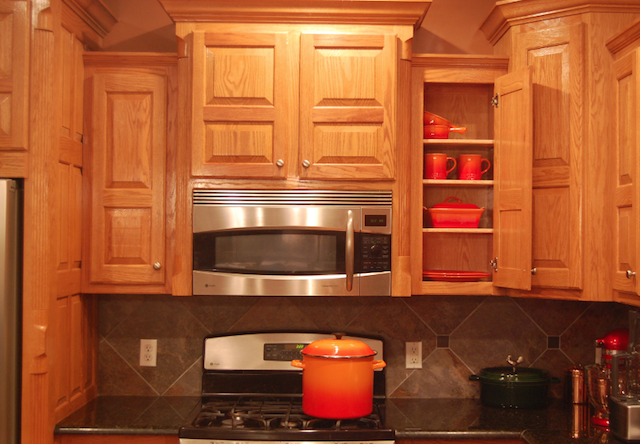
I’m in the middle of transforming the kitchen cabinets into the same system we are using in the pantry … it’s about rapidly identifying what is needed, avoiding excess, and focusing on what matters.
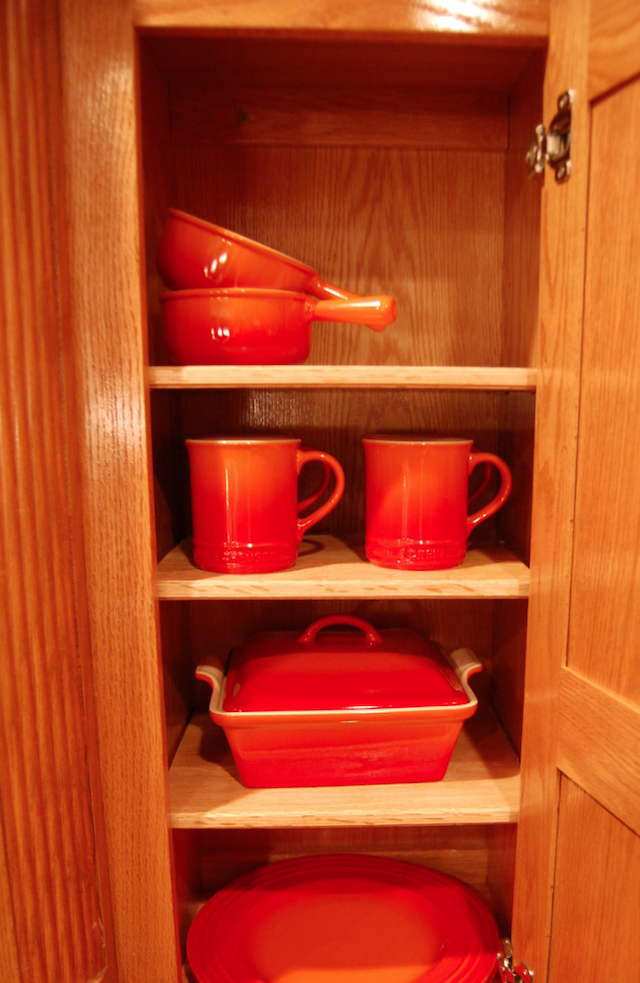
I’m in the middle of adding soup bowls to the cabinets … decided to take a picture and document this phase of the project for future reference. Everything needs to be well-organized, easily accessible, and purposefully placed.
I want every linen closet, every bathroom drawer, every utility cabinet in my home this purposefully filled. Life is too short to waste it wading through unnecessary accumulated junk, no matter how nice or expensive that stuff might be. If something isn’t needed, it’s getting donated. It may take me several months, or even the remainder of the year, to complete the entire phase of the project, but it will happen.
[mainbodyad]
Reader Comments (7)
Comments are presented chronologically, with replies indented beneath the comments to which they respond.
Heath
January 27, 2013
Always an advocate of ridding clutter, I stopped and thought about your words: Clutter is a form of poverty. I agree there is a relationship somehow and it's interesting the more I think about it. If I can borrow from a similar adage; Which came first, the clutter or the poverty?
JSG
January 29, 2013
Josh I notice you always mention fancy expensive cookware in your house. I want to share this video with you and everyone else reading this, especially the majority of us that can't afford the super expensive pans out there! You don't necessarily need to spend big bucks to have quality cooking.
http://www.chow.com/videos/show/mdrn-ktchn/#!/show/mdrn-ktchn/128378/the-science-y-way-to-shop-for-pans
Joshua Kennon
January 29, 2013
Great point! There are a lot of good brands and products at different price tiers. When you are learning to cook, you should not break the bank trying to build a dream kitchen. In a lot of cases, it is not necessary.
You should check out America's Test Kitchen consumer reviews if you are interested in finding the best performing brands at certain price points. They do a great job of testing all sorts of things.
For example, their Dutch Oven tests showed that a typical Le Creuset was the "gold standard" and absolutely perfect, but it cost $304.95 or more per pot, putting it out of reach of most people. They kept testing brand after brand and found they could get almost the same performance from the Lodge Enamel-on-Cast-Iron 6-Quart Dutch Oven which is around $50. We had that Lodge dutch oven and used it for years with very good results. If $300+ were a lot of money to someone, I think they should consider the $50 version and put the $250 difference in their investment portfolio, instead. That's what I did when I was younger. My household during my college and early-twenties had nothing more than a cheap set of pots and pans that were occasionally used, bought from Walmart.
I owe an enormous debt of gratitude to reader KansasKate from this site when it comes to cookware. She wrote me a long explanation of exactly what this video says (the thickness of the pan, etc.) and it was invaluable. If it weren't for her, I would have foolishly bought the regular copper pots you see on display at retailers and not special ordered the 2.5 mm thick professional line meant for commercial kitchens for the reasons this video explains. (I did still go ahead and buy a few of the Ruffoni pieces, despite being thinner copper, because they are the most beautiful pans I've ever seen.) For performance, that would have been a waste of money because they just aren't thick enough.
America's Test Kitchen said the best workhorse set they tested that was affordable and gave everything you could want was the All-Clad Stainless Steel Gourmet 10-Piece Set. Bought separately, they would have been more than $1,100 but bought together, they are $699.95, which is the cost of one of my stockpots. That set includes everything you need to start a kitchen - stock pots, frying pans, sauce pans, etc.
If I were on a strict budget, those would be the ones I bought, saving $29 per paycheck for an entire year to pay for them. Over their lifetime, it would work out to a couple of dollars per month to have and I would have saved almost 40% by going with the set instead of picking them up one at a time.
TL;DR: Absolutely!
Michael Starke
January 30, 2013
Replying to Joshua Kennon
I've taken a predominately piecemeal approach to my kitchen tools. If I found a particular tool (pan, knife, etc.) holding me back, I replaced that particular tool. Sometimes I would replace things a set at a time to leverage deals, combos, and sales like you mention. Some things are still around from my post-college bachelor days (cheap, lower quality, and infrequently used), and some are relatively new (pricier, of higher quality, and used almost daily). I think that this strategy has let me achieve a good "bang for the buck" so far. Someday, perhaps when I am building that dream home, and can have a kitchen built to my specs, I'll likely just take the plunge and move to a complete set of the best tools I can find at the time.
At this point, something has to save me very little time or effort (per use) to clear the "utility" hurdle, but cooking and baking are becoming a larger and larger focus for my family. Besides my office, the kitchen probably receives the greatest amount of "waking hours" use of any room in the house. On the flip side, I think it's perfectly acceptable for a person with different means and motivations to spend a fraction of what I do. Hell, when I was in my early 20s, and focused on college and expanding my career, buying anything more than the $300 non-stick set I had at the time would have been irresponsible. Now, when my career and financial status are much more stable, I can afford to sacrifice a bit of future growth in my portfolio to have what I want today.
JSG
January 30, 2013
Replying to Michael Starke
Another little helpful tip for those starting out...I take the Alton Brown approach to the kitchen, and I don't buy things that can only be used for one task, "uni-taskers" as he calls them. Don't waste your money buying things that only have one purpose, like a garlic press. Get the most for your money by buying tools and equipment that can serve multiple purposes, for a example a melon baller can be used to make melon balls, core fruit, scoop ice cream, scoop cookie dough to put on pans, etc.
Joshua Kennon
February 5, 2013
I've been thinking about that last question you posed for 9 days now.
I've concluded it probably depends on the situation. For people who lived through lean times (case in point: The Great Depression generation), keeping enough on hand to survive if things fell apart became second nature. I know an older woman with a seven-figure net worth who still, to this day, will re-use aluminum foil so she can save a few pennies. When she goes to buffets, she will tell the management she is going to take a few extra cookies for lunch the next day.
On the other hand, you get people who have never gone through hard times, but seem to amass large amounts of useless junk. Not to hoarding level, but just lots of junk always around in every room. They never let it go. In those cases, it seems to be a symptom of laziness or general neglect, which pervades their entire life and also shows up as a symptom in their net worth.
As far as I can tell: Both. It depends on the person and circumstances.
Abe
March 7, 2016
When I walk into my house and I see clutter, I cringe. I see it as a personal failure to keep my life organized and free from distractions. Of course, the excuses are always the same:
"I'll get to it soon."
"I don't have enough time right now."
"There's just nowhere to put any of it."
My excuses are void of truth, however. The truth lies in my unwillingness to invest the time into creating a system that allows me to avoid clutter in the future. The truth is that I was never taught as a child how to keep my life organized nor was I explained why it is so essential. And, as an adult I still haven't made the effort to research, analyze, and adopt a system of organization.
So, is clutter really a form of poverty? Aye, in my case, it clearly displays my lack of initiative and a lack of understanding about the value of organizational systems.
...
Time for me to get to work! Thanks for thought-provoking question.