

One of the few, big lessons I constantly hammer home is that money should work for you. It is a tool. You should not sell too much of your life for it in the form of time. You should not trade your integrity for it. In a prosperous society, money proper doesn’t even really exist; it is an idea – a word we use to describe a legally valid and socially acceptable claim check that we use amongst ourselves to trade goods and services. You amass money based on past contribution to society by giving individual men and women what they want at a profit, or in a small percentage of cases, inheriting it from someone else who did this.
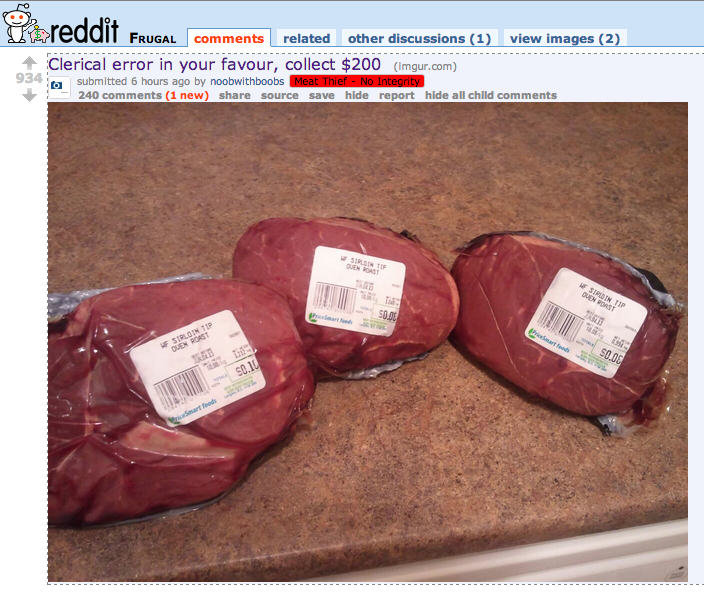
Over on a frugal board I read, there is a discussion going on about a person whom posted pictures of WF Sirloin Tip Oven Roast – 1.048 to 1.212 kg – for between 8¢ and 10¢. The person then labeled this post “Clerical error in your favor, collect $200“. Here is a screenshot of the discussion:
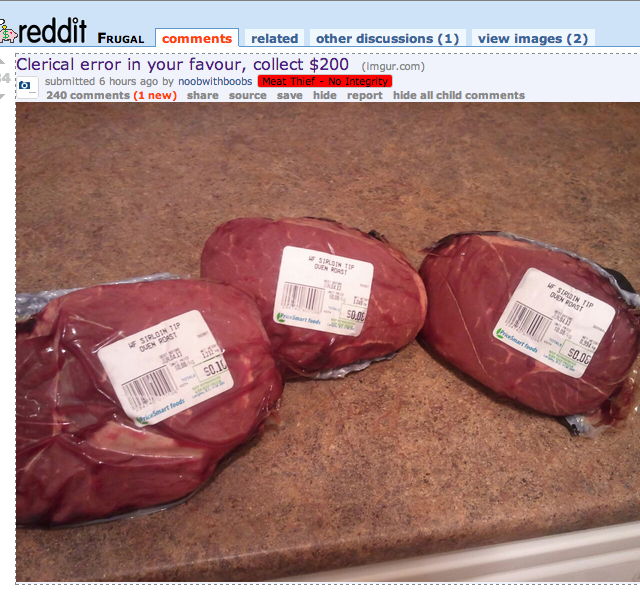
A screenshot of the post on /r/Frugal for proof of the discussion thread if it is taken down later … click to go to the page.
If you think this kind of behavior is okay, you’ve already lost. You work for money. You’re a slave to it. You’ve sold yourself, and your integrity for it. It’s not shrewd. It’s not clever. You’re a thief.
If I knew a friend did this, I’d slowly isolate them out of my life. If I knew a coworker or employee did this, I’d get rid of them. If I were doing business with someone, perhaps a vendor or a customer, and I found out they did this, I’d watch them like a hawk and move swiftly to sever all activity. Why? Because I can’t trust them. They can be bought for a few dollars. You do not steal from people. If someone makes an honest mistake, like dropping a wad of money in front of you or accidentally giving you too much change back in a transaction, you return it. The same goes for mislabeling in a business.
For something like this in an advanced economy with food security through welfare programs, there are no exceptions. There are no mitigating factors. You either have integrity or you do not. This clearly falls under the Golden Rule – “do unto others as you would have them do unto you”. It doesn’t matter if you are legally required to or not, do it, anyway.
If you encounter someone who retorts, “You won’t get very far in life taking that approach,” realize that is only true if you are particularly stupid. Intelligent people don’t have to resort to stealing. Not only is it wrong, it’s boring.
Surround yourself with people of integrity. Those who sell themselves for such a pathetic price will are not the type of people with whom you want to associate. They will justify things to themselves, not realizing how disgusting their behavior is. Someday, you’ll be on the bad end of the bargain. That’s a business, and life, lesson that can protect you. Never forget it.
[mainbodyad]
Reader Comments (43)
Comments are presented chronologically, with replies indented beneath the comments to which they respond.
Tyler Phillips
May 28, 2013
I agree with what you're saying about not taking advantage of someone's mistake, especially when the item is so clearly mispriced.
That being said, how far do we extend this logic? If a fellow owner of GE offered you his shares for $7 each, would you buy? Would you tell him it was a mistake for him to offer such a low price? Does it become more acceptable if large numbers of people are offering you GE shares at $7 like they were in 2009?
Jay Bugg
May 28, 2013
Replying to Tyler Phillips
This scenario only serves to confirm the original post.
If the market price for GE is $7 then there is no moral
issue in buying all you can afford for $7, such as in 2009. Some people the
price will go up and other think it will go down, “that is what makes a market”
and everyone is clear about the current value.
Now that the price is $23ish then you might do a quick Google
search and confirm the higher current price and ask the seller, "are you sure,
you can sell these with a broker for $23ish."
The poster noobwithboobs in the reddit article could have
asked the butcher “hey are you sure” about this price? What makes this stealing
is she knows it is “like $50 worth of meat” but made no effort to correct the
issue.
It was due to expire on June 4, 2013 (1 week from today) so it not that.
Tyler Phillips
May 29, 2013
Replying to Jay Bugg
Thanks for the reply.
Those were pretty much my initial thoughts on the matter as well.
What made me wonder is the scenario of buying shares from someone who is selling purely as a result of incompetence. They might be selling off their retirement accounts for pennies on the dollar but we deem it morally acceptable due the nature of the market.
Jay Bugg
June 4, 2013
Replying to Tyler Phillips
The issue is if the price was intended. The alert to the price not being intended is the low price. If there was a huge sign next to that meat saying, yes that really is the price, this is not a typo, then there would be no issue.
Joe Pierson
May 28, 2013
How about a $100,000 picasso marked at $10 at a flea market? Or heirs want to sell you a motel for $2.5 million that is worth $4 million because they aren't familar with the business?
Joshua Kennon
May 28, 2013
Replying to Joe Pierson
The GE example Tyler Phillips mentioned isn't comparable because as @jaybugg:disqus correctly points out, a liquid market is public, highly transparent, and all parties must be willing and able to enter into the transaction. You won't find a broker selling his clients' shares of Coca-Cola for $5.00 each when the market itself is offering $42.56. If such an error were committed, the exchange would rescind the trade. If such a transaction were done in private - such as exchanging a block of stock in a lawyer's office - and the buyer asked the seller, "Are you certain you want to go through with this as you can sell your shares for a much higher price than on the exchange?", and the seller did, the purchase would still be a moral one.
The other example, though, is an interesting one. You are essentially asking, "Is it moral to profit from information asymmetry in the case where the original owner is not aware, or has not bothered to research, the value of what he or she is selling, such as land with oil underneath it or a Picasso at a flea market?"
In this case, I would say it depends on the situation. If you are strictly following the golden rule - "do unto others as you would have them do unto you" - the path is clear. You tell them because, were the situation reversed, you would want to know. However, if you don't insist on that maxim, I think the stronger moral argument, if you forced me to choose, comes down on the side of the buyer, unlike the meat example. The buyer has experience and knowledge that took time and effort to acquire. The seller examined the object, decided what to charge for it, and wasn't willing to investigate further. I would argue the seller has no recourse, nor moral claim as they are expecting to profit from the efforts of the buyer without contributing to those efforts. It wasn't a mislabeling - they didn't do their research and had the item turned out to be worth less, they wouldn't offer a retroactive refund on the purchase cost, therefore why should they participate in the upside?
In other words, I think you could either argue there is a golden rule imperative here, or you could argue the moral rights are on the side of the buyer, and in both cases, be fully correct. I tend to side with the buyer.
Joe Pierson
May 29, 2013
Replying to Joshua Kennon
I still sense a deep underlying double standard. Throwing your logic back at you, an old lady, who visits four supermarket chains scanning for mispriced meats every Saturday morning, is that immoral? She has an information advantage as she has been shopping for decades, knows all the prices of all the various cuts of meats, probably better then the store’s butcher. In addition, she spends hours researching all the supermarket chains every Saturday morning so she has certainly “earned” that information. The supermarket could have allocated an hour of a cashier’s time double checking the prices, especially for the expensive meats, but they didn’t (they didn’t do their research as you would say). They calculated that it wasn’t financially feasible. Thus, I believe, the supermarket has no moral claim expecting to profit from the efforts of the old lady. That is, why should the old lady provide free labor for them by reporting mispriced items?
Joshua Kennon
May 29, 2013
Replying to Joe Pierson
The difference is subtle but substantial:
If you brought the clerical error to the attention of a manager or employee of a grocery store and asked, "Did you mean to charge this?", they would say, "No, it was a mistake." It was a typo, not a good faith exchange of goods and services.
It would not be immoral to buy meat for 1/100th of its price if you brought it to the attention of the meat department manager and asked, "Can I really buy this for [insert price here]?", he or she confirmed it was, and told you that you could have it.
Likewise, if you brought the painting to the seller, and asked, "Is this the price you wanted for this item?", they would say, "Yes. Pay me $x and you can have it." The seller is the manager, the owner, and the shelf stocker. They have examined the item, determined what they wanted for it, and put it up for sale. It is a good faith exchange.
Guest
May 29, 2013
Replying to Joshua Kennon
So in your example, what if the clerk placing pricing labels on the meat tells you it's the right price? Does that absolve you of responsibility, or should you continue up the chain of command until you get someone who realizes the mistake?
FratMan
May 29, 2013
Replying to Guest
Guest, I'm guessing Joshua would say that you should use your common sense and make an honest assessment of the specific facts of the situation.
If you're at "Joe's Meat" and you bring a pricing discrepancy to Joe himself, you should feel comfortable abiding my whatever he says (i.e. he'll either thank you for bringing it to his attention and charge you the proper price or let you have the discounted price as a "reward for your honesty" that might come with the side benefit of turning you into a more permanent customer).
If you are at a big box grocery chain, I would make a value judgment about the clerk's ability to make those calls within the scope of his employment. Is this some 16 year-old kid that just wants to go back to texting and so he tells you that you could have it? Sure, you are legally in the clear, but we both know that was a questionable exercise of authority. I would ask for a manager of the store, and upon finding him/her, I would abide by whatever manner they chose to resolve (or honor) the pricing discrepancy.
But if you are dealing with an experienced clerk that has been there every day for 20+ years and you are familiar with his competence, I would feel comfortable taking the discount if the clerk offered it to me.
Joshua Kennon
May 29, 2013
Replying to Guest
I would simply ask anyone with a name tag that officially represented the business. At that point, they are the ones responsible but you have attempted to clear it with the seller. If the clerk lied to you, or is trying to cover up his own mistake, you can't know that. It would be better to take him at his word and know that you have made the moral choice. You can't control what he does nor is it going to be advisable to go around calling people liars without any proof.
Scott McCarthy
May 29, 2013
Replying to Joshua Kennon
This conversation immediately made me think of the example you gave a few days ago about a family friend of yours making unsolicited bids to buy people's homes (which weren't on the market) for less than half of their fair market value, and insisting that the offer had a very short time until expiration, effectively limiting the ability of the would-be seller to conduct any pricing research.
By the line of reasoning that you employ here, would you say that this family friend of yours may not have been acting morally? If so, why did you recommend this as a viable way to increase cap rates on residential real estate to another of your readers?
Joshua Kennon
May 29, 2013
Replying to Scott McCarthy
That is a very interesting question.
After thinking about it, here is what I would conclude:
He (or she) is simply laying out the terms under which he will buy the property on a take-it-or-leave-it-basis. He has no moral or ethical duty to consider the feelings of the seller, and they are free to tell him to get off their front porch and never come back. Neither party is being forced into a transaction. If the seller doesn't have enough time to research the value, and doesn't like the terms, they don't have to accept them. It is two, free, willing moral agents acting in their own best interest.
I do not think they are analogous.
This is especially true since the buyer also does not have the assurance of a home inspection (there could be terrible terminate damage or the house could be a former meth lab). In some cases, the seller could end up in the more favorable position. It just happens that, in the aggregate using the law of averages, the capitalization rate for the buyer is often increased.
Scott McCarthy
May 29, 2013
Replying to Joshua Kennon
And the buyer isn't being forced to buy the meat, either. The seller could presumably opt-out of the transaction, as well, if the cashier spotted it, and given her vast experience in ringing up people's meat, recognized that the label was misprinted. And if the store is so incompetent that it can't get the price right, who's to say they got the expiration date right? That meat may well be full of - ok, well I don't think termites eat meat, but some sort of bacteria or something. Does the buyer's acceptance of risk stemming from proven incompetence mitigate thing here? If not, why would it be different for termites and houses?
Another fun thought: self-check-out lines...moral hazard?
Joshua Kennon
May 29, 2013
Replying to Scott McCarthy
This discussion reminded me of something that happened in my 8th grade civics class. In the small town where I spent a big chunk of my childhood, the social studies teacher once told a story about the grocer's boy who was a few years older than us. This young man wasn't a particularly bright guy, so he had no idea what he had disclosed to the community when, during a discussion about work, he talked about how his father made him go to the store before school days and contribute. One of his jobs was taking a kitchen hose and soaking the meat before packaging it to increase the weight on the scales as the meat absorbed the excess liquid. The net result was customers were overcharged and profits artificially inflated through theft.
I shouldn't have been surprised - it's a trick so old it even garnered its own Bible verse (Proverbs 20:23), which calls the practice an abomination - but I remember being completely blown away that it would have even occurred to anyone to do that. How could you face your neighbors and friends knowing you were stealing from them?
Richard
May 29, 2013
Replying to Joshua Kennon
There's a slight difference here - when someone chooses to sell a stock at the market price, that is a conscious decision. Similarly, if you walked up to a butcher's stall in a bazaar and asked him what the price was for a piece of meat, that would also be a conscious decision on his part and there would be no problem in buying at that price.
The supermarket has chosen to create a system that automates this process. It will inevitably have errors, many of which will not be noticed. Some of them will cause unwitting customers to overpay (see the example below from @Sluggie). In these cases it can be difficult to convince the staff/management to correct the error in a reasonable amount of time. Other errors will allow customers to underpay if they don't point out the error.
So in this case it seems like a clear moral rule. Would the same rule apply for program trading in the stock market (which is also a set of automated rules to determine prices, that sometimes creates the wrong outcome)? If so, are we all responsible for bankrupting Knight Capital?
Anon
May 28, 2013
I hate to disagree again, but straight from the horse's mouth:
"...found a manager and was like 'Is this for real?'
Turns out that corporate had sent them an extra 30 legs for easter and they had to push them before the sell-by date, which was three days from then, and lamb didn't sell well in the area..."
I think if you bring the unusually low price to a manager and he or she says it's no price error, you're not doing anything wrong by buying it. Would you rather the meat go bad and tossed in the dump?
I would delete this post. Not so much because of the philosophy, but rather because the instance you pointed out is not a good example. You might owe the reddit dude or gal an apology.
Yaacov
May 28, 2013
Kudos to you! This is beyond so many people. Many people who I know that are kind hearted, not aggressive and would not pick-pocket, shoplift or outright steal from someone have no inhibitions engaging in this behaviour.
It is akin to stealing from the gov't i.e. paying cash to avoid VAT payments and income tax. It is beyond me but so many friends of mine aren't shocked by this unethical behaviour.
Why do they differentiate between stealing from a person and stealing from a "thing" (must be a better description). It appears that the answer has something to do with their viewing the gov't or companies, as a wealthy aggressor, or as stealing from them so why not return the favor.
Any thoughts?
Joshua Kennon
June 10, 2013
Replying to Yaacov
It comes down to a mental model that deals with proximity. People overweigh that which is close at hand (an army of 500 at your gates seems scarier than an army of 5,000 an ocean away; a paper due tomorrow is scarier than three finals two months from now). When someone is dealing with an institution, it seems to add a layer of distance, increasing proximity, between them and the ultimate people they are harming. I think that is why it is easier for most people to take action against the intermediary when direct action against the beneficiary of the intermediary would cause them to see the pain they are inflicting and activate their empathy.
Joshua Kennon
May 28, 2013
The post you are referencing was about a past event in which the original poster did the right thing regarding the purchase of legs of lamb.
In this case, the purchase of sirloin tip oven roast, she did not do the right thing.
You are engaging in a mental model fallacy from behavioral psychology - I won't tell you the actual title so people can seek it out for themselves and they'll memorize and integrate it better - in which a person justifies a present immoral action that is unrelated because of a past moral action (or visa versa). The two have nothing to do with one another but in order to remain "morally neutral", those without a strong ethical code will attempt to balance the good and the bad in a form of accounting on a subconscious level. This mental model is one of the "big 100" ideas; it's particularly useful in designing incentive systems and loss prevention procedures if you own or run a business.
Anon
May 28, 2013
Replying to Joshua Kennon
You're right; I realized my error like two minutes after posting. I fully retract my post and do apologize to you. I'm gonna take a break from commenting!
Sluggie
May 28, 2013
Well, what would you do in THIS case?
Using easy numbers, mostly because I don't remember the actual ones:
Chicken was $3/lb. The package was marked '2 lb.' The price was marked $9.
I waited an unreasonable amount of time (10 minutes?), showed the mistake to the butcher, and he said, "That's what the machine printed. That's what it sells for."
Yes, I could have complained higher up. I could have continued to fuss (after all, they're ripping off the customer).
Instead, I figured I'd already invested too much time on the issue. I let it drop and bought something else.
Rick
May 29, 2013
What if the person with lack of morals and integrity is your schizophrenic brother? Do you think i should isolate myself from my only sibling?
FratMan
May 29, 2013
Sluggie, you would have three basic choices based on your own assessment of your opportunity costs:
(1) Since you are aware of the pricing discrepancy, you could notify higher management and climb the chain of command until you get the advertised price. Essentially, you would be deciding that the $3 in savings was worth your time, either out of an economic desire that your time was worth that much money, or out of a moral desire to "get things right" and perhaps aid future chicken customers that come after you.
(2) You could pay the $9 for the two pounds. Since the butcher told you "that's what it sells for", you could make the decision whether the two pounds of chicken are "worth buying for" at the $9 price. If: $9 seems like a good deal to you, you believe this is a one-time mistake, and you don't find the moral/economic pursuit of complaining higher up to be worthwhile, this may be the rational course of action. Otherwise, see option #1 or don't buy the chicken.
(3) Insulted by the butcher's attitude and the mispricing, you could leave the store and make your purchases elsewhere. Why not reward other places of commerce for pricing things right and hiring helpful employees? Let those other businesses reap the rewards of having you as a customer for doing things right. It can be sensible to punish incompetence by not giving them your business (no place of commerce has a right to our money--the burden is on them to prove they are selling a product in such a way that we would willingly give up our money for what they are selling).Maybe a couple years down the road, you could visit the place again to see if things changed.
You could choose your own path based on your own value system and how much of an obligation you feel to: help future customers, get the right price, reward/punish good business practices, etc.
Sluggie
May 30, 2013
Replying to FratMan
You know, I regretted posting this question almost immediately. It was a butcher-counter frustration, but it doesn't relate directly to the issue at hand.
However, there is definitely a time factor involved in getting customer service to resolve an issue.
It's the only grocery store in 20 miles, so I'm not likely to go elsewhere for all of my groceries. However, I double-check the prices now.
And, sometimes, they have wonderful specials -- like the time the butcher ordered 3 cases of chicken breast, but the warehouse sent him 13 cases. They couldn't send it back, didn't have room for it, and marked it down dramatically.
It just couldn't believe that they didn't recognize the bad math: 2 x 3 = 6.
Joe
May 30, 2013
How is this meat situation different from the way you get your milk for free? (https://www.joshuakennon.com/the-cost-of-milk-for-my-household-is-negative/) I'm not asking to be mean or acuse you of stealing. Just trying to understand the moral difference. Someone's losing money in each situation.
(edit: fixed typo)
Joshua Kennon
May 30, 2013
The grocery store is the one that told us we could do it due to an arrangement they have with the diary farm that allows the dairy farm to save money by getting the bottles back and sterilizing them for reuse instead of buying new bottles from overseas and having them shipped into the country, we regularly return the bottles to the grocery store checkout lanes when buying our other groceries, all the checkout people know about the program and honor the price even we say, "We're here to return bottles".
The dairy farm has clearly done a cost-benefit analysis based on the replacement expense of purchasing new bottles and determined that it is less expensive for them to recapture part of their past COGS through a rebate program. Though the individual transaction may cost them money, in the aggregate, it should increase their profits as it lowers future expense.
All parties are fully aware of the arrangement, which is actively encouraged on the part of the seller, and all parties benefit.
In what way are the two situations comparable?
Joe
May 30, 2013
Replying to Joshua Kennon
I didn't fully understand the milk situation but now that I do, I agree that they're not comparable at all.
Joe
June 6, 2013
Replying to Joshua Kennon
BTW, would you consider it moral or amoral to buy more milk than your family could possibly drink, simply to make money?
Joshua Kennon
June 10, 2013
Replying to Joe
I've thought about this question for three days.
I have a hard time answering it because I simply wouldn't do it.
What about arbitrage on a commodity exchange? It's almost exactly the same thing and I wouldn't think twice about it.
Here's my conclusion: If milk were a limited resource, and there were others in the community who were unable to take advantage of the opportunity because I took more than I needed, it may not be immoral but it would certainly make me, if you'll pardon the language, an asshole. I wouldn't want someone to do that so that I was denied the opportunity to get milk, so I should act accordingly.
That's the best I can do. That's what would allow me to sleep at night.
Joe
June 10, 2013
Replying to Joshua Kennon
I've been thinking about it as well (while awaiting your reply). I like how you use the "sleep at night" test.
I arrived at a similar answer: buying more food than you can consume is immoral regardless of the other aspects of the situation. It's wasteful and disrespectful to the earth, the farmers who grew it, and (in the case of meat and dairy) the animals too.
I realize this is sort of a cop-out since it doesn't address the milk bottle refund situation directly, but if it was me, that's how I'd think of it.
Joshua Kennon
June 10, 2013
The implicit questions in your question is, "Do you owe a special bond of allegiance with someone, particularly someone with mental health needs, simply because he is related to you genetically?" and "Is a different standard applied when one's free moral agency is limited?.
Those are personal moral considerations that you must answer for yourself.
For me? Yes. I would isolate the sibling out of my life because my commitment to myself, my spouse, our future children and grandchildren, my business partners, and the other people with whom I am interconnected, especially who rely on my integrity, vastly outweigh having him over for sandwiches and movies. The answer may be different for you. What can you accept in your life? What are you willing to sacrifice?
Whatever it is, make sure it is because it is what you want; not simply because you absorbed some script about what you "should" do from society.
innerscorecard
September 16, 2014
If by some odd chance you read this e-mail on this old post...
What do you think of Warren Buffett's scams and stealing that he did as a kid? Do you think that reveals something about his character? I thought it was fascinating that Schroeder covered his escapades stealing golf clubs from Sears in The Snowball.
Joshua Kennon
October 30, 2014
Replying to innerscorecard
Even though my standards can sometimes be exacting, and I've never shoplifted anything in my life (far from it as a matter of fact - as teenagers, Aaron and I actually reverse shoplifted once when we learned a gift we had been given was stolen from a store, sneaking it back into the establishment and paying for it ourselves at the counter), I don't think it's fair to judge a person who spent the subsequent 70+ years living a life of integrity, and proving his behavior was significantly above average, for an infraction committed before his frontal lobe was even fully developed.
People can and do change but it takes a tremendous amount of effort and counter-evidence to restore a reputation once destroyed or tarnished. Redemption must be permitted otherwise you get all sorts of disenfranchisement and bad societal effects (with no opportunity for reform, you get higher crime rates, less educational attainment, etc.) In this case, I think the evidence is fairly overwhelming it was a youthful mistake in judgment not indicative of character. To condemn such a person despite never doing it again is a bit too Les Misérables for my tastes.
Your question reminded me of a study I read last month but I have no idea where I put it. I wanted to write about it on the site. One of the theories it examined was shoplifting among males in the period around puberty. Given its prevalence in societies across the world, the working hypothesis was that it was an evolutionarily evolved trait to prove to mating age females that a male, especially if poor or lower social class, was adept enough to secure resources. It was fairly convincing ... now it's going to drive me nuts because it's probably buried in a pile somewhere.
Bryin
October 30, 2014
Mr. Kennon-
If you believe in the free market and capitalism you should buy the meat at the price on the label. If it was intended, of course, it is fine. If it is not then the business should be punished for sloppy work. Just has many have pointed out, many business situations result in profit because one person is less educated about something than another. This corrects problems in the market. Perhaps the seller of the meat will fire the employee that mislabeled it and correct a weakness in their business. Or perhaps their systems are flawed and need updated, after all the transaction could have been stopped at the point of sale by an alert cashier.. Your comparison of money falling out of someone's pocket is not completely accurate. That is an accident that does not take place in the market (exchange of values). Once you enter a free market, the market itself will resolve all pricing accidents and inaccuracies. This is not stealing, no dishonest act has taken place.
All that being said, it is stupid to post a pic of it on-line.
Joshua Kennon
October 30, 2014
Replying to Bryin
There is nothing inherent in capitalism that requires one to take advantage of an honest mistake that was never intended in a free market exchange. It's not a question of one party being less informed than the other, it's a question of a labeling error that, upon being brought to their attention, would be immediately corrected. Life is too short, making money is too easy, and integrity is too valuable to do something unethical for a piece of meat. The golden rule passed down thousands of years ago is sufficient here: Do unto others as you would have them do unto you. You have no idea if a shopkeeper mislabeled because he's under stress from his wife being in chemotherapy, or whether his eye sight is going. In writing our own story, we each get to make choices. Those choices are what define each of us. I'm unwilling to live with such a choice because I wouldn't want someone to do the same thing to me or one of my family members. I don't need laws to get me to behave that way, nor do I require regulations. I do it because it's the right way to behave.
(For the sake of honesty, I'll also confess there is probably some degree of intellectual arrogance at play here, too. If I witnessed someone do something like this, my first, visceral emotion would be contempt. Far from being clever, in my mind, it would be akin to he or she admitting that they were too stupid to get ahead in the world without taking advantage of someone else. I could never mentally respect them.)
If the moral argument is insufficient to persuade you, then let me make an economic argument solely to your own self-interest: Reputation capital is real. Reputation capital is powerful. I've seen it secure unbelievably cheap financing on incredible terms, as well as shut doors in faces the person never even knew had been closed off to them.
Some people might not care if you took advantage of a situation like this. I can tell you there are a lot of people - employers, vendors, current and potential future investors - who would watch you do something like that, say nothing, and file it in the back of their mind. It may be the deciding factor when they choose whether to hire you for that lucrative job, or back your startup, or recommend your company to a friend. For a tiny, marginal gain in utility you might very well have traded away a lottery ticket. Therefore, even if you are only interested in getting ahead, and have no moral qualms about buying the improperly labeled meat yourself, honesty is often far more profitable because the world is much smaller than you think.
Bryin
October 31, 2014
Replying to Joshua Kennon
You are applying YOUR morality to this situation. I do not see it as a moral situation but as an economic one. I do not necessarily disagree with your opinion in terms of ethical and moral judgment. I disagree with your thinking in terms of economic decisions. As an economic actor you are expected to make the most beneficial decision within the bounds of the law. If you do not act in this rational, self interested decision then the free market economy begins to break down.
Let's suppose you inform the grocer of the error and he corrects it. By depriving her of losing money you have greatly lessened the economic consequences of her economic decisions. Perhaps the grocer has hired cheap, sub-standard help to price their wares... or perhaps the grocer has a bad apple employee that did it on purpose... or perhaps she hates her job and just does not care much.. If the grocer loses money (suffers economic pain) they are much more likely to fix the problem than if they do not. Perhaps without the economic pain they persist in their poor decision economic decision making and suffer additional losses.
You applied your morality to this situation and I am sure you realize morality differs from person. As you also know many people have a different view of the situation and would act differently. Do you think we should rely on some individual's view of morality to govern our economic system? Or should we adhere to the principals of the free market to govern the system? It is easy to see that relying on an individual view of morality has many problems in governing an economic system. Does the moral view of the situation change if the person that purchased the meat is very poor? Perhaps this low cost meat fed a family that rarely gets to eat good quality meat.
It is not that I disagree with your actions in this situation, you acted as I would have. Further, I can't see how anyone would know you acted in this and you would suffer economic loss as you alluded to in your conclusion... unless someone was stupid enough to post it on-line.
Joshua Kennon
October 31, 2014
Replying to Bryin
I don't think an argument can be made that multiple forms of morality exist. After thinking about it for years, the only conclusion at which I can arrived based on a rational observance of the factors involved is that morality must be defined relative as it is here.
If you can come up with a better reasoned, more persuasive definition of the term, I'll adopt your position immediately. Convince me.
No it doesn't. In what amounts to a form of greedy reductionism, you've essentially outsourced your thinking to this deified economic concept so you don't have to feel personal responsibility for inflicting harm on others; harm that, if it were meted out to you, your spouse, your family, or your friends would likely leave you, and/or them, feeling wronged.
I'm not telling you that you can't do it. It's not illegal. Nobody is going to stop you. I'm just telling you that, even if you don't agree with me it is immoral or unethical as a violation of the Golden Rule, it's foolish in terms of self-interest for most people as the true economic cost of that meat could end up being hundreds of thousands, or millions, of dollars in lost future wealth to you and your family based upon the damage it does to your reputation capital. If you think that trade-off is worth it, and can sleep at night, do it. I'm not standing in your way, just telling you there are consequences and - yes - economic inputs you might not be considering in your model. A lot of people will consider you a thief, even if you don't agree with that summation and the law doesn't, and it will close off opportunities.
You may think it's "my morality" but the beliefs of the counterparty in economic transactions has real bottom-line consequences.
For example, I'd never hire someone, no matter how talented, if I saw him engage in behavior like that. I've personally witnessed a bank president turn down what would have been a lifeline of a credit package because he thought poorly of the borrower's ethics. I've watched wealthy men and women decide not to back what otherwise sounded like good business opportunities because some small behavior, like this example with the meat, made them question the character of the entrepreneur.
I've also seen the flip-side. I was sitting at the desk of a couple of underwriters at one of the largest insurance companies in New Jersey when they approved a seven-figure settlement with a young man who had been severely injured. It was one of those cases near the line that could have gone either way. They were walking me through the case, explaining the story behind it. Even though they could have gotten the company off the hook, and left this young man destitute, they decided to pay out the money entirely because the investigation into his background had revealed everything about him was extraordinary. He was working extra jobs to try and support his parents. He did well in school. Everyone talked about how honest and good he was. That young man will never know that, behind closed doors, it was his reputation capital for seemingly meaningless situations that resulted in him spending the rest of his life in comfort, despite his medical problems, rather than being stuck in bankruptcy and despair. It shows up nowhere in the paperwork. The underwriters will deny it ever happened. I was in the room. I watched them sign off on it.
Life does not exist in a vacuum. The trade-off costs of every economic decision are not limited to the cash outflows or inflows measured today. I'm just encouraging you, as a fully autonomous, independent adult, to choose wisely. Character is capital.
peterpatch79
October 31, 2014
Replying to Joshua Kennon
I got thinking on a tangent about this and was wondering where do we draw the line between what is considered an obviously grossly mispriced item like the meat and something that just appears to be a lower priced item. For example if gold bars are selling for $100 in the market but someone has theirs for sale at $99 it would probably be immoral not to mention they could just dump it on the market for a dollar more. But in the world of meat where distance to distributor, quality and other factors cause greater price variation the line of immorality would be far more vague, although the prices in that reddit thread were obviously well into obvious mistake territory.
Joshua Kennon
October 31, 2014
Replying to peterpatch79
Ah ... now that's a question!
The more I think about it, the more I have to say, I don't know.
I suppose you could argue that, like the law, to engage in immoral behavior requires mens rea. If it never occurred to you it was underpriced, and you couldn't have known it was underpriced, it cannot be unethical.
It is a fine line, I suppose, but personally, I don't think you'd need to inform them of the information asymmetry. For example, if you said, "Is this price - $99 - correct?" and they confirmed it, that would be enough. Even if gold were $200 or $500 elsewhere, I don't think it's your job to run their business or do their homework for them. They are willing, able, and capable of entering into a transactional exchange with you and satisfied with the proceeds so there's nothing immoral about that to me. It's not an error. They want to sell the product to you for $99. They confirm it. They are happy with it.
Think about the people on Antique's Roadshow. If you found an original copy of the Declaration of Independence and bought it for $30 at a yard sale, I don't think it's immoral as long as you made sure they meant to price it at $30. If they instead said, "Oh, no, that was supposed to be $50", and you pay $50, I don't think you've done anything immoral. The fact you could turn around and sell it at Christie's for six or seven figures is inconsequential to the morality. If you felt like it violated the golden rule, you could always go back and pay them half the proceeds after you had disposed of the asset (some people would feel this necessary, others not).
It's ... that's really interesting. What a great question ... I'll be thinking about this for weeks.
Bryin
November 4, 2014
Replying to Joshua Kennon
Josh,
Examining the theoretical is important. Only using the theoretical can we examine the extent of our actions. I would never argue that in your specific examples your actions in the case are correct. But when we start of examine other actions and circumstances your argument starts to lose strength. Citing my examples as simplified textbook versions of real world economics is avoiding legitimate challenges to your point of view. Each scenario I pointed out was/is a real life scenario in the market.
Your assumption that the purchase of meat creates a guaranteed loss of reputational capital. I agree that there are certainly SOME people that may see this action as dishonest, I am equally sure not ALL people would. The purchase would only impact reputational capital with SOME people. Then you have to factor of the those that were impacted the degree of impact would be different, some more and some less. Also, how would the loss of reputational capital take place without posting the purchase on the internet? If one simply purchased the meat, how would anyone know the trade actually took place? If no one knew then no loss of reputational capital is possible.
I would alert the grocer to the error, not because I fear the loss the reputational capital (I see little chance of that because it would not be posted on the internet) but simply because that is how I choose to live my life and who I want to be. I agree with the link to your definition of morality. If you said- "don't do this because you don't want to be that kind of person" then I am onboard. But when you say, don't do this because it has consequences in the market place you lose me and I want to argue. In the end, all our actions should be driven by the idea that our actions define who we are and not what our potential gain and loss is from that action.
Joshua Kennon
November 4, 2014
Replying to Bryin
Since we seem to agree that neither of us would do it just because it's not the right thing to do, and that's not the type of people we want to be, I take it we are, at this point, just examining whether there is an economic rationale for not taking the meat?
If so, do I understand your position correctly in that you concede some people will judge you for your actions, causing potential disutility, but you consider this meaningless as the chance of discovery is of such low probability that it is effectively not worthy of concern?
If so, that could be a rational argument.
Growing up mostly in towns where the population was less than 3,500 people, I have learned that the hidden things do not stay hidden. What you think can be kept a secret, or go unnoticed, doesn't. Not in the long-run, anyway. Partially, this is the result of basic probabilities. Even if the chance of discovery is low, a person who sees no issue with the behavior is prone to repeat it whenever given the opportunity, leading to a higher chance of detection over a lifetime; the old chestnut about character revealing itself if you wait long enough.
That small town dynamic never cease to amaze me. Such-and-such's-daughters-boyfriends-mom saw so-and-so at the park after hours with a man who wasn't her husband and johnny-at-the-automobile-repair-shop thinks it is her coworker with whom she is having an affair. The grocer notices something wrong with the meat prices and checks the receipts or security footage, goes home to his wife, and complains about being cheated by a dishonest customer (rightly or wrongly), now she goes to Church and talks about it with her friends. A car is parked in the wrong place at night. A regular restaurant patron misses a few days at his regular time and place. I grew up in a world where if you did something wrong at the public pool, your parents probably knew about it before you could run home because someone called them and told them after one of their kids spotted you doing it.
This means there could very well be a different set of trade-off calculations for a large, anonymous place such as New York City and a small community in the middle of Wisconsin where people are more likely to notice deviations in pattern or share information among closed social networks that overlap with yours.
Of course, as you point out, the chances of discovery have increased exponentially now that everyone carries a camera in their pocket, security tapes watch everything, and social media allows posting and sharing with almost no effort. I'm not sure it's a good thing for society but we now live in a world where a mistake in judgment caught on camera ten years ago can follow you for the rest of your life thanks to YouTube. I mean, is a woman like this ever going to be able to rise to prominence or prestige? I doubt it. Not now.
I don't agree it's a strawman because I'd be arguing the exact same thing even if I were a sociopath who viewed morality as nothing but an abstract concept. From a purely utilitarian standpoint, even if I had no empathy and wasn't in the slightest bothered by harm to others, I'd be honest solely for the sake of my own personal, raw, naked ambition as under the present system, it presents me a greater opportunity to acquire the things I wanted given that my base assumption differs from yours in I think detection is of a much higher probability than you seem to believe, no doubt colored by my own life experience. I wouldn't be looking at the meat in isolation, I'd be looking at it as part of a much bigger portfolio of behavior that could help, or harm, my own ambition and greed. If you plan on robbing a bank, you don't rob the grocer of a few bucks.
I'm also probably, at least in part, influenced by the fact I secretly follow several admitted sociopaths on a handful of sites and read their writings. The other day on Reddit, people were sharing their confessions and one guy talked about how he was a horrible kid - hurt animals, tortured his sibling, etc. I might not get all of the details correct but, basically, he learned that he could get what he wanted by mimicking virtue far easier than he could by mimicking vice so now he's the perfect guy, in the nice house, with a great life, great marriage, great kids. Yet, inside, he's still the same. It's all an act. He didn't change because it was right, he changed because it got him what he wanted.
In the long-run, I'm convinced that, at least under present conditions in our culture, society, and laws, honesty is more profitable.
Again, if you think the probability of detection is low, you're not going to agree with that I'm sure but I can't get myself there. My entire life experience up until this point has taught me it just isn't true. Leaving aside the incredible in-house forensics of places like Target and Wal-Mart, the face detection and risk assessment systems of casinos, old-fashioned human networks are one of the most powerful forces in life. Someone, somewhere knows. Which means, eventually, everyone knows or can know if they care to know.
Perhaps it's just my inherent conservatism. As with investments, I overweight the probability of negative outcomes and react accordingly. When I think about a hypothetical, dishonest version of me in an alternate universe, given the potential downside, I'd require huge payoffs to take risk. A few bucks saved on meat wouldn't fit into that category.
Bryin
November 7, 2014
Replying to Joshua Kennon
I agree with your summations. I think our divergent views are a result of different experiences. I have never lived in a town as small you describe so weigning the possibility of being "caught" buying the meat. We do diverge on the interpretation of someone else buying the meat. I would not ascribe as harsh a judegement as you would. I don't see it the act in the same terms you do. I don't believe that buying the meat would mean that person is capable or more heinous acts such as outright theft.
(An interesting aside- I went to a business seminar put on by a national accounting firm yesterday. One speaker was the head of forensic/fraud accunting. She said in her 30 years of finding fraud she has become convinced that anyone is capable of anything given the right circumstances)
I find your example of the psychopath who found is was easier to get what he wanted by being good very interesting. He claims is still the same person inside as when he did terrible things. I would conclude that he is only one small step away from committing horrible acts, as soon as he calculates that the horrible act will benefit him more than being good or that he won't be caught then he will act in an immoral manner.
This is why considering the potential costs/benefits of an act do not result in a determination of it is right or wrong. Sooner or later it becomes undeniable the immoral act has a greater benefit than cost. I see buying the meat as an act that has a greater economic benefit than cost given my personal experience. But even if the act has benefits with no cost, it is still wrong. The morality of act has nothing to do with costs or benefits. This is why morality must remain separate from cost/benefit analysis.
Although you and I might on morality (and get a many people to agree with us) we both know there is no universal morality in but few instances. For example, killing someone is wrong (pretty universal morality) but there are many situations where killing is morally permissible and even lauded as being good. (I don't see many people condemning the Navy SEALs that killed Bin Laden but there are those that will). The only conclusion is that morality is situational and specific to each person. As people view different situations differently there will always be different moral conclusions.
Back to the meat example... if someone purchased the meat and sited one of the economic reasons I sited for the reason they purchased the meat... the least you need to do is recognize they applied a different criteria then you did to the situation and do have a moral argument for purchasing the meat... That does NOT mean they are right (hopefully with some education they would see their error). The reason I called your economic cost/benefit analysis a straw man was it is irrelevant in determining the morality of the act and it is subject to qualification from person to person.
I might well have written about the morality of the meat purchasing situation (if I had blog)... But what I would have written would have been different. My question would have been- Is this who want to be? (to be honest I would harangued the poster for posting it on-line as it is moronic). I would have offered it as an example of how something that is easy to get away with will in the long run damage your moral self image and stop you from being the person you really want to become. I think the meat is fantastic example for people to learn and grow. Not about economic gain or loss through immoral acts but about short term economic gain at the expense of personal integrity. I don't think the person that buys the meat is necessarily morally suspect but in need of education.