

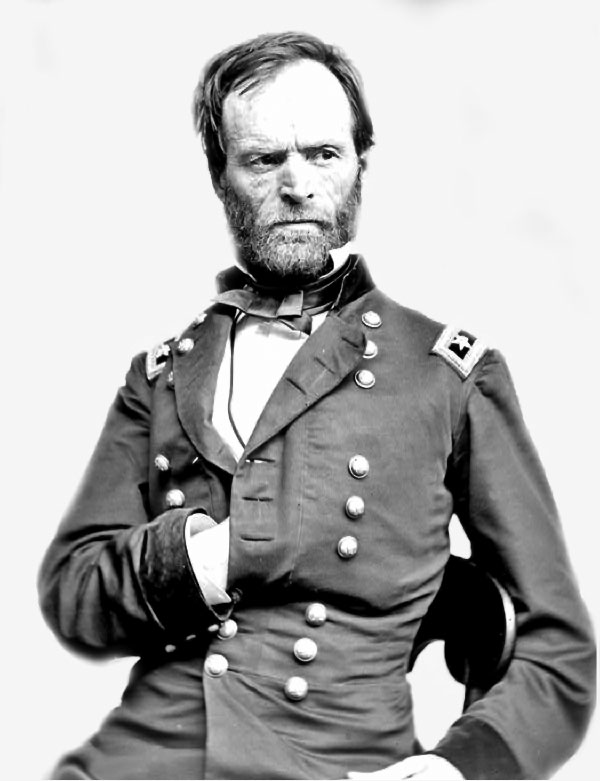
 As the American Civil War dawned, William Tecumseh Sherman, the man who was to be called the “first modern general”, remarked to a Southern friend:
You people of the South don’t know what you are doing. This country will be drenched in blood, and God only knows how it will end. It is all folly, madness, a crime against civilization! You people speak so lightly of war; you don’t know what you’re talking about. War is a terrible thing! You mistake, too, the people of the North. They are a peaceable people but an earnest people, and they will fight, too. They are not going to let this country be destroyed without a mighty effort to save it… Besides, where are your men and appliances of war to contend against them? The North can make a steam engine, locomotive, or railway car; hardly a yard of cloth or pair of shoes can you make. You are rushing into war with one of the most powerful, ingeniously mechanical, and determined people on Earth—right at your doors. You are bound to fail. Only in your spirit and determination are you prepared for war. In all else you are totally unprepared, with a bad cause to start with. At first you will make headway, but as your limited resources begin to fail, shut out from the markets of Europe as you will be, your cause will begin to wane. If your people will but stop and think, they must see in the end that you will surely fail.
Years later, even as he destroyed the South, Sherman wrote in May of 1865:
I confess, without shame, I am sick and tired of fighting—its glory is all moonshine; even success the most brilliant is over dead and mangled bodies, with the anguish and lamentations of distant families, appealing to me for sons, husbands and fathers … tis only those who have never heard a shot, never heard the shriek and groans of the wounded and lacerated … that cry aloud for more blood, more vengeance, more desolation.
Sometimes, when I hear the rhetoric of the far fringes of politics, I marvel that mankind has not learned from the lessons of our forefathers.
This is on my mind because I just bought a copy of Southern Storm: Sherman’s March to the Sea, about the campaign during which General Sherman tore out the heart of the South, burned its cities, and occupied Atlanta, helping bring about the end of the American Civil War.
Reader Comments (2)
Comments are presented chronologically, with replies indented beneath the comments to which they respond.
Austin H
January 18, 2011
I'm far from a history buff, but I did have to go on a staff ride in South Carolina and read the book listed below on Sherman's march to the sea. His march to the sea is usually synonymous with the concept of "Total War' and, in my opinion, is the last time the United States has experienced this devastating situation.
Sherman is an aumnus of my alma mater and war is war, but damn was he harsh. I'd be interested to see your opinions of his scorched earth procedures. Not exactly what my soldiers were allowed to do in Iraq.
http://www.amazon.com/gp/product/0807120286?ie=UTF8&tag=austinlhillco-20&linkCode=as2&camp=1789&creative=390957&creativeASIN=0807120286
Joshua Kennon
January 26, 2011
Replying to Austin H
I’m still thinking about the scorched earth philosophy, Austin. I’m not sure where I fall on it because, one one hand, if you can end the conflict quickly, it could result in a much faster resolution and less net destruction. On the other, it can be devastating and make it incredibly difficult to recover. I’m sure I’ll write about my thoughts in depth one of these days.