

I’ve spent a big part of today doing investment research on synthetic gemstones vs natural gemstones. Following the recent reading foray into the world of jewelry retailing, distributing, and mining, I kept coming across a company called Chatham. They had reportedly perfected the art of manufacturing gemstones such as rubies and sapphires inside of a laboratory. The gems they create are called “synthetic” because they chemically identical to the gems found in the Earth – literally, the exact same product with the exact same “physical, chemical, and optimal” properties – only made by scientists in a high tech facility.
Interestingly, they are often more beautiful with more sparkle than traditional gemstones because they don’t contain the impurities that are a by-product of gem formation within the Earth itself. Synthetic gemstones are able to be identified and differentiated from mined gemstones because they are too perfect. You read that right: The quality is too high.
[mainbodyad]By all industry accounts, synthetic gemstone production is just now coming into its full fruition. Back in the 1990’s and earlier, the only economically feasible alternatives to fine jewelry were “simulated” gemstones, which were colored glass or other materials (think Cubic Zirconia) meant to look like the real thing. You also occasionally encountered quality control issues when mined rubies were filled with glass. Now, however, a synthetic sapphire is almost certainly to be of higher quality than a mined sapphire. The same goes for emeralds and rubies.
Put bluntly: As of now, in 2012, someone who buys a mined gemstone is paying 10, 20, 50, or 100x the price for an inferior product.
Upon discovering this, I found it incredible that there is still a pricing differential between mined gemstones and manufactured synthetic gemstones. Despite the latter being vastly superior in appearance due to the lack of impurities, they often sell for pennies on the dollar compared to the former! It is totally, completely, and incomprehensibly irrational. You buy a Mercedes or Bentley because it is better than a Ford or Honda. You buy a Steinway & Sons grand piano because it is better than a Kawai. You buy a Brioni suit because it is better than a no-name private label brand at a discount retailer. You buy an expensive watch because it is well constructed and made of the finest materials compared to a $10 bargain bin timepiece. Yet, here, you have people paying more for a product that is of lesser quality. This is stupid. Plain and simple, it is stupid.
To satiate my curiosity, and near disbelief this could be happening in the market, I did some research and found a local department store that sold quality synthetic gemstones. Twenty minutes ago, I ran out and purchased several, including a ruby, blue sapphire, white sapphire, pink sapphire, and emerald, as well as several other pieces. I bought them and brought them back to my office to study them. Here are is a quick cell phone picture (not the best, I know, but it will suffice):
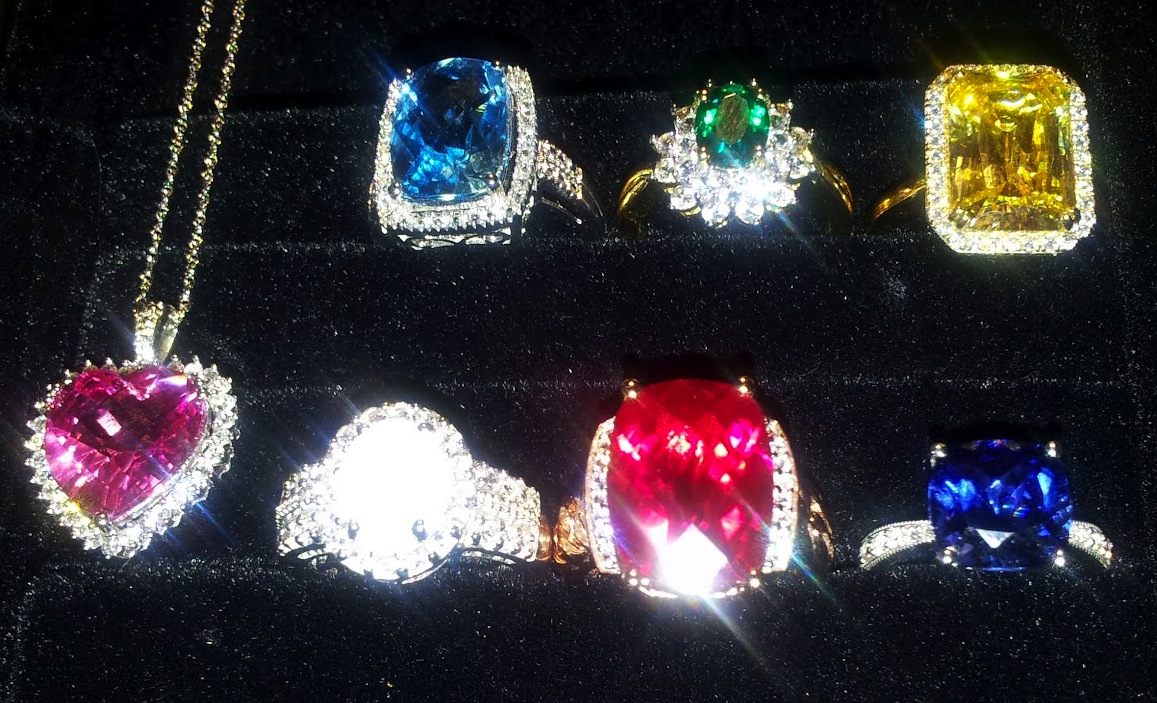
Synthetic gemstones are chemically identical to mined gemstones and often more beautiful due to the lack of impurities. Despite this, they sell for pennies on the dollar. I don’t think that is sustainable in the long-term.
Had these synthetic gemstones been mined from the Earth, they would have easily cost well over $100,000. Instead, I was able to buy them for $696. That includes sales tax and is full retail with no discount. They are the exact same product other than they are set in sterling silver and 14k gold instead of platinum or 18k gold. There is no chemical or molecular difference between the ones mined from the planet and the ones made by scientists on the surface of the planet. None.
Are Synthetic Gemstones Going to Do To Mined Gemstones What Synthetic Pearls Did To Harvested Pearls?
My first thought upon realizing this was to remember a story from the 19th century Gilded Age in the United States. One of the barron robbers gave a family member a strand of pearls that would have cost $1,000,000 in today’s wealth. Shortly thereafter, the process of making pearls in farms by seeding oysters was perfected and those same pearls became, for all intents and purposes, nearly worthless. It was a near total loss of purchasing power. I cannot see any situation in which the same thing doesn’t happen for gemstones over the coming decades. Perhaps, diamonds, as well, now that synthetic diamonds are becoming cheaper and cheaper to produce.
What are my conclusions?
- Gemstones as a store of value or show of wealth have seen their day. In the future, they may become common. As one source put it, aluminum was once more expensive than platinum until we figured out how to manufacture it. Only exceptional gemstones will hold any value, and even those probably won’t make up their inflation-adjusted maintenance expense such as insurance and storage.
- I am not sure what the future profitability of high end jewelry retailers who rely on gemstones as major price points will look like decades hence. Human psychology being what it is, people will always want ways to display their wealth and differentiate themselves. I think high-end watches have largely filled this role. There may be a lot of growth in that market if it becomes a replacement.
- Technology really does pose a threat to nearly every business, even the oldest ones. You cannot rest if you are running a business. You always need to be ahead of the market.
I’m about to close the book on this chapter and move on to another industry. I’ve been thinking about real estate lately so perhaps I will begin to look into som eof the more interesting legal structures or tax liens certificates.
Footnote: I hate the term “natural gemstones” because even synthetic gemstones are “natural” because they occur “in nature” given that humans are part of nature. It is a linguistic fallacy but those are the terms people use when discussing the topic.
[mainbodyad]
Reader Comments (40)
Comments are presented chronologically, with replies indented beneath the comments to which they respond.
Gilvus
July 15, 2012
Joshua, before you move on to a new industry: could non-synthetic gemstones continue to fill a numismatic market, in the same way that baseball cards, stamps, and rare coins made of base metals do? If that's the case, then non-synthetic gemstones would still be in high demand - just in a niche market.
Joshua Kennon
July 19, 2012
Replying to Gilvus
Yes. There is always a market for things that are unique and special. I watched a scroll that was 400 to 500 years old sell for $32.5 million Hong Kong dollars in a live Christie's Internet auction. It is just parchment with ink. Someone wanted the "idea" of the object because you could have reproduced it for under $50.
So, yeah. Absolutely.
W.M.
July 15, 2012
In the case of gems, we could start discussing them in terms of "intentional" versus "unintentional" stones.
Martel
July 16, 2012
Interesting topic; I concur that the perceived exclusivity and price point of "natural" gemstones over synthetic ones will fade reasonably quickly once synthetic stones become more commercialized and the technology matures. There are just too many uses for gemstones in certain fields: optics (high gain lasers for example), industrial applications (the mythical diamond coating), science and engineering in general (acoustic/electrical/mechanical properties of gems), etc. I could see some really neat composite materials being developed using gems if they become cheap enough.
Thanks Joshua for giving some insight into how you look at certain industries and delineate the effects of changing circumstances like this - so it's probably not a good idea for a long-term investor to go for broke in the natural gemstone industry 🙂
pHuzz
July 16, 2012
I read often, and may tend to disagree with you on some accounts, but I usually bite my tongue and let it slide. There are a hand full of area's in which I might consider myself an expert, and automobiles are one of them.
First off you say that Mercedes or Bentley is better than a Ford or a Honda, but better is subjective. The only area where I would say they are better is luxury, you have better chances of finding real wood in a higher end car. However parts are more expensive, labor is more expensive, and they are certainly not any more reliable than than one of my personal favorites, Toyota.
To look at it from a value point of view. A Mercedes SL-500 is worth almost 10% of its original sale price after just 10 years, and that is with an unusually low number of miles for something of that age. It can be in immaculate condition and still be just as much car as was originally paid for, the engineering is no different, the materials haven't changed. There 'might' be some wear on the drivers seat after the 80,000 miles. If you were looking at it from a value investing point of view. It is still the same 100k+ dollar car that it was before. But it is now disproportionately 'worth' less than its value. It is a self perpetuating situation. Nobody will pay much more for one because they know they can find one cheaper. Nobody will buy them because they know the price drops drastically over time and will never go back up. Which all works together to make the price be even lower than either two of the situations would explain.
Likewise people that pay more for a car assume they are getting more car because after all.. they paid for it. The perception is reverse than what it should be. People think its a high quality car because its worth more. But it is worth more simply because people think its higher quality. Neither of these are based on the actual quality of the car. Even Mr. Enzo Ferrari despised his customers because he knew they were only buying the cars for the name, and he was only building them to fund his racing.
Back to the article, its not about what the item is worth, its about the value we put on the item. Just like diamonds, the price is indicative of what we will pay for the product. There are tons of products in the world that people truly believe are worth more simply because of the name we give it. But what is in a name? I believe a rather famous person once wrote about such things.
Joshua Kennon
July 17, 2012
Replying to pHuzz
You are very much correct that better is subjective. It would have been more accurate to say "more luxurious".
Anon
July 18, 2012
Replying to pHuzz
Huh? Some cars ARE better than other cars. We're not talking about colors being better than other colors. What's wrong with using plain English?
Anon
July 16, 2012
The better comparison would be a Bentley made by Bentley Motors Limited, as opposed to an exact replica made by former employees over at the newly incorporated Parabentley Inc. What's more, Parabentley Inc. uses better paint.
Patrick
July 17, 2012
This reminds me of guitars. Fender makes Custom Shop models that cost twice as much as their standard American made models. Having played them both, they are within 90-100% in terms of similarity. And then there are companies such as Nash that make Fender guitars and do an even better job than the Fender Custom Shop folks, but the cost is closer to a standard American made model. For re-sale value, getting a Fender American made or Fender Custom Shop is the better choice but for an actual guitar, the Nash is arguably the much better guitar.
peterpatch79
July 18, 2012
Replying to Patrick
That is 100% true. I found it strange that people will pay 50 grand for a late 50's Fender strat simply because it is rare. People have tried to convince me , among other reasons, that they sound better because the wood is older or the electronics used better materials or because they were made under close watch of Leo himself. I don't know how much to believe that, I think that with today's electronics and guitars we can mimic those old tones almost perfectly and get some pretty interesting new ones as well.
Joop Gal
April 7, 2013
Replying to peterpatch79
Guitars are a great example on how name affects price. My Danelectros are cheap by name and manufacturing process but to me they sound and play like a million bucks. I have played more expensive guitars (those custom shops for instance) but have yet to find something that feels so natural to me. In my opinion any Dano I grabbed had the same feel and playability. I own a Pro and a Baritone.
spingus
July 19, 2012
I would still rather have a strand of naturally occurring pearls than cultured pearls. In that case it is the inherent imperfect nature and difficulty in collecting together individuals that look enough alike to make a beautiful necklace that holds appeal.
I would also rather watch the Rockettes than a cgi generated chorus line made of replicates of the same girl. Each Rockette is of similar height and body type and is dressed identically, but they are each individuals as well. Delicious.
Joshua Kennon
July 19, 2012
Replying to spingus
That is how niche markets develop long after low cost producers enter an area. Think of custom high-end cars that have been restored or bespoke suits. There will always be a market where people buy the 'idea' as much as the product itself. I'm that way to some degree on high-end fragrances.
clunkygirl
March 9, 2017
Replying to spingus
Well, CGI is not an exact replica of a person either. If you could make an exact replica then there would be no distinction. The replica to be a true one would have to be the same biologically/chemically AND intellectually (meaning they'd have to have artificial intelligence). And yet, they'd still be different bc they'd encounter different experiences, but this is a dimension added bc we are talking about life and not a stone. A perfect, IF flawless stone would be the same either way, if it is the idea of it being naturally formed that you find attractive - that's fine, that's a valid statement/reason.
Sapphire miner
November 1, 2013
Hi Joshua.
You've already guessed by my name that my viewpoint is opposite to yours. For the record, I do not run a commercial operation - I hold several small miners claims on the Rubyvale/Sapphire/Anakie gemfield in Central Queensland, Australia - at one stage the world's most significant sapphire field, nowdays no longer but still important (this appears to be a US-based blog?). So I don't actually rely on it for a living.
It all comes down to perception really. In my own opinion, the difference between a fully synthetic sapphire gem and a natural one is the difference between something that is clever....and something that is special. To invent technology that can rapidly churn out perfect, flawless-looking gems that are chemically identical to the natural ones, for pennies to the kilogramme, from a vat full of chemicals overseen by blokes in white lab coats is clever - no argument there. But when you have something possesed of inherint beauty - the same basic reason you buy the synthetic gem - that was created by nature in a rare geological event, at a time when dinosaurs still walked and has lain hidden in the earth for tens of millions of years before being discovered, and it and others like it are exceedingly rare....then you have something special.
Another way of thinking about it might be like this: I create a new technology to cleverly combine nickel, iron and a peppering of other elements in such a way that the result is totally indistinguishable from the natural object, both by eye and even by chemical analysis - it is identical right down to the molecular level. Having achieved this.........do I not now have a meteorite? I'll leave you to think about the difference between between something I whipped up in a laboratory and something that really did fall to earth after traversing time and space beyond our understanding. My clever copy lacks any and all of those qualities and for me to pass it off as the real thing to which the name was originally given would be fraud.
So I think you've slightly missed the point of why the natural stones still command a much higher price than synthetics. They are very rare and extremely ancient natural objects of great visual beauty. The synthetic is about as rare and ancient as the plastic pokemon toy that my son will find in his next kids' meal from McDonalds.
However, I still do fear that you may ultimately prove correct about the destruction of the natural object's value. When the synthesizing process becomes perfected to the point that it is no longer possible for even a laboratory to tell the difference - and the push is on to do so - then won't be possible anymore to know whether you are buying a rare piece of ancient history or something churned out of a chemical bath in an industrial precinct in Bangkok. At that point, no one could be expected to pay a premium for sapphire jewellery and several thousand years worth cultural history will have ended.
Just my 2 cents worth.
Lab Monkey
July 9, 2016
Replying to Sapphire miner
When comparing the ecological impact of lab created sapphires its important to recognize bauxite is not primarily mined for sapphire production, rather for the production of aluminum metal. Worldwide production of bauxite was 234,000,000 tons in 2014:
https://en.wikipedia.org/wiki/List_of_countries_by_bauxite_production
Whereas in 2013 approximately 1000 tons of synthetic sapphire was generated for gems:
http://www.gia.edu/gia-news-research-Sapphire-Series-Treated-Synthetics
The summarized molecular formula for bauxite is Al2O3+2(H2O) with a formula weight (FW) of ~138 g/mol. Corundum is Al2O3 with a FW of ~73 g/mol. Assuming a100% conversion of bauxite to corundum it takes 1,890 tons of bauxite to make that 1000 tons of synthetic sapphire gems or 0.00081%. Therefore the amount of bauxite used for gem production is minuscule. Those mines would exist in any case and no mines were specifically opened solely for the production of bauxite for gem production. The same cannot be said for the production of natural sapphire. Sapphire mines are dug for one thing - sapphires.
Given those facts synthetic sapphire is indeed more earth friendly than natural.
One the point of natural stones being better than synthetic for their "natural" beauty...
Most natural sapphires don't look like much coming out of the ground. Even after being cut they are full of inclusions and lack proper color. To address this these sapphires are heat treated, fracture filled and otherwise tarted up long before they are brought to market. The rare sapphires that do not require such treatment are usually priced well above the means for most people and frankly don't look any better than the tarted up versions and certainly not the synthetics. Therefore the belief that a dirt stone is better than a lab stone because its "natural" is in most cases wishful thinking. If you like cracks and dirt in your gemstones inclusion generated synthetic stones are available.
Now if you value a gemstone for its age I suggest you take a trip over to Jack Hills. The zircons there have been confirmed as being the oldest on earth at 4.4 B YO. They don't look like much but hey, they're old!
Personally I don't care how old the stone is. If I did ancient rocks aren't hard to find. The Grand Canyon alone is full of them:
https://en.wikipedia.org/wiki/Geology_of_the_Grand_Canyon_area
Old rocks are not that special. Meteorites are an interesting case but lets face it - the entire earth is made from ancient meteorites so no, even meteorites aren't that special.
I think a decent analogy here would be to compare synthetic gems to spices. Spices were a rare and highly valued commodity that only the very, very rich could afford up until the 18th century or so. A handful of peppercorns would have been worth a fortune! Today they are worth a few cents. Does that make them less flavorful? Not to me, in fact it makes them taste better because at that cost I can afford to eat them and not stick them in a safe. Same with gems. If one owns a piece of jewelry worth a few million dollars where and when can it be worn safely? You'll need a security team while wearing it and a secure location to store it when you're not, plus the hefty cost of insurance.
What a hassle!
OR you can have the same thing, just as blingy with fewer flaws and negligible environmental and social baggage for less than the price of a cheap used car - heck maybe less than a used cell phone. No security team needed and you can wear the gems in public.
White's Fd
November 3, 2013
hi, I sort of understand where you're getting at, but how about looking at it in a different
viewing? For example, Rolex watches even stainless version are selling at an expensive
price; however, there are some high quality immitation that are the same in everyway,
even the 904L material as well as same mechanism with 1/10 of the price of real. But
some people are still paying high price for the real, as an appreciation for the developer
of the watch. Back to this case, natural gem may not be perfect as synthetic one, but their
imperfection is what makes everystone unique and carrying it's own characteristic. And
synthetic can only be call synthetic because we didn't design this substance. People are paying for the creation of natural environment as well as the efforts that the miners had contributed. Imagine one day if there's a type of memal that can be created and identical
in everyway like human with same perfect personalities. . .
Are we going to call them "mimic"? or maybe that's why we'd try to mimic everything but ourselves.
Sapphire miner
November 6, 2013
Replying to White's Fd
Agree with you there White's Fd.
With due respect to Joshua, he isn't looking for value beyond the physical properties of the object. Would he think that the Statue of David is merely a lump of rock, the value of which can be entirely summed up by the weight of the marble? Is the Mona Lisa only worth the cost of the canvas and the paint?
On a side note, you'll find that the synthetic gemstone industry often promotes synthetics as more environmentally sound because no mining was carried out, no trees torn up, no earth disturbed. The problem I have with this sales pitch is that it is an utter falsehood, certainly where synthetic sapphire is concerned anyway.
Synthetic sapphire is most commonly produced through a technique called "flame-fusion" whereby aluminum oxide (alumina - as this is what sapphires are, chemically speaking) is fed into something resembling a blast furnace and melted at extremely high temperatures until a transparent crystaline mass is formed. This material is the equivalent of rough stone for cutting into gems.
So far so good. But the question now becomes......where did they get the alumina needed to make the synthetic in the first place? Ever seen a full-scale bauxite mining operation? The bauxite ore needed to make alumina in any quantity is extracted by one of the world's largest strip mining industries, in massive operations that occur all around the world, some no doubt adjacent to environmentally sensitive areas. So straight away, the sales pitch of being more ecologically sound is a huge fallacy.
Now that you have dug your bauxite, you still need to extract the alumina. This is done in enormous refineries where millions of tonnes of bauxite is digested in building-sized vessels filled with concentrated sodium hydroxide - a rather nasty chemical. The end result is the white alumina powder and large quantities of alkaline red mud as a by-product.
Contrast this with sapphire mining. My field is one of the largest sapphire fields in the world and having been up and down the length and breadth of it, I can say that all of the mining in the past 100 years would not come close to a single large bauxite mine (and there are large numbers of such bauxite mines worldwide). Sapphire mining will never rip up this amount of earth and the reason is simple - sapphires are by their nature, very rare. You can't just go around excavating the countryside for them because in nearly every case, they aren't there. There are only a handful of known deposits worldwide that are worth mining. Nor are any chemicals used. Extracting the stones is a simple process using machinery akin to a smallish sand/gravel plant and a team of people with sharp eyesight.
I'm talking my own book of course but I'd reccomend that people go for the special, natural item.
Jay
February 15, 2014
Replying to Sapphire miner
One point missing here Joshua, all cars are man made, you can either increase or decrease productions, quality etc but synthetic and natural totally different, as the value goes up cause of the rarity of natural, for ex very few countries in the world produce quality sapphires, it is not only the content of chemicals of the gem stone based for prices
Itachi Madara
February 15, 2015
I wonder do these man made stones last for 1000's of years or do they start to break down?
Sammael
February 16, 2016
Replying to Itachi Madara
They will last even longer than the natural ones. Because of lack of flaws and imperfections and having pure crystal structure they can take damage that would break the natural ones.
clunkygirl
March 9, 2017
Replying to Sammael
yep!
Tadilac
April 4, 2015
This is a principle of scarcity. People buy authentic gemstones for the same reason they buy antiques.
Joshua Kennon
April 4, 2015
Replying to Tadilac
The scarcity only exists in their head, though. It's not real, actual scarcity of the end product, meaning it's a psychological quirk, not an economically justifiable one. Those who are attracted to it are attracted to an idea.
Louis Byron
July 8, 2015
Excellent and sober analysis of why precious gems in general are probably a poor investment for the average investor. However, the market for fine colored gemstones is conversely one of the few markets left of the traditional "hard" assets where I would argue that true supply and demand function largely unimpeded by monopoly or global centralization (c.f. the international white diamond market in the first case, and precious metals like gold and silver in the second). The scarcity of fine, top-quality gemstones is not really artificially "manufactured" as you suggest but rather is the result of a specific evaluation, albeit a subjective one, that gemstones that come from the earth have a special quality unmatched by ones manufactured by man--regardless if they are "objectively" the same stone in terms of exact chemical composition. But since when do subjectivity and "psychology" (as you chalk high values up to) not affect an item's perceived value? My investment philosophy is that intrinsic or real value as it is sometimes called is the same thing as so-called perceived value. Aluminum was always a commodity item, even if it was a very expensive one. Fine rubies (for example) may have had relatively flat periods in their value over time but overall have never lost their value (and have often gained) for thousands of years. A pretty good track record--especially since you can evacuate with them safely in your sock should the need arise 😉
John Robin
August 29, 2015
The one thing he doesn't realize or remember is that natural gems are by far more rare. The more rare a gems stone is because of size, color and clarity is what controls the price of natural stones. Man made stones have little value because they are mass produced to a customers demand of specific size and color. Remember RARE equals a comparitive value which will not decrease unless some undiscovered mine is developed which floods the market.
vellagolf
February 23, 2016
I don't know why they are called Synthetic Gemstones, but after going through this content I have an information about the why they are called synthetic. I'm really surprised that they're exactly the same product in terms of physical, chemical, and optimal. Thanks for sharing this information.
Synpathetic gemstones
February 24, 2016
Natural gemstones will always be superior to synthetic, and the #1 reason why, and the maybe the only reason. Is natural has healing powers and synthetic does not, and never will! So your theory is not thought out and full of inclusions! Lol
tara
March 10, 2016
I totally disagree with this, what you're saying is why buy a Louis Vuitton bag when you can get a replica?! No thankyou. Many people buy gemstones because its an original piece from nature, synthetic can't be compared.
john
August 8, 2016
Replying to tara
the louis vuitton replica doesn't have the same materials or construction. a synthetic emerald has exactly the same chemical and physical properties than the natural emerald.
Shan Nanditha Thommage
August 25, 2016
Replying to john
The value of the gem stone depend on the time it took to become to a such a master piece. it took millions of years with all kind of era of memories in it. when you think about it this where the value restored.
As I am a chemical engineer we create gems in laboratory can not compared with natural stone. when you look at carefully there number of difference in gems created in the lab and created by nature. I believe you still love a human been which than a robot.
Joe5
December 6, 2016
Replying to john
sorry, not true, a natural gemstone, has also physical and chemical properties that can never exist in a synthetic created gem.
like gas bulbs, salt crystals, ....
wendygoerl
December 14, 2016
Replying to john
It most certainly can. And while it may not be true of Louis Vuitton, there are many examples of fake being detected because they're actually TOO GOOD to be genuine.
Dave Cockayne
April 24, 2016
Something else to consider is the ethics problem of mined gems. Most gems come from some pretty nasty places in the world and it wouldn't take much of a push to make 'natural gems' as socially toxic as wearing fur. If you want to spend lots of money on a bit of old rock, buy fossils.
Odinson
July 26, 2016
If gold could be produced in a laboratory, would it be called synthetic gold? Of course not. Gold is gold. The same should be done with precious stones. Mined or made the price will fall. Gold already is being produced in labs, but it costs much more to produce than to mine.
Watson
October 24, 2016
Replying to Odinson
Gold is an element, to make it from its components requires ridiculous amounts of energy to do. gemstones are mineral crystals made up of elements (and compounds, which are made up of elements), making them far easier to produce
wendygoerl
December 14, 2016
First of all pearls are "natural" or "CULTURED," not "synthetic." Second, much of the value of ANYTHING depends on supply and demand. Pretty stones are in demand, supply of natural gems are rare.
There are two reasons natural stone command higher prices than "perfect" synthetics. One is that the flaws make them more unique--they're individuals. It's the same as silverware artists deliberately not buffing out all of the hammer marks to show that the fork isn't machine-made.
Another is that some people DO recognize the difference. People sensitive to the energy of crystals report that synthetics don't have the souls of natural stone--they're simply several thousand years too young for their energies to have developed.
If your only criteria for what you're willing to pay for is how it looks, then you may as well buy glass, because in many cases, simulants are even cheaper than synthetics. And most people can't tell the difference.
Just wondering
October 10, 2017
I enjoyed this article and at one time agreed with it wholeheartedly but I have a drawer full of synthetic gems jewelery and well... hard to explain but when I go to put something on I find I never choose those items. Perhaps my earth mined gems with their little flaws are calling to me in a way the others cannot. I can not describe this feeling any other way.
curious_shopper
October 11, 2017
Since this piece was written in 2012, I was wondering how things have developed since then? I would imagine the quality of synthetics has improved somewhat and I would also like to ask whether they have had an impact on the price of earth mined gemstones? I'm currently looking for an engagement ring and with all the other expenses in life, it is terrible of the jewellery industry along with advertisers to pull at the heart strings of consumers and make them think that they are lesser for not spending as much. This article brings a lot of insight into the current state of affairs of how we got to where we are in the psychological aspect of jewellery purchase https://www.theatlantic.com/international/archive/2015/02/how-an-ad-campaign-invented-the-diamond-engagement-ring/385376/
Donna Bayley Lovett
February 7, 2018
What beautiful pieces. My heart is happy, looking at your above photo. I have one synthetic ring, a blue sapphire surrounded with real white sapphires, and it's one of my favourites. (It's the replica of Princess Diana's ring - now Kate's ring) We would never be able to afford the real thing, so I'm okay with synthetic- it looks JUST as lovely.