

I’ve seen a lot of rumblings on the Internet over the past few months about writing in cursive. From people complaining on Reddit that it is the most useless skill they have to the media uproar in the George Zimmerman trial when it was discovered that star witness couldn’t read cursive and had to have the letter read for her in court, for one reason or another, it seems to be everywhere.
There is a good body of academic studies that link the mental processes involved during writing long-hand and the ability to retain key information, learn new ideas more quickly, stave off age-related mental decline, and force growth more quickly in the brain’s processing centers according to one study done at Indiana University examining the MRI activity of children who had been trained writing longhand versus those who had not. It has to do with the way the brain maps the spacial relationships between the symbols you are making with your hand and the actual content. It’s tied to our biology; the evolution of the human mind. These connections and development happen in a way when you put pen to paper that does not occur when you are typing. If you are studying something important, or you want to think clearly about a topic, writing it out longhand forces changes in the way your neural networks analyze the information.
Based on the sheer volume of research done in this area, there is no question that the act of writing is valuable in a way for our cognitive development in a way that clicking little plastic buttons or seeing text on a screen cannot replicate. Typing is efficient in some cases, but it is a poor substitute as it does none of these things for your brain or processing. (Taking it too far, being tied to a screen all day can actually cause a form of dementia that causes a young person to have a brain that resembles that of person with a brain injury.) And I am not an impartial bystander who is opposed to typing. I made my initial money founding and running an Internet company. I’ve been able to type since 4th grade when I convinced the teacher to let me skip recess and use the computer lab to learn. The last time I tested myself, my typing speed was exactly where it has been since I was in high school, between 120 to 136 words per minute with 99%+ accuracy (the speed, I imagine, has something to do with my dad making me taking piano lessons throughout my childhood as the skill sets seem comparable – it’s all just hitting keys in a coordinated manner). I am not advocating the disavowal of typing. It has its place.
These studies were the reason that, years ago, I decided to make longhand part of my process. When I have something important to think about where the stakes are truly high, I do not sit in front of a computer. I go outside, pull out a notebook, and start writing. It’s one of the reasons my thought processes are so disciplined – you aren’t as prone to making sloppy mistakes when you have to take the time to think a matter through before drawing ink across the page. Half the time, even if I am making a quick list, I still use paper. Last night, I wrote out a list of potential ideas for the About.com site, to keep as part of an on-going file, so I can grab it and use it as an inspiration starting point when I need to get another article published. Most of my “big idea” or “think about this” work is done by hand. It sticks in my mind, more.
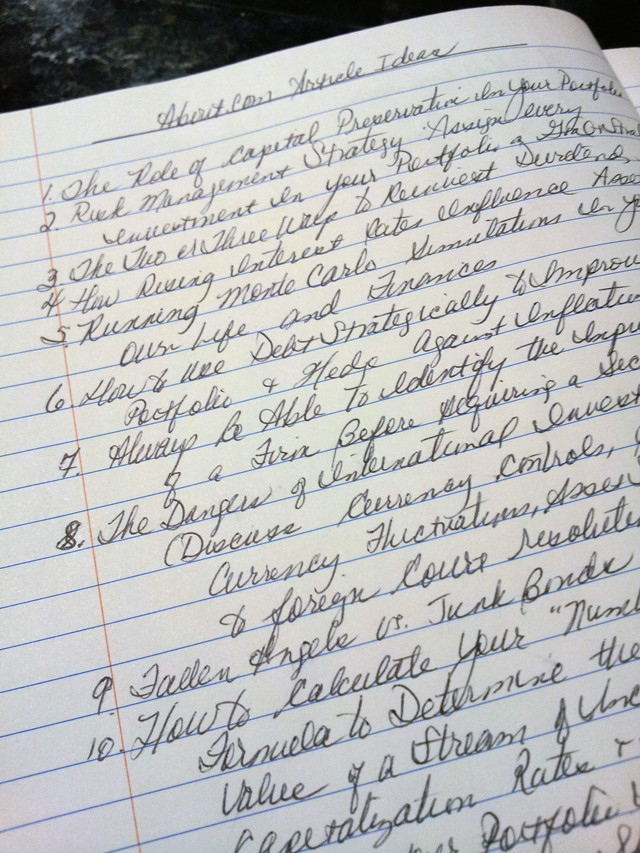
I write in cursive even when I scribble out a quick list without any concern for the handwriting quality or formatting. Like all things in life, when you learn to do it correctly, it’s faster and more efficient. I owe an enormous debt to my elementary school teachers who made it a priority.
With that established – that writing longhand is superior in many respects – the question then turns to whether cursive is superior to print.
Yes. It is.
That’s not a qualitative consideration, it’s a quantitative fact. There are a reason some things evolve. Writing in cursive is a skill that, if learned properly, can result in radically faster transposition from what is in your mind to what is on the paper or screen, just as studying key location on a keyboard is faster than the hunt-and-peck method. (The fastest form of handwriting is actually a combination of print and cursive that elementary school students naturally adapt on their own.) It requires less stopping and starting, is more fluid, and helps avoid muscle cramps. It did not suddenly come out of nowhere – it was developed in the same way humans discovered agriculture, music, animal husbandry, or fractional reserve banking.
In almost all cases, when someone complains about cursive, they do so because they struggled with it in school as a child and there is a mere association effect that is clouding their thinking. Yet, whether they realize it or not, it is a useful skill. If you still have problems with writing in cursive because your muscle coordination is lacking, use the alternative hold, which alleviates a lot of the problems for someone who can’t use the standard grip. Otherwise, switch to a different typestyle. Not everyone has to write in that 1970’s abomination known as D’Nealian. Personally, I use a mix of Spencerian cursive (the font used in Coca-Cola and Ford’s logos) and Macedonian cursive as I was a weird kid who adapted each of my letters based on which one I liked best (and sometimes can’t make up my mind – hence the multiple variations on capital letters based on my mood). Some folks don’t write well in one particular typestyle, which is likely the problem if you are having a bad go at it.
With cursive now being an optional inclusion in the common core curriculum, and private schools seeming to insist on its inclusion in the lesson plan at greater rates (something for which I haven’t found hard numbers but seems to be the case based on a quick, anecdotal survey), I fear this is one more area in which the advantages to my socioeconomic class are going to become evident in second and third order ways that no one anticipated a generation from now. That is true even if the neural studies and MRI scans turn out to be wrong (I doubt it) and it only serves as a subconscious form of signaling theory that will introduce more employment and social barriers. Even now, if I were in a room and someone said, “I can’t read cursive”, my first thought – that subconscious, momentary flash where the brain’s sub-networks are firing before your higher mind kicks into gear – would not be kind. It’s going to come with all sorts of baggage and expectations about the quality of their education. I’m going to presume, rightly or wrongly, that they probably aren’t the brightest crayon in the box because, more often than not, that was the experience someone in my position had growing up throughout childhood. Again, it’s mere association. That’s one powerful mental model.
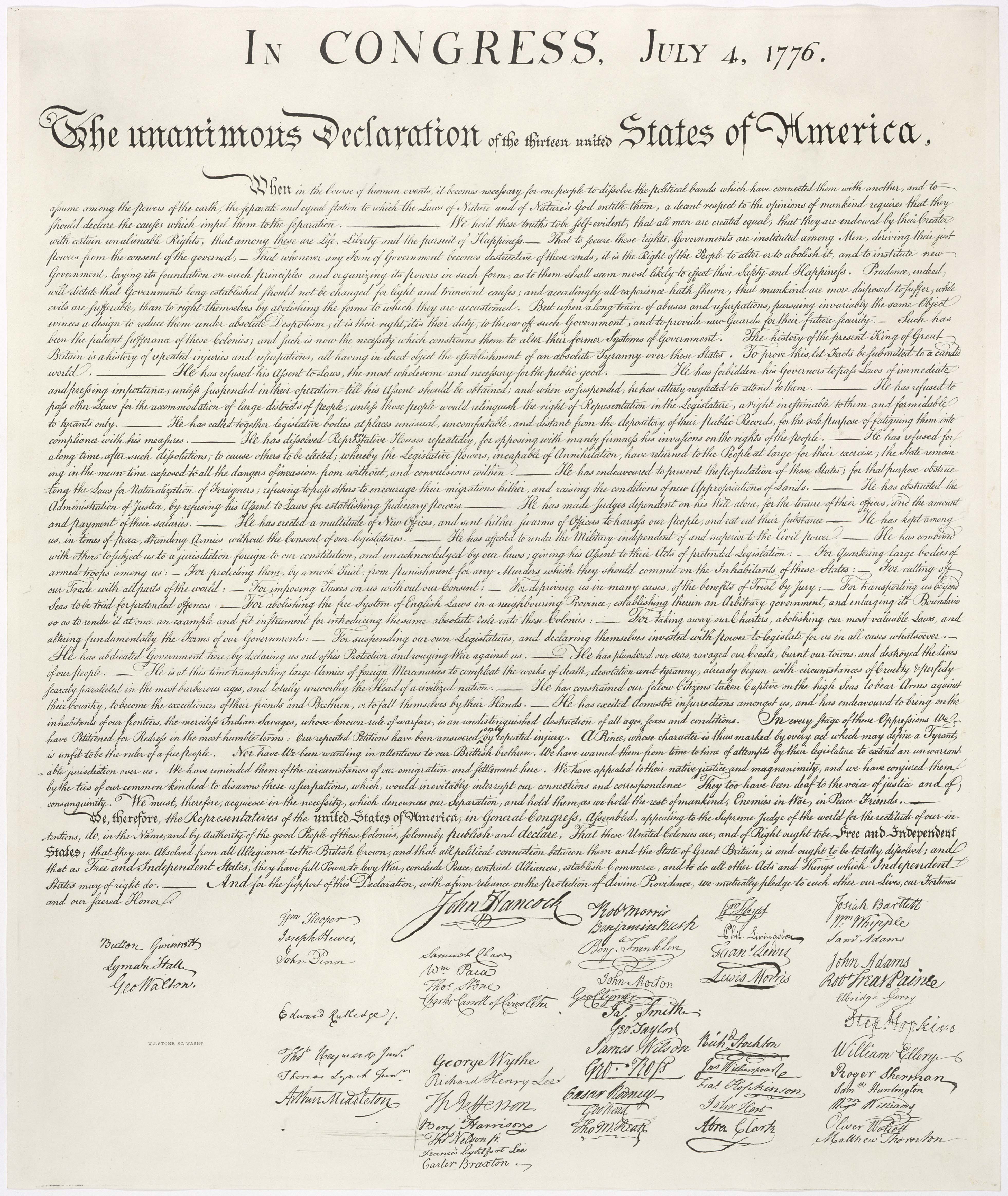
The most important historical documents in most languages are written in cursive. If you are a native English speaker, and can’t read this, there is a serious issue in the quality of your primary education. Even if no one else knows about it, fix it. Do it for yourself. It’s not a waste of time. This should be no harder to read than print.
If you haven’t written anything out by hand in a day or two, I would highly encourage you to change your work process to include longhand cursive. Years ago, I looked at the evidence and concluded it was superior for memory retention and cognitive processes so I adopted it. I could never go back. I can’t think of a single day since I was a teenager in which I haven’t done a considerable amount of thinking and writing. God only knows what is in the bookshelves full of journals I own – startup ideas, investment valuations, floor plans, theories on the dynamics of power, dividend calculations. I’ll order them all burnt upon my death.
(As an interesting side-note: Even the color of ink you use has an influence on your behavior – teachers that opt for a red ink pen tend to grade much more harshly than they would have if they had read the exact same essays and marked them using another color. I suspect this relationship would hold in non-written evaluations, though I have no proof of that. The topic of color psychology is a fun thing to research.)
Reader Comments (21)
Comments are presented chronologically, with replies indented beneath the comments to which they respond.
Richard
August 27, 2013
Do these studies show how strong the link is from cursive writing to increased intelligence, rather than the other way around? That doesn't make much of a difference if you are evaluating other people based on it but it might affect your choice to focus on it.
I find myself using handwriting for note in any kind of meeting or interaction. It's something about the ease (of certain things) and the feedback that guides you unconsciously. Part of the value might be the need to focus on writing well. Eventually this becomes instinctive so we don't need to think about it but maybe that part of it triggers a focus on other kinds of quality too.
Joshua Kennon
August 27, 2013
Replying to Richard
On cursive, specifically, the results are inconclusive. The definite benefit seems to be in in writing longhand. I advocate for cursive given the efficiency of it over block print, and actually tend to agree with some of the other folks in the field who have studied it that it is so simple these days that it should probably be the only form of writing taught from kindergarten given the speed advantages. If we are going to teach typing, teaching print longhand makes no sense. It's inefficient and redundant.
The best source I've found on that topic is Indiana University neuroscientist Karin Harman James. Her body of work draws a fairly clear line between teaching children to manipulate and write by hand instead of typing and "significant changes in the brain".
The former chief resident in neurology at the UCLA School of Medicine, Judy Willis, is a big advocate for writing as she believes the evidence is that it is responsible for brain changes (she has a nice interview on the topic here.
Richard
August 27, 2013
Replying to Joshua Kennon
Interesting - it still leaves me to wonder whether there are other skills that are equally valuable. Many skills that were once essential are replaced by technology over time. In the past, handwriting would have been a greater sign of practical intelligence because it was a requirement for some forms of communication. Now it's been partially replaced and it's as much a choice as a requirement (this will only be more so in the future). There must be other skills that also serve a similar purpose in developing the ability to think more thoroughly.
Someone
August 27, 2013
A couple of years ago, I took a college class. I was a non-traditional student as a 30-some year old. I learned cursive in grade school, although my skill had degraded a little bit into a mix of cursive and my own style. I thought my handwriting could be better. Nothing prepared me for the handwriting styles of today's college students. Most of them looked like what I would expect from students in first or second grade. Blocky printing and poorly formed printing at that. I was shocked.
For my own day-to-day use, writing is indispensable. Although there are many computer applications that can replace a lot of my note taking, I find that notes that I keep on my computer tend to get lost or forgotten in the filesystem. That's why today I use a binder with dividers and looseleaf paper. This is where I keep my notes for various projects and ideas and goals. I write in this every single day. I find that I am not able to keep track of this volume of information, or even able to think things through properly without writing on paper.
Ian Francis
August 27, 2013
I'd be curious to see the relation of writing long-hand to college degree. I remember my days in high-school and before (unless I am having a serious mental block, US English doesn't have a word encompassing grades K-12, I believe in UK English it is primary school), and used cursive often at the time. Getting a degree in engineering basically untaught much of my writing lessons. I don't think there was anything specific to writing in print rather than cursive, but I think the type of information we were writing down, mostly numbers, figures, and equations, led most everyone to drop cursive because it is not conducive to math. I do, however, remember specific classes that taught us aspiring students how to write like an engineer, without emotion or excessive descriptors, and as succinct as possible. It works well in the STEM fields, but is pretty much the opposite of everything I was taught growing up. I still remember my cursive and could certainly read it, but my writing would be quite slow if I took it up again. I just hope I don't develop dementia because of it.
-Ian Francis
Austin from TX
August 27, 2013
Replying to Ian Francis
Fellow engineer (undergrad) with the same cursive to block experience. I tried cursive today and it was horrendous, but entertaining. I'll try it for 21 days and see if I can make it a habit. Is it wrong that I like that some others can't read it?
joe pierson
August 27, 2013
I am an engineer that deals with equations so I use whiteboards a lot, there is no option to use a computer keyboard. Hard to believe natural selection wired us for cursive, it's use is much too recent in our evolution. Probably because cursive punishes mistakes forces you to think it though, much like the old ribbon based typewriters.
Joshua Kennon
August 27, 2013
Replying to joe pierson
Natural selection wired us for physically manipulating and mimicking figures as symbols (the benefits are for writing longhand, not cursive, specifically; cursive is just a more efficient way of doing it in most cases). There are some fairly complex cave drawings in Europe going back 40,000 years, and the average familial age between reproduction for humans throughout history has been in the high twenties, so it's been at least 1,400 or 1,500 generations. This evolved into text (how long it took is an open question; no one knows for sure whether the Tărtăria tablets really are the oldest known example of script).
The complexity is young, so I don't think cursive, proper, had anything to do with it, but the idea of physically representing an object, either through diagrams or letters, isn't, especially if it lead to greater reproductive opportunities as it is a superior tool. We saw how rapid adaptation can happen (200 years or less) in a genome thanks to the now famous evolutionary trajectory of the Peppered Moth in England during the Industrial Revolution, so I don't think 40+ millennia is unreasonable. There seems to be some sort of important neurological process that involves being able to picture an item, contemplate its physical form and spacial dimensions, then attempt to reproduce it that triggers multiple internal systems. My guess - and that's all it is - is that identifying and smacking a button is far less demanding.
When it comes to the improvement in writing quality (sans the spacial recognition, etc.) I think you could very well be right that the reason cursive or longhand, in general, results in better thinking outcomes is because one has to stop and contemplate what is going on the page before writing. That simple reflection could make all the difference in the world. It's definitely worth consideration and it would seem to make sense!
James Crooks
August 27, 2013
Like many others, I learned to write cursive in grade school. I remember it being one of the first times I really struggled in school, as my fine motor skills were rather weak compared to my classmates. Eventually, though, it became fairly ingrained and I wrote essentially everything in cursive script for a couple of years, and then finally adopted the mixed script that I use today. That said, I probably use more separation than most people who write mixed script; I was a mathematics student in college, which required clear symbol separation. On the other hand, my symbols and letters tend to have a fair number of flourishes. I was also taught formal block printing (for an architectural drafting course) in high school. That was far worse than cursive; it was both unnatural feeling and put a lot of strain on my hand.
What I find interesting though, anecdotally speaking, is that writing longhand seems to make it easier to not just remember, but think through ideas. I write scientific software as part of my work, and I often find myself writing lists and diagrams by hand so I can get a clearer picture of what I'm doing. I'm sure this is fairly common, but I've even taken to writing trickier code snippets by hand first, as for some reason, it's easier for me to reason through the logic and compare it against the mathematics it's derived from when writing with a pen or pencil. It's a curious thing; I wonder if there's some priming effect from writing longhand, perhaps in locally sensitising the neurons near those activated by writing longhand. Seems likely that would trigger the spatial reasoning module, and this perhaps bleeds over into logical reasoning. An un-informed hypothesis, as it were.
On the other side, there's an interesting question in why doesn't typing cause this? What makes them different? The fact that there's less specific action associated with each symbol? (Hitting any given key is pretty similar to hitting any other given key, unlike penning symbols, so perhaps that's difference.)
Joshua Kennon
August 27, 2013
Replying to James Crooks
Your process sounds almost identical to mine when I am analyzing a business or mapping out a strategy for something. I have a huge whiteboard that I will go and stand in front of, as well as a pile of notebooks, and I'll have to draw it out by hand to "get" it. Suddenly, the logic of it makes much more sense.
My suspicion is your hypothesis on typing (hitting any given key is pretty similar to hitting any other given key) is probably correct. I can't prove it, but it would seem to fit with the evidence that the benefit of longhand (not cursive, specifically, but just the act of writing) seems to have to do with the brain making those spacial connections to manipulate the figures.
James Crooks
August 27, 2013
Replying to Joshua Kennon
My whiteboard has only recently re-aquired a place to live; I find it helps immensely, but in a different way. I've found the whiteboard is generally more useful for 'large-scale' thinking. Sketching ideas, structuring plans or projects, and so on. On the other hand, my notebooks tend to be filled with details: calculations, bits of code, and so on. I'm curious, do you find a similar dicotomy in how you use your different tools? I wonder if there's something, perhaps to do with standing as opposed to sitting, or merely the size of space, that affects how one works with their tools, or if it's just something idiosyncratic.
As for typing, if it's true that the important difference is between associating specific movements with specifics symbols (as with writing), then it might suggest we draw on some level of procedural memory when trying to access factual information. As if we stored the abstract knowledge of what we write down in both our brain and muscles (metaphorically, of course, it would really just be two sections of the brain.) That would seem to fit with the studies you've linked to.
Patrick
August 27, 2013
I do an exercise from a book called The Artist's Way by Julia Cameron. It involves writing "Morning Pages" every morning, which is 3 long hand pages on paper. I've tried to do it with typing and the difference in what I got and how I felt was night and day, writing them out by hand in my experience is clearly superior in terms of my getting the benefit from the exercise. For those who are curious here's a link with some more info (note: not affiliated in any way other than having bought and enjoyed Julia's book): http://juliacameronlive.com/basic-tools/morning-pages/
peterpatch79
August 27, 2013
I can also add some anecdotal fuel to the cursive fire.
When I was studying for my professional accounting designation I had a really hard time getting great grades in the business case component. I took a highly lauded prep course to bring my grade up. The course involved two 8 hours days of furious , almost non-stop, note taking. The Prof made all of us take notes by hand in cursive and even brought a big pile of foolscap and pens for people who needed them. She cited a lot of the same source material that Joshua referred to. I went from being the equivalent of a C case writer to an A case writer after taking the class. I could also write cases much more quickly which ended up saving me loads of study time. I can still remember many of the most important concepts from that class, however I also remember straining to write the notes fast enough, my hand muscles were not used to it.
Matt
August 27, 2013
Given the differences between cursive and print, I wonder what are the efficiency differences between an alphabetic printing system like English vs a logographic system like Chinese. Logographic systems are probably more difficult to learn given that there are thousands of characters and not as much recombination that can occur in a language such as English. This created a very sharp distinction between the literate scholarly class in China compared to the rest of the population. There was this distinction in Europe during the dark ages, but literacy drastically improved during the industrial area, whereas China had a literacy rate of around 20% around the end of World War II. Now of course this can be influenced by other factors such as industrialization rates, wealth, and other socio-economic and institutional factors (literacy in China is now close to on par with Western Countries), but I'm curious as to how the discussion on brain structures would apply to this difference in writing systems. The curious thing is that although China now has a phonetic system (pinyin), traditional logographic systems are still the staple of writing in China.
TLV
August 27, 2013
Based on this, do you worry if your project to switch your library to digital/e-books will affect your retention of things you read, since your margin notes, etc. will be typed instead of long-hand?
Joshua Kennon
August 27, 2013
Replying to TLV
Yes. Significantly. I think the next couple of years will avoid it becoming a problem, though, as handwriting technology on tablets and touch screens is becoming very precise. I think we're probably only a few years away from me having a 20"+ tablet-like device that I can write on just like paper. Until then, if I have to take handwritten notes in a separate binder, I may continue to do that.
Jackie
March 11, 2025
Replying to Joshua Kennon
Are you still using regular pen and paper? I’ve just started using an iPad and Apple Pencil and its incredible.
Scratch
September 11, 2013
Until the coming of the typewriter at the end of the 19th century, handwriting was part of a good education. After the typewriter, we began to see handwriting as unnecessary. We felt that machine writing was superior, as it was used for "business." I'm surprised it lasted as long as it has.
With a handwritten letter, the writer makes a personal connection with the reader. It shows respect in a way the typewritten page can never do. The machine depersonalizes the human experience. Our high regard for the machine is misplaced.
The demise of longhand is an early result of our journey toward illiteracy.
Jimmy
September 12, 2013
I'm not sure what to think of the rest of the article, since I might have just been a slow cursive writer, but in my honest opinion, I think that the "This should be no harder to read than print" declaration is plain wrong. Even zoomed in, if analyzing each word letter by letter, it's fairly difficult to confirm what a letter says, especially if it is a long one (h, l, f, etc.). Unless "purpose" was spelled as "hurpose" in the olden days of yore, I, for one, think that the Declaration of Independence was written more for display than comprehension.
(I also read line 6's "happiness" as "Slappinefs," and couldn't quite figure out what it said without googling. Even now I doubt that said word isn't Slappinefs.)
(As for myself, I used to write in cursive until a teacher complained that it was really hard to read and encouraged me to write in print. Nowadays, I use a scrawling print that might as well be my own brand of cursive, and, to more or less everyone including myself, it looks much more legible. As a teacher's assistant at a middle school internship, practically everyone's handwriting was legible except for this one kid that used blue pen and wrote in skinnily-fat cursive (That phrasing would make sense if you saw his handwriting), so there seems to be some sort of discrepancy between what this article advertises in terms of legibility in theory and in real life.)
Dheeraj
July 31, 2024
typo: brain industry should be brain injury
Joshua Kennon
July 31, 2024
Replying to Dheeraj
Thanks for spotting that! I just fixed it.