

The odds are good you won’t read this entire post. The reason? It has to do with confirmation bias. If you think what I am going to say conflicts with your belief system – whether you are a scientist or a Christian – you won’t finish it to avoid cognitive dissonance even though you aren’t entirely sure what I will say.
Ruby and I have been discussing Glenn Beck’s week of “Islam is going to result in the rise of the Anti-Christ” television shows that have been all over the news lately. (I’m really not making that up – if you live outside of the United States, seriously … find the clips online if they are available. This is one of the highest rated television shows in the world.)
That’s not really the point. It occurred to me that the entire discussion provides the perfect example to illustrate one manifestation of the psychological concept of cognitive dissonance and how the human brain responds to conflicting input or belief systems, especially when the choices are purely binary (that is, mutually exclusive).
Jesus and Captain Kirk Cannot Co-Exist
Consider the following statement:
Someone who believes in Christian eschatology (that is, the world will come under the influence of the Anti-Christ and the false prophet who will introduce a single global economic system, persecute Christians and declare himself God before Jesus Christ returns at the battle of Armageddon where all mankind has joined to fight before he doles out some WWE-style smack down) cannot, by definition, also believe that humanity will ever achieve space travel and colonization.
Christian eschatology is based upon the absolutely non-negotiable position that all mankind will be judged and humanity as we know it ended upon the Second Coming of Jesus Christ (or “The Second Coming” as it is often used in American culture; e.g., “He thinks he’s the Second Coming”).
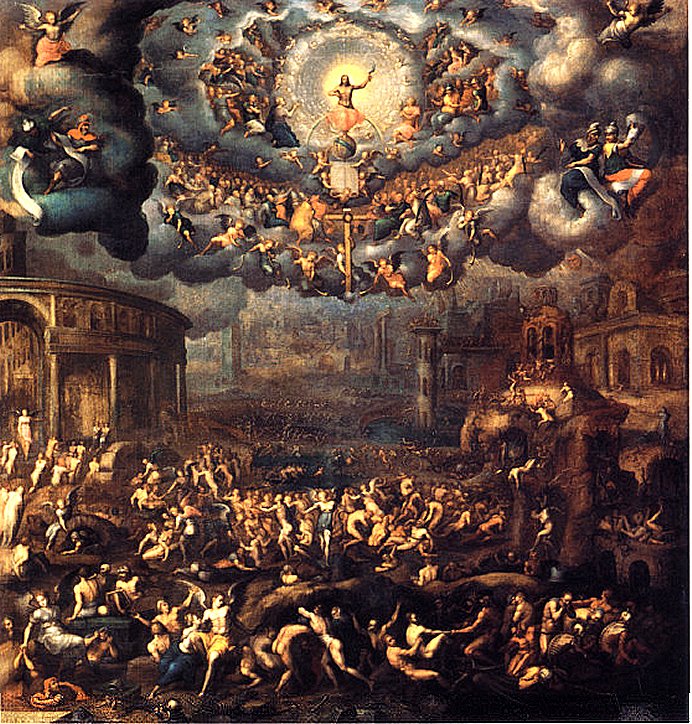
You can either believe in the modern day interpretation of Christian eschatology or you can believe in Star Trek. They are mutually exclusive.
However, if even a small portion of mankind no longer lives on planet Earth or has established a colony on Mars, the Moon, or in some sort of Space Station city that people like Richard Branson and Jeff Bezos would like to see happen, then “all of mankind” cannot be here, on Earth, cannot be under the government of the Anti-Christ, cannot be forced to take the “Mark of the Beast” and cannot unite in a war against the return of Jesus Christ.
This would indicate that if mankind ever did achieve space travel in any meaningful way, the Book of Revelation, as modern Christians believe it will happen, cannot come to pass and that it was a lie. Hence the mutually exclusive part. Only one can be true or happen but not both.
Cognitive Dissonance – How Humans Handle Conflicting Belief Systems
Cognitive dissonance occurs when the brain holds two conflicting beliefs that cannot both be true. The brain tries to deal with this information in one of several ways:
- Denial: I’d be willing to bet that a decent percentage of people who say they believe in the Biblical account of the end-of-the-world would say they also believe mankind will some day achieve Star Trek-like technology at the rate we are going provided you did not ask the questions together in a relatively short period of time so they didn’t make the mental link between the two scenarios. By remaining in denial about the mutual exclusivity of the possibilities, the person can go cheerfully through life without confronting any hard decisions or experiencing emotional turmoil related to the quandry.
- Hostility: The brain experiences hostility and causes the person who suffers the cognitive dissonance to get angry and, in some cases violent, with the person who points out the cognitive dissonance. You see this a lot with fundamental terrorist groups that kill anyone who is an “infidel” or an “enemy of Islam”. In cults you hear people say, “They are blind to the truth of the prophet”. In racists groups hear people say, “They are a race traitor”, etc. The list is endless but the underlying emotional response is the same.
- Modification of Beliefs: In this resolution mechanism, the original belief system is modified. People used to believe that Nero was the Anti-Christ. When Christ didn’t return, they went through other world leaders, including Napoleon. Each time, they have abandoned their previous beliefs and modified the interpretation of the book of Revelations to fit the world in which they lived.
A Few More Biases You May Encounter
Now here is the really interesting part.
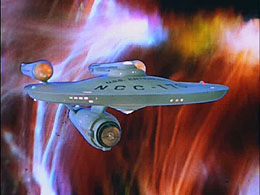
If mankind ever makes it to space in a meaningful way, the Christian end-times cannot happen since the outcomes are binary.
Throughout this entire post, I haven’t given a single word as to my personal belief or opinion on anything we’ve discussed. You have no idea whether or not I believe in Christian eschatology (well, unless you are a family member or friend).
The point is that I’ve simply illustrated a concept. I chose Christianity because it is a fairly important part of the American culture that everyone, even atheists, know enough about to follow the illustration.
But if you suffer from first conclusion bias, confirmation bias, and several of the other mental models, your mental response would have been one of the two following things based upon your own belief system:
- “Of course he says that! He is a fiscally conservative right-wing Christian who believes in a book of fairy tales” or
- “Of course he says that! He is a socially liberal rationalist who believes life should be viewed through the lens of science and calculated analysis of data.”
If you found yourself thinking either of those things at any point during this article, your mind was automatically attempting to protect your own first conclusion bias to avoid cognitive dissonance even though I never said a word about my own personal beliefs. You would have inferred them entirely based upon your own world view and projected your own biases and prejudices onto me. This explains the lunacy of the far-right and far-left media if you’ve ever wondered how two people can listen to the same commentator and one scream “liberal bias!” as the other screams, “conservative bias!”. It is the same concept at work.
Seriously – go back and re-read this post. You won’t find my personal opinion on the topics involved anywhere. It’s all in your head based upon your own beliefs.
Pretty cool, huh? Who would have thought Captain Kirk and Jesus would have so much in common.
But you know the absolute coolest part?
If you actually read the first sentence of this post, it drastically increased the probability you reached this point due to an ingrained psychological need to prove that “you are different” and I “don’t know how you’ll respond”. And I knew that when I wrote it. But teaching you how that works – because it is another mental model that I’m not going to give you the name of, yet – was worth it so forgive the trick 😉
Reader Comments (26)
Comments are presented chronologically, with replies indented beneath the comments to which they respond.
crabhooves
February 28, 2011
Hah. Halfway through I thought "hmm I bet he said that so that people would react defiantly to prove they are the exception".
I think your argument rests on a faulty premise though, it's not a firm, absolute binary. It's more like an ambiguous word that can be twisted if need be. Christians are notorious at modifying and cherry picking their belief systems to suit themselves (though as you would fairly point out, this is a human trait, it's just more egregious when they claim theirs to be the infallible divinely inspired truth).
It's not a difficult stretch at all to claim that the "earth' is a metaphor for any lands humans dwell on. There's not even one authoritative version of Christian eschatology, it's mixed even among denominations.
Joshua Kennon
February 28, 2011
Replying to crabhooves
The actual text in the book of Revelation refers to the Valley of Armageddon in the Middle East. The belief is that is where the final climactic battle will take place - it's a physical location like Detroit or Tokyo. To stretch that would take some mental acrobatics that would surprise even me ( wait ... nope. no it wouldn't). It's nearly 3:15 in the morning here and I don't want to go get the verse of the shelf to reference it (you're smart, you'll be able to find it in a few seconds), but it doesn't talk about Christ returning to earth, he returns to THAT SPOT and steps down on the Mount of Olives and kicks the anti-Christ's a**. (okay, that is the short version).
If someone believes in the literal Bible, it is binary. The Mount of Olives in Israel is a physical location. Also, you have to realize there are some crazy folks here in the United States when it comes to *literal* translation of the scriptures. To illustrate: A few states away, there are groups of people that take certain passages of the Bible so literally they spent tens of millions of dollars to build a "Creation Museum" that shows mankind is only 6,000 years old and has exhibits of humans riding on Dinosaurs as pets even though they lived hundreds of millions of years apart. That is my target audience. They teach their children that if you accept dinosaurs were here hundreds of millions a years ago, it means the Bible is a lie and you are damned. They react with such hostility to even the notion that mankind might be older, even when we have ruins under the Ocean of cities that date back to 14,000 B.C. that have been found in the past 10 or 20 years. They think it is all an evil plot meant to tempt mankind into doubt.
See it for yourself. It is a sight to behold: http://creationmuseum.org/
Joshua Kennon
February 28, 2011
Replying to crabhooves
Oh, and I forgot: They believe Adam was white, too. Even though we are a global minority, don't come from the Middle East, and we know from genetics all humans started out with the pigmentation skin color of modern day Africans (that is, black as night). See for yourself: http://www.flickr.com/photos/singingwitness/4648255796/
difff23
April 3, 2016
Replying to Joshua Kennon
Could you please upload another link? This photo was removed.
crabhooves
February 28, 2011
I'll be honest, I'm loath to read the bible and go through it's mess (if I had written it, it'd be a hell of a lot more concise and clear than it is, plus it's late here as well and my day isn't anywhere close to finished) so I will take your word for it (not that I doubt you). But simply because it says that Jesus will fight the final battle on the Mount of Olives in Jerusalem doesn't mean that there can't be battles elsewhere on other planets.
For instance in Star Wars, the final battle of the Clone Wars was fought on.....that planet (ugh I'm making such a compelling argument), but the scope of the war engulfed the entire galaxy. There's no reason any eschatological war couldn't be the same, the final blow struck on earth, but battles everywhere humans exist.
What would really put a dent in it is if the Earth was to be destroyed (which is an assurance, the universe will outlive our beautiful little blue marble by many orders of magnitude) before any of this was to take place.
I wish I could say what you said about American Christians was news to me and it wasn't prevalent enough that a foreigner (albeit one with a keen and inquisitive eye) would know all about it. To my eternal shame, the man that founded the Creation Museum comes from my country, Australia. Good riddance I suppose? Although i really wouldn't wish him on any country.
On another note, since you're such a bibliophile, would you be able to recommend a good foundational book to learn about Economics? Preferably one without a pervasive, expressed bias, I know you're a fiscal conservative, but I trust in your judgement and integrity enough to believe that you will recommend me the most helpful book with the least bias that you are aware of.
Joshua Kennon
February 28, 2011
Replying to crabhooves
Really? Even if one doesn't believe a single word in it, I would think the Bible would be interesting reading solely from the perspective that it is one of the few documents, or rather collection of documents, that has survived as a window into past civilization. But, it is true what you say: I'm a bibliophile and I also follow the rule that I try to never discuss anything with a strong opinion unless I've read it myself and formed my own opinion. That includes the controversial health care law in the United States, major religious books, essays, studies, etc.
I've always enjoyed reading the Bible, with the Book of Proverbs probably being among my favorite texts anywhere (although there are a lot of entreaties in it against visiting prostitutes so I'm guessing that was a problem at the time Solomon penned most of it ...) I try to live most of my life by the Bible, though I fundamentally reject some of Paul's teachings (e.g., the idea that it is okay to own slaves and that they should willingly submit to their masters - I think the ownership of one human being by another is demonic).
One area I do find particularly interesting is that the entire idea of accepting interest on money loaned to anyone except foreigners and a few other special cases is wholly and completely unBiblical. Our entire western banking system is against scripture - people who take interest on their money are, for the most part, repeatedly called wicked and ungodly. But you'll never hear that taught in a Church anywhere. Interestingly enough, the entirety of the Bible repeatedly and constantly calls wealth a sign of God's blessing so I do find it ... quirky, shall we say ... that God apparently considers dividends okay from successful businesses but not renting money out to others. That perplexes me, or rather the thought process behind it perplexes me. If Coca-Cola wants to pay you 8% in exchange for you lending money so it can build a factory and earn a higher return, I don't see the problem when two willing counterparties are involved. Nor do I think my grandmother, the one who owned the sporting goods store, is going to hell because she used to buy certificates of deposit. But that is another case of us just blithely ignoring the parts we don't like.
Personally, I've never understood how so many people consider themselves a Christian without having read the entire document. If a man or woman is really staking your soul upon the divinity of Christ, which is the entire theological underpinning of the gospel, it seems important to read the book cover-to-cover. I haven't met many people who have, though, so when something comes up and I start talking about something that isn't served at "Church Lite" in nicely packaged formats, they just look at me like I'm crazy.
I think the biggest problem I have is with the publishers and translators of Bibles, who purposely edit out differences in the text. For example, there is a reason some Churches omit the book of John from the gospels. It is completely inconsistent with the other books in the original translation because John is considered a first-hand account, whereas the other three books are thought to be written much later by people who weren't there to witness the events. If it is filled with so many errors that don't match Matthew, Mark and Luke, that would indicate that it the latter three couldn't be divinely inspired because, it stands to reason, God wouldn't make factual errors, right? That should at least be discussed. Instead, some of the major Bible publishers remove the offending passages without telling anyone and hope no one notices. But mention that to all but someone who went to seminary and they freak out. Most pastors know this - well, the good ones do anyway - but they don't want you to mention it in front of those who are "weak in the faith".
For example: Take when Jesus was brought to Pilate. Matthew 27:11-14 says that Christ remained absolutely silent and didn't respond to a single charge. Yet, in the same account of the same event, John 18:33-37 says that Christ responded to all of the charges and answered Pilate.
Now, one of those has to be factually inaccurate. They cannot both be true. But the average Christian is so lazy they will not read the book, at least enough to have an intelligent conversation about it. I would very much like to have an answer to the contradictions that occur in several of the gospels.
Likewise, the final last words of Jesus are different in each of the four gospels. In Matthew & Mark, they are, "My God, my God, why hast thou forsaken me?" with differences in "God" (Eli vs. Eloi), Luke says his final words were, "Father, into thy hands I commit my spirit" and John says his final words were, "It is finished". Now, final words are the last thing you say. Only one of those can be correct.
On the issue of conciseness, to be perfectly fair, the Bible contains between 66 and 81 books depending upon which version you read (the 66 book version is the one used by modern-day non-denominational and protestant Christians after Martin Luther took out a pen and started scratching out books during the reformation - but, again, that is the short version since it was a bit more complicated than that, with the latter figure being in the Ethiopian Orthodox Church).
As this rundown of the Books of the Bible shows, different denominations of Christianity have entirely different Bibles, some with some books, others with other books.
Plus, those books were written over a span of thousands of years and multiple languages. We only call it "The Bible" because the Catholic church packaged the important scriptural books together in one easy-to-carry format. Before that, each book was kept by itself on scrolls. There was no "Bible" proper as we know it until a couple of centuries until after the time of Christ.
As for economics, there are two main books with which to start. First, "Basic Economics" by Thomas Sowell. Sowell writes extensively as a far-right wing commentator on a variety of social issues but as an economic thinker, that book does a better job of explaining the fundamentals of how the world functions as it is (not as we think it should) than almost anything I've ever read. It is clear, concise, and accurate. I've recommended it to members of my own family who wanted to learn about economics.
Another popular choice: Greg Mankiw at Harvard is considered to be one of the best economics writers in the world but over the past 5 years, his opposition to a few major pieces of left-wing legislation have resulted in some parts of the fringe writing him off as partisan (which you should be aware of since you are concerned about bias). For example, Paul Krugman accuses Mankiw as using right-wing "talking points" against health care because Mankiw says it is "schlocky" to use life expectancy relative to percentage of GDP spent on health insurance as a measure of productivity because Americans eat so unhealthy and are so incredibly fat that it skews the data. Krugman says you can't just say something like that with a waive of the hand but, on this point, I think Mankiw is correct. Not factoring in how the world *is* - not how we *want it to be* - is an enormous mistake. Americans are fat. Strike that. Americans are obese. To think this doesn't factor into our inflated health care system and result in a significant part of the cost structure is naive and disingenuous.
He has several economics textbooks, each of which are geared to a different course level (so you'd want to start with freshman-entry obviously since that is going to carry about 90% of the water in understanding how the world functions). That book would be "The Principles of Macroeconomics" which has like 8 or 9 editions. The most recent one just came out this month.
If you want a shorter version, every time "The Principles of Macroeconomics" is released, they also release a companion book called "Brief Principles of Macroeconomics" which is a more concise version of the book aimed at high school honor students with the same concepts and ideas. Depending on your needs, either would work. The downside is, they are expensive. Really expensive for a book.
paxnorth
March 1, 2011
Replying to Joshua Kennon
A point worth keeping in mind (as Joshua Needleman points out in Money and the Meaning of Life), is that prior to Capital markets, which allowed money to be loaned as a risk, with the possibility of reward, money was generally borrowed as the result of some catastrophe which had befallen someone (a crop failure for instance).
Thus, the charging of interest in biblical time would have most often implied earning a profit, from instances of another's misfortune, and in circumstances where they may have been entirely at the mercy of the lenders, and this may be why the biblical injunction against charging interest (at least, to member's of one's own tribe )arose.
Joshua Kennon
March 1, 2011
Replying to paxnorth
That is an absolutely wonderful, fantastic point, paxnorth. You are completely correct! Capital markets as we know them weren't functioning then so our paradigm isn't appropriate to understand it.
Thanks for commenting! That made my day.
Joshua Kennon
March 3, 2011
Replying to paxnorth
Oh, and thanks for the book mention. I'm adding it to my reading list.
crabhooves
March 2, 2011
Replying to Joshua Kennon
Ah Joshua. How I love your epic replies. I can get very verbose (although I'll try not to this time) and I can do so here without feeling guilty that I'm making peoples eyes glaze over, well at least If I am, you are as well!
I should clarify that I was loath to read the bible at the time I had written it, although I do have a distaste for it in general. When I was a christian I agonized over what the bible said about homosexuality and it....upset me to say the least to know that the text I had always been taught was the voice of god demanded people (like my adolescent gay self) to be stoned to death for being gay.
Re. Paul, I would hope that you reject his writings for other reasons as well, he was quite the misogynist on top of his other flaws. I suppose his one redeeming aspect would be that he declared circumcision unnecessary (I believe it was Paul, I don't know for sure) and thus saving generations of foreskins! (although that divine protection seems to have fizzled out in America..).
Didn't Jesus say that it was easier for a donkey to pass through the eye of a needle than for a rich man to enter heaven? That always stuck out to me. I think usury was illegal for a lot of medieval European history, but there were ways around it. I vaguely remember reading about a set of three contracts when used together would produce interest. If you know anything about that, or medieval finance/investing in general, I would -love- to see a blog post about it. I believe Sharia Law still forbids interest, but Islamic Banking finds ways to emulate interest anyway.
Thanks for the recommendations, I'll pick up both of them the first chance I get. I'm going to TAFE (that's sort of like a vocational college and community college combined, it's an Australian thing) to get my year 12 certificate that I missed out on when I was in school, so I'm looking to get a head start on the subjects.
Joshua Kennon
March 3, 2011
Replying to crabhooves
That makes sense. If you grew up as Christian and then had to deal with the fact you are gay, then a normal response would be rejection. That isn't always the case but it is certainly common. (It is human nature not to want to be around people that treat you like crap - most fairly tales are built upon escaping such situations, from Cinderella to Oliver Twist).
Over the past 20 years, several family acquaintances of ours left their wives and children after coming out of the closet. Many of the people involved are still waiting for the men - I'm not sure if they knew each other or not - to "come back" because these people - the men's families - as well meaning as they are, actually think it is a duty for them to suffer through marriage and live with someone to whom they aren't attracted and / or be celibate. It strikes me as an almost insufferable cruelty; moral superiority is always easy when you don't struggle with a particular desire. It's easy for the divorced-and-remarried to white wash their sin and criticize the gay teen or the drunkard to scream fire and brimstone at the gambler.
The verse about money involved a camel, not a donkey. (Christ rode a donkey into Jerusalem on Palm Sunday in part because centuries before, the Jewish prophet Zechariah had written, "Behold, your king comes to you, triumphant and victorious. He is humble and riding on an ass, on a colt the foal of an ass." You can find it in our modern Bible in Zechariah 9:9. To the priests at the time, it would have been an all-out declaration, "I am the messiah" and a blasphemy in their eyes worthy of death.)
I always took the verse to which you allude to be a warning that wealth has a tendency to possess people where they become ruled by their property rather than them ruling over their property. I believe it is connected to the lesson taught in Luke 12:16-21 where Christ tells the parable of the rich man who becomes so convinced of his own perfection and confidence that he plans on building barns to hold all of his wealth when, unbeknownst to him, God requires his soul that night and he can't take it with him into the afterlife.
Personally, to paraphrase a very famous quote, "I love the Church so much that I consider it my absolute prerogative to criticize her for her failings more than any other institution". Much of what I talk about comes down to one thesis: A significant portion of the church is so "heavenly minded they are no earthly good". My criticisms of the Church are borne from love and frustration at an almost willful stupidity. I think a scientist figuring out how to cure HIV so a 6-year-old child in Africa doesn't have to suffer through one of the most horrific deaths imaginable without any medication is doing more good for Christ than 1,000 church members meeting on Sunday morning talking about the evils of Obama or whether or not we are living in the end times. That is one of the reasons my foundation - which I rarely, rarely talk about - focuses on results-oriented giving.
LacunaMatata
April 4, 2012
Replying to crabhooves
Trust me crabhooves, on this site you're not alone. Sounds like just about everyone on here wants a penis up their pooper
crabhooves
February 28, 2011
*just to clarify. When I said bias, I didn't mean bias as a shorthand for opinions I don't agree with. I meant it in the proper definition of bias, a presupposed set of beliefs through which all data is interpreted through. Everyone has a bias of course, but some people are better at controlling theirs than others.
Joshua Kennon
February 28, 2011
Replying to crabhooves
Ah, then by that definition you should have no problem with Sowell's work in this regard (again, if you ever read some of his other books, you might have the urge to throw the text across the room due to a handful of his social positions; that said, it cannot be denied without being intellectually dishonest that he is one of the most brilliant thinkers in his field). Here is a link to the most recent version of his book.
Elisabeth
February 28, 2011
Great post! Maybe we should put together a study of the correlation (ha - there I am assuming there is one) between education level and religious tolerance.
I'll never forget a very basic lit course in undergrad in which another student pouted through the Epic of Gilgamesh; she took it very personally when we compared it to similar parts of the Bible - and learned it was written first (although who knows how long it was verbally shared).
Joshua Kennon
February 28, 2011
Replying to Elisabeth
That would be an interesting study!
I'd bet money that the average Christian has no idea that the Epic of Gilgamesh has a flood story almost identical to Noah.
I'd also bet money that most people don't realize that the Old Testament laws were largely recycled from the Code of Hammurabi and the Code of Ur-Nammu, King of Ur in 2050 B.C. That is interesting because Abram, or Abraham as we call him now, was born in the land of Ur within a century or two of those laws being established and would have grown up under them. It is clear when he left his homeland he took the laws with him.
DeyC3
February 18, 2012
To be honest, the part I am having dissonance with is why you are still a Christian. Like crabhooves, I agonized over a lot of things for many years. In recent years it has become clear to me that my greatest regret is that I took so long to painstakingly remove myself from Christianity. Christianity is a great deal of foolishness parading as ancient wisdom. You have pointed out a number of reasons why we know that the Bible is very clearly not "the perfect word of God." You are aware of the lack of foresight that the ancient doctrines had (a real god would have known that interest would one day be important). Without Spirit and Truth, what is there left to worship in? As far as we can see from the Gospels, Jesus Christ was wrong about a lot of things. What makes you okay with that?
As an aside--while prosperity was a sign of saintliness in the OT, Jesus, and his brother James, pretty well tore that to pieces.
The Book of Ecclesiastes was always my favorite. I am now 100% convinced that the last verse or two were added later--they completely conflict with the spirit of the rest of the work.
Daurade
February 26, 2012
Replying to DeyC3
In a sufficiently advanced and widespread intergalactic civilization, the "world" would take on a different meaning perhaps. I'm not sure the two scenarios you present are mutually exclusive. Thought-provoking post, though.
Daurade
February 26, 2012
Replying to Daurade
Oops, I meant to repond to the original post....
Guest
April 4, 2012
You forgot the class of people who don't give two shits whether Kirk and space travel can co-exist at all. These people don't have hostility, modification, or denial. We just give a shrug and say who cares.
Guest
April 4, 2012
*Kirk and space travel can co-exist with Jesus
John C.
June 1, 2013
I don't know how different Protestant denominations view the Final Judgement, but the Catholic Church (as well as Orthodox churches) don't actually believe the Anti-Christ to necessarily be one person who's going to come and lead us all away from God. And in fact, the Catechism of the Catholic Church officially teaches that the Book of Revelation is not meant to be taken literally as something that will happen in the future. On the contrary, the CCC teaches that is was all written in response to things that had already happened to the early Christian Church. Otherwise, a fantastic post, Joshua! Thank you for sharing.
Jonathan Neufeld
November 9, 2016
Well when the bible was written none of its authors actually believed there were other planets besides this one, which I think dramatically undermines the assertion of a simplistic dichotomy between secular humanism and Christian eschatology.
Jonathan Neufeld
November 16, 2017
Replying to Jonathan Neufeld
Just reviewing some of my old comments and this one piqued my interest. I would reply to myself with "they STILL don't!" as many of us can attest to the resurgence of Flat Earthism, which also denies the existence of stars, planets, and even gravity itself. It's a rather poignant flavor of solipsist epistemological nihilism with a musky aroma (that musky aroma comes from the non sequitur of evil NASA scientists spreading lies).
Cody A. Ray
May 31, 2017
Wait, so what was the name of the "surprise" mental model at the end?
Donna Bayley Lovett
September 19, 2017
Reverse psychology works (usually) every time, unless you're smart enough to know that someone is using reverse psychology on you. 🙂