

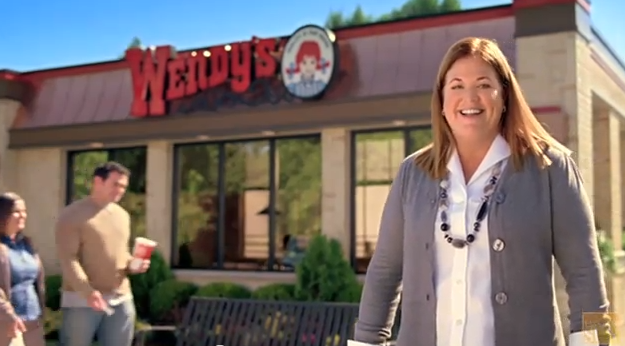
Wendy’s recent commercial introducing the remade cheeseburger named after founder Dave Thomas is one of the best examples of marketing and psychology I’ve ever seen. It’s brilliant; mental models applied in a constructive way.
I’m not going to take the fun out of it, but be on the lookout for some of the clues as to which mental models are at work: By invoking the imprimatur of the founder through his daughter and namesake – yes, the real Wendy of Wendy’s – it immediately lends credence to the company’s departure from the past. The whole “My father named the restaurant after me, now it’s my turn to honor him by renaming our cheeseburger Dave’s Hot ‘n Juicy” while showing a clip of Dave using those words triggers reciprocity, the parental-child bond, nostalgia, and so much more. It’s just brilliant. Absolutely brilliant. Have fun and study this.
This is what mental models can do for you. Watch the commercial. They were created by The Kaplan Thaler Group. I think they earned their fee.
Some Notes on Dave Thomas and Wendy’s
[mainbodyad]In my “hall of paragons” that I developed years ago, where I profiled, studied, and learnt everything I could about certain people, including the lessons I wanted to take from them and the things I wanted to avoid from their lives, Dave Thomas was among my favorites. A high school drop-out (who subsequently got his GED after building his empire), Thomas worked for the legendary Colonel Sanders of Kentucky Fried Chicken (KFC) fame, despite disliking chicken. He went on to open his first Wendy’s restaurant and over the remainder of his career, built a multi-billion dollar company and a personal fortune worth more than $100+ million at the time of his death.
I remember getting word of his death on January 8th, 2002, nearly ten years ago. It was around this time I read his autobiography, Dave’s Way, which I enjoyed. I was visiting my parents on winter break. My mom saw the news on the Internet and told me that he had passed away. I went to a nearby Wendy’s and had a late lunch to honor him, but the person in the drive-through window didn’t even know who Dave Thomas was. (Let that be a lesson to those of you who mistakenly believe that building something and growing rich will make mankind appreciate you. You do work because it is right and good, even if no one recognizes it. This same drive-through employee had a job because of the work of Dave Thomas, yet didn’t even know it.)
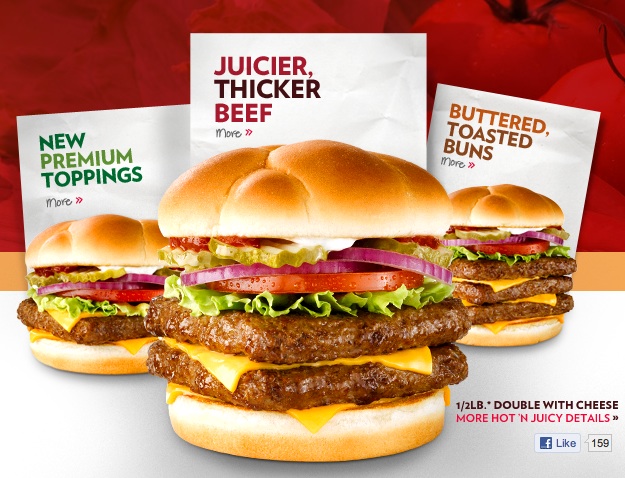 I’m encouraged by the change, though I haven’t yet had one of the new Dave’s Hot ‘n Juicy cheeseburgers (I plan on trying them later today). It’s meant to help combat the difficult sales and profit conditions Wendy’s has faced, especially relative to McDonald’s, over the past few years. Following the introduction of sea salt fries, the Wendy’s classic cheeseburger is getting thrown out the window and replaced with Dave’s Hot ‘n Juicy Cheeseburgers.
My only criticism is that if you click on the picture of the new burger on the company’s website, it doesn’t take you to a page that explains the product or what makes it different / better than the old version. Instead, it takes you to a page talking about Dave Thomas. Seriously? Someone really dropped the ball on that one.
Wendy Thomas and Her Siblings Own Wendy’s Restaurants
One of the things I like about the Wendy’s story is that Dave’s daughter, Melinda Lou “Wendy” Morse (again, the namesake of the restaurant and the woman in the above video) and her siblings bought Wendy’s restaurants in and around Columbus, Ohio.
Reportedly, the Thomas children (now in their 50’s and 60’s) own more than 30 of the restaurants, meaning they still have a big part of their economic wagon hitched to the business their father built. But here’s the funny thing. A few years ago, when I was visiting friends in Columbus and then they took me to the Wendy’s headquarters building, I remember being completely in awe of how much better run, cleaner, and more efficient the Wendy’s restaurants in the area were. When I found out who owned many of the establishments that impressed me so much, it made perfect sense. The Thomas family just runs hamburger joints better than other people. All of their franchisees should have that kind of passion.
[mainbodyad]
Reader Comments (5)
Comments are presented chronologically, with replies indented beneath the comments to which they respond.
FratMan
September 19, 2011
Here's a fun Munger mental model fact about Dave Thomas. He created the triple cheeseburger not because he wanted to sell it, but to increase the sales of the double cheeseburger. And he priced it goofy, like--- cheeseburger ($0.99), double cheeseburger ($1.49), triple cheeseburger ($2.49), so therefore, he could make a lot more money selling doubles instead of singles. Of course, the triple was the most profitable, but he wasn't concerned about their fledgling sales. He knew that comparatively, the double cheeseburger would be the most attractive option, because it seemed cost-efficient, and customers could buy it guilt-free without feeling like a piece of lard because the triple cheeseburger existed out there. No one in Wendy's marketing embraced the idea at first, but Dave saw it through, and it worked out well.
Gilvus
September 19, 2011
Replying to FratMan
Contrast principle. I'm reading Influence by Rob Caldini right now, but instead of a mental model he calls it a "weapon of influence."
I like the idea of amassing an arsenal of mental models...
Aunt Donna
September 22, 2011
I just wish they would bring back the original Taco Salad!!! 😉
UpstateFriends
December 21, 2011
The mental model will only get a person in the door, if the food isn't good, the journey ends. Wendy's should have left open the option of still being able to get the old classic burger, instead of completely abandoning it. The sales pitch of this--if you don't like our new burger, we don't care about your business.
Joshua Kennon
December 22, 2011
Replying to UpstateFriends
"The mental model will only get a person in the door, if the food isn't good, the journey ends." - True. Very true. But, ultimately, I think from a business standpoint they made the right decision because sometimes widespread adoption requires the removal of the original, now alternate, choice. Canada's switch to $1 coins from bills proves this. The United States did the same thing, but left the $1 bills as an alternative, and the coins were never adopted, costing taxpayers millions of dollars in wasted printing costs each year. Had Wendy's left the original cheeseburger, it would have virtually guaranteed the failure of the rebranded line.
Many food companies get around this impasse by secretly, and slowly, modifying the recipe, removing or adding ingredients, and hoping no one notices. My favorite cereal 10 years ago was Honey Bunches of Oats but in order to keep costs down, they slightly modified the recipe instead of raising prices. I'm not a fan, now. In fact, I prefer a lot of things over it. They ruined it. Many people won't notice.