

Visiting Aunt Donna, Mexican Coke, Race Cars, and Putting Together a Retirement Plan
Our afternoon was spent in Independence, Missouri taking advantage of the secret rebate Costco is giving its members on imported Mexican Coca-Cola. At Amazon, a 24 pack of 12 ounce Mexican Coke is $44.95. Costco normally sells them for $19.92 if you have a club membership. Today, they offered an instant cash discount so you could get a pack for only $15.00 in a special deal (which, for some reason, they wouldn’t even confirm over the phone. We had to go to the store and see it for ourselves). They even had regular packs of 36 cans for an attractive price. We loaded up everything we could fit in the car to take advantage of the savings, which means the house has a supply that should last us several months.
Personally, we don’t drink much cola these days as we try to cut out sugar – maybe a single serving a few times a week in between long dry spells – but friends and family are crazy about the stuff so we try to keep it on hand. My nectar of choice is coffee; my husband, tea. I imagine I’ll be dipping into one a day as I continue my obsessive case study of the sugar water empire (there are still three or four more books to get through plus a handful of the tertiary 10K filings for related businesses). I like the serving sizes of the Mexican Coke much better because they are only 12 ounces, or 150 calories, compared to the 20 ounce, 240 calorie bottles that are now standard in convenience stores due to Coca-Cola’s obsession with selling more concentrate to the bottlers.
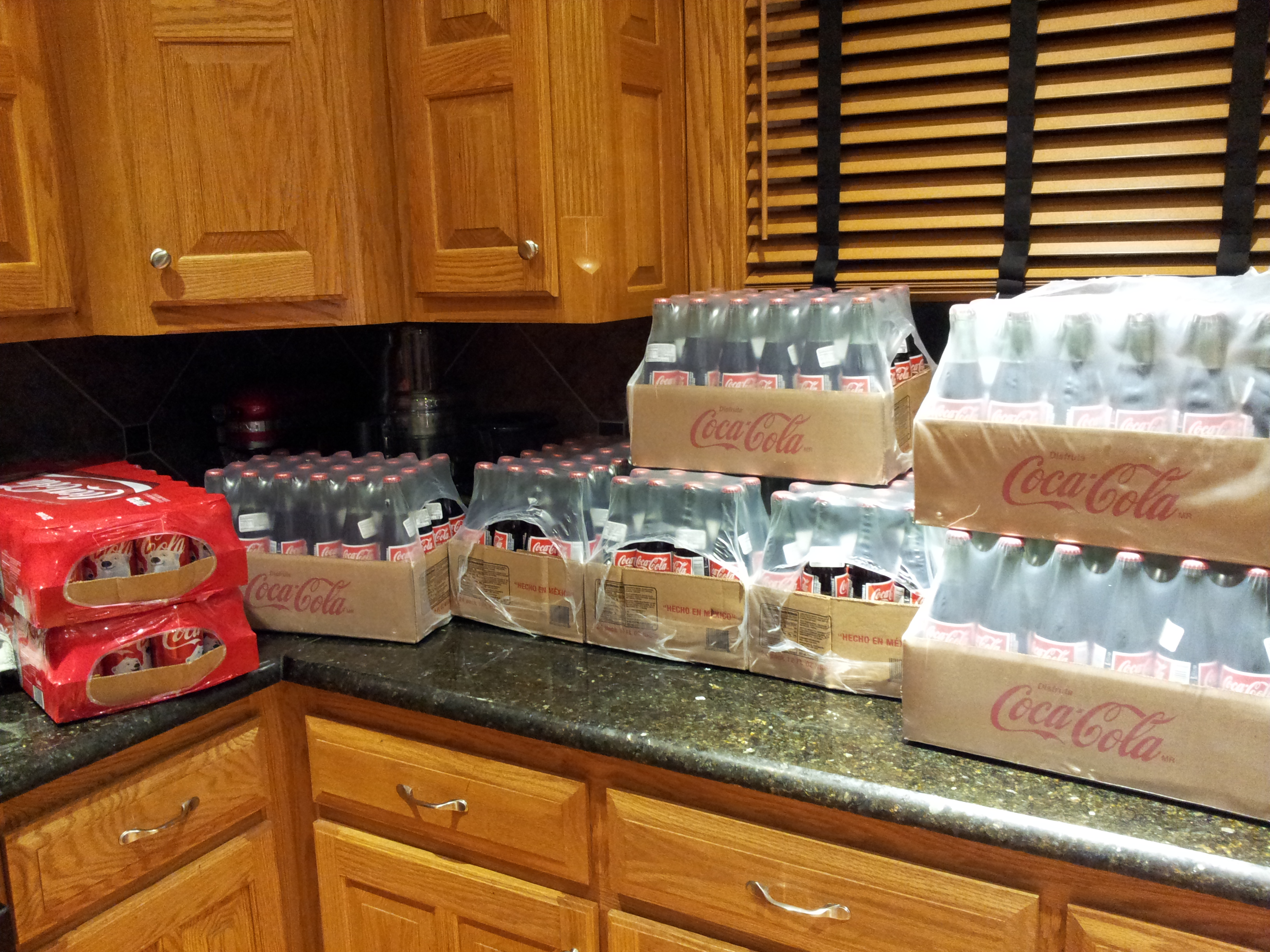
Our kitchen cabinets are currently over-run with Mexican Coca-Cola. We’ll get to it tomorrow … Click to Enlarge
Afterwards, we went and visited Aunt Donna, who is the reason this blog exists before I sort of strayed and began writing about other topics. We got her signed up for Netflix, met her new dog, and hung out for a couple of hours.
After arriving back home, I spent hours putting together a retirement package for a family member who is reconfiguring everything. It has a handful of challenges based on the relevant parameters such as an absolute restriction on any technology or restaurant stocks (and, possibly, tobacco shares, though that hasn’t been settled), an existing very-large concentrated position in a single corporation that cannot be sold, and some other limitations that make hitting my desired composition a bit tough. They want to remain fully vested in equities for the remainder of their lifetime, and, if possible, buy-and-hold the stocks selected so that they can take the dividends as a paycheck a couple of decades from now.
I should go to bed – it’s already 3:07 a.m. – but I was hoping to respond to some of the questions people had left me in earlier comment threads, or more contact form submissions. I’m thinking that might have to wait until tomorrow. I’m not ignoring those of you who wrote me, I just haven’t had time to give you a response you deserve. For now, I might read or go curl up under the covers.

We need to finish our Christmas shopping this week. Costco had these freaking sweet Shelby Cobra race cars for kids that I thought would be awesome for one of our nephews, but we already setup the custodial trust for him, and I’m sure we’ll pick up a few more gifts, so it would be ridiculous to keep showering presents on people so young or they might end up spoiled. It needed to come from someone else in the family. I tried to get in touch with my parents to see if they wanted me to pick it up for them to use as one of their gifts but everyone was busy so I couldn’t get anyone on the phone. I might have to go back and get it. If I had a couple of twin boys at the moment, I would have bought four or five of them and setup a race track a la the Disneyland Autobahn Autopia so they could race their cousins. Though knowing my obsession for miniatures (I will someday visit Minimundus!), I’m sure this would have turned into some enormous project with working traffic lights and simulated explosions so it’s probably best as my schedule can’t take that with everything on the agenda.
I … could still draw up blueprints, though, right? It’s not 4 a.m., yet, so I can stay up just a little bit longer … this is all I’m going to think about …
Reader Comments (9)
Comments are presented chronologically, with replies indented beneath the comments to which they respond.
emmanuel
December 16, 2013
how much sleep, on average, do you need?
mikecrosby
December 16, 2013
I just read another blog post about envy. Then I start reading your blog post and see the picture of all that sweet, lovely, wonderful coke;)
Anon
December 16, 2013
I believe Whole Foods 365 cola is healthier than Coca-Cola.
weixiluo
December 16, 2013
Joshua, from your tasting skills to your vastly more extensive knowledge of Coca-Cola, is there any difference between Canadian coke and Mexican coke, knowing that both are make with sugar cane instead of corn syrup like in the US?
Joshua Kennon
December 18, 2013
Replying to weixiluo
I don't think I've ever had a Canadian Coke in my entire life. This needs to get added to my "to do" list.
calegp
December 17, 2013
Have you see this?
http://en.wikipedia.org/wiki/Miniatur_Wunderland
The whole city actually works.
http://upload.wikimedia.org/wikipedia/commons/a/ab/Knuffingen_Airport%2C_Miniatur_Wunderland_Hamburg%2C_1.jpg
Night is amazing.
http://i.telegraph.co.uk/multimedia/archive/01887/night-cars_1887172i.jpg
poor.ass.millionaire
December 18, 2013
I understand that your basic investment strategy is to buy and hold lasting companies when you can get them at good PE ratios. So let's say someone has a portfolio of your favorites that they brought 10 years ago.
1- how safe and stable is it for them to simply hold on to them (have they appreciated so much that there is little risk of losing initial principal? How long does it take to secure the principal with they type of stocks you like?)
2- what would be the typical blended dividends, if they wanted to live off it? I'm wondering how large of a stock portfolio one would need to generate a nice income.
Reason I ask is that these types of objectives are similar to my real estate investments. I'm looking at buying a new building, but am getting priced out of most SF neighborhoods. Since I buy and hold, I'm considering an up and coming area. It has some problems with crime. But it is also going through a lot of changes like a new light rail that whisks people to downtown in 20 minutes, a huge and major new development over the next 10 years and a large shopping area. Since this neighborhood is on the edge of the city, all these things will make it more connected to central SF but also give it gravitas to be a destination for shopping, etc. Plus all new tenants moving in are professional in nature, so I don't mind waiting out the longer term trends, which will add the appreciation value that I am seeking. It may take 10 years to see a large equity pop beyond what SF will experience anyways, but as long as it's cash flowing its a good long term bet.
Joshua Kennon
December 18, 2013
Replying to poor.ass.millionaire
I try to keep it simple as not to scare people away, but I won't be able to do that and answer your question sufficiently. My actual investment strategy is to acquire the greatest net-present-value cash flows I can, on an after-tax, net-of-inflation basis, adjusted for risk, while attempting to manage correlation risk so that no single threat, or confluence of threats, could result in permanent capital impairment sufficient to harm my standard of living. That means I am open to acquiring, creating, or expanding any asset of which I feel I have a good understanding, with the highest assets on the list being based on the opportunity cost of everything else around me at the moment.
This site tends to gravitate towards discussion of common stocks because that's what most people understand, and what most people are dealing with in their 401(k), IRAs, or other assets. There is nothing inherently special about them that would cause me to like them over asset classes, except they tend to meet that brilliant test Ben Graham laid out almost a century ago - "At what price, and on what terms?". If I could find first secured mortgage bonds backed by real estate, factories, or railroad lines, with 25% yields in the midst of a Great Depression, I'd be buying them rather than stocks. If I could get my hands on the 50 Shades of Gray copyright at a stupidly low price, I'd be buying it. So, again, it's just that in most situations, at most times there have been very intelligent things to do when it comes to the equity market. I would never want 100% of my net worth in it; it is but one piece of the overall wealth pie.
With that said, when it comes to equities, both my career and a lifetime of academic research indicates exactly what you mention as to strategy: Nothing beats finding high quality businesses, at attractive prices, and then hanging on to them with a death-grip. The way our tax structure is setup here in the U.S., you get all sorts of advantages, such as the deferred tax asset that begins to accrue in your favor and the lower taxation of dividends (which is worth its own discussion given the fact the United States is one of the only places on Earth that double taxes corporate earnings, explaining, in part, why so many managers ship subsidiaries overseas). Even if the nominal returns are much higher, you end up with far less wealth through active trading due to fees, commissions, and taxes, especially if you are holding less than 12 months, which means you have to pay ordinary income taxes on your gains.
With all of that out of the way, I can now answer your questions more directly.
1. Asking this is like asking, "How safe is it to hold real estate?". It is impossible to answer, as posed. To put it in real estate terms, you would respond: Which property? What location? How much gain to you have built into it that would be taken away in taxes were you to sell? Are any developments nearby going to threaten the cash generating power of the asset (e.g., with a stock, even the most lucrative horse and buggy manufacturer was in trouble when Henry Ford began rolling out the Model T) or increase its ability to generate cash (e.g., a new highway going in right next to a plot of land that could serve as a gas station)? Do you have a diversified enough property (stock) portfolio so that a handful of losses can be offset elsewhere by unexpected increases? Furthermore, "What opportunities are available to you to extract value?" is also relevant. I should write about that ... most investors don't think about it, but there are many ways to get your hands on cash or assets without having to sell a holding.
2. It depends on the blended dividend yield of the holdings you select and you can't compare it to real estate because good companies tend to increase the payouts every year at rates much faster than inflation or would be possible in, say, an apartment building.
Higher growth companies with lower payouts are going to expand much faster, but you get less cash. Slower growth companies which can't use the money have higher payouts, but the payouts aren't going to grow very quickly. Looking at the S&P 500 as a whole, over the past 130+ years, the median dividend yield has been 4.37%, with a low of 1.11% set in August of 2000 and a high of 13.84% set in June of 1932. At the moment, it's at 1.90% (part of which is a structural change caused by corporations getting around dividend taxes by using share repurchases, instead. Look at Exxon Mobil - they paid $10.4 billion in dividends last year, but bought back $20.6 billion of their own stock. It's a tax arbitrage.)
Wal-Mart is a good example. Back in the 1960's, 1970's, 1980's, and 1990's, it was a rapidly expanding retailer with what appeared to be a relatively low cash dividend yield. Yet, the dividends were rising so rapidly that if you bought a block of stock, it only took 5-6 years before your actual annual income was bigger than if you had bought the fatter dividend shares of other firms originally.
If a person wanted to earn $50,000 a year, and were sticking all of his or her money in companies like AT&T or Royal Dutch Shell, it's only going to take $800,000 to $1,000,000. If they are sticking their money in shares of things like Disney, it's going to take nearly $4,200,000 because of the low dividend yield (but that dividend has been growing insanely fast - back in 2003, you were collecting $0.21 per share, today you are collecting $0.86 per share; a 4x increase in 10 years is one heck of a deal).
The closest parallel to real estate would be a special type of securities known as an MLP (master limited partnership). It can be a tax nightmare if you don't know what you are doing, and you should almost never buy them in retirement accounts, but they are essentially businesses structured as partnerships rather than corporations, which distribute almost all of their earnings in cash and use depreciation charges to reduce the amount of tax the investor has to pay. For example, it would only take $714,285 or so in LP units of Energy Transfer Partners to generate a $50,000 cash income.
One time-honored strategy for long-term equity investors is to build up large positions over time through tax-shelters, and then, when in retirement, sell off the stocks to swap into 10-year high-grade corporate bonds. Over the past 30 years, these securities (which often hold first, secured mortgages on the assets of huge companies like Coca-Cola or General Electric) have tended to yield around 7.2%. Right now, they're half of that because of the Federal Reserve, but they'll revert to the mean at some point. In that case, the financial planner would sell off the common stocks, buy the bonds, then extract the bond interest (which was interest-free because it was held in the shelter) regularly, which the investor would treat like a paycheck. Thus, the moment the investor needed to convert his or her stocks into a given income, they could. The stocks grew faster than other asset classes, then were swapped for the higher yielding asset class when it came time to collect checks.
Joshua Kennon
December 18, 2013
I came across that several years ago and it's also on my to-be-visited list! I don't why I love stuff like this so much, but the architecture, scale, and engineering makes me really happy.