

We Have Been Quietly Buying Real Estate in the New Albany, Ohio Area To Serve as Our Personal and Business Headquarters
Following a nationwide search that took more than a year, involved several dozen variables (ranging from tax rates to climate projections over the coming decades), and included two site visits, Aaron and I have been quietly purchasing real estate in and around New Albany, Ohio.
The city, ranked as the number one suburb in America by Business Insider, beat out the other two finalists as we looked far and wide for a place to establish a permanent home for both our family and our wealth management firm. (For those who are curious, the runners up were Cornelius, North Carolina, which is outside of Charlotte, the nation’s second most important banking and financial center behind only New York, and Alpharetta, Georgia, which is outside of Atlanta, an economic powerhouse with a broadly diversified economy, although we were equally as open to the Buckhead area.) I shared with you that this was coming in a recent post – the fact we had identified another area, though I only let clients of our firm know where it was in a privately published letter since I didn’t want to publicly announce it, yet – so it probably isn’t a huge shock.
If you haven’t heard of New Albany, Ohio, you will; most likely, sooner rather than later. The city is one of the wealthiest in the world. It boasts a household median income of $224,824 versus $149,471 in Newport Beach. More astonishing, not only are taxes in Ohio a fraction of what they are in California so those far higher median incomes go further, but the median home price is New Albany is only $634,600 versus $2,000,000 in Newport Beach, while providing far nicer, higher quality construction, better materials, and significantly more space, both internally and in terms of land. For example, in the New Albany Country Club areas, houses tend to run from $850,000 to $3,000,000 or so but what you get for that money is order of magnitudes higher than in Southern California. This means attracting and retaining talent for Kennon-Green & Co. will be notably easier as we can better help our staff accelerate their own capital accumulation. As employers, that matters to us.
New Albany itself consists of around 11,000 folks, mostly families, living in roughly 3,300 households often headed by well-educated professionals including executives at publicly traded companies, physicians, attorneys, business owners, real estate developers, and investors, while being part of a multi-million person metropolitan area that is within 500 miles or so of 50% of the population of the U.S. and Canada. (That last point is particularly important. I can have breakfast with my family and, by lunch, be in New York, Chicago, Boston, Philadelphia, Washington, D.C., Atlanta, Charlotte, Lexington, Louisville, Indianapolis, Nashville, St. Louis, Kansas City, Omaha, Minneapolis, Dallas, Houston, Orlando, Toronto, or any other number of cities. There is a reason Berkshire Hathaway’s NetJets is headquartered down the road.)
Intel is constructing a fabrication plant in New Albany that will become one of the largest microchip manufacturing facilities on the planet. The initial investment, expected at $20 billion, could rise to $100 billion over the next decade, and will bring thousands upon thousands of highly-paid jobs into the region that further cause a fairly small geographic area to scale in ways that are presently unfathomable. In addition, companies such as Alphabet, Microsoft, Meta Platforms, and a host of other technological giants have been acquiring hundreds of acres to break ground on their own projects, constructing facilities in an area that is expected to sail through climate change fairly unscathed compared to much of North America. Fueled by these mega projects that will transform the area, population projections put the 15-county Central Ohio region at more than 3.15 million residents between now and 2050, making it roughly the same size as Orange County, California in the present. Half of that regional growth is expected to occur in Franklin County, where New Albany is located, providing a generational tailwind that should not be underestimated.
On that same note of generational tailwinds: As I mentioned a moment ago, New Albany is also a climate haven. Do not underestimate the importance of this. Absent a black swan event, of most of the municipalities we considered, Columbus should breeze through the next century or so while the coastal cities flood and the south burns. In the meantime, the present climate is quite comfortable for folks like us who grew up in Missouri. Sure, you have some cold winters but it’s nothing compared to further north. For the gardeners out there, it’s in Growing Zone 6.
The major challenge is that, in New Albany proper, housing is so restricted with so little turnover that pulling up real estate listings is all but useless. It does not in any way, shape, or form show you what the housing stock in the city looks like. To provide a better idea of how beautiful this city is, here is a roughly 35 minute drive Aaron and I took, randomly filming street after street in New Albany, back on July 13th, 2023. (Note, I recommend you click the gear in the YouTube video and change the quality to 4K then view it in full screen for the best experience.).
This land restriction, on the other hand, should serve the community well. New Albany is, without question, one of the best designed cities in the world. For example, the house that Aaron and I bought to serve as our family’s primary residence is part of not one, not two, but three – yes, three – distinct Homeowners Associations, each imposing various covenants and requiring separate dues designed to keep the architectural guidelines of the city intact regardless of growth so folk’s investment is protected. These restrictions are what make the community so desirable. They help tie together a cohesive vision that includes more than 68 miles of walking trails thoughtfully built into the landscape so you can pick a direction, essentially, and make your way through town from almost anywhere.
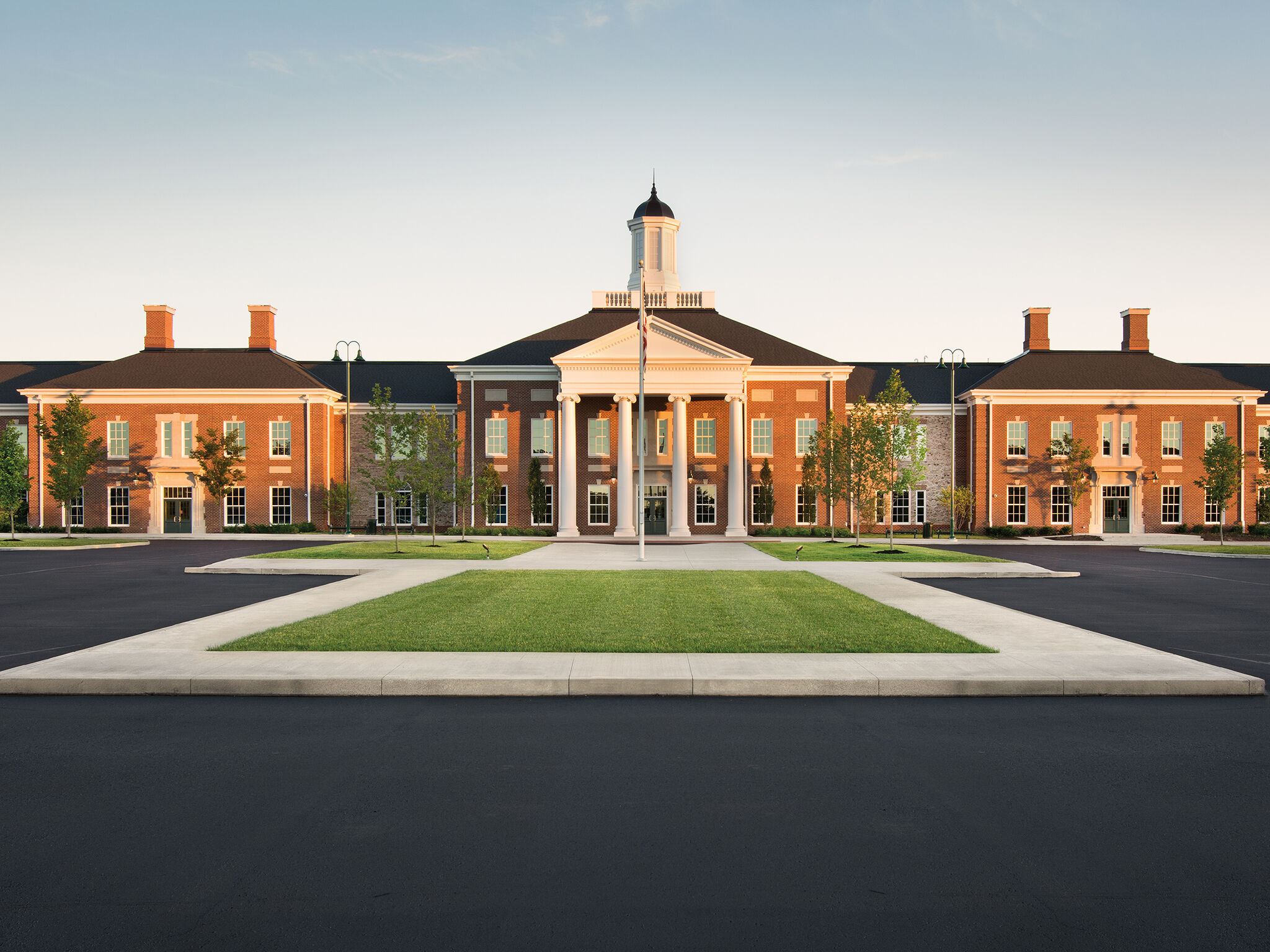
I mean, for heaven’s sake, look at the public high school – a 150,000 square foot building constructed with Buckingham Tudor and Marley Tudor brick, made by General Shale, so it psychologically reads as a classic red schoolhouse in the Georgian architectural style. This is exactly what government should be doing. I’m being entirely serious when I say it makes me excited to start paying taxes here.
Speaking of taxes, I cannot emphasize enough the importance of various state-level reforms in recent years. I remain continually shocked by the degree of over-reliance folks have on search engines and the internet in general. Ohio’s laws have changed so significantly in recent years that essentially every single search result on the front page of Google when you search “Ohio income tax rate” is now wrong or, at least, deeply misleading.
One perfect illustration: The reality is – and I’m oversimplifying a bit here for the sake of brevity – after full phase-in for tax year 2024, the top state-level income tax is going to be 3.50% plus a small local tax depending upon municipality. Business owners, however, can take significant deductions, and, if married, exclude $250,000 in income from state-level taxation entirely, then, any amount above these thresholds can exploit a PTE mechanism tax rate of 3.0% that removes the SALT deduction limit at the Federal level so the true tax above those exceptions for those in the top marginal bracket is really a net 1.89%. Using a combination of a 401(k) profit sharing plan and a pension setup, a married couple, properly structured, could really pay essentially no state-level income tax on the first $600,000 to $800,000 in earnings depending upon their respective ages and how that influences the actuarial inputs to the pension plan contributions limits. The local tax in most of New Albany is 2.0% but excludes investment income including capital gains, dividends, and interest. Taken together, for those who would be subject to a gross receipts tax, like the ones found in Tennessee or New Hampshire, Ohio is far more attractive despite the others being “tax-free”. (It’s not, quite, as good as Texas but it’s pretty darn close for those who have the ability to put together the overall structure intelligently. I consider that excess justifiable given that I’m 41 and Columbus should be a relative paradise compared to Texas as, God willing, I reach my 60s, 70s, and 80s, based upon present-known climate science.)
I’ll post more on the decision to establish our permanent base in New Albany, and share some thoughts on the six years we spent in California, in a future update. There are definitely some trade-offs but the calculations are so extreme, it’s a no-brainer.
Reader Comments (22)
Comments are presented chronologically, with replies indented beneath the comments to which they respond.
James
March 21, 2024
Thank you for writing and keeping us informed. I love what you do. That is all.
Joshua Kennon
March 26, 2024
Replying to James
Thanks for the kind sentiment - I'm glad you enjoy it!
Jessica
March 21, 2024
Selfishly I’m disappointed you didn’t choose Atlanta. Ohio is beautiful though, and you just can’t beat the genuine kindness of Midwesterners. It will be a wonderful place to raise your family!
Jose Sanchez
March 25, 2024
I fled Californian insanity for Florida, my best friend was a Seattle to Ohio refugee. I've respected your rationality and mental models in the past, but observing your previous alarmism to "pull up the drawbridge for a few years" in the face of a certain election that resulted in lower taxes and less war, I wonder if that's caused a rethink. The climate alarmism to the tune of inundated cities and the south on fire seems similarly overwrought. The projections and models have always been wrong, NOAA stations are corrupted by encroaching heat islands and the solar cycle is ignored for some reason.
Voting with your feet makes a significant statement about how you want to live. Six years in SoCal have shown your family what occurs when the lefties get most of what they want- and that's obviously caused a decision to leave. Ohio also locks up criminals to a greater extent than blue areas, doesn't tolerate as much degeneracy outside the cities and of course, lower taxes. As we say to newcomers here, "Welcome to Florida- remember why you left wherever you're from... and don't bring that here!"
Joshua Kennon
March 26, 2024
Replying to Jose Sanchez
I mean this in the best sense but this made me laugh:
Mostly because it reminded me that you truly can never really appreciate the extent to which people bring their own beliefs and experiences into the analysis when communicating over text-based forms since there is no opportunity to hear tone, ask follow-up questions (except in threads like this), etc.
As best I can tell (I could be wrong, if so, I apologize), you are referring to a comment I made in the comment section chain seven years ago on this post, when I mentioned that a series of events in the United States beginning with the Pulse shooting in Orlando (which, up until that time, was the biggest mass casualty event since 9/11 but has quickly been eclipsed by massacres that came after it) through the insanity of the 2016 election, along with other issues in our personal life (that were not discussed or really brought up at all on the blog) had made us decide to pull up the drawbridge and essentially go silent.
Interpreting my statement about the election entirely, or even mostly, is not indicative of reality. There was a lot more happening that I didn't disclose, including in inter-personal relationships in my own family.
But, because it might be interesting, for context, let's revisit where I was seven years ago when the statement was made. I had spent the past few years, at that point, fighting and preparing legal and accounting battles so the government would just get out of my life, recognize my marriage, and stop trying to dictate how I ordered my personal finances. It had gotten truly insane - I couldn't even buy a car without worrying about Aaron or I creating gift tax implications for each other, mostly as a result of the far, far-right wing crowd in rural Missouri being utterly obsessed with our lives. At that point, a Baptist church in Missouri had filed suit against the Missouri Attorney General, if I recall correctly, because he had allowed out of state married couples who filed joint Federal returns do the same in Missouri under the full faith and credit clause of the constitution, which they claimed violated Missouri's constitutional ban on same-sex marriage (in their world the Supremacy Clause presumably didn't exist). They had requested the court force the state to turn over a full list of all married couples who had done so, which would involve the disclosure of my personal finances against my will to a religious group that had nothing to do with me with the sought relief being a forced restatement of our state filings. The case was pre-empted ultimately by a Supreme Court decision that made it moot.
So when this rolled around, and given that I knew who was waiting in the wings for Federal court appointments, I was about ready to go disappear to a cabin somewhere. While I didn't, quite, do that - I ended up working like crazy to build a fiduciary - in those seven years, we did pull up the drawbridge. We retreated to Newport Beach, which was one of the best decisions of our lives. I focused on myself, my husband, our soon-to-be-born kids, and our firm. Together, he and I built a paradise so to speak. We ate at nice restaurants. I had expensive clothes made. I read a lot of amazing books. I gave away a lot of money while still doing better over time. I helped a lot of people solve problems in their own portfolios and businesses. I fell off the grid except for those close to me while enjoying the fruits of what I had built for so many years going back to my days in college and selling letterman jacket awards rather than simply reinvesting everything I earned.
In regards to Trump, specifically, since you allude to him, running to the safety of California was prescient. I was not only right, it's difficult to overstate the benefits, and necessity, of what we did to counteract his administration. As a result of his time in office, we were forced to spend untold money - literally millions of dollars - proactively navigating the various judges he had put on the bench, ranging from Georgia to Texas, so there was nearly no chance that once we had biological kids through gestational surrogacy, the government could come in and take them away or claim we were not the parents. I'd have to review all of the files but I am pretty sure we've had at least 9 or 10 law firms working for us in various capacities for the past few years, each with specific missions and objectives. Lawyers in Washington. Lawyers in California. Estate plans. Trusts. Proactive sealed court orders. It was exhausting but, in the end, we won. (One of the judges that was appointed by a narrow party-line vote to a lifetime on the Federal bench after Trump nominated quite literally - literally! - ran a personal blog where he spent extensive time writing about how how gay men are f*****s and don't deserve constitutional protections. I'm serious. It's how he spent his time rather than, I presume, watching movies or playing golf. I ensured he had zero jurisdictional authority over my holdings or family. In fact, I lost track of how many dossiers I had on Federal judges at that point. It was so absurd by the end. One guy had never even heard a single trial, was considered "non-qualified" by the American Bar Association, and had only become a lawyer three years prior. The level of incompetence and second-order effects is massive. What could possibly go wrong?)
It's one of the reasons the Republican "small government" branding on the right is so crazy to me (and why nearly no one in my generation buys it). California largely left to me to order my own life. It recognized my marriage. It protected my kids. Most of the nutty bills could be navigated against given our wealth - let's be real, no matter how badly the school system did, I'm rich enough I could opt out for private instruction, for example. Taxes remain the exception and even then, they are not absolute given certain binding Supreme Court decisions and/or laws passed by Congress that limit what California can do.
That said, our decision to leave California is multi-faceted. Politics played a role (taxes, definitely) but it was one of many. I described one of those other factors elsewhere in this thread where Newport Beach had become so desirable we couldn't continue expanding if we wanted to hire people and relocate them because even if, say, they were married to another professional with a combined household income of $500,000 they had no hope of ever affording a single family home within a reasonable commute. Altruistically, I don't want to be the only one living on the top of the hill, so to speak. Selfishly, it's in my best interest to help those around me get rich themselves. It was a major hurdle to overcome if I were to stay in Newport Beach. And on the crime front, the city had nothing in common with San Francisco, which was so distant it would be like the time I lived near Kansas City worrying about what was happening in Chicago 400 or 500 miles away. There was no crime so to speak. Irvine next door is the safest city of over 300,000 people in the entirety of the United States.
For example, another factor was I wanted our kids to grow up near their many cousins. We're much closer to family in New Albany than we were in Newport Beach.
And something else worth point out: There is absolutely no chance we would have chosen Ohio had Joe Biden not won the 2020 election since he enacted, over the opposition of most Republicans in Congress on a near party-line vote, the Respect for Marriage Act that provided significantly strengthened protections against instability in the Supreme Court (particularly important in a post-Roe world) as well as the CHIPS Act that is going to see the largest investment in Ohio in generations. The initial $20 billion was hiked to $28 billion a few days ago. It will completely transform the region. Biden, and the conservatives in Ohio who focused on creating a business-friendly environment, both deserve credit. They both absolutely had a hand in us selecting this site, at this time.
And that's an important point. Most great areas where people with high income and significant wealth want to live are purple, not red or blue. Most successful folks really are middle-of-the-road pragmatists. The primaries, in contrast, have caused the parties to begin putting up ever more extreme politicians, further polarizing the nation.
On a final note - I hope this response is even semi-coherent since it's late and I'm not even proofreading it - the statement about "remember why you left and don't vote that way here" always struck me as absurd. I didn't change the way I voted when I moved from Missouri to California since I'm a policy-focused guy looking for the best outcomes with the greatest individual freedoms balanced by overall societal burden. I won't change the way I vote in Ohio versus California, either, since there was no change in the first place. But, presumably, if self-selected people move because of politics, then by definition, they are more probabilistically going to be even more conservative or liberal than the "base" conservative or liberal in the target state. Case in point: You see what happened in Idaho where recent in-bound migration resulted in a significant extreme movement rightward which also left California lurching even more violently to the left. In other words, it seems like a slogan that made sense in 1970s but has no relation to politically reality today. If anything, the inverse is true.
Wait! Climate change. You asked about it. It will be something I'll try to respond to in either a post or elsewhere since I see a few people asking about it. The short version: The phrase I used had an element of literary hyperbole but the sentiment I need to get across is that there is essentially no sane person in the upper parts of society, where people are allocating billions of dollars with enormous financial stakes on the line, who seriously thinks climate change is to be taken lightly. I'm not talking about the feel-good virtue signaling. I'm talking about real money. Real decisions. It would take days for us to discuss the extent of it. It's happening in areas that the average American is clueless about. Take regional banks in the south ... they are making 30 year loans using out of date FEMA maps that their own scientific sources are telling them are likely going to be wiped out and transferring the most at-risk properties to the secondary market, pocketing the initial underwriting fees and servicing but bailing before it becomes a problem. They aren't willing to keep their money on the line so taxpayers ultimately end up on the hook. Berkshire Hathaway, the insurance giant with the highest statutory net worth of any insurance group on the planet, was warning - what? - back in 2005 or 2006 that it was seeing heating Oceanic temperatures that were likely to lead to a massive cost problem and therefore required adjustments to underwriting standards. A lot of Americans are going to remain in total denial until they can't find a buyer for their house or get insurance. Folks just have these odd blinders on about the issue.
It's just wild to me this question is even being asked. I mean ... do you think all of these bank executives just love leaving free money on the table? They are transferring these home mortgages to government-backed entities out of the goodness of their heart to help Uncle Sam? I know a lot of bankers who are wonderful people but that's not in their card deck. It isn't how they operate.
My theory - and I could be wrong here - is that it's going to be like interior design. The very top of society has these trends that aren't really visible to most people but those who live in that world are surrounded by it. Then the next level down picks up on a few of them. Several years later, it's all over social media and cheap knock-off versions are in every corner of the nation. Real-world example: We're a few years into a cycle where folks at the top are having their kitchens done in things like Farrow & Ball Green Smoke and walnut wood (of course these are regional to some extent. You're not going to see quite the same thing in Dallas versus San Francisco.) By the time the typical upper middle class American realizes it, it suddenly explodes everywhere and it's all anyone talks about or sees.
All of this is really just dancing around the central point, though, isn't it? Everything I try to do, what I write about and attempt to help people see because I care about them and want them to have a good life, is that there is an advantage to probabilistic thinking. Your job is to go through your own life figuring out how you want to spend your time, where you want to be, with whom you want to be surrounded, and then arrange things so that you increase the probability of achieving that, to the maximum degree possible, compatible with a trade-off level you find acceptable. That calculation is personal for everyone because everyone has their own tastes, preferences, and competing variable inputs. For example, if you are a young person who got the job opportunity of a lifetime in Miami, does it matter if Miami has a high chance of being underwater in fifty years? Take the job, pile up money, but don't tie your entire financial fortune to the Miami area. That would be foolish. Have a plan on how to get out or build dual roots elsewhere. Likewise, if you woke up tomorrow and found out I bought, say, a penthouse overlooking Houston, none of this is incompatible with what I've written. Rather, viewed through the philosophy of what I'm saying, you should be able to surmise that it isn't economically determinative to me.
Edit: Anyway, again ... I hope that is coherent. It's past 1 a.m. here and I have called it a day so if there is anything useful in that free-form thought up above, I'm glad. If not, I hope it was at least entertaining.
Jose Sanchez
March 28, 2024
Replying to Joshua Kennon
I very much appreciate your detailed response. As a former SF Bay Area cop I am (was now, thank goodness) quite used to violence done by evil people, so Pulse was unfortunately par for the course, albeit higher numbers of victims. Bataclan and Nice were still top of mind then as well- lots of our training became geared to active shooters, vehicle attacks, bombings and riots. The feds spending years ignoring Mateen for... reasons, was also standard operating procedure.
Regardless I thank you for the window into your thoughts and life- I've benefited greatly from your perspective over the years and am always happy to see a new post to explore.
Joshua Kennon
March 26, 2024
Definitely a plus. God forbid we ever need it but if we do, it is also in-network for the Kennon-Green & Co. health insurance plan.
Joshua Kennon
March 26, 2024
Thank you!
The climate change question as regards to Texas, specifically, is a great one. I just wrote a response a moment ago briefly touching on some aspects of climate change overall, but it's really different depending upon where you are going to live, right? Texas is like California in that it is so massive, it's a bit useless for me to talk about "Texas" per se. I should have been more specific.
Some general problems will be difficult to deal with - e.g., read The Heat Will Kill You First. Still, a good deal of the issues throughout most of Texas can be handled with significant improvements to infrastructure and building regulations. For example, a well-designed power grid and higher quality facilities are going to let most people live comfortably indoors - certainly better than in Dubai, for instance, where folks live just fine provided they have money - with the obvious note that many of the things taken for granted today won't be possible. Relatedly, a major concern will be border security as if the situation is utterly untenable closer to the equator, hard decisions are going to have to be made and Texas is on the front lines. It will be far, far worse than what is happening now. Water availability might also be an issue but not so much as some western states. Wildfire will be a bigger concern in some areas to the point it could rethink how people have to live with the surrounding environment.
In terms of specific areas, for example ... that's where things get interesting. Really dig into the details and tell me the odds of how you think The Woodlands, Texas is going to fare over the rest of the century. It's a great area. It hit a lot of our required metrics.
Yet, by the time I am comfortably in general retirement age, it is projected to get ~102 days per year where the temperature outside feels like it is over 100 degrees Fahrenheit versus only ~18 days per year in Columbus. If you have money, why in heaven's name would you want to live under the former conditions if even if the more modest estimates turn out to be correct? Forget the significantly heightened hurricane risk. Who wants to walk outside and feel like they live in a bathroom? I don't care how much a person might like linen suits and iced tea, draw the line. That's too much.
If you're wrong and nothing happens to it, no harm no foul. If you are right, you've overcommitted to a swamp that regularly faces inundation. Why not establish a base in a safer area then, if you want an office elsewhere, lease space to take advantage of it?
But, no, Texas is not facing anything similar to what I think Florida will. It's more of a comfort and quality of life thing for me. (Regarding Florida, there are entire communities going up in en masse that I don't think can adapt or survive the rest of the century. It's going to be a hard sell for folks in Iowa, Nebraska, Michigan, you name it to approve Federal spending for people who keep building next to an area that repeatedly has onslaughts of stronger and more frequent hurricanes.)
And, because I spoke elsewhere in this tread about the importance of probabilistic thinking, here is an example: I think a lot about The Great Frost of 1709. I didn't put a huge amount of weight on the variable, but there is a remote theory that a series of events could cause climate change to result in rapid cooling instead of rapid heating in certain parts of North America resulting in periods like that one. Columbus, in particular, is located in an area that it shouldn't be a huge problem. When we arrived, the windchill was negative sixteen degrees due to a winter storm that took down most of the Midwest. The houses and infrastructure are built for it, including back-up whole house generators. If such an extremely unlikely second-order or third-order complex outcome resulted from systems we barely understand, all things considered, it would be relatively fine compared to Northern Michigan or Canada. The bigger threat would be the food supply unless society went to hydroponics. The technology exists. We're choosing not to use it.
Trey Henninger
March 26, 2024
Joshua, thank you for the detailed response.
I find it so interesting that you specifically called out The Woodlands. The Woodlands is in my top 3 locations where I think I'd setup a long-term base of operations for myself / family. It has many of the appealing features you've outlined for New Albany in terms of wealth concentration, similar access to most of the country in terms of proximity to major airport, close proximity to high density economies of Houston, Austin, and DFW.
Likewise, a place like The Woodlands is actually highly protected from the potential devastation of hurricanes compared to a place much closer to the coast. Being 100 miles inland is often plenty to avoid the worst effects while also being on the inland side of Houston, one of the nations top 5 economic city states.
It sounds like perhaps I have a greater acclimation to high-temperature weather than you and your preference for more cold weather. While ~102 days per year of temperature above 100 degrees Fahrenheit is NOT fun, it's also not devastating for an area like Texas where I would guess the average summer already has 80+ days per year of a heat index above 100 degrees Fahrenheit. The increase will be noticeable, but the area already has nigh-universal A/C.
In contrast, the prospect of living in an area where perhaps ~102 days per year are *below* 40 degrees Fahrenheit, seems horrid. It's my understanding that more humans die from cold than heat. I believe you've outlined that on your own blog at some point in the past.
Of course, being in Texas offers some additional benefits which I'm sure you're aware:
- Unlimited homestead exemptions
- No income taxes (which you cited)
- Access to what in 20-30 years is likely to be the largest economy in the country, but is certainly the fastest growing economy already
Anyway, this is not to convince you of anything in particular. I just found it so fascinating that you'd call out one of the few specific areas which I had also identified that had a LOT of overlap in terms of appeal from what you're looking at in Ohio. I will add that book (The Heat Will Kill You first) to my reading list. I agree that a warmer environment isn't necessarily ideal. Although, I think in terms of a potential family dynasty, it would pay off well to have a home base in one of the strongest worldwide economies and the largest in the United States.
You called out particularly that a strong power grid, and high-quality infrastructure can mitigate a lot of these problems and I think that's exactly what we're going to see happen in Texas over the next decades. Few states in the United States will have the amount of resources available to build new and expensive infrastructure to fight climate change related impacts than Texas. The sheer *SCALE* of building already going on in the state is crazy to consider. That culture of *building* is likely to be very helpful regardless of the future we face.
Additional Note: I know you've played Civilization in the past. If any local economy on Earth can afford to build mega-projects like large-scale seawalls to prevent negative impacts from rising sea levels (protecting the Houston Ship Channel for instance) or widespread desalinization plants to increase drinkable water, it's going to be Texas. They've done it in the past with the Galveston seawall and that was before Texas became an economic powerhouse. Even if one chooses not to live in Texas, I wouldn't bet against its future economic might. Seems like a bad bet.
Joshua Kennon
March 26, 2024
Replying to Trey Henninger
Fantastic comment.
You're probably spot-on about our preference for relative temperature comfort as 102 days of the year sounds nightmarish to me. I mentioned The Woodlands, specifically, because it really does hit so many of the metrics to the point it was in multiple rounds of the semi-finals and I've loved the area whenever we've been down there. The real estate is fantastic - what you can get, dollar for dollar, for a property is really attractive. There is also a lot of great office space in the region. Interestingly enough for the past ... I don't know, maybe 15 years? ... I have one of my favorite home fragrances shipped into wherever I am my from a store in The Woodlands called Maggie's as it's built from many of my favorite scents - amaretto, almond, vanilla, and cinnamon. The house in Missouri, our place in Newport Beach, my office on Newport Center Drive ... it's been a constant wherever we've been. If I had to pick a place in the state, it was in my top few.
(We also looked at Preston Hollow outside of Dallas. It checked a lot of boxes but I think from a purely legal strategy standpoint, there is no chance our attorneys would have even allowed us to consider it, though, after what happened in the Jason Hanna and Joe Riggs case where a judge kept the parents from their own biological kids and forced the gestational carrier (a surrogate with no genetic relation to the baby) to be recognized as a parent on the birth certificate despite her objection and the actual parents' plea. It was a nightmare situation that, thankfully, was reversed on appeal. There are arguments that marriage equality alone post-Obergefell isn't sufficient protection. Far, far too risky.)
So, yes, to be clear: I believe, strongly, Texas will still be a powerhouse economy. It will have simply gone beyond the comfort level of a place I'm willing to consider. As you get down towards the coast, the closest I want to be to swamp-like conditions, to employ a bit of hyperbole, is playing Swamp Attack on the iPad or eating at the Blue Bayou at Disneyland. I'd be much more likely to move to New Hampshire or Vermont and run everything from a maple syrup farm.
Trey Henninger
March 26, 2024
Replying to Joshua Kennon
Without going into too many details that would disclose too much, I think it is clear based on your other mention in Dallas that we're aligned at least on some of the ideal target factors we're selecting for.
A big difference being that we clearly face distinctly different legal risks as you've alluded to and are understandable for you to prioritize above all else. Everyone has their own battles and priorities. That's what makes a marketplace.
Best of luck in your new home.
P.S. Based on your writings here and elsewhere, I bet you have spent a lot of time thinking about some of the divergence in economic forces within the US regions/states over the past few decades and perhaps their impacts on socioeconomic factors and downstream political impacts over the coming decades. Perhaps consider writing more in depth on those topics in a standalone post in the future. I would certainly enjoy reading your thoughts as to that effect. I think a lot about the divergence between say the old rust belt and the gulf coast or internal migration patterns away from California/Midwest towards cheaper areas based on housing costs, etc...(Which you alluded to housing yourself in this post.) Over many years, decades, we are likely to see continuing impacts whether it be redistricting or wealth concentration effects in havens like New Albany.
Joshua Kennon
March 28, 2024
P.S. Just remember another good book suggestion worth reading on the topic: The Great Displacement by Jake Bittle.
Joshua Kennon
April 6, 2024
Colorado, while beautiful and home to several of the cities I would have enjoyed living in personally, was excluded early on because the cost constraints on the housing side presented many of the same problems if we wanted to continue expanding and hiring people down the road. For example, in Boulder, the median home price was in the low seven-figures but what you get for that is rough compared to many other metropolitan areas in the United States. The presence of increasingly violent wildfires and the water problems took it out of the running. There were significant tax advantages, which were great for the Kennon-Green family, but if we were going to go to the enormous cost and planning effort of relocation, it felt like too many things were still left in the "problem" category that were solved with other areas.
I did run some scenarios, though, if the Governor ever gets his wish and Colorado becomes an income-tax free state. There would be a decent chance Aaron and I might end up with a cabin there. We had actually been looking at real estate deals in places like Ouray but then the pandemic made everyone go crazy and we abandoned those plans since there were other things to focus on and inventory had become a nightmare. There were a couple of other small towns I considered, closer to Denver, but never done anything. For example, for years I kept track of land in Idaho Springs, Colorado simply because I liked the area - nothing glamorous at all but there was just something about it up in the hills I liked. Being in California, though, I got tired of wildfires and don't think I have it in me anymore. I like being places where the land doesn't burn. It was a surreal experience being about the only people in the old office at 5 Park Plaza in Irvine, up on the 15th floor, during the pandemic, as that Silverado fire caused Irvine to evacuate. The office filled with smoke, our phones were screaming that the evacuation line was nearing us, and we should get out now.
Joshua Kennon
April 6, 2024
Thank you for the kind words!
It's an interesting paradox, isn't it? The more people who decide they don't think climate change is happening, the more mis-pricing of risk and assets occurs, which is good for me ... yet it feels strange to celebrate that.
Everyone pictures these doomsday scenarios but that's not likely what will happen. At all. Capitalism will slowly work its magic, just as it has since it emerged in its most recognizable form in The Netherlands back in the 17th century, and cause prices to reflect risk. Mortgages will get more difficult to secure as flood maps are updated. Insurance will cost more, if it is attainable at all. Construction costs will rise as houses need to be hardened. (For example - sure, you can build most houses in Florida to withstand very, very strong hurricanes but then you have far greater costs which make it a lot less appealing to individuals and families.) The Republic nature of our government means it's unlikely the Federal government will act as savior because Senators from Nebraska and Missouri, Ohio and Michigan, Wyoming and Kentucky will tell the folks in Florida and California to go to hell; they aren't going to raise taxes to help people living thousands of miles away keep rebuilding on a beach.
I will say - and just something to consider or not - that the real estate holdings of the three people you mention don't negate any of that. Bill Gates is quite literally the largest acquirer of fertile farmland across the United States with 268,984 acres spread across 18 states. He owns dozens of homes in areas tied to his specific business and philanthropic holdings, all of which are economically meaningless to him. Utterly meaningless. Him spending $20 million on a house is like the typical American finding a penny on the floor at the grocery store. It doesn't matter if it can't get insured. It doesn't matter if it does end up underwater (which also isn't likely considering he is almost 70 years old and, statistically, isn't going to be here in 50 years unless he breaks the world record for oldest living man). He can live there for the rest of his life, jetting between houses as he works on his project, and if it gives him happiness and utility for twenty years, great. It will mean nothing to his kids and grandkids if nature reclaims it.
Nancy Pelosi ... this one is the funniest to me because based on the present best-known science, San Francisco is likely to be one of the best cities for climate change in America. (The reasons not to live there have to do with insane politics and crime, not a warming planet.) The worst-case most extreme scenario for San Francisco by 2100 is an 8.2" rise in water levels. San Francisco sits an average of 52 feet above sea level and its residential areas will be essentially non-impacted. It is not Miami, which is going to be underwater. Nor does it have the problems of Tampa (which sits 48' feet above sea level but the problem is mostly the increasing probability of two or three strong hurricanes hitting in a single season making it - again - a bad bet from a capitalistic standpoint.) People just hear "California" and don't realize you have all these unique micro-areas with specific patterns. It's literally in like the top 5 cities along with Columbus, Ohio for the best areas to live if you are concerned about climate change.
But, beyond that, and the reason it's funny to me, is that her power in Congress derived from, and required her living in, San Francisco since she was relocated there as part of her husband Paul's career generations ago. Climate change wasn't even a thing then (at least not to the general public) and given the couple's hundred plus million dollar net worth, and the fact she's 84 years old, why would she give up her political authority and move for something that is economically not important to her and she won't live to see? She would have to live to be 160 years old to see the consequences and even then, not in her hometown of San Francisco.
The beach mansion President Obama bought? Yes, it is projected to be underwater under the single most extreme climate change model ... by the year 2100. He would be 139 years old by then. Likewise, the normal economic constraints that will apply to 99% of Americans simply don't matter considering he is worth an estimated $135 million at the top-end and generates roughly $20 million a year in income not including investments. The guy is 62 years old. He doesn't have the same economic calculations as a middle class 30 year old or a poor 22 year old.
In other words, we all know that in a few billion years the sun is going swallow the Earth as it burns out. Yet, we are all still reading books, planning family dinners, learning musical instruments, planting gardens, having babies, getting college degrees, discussing politics ... because it has no present importance to how we live, and enjoy, our lives today. For 60, 70, and 80 year old folks with net worths in the $100+ million to $130+ billion range, there is nothing inconsistent about believing in climate change and owning a beach house.
Capitalism is going to solve this because capitalism forces folks into more efficient and productive deployment of resources (which, in turn, is responsible for the greatest rise in living standards in all of human history); choices they do not want to make. No one wanted to believe the steel mill will close or the television will unseat the radio, especially if their economic livelihood were tied to it, but it happened. It will simply cost too much to live in some of these places for most people. It will be too inconvenient. That will change migration patterns. It will happen one family at a time with no big "event", most likely that causes folks to realize it, sort of like the implosion of Detroit or the hollowing out of the Rust Belt. Some people won't even realize it is occurring as life shifts around them.
But, yeah ... I think it will be the mortgage and insurance markets acting as the invisible hand of capitalism.
Mark Stieneker
April 14, 2024
Replying to Joshua Kennon
Sorry for the late response. I appreciate the detailed response. There have been many climate predictions going back to the late sixty's based on scientific studies and expert predictions. Interestingly, none have come to fruition. Go out and embrace all the bounty that comes with being a 21st century American. Btw, I noticed you did not comment on Obama's oceanfront property. He says he believes in Global Warming, but his oceanfront property he owns proves he doesn't in my opinion.
Joshua Kennon
April 6, 2024
Thanks! Now that the kids are a bit older, it's made it much easier to start writing, again. I think with three recent posts published, it's been the longest stretch of updates in years ...
Joshua Kennon
April 6, 2024
P.S. Regarding color trends, I have a hunch that, years from now, Bradley Odom Interiors down it Atlanta will get credit for the movement towards greens suddenly going decisively to Green Smoke as being the color. There was a specific kitchen he built for a client that used Green Smoke and Walnut in the main part of the kitchen but, behind it, a Ralph Lauren cafe-like galley in a different green, super high-gloss and much darker. It became an obsession for a lot of people outside of design circles.
https://uploads.disquscdn.com/images/db3bf2cb88fd40f01d07591e20156365a114671ba51dae78c7b4e4f18ed2db3f.jpg
https://uploads.disquscdn.com/images/15780a2175bb7f7d89c37e21cc16c49c5e42cc9f143fff5b55330bd2c0dae136.jpg
https://uploads.disquscdn.com/images/245b537416eb244a71605b2a9bc8ab60a609967df06bd8db901ee9bd7e691d69.jpg
https://uploads.disquscdn.com/images/6764f916d943192d7c205e08bcb73c432f0ec5ce6cff9b9f4090e3bf505a96c6.jpg
Joshua Myers
April 6, 2024
Welcome to the neighborhood! We live in an adjacent suburb, but a few of our rental properties in New Albany. The area has been under the radar for quite a while. I think you're right that people are going to hear a lot more about the area in the coming decades. It's really an amazing place to raise a family.
Joshua Kennon
April 14, 2024
Respectfully, Exxon Mobil's internal memos show as far back as the 1970s the near exact trajectory that was likely to materialize, rejecting the cooling predictions, and it has been darn near spot-on for the past half century. Every year, the old Standard Oil scientists from half-a-century ago look more and more like geniuses. It's going to be an enormous problem, I suspect, in future climate litigation.
But, regardless, here is my thought on this late Saturday night: If, in the face of overwhelming evidence, you simply do not believe it is likely to materialize, then do the most American thing possible and profit from it.
I'm completely, 100% totally serious.
Go capitalize your own reinsurance group - plenty of folks have done it before and many more will in the future - and write business to your heart's content in these very areas. If you're right, the underwriting premiums should be a money printing machine and you could end up an extraordinarily wealthy man by exploiting the mis-pricing. Better yet, park a bunch of the float in the interim in mortgage backed securities primarily holding security interests in properties located in low-lying coastal areas that the regional banks are trying to shed which, by then, would be severely undervalued if the risk truly is overstated; a 2-for-1 jackpot of pecuniary advantage.
You can the laugh at all the folks who believed the best available data, including Berkshire Hathaway shareholders like me who left so much money on the table. Our loss is your gain.
This is the glory of free markets. You get to vote with your dollars.
To be fair, if you're wrong you get wiped out. If I'm wrong ... it doesn't really matter. Okay, sure, I ended up with a few million dollars of real estate I love in suburbs surrounding a wealthy metropolitan area in the nation's seventh largest state economy. You got me there. It's not exactly a tragedy. Otherwise, as long as people are eating Hershey bars and drinking Coca-Cola, brushing their teeth with Colgate toothpaste or eating Big Macs at McDonald's, browsing Instagram or smoking cigarettes, using Windows or Office 365 or Adobe Photoshop, taking a Tylenol or wearing a new pair of NIKE's, I'm going to be fine. If anything, I'll be relieved it didn't happen and so many people were spared.
https://media1.giphy.com/media/9e6E0slRWos0RrLpTl/giphy-downsized-small.mp4
Mark
April 14, 2024
Replying to Joshua Kennon
We do have something in common . I too will be fine as long as people are drinking Coco-Cola, brushing their teeth with Crest or eating Big Macs. Oh, I forgot filling their cars with Chevron gas and smoking cigarettes. Cheers.
Joseph Powanda
April 22, 2024
Hi Joshua,
Can you elaborate on the attractiveness of Cornelius? My wife and I are considering a relocation to the Charlotte area over the next few years (coming down from Washington, D.C.) and would appreciate any additional insight before we begin seriously scouting. It is great to see that you have the capacity to begin writing again. Each article is a pleasure.
Warm regards,
Joe
Joshua Kennon
May 2, 2024
Thank you so much for the kind words! They made my night!