

Yesterday, we took a look at the worst paying college degrees. Today, I want to look at a list of the best paying college degrees. It is clear that, like all things in a free society, supply and demand determine payoff. Engineers rule the day when it comes to making a wise investment in education, boasting low unemployment and starting and mid-career pay that is far above the median household income in the United States. It’s no wonder that engineers are disproportionately represented relative to the population in the ranks of the top 1% of wealth.
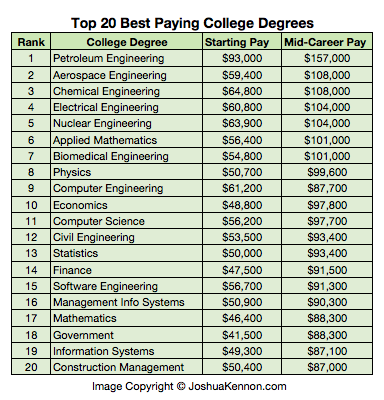
All College Degrees Are Not Created Equal
There is no question that the single best indicator of whether or not a person does well in life is whether they have a college degree. In the United States, for every 100 millionaires, roughly 90 are self-made. Of those, 81 have college degrees. The other 9 don’t have a college degree. That’s a high correlation when you consider that in the United States, for every 100 citizens, approximately 30 have a bachelor’s degree or higher and 70 do not.
The thing few people are admitting, though, is that just like investing in stocks, the price you pay for your degree relative to the earnings power determines the return you earn on your money. In other words, if you overpay for a degree program that doesn’t substantially boost your household’s income, you could end up with a slightly larger paycheck but much higher student loan debt payments; a disastrous situation that created a perverse reality where you were worse off for having gone to college.
The Difference Between the Best Paying College Degrees and Worst Paying College Degrees Is Huge
When comparing the list of the best paying college degrees to the worst paying college degrees, think of this: A high paying college degree can generate as much as 200% to 300% more annual income in the very first year after graduation, while enjoying much lower unemployment rates than a low paying college degree, and yet both degrees cost the same amount of money. Over the course of a career, the difference between a high paying college degree and a low paying college degree can be magnitudes; in the millions of dollars. To be specific, according to a recent USA Today article examining the income generated from the best paying college degrees compared to the worst paying college degrees:
An analysis of the projected lifetime earnings of 171 college majors provides a clearer picture of what one bachelor’s degree means compared to another in the labor market. And the answer can be as much as $3.64 million.
That’s the difference between what petroleum engineering majors can expect to earn over a 40-year career ($4.8 million) and what counseling psychology majors could earn ($1.16 million). Even the lowest-paying major beats the $770,000 average earnings of a person who holds only a high school diploma.
All things equal, a counseling psychology major costs the same as a petroleum engineering major. The payoff is an extra $3.64 million over a career, or 414% more money for the same amount of work and the same financial investment.
Sometimes, It Makes Sense to Go With the Best Paying Degree and Use It As a Platform for Your Passion
Imagine your passion is providing food for poor children who go hungry. You have a choice between a chemistry degree and a degree in social work. Both require the same cost and total student loan debt. The difference in pay and employment prospects is monumental.
[mainbodyad]If it were me, I’d become a chemist, earn a good living, and then use my savings to start a company and a non-profit foundation. Through the company, I’d develop some sort of product that the market wanted – cosmetics, sunscreen, bath products, body butters, something – and then have the corporate charter or limited liability operating agreement written so that a percentage of profits were automatically donated to the related non-profit foundation, providing not only a tax-write-off but a source of funds that I could then use to run a food bank. But, again, that’s just me. That’s how I’m wired. Before long, I’d set it up so the non-profit were collecting money from outside sources and put myself on the board of trustees, collecting a salary and fee for the time it took to build the organization so that I could make my passion my full-time job.
Within a 10 year time span, I’d accomplish more, and help more children, than I would in three lifetimes of being a social worker. And, I would have done it driving a Lexus and wearing cashmere sweaters. To some people, that doesn’t matter – they just want a decent house and financial security. There is no right or wrong answer, it is about what you and your own family want based on your personality, desires, and values.
The lesson: There are multiple routes to your wished-for port in life. Your ship doesn’t have to take the hardest, most difficult journey in the saddest, moth pathetic boat. I prefer the fastest, most direct, most enjoyable vessel. That seems to be the only rational way to behave. If you are considering a major, you might want to look at the best paying college degrees as a starting point.
Reader Comments (8)
Comments are presented chronologically, with replies indented beneath the comments to which they respond.
Tricia Drake
October 19, 2011
I love being an engineer and some of the benefits Joshua mentioned are true in my experience - low unemployment, higher than average pay, high demand for skill. Also, I think it's a good way to build lifetime wealth because engineers are not expected to drive fancy cars, wear expensive clothes and have a costly social life. On the other hand, I don't think you will find a lot of engineers in the top 1% of wealth. Engineers are wage earners - and we are kept only well enough paid to stay with a company and do a good job. I think you will find wealthy engineers who carefully saved and invested the extra over a lifetime of earning, but I would be surprised if you found very many engineers making $300,000 per year.
Joshua Kennon
October 19, 2011
Replying to Tricia Drake
Great points! I think it was Dr. Thomas Stanley in his research of millionaires that found engineers have far more net worth per every dollar of income than other professions for the exact reasons you mentioned. He also found that they tended to do more research on products, from washers and dryers to cars and televisions, meaning they bought things that lasted much longer and worked much better. That led to far less "per use" cost for everything they owned, allowing them to stretch their purchasing power and get great deals.
So your intuition is totally correct and matches every bit of data I've ever seen. Engineers as a profession aren't in the top 1% of income (as of the most recent data, that is about $585,000 per year) but they are disproportionately represented in the top 1% of wealth (from saving, living within their means, and investing the difference). It's proof that certain behaviors tend to lead to certain outcomes.
m r
August 26, 2013
Replying to Tricia Drake
"Engineers are wage earners - and we are kept only well enough paid to stay with a company and do a good job."
NAILED IT.
Nicole Davis
November 29, 2011
Starting salaries for software engineers are > $100K at elite companies like Google. I suppose you're using national averages? On a different note... Here's a question my husband and I are pondering, wonder if you have any input: we both graduated from an Ivy League university, and are wondering if our two children should attend a similar school (if they want to and are accepted). By the time they attend (first child starting in 5 years), adjusting for average annual tuition and housing expense increases, I calculated that it will cost about $640K to pay their way (for both). That's about half of our current liquid net worth. Worth it or not?
Matt Sharper
December 18, 2011
this is spot on it's better, its when your passions are vauge so to speak i.e "my passion is to help children" that could mean anything and is a good starting point.
Michael Starke
February 12, 2013
TL;DR: If you're going to go for a STEM degree, don't use up your electives diving even deeper into technical topics, if you need that knowledge, you'll pick it up in short order anyway. Use those credits as a chance to broaden your skill set into business, finance, art, and history, it will make it easier to relate to your non-technical co-workers and superiors. Be the "bridge" between the technical and non-technical worlds.
I wonder if a certain amount of the success of those gifted in the STEM fields has simply to do with the fact that they're natural "optimizers." They look at problems, even large, complex systems, and quickly come up with a workable solution. Sometimes that initial solution isn't the best, but piece-wise refinement gets them to the optimal solution much more quickly than someone without the natural aptitude with a "guess and check" approach.
It appears that that natural talent is what employers are looking for the most. I'm not saying that a PetE doesn't need a deep understanding of chemistry and geology, but knowledge can be acquired, whereas, in all indications, the STEM "brain wiring" is something that you're either born with or not. Driven people with natural aptitude can achieve spectacular salaries, even better than those in the table above.
I've mentioned before that I work in software. I've never billed myself as a "software guy" though. I solve problems; most of the time, the solution is software, but not always. I'd like to think that my other skills I acquired during my education actually are more valuable than the "book learning" I picked up in courses in my major.
Other things that I think helped me immensely were extracurricular activities that forced me to write, and speak. Being able to communicate your thoughts clearly is tremendously valuable. Learn how to break things down at different levels of abstraction, and then relate those abstractions back to examples in the real world. Your boss may or may not be able to understand the technical minutiae, but they'll certainly get it if you can make it accessible through analogy and metaphor.
Josh Hill
February 18, 2013
Loved the article,
I liked how you placed it that you became a chemical engineer that you could help more children than a social worker.
To me that would be a no-brainer but to most of my classmates would be shocked. I would use Engineering(or Finance it has not been refined yet) to fuel my art hobby. For me, I believe that you DON'T have to have an art degree to be good at art, it is something you learn by trial, I could dump 100,000 dollars on my brother for an art degree, yet when he could still be struggling to draw stick figures.
I get comments all the time saying "Hey, why do you want become an Engineer/Businessman when you are so great at art? I respond, you don't automatically lose all you art talent on the first day of Engineering/Business school. Will I be limited in creating art, yes. But, I if I never draw again for 5 years I could probably do just as good give or take a few warm ups. But, by sacrificing my art time for science/business time I can be financially secure(I use secure rather independant to ease confusion from my classmate). Does it bother me that I have 3.125 GPA, no. You don't have a text book smashing, 100 point A++, 4.0 GPA, principle pet, and intellectuality BO$$ to be an Accountant or Engineer you have just have to have the craving for knowledge even though your stats say otherwise.
For me I don't follow society unless some black swan event comes our way, I prefer to follow my own dreams and goals. That is how ideas are born.
Joshua Kennon
February 22, 2013
Replying to Josh Hill
Great points. We are having this discussion in my family now. Certain fields - art, music, etc. - don't benefit from a degree nearly as much as raw talent and / or experience. Someone who wants to pursue those as a career is going to be absolutely crushed by large debts, whereas someone in a more lucrative field won't.
I think your approach is a wise one. You can have your cake, and eat it, too.