

It is a fairly regular occurrence for me to get messages from individuals who advocate a portfolio consisting entirely, or almost entirely, of gold, held for the long-term. They usually follow the same pattern, are from the same demographic, and come through the contact form. This morning, there was a comment left about gold and I decided to finish this article on asset allocation, specifically detailing the results of investing in gold versus other asset classes, so that in the future, I can save time and post a link directly to it.
There is nothing wrong with investors who want to invest in gold, keeping a little of bullion on the side or allocating a smaller percentage of the total holdings to something like American Eagle gold coins or Canadian Maple Leaf gold coins. Likewise, there is nothing wrong with trading gold, if you know what you are doing and willing to take the risk of speculating in a commodity, which will almost certainly lead to long-term losses if kept up for long enough. What we are going to discuss are the people for whom gold is a secular religion.
A Look at Gold Returns For the Past 86 Years
We have looked at the returns of stocks vs. gold in the past. Let’s run another, more detailed scenario. Imagine the year is 1925. (We can go back further back in time but the data for many of the asset classes gets sketchy beyond that point.) You can invest $21.00 in United States cash into any of the following asset classes:
- Choice A: A pile of United States currency buried in your back yard
- Choice B: A 1-Troy ounce gold coin locked in a vault
- Choice C: Short-term Treasury bills from the United States government
- Choice D: Long-term Treasury bonds from the United States government
- Choice E: Large capitalization stocks (e.g,. General Electric)
- Choice F: Small company stocks (e.g., the thousands upon thousands of smaller businesses that raise money from investors)
A genie comes along and puts you to sleep. You wake up at the end of last fiscal year (2011). What were the results of each category after 86 years?
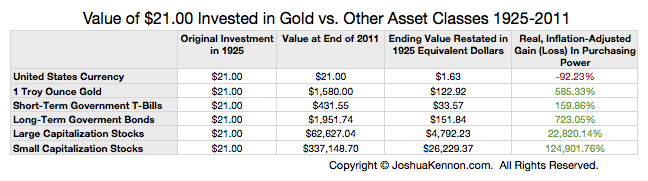
In purchasing power equivalents, the currency buried in the back yard lost a staggering 92.23% of its value. Gold investors are right when they say currency is a terrible long-term holding.
[mainbodyad]It is from that truism – that currency is a terrible store of value due to inflationary pressures of governments printing more money each year – that long-term gold investors make a logical error. The assumption seems to be that assets denominated in fiat currency derive their intrinsic value from the currency itself, which is not true (we will get to the reasons in a moment).
The gold, on the other hand, actually gained 585.33% in purchasing power after accounting for the depreciation of the currency. Gold definitely beat currency on a long-term basis.
However, the businesses of the nation slaughtered gold. The large companies gained more than 22,820% in purchasing power and the small businesses gained more than 124,901% in purchasing power, both after adjusting for the loss of value in the currency.
Productive Assets Make Better Long-Term Investments Than Gold Due to the Generated Surplus
How is this possible? Businesses and other productive assets, by definition, are systems that produce surplus value, or purchasing power. It doesn’t matter how we measure that value – dollars or gold. That is, in a nutshell, what we care about: purchasing power. Investing is about putting aside money today so that you can enjoy more cheeseburgers, cars, houses, video games, watches, vacations, books, tickest to concerts, or rounds of golf in the future.
Gold isn’t a productive asset. After centuries of owning it, you still hold the same lump of yellow metal. It doesn’t do anything. It creates no value.
Imagine that you owned all the gold in the world and I owned all the productive assets in the world. What can you do? Your gold can’t keep your warm in the winter or cool in the summer. You can’t eat your gold. You can’t drink your gold. You can’t use your gold to lower your blood pressure. To achieve those things, you need to convert your gold into goods and services. As the owner of the assets that produce those goods and services, that means that you are going to have to give me more and more gold as time passes (you don’t think I’ll keep prices constant, do you?). Since gold, on its own, can’t multiply, I am going to own 100% of the gold and 100% of the productive assets within a few decades, if not sooner.
If the dollar collapses and we find ourselves back on the gold standard tomorrow, don’t you think Coca-Cola is going to require you to give it some of your gold in exchange for a beverage? Don’t you think Phillip Morris and Altria are going to require gold to sell tobacco? Don’t you think McDonald’s is going to require gold before handing someone a Big Mac and fries? Aren’t all of those companies going to run their affairs so that they bring in more gold in sales than goes out the door in expenses, leaving a profit, now in gold instead of dollars?
Wealth is created by productive assets. In fact, going back to our illustration, at the end of the 86 years, the original gold investor still has what he started out with – 1 Troy ounce of gold. At the same time, the owner of the most productive asset, small businesses, would have enough wealth to buy 213+ Troy ounces of Gold. Those extra 212 Troy ounces of gold came from the surplus of the productive assets over time.
(Reminder: As we have discussed too many time to count, the return you earn on your productive assets depends on the price you pay to acquire them. You cannot buy a business at a 1% earnings yield with 10% growth and expect to do well, especially if Treasury bonds are yielding 6%.)
[mainbodyad]Let’s go beyond that for a minute. Not only are productive assets better for the owner than stores of value, such as gold, they are better for society, civilization, and standards of living. If I had $100 billion and I kept it all in gold, locked in a mountain, no one benefits. Yet, if I invested in creating new companies that research pharmaceutical drugs, build bridges, construct apartment buildings, develop clean energy, engineer safer aircraft, prolong human life through genetic discoveries, and reduce birth defects through hormone treatments, life gets better. People trade me claim checks on their future output (which is all money is), and there is more happiness, comfort, and longevity.
That is why one of my heroes, Charlie Munger, refers to people who want their whole net worth in gold as economic “assholes” (pardon the language). In a way, they are. They extract their claim checks on society from civilization and then sit on it, like an ostrich watching over a stillborn egg. Their wealth neither enriches them nor makes life better for anyone else.
When Is Investing In Gold Intelligent?
There are times investing in gold can be intelligent. For example:
- In certain circumstances, trading, rather than holding, gold can make sense
- If you are escaping a country and need a non-traceable form of wealth, gold is one of the best options you have
- If you are unable to own and protect productive assets and you think the world is going to end
- You own a productive asset that requires gold as a component
Other than that, there aren’t many reasons to keep a big portion of your net worth invested in gold.
Reader Comments (19)
Comments are presented chronologically, with replies indented beneath the comments to which they respond.
Martel
September 29, 2012
Hi Joshua,
There's a gentleman I
work with who insists we're on the cusp of a catastrophic economic collapse to
be following by a great social upheaval who fairly frequently speaks to me
about the importance of owning gold for the coming apocalypse so to speak. Lately
he has been buying silver as gold has become overpriced in his mind. He also
mentions contingency plans on packing his "guns and gold" and moving
his family to rural parts of the nation or to Canada to escape. I get the
impression that much of his investments are tied up in gold...which makes me
feel uneasy for him if/when the gold markets correct. He's also a huge
proponent of the going back to the gold standard.
Anyways, initially I
was taken aback by all this as his thought process weaves a fairly compelling
argument. I see there's a very real benefit of having contingency plans and
backup systems if case of disaster - but the point is not to obsess over them
at the expense of your main investments and daily life.
This post reminded me
of him, and I wanted to say thanks for this post and your earlier post on the
gold standard - that helped me to put into precise words why such a system
leads to unstable markets, and ultimately limits human potential.
Martel
Gilvus
September 29, 2012
Replying to Martel
The whole "impending collapse" thing has been preached by doomsayers for as long as the historical record has allowed, whether it's in economics, food supplies, natural disasters, or religious Rapture. In other words, humans have tried (and usually failed) to predict catastrophe for as long as humans have existed.
That said, it doesn't hurt to be prepared, because bad things do happen, with their severity being inversely proportional with their frequency. Health/car/homeowner's Insurance is good. Keeping a supply of non-perishable food and extra water at home is good. Buying gold in lieu of putting money into your child's 529 account...not as good.
Jack Scheible
September 30, 2012
Replying to Martel
And if there is a collapse, what is he going to buy with an ounce of gold? Silver will be more useful -- and has been used as currency much more than gold. Even more useful will be lead -- esp. in the .22LR, .30-06, and various NATO denominations. With a few .22LR, you can buy a rabbit from someone who can shoot it. With the others you can get larger animals and protect yourself and your family.
When you go to Wal*Mart, check out at the Sporting Goods counter (which is usually faster anyway) and pick up a box of ammo.
Jack Scheible
September 30, 2012
Actually, an "about new" silver certificate from that era will get you about $500 now. So the currency buried in the backyard is now worth about $10,000. Beats everything but stocks.
Joshua Kennon
September 30, 2012
Replying to Jack Scheible
Ha! True. The value of the paper to collectors would be worth more than the value of the currency it represented. Personally, I prefer scripophily for stocks and bonds. I have old certificates from the 1800's that I rotate on the walls from time to time.
You think it would have held up in a coffee can buried outside, though? Surely it would be nothing but mud by now. They would have been fine in a bank vault.
Jack Scheible
October 1, 2012
Replying to Joshua Kennon
Ah, but then you have to deduct the cost of the bank vault. This also applies to gold storage. Now, we can look at the gold coinage. A $5 gold piece is now worth about $500, and a $20 gold piece about $1900. So maybe $2500 for the lot. 25 silver dollars would probably get you about $650 today.
Michael
September 30, 2012
What about buying ownership (stock) in companies that mine precious metals and sell them to the "gold hungry" suckers? 😛
Joshua Kennon
October 4, 2012
Replying to Michael
Very smart people can make a lot of money trading and speculating in mining enterprises, especially prior to the run up or collapse of a given commodity. I don't think they are appropriate holdings for someone who wants to buy a block of stock and sit at home collecting ever-increasing dividends each year. It's just not in their nature.
Mike
October 1, 2012
Love your articles Joshua,
I have learnt so much from you!
Quick question for u about this article:
I thought the Dow went up about 100+ folds in the 20th century. The numbers above are quite bit different.
How did you actually come up with the above numbers?
Thanks!
Mike
Joshua Kennon
October 2, 2012
Replying to Mike
For the 20th century (1900-2000), you are correct. I don't recall the exact figure off the top of my head but it is somewhere up there.
The series we used for the date ranges in question was from the Ibbotson / Morningstar Market Results for Stocks, Bonds, Bills, and Inflation. It is a great resource if you are in money management, financial academia, or just enjoy verified statistics as a basis for testing various concepts. Here is the source page from the Morningstar Corporate Data products site. They have released a new version (I am one version behind because I forgot to order it last year).
One great thing about it is they actually back-test various portfolio compositions (e.g., 10% bonds and 90% stocks, 20% bonds and 80% stocks, etc.) and measure total returns, volatility, etc.
Real estate
October 3, 2012
Here's the problem with your analysis - long term
Stocks in general are far superior true. But taking your example, there are many large companies that used to be listed and then went bankrupt. For every coca cola and McDonald's decades performing Thoroughbreds there are tons of companies that got bankrupt, delisted etc. at least the us gov bondholder never lost their principle. Also
In people's models they gloss over decades of poor growth. For example many 401 k holders gains from the early 2000s were wiped out now. Maybe you tell him wait til 2030 and they will be rich, but in the meantime their retirement and college fund is eroded and their kid is about to go to school, and their retirement is right around the corner and they are panicking. Timing is everything. Meanwhile mr bond holder looks at his account and sees a nice chunk of cash still there, and mr gold hoarder laughing as he cashes the gold he had slowly accumulated. Now maybe the guys who bought google back in the day are sitting good, but most got slaughtered.
Joshua Kennon
October 4, 2012
Replying to Real estate
This is an example of everything that is wrong with investor thinking and why so many people get terrible results.
1. Even accounting for survivorship bias, the mathematical nature of geometric compounding more than makes up for any firms that were wiped out along the way.
Imagine you bought a portfolio of 10 stocks that earned an average of 8% each, with $10,000 invested in each for a total of $100,000. Three of those companies go bankrupt. A 30% failure rate is catastrophic. You shouldn't be anywhere near an investment portfolio if 3 out of every 10 companies you own goes bust. Still, let's assume that is what happens.
Over half an investing lifetime (25 years), the portfolio has only 7 stocks still around, not the 10 you started out with because 3 went bankrupt. Despite losing $30,000 of your initial $100,000 investment, your starting portfolio has an ending value of $479,400. That is a compound annual growth rate of nearly 6.5%, which is almost 2x the rate of inflation.
Catastrophic failure rate of 30%, mediocre returns on the remaining 70% of stocks, and compounding still produces a return that increases purchasing power.
So if some of your stocks go bankrupt: Who cares? If more than one or two happens in your lifetime, you should be indexing, not picking individual securities.
If you did manage to get a single McDonald's or Wal-Mart in there, the results would be astonishing. Wal-Mart, for example, would have pushed the ending portfolio value to something like $12,000,000 or $15,000,000. But you can't bank on those. They are nice if they happen but they are the exception, not the rule.
2. Over and over and over and over again on this site, I drill into your head that investing is about purchasing the greatest possible earnings you can, adjusted for risk and discounted back to the present.
Any investor who bought stocks at 50x earnings in 2000, when they had a 2% earnings yield, while long-term Treasury bonds were yielding 6%, or 3x as much with virtually no risk, was guaranteed to have a terrible decade. Every decent financial academic was writing this - Jeremy Siegel was getting honest-to-God hate mail because of the newspaper articles he was publishing pointing out the inevitable subpar returns that must follow on the back of these valuations! Stocks are not lottery tickets that can return magic compounding at any price. The price you pay determines your return. That is the statement I have probably uttered 10,000 times in my articles, essays, and lessons.
So, no, there is no glossing over bad performance. It is just that anyone who called themselves an "investor" would never have bought an asset for an earnings yield of less than the long-term Treasury. Anyone who did was either ignorant, foolish, reckless, or speculating. Take your pick.
Besides, in the real world, rational people don't dump lump sums in the stock market all at once and then never think about them again. The 2000-2010 period looks terrible on paper, but virtually everyone who owned stocks through a dollar cost averaging plan with dividends reinvested during that time made real after-tax, after-inflation gains in purchasing power. It wasn't nearly as bad of a decade as people make out but that is because their "analysis" consists of looking at a stock chart, ignoring recurring capital contributions, ignoring dividend distributions, and ignoring the power of reinvesting those dividends into additional shares.
mercury
October 4, 2012
when u r talking about gold 86 yrs is not a good interval. go back 2000 years through and count all countries. others have done this and it has been shown that gold can prevent against the fat-tail risk of hyperinflation. it is meant as a hedge and i think alot of gold bugs forget this thinking it will return a high yield.
PrimeValues.org
November 4, 2012
In a possible deflationary scenario gold might drop tremendously... what if the 2008 platinum crash repeats itself - this time with gold? Those humps left on charts during 2011 and 2012 don't look too promising. Not even QE2, QE3 managed to push gold above 2000 $ an ounce... It keeps falling back...
James
April 15, 2013
Might be time to repost this article. Gold and Silver getting hammered today. And with gold being all the rage the past 5 years I can see this getting really ugly because of all the speculative investors in it.
Joshua Kennon
April 21, 2013
Replying to James
It's been fascinating to watch, hasn't it? I've read some traders are likening it to the 1987 crash in stocks as it is the biggest collapse in 30 years.
FratMan
May 3, 2013
This might be a dumb question, but......
Is the easiest way to get rich to just take $1,000 each month, put it into an American small cap index fund, and repeat ad nauseam?
Joshua Kennon
May 3, 2013
Replying to FratMan
From the securities markets? Historically, yes. More specifically, going back to 1926, a small cap value index fund based on a basket of stocks that have certain characteristics (low price to book ratios, low price to earnings ratios, high dividend yields, low debt ratios, etc.)
That particular type of asset has, in the aggregate, compounded between 12% and 14% for almost a century. Stripping out inflation, you get real pre-tax returns of between 8% and 10%. It's made possible by the relatively less efficiency the market for smaller names (lots of people know IBM, how many people know something like Orchids Paper Product Company, which makes off-brand tissues and napkins? (Note: Random company chosen from screening list for market size - until a few seconds ago, I'd never even heard of it and know absolutely nothing about it.) Plus, it's easier for a small company to grow.
FratMan
May 5, 2013
Replying to Joshua Kennon
Awww Damn, I thought this was like Buffett leaving the name of a stock in a jacket that got auctioned... Alas, no "paper" trail 😉
Random question: For the hell of it, I read the financial statement for Orchids Paper and saw that the company is subject to 7% share dilution due to management options that vest between 2015 and 2022. Is that normal for a small company? In general, what do you consider tolerable levels of share dilution? I thought 7% was a bit on the high side, but my small cap knowledge is somewhat limited when it comes to stuff like this.