

A huge percentage of the writing on this blog is about positive models for success, including using things like mental models in an ethical and honest way to maximize your gains in life. Yet, I also keep case studies and files on anti-models of behavior; things that, if emulated, can cause suffering, distress, unhappiness, and failure. Very rarely do I share them because I try and follow the rule to praise publicly, criticize privately, but this is such a textbook example that I think it’s worth highlighting.
It comes from a blog called This Is Thin Privilege. Some of the posts are reasonable – like linking to an article discussing the very real psychology of beauty capital and how it influences business outcomes and job promotion. A significant majority of the time, however, it is filled with illustrations of the type of thinking that you should not only avoid in your own life, but cause you to run – as quickly as possible – if you see in friends, colleagues, or acquaintances. It’s not healthy. This kind of irrationality and selfishness is evidence of deep maladaptation. Avoidance is the most rational mechanism for dealing with this kind of damage.
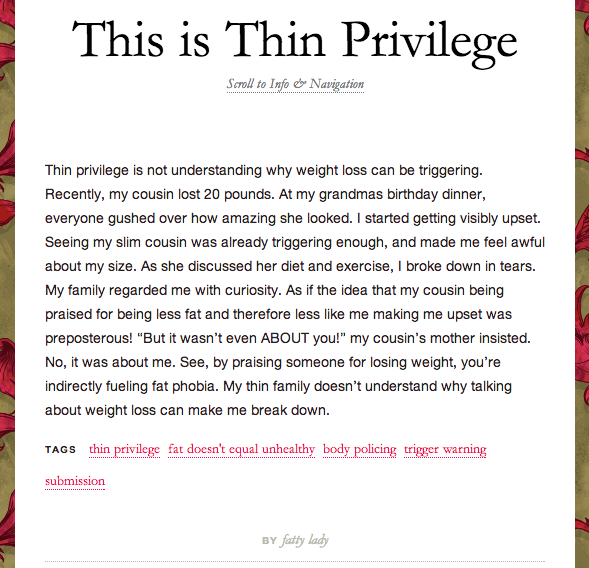
This is the type of emotionally sick, fragile thinking you should not only avoid in yourself, but those you permit to be around you.
Someone else’s happiness or success takes away nothing from you in most, if not nearly all, cases. It is not the job of individuals or society to make people feel better about the things under their control that they refuse to change. It’s closely related to the model of using the primary mission of your life to determine which trade-offs you are willing to make, and which you are not.
Except in extraordinarily rare circumstances, nobody is going to step in and give you the things you want in your life – not the money, not the body, not the career, not the skills, not the recognition. There is no calvary on its way to help you. There are no fairy godmothers coming down to waive a wand and manifest your dreams. Instead, you will get back an amount equal to the intersection between three variables:
- Your greed for it, which is psychological,
- Your effort towards it, which is physical, and
- Your base ability to achieve it, which is largely genetic.
There is also small degree of luck, but in a nation such as the United States, it plays a much smaller role than it ever has historically, or in many other parts of the world (family wealth, as one illustration, is now more tied to personal achievement and merit than it ever has been, with only a relatively small minority of the top 1% of society having inherited any of their money; most of it is first-generation made). In some parts of the globe, it is still very prominent – no matter how smart you are, if you are born in the Congo or North Korea, at the moment, you’re going to have a far more difficult go of it.
You have no right to expect others to withhold their praise or joy in the accomplishments of others because of your own failures. If anything, insisting that they do, even in secret, makes you even more of a failure. Celebrate success. Emulate habits that lead to prosperity, good grades, healthy lifestyles, and stable households. Look up to those who have achieved, through their own efforts, the things that you want for yourself. The moment you demonize virtue, you’ve doomed your own life.
I am telling you this because I want you to be successful. If you have these thoughts, acknowledge that they exist and then set to work crushing them. It may be hard, but you have to find a way to retrain your thinking. Otherwise, you’re poisoning yourself, guaranteeing failure.
[mainbodyad]
Reader Comments (37)
Comments are presented chronologically, with replies indented beneath the comments to which they respond.
Charles Reeves
November 7, 2013
Very wise words. Thanks for posting.
Joe O
November 7, 2013
Great post. In your list, I would change "greed" in #1 to "desire" - too much tied up in the connotation of the word greed.
Joshua Kennon
November 7, 2013
Replying to Joe O
It makes me so happy you mentioned that because this phenomenon - and that word in particular - has been the subject of a rather intense topic of conversation around here for the past few days. I purposely used the word greedy in that sense, knowing it would cause a hitch for Americans.
With all of the Korean dramas that have been on (I'm still watching them after falling off the bandwagon), there is a word that is best (roughly) translated into English as "greedy". Lost the love of your life? You weren't "greedy" enough for it. Didn't have all your dreams come true? You weren't "greedy" enough for it. Then proverbs like, "You get out of life as much as you are greedy for".
We've been talking about other words that have very different meanings depending on who reads them, too. Consider "confidence", which is used very differently.
Americans tend to associate the word with a combination of avarice and covetousness, rather than ambition. That difference has become somewhat of an obsession since I started thinking about it - how words come to represent different things to different people; often, disagreements are about underlying vocabulary rather than substance.
The word "scheme" is also a great example. In most Western nations where English is prevalent, with the exception of the United States, "scheme" is used like "plan", with no negative connotations - whereas we say retirement plans, pension plans, etc., elsewhere it isn't uncommon to say things like "retirement scheme", "pension scheme", etc. To us, as Americans, it has a horribly negative connotation of wrong-doing, embezzlement, theft, espionage, and dishonesty. Yet, it's a perfectly benign word elsewhere, for a majority of the English speaking world.
I'm assembling a list of words that have these very different meanings depending on geography. "Friend" is another one - it's used very differently in Brazil than it is in Germany, with radically different social expectations. In the United States, "sweet", as an adjective for a person, often has a subtle, judgmental tone when used south of Mason Dixon line compared to Northerners (due to the regional ability to be condescendingly rude while maintaining the facade of absolute politeness).
TL;DR: Yes, you're right. Yes, it was intentional.
Scott McCarthy
November 7, 2013
Replying to Joshua Kennon
You can add "reckon" to your list. At least based on my experience growing up in New England, the connotation was that only stereotypical southern simpletons would use that word in anything other than a mocking tone. But I've heard it used frequently here by foreigners here who were taught British English.
Frankie
November 7, 2013
Replying to Joshua Kennon
Very interested in a future post on this. The word struck me oddly in another post of yours, but after a moment of thought I could see what you were trying to convey. It has been on my mind from time to time since and I've been trying to put such highly accurate descriptors in my self assessments since, without regard for (or in spite of) social connotations in an effort to be more self aware.
I think proper use of words like greed when assessing ourselves is important to maximum self awareness.
lauren
January 8, 2014
Replying to Joshua Kennon
I didn't know that about the Korean translation, but it seems to be a similar case in the German language. The German word for what we'd call 'desire' is 'Lust' (pronouncing the ,u' a bit like the oo in 'book'). The word 'lust' in English is often negative-- like you're obsessing over something that you shouldn't be. But in German, you can have 'lust' for a particularly tasty-looking cookie, but not feel overwhelmingly passionate about it.
Frankie
November 7, 2013
Writing like the blog above upsets me, although less than it used to. I felt this desire to break down how irrational the mindset was, and help show them how utterly obvious the truth is.
What I found in those younger years is negativity almost always strives to preserve its state. This desire to preserve an opinion is almost never present in positive successful people. Of course, the negative person would tell us that the successful person is positive because of their success.
It seems as though the key difference between positive and negative, successful and unsuccessful, creating and destroying, and every other similar pair is this: the reversal of cause and effect.
I'm overweight because running hurts my knees.
Vs.
Running hurts my knees because I'm overweight.
I don't get paid enough to do that.
Vs.
I don't get paid much because I don't do enough.
I'll treat my employees better when they start performing better.
Vs.
Ill treat my employees better because well treated employees care more about my business.
I'll hire more people when my business gets too big for me to handle.
Vs.
I'll hire more people to allow my business to grow without sacrificing the service I provide
Negative people are negative because they have failed so many times.
Vs.
negative people have failed so many times because they're consistently negative.
Frankie
November 7, 2013
Replying to Frankie
One I left off, and the most common thus far:
Why should I care about my employees if they don't care about my business?
Vs.
why should my employees care about my business if I don't care about them?
joe pierson
November 7, 2013
I still consider luck a solid #4 and not just a footnote.
And when I refer to luck, I don't mean luck in the sense your were born rich, but luck in the sense you were born with great role models, either parents or relatives. That means a lot. Look at Warrens role models, and Mungers role models, and yours.
At least that is what I have found in my personal experience.
I have one set of cousins that are all very successful, their parent (my uncle) is very driven, very well read, but very middle class too. At the dinner table he constantly asked them questions about life, their desires, their goals. They all are now "greedy" driven self made people.
I have another set of cousins, their parent (another uncle) hated his job, didn't like private industry, though of job as just a means to put food on the table, never worked past 5, and talked about retirement everyday. All the kids (eight of them) have the same deadend jobs and all talk like him.
There is a huge momentum driving members of both of these families, like a whirlpool, you can get out, but it's really really difficult. And it's pure luck which whirlpool your born into.
This type of stat doesn't show up on any kind of survey.
Nicholas Archer
November 15, 2013
Replying to joe pierson
I'm feeling foggy headed this morning, but wouldn't Social Mobility be a measure of
this in a sense? For instance, my parents, have a lot of negative habits
that I consciously avoid because I have seen the results of those patterns. I think a lot of people don't analyze their situation enough and that leads them to just follow what
they have seen. In other words, I think this can still be looked at from a genetics/intelligence angle. Does that make any sense? Also, even though you are born into a family of luck, one still has the ability to seek out others that can benefit them, that has little to do with nuclear family. We aren't plants, we can move around the community and find better models. I don't think Warren Buffet woke up one morning and found Alexander Graham sitting in his bathroom reading the newspaper; he sought him out because he admired him.
Odai
November 7, 2013
It's funny that you mentioned this blog, because I recently discovered it and have been reading through it. They actually have made me aware of discrimination against fat people I never paid attention to (like getting mocked even when attempting to lose weight); but while I agree that people shouldn't be harassed over their weight, I really disagree with their "being obese is healthy" mantra, as well as "what you eat has no effect on your weight".
Something I've really been trying to understand is how much of the submissions are from trolls. Stuff like this seems like it's mocking the blog more than supporting it, but Poe's Law...
joe
November 7, 2013
Never thought of the word 'sweet' being condescending. In the south, if you grill food good, you are 'talented', and if you do something kind, you are 'sweet.' The tone of the word is all important though.
Yaacov
November 8, 2013
The girl is wrong.In this you are correct and this type of thinking is frustrating and foreign to me as well. However, should we not be sensitive or empathetic towards this girl?
Sure, we shouldn't hold back from praising the other girl who is successfully dieting. Sure, we should run away from this wrong type of thinking. But should we despise someone who has a wrong mental mode? No, we all have our frailties. We don't know what life or depositions one has to deal with.
I tend to think we should train ourselves towards empathy and understanding as long as it doesn't lead into the trap of tolerance and acceptance. This method is also more conducive to eventually helping the person.
William Michaels
November 8, 2013
I have always been fascinated by success. Why some people are and some people are not. I have seen people with great talent who never achieve success. Its almost always themselves that pose the key barrier.
Isn't it strange that princes and kings,
And clowns that caper in sawdust rings,
And common people
Like you and me
Are builders for eternity?
Each is given a bag of tools,
A shapless mass,
A book of rules;
Each must make
Ere life is flown
A stumbling block
Or a stepping stone.
Breathaholic
November 8, 2013
In some cases, not all, emotional roller coasters lead to folks eating more. Feeling lonely, sudden feeling of sadness, boredom, stress, envy and not wanting to really examine the source of these emotional states, we instead tend to stuff our mouths with food. Some use alcohol, others sex, some drive fast ..... as a species we are not all that original and creative when it comes to self destruction.
Maybe, her tendency to have break downs is a real reason she is overweight. Not the other way around. Learning and observing oneself and seeing how our emotional equipment works is one of the top investments in the world. It can be done early in my childhood, but have seen folks do it later. Self-awareness is awesomeness:)
Problem is, person will need to get to the idea of wanting to know how she/he is wired on their own. They are deaf to rationality of arguments and logical renditions, hey it is a freaking emotional issue for them.
It makes me sad, so I will go and examine source of that:)
lokgp
November 8, 2013
Hi Joshua,
I have been turning this human weakness in my mind for 2 days. In a sense, it just means envy. And I have to admit, I am guilty of it myself, sometimes, and would have to restrain myself from falling into such a mode.
And I have seen that envy mode on my friends as well. But this brought my mind back to a Chinese saying:
"People fear getting famous, pigs fear getting fat."
It just means that when a pig gets fat, the pig gets killed for meat. So, an intelligent pig would prefer not to get fat. And when a person gets famous, he will be subject to jealousy, envy, which might bring harm from others - and death attempt as well. And also many people would want to get favours from him - free dinner, donation etc. Eg: Kublai Khan and his spouse faced plenty of death threat before he became the Mongol Khan.
Come to think of it, I feel that envy and jealousy is just a natural trait of human. Envy of your beautiful wife, envy of your high achieving children. Jealous of your Ipad Air when it is out of stock, your neighbours new BMW, your relative new penthouse etc. Perhaps it is cultural, if you disagree that it is natural.
I find that I am at fault too, when I flaunt my successes, or latest travel experiences to my friends, even when I have tried to down tone it a bit. Some people or friends will feel this jealousy as they compare themselves with you - relatively.
And as I take note of that cold envy that friends feels, I have chosen not say too much about my travels or to bring too great a souvenir. I feel that it is possible for us to limit or to stop the development of envy and jealousy from others.
When I am to join friends with lesser income for an event, I try to wear clothing that are more worn out to help ensure sure that I don't feel out of place, and also to ensure that they don't feel out of place. I would prefer not to turn friends into enemy. The restaurant that we visit should also fit their personality and income level. It does help make us feel closer.
Perhaps, we should stop this envy mentality in our mind, and also not flaunt our successes too much.
This brings to mind that when you tell others how great your business are doing, it would attract competitors as well. You could have been that silent rich man, slowly compounding forward.
But on the contrary, this is a self-promoting world. Self-promotion brings even more successes, and is necessary in many employment and business. How else do you expect others to know you are any good if you are not selling yourself?
I guess a balance is necessary between sharing with others your successes, and also to play down your successes to keep envy at bay.
What are your thoughts?
Nicholas Archer
November 15, 2013
Replying to lokgp
Hey again, really like your comments. Lol.
Information asymmetry is the answer here. There is no one generalized rule that always works. To make this easy: Pretend you are a single digit millionaire. To your single-digit millionaire friends maybe you can show them the things that you are most proud of. To your middle class friends, you enjoy other topics of conversation. And, to your billionaire friends, don't embarrass yourself by showing them your favorite objects of desire. But hopefully, you are attracted to these people by their talents, humor, and shared interests such as music, Philosophy, Mathematics, etc. That way income is not a barrier. For me, since I tend to be very social and warm, it is hard for me to practice not sharing information with everyone. But, because I frequently feel regret after I realize I shouldn't have shared something, the "Information Asymmetry" Mental Model has literally become a mantra for me.
I'll be reflecting on a bad encounter due to my big mouth and say aloud in my car, shaking my head, "Information asymmetry, information asymmetry..."
My first memory of that concept was from my first boss at a family pizza restaurant, Dominic, his sons where popular in high school and one of them wore a big, beautiful 18k necklace. I asked Dominic, "why don't you wear a gold chain like Antonio?"
"Because if you show people you have a lot of money, they won't want to give you any more."
He always wore old Wrangler jeans, and a white hanes tshirt to work.
He retired back to Naples a couple years later along with his sons after they graduated high school.
lokgp
November 15, 2013
Replying to Nicholas Archer
Yeah, Nic. We just gotta talk about what others want to talk about. And show what others expect to see. Gotta blend in, to life in peace and harmony. That's why people dress up like monks and offer flowers, to get donations. It won't work as well if you are asking donation in airport while wearing a business suit. Thanks for the heads up, Nic: Information asymmetry. I'll keep in mind of that. 🙂
moshe
November 10, 2013
First you write "Your base ability to achieve it, which is largely genetic.". then you write "There is also small degree of luck, but in a nation such as the United States, it plays a much smaller role". Isn't it a contradiction?
Joshua Kennon
November 11, 2013
Replying to moshe
No. They are multiple variables interacting together to result in a final equation, some largely influenced by probability distributions of biology (e.g., your genetic abilities) or dumb luck (e.g., winning the lottery), offset or minimized to a very significant degree in certain countries such as the United States and Canada relative to other nations, as a result of the economic and political systems that make it possible for other factors (e.g., personal motivation, drive, ingenuity, work ethic) to play a larger role, and forms of capital that can be developed, such as political capital.
For example, if genetics, which are beyond the control of the person and set the range of abilities that can be developed through effort, were entirely responsible for wealth distribution and standard of living payoffs, net worth would correlate with IQ. It doesn't. The Richest 400 Americans and the smartest 400 Americans are not the same people. Nor are the most beautiful 400 Americans. Nor the most politically powerful 400 Americans. It's a complex formula combining some things beyond the person's control - like the home into which you are born - but most things under your control - like what you do with your time and money; at least in Western democracies. There is little self-empowerment or enrichment if you live in North Korea.
moshe
November 11, 2013
Replying to Joshua Kennon
But college education (which has a lot to do with being smart which is largely genetic) is very important for success, but not the only thing that is important. And so was being born in an aristocratic family very important in all of history but not the only thing
My point is you write " I’d rather have a lazy person with 10x the output than a hard working person with 1x the output" why shouldn't the latter person that can't do better fell sorry for himself?
Joshua Kennon
November 11, 2013
Replying to moshe
Because I'm interested in everyone living their best possible life, which means doing the best with the cards that were dealt to you. If that means you ultimately have a little more or a little less than your neighbor, that's - to quote one of my favorite thinkers - "too damn bad".
In this case, feeling sorry about the situation, rather than accepting it and moving on to choose among the best options available, is irrational and self-defeating. It accomplishes nothing, makes life less enjoyable, and due to the way human psychology works, more likely to make him feel helpless and fall further behind that where he could be based on his own, personal range of possible aptitudes. So not only does it make him unhappy along the journey, it also leads him to (more often than not) fail to reach the heights he otherwise could have reached. It's the inverse of a virtuous cycle; a negative feedback loop.
That's why I constantly harp on people making decisions based on their own personal opportunity cost. A rational course of action for one person might not be the most intelligent thing for another based on the trade-offs, implicit and explicit costs, social ramifications, etc. Is it fair? No. But there is no way around it so acceptance is the only intelligent way to behave.
For example, regardless of the effort I put into it, there is no possibility I could have ever become a professional NBA player. How much time has that occupied in my mind? Zero. It wasn't on the drawing board, so it was struck off. In my case, this was no great tragedy as I'm not particularly fond of playing the game, but what possible good could have come from worrying about it? And the time I would have spent mourning it was time I couldn't have been building businesses or researching investments.
In other words: Sure, he can feel sorry for himself, but by doing so, he's destroying his own best chance at happiness, accomplishing nothing, and wasting precious mortal deposit that will someday run out entirely.
It's a foolish, foolish way to go through life that ultimately harms no one but the person himself. Even though that doesn't effect me in any way, it grieves me to see potential - no matter how small - wasted like that. All we can each strive to accomplish is to become the best version of ourselves we can. Neither man nor gods have the right to expect more.
moshe
November 11, 2013
Replying to Joshua Kennon
So you have to be lucky to be born in the usa, you have to be lucky to have good genes, you have to be lucky to be born in the right home, you have to be lucky to have the personal motivation, you have to be lucky to have the drive, you have to be lucky to have the ingenuity, from here on its work. Quite a lot of luck, don't you think?
So the reason for him to be happy (even if he has 2 minimum paying jobs that hardly puts food on the table) is, because if he isn't happy, he won't be happy.
Joshua Kennon
November 11, 2013
Replying to moshe
I'm not going to be able to help you or illuminate any further without spelling it out, which I've tried to avoid doing so you'd grasp it on your own. This is the closet I'll get without giving away the punchline. You should be able to work it out from here:
You're running around on semantics - the language - when the better model is to think of it using mathematical logic. The role of luck and random probability distributions determine a range of possible outcomes, but they are not destiny as the other variables under human control can exert a very powerful influence on the final result; like a video game, wherein the multiplier applied to damage and defense is shifted depending on the difficulty level selected. While "unfair" in a sense - some folks get to start life on easy with powerful weapons and higher defense, while others have to play on difficult mode with a wooden stick and no defense - it's simply the nature of the universe. Therefore, the most rational course of action is to simply accept what cannot be changed and then set out to maximize the outcomes possible for each individual human given their own personal range of possible outcomes.
In all but the most exceptional cases (e.g., someone born with severe down syndrome, severe clinical depression, etc.), sheer will of effort is often sufficient to overcome most of the random probability handicaps. That in no way indicates that luck is not a component, only that it is not an irrevocable fate decried by the gods beyond the ability of man to change.
Joshua Kennon
November 11, 2013
Replying to moshe
You seem to think I am discounting the role of luck. I am not. What I am doing is, perhaps, a bit unfair because I am dangling the conclusion that you should reach based on the role luck plays right out of arms' length, prodding you on just a bit to try and get you there on your own. If I tell you what it is, it will be lost on you. If you work it out yourself, it will change your life. Here is the closest I'll get without giving away the punchline.
You're running around on semantics - the language - when the better model is to think of it using mathematical logic. The role of luck and random probability distributions determine a range of possible outcomes, but they are not destiny as the other variables under human control can exert a very powerful influence on the final result; like a video game, wherein the multiplier applied to damage and defense is shifted depending on the difficulty level selected.
While "unfair" in a sense - some folks get to start life on easy with powerful weapons and higher defense, while others have to play on difficult mode with a wooden stick and no defense - it's simply the nature of the universe. Society often seeks to mitigate these advantages and disadvantages to the degree that can be fairly accomplished (e.g., John Locke's "Veil of Ignorance" theory of social compacts), but not all volatility can be overcome.
Therefore, the most rational course of action is to simply accept what cannot be changed and then set out to maximize the results for each individual human given their own personal range of possible outcomes. Parents were drunks who didn't save a dime to help you get through college and beat you? That sucks, but you can either accept it, cut them out of your life, and move on or you can dwell on it and let them steal the remainder of your life. Suffered a career-ending injury that derailed your plans to go professional? Again, the agony and pain, physical and emotional, are real, but there comes a point at which you have to stand up, say, "enough", and plot a new course.
No one is going to make you do this; a man can continue in his misery until he dies - nobody is going to step in and stop him from throwing away the most precious commodity of all, time. The universe will be happy to let you die broke, friendless, and without accomplishment. It's agnostic on the outcome of your life, which is all the more reason you shouldn't be.
In all but the most exceptional cases (e.g., someone born with severe down syndrome, severe clinical depression, etc.), sheer will of effort is often sufficient to overcome most of the random probability handicaps. That in no way indicates that luck is not a component, only that it is not an irrevocable fate decried by the gods beyond the ability of man to change. In cases where it is not, the world in its present form offers so many paths to conventional success (financial independence, stable household) that it's not that difficult to opt for a different path to the same destination when roadblocks erect themselves on a certain trail.
In the case of those rare situations where the handicaps cannot be overcome, being emotionally despondent about it only worsens the situation, while achieving nothing. Therefore, acceptance is the wisest, best action. Embrace who you are, what you can do, and enjoy life for what it is. The only thing capable of stopping this step would be envy, which is the stupidest of all sins (it's been likened to drinking poison and expecting the other guy to get sick).
Take a look at the attached equation. While simplified, it should give you an idea of the expressions you should be using. Some of the variables cannot be modified - Ability, for example - but the outcome of the formula can be changed by working to increase the values of those that can.
I work very hard and the bottom part of that formula - the I*E component. When I wanted to intern in the executive wing of a multi-billion dollar insurance giant, I got myself elected to the student council board so I could attend board of trustee meetings at the university, made contacts, and had them introduce me to the CEO, who then called me and invited me to come work there for several months so I could learn all I could about the industry. It was a way to shortcut the random probability factor of a mere letter or request resulting in the outcome I wanted. I wasn't going to let probability alone determine what happened to me, so I changed fate by working every possible angle until I got what I wanted. When I wanted to try my hand at the record industry, I did the same thing, securing an internship in the main New York office of Warner Music. It's how I got my first book published by a major publishing house while still in college. It's how I was effectively retired in my early twenties. Think of life like one giant video game. When you do, and you view it through a formula like this, luck is simply one handicap that you have to deal with for better or worse. Sure, sometimes it sucks. And you feel miserable about it. No one is denying the pain or the unhappiness - only that you can't let it stop you if you want to be successful; it's just something you have to accept.
Or don't, fail, and be content with it. You have that freedom, too. If you decide the whole game is too hard, you can stop playing, you just shouldn't complain about it because you made the choice using your own free will. Which is, again, why things like this do not apply in places like North Korea, where that isn't the case.
Joshua Kennon
November 12, 2013
Replying to moshe
No. You're getting hung up on the semantics when you should be thinking of it as a mathematical expression with weighted variables, some under your control, some not, with each individual human being given a different set of base stats from which they have to start. The formula is not destiny in the case of most people.
More specifically, here is my answer.
TheLonelyHumanist
November 13, 2013
Replying to Joshua Kennon
The larger point, though, is that society doesn't require you to be an NBA star to enjoy a good life. It DOES require you to know how to achieve an income.
Joshua Kennon
November 13, 2013
Replying to TheLonelyHumanist
Yes, but there are so many countless ways to enjoy a good income that doesn't it negate the objection? Part, if not most, of the problem is that the past generation or two of people were taught "rules", if you will, that are no longer relevant. It can be emotionally hard for some people to accept that the social compact they were taught existed does not, actually, exist; like showing up to a baseball game and being told you will be competing in a spelling bee, instead.
Tyler Phillips
November 13, 2013
Replying to Joshua Kennon
Can you give us an example or two of these "rules"?
Guest
November 13, 2013
Replying to Joshua Kennon
No, I don't think it does. The preponderance of potential ways to make money does little to soften the frustration of the individual who does not possess that critical skillset. Just ho
Joshua Kennon
November 13, 2013
Replying to Guest
What comes after "Just ho"? I need to know, now or else I might no
TheLonelyHumanist
February 28, 2014
Replying to Joshua Kennon
IQ and wealth not correlated? I'm going to need to see some data. That's the opposite of everything I have seen.
Joshua Kennon
March 1, 2014
Replying to TheLonelyHumanist
It's 1:58 a.m. here and I've been up for almost 48 hours with barely more than 3 hours of sleep so forgive me for lacking my usual thoroughness. This piece does a good job explaining a fairly recent academic study showing that IQ doesn't correlate with income once other factors are accounted for, and Dr. Stanley's research down at the University of Georgia show that grades (which aren't exactly IQ) also have no significant relationship with ultimate net worth.
The bigger factor is self-control, which does have some significant genetic components.
TheLonelyHumanist
March 1, 2014
Replying to Joshua Kennon
Looks like a correlation to me: Compare the number of poor in the under 100 to the number of poor in the above 100. Compare the highest IQs with the lowest. On the bottom end its night and day.... It would be interesting to see what this chart would look like if the wealth values went all the way up to the seven or eight digit territory.
Also, one must be careful in accounting for variables. For instance, sufficient IQ might be a requisite to recognize the need to practice self control . Any analysis that did not recognize such a relationship (if it exists) would inadvertently be go a long way in reducing the IQ-Wealth correlation.
Nicholas Archer
November 15, 2013
As long as you are criticizing a flawed thought pattern, I see only great benefit to your readers.
Just as long as the general mood of your site stays upbeat and uplifting, Anti-model on!
As soon as I started reading that "This is Thin Privilege" article, I started mentally vomiting.
And you are correct about people disagreeing with vocabulary and not the message.
I was trying to help a loved one get over her difficulty swallowing pills.
I told her to, "Put the pill in your mouth, float the pill in the water in your mouth, and then
snap your head back and swallow."
Guess which word caused a huge argument(quarrel)?
Erin D Lindsey
November 21, 2013
I have been reading your blog for about eight months now, though I have never been moved to comment on anything thus far. However, I feel I can provide some insight on the anti-model in this particular entry.
Tumblr is proving to be a sucessful sounding board for young people who are wary of airing their feelings on Facebook, lest their parents/teachers/potential employers might take offense to something thay say. I was encouraged to join Tumblr because most of the TRON fandom seem to be moving there from LiveJournal. And the longer I have remained on Tumblr, the more I have encountered the type of mindset you described in the above entry. It is an anti-model that I am quite familiar with, because it was me from age 17-25.
As a 36-year old, it is very disheartening to see young people, many who have come up during very difficult times and who have substantially fewer prospects than I did coming up in the 1990s, decide to argue for their percieved limitations instead of trying to overcome them.
Like many of them, I have struggled with obesity and a rather debilitating mental disorder - but around the age of 25, after many failed attempts at community college, and after living off my parents for most of that time, I realized that I was not going to win the lottery. My mom could not afford to support me forever.
I came to terms with the fact that I was not going to be whisked away into an alternate universe where I was the Chosen One, which would have excluded me from having to participate in the "ordinary world." If I wanted to live the way I wanted, I was going to have to do something for myself. It's been a long and tough journey. At 36, I am still only making 15.00 an hour, though I have finally managed to form a game plan for what I want to be doing with the rest of my life. Hopefully things will start to get better soon.
I told my friends and roommates my plan to go back to college and lose thirty pounds, and got lectured for "giving in to social pressures to conform to unrealistic standards of beauty" and that "being fat doesn't mean you're unhealthy." I weigh 185 lbs. Losing thirty pounds isn't going to kill me - and may make it easier to compete in the field that I plan on going into.
But for some of the people I have been associating with, a grab at being more functional and successful is a betrayal. It is Letting The Side Down. See this entry, here: (not mine.)
http://www.xojane.com/issues/front-til-you-cant-front-anymore
I reblogged the above post, knowing that I don't agree with it 100%, because the social pressure to conform to the hive-mindset I have been entrenched within for the past few years was that atrong. The thing is, I don't see my mental illness as "Who I really am." I see it as the thing that keeps me from being who I really am.
But trying to be more functional and celebrating that functionality is seen as cruel, insensitive criticism towards those who are still telling themselves that they can't improve their situations and the world around them, that they shouldn't even try, aside from "signal boosting" socially and politically progressive posts; that this is just "how they are." I see the phrase "ableism" tossed around a lot. Yes, "privilage" does exist, and it does rig the game - but we should be working to change the game, not repetedly reblogging pictures of Tom Hiddleston and Benedict Cumberbatch in the hopes that someone will someday do it for us.
We should be helping to make more opportunities in society for those who have a condition that makes it harder for them to participate, and to help them become aware that those opportunities exist. We shouldn't be criticizing and ostracizing people for their weight - not because "fat is healthy" and "all bodies are beautiful" but because people shouldn't be jerks.
But the backlash against what a lot of folks, especially on Tumblr, see as "normative conformity" has turned into a sort of counter-conformity where those who do not tow the party line are just as ridiculed and ostracized as they probably were by folks in the mainstream of society. It's a rather unfortunate side of human nature that proves that tribalism is just as alive and well as it ever was.
Oh well, this is already too long. Thanks for reading.
Joshua Kennon
November 21, 2013
Thank you for sharing this; I enjoyed your perspective (and a belated, "welcome to the site!").