

After a 4,484 Day Wait, I Finally Bought the Theodore Alexander Althorp Grand Staircase Secretary Desk
This project in New Albany is taking me down memory lane and making me revisit different times in my life. That statement will make sense in a moment.
I finally did it. I bought the Theodore Alexander Althorp Grand Staircase secretary desk that I’ve wanted for a long time. It is a walnut and burl workhorse for reading and document review that features a ton of storage and hidden compartments. The stairs open. The staircase moves and reveals “rooms” behind them with more compartments. Pens, highlighters, Post-It notes, basically anything I need to review, stacks and stacks of paperwork can be placed neatly in here with no distractions from phones or computers.
The backstory: On February 16th, 2012, Aaron and I were at the Country Club Plaza in Kansas City. We popped into a home design store that was there at the time and saw it for the first time. It was incredible. I took pictures. I was only 29 years old. My thinking, which is no surprise to many of you, came down to a time value of money trade-off. I could either purchase the desk or I could increase my ownership of wonderful businesses. Even using historically conservative assumptions based upon real return data, each dollar put in equities should have compounded to at least $13.07 in real purchasing power by retirement whereas that same dollar left until the end of natural life expectancy might grow to at least $54.15 in real purchasing power for my then-future children and grandchildren. With a price tag that was not modest, this was real money.
For that reason, after reflection and a few calculations which included a review of other choices on the table, we decided to purchase a Century Furniture desk at far below retail using the Berkshire Hathaway shareholder discount, instead. We were so young and focused on expanding our online businesses, piling up ownership of stocks, setting up a home … we certainly did not deny ourselves much but this was one of those areas where discipline and prudence caused me to make a choice based not on my heart, but on my head.
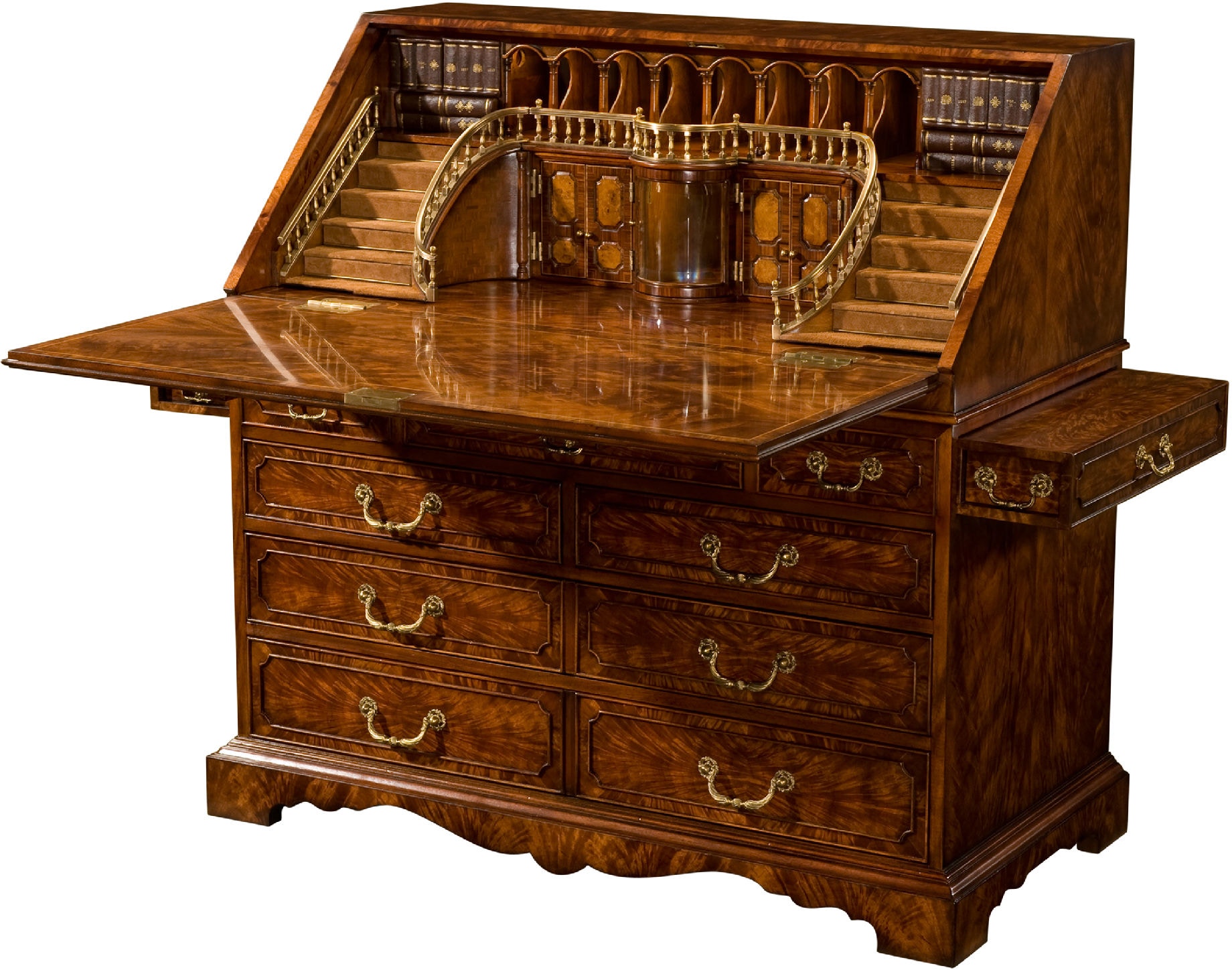
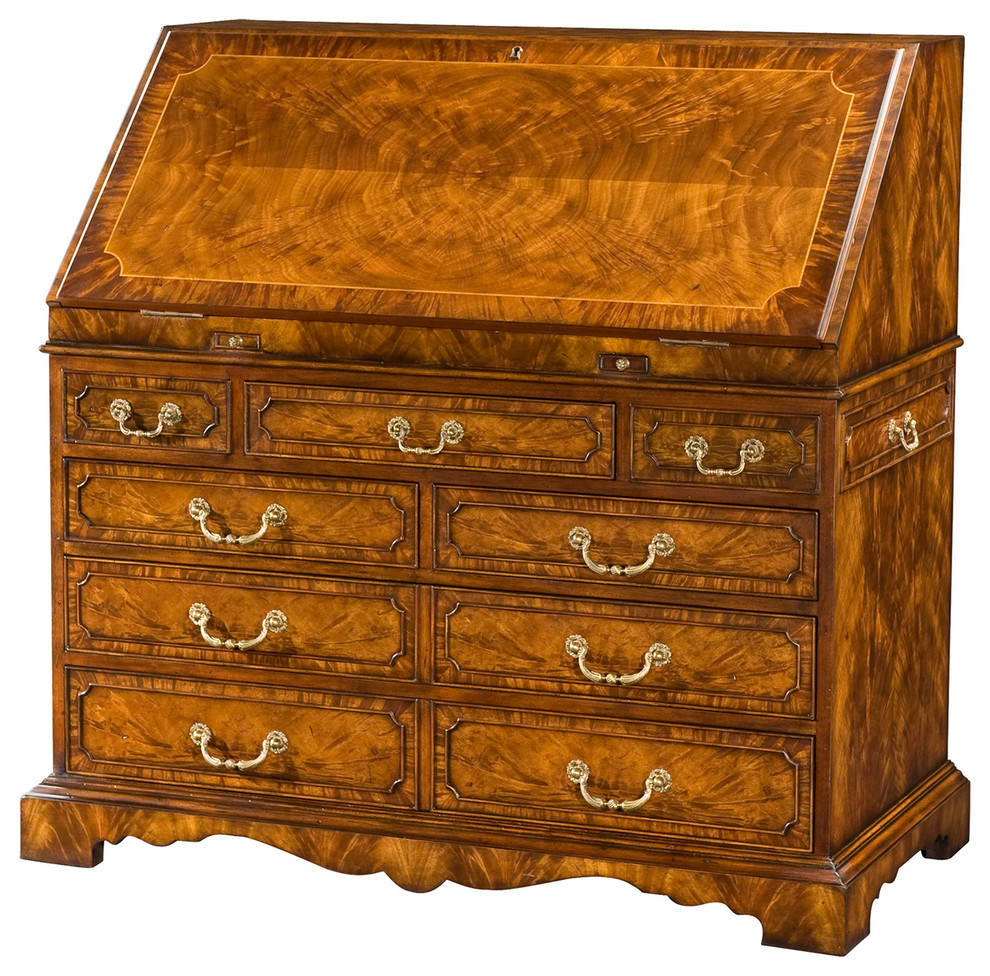
After opting for the Century Furniture desk, I wanted to amortize the cost as far out as I could, getting the daily use figure down to essentially nothing. Still, the Theodore Alexander desk never left my mind. I knew that at some point, I would buy it when I had a specific use case and the time value of money calculation was different. With it being 2024 – a dozen years later – the “n” variable in my compounding calculations has changed. I’m older. My income and net worth are far higher so that it’s pointless for me to deny myself something that brings me so much happiness. Future me is going to get far more joy and utility out of using the desk each day than an extra five or six figures in real purchasing power at retirement, which won’t make any noticeable difference in my standard of living.
Unfortunately, there are none for sale on the auction markets right now. I wasn’t going to put it off any longer. I had waited long enough. Instead, I found two authorized dealers. The first would ship it to me right away and would charge me full retail plus sales tax plus shipping for delivery in two to three weeks. The second would ship it from the manufacturer but they would give me a 21.78% discount plus throw in free white-glove delivery. The catch was I would need to wait until Thanksgiving or Christmas.
It will shock no one that I took the discount and free shipping. I’ve already been patient, waiting 4,484 days since I first saw it to actually make the purchase, so what are a few more months? I also trusted the second dealer quite a bit. My experience working with them thus far has been excellent. I had a question about a specific piece of furniture and they got the actual factory to send me a picture of it on the factory floor so I could look at the finish to decide if it would work with what we were doing.
Other Updates About the New Albany Project
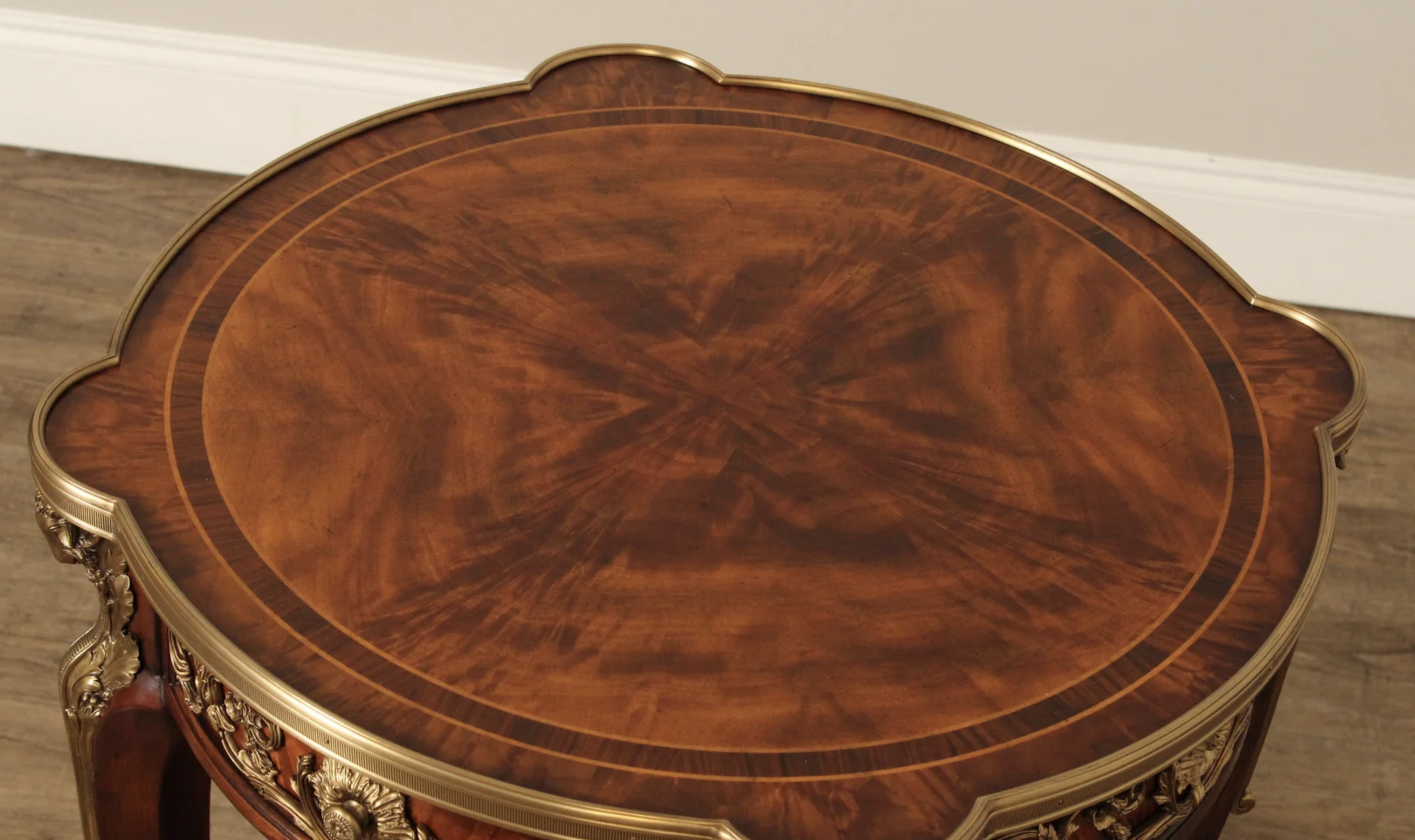
Speaking of Theodore Alexander, we found some side tables by the same manufacturer that I think are going to be perfect for the merger of form and function we’re looking for in the space we are envisioning. Placed next to a large, soft Chesterfield leather sofa or a beautiful, upholstered chair – the kind you can curl up into with a book and a cup of coffee – these are going to be ideal.
As with nearly everything we’re adding to the property as we transform the interior design to match the architecture, the price was good, too. Not spectacular like some of the bargains we’ve been getting, but still really satisfactory. We were able to pick up a matching set in near perfect condition via the secondary market for about 34.8¢ on the dollar for what we would have paid retail post-ordinary discounts or sales (since almost no one pays full retail, anyway, if they know what they are doing). Why wouldn’t I take a few insignificant scratches that can be repaired for such steep savings? Indeed, it’s no secret that one of the big keys to how we’ve managed to amass our family estate over time is that we were careful on the utility of money side, wanting to have our cake and eat it, too. By making our dollar outlays so productive, we still get what we want but it frees up more cash to devote to acquiring productive assets, which in our case has mostly meant ownership in wonderful businesses.
There is also a game aspect to it I’ve talked about at least two dozen times on the blog over the years. Bargain hunting is fun. Stocks. Bonds. Real estate. Side tables. Cars. Fountain pens. It truly doesn’t matter how much capital I accumulate, the dopamine hit of getting value is so rewarding. The drawback, and why I think a lot of folks can’t do it, is that it requires a lot of patience. Heaps and heaps of patience. You have to be able to calmly wait, sometimes for years, while you delay consumption. If you focus on quality, though, once you get the compounding cycle going, it’s not a big deal. As an added bonus, you can often meet lots of interesting people, many of whom are passionate about shared interests and whom are a wealth of knowledge.
Of course, a downside the practitioner can’t really mitigate: When you find something you truly love, you may not be able to get it, again, if anything ever happens to it unless you’re willing to pay full price. For example, some of you may recall the phenomenal deal we got on that new Jaguar XJL 3.0 AWD Portfolio Edition at the very end of 2016. True, we had to make one trade-off (I wanted the wooden steering wheel but the model the dealer wanted move in order to make room for new-year versions had a heated leather steering wheel, instead). No matter, it was otherwise perfect. That car has been, and continues to be, an absolute dream. It easily ranks in the top ten purchases we’ve ever made in terms of joy and utility relative to cost. We were so happy with it, that Aaron and I considered buying a second model in Black to match the white one before deciding to wait and see what we needed once we had kids. A couple of years back, we both came to the conclusion that if anything ever happened to the one we had, we’d just go buy another new Jaguar XJL as long as they were largely the same, even if we had to take it at sticker. Unfortunately, management of the company decided after many, many generations to discontinue four-door luxury sedans and eliminated the flagship model so it’s not even possible, anymore. That means when we do go to look for another one at some point, everything will be back on the table. The benefits are worth it. It’s simply something one must deal with if they insist on saving money.
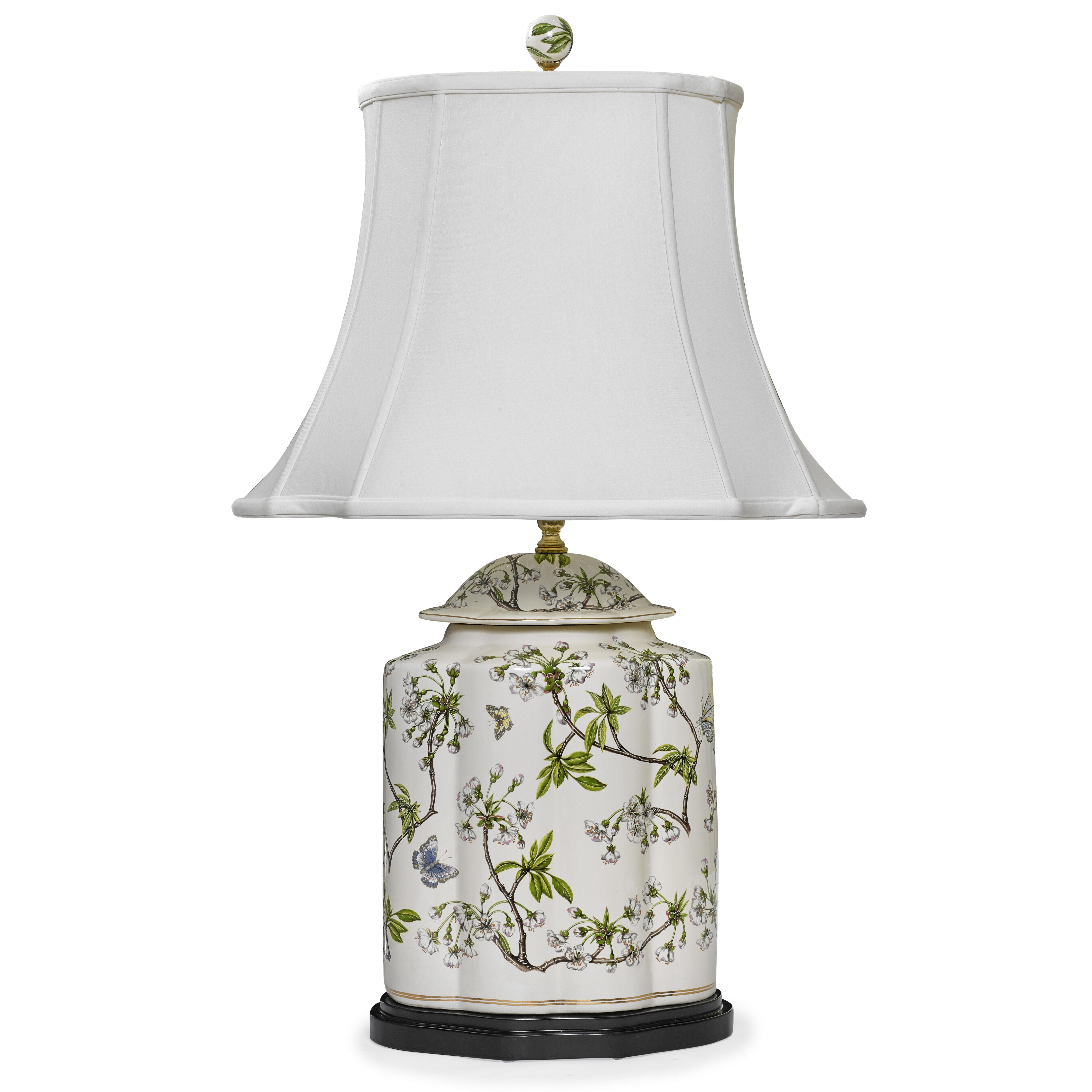
Elsewhere, we’ll have a couple of lamps in the style of temple jars.

We also decided that we are going with a bit of a bird motif for three reasons:
- Partly, this is because our return to the Midwest has reminded us of how much we missed having beautiful birds around everywhere – cardinals, blue jays, mourning doves, robins, hawks – especially when they are in flowering trees or standing out amidst the crisp white snow. It’s been a lot of fun to spot them on our walks with the boys or listen to them singing each morning. As I write this, there is a beautiful lady cardinal tending a nest in the evergreens outside the window, popping in and out of the branches as she inspects her work.
- Partly, it is because there is an abundance of historically appropriate flatware, dinnerware, artwork, and decorative accents that we can select from, allowing us to buy from not just modern retailers (e.g., in the case of dinnerware where improved safety standards are a must), but also from auction houses, antiques dealers, estate sales, and private negotiations.
- Partly because we simply think they are beautiful and in-line with the more historically-appropriate side of the design spectrum where we are dialing in the pattern language. Jewel tones. Gold accents. There is a joy, and a warmth, there that doesn’t exist in colder patterns.
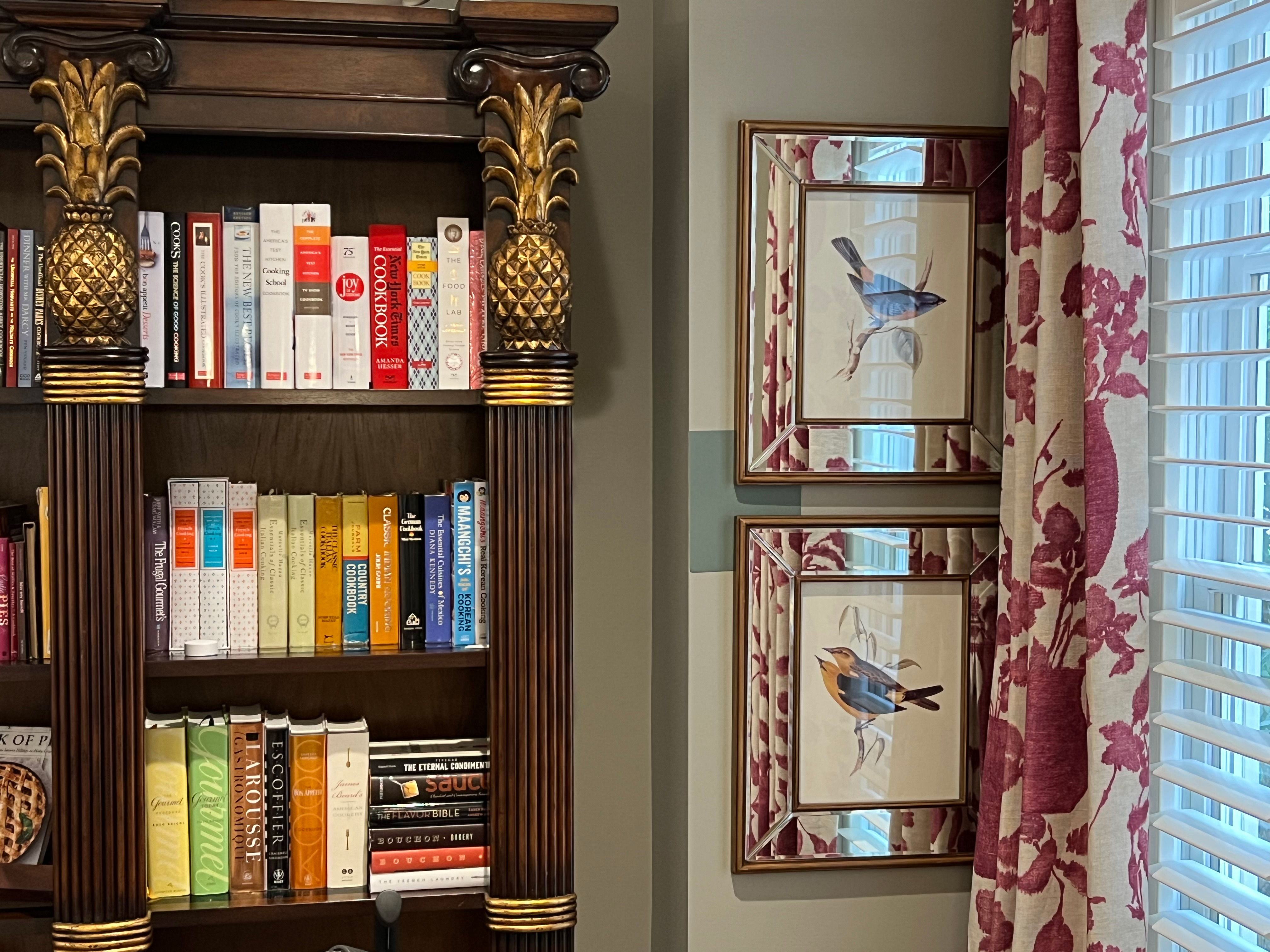
The key is to keep the general room tight and clean so there isn’t too much clutter or ornamentation, allowing the pieces to stand out. That’s going to require millwork in the spirit of the era; something like the Kuiken Brothers classical reproductions. It’s a very Benjamin Franklin / Thomas Jefferson / Alexander Hamilton / George Washington type vibe. The tobacco, spice, coffee, and chocolate investments we have, both personally and on the books at Kennon-Green & Co. for the private clients, seem particularly appropriate in the setting given their distinct timelessness. Of course, I love our software and technology investments, too. It’s just … how can one not want to sit by the fireplace and study the dividends coming in from selling cinnamon and thyme?
I love themes. If you’re going to do something, do it right.
Again, I reiterate: This will take 36 months to complete. Even a year from now, it will be nowhere near where I want it to be by the time the project is completed. It is going to take patience as choices start to compound on themselves. But both Aaron and I see the final vision.
I do think, too, that psychologically this is Aaron and I rejecting both:
- The throw-away “fast fashion” in furniture and housewares. We’re both tired of our society making everything so disposable.
- The chaos of the always-on era of globalization where you can’t help hear about every single conflict and disaster happening in the world at any given moment.
All of my systems – how I handle the phone, email, television – are designed to minimize distractions. We are essentially building, in design language, what amounts to a pre-internet world. It forces us, via structure, to think more slowly and methodically. It allows us to step back and see the big picture. It also has massive benefits for personal contentment.
Reader Comments (11)
Comments are presented chronologically, with replies indented beneath the comments to which they respond.
Robert Hotaling
May 29, 2024
Love that you realize the value that has escaped others from your generation. Gray floors, white walls and furniture make for a stark and cold environment. Georgian, Federal, Chippendale, Queen Anne style is much warmer and inviting. As you pointed out, it slows you down and invites a person to sit and relax. And the beauty of well made wooden furniture is to be admired and appreciated. Growing up in Pennsylvania in the 70s and 80s I saw a lot of fine furniture as my mother was a collector. Henkel Harris, Kittinger, Statton (now gone) all in mahogany, cherry and walnut. Seems you like more French Provincial but I may be wrong. Anyway, I am glad you are back and writing articles.
A word of warning but I think it is too late. Getting bit by the fine furniture bug can be costly and hard to shake. But there are worse things. Hee hee.
Question, will you podcasts be available via subscription? I would like to subscribe.
Thanks
Joshua Kennon
June 1, 2024
Replying to Robert Hotaling
It is turning into a wonderful fascination. Aaron and I joked that we're going to need to build the Kennon-Green warehouse like MGM studios used to have for its set design to store all this stuff because I'm finding pieces that are incredible and would work for some space but not the one we're designing now. (There was a set of chairs the other day that would have been perfect if someone were building a German-style Snow White house in the forest. I didn't get them but if I had the warehouse, I would have and just put them on a shelf somewhere.)
It's funny, too, because of the time element of it. For me, this has to be a side recreation as we do this project, but I can see how it could be an obsession. I was going to bid on a Theodore Alexander side table this morning but got preoccupied so I didn't make the auction in time. Someone in Tennessee got a fantastic deal on it, though - it went for only $450 plus a 20% Buyer's Premium - when new it would have been a couple grand:
https://www.liveauctioneers.com/item/177705723_theodore-alexander-shaped-front-two-tiered-console-table
Someone else in that same auction got an English-style Maitland Smith console for only $800 plus 20% Buyer's Premium:
https://www.liveauctioneers.com/item/177705698_maitland-smith-english-style-flame-mahogany-sideboard
It really is a treasure hunt!
You're also right in that there are definitely elements of French Provincial. English neo-regency along with small elements of Chinoiserie really do it for us, too, and they mix well in the same house as, historically, that's what you would have seen as a given room was designed around a theme. Aaron and I kind of refer to our taste as as "restrained opulence" or "controlled opulence" with a heavy dose of masculine-type colors and textures (rich greens, browns, etc.) A perfect illustration is the set design for certain rooms of Bridgerton. The designers did such an amazing job - and deserved the awards they won, in my opinion - for how they went through historical spaces and then augmented them with auction house purchases, second-hand estate sales, and markets in Paris to specifically recreate something you would have seen.
One of my favorite examples is the breakfast room of one of the main characters in the first season. I, of course, love the ornamentation. Yet, for those who don't, if you actually remove the accents (sterling silver teapot, candlesticks, the urns in the background, etc.) the lines of the furniture and the room are almost similar to a lot of modern design - straight, clean, a lot of well-spaced ninety degree angles on a grid pattern. The sense of excess comes from the materials. It's actual wood. From a tree. Cut down and formed by a skilled worker into something beautiful, which reads differently than MDF. The scrollwork in the silver. What is timeless about it, though, is you could take that same room, swap the accents for something contemporary, and suddenly it would look in place in a new estate being constructed today. There are a dozen different ways you could make that room feel wildly different using the exact same bones, so to speak. Masculine or feminine. Light or Dark. 1824 or 2024. The framework is so good.
https://uploads.disquscdn.com/images/8b56a7278fecc5a2c066cc6ecf35640d9ba951613c3af3652184b8550d308c75.jpg
Regarding the podcast, we haven't made distribution decisions, yet. The technical side of it is now setup and we will begin recording soon. The complexity will arise because I need to be able to release more candid, in-depth versions to clients of the firm (for whom a fiduciary relationship exists so I can be more candid, especially if talking about things going on in the world as they influence businesses we may or may not own) and, if we make the decision to permit it, broader release either in some truncated form and/or on a delay.
Adam
May 29, 2024
Looks great! I'm glad to see you posting regularly again. It's like having an old friend back in town. Looking forward to your podcast! -Adam
Joshua Kennon
June 1, 2024
This is a wonderful question. The opportunity cost of time is one of the biggest decisions I have to make because, in my case at least like a lot of other highly productive families, time is more limited than money. I, like everyone else, have precisely 24 hours in a day. That's it. That's the limit of it.
In a lot of areas, as our life has become busier and our responsibilities have increased (e.g., having kids, coming out of retirement to start the firm, the firm growing so quickly which includes employees, more clients, etc.) the solution has been to focus on outsourcing things that, either or in some combination, 1.) don't require our specific skill set, 2.) cannot be justified relative to the economic cost of an hour unit of our time, and/or 3.) we don't enjoy.
How we outsource that work depends upon a number of factors. This has scaled pretty significantly so that essentially all of my work time is devoted to the firm (specifically, client meetings and asset management) and all my personal time is devoted to the family or just relaxing so my mind is clear when I get back to work.
For example, we bought a house in an area where we don't have to deal with lawn care. We then hired a landscaping company to take care of the flowers and trees so we show up and it's as beautiful as a park without having to do anything. We outsource a good deal of tax and accounting work to one of the largest firms in the United States. We have several law firms with which we regularly work and I can assign projects if I'm too busy to focus on them, allowing me to just come in at the end and review their recommendations. We have a house cleaning service that keeps our home as nice as a hotel so I don't have to think about the bathrooms being clean, the floors mopped, or the carpets vacuumed. I set aside multiple times per year to review advances in automation and software to see if there are any solutions that can do a lot of heavy lifting for us, some of which have been transformative. We have service contracts to handle things like the printer supplies and maintenance. I have a wonderful team of private bankers at a couple of different banks that have made my life so much easier because if I want something done, or am trying to research a specific area, they can usually make it happen or get me answers almost immediately. We have furniture restoration people that we've begun working with who make house calls and fix anything we're buying that got damaged in shipping. We have preventative extermination services take care of our properties on a negotiated maintenance schedule. We have a specialty window company come out and regularly maintain and check these ridiculously expensive historical wooden windows on one of the houses we bought in New Albany. We have insurance agents.
The list goes on and on and the primary objective is, "Can outsourcing this free up more time for me to sit and read investment reports and/or manage portfolios?" or "Will this reduce my stress and time commitments so I can focus on the firm and/or my family?" (A huge part of how we structured this - particularly the emphasis on scheduled, routine maintenance even if it not necessary as it ultimately saves more capital and prevents time-sensitive emergencies in the long-run - was actually emulating the efficiency with which Donald Bren at The Irvine Company managed his residential and commercial properties along with the operations of his primary holding company. In some ways, it was as transformative a case study as discovering Berkshire Hathaway was during my youth. Experiencing it first hand, on both the residential and commercial side, as we were setting up a base in Southern California to go through the gestational surrogacy process was like watching a masterclass. It is not an accident, nor a fluke of statistics, that he ended up being the wealthiest private self-made real estate developer in the world for a good portion of his life. I truly believe he could be re-born today and if he started over at 21 years old, would still end up amassing a huge real estate empire from scratch, again. I suppose it's to be expected of a guy that became obsessed early in life with the structure and order of Andrea Palladio's architecture, which focuses on the beauty of mathematical proportion, order, and symmetry.)
Anyway, for the interior design project of the main New Albany house we bought for ourselves to serve as a primary residence, it is, as you mention in your second paragraph, entirely entertainment value. I work so much, it gives me a chance to completely switch mental gears and relax. I enjoy the treasure hunt aspect of it, as well as making things beautiful. By setting a 36-month timeline with the goal of transforming the property into a jewel-box, essentially, it's like a real-life version of playing The Sims. If I am three hundred pages deep into documents I need to read, I can get up, walk around, and think about it to clear the board before returning to my desk.
There is also another motivation in that Aaron and I are keenly aware we are designing the film or television "set", to speak, that will serve as the backdrop of our children's memories. Designing the space to be not just beautiful, but whimsical in a sense, is important and fun. Long after we're gone, and they are parents and grandparents themselves, we want them to think back to the years as not just being ordinary, but magical in a lot of ways. They will forever associate autumns with baked pies and apple cider, wreaths on the doors that change with the seasons, Christmases with giant trees and garland wrapped around stairwell banisters.
A big part of the project has been designing a playroom for them. It will take time, too, but we transformed a space into a domain entirely for them filled with books, blocks, toys, and other items that allow them to build and imagine without any electronics. Eventually, we'll add a television in a cabinet as they get older, but one of the absolute best decisions we ever made was a near total ban on screens so they had an analogue childhood. We had a custom-made carpet put in that features a star pattern, we found two amazing 5' or 6' tall Hollywood Regency style chairs that look like something from Disneyland that we will eventually have reupholstered ... we got them an old-fashion 1940s-style vinyl record player and radio so they can listen to music. They have a bunch of musical instruments. There is a kid-sized kitchen, a pretend Washer & Dryer, vacuum, model firetrucks and construction equipment ... every imaginable Play-Doh set, they can entertain themselves for hours by making up games or inventing characters. We're basically using design choices to create an environment that lets them develop in the way the human brain evolved. Plus, as we work on the house itself, we talk to them about what we are doing and sometimes one or both of them will even sit and help us look at listings to decide if we should make an offer or bid on a piece of furniture.
So ... yeah. There is no element of work or labor to this design project to me. It is all recharging / recreation / entertainment. Given my schedule, and the demands on my time, it's been an amazing and well-needed creative outlet.
Joe Pierson
June 1, 2024
Thanks for detailed response to my comment, you are a wonderful dad and make family life interesting and fun.
Joshua Kennon
June 1, 2024
1. Ah! Great question. It's an optical illusion in the picture above since it isn't showing the entire space floor-to-ceiling. The former owner of the house had it completely upgraded by an interior designer before we bought it and one of the things she did was put in what are known as "Plantation Blinds" (aka less frequently referred to as "Estate Blinds") that allow you to open them in quadrants (upper right, upper left, lower right, lower left) as well as completely open them to have the full view of the window. You can use the curtains, of course, but it's just an additional accent. Here, I'll grab a quick picture of what I mean because every window in the house is essentially like this, even the small accent windows ...
https://uploads.disquscdn.com/images/3ecca382da67507cbf6db168e053075b6068aff5e4a4652740bcd05101f00e10.png
2. This is such a huge question. Massive. My goodness, I feel like it should be a 100,000+ word treatise. Okay, here are my thoughts. Take them for what you will.
Taste, of course, is personal in the sense that people can have wildly different preferences (e.g., historical vs. modern, ornate vs. streamlined). However, regardless of those differences, there is absolutely a distinction between well-executed and poorly-executed.
The key is to find the style you like - be it ornate or simple, colorful or monotone - and then execute it well so it is cohesive and works together based on the practical need to occupy the space; e.g., doing what needs to be done there without irritation or friction. If you like a minimalist modern house, don't ever let anyone shame you for it, but make sure it is done well. If you want a historical ornate house, the same.
Actual examples might help. To illustrate: Some folks try to build a historical space and simply buy anything that has gilding on it, ending up with a room that is especially ornate but lacks the design language that made such rooms work. In other cases, people try to go super-modern and just end up creating these horrifically cold homes. Examples of such "bad design" would be, respectively, 1.) the outright abuse of rococo furniture elements in Donald Trump's penthouse that turns what could be a few incredible pieces into the embodiment of tacky, and 2.) the hellscape that is that modern abomination Kim Kardashian calls a house but looks more like the interior of a psych ward. The sinks she installed in that house are so unbelievably stupid it's genuinely funny. There is something deeply mentally unwell about that space.
The first place to start is to read Christopher Alexander's treatise A Pattern Language. You can learn more here:
https://www.patternlanguage...
Then the follow-up with his book, A Timeless Way of Building. You can learn more here:
https://www.patternlanguage...
These books, particularly A Pattern Language, were transformative to the field of architecture a couple of generations ago. They discuss why some design languages work despite seeming wildly different (e.g., Western vs. Eastern), and it goes into concepts like humans wanting light on three sides of a room, architectural elements being "human" scale, buildings laid out according to purpose (e.g., communities where you can walk and have a central area to socialize within walking distance lead to far greater happiness).
Then, I'd probably start with studying the Georgian and Federal eras along with the Palladian architecture movement that provided the foundation. Those three will do a lot of heavy lifting in terms of understanding why some things work. For example, in these architectural schools, the door mouldings, particularly the area above the door, have a specific hierarchy to subconsciously motivate the person in the room to enter or exit at specific locations to create a purposeful flow. Your brain picks up on the size and design differential. However, when someone who doesn't understand these concepts tries to do something like the Trump penthouse, they over-design every door with the highest hierarchy language and it just makes the space confusing and uncomfortable because your mind doesn't subconsciously pick up on what the room is trying to communicate. The best crash course you can find online before you start reading thousands of pages of books is to binge watch the entirety of Brent Hull's YouTube channel, which you can find here:
https://www.youtube.com/c/b...
Aaron and I were some of the first subscribers and seeing it blossom has been so rewarding. For the past couple of years, I've recommended it to anyone who wants to understand historical building patterns. I mean, there are people who don't even realize the different historical types of kitchen cabinets but the moment they learn it for the first time, realize why some kitchens feel very, very expensive and tailored and others don't (e.g., "Inset" kitchen cabinets are always going to appear far better in visual design and quality but they are harder to make so as the United States began mass production during the mid-20th century, "Overlay" cabinets became more popular because they could be pounded out cheaply with less skill. There is full overlay and partial overlay. In our house, for example, they clearly spent well during the renovation right before we bought it but the kitchen was done in a partial overlay, which is the middle category and it drives me nuts it's not inset. It wouldn't have cost hardly anything more relative to the value of the house.) Likewise, you want cabinets to go all the way to the ceiling in most kitchens and the crown of the cabinet become part of the moulding of the room itself. The Brent Hull channel also has videos where he takes existing houses and "fixed" them with an overlay tissue paper, correcting the design language to be more in-line with what we know historically works. But it's all great. I'd consider starting with the videos about the proportion rules, like this one:
https://www.youtube.com/watch?v=W9JWBWiEKWQ
For example, the columns you see on buildings were understood by the Ancient Greeks as having gender with the Corinthian being a young woman and the most ornate and the Tuscan being a stronger, mature man being the most streamlined and strong. It's all based on a mathematical ratio and communicates different things.
I'd also go buy all the design books you can - particularly photography books about interior design by companies like Rizzoli - and as you work your way through them, identify what you like, what you don't, and then try to reverse engineer the reason. Building a large enough sample set of what brings you joy starts to let you see commonality to it. Build a database of pictures, vendors, and designers. You can find them on places like Amazon here:
https://www.amazon.com/s?k=...
I'd also sign up for a free subscription to Traditional Building magazine. It is a phenomenal resource. You can do so here:
https://www.traditionalbuil...
The point of a design language is to walk into a space and say, "What do I want this room to say?" That should translate into, "1.) What do I want to happen in this room?, and 2.) How do I want people to feel and interact as that thing occurs?". For example, if you want to have a bunch of people over several times a month and eat good food while having great conversation, you're going to be far more successful if you have an enclosed dining room with doors that shut, a dark color on the walls, and light that goes more towards the mid-to-yellow side of the spectrum. There are biological reasons for this going back to humans gathering around fireplaces. Consultants in restaurant spaces, law firms, etc. get paid a lot of money because they have these languages memorized and can speak them. Likewise, there are actual mathematical ratios between the number of people in a space and the square footage. If you exceed that, it will not feel like anything ever begins and people don't connect. Again, it goes back to biology.
(Actually, the best example I know of is from the casino industry. I think it was the 1970s when there was a book released for professionals in the industry trying to figure out why some casinos printed money and other struggled and it came down to the fact you could increase revenue if you created low ceilings, didn't have people's backs exposed to large spaces, specific interior design elements, etc. because it made people feel comfortable and not vulnerable so they would sit and play slot machines for hours.) It's related to concepts like those found in Drunk Tank Pink, which goes back to research by the United States military on the psychological influence of color. The color of the room you are in can and will influence decisions you make in your life at various times. Heck, calorie consumptions is materially influenced by the size and color of a plate and tablecloth as it messed with our perception.
You can get a copy here:
https://www.amazon.com/drun...
Wine is another example - some of the best wine experts in the world were once given a white wine that had been colored with red food coloring and they swore up and down it was red wine. You can read about it here:
https://www.realclearscienc...
Gosh, there is so much. I don't even know where to start. The keys are:
1. What you are trying to say, which means being very deliberate about answering: 1.) what do you want to happen in this room? and 2.) how do you want it to happen?
2. Proportion. Spaces must be human-scale and design with a hierarchy.
3. Color. This includes paint, wallpaper, and textiles.
4. Light. This is huge. The most comfortable rooms are always going to have light coming from at least two, preferably three sides. The time of day you plan on using the room, and its purpose, should influence the lightbulb color substantially. For example, it is madness that so many people have just replaced their house lights with 7000K or higher blue light bulbs. It has meaningful biological consequences on the way the human body works.
Again, your space can be minimalist or maximalist. Historical or modern. Colorful or monotone. The key is to get the design language cohesive so that it is all saying the same thing and works in harmony together.
I'd begin with book A Timeless Way of Building that I mentioned earlier. You'll never see the world the same, again. You look around and it's like discovering Charlie Munger's mental models. It's a framework for discussing biological forces interacting with physical space based on human evolution and why we, as a species, prefer certain things a certain way - why certain spaces feel "right" and others cause us discomfort - even if they appear wildly different in design on the surface.
oldcodger
July 8, 2024
Hi Joshua, you could update:
https://www.joshuakennon.com/the-socialists-have-taken-france/
With “the communists have taken France” awkward times to say the least
Joshua Kennon
July 30, 2024
I might try to write about this at some point because my thoughts are complicated. The problem is that the doctrine, as it had been used, is a separation of powers violation and anyone close to politics knows that Congress has taken advantage of it to avoid passing controversial laws since they can have an agency deal with the backlash. The reality is, Congress needs to do its job. Constitutional violations are not the answer.
That is, I care a great deal about how things are done since principles matter when protecting the integrity of a system. You do not want to allow one of the three branches of government to gather too much power unto itself or you get the kind of abuses suffered under monarchs and despots. (What really surprises me is that the same people super-concerned, rightfully so, about a second Trump presidency and the Project 2025 agenda seem apoplectic that the executive branch just had its power balance restored with more deference given to the legislature and courts, as it should be. I really feel like we need a national movement to restore civics lessons, particularly about the importance of the constitution and how it can protect the average citizen from the government's tendency to accumulate authority that do not legitimately belong to it.)
But, again, that is a gross oversimplification of my thoughts. I mean, Chevron was only part of the regulatory framework (for all intents and purposes) for part of my lifetime and I'm only 41 years old. It was originally a right-wing coup and took years to take off and become a thing, then it stopped being used almost a decade ago, so the idea we are inevitably damned to go back to rivers on fire or something is completely ahistorical and hysterical. We, as a country, need to hold Congress accountable and demand they do what we hire them to do. You can't have agencies flip-flopping on key regulatory matters every four years when the administration changes. It's bad for society.
Robert Gambill
October 12, 2024
If interested in adding another theodore alexander althorp piece let me know . I have the secretary for sale on offer up .
Joshua Kennon
October 26, 2024
We used what I suppose you might call a "location station" approach by tying specific things to specific locations. We talked to the kids and let them know that the playroom is their domain and is setup for unstructured free play - books, Lincoln Logs, building blocks, Hot Wheels cars, plush stuffed animals and Muppets, etc (and it becomes increasingly more and more awesome with each passing month as they get older so the toys can get more sophisticated.) Yet, the rule is that toys must stay in the playroom and must be put up every night or the deal is off. The track record isn't perfect, yet it's very, very good; at least 95%+. They only color with markers and crayons at a specific booth and table in the house, nowhere else. (That same booth is used for the mega Play-Doh collection since we bought essentially multiples of almost every color, all the toy sets we could find, etc.) When they want to do art, they ask to go to that booth. We only eat in the kitchen, at our seats. The sole exception are fruit gummy snacks during a Disney movie in the living room.
The grandparents do the same thing. Like, when they help grandpa build bird houses with actual tools, they go outside and do it in the garage. When they paint with water colors, grandma puts them in artist aprons and they only do it at a certain space in their house.
This way, they get all of the fun and creativity, but I don't ever have to sit down surrounded by mess after working long hours as we continue to scale up the firm. Aaron and I need the house to be clean to maintain our sanity.
It isn't possible for a lot of families that have much smaller houses. I understand that and fully appreciate it. But it was absolutely a setup we could implement so there was no reason not to do it given its advantages.
Relatedly, the chairs in the playroom you mentioned are very similar to what you posted.
The piano is now a fascination for both of them so the rule is they can absolutely play it and bang on it if 1.) they ask first (which we almost always tell them "yes"), 2.) they have to take turns, and 3.) they cannot hit the piano, only play the keys with their fingers. So it's this idea that "This is how we behave in this area and here are the reasons" seems to have worked very well for us.
We read a lot to them, made sure to teach them their numbers, alphabet, etc. early on, answered questions no matter how many times they asked, and play logic games with them. We then enrolled them in local classes from time to time - we started swim lessons, we had them take dance classes, etc. - so they could meet other kids and experience different things.
We're still having the big conversations about education specifics. Our philosophy thus far has been to augment everything we want them to know by teaching it ourselves. Tonight, Graham and I were sitting in the living room talking about earthquake because he wanted to know what caused them. I told him, we watched earthquake footage online, and I explained there are small earthquakes in Ohio but they are very rare. Dorian became curious and came over to join us, asking questions.
So ... I know they will learn phonics-based reading. I know they will learn manual cursive writing. We'll teach them to read music. We'll teach them to type. We'll probably teach them file-based operating systems for actual computers. We occasionally order random instruments for them to try - we have a tongue drum from China, I was looking at recorders and flutes the other day. We teach them to cook, even though they can't handle anything dangerous, yet.
It's basically the approach of, "We are here to help you learn everything possible before you go out into the world, so what do we think would have been valuable if the roles were reversed ... what would we want to know?"
Sometimes it catches me off guard because this approach is universal in the family. My mother-in-law apparently taught the kids roadsigns the other ay so we were driving and all of a sudden Graham saw a lane merger sign and announced, "Two lanes become one lane!" very proudly. It was so out of left field it cracked me up. So I'm pretty sure they could pass most of the written test of a license at this point given they've mastered speed limits, roundabouts, yield, stop signs, etc.
I'm working on classic fiction now. I've been reading the original Lord of the Rings and so I've talked to them about the plot several nights in a row, explaining the ring of power and how it has to be destroyed.
We take them to the big community events where they get to get into firetrucks and ambulances and police cars.
It's just sort of all-encompassing. We also make up characters for bedtime stories but usually work in things we want them to slowly absorb. The other day, one of the people built a rocket ship and worked his way past the planets of the solar system, so we said them as he traveled by them, then worked our way backward. We talked about how some were so cold they were horrible; the big red spot of Jupiter, etc. They were invested in the story of him getting home, meanwhile we were trying to get them to understand that Saturn has rings.
It's ... yeah. I'm not sure how you'd describe it. Very, very deliberate knowledge transfer disguised as stories, music, and creative play. With zero - zero - electronic devices other than sitting down to an Apple TV and watching Disney movies at the end of the night. Grandparents occasionally let them draw on an iPad coloring app or watch YouTube cartoons but it's, again, something they know they are getting away with from grandma and grandpa. We were absolutely devoted to making sure they had an analogue childhood for brain development reasons.
Cody A. Ray
October 27, 2024
Replying to Joshua Kennon
Thanks for such a thorough response, as always!
I really like that approach to education, particularly where the parents intentionally have a hand in teaching them everything you want them to know yourselves. Do you also have a nanny or something, or do you and Aaron setup "shift" where you swap for work, or something else?
I love this little story. So cool that they can come back with facts that they picked up elsewhere ... and reiterates the importance of choosing who they spend time with too.
My daughter is just under a year old, so we haven't started movies or cartoons or anything. ... and I'm pretty anti-screen myself. That being said, I'm not sure if you're familiar with the cartoon Phineas and Ferb, but it centers on two kids during "summer break" who have this sort of "let's build a rocket" creativity that mixes in science, music, art, etc in a way that you might appreciate.
When did you start reading larger stories to them? We're still on short picture/board books and have started mixing it up via weekly library trips. I'm super looking forward to books with more substance though. 🙂