How Much DNA Do You Share With Your Blood Relatives?
How much genetic material do you share with your biological relatives? Take a look at the family tree below and the figure in the red box is the percentage of genes your body has in common with your blood relatives. For example, your first cousin has 12.5% of the genes you do (implying, inversely, that 87.5% of their genes are different). Your third cousin twice removed, on the other hand, would have only 0.195% of the same genes, meaning 99.805% of their genes would be different. This assumes, of course, that you have no double relations in your family tree (e.g., sharing a great-great grandmother from two sides of your family tree).
The chart also ignores relatively rare phenomenon such as the elusive double cousin. These relationships arise when two siblings of one family reproduce with two siblings of another family. This results in the children being related to each other through both parents, and sharing the same grandparents. As a result, double cousins are genetically equal to half-siblings, sharing double the genetic material normally seen in first cousins.
Reader Comments
(252)
Comments are presented chronologically, with replies indented beneath
the comments to which they respond.
D
Doug
September 16, 2011
Not sure I understand. I would expect to share well over 99% of DNA with my immediate relatives. How do you calculate that I share only 50% DNA with them?
J
Joshua Kennon
September 16, 2011
Replying to Doug
Your body was created by taking roughly 50% of the genes from your father and 50% of your genes from your mother. If you have siblings, different genes in different combinations were passed onto then due to sexual reproduction creating a roulette effect, resulting in siblings sharing roughly 50% of the genetic material, as well.
The exception is identical twins, who share 100% of DNA due to coming from the same egg and the same sperm, which split and began reproducing independently from the same gene pool combination.
On a related note, a common misconception is that identical DNA must result in identical outcomes. Identical twins, for example, have different fingerprints, which you can read about here: http://www.nytimes.com/2009/10/06/science/06qna.html. If one twin suffers from autism, there is only a 90% chance the other will, too (not 100%). If one twin is gay or lesbian, there is only a 50% chance the other is too (not 100%), etc. etc. This is because of, in simplified terms, the fact that our genes have 'on/off' switches attached to them that can be flipped through conditions in the womb, environment throughout life, exposure to certain chemicals, and a host of other factors. For a very basic explanation of how genes get flipped on or off, read http://www.thetech.org/genetics/ask.php?id=63
And, of course, it's fascinating how our ancestral DNA plays a role in our day-to-day lives. Most of the humans alive on planet Earth cannot drink milk; the figure is around 70% for adults. If you live in the United States and are white, though, you wouldn't realize this because your ancestors developed a mutation that allows us to process cow's milk. This explains more: http://www.thetech.org/genetics/ask.php?id=250
If you prefer a hierarchy written out, Genealogy.com has that at http://freepages.genealogy.rootsweb.ancestry.com/~laetoli/degree.html
D
Doug
September 16, 2011
Replying to Joshua Kennon
Ahh ok.. it is just a semantic difference then. I was comparing your percentage to statements like "Humans share 98% of their DNA with chimps". That percentage is about how much of the data contained in the DNA is the same regardless of ancestry, where you are talking more about the bloodline path of where it came from. Thanks for the clarification!
S
Salamander
March 21, 2012
Replying to Doug
I agree the "DNA shared" figures are misleading. They make it sound as if there were an infinite numbers of genes, when of course there are only so many ways to code for whatever protein. Perhaps it would be better stated as "probability you share a given gene because of shard ancestry" for, say, eye color (which is itself polygenic, not blue-or-brown as taught in grade school!). Some genes also tend to be transmitted together. You share some/many genes by pure coincidence. Thanks.
R
Re
January 1, 2015
Replying to Salamander
There may not be an infinite number of genes, however there may be infinite COMBINATIONS.
Actually, the most recent and large sampled research (Australian Twin Registry) plus another (forgot its name, sorry) shows that the concordance of monozygotic for homosexuality (male) is only 20%. There is obviously a biological cause/trigger (with only a genetic susceptibility to that environmental trigger) to male homosex.
D
Drakkar77
July 2, 2013
Replying to Joshua Kennon
The gene that processes lactose can be switched back on by consuming enough milk, at least in some people. Epigenetics is still a rather new science and so it's not understood as well yet.
M
Matthew
December 4, 2013
Replying to Joshua Kennon
Am I 50% my father and 50% my mother then? Am I not unique? Is there anything unique about me? I dont want to be 50% someone and 50% of someone else 🙁
J
Joshua Kennon
December 4, 2013
Replying to Matthew
Your genetic material is but the combination results in a completely new, never-before created outcome that is entirely unique.
M
Matthew
December 4, 2013
Replying to Joshua Kennon
But still that combination is 50% my mother and 50% my father??? It makes me feel sick.
-
-A
December 22, 2013
Replying to Matthew
I actually think it's a beautiful thing. You come from both your parents, but are made from a very unique combination of their DNA - as well as that of your grandparents, great grandparents, etc.
M
Matt
February 27, 2014
Replying to Matthew
Are you serious? How does that make you feel sick?? That's the entire point of replication.. survival. We are the result of everyone who has come before us. (see what I did there?)
M
Matthew
February 28, 2014
Replying to Matt
It makes me feel sick because it means there is no me. If im half my mother and half my father, wheres the me part? See what I didnt do there...?
F
Frank
March 6, 2014
Replying to Matthew
No I don't. By your definition no organism that has ever lived is much of themselves. Only thing that are more "themselves" than the rest are tumours. Trying to relate the "you" as a philosophical term to genetics is just plain dumb.
M
Matthew
March 16, 2014
Replying to Frank
Tw*t. Off course you didnt see what I DIDNT do there.
Im glad my question revealed your non-existent sense of self, and you then reintergrated yourself by making the source (my question) invalid. Too "philosophical"?
J
Jeff
March 6, 2014
Replying to Matthew
It makes me feel sick how dumb you really are, Matthew.
M
Matthew
March 7, 2014
Replying to Jeff
There we are then thanks very much.
M
Matthew
March 16, 2014
Replying to Jeff
Did you read Franks comment before you responded? And dont use my name like you know me, Jeff/tw*t.
J
jamiinvegas
November 26, 2014
Replying to Joshua Kennon
Actually you are more closely related to your mother genetically than your father.
B
BarbB
January 2, 2015
Replying to Matthew
It sounds to me as if your parents are not very nice people and you don't want to be like them. Your genetic makeup is not your destiny. Your height is a trait that is highly determined by your genes, but whether or not you are kind is something over which you have a high degree of control.
Z
Zachary Johnson
August 21, 2014
Replying to Joshua Kennon
It's basically 0.5 to the power of X where X = the amount of tiles you move across from child to parent to find the relevant relative.
W
William_JD
June 8, 2014
Replying to Doug
How does he calculate that? By using sloppy thinking.
K
K
September 22, 2012
What are the figures for half-sibling relationships?
J
Joshua Kennon
November 30, 2013
Replying to K
Cut the sibling percentages in half.
B
Beetlejuice118
January 12, 2015
Replying to Joshua Kennon
lol
T
Tashina
January 6, 2013
I found out I have a cousin whos dad is my mom's scound cousin. And his mom is my dad's scound cousins aswell, how much DNA do we share?
M
marinegolfer68
April 9, 2015
Replying to Tashina
depends on what time the train left New York... actually according to the chart, the become closer related dna wise... this cousin would be the same as a first cousin (per dna) to both your mom and dad which would make a second cousin for you (per dna) 6.25
L
Lukek79
April 29, 2013
Anyone noticed how those percentages dont add up to 100? Haha
L
Lukek79
April 29, 2013
But instead 341.211? hmmmmmmmm
J
Joshua Kennon
April 29, 2013
This is a joke, right? Please tell me you realize the numbers shouldn't add up to 100% ...
Z
Zachary Johnson
August 21, 2014
Replying to Joshua Kennon
Yh, its supposed to be 50% to the power of P where P = the amount of relatives you go through and including yourself as +1. So 0.5^P+1 Mathematically its impossible
J
Joshua Kennon
April 29, 2013
Again, this is a joke, right? ...
F
Frank
March 6, 2014
Replying to Joshua Kennon
There are people believing Santa Claus is invented by Coca Cola and the moon is made of cheese, what can you do.
J
John Tate
April 30, 2013
Why would the numbers add up to 100
J
jjay09
May 3, 2013
why is it that even charts displaying the family tree is done so in a such a sexist way
J
Joshua Kennon
May 3, 2013
Replying to jjay09
Given that there were two possible ways this chart could have been presented by whomever designed it, it is impossible to say whether or not the chart is presented in a sexist way as there was a 50% probability of either the paternal or maternal lineage being used as the illustration (a complete family tree would have been more difficult to read and therefore not as optimal to utilize as a visual aid so we will exclude it from the analysis).
Absent other information, a determination of sexism is impossible. For example, had a maternal family tree been used, a man could have claimed it was sexist but it would not make it so. There simply isn't enough evidence to indicate either way.
Without said evidence, or any additional supporting data, the conclusion that the chart is sexist is a form of subconscious confirmation bias meant to strengthen a present conviction in the observer that reinforces preconceived ideas.
(An an interesting discussion of second and third order effects, one could argue, upon studying, say, 100 textbooks with family trees in them, that a distribution that represented more than an approximate 50/50 split would be sexist but even this would be problematic as people are influenced by their life circumstances. In the lower and middle classes, nearly 1 out of 2 boys are now born to a mother out of wedlock, which would theoretically lead to a higher probability of them using her bloodline if they were preparing a chart such as this, skewing the results in favor of women. On the other hand, given past legal precedence based on the nearly now-defunct patriarchal structure of marriage a century ago, names are passed down from the male in almost all cases as a result of cultural practice, meaning that a person might be more interested in knowing where his or her namesake originated due to a myriad of subconscious forces, such as mere association tendency (which is so powerful, there is overwhelming statistical evidence that boys with names like "Dennis" become dentists far more likely than should be the case; it's the way the human mind pulls us in certain directions). Therefore, you could expect the distribution to favor males. Still yet, whomever prepared the chart could be a medical student studying Y-STR on the Y-Chromosome and want to illustrate the unique situation found exclusively in males that causes each and every person on the male only chart to share an identical copy of nearly half the genetic material that composes their body.)
TL;DR: It is mathematically impossible based on present evidence to conclude whether there was any form of gender preference in the creation of the chart.
J
Jonelle
July 24, 2013
Replying to Joshua Kennon
try this article - Charlemagne's DNA and Our Universal Royalty
We're all probably related!
R
Re
January 1, 2015
Replying to Joshua Kennon
The only thing that needs to be done to satisfy this person would be to
list the women first and then show the men as subservients to the women,
and then maybe to add a 50 in the mother box and a 25 in the
grandmother box and so on. This chart has been simplified to remove any
redundancies because everyone is assumed to know that the mother and the
father are on the same level and there is no such subservience unless
you are reading into the chart that way, and then if you were, then she too is sexist in your own way (reverse discrimination). (I hope I am not being sexist by assuming that JJay is female.)
D
Darrel
August 15, 2015
Replying to Joshua Kennon
So, humans and chimps share 97% of DNA, but siblings, parents, and children only share 50%?
S
stacie
June 4, 2013
I have a first cousin that i believe is my half brother what would the percentage be if we did a dna test?
J
Joshua Kennon
November 30, 2013
Replying to stacie
If he is your cousin, 12.5%. If he is your half brother, 25%.
R
regina
October 5, 2014
Replying to Joshua Kennon
I had my father's nephew take the test, his test came back 20 something % and my father's niece also took test and she shows about 12% so what am I looking at a possible 1/2 sibling. The nephew is my fathers brothers child and the neice is my fathers sisters child. so they would be my first cousins,right, with the chance the nephew is actually my 1/2 sib.
B
Beetlejuice118
January 12, 2015
Replying to regina
The tests said you share roughly 20% with your male cousin and only 12% with your female cousin? If that's the case your dad fucked his brother's wife and she had his baby. I'm assuming you're trolling though because your family would have split up the minute the test came back and punches would have been thrown
R
regina
April 2, 2015
Replying to Beetlejuice118
Actually they are all gone, so there is no way of knowing for sure, other than the facts of the DNA profiles. Thanks for the response. I will be taken my theory to the grave with me.
T
Tonia Olsoe-Rubeo
October 24, 2016
Replying to regina
I think it is an average. Your dad gets half his genes from his dad and half from his mom. But which ones he gets from each parent may be more or less similar to which his siblings get. Your dad and his brother may have had a higher number of genes in common (they were both more like their dad's dad for example) than your dad and his sister (who might have been more like her dad's mom). Leading to larger genetic similarity with his nephew than his niece. Not necessarily is there some deep dark secret.
J
Jay Sullivan
July 27, 2013
This chart is completely wrong. This is not taking into account that the most unrelated people in the world share about 99.5% of their DNA. Taking that into account, siblings share about 99.75% of their DNA ((100% + 99.5%) / 2). Cousins share about 99.615% ((99.75% + 99.5%) / 2). Second cousins share about 99.5575 ((99.6125%+99.5%) / 2), third cousins 99.52875, etc.
M
Melissa Ramirez
August 20, 2013
What is he if we have the same Grandmother but different grandfathers? Do we have the same blood?
J
Joshua Kennon
November 30, 2013
Replying to Melissa Ramirez
You would cut the appropriate figures in the chart in half (divide by 2) as you share half the common ancestors.
W
wayne
November 20, 2013
I assume when you say siblings share 50% genes that this is for all practical purposes an approximate figure. If I have 4 brothers, they all share 50%, yet a different combination of the original pool?
R
Rae
November 25, 2013
Not sure I am understanding. I met someone I enjoy spending time with and recently was told that my great grandfather and their biological great grandmother are brother and sister. I was devastated and was trying to figure out are we really genetically related and if so, what is the relationship.
J
Joshua Kennon
November 26, 2013
Replying to Rae
That means your shared common ancestor is on the great-great grandparent level. You are 3rd cousins with only 0.781%, at most, shared genes. You are practically strangers. None of the 50 states even ban second cousins and you are even more distant that that - I know of nowhere in the world, throughout all of history, where such a congress would be forbidden.
Frankly, I can't name a single one of my third cousins and wouldn't know them on the street if I met them. I imagine there are a significant amount of people in the United States married to their third cousin and don't have a clue. This is not something that should cause you any emotional distress.
B
bianca
November 30, 2013
Is the DNA percentage less for second cousins who share the same great grandmother but different great grandfather? would it be next to nothing? I apologize for my ignorance in advance.
J
Joshua Kennon
November 30, 2013
Replying to bianca
Yes, the number would be cut in half as you only share a single common ancestor instead of two common ancestors. You'd only share a maximum of 1.5625% of your genes. There should be no issues with birth defects were such people to meet randomly, get married, and have a child, nor would such a union be prohibited anywhere on the planet to my knowledge.
K
kim
December 2, 2013
Replying to Joshua Kennon
I didn't grow up with my boyfriend or know him
but found out that my dad and his mom are 1st cousin s and we share the same great grandparents.....what are we 3rd cousins?
A
AntonDubinksy1960
April 12, 2014
Replying to kim
You are first cousins once removed, so share about 6% of the same genes.
P
PJ
July 2, 2014
Replying to kim
You are first cousin once removed to his mom and he the same to your dad. that makes the two of you as far apart genetically as second cousins, meaning you share about 3%
J
JD
January 18, 2014
I don't understand what they mean with "first once cousin removed" or "second cousin once removed". Why does removed mean there? Why remove them?
I would appreciate if someone could explain please. Thanks very much.
J
JD
January 22, 2014
Replying to JD
apparently I made typo: I meant: "first cousin once removed" and what does "removed" mean there? and the rest of the questions...
Thanks very much for your help.
F
Frank
March 6, 2014
Replying to JD
Weird English family member classification that basically
screws up anything to do with generation. Without the removed and stuff basically your father's cousin is your cousin too......
Q
qreusgurl .
July 13, 2014
Replying to JD
Removed means your cousin's children. It's just a simpler way of saying they're not as closely related. It can get confusing.
W
Welbru
December 29, 2014
Replying to qreusgurl .
No, it can also be your cousin's parents. It means a generation up or down.
In my family we call cousins once removed up 'uncles' and 'aunts' even though they're not direct uncles and aunts.
B
Brad
January 24, 2014
I was adopted at 3 days, I know my mother, I think I know my father, Could I DNA test my possible sister's daughter and match to mine to see if we match. (Sister would have different mother). Would it be enough DNA match to see if I am part of that family?
J
JD
January 27, 2014
Replying to Brad
why not compare your DNA with possible half sister then you get better results to show you are or not part of that family. There should be about 25% match between you and her. With her daughter the percentage obviously would go down more to 12.5% match or even less I think...
Best wishes...
L
Libby Hanna
January 26, 2014
i'm a double cousin, mums brother married dads sister, its super interesting to know how genetically similar I am to my cousins!!!!
D
Dylan Mckay
August 4, 2015
Replying to Libby Hanna
they are like half siblings to you 25%
K
kristy
February 12, 2014
Why would there not be a 50% in the mothers box that makes no sense to me
F
Frank
March 6, 2014
Replying to kristy
Assuming either parent is the same? Duh?
T
Tom
March 26, 2014
In the context of us sharing 96% of our genes with chimpanzees how does this chart make sense? Do I share more genes with a chimp than my sister?
C
Caihlyn
March 30, 2014
Replying to Tom
100% of your genes are from 'humans'. 50% of your genes are from a specific human being, your mother and the other 50% are from a specific human being, your father. You are 100% made of human genes. Chimps share 96% of the same genes as 'humans' ... not a percentage of a specific human being's genes.
A
andrew
May 22, 2014
Do we share 25% of our dna with half siblings?
D
Dave Stupple
May 28, 2014
Surely this is not right. My sister and I both got 50% of our DNA from our mother and 50% from our father. But we almost certainly did not inherit an identical 50% from each, so I do not have 50% DNA in common with my sister. The common DNA down the bloodline is always going to be lower than these figures, isn't it?
U
Ulysses Elias
August 26, 2016
Replying to Dave Stupple
If you and your sister inherited the same 50% of DNA from each parent then you and your sister would have 100% DNA in common with each other. Its because the DNA you receive from each parent is not the same as the DNA that your sister received from the same two parents that the amount of shared DNA is claimed to be only 50%
W
William_JD
June 8, 2014
None of this analysis works. Parents share almost all of their genetic material. If not, they couldn't produce offspring with each other. The amount of shared genetic material among siblings (or cousins or whatever) will vary depending on the relatedness of the relevant ancestors and random chance in how the genetic cards are dealt.
N
Nathan
June 8, 2014
Replying to William_JD
Let me take a stab and guess you didn't do so hot in your science classes? The analysis is correct. Borrow a high school genetics textbook and check the index for autosomal DNA consanguity. The layout might change but they all have the same information because that information is accurate. It shows the average contribution from each ancestor assuming no intermixing of the family tree for several generations to avoid more complicated calculations such as double cousins being as related as half siblings.
S
Sardeth42
July 22, 2014
Replying to William_JD
..? I don't follow?
These are just statistical probabilities. Within a few generations other (healthy-normal) factors aren't going to be enough of an influence...
The more people you tested this the more accurate the numbers would become. 'Tis the nature of statistics...
^None of this should have seemed unclear.
Of 46 Chromosomes your parents each have each single sperm and egg only carries 23.
Additionally of these chromosomes they are broken apart and recombine together in a (most likely) different manner...
Whilst we might share the vast majority of our DNA with most every other human on this planet, their are different alleles.
These are averages that are given presuming otherwise unrelated people; and as we know everyone is related somehow, but this shouldn't even be an issue as after consecutive generations because presuming no major irregularities,
AI would only share less than 0.00001% gene-similarity with any one of my Great*18—Grandparents (That would be a "level 20" ancestor of mine)
And I would have 1,048,576 Great*18—Grandparents under the atypical model provided here, but honestly even if you adjust those numbers either way by an 'order' of 15 it's still going to be less than 5%...
M
me
August 20, 2014
So my dad has two cousins who are married. The other one is his paternal cousin and the other one is his maternal cousin, so they're not related to each other, but both are his cousins. Their children are my double second cousins or what? What would the percentage be?
M
Mike
September 23, 2014
Ok I'm the father of two girls I just took a DNA test on my oldest she is not mine The weird thing about on the test it says shared alleles I'm 16 of 23 with that many matches I would think that I would be the father but I'm not here's the question could it be one of my brothers or even how about my father
S
SJ
October 18, 2014
I know normal siblings are ~50% similar in DNA makeup. What would the percentage be if their parents were first cousins? ~75%?
On a side note: I only received 19% DNA from my paternal grandmother. I know it should be ~25%. What is the variance extremes that others have seen? Thanks!
K
Karen J. Harrington
December 2, 2014
What is the percentage of DNA I would share with my half-sibling's daughter? I am female, half-sibling is male. He is 10 years my senior; his daughter is 12 years my junior. Half-brother and I have same birth mother.
W
Welbru
December 29, 2014
Replying to Karen J. Harrington
She's your half niece, so wouldn't you just halve the percentage for a full niece? I don't thin gender or age would have anything to do with it.
B
Beetlejuice118
January 12, 2015
Replying to Karen J. Harrington
Tell me that wasn't a serious question lol
B
Beetlejuice118
January 12, 2015
Replying to Karen J. Harrington
Sex and age have nothing to do with the gene you share with relatives (if you don't count the X chromosome men receive from their mothers, which is about as significant as a drop of water in a pool). Age will never have ANYTHING to do with ANYTHING. You share roughly 50% of your genes with your full-sibling. If it's your half-brother you share half of the genes you and a full-sibling would share (which is 50%). So you and your half-brother share about 25% of your genetic material. When he has a child, you will share half the genes with his kid as you did with him. So you will share 12.5% with your half-brother's daughter (the same amount first cousins share).
P
Paul
June 20, 2015
Replying to Karen J. Harrington
Rule of thumb for any half relationship is to find the full relationship percentage and divide by two.
For example, full siblings average 50% shared DNA, so a half sibling will average half of that (25% shared DNA). So to answer your question:
Your half sibling's daughter is your half niece, so since you would share 25% DNA with a full niece, you share half of that with a half niece, therefore the answer to your question is 12.5% on average.
S
Sassy lou
December 29, 2014
All my husband wants to know is how much for his sperm? He has delta 32!!!
B
BarbB
January 2, 2015
It sounds to me as if your parents are not very nice people and you don't want to be like them. Your genetic makeup is not your destiny. Your height is a trait that is highly determined by your genes, but whether or not you are kind is something you have a high degree of control over.
B
Brilliand
January 30, 2015
Don't be careless with infinity, man. The number of possible gene combinations is indeed vast, but you cannot get infinity by multiplying finite numbers.
The author of the article you linked did the same thing calculators tend to do in that situation - "The number's too big, I quit."
J
JustTellMeWhy
March 13, 2015
Joshua, this chart is great, it's exactly what I was looking for! Now, I know this article is a few years old, but hopefully you're still responding to comments. I recently signed up for a DNA testing website, and they told me that I shared %0.92 DNA with somebody. I'm just wondering what math formula I could use to figure out what my possible relationship is to this person. Any ideas?
V
vermontsilkie
April 8, 2015
Thanks for this chart. Even my college genetics professor couldn't explain when I asked how much DNA I would share (on a statistical basis) with double second cousins. (Grandmother's brother married Grandfather's sister). Your chart makes it clear.
Now a question: I have a brother with whom I share 44% DNA instead of the expected 50%. I realize that's enough shared to rule out a NPE which we didn't think anyway. Plus I obviously can't share the Y chromosome. But still... are you just doing the mathematics or do you understand from a genetics point of view how that happens?
V
vermontsilkie
April 12, 2015
Replying to vermontsilkie
To partially answer my own question - this kind of statistic is an area my reasonably recent genetics course did not cover - I am picturing my parents with two copies of each chromosome (each with its many genes). I know each will pass only one from each set down to me, and with a bit of luck I will end up with a full set of matching pairs but one from each parent. (And yes, I know it is actually more complicated than that considering there is also recombination in the mix.) Now the same two parents create another child. But Mom's egg is a different one, with a randomly different set of her genes, that being again, just one from each of her pairs. Same with Dad's sperm. Statistically that next child should get 50% of the same genes I got but *WAIT* not necessarily exactly. Theoretically the genes could be all exactly the same or all completely different but except for identical twins which is not the same as division of the already-fertilized ovum occurs, it just doesn't happen. So really, sharing only 44.2% with my full brother isn't that unexpected. I am female so we already know one chromosome I don't share, the Y. We could have the same X chromosome or not. And so it goes.
S
Stevie Mac
September 7, 2015
Replying to vermontsilkie
Logically, if you have a double relative, you'd just double what you have in common with the single version of that relative.....because you have the single amount but from both sides. So, second cousins= 3.125. x 2 = 6.25%.
50% is just doing the maths.. its like an average but sure they understand how it happens. You definitely have exactly 50% from each parents though....
А
Атул Кумар
April 10, 2015
Then why some article say we share
98 % with Chimpanzee
85 % Zebra fish
36 % Fruit fly
Are they even closer than relatives ? 😛
Z
Zachary Johnson
July 28, 2015
Replying to Атул Кумар
This. You can't assume that genetic copying from parent to child results in 0.5^X genetics for each generation you move through up or down when using this.
S
Stevie Mac
September 7, 2015
Replying to Атул Кумар
I read that humans have approx. 99.9% of the same genes. These percentages are saying how much you inherit directly from each parent. I think another way to look at it is you have 50% of the other 0.1% from each parent. That is an important 0.1% because its the part that makes people differ, or makes them individuals, so getting that from your parents makes you like them above and beyond your similarity to all people.
H
HannahHannah
June 22, 2016
Replying to Атул Кумар
It's been like a year, but the relation to other animals is from the DNA that makes us human. The human species as a whole has human DNA. Fruit flies have their own DNA. Chimps do, as well.
When you get into the genetic similarities between familial relations, you are look at an entirely different relationship. You aren't looking at the differences between the DNA of species. You are looking at variations within the species.
Humans and chimps have several key genetic markers that are different from each other, with a 98% similarity.
Z
Zameer Shaik
July 6, 2015
My mother's father and my hubby's father are ownmyrothers in the same way My mother's mother and my hubby's mother are own sisters...
Technically my hubby is my mother's first cousin(female)
So to what extent does my mother's first cousin(female) and My (male) DNA matches?
My kind request to answer quickly
We r getting married soon
Thanking you
M
MaryJo Wilson
October 7, 2015
Replying to Zameer Shaik
I think you should share about 6.25% of your DNA. The equivalent of her being your 1st cousin once removed.
N
No Name
August 14, 2016
Replying to Zameer Shaik
Ew you're marrying your double cousin
U
Ulysses Elias
August 26, 2016
Replying to Zameer Shaik
Don't worry. Charles Darwin married his first cousin and had children with her and he knew more about genetic inheritance than just about anybody.
J
Jessij 23
July 8, 2015
Hi well I see that this is a super old discussion but I guess I could give it a try and hope someone can answer my question. .. my sister and I married two brothers not that is mattes what they ate but my sister and my brother in law had 3 sons and my husband and I had 3 daughters. .. sooo... my question is how genetically close are my daughters and my nephews? Can they pass as siblings considering that they share the same family genes fom both sides ?
J
Jessij 23
July 8, 2015
Hi well I see that this is a super old discussion but I guess I could give it a try and hope someone can answer my question. .. my sister and I married two brothers not that is mattes what they are but my sister and my brother in law had 3 sons and my husband and I had 3 daughters. .. sooo... my question is how genetically close are my daughters and my nephews? Can they pass as siblings considering that they share the same family genes fom both sides ?
M
Marli
August 18, 2015
Replying to Jessij 23
They can only pass for double cousins since you and your sister married two brothers. They can't pass for siblings. Sorry for my bad grammar.
M
Marli
August 18, 2015
Replying to Jessij 23
Genetically they are as related as half-siblings.
W
wanda
August 20, 2015
Ok, kind of a gross question.. but "if" my parents were full siblings, would I have more than 25% shared DNA with one of their siblings?
S
Stevie Mac
September 7, 2015
Replying to wanda
Yes. I think if your parents were full siblings, you'd also be closer to each parents. You'd have 75% in common with each.
You'd also have 50% in common with one of their siblings. Probably the easiest way to think about it is they'd be a double auntie or uncle.
I think of it like you are 100% of both parents which makes your auntie/uncle as close as a full sibling. You are just two of their siblings recombined.
(Actually you have approx. 99.9% of your dna in common with all humans....so I think we are talking about 50% of the 0.1% that makes people different).
L
Larry Gong
January 2, 2016
Replying to Stevie Mac
confused the sh* outta me but who gives..
D
De Brown
October 2, 2015
If a half sibling test was done without the fathers dna what do the following numbers mean? Subject 1 .00334 = 0.3% and #2 was 0.39 with 28.2% ? Are they related
B
Bill andrade
October 13, 2015
Maybe someone can help. My wifes second cousin lives in a home That we Have on our property. We have applied for a hardship so she can remain there the rest of her life. She is 80 years old but the planning dept says she is not
A relative.
Would a sna test help.
L
Larry Gong
January 2, 2016
Replying to Bill andrade
fk no..
A
Anthony Sassienie
November 29, 2015
So basically, once we get passed our siblings, parents, aunts, uncles, grandparents, our own children and grandchildren, then we are hardly related to the rest of them.
I am very close with my first cousins relationship wise and comes as a bit of a shock that I am only 12.5% related to them and is not far short off the stranger mark.
U
Ulysses Elias
August 26, 2016
Replying to Anthony Sassienie
No, it is not true that you are 12.5% related to your first cousin" It IS true that you share 12.5% DNA. These are two very different things.
Remember that you are related to your cousin by time spent together, i.e. a shared PERSONAL history, a shared family culture, a shared FAMILY history, shared family stories, etc.
T
Tim Gray
June 28, 2016
Question: If two sisters share 2,069 cms DNA, I'm assuming they are half sisters. However, the family knew this but they didn't. Some expect the brother of the father to be the dad of one of the girls. However, wouldn't you expect more of a closer match if that were the case, around 2700 cms or am I looking at it wrong? I match them on the fathers side and match one at 256 cms but the other at 96 cm's. Is that more indicative of perhaps a cousin of the father instead of a brother? thanks
V
vlinderbeest
July 4, 2016
Something isn't right here. If I only share 50% dna with my brother, but I share 95% dna with a chimp, how come my brother still looks more like me than a chimp does?
N
Niclmp
July 27, 2016
What about a cousin from your moms twin?
A
abel espinoza
July 28, 2016
What if theres more than one brother is it still 50 ?
H
Hannah
July 31, 2016
Replying to abel espinoza
Yes
L
leon
July 30, 2016
right
B
Brad Parr
August 2, 2016
If I (Brad) has the parents Glen and Tracy and my one sister (Alison) has the parents Tracy and Matt, and the other sister (Leah) with the parents Glen and Steph, how genetically alike am I to each of them?
L
Laurence Lhoest
August 4, 2016
If someone shares 0.25% to 0.30% of my DNA. Does it mean that we automatically share the same great great grandparents or great great great grandparents?
N
No Name
August 14, 2016
Another weird relationship I thought of today, if your dads mom and moms dad (or the other way around, whichever you wish) had a kid. Would be a double aunt/uncle to you. What percentage of genes would you share with a double uncle or aunt?
N
No name
August 21, 2016
My moms sister had a baby with my dad's cousin what am I to the baby
T
Tonia Olsoe-Rubeo
October 24, 2016
Replying to No name
You are BOTH a first cousin to the baby (your moms are sisters) and a second cousin to the baby (your dads are first cousins).
R
Ruth Sakiestewa
October 31, 2016
Replying to Tonia Olsoe-Rubeo
What is considered inbreeding in the anthropological sense?*
L
Lionel St. Clare
August 31, 2016
I just want to point out that the percentages in the boxes (except for parents, which are "always" 50%) represent averages that can vary from person to person. On average we have 50% shared DNA with siblings, but the number can actually range from 0 to 100 percent (look at identical twins for example). Similarly, aunts/uncles/grandparents AVERAGE 25, but can range from 0 to 50.
It is inherently probabilistic. By change, the 23 chromosomes I got from my mother could be, by chance, the very same 23 my sister did not get.
D
DrJay DrJay
February 16, 2017
Replying to Lionel St. Clare
Very misleading comment/thought process. The probability curve is a bell curve and not linear. Therefore, though it might be "theoretically possible" to have inherited 100% of the same genes, this would be the equivalent likelihood of getting struck by lightning in the same spot on the earth every day for the rest of your life, or drawing 10,000 royal straights in a row at poker, theoretically possible, but realistically nil. For example, over 99pc of people are covered in the 22-28% range for the 25% boxes, a MUCH narrower bandwith of realistic possibility than just saying 0-25%.
L
Lionel St. Clare
August 8, 2017
Replying to DrJay DrJay
That's why I said there was a range of probabilities for each percentage. Obviously have 100% of the same genes would be hopelessly unlikely. Please don't twist my words.
J
Jane
September 10, 2016
Ok so I've been wondering about the relation between me and a friend of mine, my grandmothers sister married his grandmothers brother how are we related ?
T
Tonia Olsoe-Rubeo
October 24, 2016
Replying to Jane
Your great-aunt married his great-uncle. (So you both share a great-aunt and great-uncle, but you are each related to a different side of that couple.) Let's assume this great-aunt and great uncle had a Son Adam, who had a Son Ben. Your parent and his parent are each first cousins to Adam. (If your parent and his parent were introduced to each other, someone would say: "This is your cousin Adam's cousin.")
Adam is a first cousin once removed to both you and your friend and (on average) shares 6.25% DNA with each of you, but not necessarily is that same amount shared between you and your friend.
You and your friend are one generation lower than your parents, so you share a second cousin Ben. You and your friend can each say to the other "You are my second cousin Ben's second cousin." You and your friend each share 3.125% DNA (on average?) with your second cousin Ben, but not necessarily with each other.
D
dan69
April 16, 2017
Replying to Jane
Since u have the common great grand parents u r 2nd cousins
C
Carrie Nyquist
September 15, 2016
My cousin and i are double cousins? His mother my dad brother and sister, my mother his dad brother and sister? My cousins kids and myself are considered what?
T
Tonia Olsoe-Rubeo
October 24, 2016
Replying to Carrie Nyquist
Double cousin once removed
R
Ruth Sakiestewa
October 31, 2016
Replying to Carrie Nyquist
Aren't you & your cousins simply half sisters & half brothers?*
D
DrJay DrJay
February 16, 2017
Replying to Carrie Nyquist
This is the exact definition of double cousins, or double first cousins to be extra precise. (I don't know anybody who actually uses "half-cousin", "double cousin", "cousin twice removed", etc in actual speech/ I always just say cousin for them all and love them all the same lol.)
Your wording is complicated, but basically 2 sets of siblings have children. That is the exact definition of double cousins.
The resulting children have different parents but share the same 4 grandparents. You're genetically about as similar as half-siblings (25%), since all your DNA ultimately comes from a combination of the same 4 people.
Your double cousin's kids are your double first-cousins once removed. Whenever you "go down" a generation on one side only (in this example, going "down" to your cousin's kids), you add +1 removed. If it were your cousin's grandkids, they would be your double-first cousins twice-removed. His great-grandkids would be your double-first cousins 3-times removed and so on.
C
carriefornia
September 15, 2016
I am so confused , I met my double cousins daughter we both share the same family members on her dads side, so how would I introduce her ? Shoulkd I say ist cousin 2nd cousin or what? The weird part her dad and I we born 6 hours apart same hospital same doctor and we look alike.
T
Trent
March 13, 2017
Replying to carriefornia
She would be your double 1st cousin once removed, however you could just say she is your cousin or cousin's daughter. I also have 2 double cousins so been down this road before.
C
carriefornia
September 15, 2016
How much DNA do we share the double and myself?
E
Ezra Mable
September 19, 2016
Replying to carriefornia
This is just a guess from what I've pieced together looking into DNA: On average, people share about 25% of their DNA with their aunts and uncles. This would make both of your cousin's parents about 25% related to you.They could randomly give the whole of their 25% to your cousin, 0% to your cousin, or anything in between. So, you could be anywhere from 0% related to 50% related to your cousin, hypothetically. It would probably average out over many people in a similar situation to be that you are 25% related to your cousin. That makes them, like the article says, genetically equal to a half-sibling but also an aunt or nephew. That person's daughter would be, on average, 12.5% related to you, genetically like a cousin. I think that the actual relationship would be first cousin once removed (the 6.25% person in the chart above) regardless of how similar you two are genetically because it is based on the family tree position and not genetics. First cousins are related to you from a diagonal line down from your grandparents. How many times they are removed depends on their generation. This girl is one generation after yours, or three down from your grandparents instead or two down like you.
C
carriefornia
September 15, 2016
This is obviously and old post I guess I will leave it unsolved it is a real brain thing now!!!
C
Cynthia
September 16, 2016
I thought for many years that I had a sister, It turns out she was my mother. How much dna will I share with her other children? I do not think that we had the same father
D
DrJay DrJay
February 16, 2017
Replying to Cynthia
Then you are half-siblings, same mother and different father. This would be 25% shared genes, or half the amount for full siblings.
B
Bob Roberts
September 21, 2016
2 kids overweight, one 2% body fat. Uncle thin.
C
Cortney
October 4, 2016
If me and my cousin have the same grand mother but not the same grand father are we considered half first cousins or just first cousins
D
dan69
April 16, 2017
Replying to Cortney
u would just call each other first cousins but u would be genetically half first cousins which is the same as a first cousin once removed
M
Muralikrishna
October 19, 2016
our father died 46 ago, when I was one year old, leaving properties to his own sister for life time enjoyment and after her life time to come to his son / daughter i.e we. .Now our aunty does not agree that we born to our father / her brother, and thus she claims her self to the LH of the property. Please advise how can we prove our paternity. They deny all records. We are well educated and live far away from our home town. Our being away from india, being misused by our aunt in the most inhuman way. If I propose for DNA test with my Aunt ( my fathers own sister ), can I prove that I my biological father and her own brother are same ? Please advise ...
F
freddy bobby
October 19, 2016
if i sleep with my sister how many dna's will she have?
C
Char
October 23, 2016
My cousin and my mothers are sisters and our fathers are brothers, is my cousin and I basically sisters?
M
Me
October 29, 2016
Replying to Char
Genetically, you're the same as half sisters.
T
Tido
October 27, 2016
If your 50% with your brother/sister then where does the other 50% in your brother/sister go to?
H
Handsome Jack
November 25, 2016
Replying to Tido
50% is just an average. It is possible to be anywhere from 0-100% related to your sibling since you and them only receive a randomized 50% of genes from each parent.
T
Tido Black
January 7, 2017
Replying to Handsome Jack
That's true. That is unless you're identical twins, then you should technically have 100%.
D
DrJay DrJay
April 18, 2017
Replying to Handsome Jack
It's also "theoretically possible" that a meteor will strike the earth and wipe out our entire species within the next 5 minutes. However, this is not gonna happen.
E
Ellie on Disqus
January 2, 2017
Replying to Tido
The 50% of each parent's genes comes from a cell in meiosis. So the other 50% is in another sperm or egg cell with the exact opposite chromosomes from each parent.
T
Tido Black
January 7, 2017
Replying to Ellie on Disqus
That makes sense. Thanks
D
Dsess
October 27, 2016
If my grandfather has a brother which is my great uncle (they have different fathers)... What would the percentage be with me and my great uncle's son?
D
DrJay DrJay
February 16, 2017
Replying to Dsess
For half relationships, you literally halve the probability percentage for the full relationship/ For example, full siblings share about 50% of their genes, therefore half-siblings share about 25%. Your great uncle's son is your parent's cousin , therefore your first cousin once-removed. However, you are technically "half"-first cousins-once-removed (quite a technical mouthful), since they are half-siblings.
Since FULL first cousins once removed share 6.25%, just halve that and you get 3.125% between you and this relation.
L
Lysa Nicolle
October 29, 2016
If my DNA says I have a sister from a parent and once removed of a brother or sister or something like that. Then does that mean we are stepsister or half sistera
T
Tinkerbell Darling
February 10, 2017
Replying to Lysa Nicolle
Step- sibling equals NO BLOOD relation. One of their parents married one of yours. Half sibling means you and the person share only ONE parent. I don't know what you mean re: "sister from a parent once removed"
M
Mark H. Vosburgh
November 3, 2016
Who made this chart? If my brother and I have the same parent, we share 100% of the same DNA. My first cousin and I share 50% if we share one sent of grandparent. Someone started this chart wrong, therefor splitting every generational divide twice too much. If I'm wrong, please explain to me how. The math here doesn't add up.
The chart is right: you have half of your mothers genes, and half of your fathers genes. What 50% you inherit from each of them is random. Your sibling also inherited half of your mothers and half of your fathers genes, but these were randomly chosen seperately from yours. On average, half of the genes you inherit from your mother, your sibling will also inherit, and half of the genes you inherit from your father your sibling will also inherit. So you only have 50% of your genes in common with your brother, even though 100% of both of your genes came from the same two individuals. (Unless you and your brother are identical twins, in which case you do have 100% indentical genes.)
H
Handsome Jack
November 25, 2016
Replying to Mark H. Vosburgh
I second Asadder......'s comment. The only thing I would add is that the 50% is just an average. Since you receive a randomized 50% of genes from each of your parents, it is possible to be more or less than 50% related to your sibling. It is even possible to be 0% or 100% related to your sibling, if you each received completely different or the same halves from your parents, respectively. That would be extremely improbable. Still this phenomenon can explain why some siblings look almost identical while some look radically different.
D
DrJay DrJay
April 18, 2017
Replying to Handsome Jack
Mark, your DNA originated 100pc from the same people, but this does not mean that you received the same gene for each trait, because the parent can provide one of two different genes for every single trait. WIth randomisation, the more traits one speaks of, the closer and closer this figure will approach 50pc shared genes between siblings.
Jack, I think you underestimate just how improbable it would be to arrive at actual values which are anything more than a percentage point or 2 off from the averages provided. Over 99pc of people will fall at or extremely near these calculations. Anything close to 0 or 100pc would be less likely than aliens landing on earth tomorrow morning at 6am - theoretically possible but severely improbable. Not worth mentioning.
L
Laurie Craven Grizzard
February 14, 2018
Replying to Handsome Jack
Thank~you! Someone finally gets it. There are some wacky assumptions in a lot of these comments.
D
DrJay DrJay
February 16, 2017
Replying to Mark H. Vosburgh
No, no, no my friend...If you shared 100% of your brother's DNA, you would be clones of one another, i.e. IDENTICAL TWINS.
You both inherited 100% of your DNA from the same PARENTS, the same people, but you did not inherit the exact same set of GENES from those people.
You know that each parent has 2 sets of genes, which they inherited from their own parents, right? When the child's DNA is being formed, half of the father's genes are selected at random and half of the mother's genes are selected at random.
Think of it this way.If your parents were each were a deck of 10 cards (representing genes), then 5 random cards would come from mum and 5 random cards from dad. Why would you expect the 5 random cards you inherited from each to be the exact same as the 10 random cards your brother inherited. Your mum might give him 1,3,5,7,9 and you 2,4,5,7,9 from her total 1,2,3,4,5,6,7,8,9,0 genes. We're only talking about ten cards, whereas genes number in the thousands. This is why you receive approximately 50% of the SAME EXACT genes as your sibling.
Then you just continue following that logic and apply to any relationship. Does that help?
S
Sandra
November 25, 2016
My sons married first cousins, what percentage of DNA do heri children share? 62.5 percent?
H
Handsome Jack
November 25, 2016
Whats interesting is that your great-grandparent and 1st cousin are equally related to you.
K
Khandi Marie Morrison
December 1, 2016
From what I can see on this chart, the person graphing is only following the mother's line, not both lines. Therefore, one would assume that, given two distinct lines with no intermarriage over time, each foreparent gives half of their DNA. Self>mother 50%>grandparents each 25%>great grandparents divide by 4>gggrandparents divide by 8, etc.
D
DrJay DrJay
February 16, 2017
Replying to Khandi Marie Morrison
This is just an example. Obviously, one could substitute male for anywhere it says female and vice-versa.
N
Neecee
December 4, 2016
What would my grandfathers' brothers' daughters' son be to me and how much DNA do we share? I'm lost here.
B
Buzzbee
December 12, 2016
Replying to Neecee
You are referring to your second cousin, and you would share 3.125% of your DNA.
N
N/a
December 24, 2016
My father slept with my aunt. She had a baby but my fathers claims he is not the father. I would like to do a DNA test. If she is just my cousin our DNA would be 12.5 but if she's my sister it would be above 50? I just want to make sure.
J
Just asking
December 25, 2016
Replying to N/a
I am no expert but do have have some similar experience. No, if the offspring of your aunt is your father's baby the MOST DNA the child could have to match you would be could be 50% match but highly unlikely. Your father has two genes to pass for each trait and could pass one to you but the other to a sibling. But odds are you and that sibling would receive at least half of the same genes. You got your mother's half, too. Unlikely that a sister would have exactly the same genes unless they are identical twins. Most likely you might receive between 13% and 25% from your aunt. If you have at least 60% same genes you are probably half siblings but it is possible it could be less or a little more. My half siblings was around 25%. Just depends on which genes they passed on to that baby and which genes were passed on to you. Also, depends on if the sister you think is your aunt is really your biological aunt. DNA doesn't lie; people do. DNA over 50% would be a possible in my mind. Best get a geneticist if it is close. 50 or less is highly unlikely but still possible.
D
DrJay DrJay
February 16, 2017
Replying to Just asking
Your maths are incorrect, as can be seen from the initial table. You do not share over 50% of your DNA with ANYBODY unless you are identical twins or a clone (even the children of 2 sets of identical twins would share only 50% DNA, like full siblings), so 60% is automatically incorrect. You can see that even a parent and child share only 50%, just like full siblings, and she is describing a less similar relationship than full siblings, therefore the answer MUST be less than 50% .
In fact, the situation the asker has proposed would result in a 1/2-sibling + 1/2 first cousin relationship. They would share the same father and also be first cousins through the mother/aunt. If you add the genetic probablities of a half-sibling (25%) to that of a first cousin (12.5%), then the asker should expect to have 25% + 12.5% = 37.5% DNA in common with the person in question.
More intricate explanation: Since they would share 4 grandparents and 1 parent, they would be more genetically similar than half-siblings or double cousins (sharing either 2 grandparents and 1 parent or 4 grandparents and 0 parents, at 25% shared DNA) but less than that of full siblings (sharing 4 grandparents and 2 parents, at 50% shared DNA)
D
dan69
April 16, 2017
Replying to DrJay DrJay
siblings can be more than 50% related but 50% is the average
D
DrJay DrJay
April 18, 2017
Replying to dan69
You're being fastidiously technical, which is unhelpful to people who aren't understanding the basic concepts presented. It's like arguing that it's 4:59 as opposed to 5:00.
Obviously these calculations are all averages, but I'm not talking about a couple of percentage points from 49-51% (which covers over 95pc of cases) or 48-52% (which covers over 99pc of all cases). For me and the rest of reasonable humanity, you can just call it 50pc. Thanks.
L
Lionel St. Clare
August 8, 2017
Replying to DrJay DrJay
You seem hellbent on aggressively shooting down people who simply make a point that the numbers in the boxes are averages, which is true and not mentioned in your article. You seem like a very sensitive person.
D
DrJay DrJay
February 16, 2017
Replying to N/a
Please see my reply above/below. You should expect to share about 37.5% DNA if she is indeed both a half-sibling through your father, as well as a first cousin through your mother/aunt. FULL siblings share about 50% (you can NEVER share more, unless you're identical twins or clones***), and you're describing a relationship that makes you LESS than full siblings (though more than half-siblings), therefore you would expect the shared DNA to be between the two, bewteen 25-50%. More precisely, exactly halfway between the two, which is 37.5%.
(***Note, just for fun (complicated statistics, lol): We're speaking about general probabilities here. For example, two full siblings could theoretically inherit almost exactly all of the same DNA from each parent, let's say to 90%, but the odds are astronomically against it. The percentages provided will cover most situations on average, andover 99% if we add a few percentage points +/- to either side . For example, we say first cousins share 25% since this will cover 50% of cases. It would statistically be more accurate to say 24-26pc, which would cover let's say about 90% of cases and then 22-28% to cover over 99% of cases, but you're speaking about relatively insignificant differences.)
L
Larry
December 26, 2016
Did my grandfather accidentally sleep with the wrong woman? Can DNA tests confirm or deny if I and a first cousin have the same grandmother? My father and my cousin's father are brothers and both deceased, as are their parents.
S
Seaton Smithy
June 16, 2017
Replying to Larry
Yes, an autosomal DNA test (the only kind Ancestry sell and called Family Finder at FamilyTreeDNA) willtell you if you are full cousins or half cousins.
M
mohan kadium
January 1, 2017
Actually, I want marry my cousin, but my family is not accepting my marriage due to family relation. They are thinking that there will be a baby birth disorder to our child in our future.
But here my grand mother’s are different, is there any chance to happen as my parents think. Please help me and clarify this.
I'm from first grand mother and she is from second grand mother but father is same. https://uploads.disquscdn.com/images/ca3b5c1366519db016931c5520971c7f68f0a32c1254f305d483a7f40a44f775.png
Find the attached Screen shot for my family relation chart.
Pls reply me as soon as possible or mail me mailid: [email protected]
8106191522
T
Tanz Mason
March 26, 2017
Replying to mohan kadium
Wow this is an awesome question...I hope you have your expert opinion by now...looking at the chart above I would say in relation to each other you are first cousins once removed which would suggest you each share %6.25 of the same genes...In an article named 'understanding genetics' it states..."First cousins only have a risk of 4-6% of having a child with a disability. This means that 94-96% of the time they have a healthy child.
The risk for second cousins to have a child with a disability is even lower. Their risk is just a bit higher than the 3% risk that all unrelated couples have. So, for every 100 second cousins who have kids, 96-97 children are perfectly healthy.
The bottom line is that there is little to no increased risk for a child to be born with a disability to a couple that is related like first or second cousins.
In my cultural History (I am Maori or as I like to be referred to as "Mauri") genetics or DNA structure was of no importance...bloodlines were of the utmost importance and my Ancestral History is very similar to the one you show above...this illustrated a pure bloodline which allows me to state today, in this generation, I am full-blooded and proud of it...I am no expert in the knowledge you seek, however following the instructions offered by the experts I would say go for love!!! and good luck xx (reference used http://genetics.thetech.org/ask-a-geneticist/risk-second-cousins-having-child-disability)
According to the chart above we share 25% dna with our half siblings. I share 20% with someone I suspect to be my half sister. Do u think she would be a half sister or a 1st cousin?
L
Leftovers
March 5, 2017
Replying to Suzanne
I would look into using an actual lab for that determination. Just ask them if you can determine if they are your half sibling or cousin. The only way that I know to be sure is to test them against the parent or even the uncle or aunt. That wAy you can rule people out.
R
RP
January 21, 2017
How much DNA does my son share with my mom's first cousin's (i.e., my maternal grandmom's sister's daughter) daughter's daughter?
T
Terry
February 21, 2017
Question, hope someone can help!
My family have always believed that my great grandfather was Irish. My Ancestry DNA shows that I am 93℅ Britain, 4℅ Eastern Europe, 3℅ Western Europe, so no mention of Ireland. Is it possible that my great grandfather's Irish-ness has not been passed onto my DNA, shouldn't all the 12.5% I inherited include some Irish or was our belief unfounded?
L
Leftovers
March 5, 2017
Replying to Terry
Maybe t. He could still be Irish. DNA doesn't always split into the nice percentages when it pertains to inheritance. For example if you expect to be 12.5 %than your parent would be 25% Irish. However that parent is also 75 % something else. The 50% percent you inherited might have only come from that 75% chunk which excluded any Irish DNA. That pattern of inheritance may or may not happen. It's random. Now, it's important to remember that these tests are a bit speculative. They may not be able to identify the Irish pattern of DNA. Best thing to do is test more people in your family like uncles, parents, great uncles etc.; they are likely to be 25 or 50 percent. Also research other companies that have better sample populations related to what you are looking for. Livingdna.com is based in England I think and they advertise that they can identify the region of England or Britain that your ancestors lived in. I'm not sure if that includes Ireland but you can take a close look. Just remember these tests generalize a lot, analyze other family members tests and look for testing companies that serve the populations you are looking for.
T
Terry
March 7, 2017
Replying to Leftovers
Thanks for that. Although I am in the early stages of 'Ancestry Investigation' I have discovered that questions frequently lead to more questions! Great fun though.
T
Tanz Mason
March 26, 2017
Replying to Terry
Awesome...thanx for sharing
K
Katie Moore
March 17, 2017
Trying to figure out if someone is a half sibling (sharing the same father) or my cousin (their father being my father's brother) , is this possible with a DNA test?
T
Timothy Carney
April 5, 2017
Replying to Katie Moore
Yes. If you share around 12.5% DNA, you are likely first cousins. If you share ~25%, you are half siblings. Just did this very test and found I have 8 half-siblings, who I had thought might have been cousins.
E
emerey
March 21, 2017
If my dad's double first cousin had a child, how would that child be related to me, and how much DNA would we share? I want to know the autosomal range!!!
S
Seaton Smithy
June 16, 2017
Replying to emerey
You would be double 2nd cousins, and you expect the amount shared (approx 425 cMs) to be roughly the double the amount of regular 2nd cousins (approx 213 cMs).
E
emerey
June 16, 2017
Replying to Seaton Smithy
Thank you for your response. That is what I thought might happen but wasn't sure. Is it possible that people who are related share no Substantial amounts of DNA to be detected as matches due to the 50/50 chance of inheriting from each parent. I know it is improbable, but is it impossible????
S
Seaton Smithy
June 16, 2017
Replying to emerey
You will definitely share DNA down to 2nd cousins. At 3rd cousins there is around a 90% chance you will share DNA so you should match most 3rd cousins. At 4th cousins there is on a 50% chance, and then it drops off dramatically after that. There is very little chance of matching 5th or greater cousins - but given that you potentially have 100s of 5th cousins then it is not impossible that you will find a match through testing. My best confirmed match is to a 5th cousin.
J
Janet Ward
January 1, 2018
Replying to Seaton Smithy
I did the AncestryDNA test about 4 years ago. Quite a number of 4th, 5th, 6th, 7th, and 8th cousins are my DNA matches. That doesn't even include the many matches who have no family trees on Ancestry. I'm referring to distant cousins with whom I share identified 3ggrandparents, 4ggrandparens, 5ggrandparents, 6ggrandparents, and 7ggrandparents. I'm sure some more distantly related cousins are also my DNA matches.
E
ElizabethZaza
April 10, 2017
If first cousins share 12.5% of DNA, what if my first cousin and I share around 14.5% of our DNA. How does that fit into the equation?
S
Seaton Smithy
June 16, 2017
Replying to ElizabethZaza
12.5% is only the expected amount based on equal division in each generation. The actual amounts vary and it is perfectly normal to share slightly more or slightly less than the expected amount. If you share significantly more than expected it may mean you are related through more than one line.
P
Pasia Omega
April 14, 2017
lmao, i have double cousins AND my grandma was an identical twin, wtf.
E
Emma
April 14, 2017
I have a unique thing. Is it possible to be full siblings and after doing the DNA on ancestry we don't both match with a first cousin. I am totally confused!
T
Ted Allen Hart
April 19, 2017
Replying to Emma
First cousin is probably a NPE (non paternal event) or adopted.
E
Emma
April 23, 2017
Replying to Ted Allen Hart
figured it out. My mom had an affair before she married my dad. I had to break the news.
J
j. abate
April 19, 2017
Couldn't someone just say....first cousin share??? grandparents??? second cousins share great grandparents??? is that how it goes??? this is all so confusing (for all us who are challenged) haha
W
Will Willows
May 2, 2017
Best explanation I have read:
http://www.livescience.com/32121-whats-a-second-cousin-vs-a-first-cousin-once-removed.html
D
DeMarie Rossi
May 10, 2017
my son just did a DNA and he located my sister's son who she placed for adoption 43 years ago - the strange thing is that the test had them linked as 2nd cousins not first cousins - but this young man is definitely my sister's son - why would my son link as a second cousin and not a first cousin?
S
Seaton Smithy
June 16, 2017
Replying to DeMarie Rossi
Ancestry assigns people to pre-defined categories based on the amount of DNA shared. It does not know what the relationship is but the amount of DNA these cousins shares fits into their pre-defined category of 2nd Cousins. Ancestry also has an algorithm called Timber which is supposed to account for common DBA due to endogamy, but in reality just reduces most shared amounts, so the reported amount shared by these cousins might be understated, dropping them into the 2nd Cousin category. The most balanced assessment of shared DNA comes from the free 3rd party GEDMatch site.
D
Deborah King
May 13, 2017
My mother and my father share 1st cousins. So I am double related to their 1 1st cousins. Ancestry marked the 1st cousins of my parents as 1st cousins once removed and their children as my 2nd cousin we all share the same great grandparents on both sides of our family. Does that make us more related than regular 2nd cousins. Our family is full of double cousins so my tree is confusing. Any help would be appreciated
E
emerey
June 16, 2017
Replying to Deborah King
I have a crazy situation like that. My biological dad and my adopted dad were double-first cousins. My mom had me and then she and my adopted dad had a son. So my brother is my half-brother and my second cousin so I would expect our CMs to be higher than regular half-siblings.
E
Estelle
May 30, 2017
Hi
Can anyone tell me what the 67.3cM means? Is this a percentage? Very confused! I am trying to establish my relationship with Amanda. We have no X-chromosomes matching by the looks of things which means she must be on my dad's side. Is that correct? https://uploads.disquscdn.com/images/55636216b2fa503c737f51a077e4e2e97c7fd3841656f4feac29170d7a0faf14.png
E
emerey
June 16, 2017
Is it possible that people who are related as second cousins share no DNA or enough to be detected as matches due to the 50/50 chance of inheriting from each parent. I know it is improbable, but is it impossible????
S
Seaton Smithy
June 17, 2017
Replying to emerey
See my response to this same question below. You will always match to a 2nd cosuin - but from your other question above, aren't you talking about a half brother?
E
emerey
June 16, 2017
The reason I ask is that I found a person I thought was the son my adopted dad fathered while stationed in Germany. This guy was born at just the right time frame, in the right place, and looks like my dad, my brother, and some of my first and second cousins. He was so convinced that he took a DNA test through ancestry but it said we weren't a match. We thought he would show up as a second cousin. He couldn't tell if there was any error because he doesn't know what any of his surname matches are supposed to be like. Just to be certain, he is taking another test through Ftdna and once again uploading to gedmatch to see if he gets the same matches as before. My family doesn't know of my search, but I will share this experience with my brother shortly and ask him to do the DNA test.
E
emerey
June 16, 2017
Replying to emerey
My original question is below. I meant to post the additional comments in the reply.
S
Seaton Smithy
June 17, 2017
Replying to emerey
If this guy was your half-brother it would show in an autosomal DNA test at around 1700 cM - the same amount as first cousins and grandparents. if his first test was with Ancestry then he isn't going to get a different result from FTDNA. He's wasting his money.
E
emerey
June 17, 2017
Replying to Seaton Smithy
He would be my brother's half brother, not mine. I would be a second cousin.
S
Seaton Smithy
June 17, 2017
Replying to emerey
You should always match a 2nd cousin. If he doesn't match you or your brother on Ancestry he still won't get a different result from FTDNA.
E
emerey
June 17, 2017
Replying to Seaton Smithy
My half-brother has never tested nor does he even know about my search. He has no clue this other guy even exists! I read an article about ancestry giving the wrong matches. It took a while to be discovered because the guy was adopted, so he didn't realize there were errors in his results. I'm sure they have many safeguards...just wondered if it could have happened again.
E
emerey
August 16, 2017
Replying to Seaton Smithy
I read an article about an error ancestry made in 2012. The error wasn't immediately known because the person was adopted and didn't know what surnames should appear in his matches. I thought a lab run by humans might be capable of making another error. My hopeful match was also adopted and has no idea of birth surnames. We figure if he gets the same matches as the first test, then we indeed aren't related! I paid for the test and don't consider it a waste if it settles this issue!
H
Helen Sonnier
September 6, 2017
Replying to Seaton Smithy
NOTE: My sister did three DNA test with three different labs all of which came back wildly different. So much for the certainty of DNA results.
S
Seaton Smithy
September 6, 2017
Replying to Helen Sonnier
I suspect you are talking about the ethnicity estimates, which are little more than a gimmick anyway.
The reason the estimates vary so much is that the different companies use different definitions and different sample groups to compare you against, so of course the results will be different.
The real value in DNA testing is finding relatives matching.
S
SamNyemba
August 16, 2017
Replying to emerey
Isn't the y-DNA test the test to take? I hope that's the one you are tacking.
J
Jora Vet
July 3, 2017
My mother, myself & my cousin/aunt used 23and me to determine if my mother's sister (deceased) was actually my mother's mother (instead of her sister). The results stated that my mother is 1/2 sibling (instead of aunt sharing 29.4% & 44 overlapping segments) to my cousin. This should make my cousin actually my aunt....BUT it states that she's my 1st cousin (sharing 13.6% & 37 overlapping segments). I'm so confused....the range of these results lean one way with my mother's & my cousin's results (1/2 sibling) AND another way with mine & my cousin's results (1st cousins).
B
badhairdaylady
July 27, 2017
3 of my maternal aunts married 3 brothers from another family. All of their children are double cousins! In doing my family research, this elusive double cousin referenced is a commonality in my family! Many times over, I see several women from one family married to a grandfather and his brothers! My own parents were 1st cousins 1X removed. I think my DNA is so skewed as to render it genetically impossible to trace who is who! I have a wreath, not a family tree!
D
Debbie Betteley
August 3, 2017
My sister died last year, leaving children, I believe that we where full blood sisters, but my dads family deny this, is there anyway of testing me and one of my nieces to see if we where full siblings or would it not be possible to tell ?
D
Debbie Pinky Briley
August 6, 2017
Why is my my Mom's 1/2 brother showing up as my 1st cousin once removed? Shouldn't it be my uncle?
A
AmericanWoman
January 6, 2018
Replying to Debbie Pinky Briley
He is a half uncle not a full uncle. My half sister sisters falls in the same range as my full nieces on my DNA matches. My half sister falls under the first cousin range to her half nieces.
H
Helen Sonnier
September 6, 2017
Why? If full sisters i.e. same mother; same father, are the results not 100% or near to it rather than 50% for full sisters.
G
Gilbert Bear
September 27, 2017
Replying to Helen Sonnier
The only way full sisters would have 100% matching DNA would be if they were also identical twins.
Each person has 23 pairs of chromosomes. Simply explained, you take some of each, from either your mother or your father. Your sister also takes some of each from your/her mother and father. However, you would not have taken the same of all 46. Does that make sense?
I
Isabella Fiske McFarlin
September 20, 2017
If you have no regional DNA in common with a great grandfather (European Jewish?-- is he not your ancestor ???
I
ishaamir
January 14, 2018
Replying to Isabella Fiske McFarlin
unless your grandfather was also tested, knowing he was european Jew or Askenazi is only part of what would be his dna profile. And you may only have the factors from him that dont include that profile, right? My two sons dont have the same profile. same parents but only 38% shared dna. one has 1% askenazi and 10% Scandanavian. the other has neither of those specific profiles. I have no idea where that 1% factor comes from.
H
Hallelujah49
September 22, 2017
I share 50.0% with my mother and only 47.4% with my father... I don't understand.
G
Gilbert Bear
September 26, 2017
Replying to Hallelujah49
you definitely share 50% with your mother and 50% with your father. There is no doubt about it. Where did you get that number from?
H
Hallelujah49
September 26, 2017
Replying to Gilbert Bear
It was from 23andMe. I thought perhaps the test results were inaccurate, but I also wondered if there could be another explanation. Could it be possible that the results are accurate and my fathers DNA has changed in the 40 years since he donated half to me?
G
Gilbert Bear
September 27, 2017
Replying to Hallelujah49
The DNA a person is born with is the same for life. It never changes.
The only thing that changed was the algorithm used to calculate the results. As companies develop better more accurate methods the results slightly change. If you tested your DNA through Ancestry or MyHerritage you would see slightly different results from all three companies. It is not that your DNA is changing, just that different companies have different ways of analyzing the results. Hope that helps explain.
H
Hallelujah49
September 27, 2017
Replying to Gilbert Bear
Yes thank you.
A
Arthur Eby
December 15, 2017
Replying to Hallelujah49
Actually, your DNA code can change slightly throughout your life. As your DNA is continually copied, there is a chance that your body can make a mistake when copying the DNA. It doesn't happen often, but it is one of the primary reasons why we age. Our DNA gets scrambled as we age, so we lose the gene for brown hair, we lose the gene for good vision-producing molecules, and we lose the gene for several other things as we age. I calculated based on the information in the link below that our DNA can change by about 0.01% from birth to age 85. Not enough to cause that much of a difference between you and your dad, but sunburn, bruises, and all sorts of other things can increase the probability that DNA gets scrambled when being copied. Check out the link to learn more: https://www.nature.com/scitable/topicpage/dna-replication-and-causes-of-mutation-409
I
ishaamir
January 14, 2018
Replying to Hallelujah49
It isn't 50/50. Boys get slightly more than 50% from their mother because of the slightly smaller sex chromosom (the Y from the father versus the X from the mom) that little tiny leg that is missing on the Y gives moms advantage of 3-6% +/- on their sons. Sons only as two XX are equal. only 50% from your mom though leaves you less than 100%, so must be rounding off a bit in the algorithm
M
M A Langkilde
September 30, 2017
I recently found out that my biological father is not the man who raised me.
There is a possibility that it could be my mother's sister's husband - as my cousins show up as my half siblings. Is there any way that this can be proven w/o parents as all parties are deceased (parents)?
J
Julia Berg-Stahel
October 17, 2017
Replying to M A Langkilde
Curious. What do you mean by your cousins "show up" as your half siblings. How do you know this? Did those "cousins" also take tests? (My testing was done through MyHeritage.)
D
Dianne Harsh
October 7, 2017
I am always surprised when dna results come back - me and 3 of my siblings have tested as well as some cousin and aunts and uncles and kids and grandkids - so it says i share 46.7 percent of my dna with one brother and 51 percent with a sister and 49 percent with another brother - no surprises there - i share from 10 to 13 percent with most of my cousins - seeming to share higher with my maternal side - average 13 percent than with my paternal side - average 11 percent - my sister, one brother and myself matched an aunt 19 percent while another brother matched her 24 percent. still all within averages - what has me stumped though - is one cousin who tested and her niece has also tested - they match 32 percent - was suprised at the high percentage they matched - the niece is my first cousin once removed and she matched me and my siblings in the normal range for cousins at that level - was just shocked at the high percentage she matched her aunt.
A
AmericanWoman
January 6, 2018
Replying to Dianne Harsh
Could always be related distantly thru another line that you are not related to them thru.
D
Dawn
October 7, 2017
My wife is having a baby with my brother as a sperm donor. Me and my brother are 50% genetically similar. How much genetically can I consider that baby as my own child?
A
andy6581
October 15, 2017
Replying to Dawn
The same as though you could consider a nephew (your brother's son) yours: 25%.
R
Rene
October 31, 2017
This was the result I received from sharing my Dad's 23 and me test results, "We could not detect identical DNA segments between you and (my Dad's name)." Does this mean my Father is not really my Father?
J
Janie Raines Lambert
November 30, 2017
I have 5 sisters will we all have the same results ?
I
ishaamir
January 14, 2018
Replying to Janie Raines Lambert
No. I tested my two older sons along with my mom. My two sons have only 38% shared DNA. It isn't 50/50. Boys get slightly more than 50% from their mother because of the slightly smaller sex chromosom (the Y from the father versus the X from the mom) that little tiny leg that is missing on the Y gives moms advantage of 3-6% +/- on their sons. Sons only as two XX are equal. Still the random dna spread that becomes available is not likely to be identical (depending on how diverse your background is and the specific dna information from the company you use. My husband is Punjabi (Pakistani) and my heritage is Western European but coming into America for the last 4 centuries. One son is 53% European (and looks it) but 47% South Asian. He is almost 52% straight German/ French area (likely my Swiss ancestry) and 1% Irish/Scottish and a little Eastern European. But his brother who looks near identical to his father is only 43% South Asian and 56% Western European. But his European is more diverse. 10% Scandanavian, 26% Irish/Scottish and 18% Geman/French and about 1% Askenazi Jew. what my dna company didnt provide is diverse info on south asia. no distinction like it does for Europeans
A
AMI-Mercury
December 28, 2017
I've searched and searched for the answer to this question on the internet, but nothing comes up. Many of my family members have tested on Ancestry and quite a few matches are coming up with a much closer match to the younger generations (my kids & my sister's daughter) than to myself or my mom. How can someone several generations lower match closer than the older generations? How does my daughter match someone closer than my mom does? If the older generation (parent, grandparent) doesn't have the dna to share, how are the younger generations getting it? Are they getting shared dna from the other side (their dad's side?) Or is it because the dna testing isn't that accurate? It doesn't make sense to me. My kids shouldn't share more cM with someone than myself or my mom, right?
A
AmericanWoman
January 6, 2018
Replying to AMI-Mercury
They are related thru more than one line, likely thru your husband as well. I see it all the time in my matches where I am related to someone thru multiple lines.
B
Britney Plug
January 1, 2018
What about double second cousins? My Mum has double cousins who've had children... Does that mean I'm as related to those children as I am to my first cousins?
M
MrEddyG
January 15, 2018
Question: How dangerous would it be to have a child with your first cousin? As in birth defects?
R
random
January 17, 2018
I have a a half sister and half brother who have a cousin,does that mean im related to their cousin.
D
Donna Bayley Lovett
January 31, 2018
In my family, two cousins (my mom and Auntie Betty) married brothers, and so we were doubly related on both sides of the family. We were always trying to sort it out, 1st and 3rd cousins is what we settled on, but then what are our children to our cousin's children? We just laugh, and say, "we're all related!" We shared Bayley Grandparents (our dads), but for my cousins, my Grandpa Clifford (my mom's dad) was their Uncle. Crazy!
F
Free Agent
August 16, 2022
Ok, So this chart says my cousins grandchildren are 6% related to me? How do you prove this with a court? Please help? 911


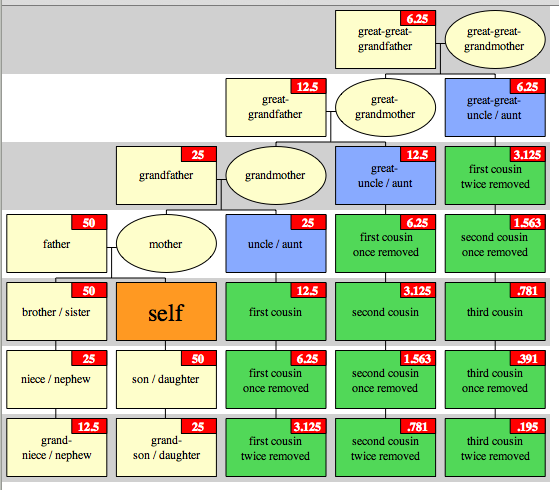 The chart also ignores relatively rare phenomenon such as the elusive double cousin. These relationships arise when two siblings of one family reproduce with two siblings of another family. This results in the children being related to each other through both parents, and sharing the same grandparents. As a result, double cousins are genetically equal to half-siblings, sharing double the genetic material normally seen in first cousins.
Doug
September 16, 2011
Not sure I understand. I would expect to share well over 99% of DNA with my immediate relatives. How do you calculate that I share only 50% DNA with them?
Joshua Kennon
September 16, 2011
Replying to Doug
Your body was created by taking roughly 50% of the genes from your father and 50% of your genes from your mother. If you have siblings, different genes in different combinations were passed onto then due to sexual reproduction creating a roulette effect, resulting in siblings sharing roughly 50% of the genetic material, as well.
The exception is identical twins, who share 100% of DNA due to coming from the same egg and the same sperm, which split and began reproducing independently from the same gene pool combination.
On a related note, a common misconception is that identical DNA must result in identical outcomes. Identical twins, for example, have different fingerprints, which you can read about here: http://www.nytimes.com/2009/10/06/science/06qna.html. If one twin suffers from autism, there is only a 90% chance the other will, too (not 100%). If one twin is gay or lesbian, there is only a 50% chance the other is too (not 100%), etc. etc. This is because of, in simplified terms, the fact that our genes have 'on/off' switches attached to them that can be flipped through conditions in the womb, environment throughout life, exposure to certain chemicals, and a host of other factors. For a very basic explanation of how genes get flipped on or off, read http://www.thetech.org/genetics/ask.php?id=63
And, of course, it's fascinating how our ancestral DNA plays a role in our day-to-day lives. Most of the humans alive on planet Earth cannot drink milk; the figure is around 70% for adults. If you live in the United States and are white, though, you wouldn't realize this because your ancestors developed a mutation that allows us to process cow's milk. This explains more: http://www.thetech.org/genetics/ask.php?id=250
If you prefer a hierarchy written out, Genealogy.com has that at http://freepages.genealogy.rootsweb.ancestry.com/~laetoli/degree.html
Doug
September 16, 2011
Replying to Joshua Kennon
Ahh ok.. it is just a semantic difference then. I was comparing your percentage to statements like "Humans share 98% of their DNA with chimps". That percentage is about how much of the data contained in the DNA is the same regardless of ancestry, where you are talking more about the bloodline path of where it came from. Thanks for the clarification!
Salamander
March 21, 2012
Replying to Doug
I agree the "DNA shared" figures are misleading. They make it sound as if there were an infinite numbers of genes, when of course there are only so many ways to code for whatever protein. Perhaps it would be better stated as "probability you share a given gene because of shard ancestry" for, say, eye color (which is itself polygenic, not blue-or-brown as taught in grade school!). Some genes also tend to be transmitted together. You share some/many genes by pure coincidence. Thanks.
Re
January 1, 2015
Replying to Salamander
There may not be an infinite number of genes, however there may be infinite COMBINATIONS.
http://genetics.thetech.org/ask-a-geneticist/infinite-combination-genotypes
TL Howard
May 11, 2013
Replying to Joshua Kennon
Actually, the most recent and large sampled research (Australian Twin Registry) plus another (forgot its name, sorry) shows that the concordance of monozygotic for homosexuality (male) is only 20%. There is obviously a biological cause/trigger (with only a genetic susceptibility to that environmental trigger) to male homosex.
Drakkar77
July 2, 2013
Replying to Joshua Kennon
The gene that processes lactose can be switched back on by consuming enough milk, at least in some people. Epigenetics is still a rather new science and so it's not understood as well yet.
Matthew
December 4, 2013
Replying to Joshua Kennon
Am I 50% my father and 50% my mother then? Am I not unique? Is there anything unique about me? I dont want to be 50% someone and 50% of someone else 🙁
Joshua Kennon
December 4, 2013
Replying to Matthew
Your genetic material is but the combination results in a completely new, never-before created outcome that is entirely unique.
Matthew
December 4, 2013
Replying to Joshua Kennon
But still that combination is 50% my mother and 50% my father??? It makes me feel sick.
-A
December 22, 2013
Replying to Matthew
I actually think it's a beautiful thing. You come from both your parents, but are made from a very unique combination of their DNA - as well as that of your grandparents, great grandparents, etc.
Matt
February 27, 2014
Replying to Matthew
Are you serious? How does that make you feel sick?? That's the entire point of replication.. survival. We are the result of everyone who has come before us. (see what I did there?)
Matthew
February 28, 2014
Replying to Matt
It makes me feel sick because it means there is no me. If im half my mother and half my father, wheres the me part? See what I didnt do there...?
Frank
March 6, 2014
Replying to Matthew
No I don't. By your definition no organism that has ever lived is much of themselves. Only thing that are more "themselves" than the rest are tumours. Trying to relate the "you" as a philosophical term to genetics is just plain dumb.
Matthew
March 16, 2014
Replying to Frank
Tw*t. Off course you didnt see what I DIDNT do there.
Im glad my question revealed your non-existent sense of self, and you then reintergrated yourself by making the source (my question) invalid. Too "philosophical"?
Jeff
March 6, 2014
Replying to Matthew
It makes me feel sick how dumb you really are, Matthew.
Matthew
March 7, 2014
Replying to Jeff
There we are then thanks very much.
Matthew
March 16, 2014
Replying to Jeff
Did you read Franks comment before you responded? And dont use my name like you know me, Jeff/tw*t.
jamiinvegas
November 26, 2014
Replying to Joshua Kennon
Actually you are more closely related to your mother genetically than your father.
BarbB
January 2, 2015
Replying to Matthew
It sounds to me as if your parents are not very nice people and you don't want to be like them. Your genetic makeup is not your destiny. Your height is a trait that is highly determined by your genes, but whether or not you are kind is something over which you have a high degree of control.
Zachary Johnson
August 21, 2014
Replying to Joshua Kennon
It's basically 0.5 to the power of X where X = the amount of tiles you move across from child to parent to find the relevant relative.
William_JD
June 8, 2014
Replying to Doug
How does he calculate that? By using sloppy thinking.
K
September 22, 2012
What are the figures for half-sibling relationships?
Joshua Kennon
November 30, 2013
Replying to K
Cut the sibling percentages in half.
Beetlejuice118
January 12, 2015
Replying to Joshua Kennon
lol
Tashina
January 6, 2013
I found out I have a cousin whos dad is my mom's scound cousin. And his mom is my dad's scound cousins aswell, how much DNA do we share?
marinegolfer68
April 9, 2015
Replying to Tashina
depends on what time the train left New York... actually according to the chart, the become closer related dna wise... this cousin would be the same as a first cousin (per dna) to both your mom and dad which would make a second cousin for you (per dna) 6.25
Lukek79
April 29, 2013
Anyone noticed how those percentages dont add up to 100? Haha
Lukek79
April 29, 2013
But instead 341.211? hmmmmmmmm
Joshua Kennon
April 29, 2013
This is a joke, right? Please tell me you realize the numbers shouldn't add up to 100% ...
Zachary Johnson
August 21, 2014
Replying to Joshua Kennon
Yh, its supposed to be 50% to the power of P where P = the amount of relatives you go through and including yourself as +1. So 0.5^P+1 Mathematically its impossible
Joshua Kennon
April 29, 2013
Again, this is a joke, right? ...
Frank
March 6, 2014
Replying to Joshua Kennon
There are people believing Santa Claus is invented by Coca Cola and the moon is made of cheese, what can you do.
John Tate
April 30, 2013
Why would the numbers add up to 100
jjay09
May 3, 2013
why is it that even charts displaying the family tree is done so in a such a sexist way
Joshua Kennon
May 3, 2013
Replying to jjay09
Given that there were two possible ways this chart could have been presented by whomever designed it, it is impossible to say whether or not the chart is presented in a sexist way as there was a 50% probability of either the paternal or maternal lineage being used as the illustration (a complete family tree would have been more difficult to read and therefore not as optimal to utilize as a visual aid so we will exclude it from the analysis).
Absent other information, a determination of sexism is impossible. For example, had a maternal family tree been used, a man could have claimed it was sexist but it would not make it so. There simply isn't enough evidence to indicate either way.
Without said evidence, or any additional supporting data, the conclusion that the chart is sexist is a form of subconscious confirmation bias meant to strengthen a present conviction in the observer that reinforces preconceived ideas.
(An an interesting discussion of second and third order effects, one could argue, upon studying, say, 100 textbooks with family trees in them, that a distribution that represented more than an approximate 50/50 split would be sexist but even this would be problematic as people are influenced by their life circumstances. In the lower and middle classes, nearly 1 out of 2 boys are now born to a mother out of wedlock, which would theoretically lead to a higher probability of them using her bloodline if they were preparing a chart such as this, skewing the results in favor of women. On the other hand, given past legal precedence based on the nearly now-defunct patriarchal structure of marriage a century ago, names are passed down from the male in almost all cases as a result of cultural practice, meaning that a person might be more interested in knowing where his or her namesake originated due to a myriad of subconscious forces, such as mere association tendency (which is so powerful, there is overwhelming statistical evidence that boys with names like "Dennis" become dentists far more likely than should be the case; it's the way the human mind pulls us in certain directions). Therefore, you could expect the distribution to favor males. Still yet, whomever prepared the chart could be a medical student studying Y-STR on the Y-Chromosome and want to illustrate the unique situation found exclusively in males that causes each and every person on the male only chart to share an identical copy of nearly half the genetic material that composes their body.)
TL;DR: It is mathematically impossible based on present evidence to conclude whether there was any form of gender preference in the creation of the chart.
Jonelle
July 24, 2013
Replying to Joshua Kennon
try this article - Charlemagne's DNA and Our Universal Royalty
We're all probably related!
Re
January 1, 2015
Replying to Joshua Kennon
The only thing that needs to be done to satisfy this person would be to
list the women first and then show the men as subservients to the women,
and then maybe to add a 50 in the mother box and a 25 in the
grandmother box and so on. This chart has been simplified to remove any
redundancies because everyone is assumed to know that the mother and the
father are on the same level and there is no such subservience unless
you are reading into the chart that way, and then if you were, then she too is sexist in your own way (reverse discrimination). (I hope I am not being sexist by assuming that JJay is female.)
Darrel
August 15, 2015
Replying to Joshua Kennon
So, humans and chimps share 97% of DNA, but siblings, parents, and children only share 50%?
stacie
June 4, 2013
I have a first cousin that i believe is my half brother what would the percentage be if we did a dna test?
Joshua Kennon
November 30, 2013
Replying to stacie
If he is your cousin, 12.5%. If he is your half brother, 25%.
regina
October 5, 2014
Replying to Joshua Kennon
I had my father's nephew take the test, his test came back 20 something % and my father's niece also took test and she shows about 12% so what am I looking at a possible 1/2 sibling. The nephew is my fathers brothers child and the neice is my fathers sisters child. so they would be my first cousins,right, with the chance the nephew is actually my 1/2 sib.
Beetlejuice118
January 12, 2015
Replying to regina
The tests said you share roughly 20% with your male cousin and only 12% with your female cousin? If that's the case your dad fucked his brother's wife and she had his baby. I'm assuming you're trolling though because your family would have split up the minute the test came back and punches would have been thrown
regina
April 2, 2015
Replying to Beetlejuice118
Actually they are all gone, so there is no way of knowing for sure, other than the facts of the DNA profiles. Thanks for the response. I will be taken my theory to the grave with me.
Tonia Olsoe-Rubeo
October 24, 2016
Replying to regina
I think it is an average. Your dad gets half his genes from his dad and half from his mom. But which ones he gets from each parent may be more or less similar to which his siblings get. Your dad and his brother may have had a higher number of genes in common (they were both more like their dad's dad for example) than your dad and his sister (who might have been more like her dad's mom). Leading to larger genetic similarity with his nephew than his niece. Not necessarily is there some deep dark secret.
Jay Sullivan
July 27, 2013
This chart is completely wrong. This is not taking into account that the most unrelated people in the world share about 99.5% of their DNA. Taking that into account, siblings share about 99.75% of their DNA ((100% + 99.5%) / 2). Cousins share about 99.615% ((99.75% + 99.5%) / 2). Second cousins share about 99.5575 ((99.6125%+99.5%) / 2), third cousins 99.52875, etc.
Melissa Ramirez
August 20, 2013
What is he if we have the same Grandmother but different grandfathers? Do we have the same blood?
Joshua Kennon
November 30, 2013
Replying to Melissa Ramirez
You would cut the appropriate figures in the chart in half (divide by 2) as you share half the common ancestors.
wayne
November 20, 2013
I assume when you say siblings share 50% genes that this is for all practical purposes an approximate figure. If I have 4 brothers, they all share 50%, yet a different combination of the original pool?
Rae
November 25, 2013
Not sure I am understanding. I met someone I enjoy spending time with and recently was told that my great grandfather and their biological great grandmother are brother and sister. I was devastated and was trying to figure out are we really genetically related and if so, what is the relationship.
Joshua Kennon
November 26, 2013
Replying to Rae
That means your shared common ancestor is on the great-great grandparent level. You are 3rd cousins with only 0.781%, at most, shared genes. You are practically strangers. None of the 50 states even ban second cousins and you are even more distant that that - I know of nowhere in the world, throughout all of history, where such a congress would be forbidden.
Frankly, I can't name a single one of my third cousins and wouldn't know them on the street if I met them. I imagine there are a significant amount of people in the United States married to their third cousin and don't have a clue. This is not something that should cause you any emotional distress.
bianca
November 30, 2013
Is the DNA percentage less for second cousins who share the same great grandmother but different great grandfather? would it be next to nothing? I apologize for my ignorance in advance.
Joshua Kennon
November 30, 2013
Replying to bianca
Yes, the number would be cut in half as you only share a single common ancestor instead of two common ancestors. You'd only share a maximum of 1.5625% of your genes. There should be no issues with birth defects were such people to meet randomly, get married, and have a child, nor would such a union be prohibited anywhere on the planet to my knowledge.
kim
December 2, 2013
Replying to Joshua Kennon
I didn't grow up with my boyfriend or know him
but found out that my dad and his mom are 1st cousin s and we share the same great grandparents.....what are we 3rd cousins?
AntonDubinksy1960
April 12, 2014
Replying to kim
You are first cousins once removed, so share about 6% of the same genes.
PJ
July 2, 2014
Replying to kim
You are first cousin once removed to his mom and he the same to your dad. that makes the two of you as far apart genetically as second cousins, meaning you share about 3%
JD
January 18, 2014
I don't understand what they mean with "first once cousin removed" or "second cousin once removed". Why does removed mean there? Why remove them?
I would appreciate if someone could explain please. Thanks very much.
JD
January 22, 2014
Replying to JD
apparently I made typo: I meant: "first cousin once removed" and what does "removed" mean there? and the rest of the questions...
Thanks very much for your help.
Frank
March 6, 2014
Replying to JD
Weird English family member classification that basically
screws up anything to do with generation. Without the removed and stuff basically your father's cousin is your cousin too......
qreusgurl .
July 13, 2014
Replying to JD
Removed means your cousin's children. It's just a simpler way of saying they're not as closely related. It can get confusing.
Welbru
December 29, 2014
Replying to qreusgurl .
No, it can also be your cousin's parents. It means a generation up or down.
In my family we call cousins once removed up 'uncles' and 'aunts' even though they're not direct uncles and aunts.
Brad
January 24, 2014
I was adopted at 3 days, I know my mother, I think I know my father, Could I DNA test my possible sister's daughter and match to mine to see if we match. (Sister would have different mother). Would it be enough DNA match to see if I am part of that family?
JD
January 27, 2014
Replying to Brad
why not compare your DNA with possible half sister then you get better results to show you are or not part of that family. There should be about 25% match between you and her. With her daughter the percentage obviously would go down more to 12.5% match or even less I think...
Best wishes...
Libby Hanna
January 26, 2014
i'm a double cousin, mums brother married dads sister, its super interesting to know how genetically similar I am to my cousins!!!!
Dylan Mckay
August 4, 2015
Replying to Libby Hanna
they are like half siblings to you 25%
kristy
February 12, 2014
Why would there not be a 50% in the mothers box that makes no sense to me
Frank
March 6, 2014
Replying to kristy
Assuming either parent is the same? Duh?
Tom
March 26, 2014
In the context of us sharing 96% of our genes with chimpanzees how does this chart make sense? Do I share more genes with a chimp than my sister?
Caihlyn
March 30, 2014
Replying to Tom
100% of your genes are from 'humans'. 50% of your genes are from a specific human being, your mother and the other 50% are from a specific human being, your father. You are 100% made of human genes. Chimps share 96% of the same genes as 'humans' ... not a percentage of a specific human being's genes.
andrew
May 22, 2014
Do we share 25% of our dna with half siblings?
Dave Stupple
May 28, 2014
Surely this is not right. My sister and I both got 50% of our DNA from our mother and 50% from our father. But we almost certainly did not inherit an identical 50% from each, so I do not have 50% DNA in common with my sister. The common DNA down the bloodline is always going to be lower than these figures, isn't it?
Ulysses Elias
August 26, 2016
Replying to Dave Stupple
If you and your sister inherited the same 50% of DNA from each parent then you and your sister would have 100% DNA in common with each other. Its because the DNA you receive from each parent is not the same as the DNA that your sister received from the same two parents that the amount of shared DNA is claimed to be only 50%
William_JD
June 8, 2014
None of this analysis works. Parents share almost all of their genetic material. If not, they couldn't produce offspring with each other. The amount of shared genetic material among siblings (or cousins or whatever) will vary depending on the relatedness of the relevant ancestors and random chance in how the genetic cards are dealt.
Nathan
June 8, 2014
Replying to William_JD
Let me take a stab and guess you didn't do so hot in your science classes? The analysis is correct. Borrow a high school genetics textbook and check the index for autosomal DNA consanguity. The layout might change but they all have the same information because that information is accurate. It shows the average contribution from each ancestor assuming no intermixing of the family tree for several generations to avoid more complicated calculations such as double cousins being as related as half siblings.
Sardeth42
July 22, 2014
Replying to William_JD
..? I don't follow?
These are just statistical probabilities. Within a few generations other (healthy-normal) factors aren't going to be enough of an influence...
The more people you tested this the more accurate the numbers would become. 'Tis the nature of statistics...
^None of this should have seemed unclear.
Of 46 Chromosomes your parents each have each single sperm and egg only carries 23.
Additionally of these chromosomes they are broken apart and recombine together in a (most likely) different manner...
Whilst we might share the vast majority of our DNA with most every other human on this planet, their are different alleles.
These are averages that are given presuming otherwise unrelated people; and as we know everyone is related somehow, but this shouldn't even be an issue as after consecutive generations because presuming no major irregularities,
AI would only share less than 0.00001% gene-similarity with any one of my Great*18—Grandparents (That would be a "level 20" ancestor of mine)
And I would have 1,048,576 Great*18—Grandparents under the atypical model provided here, but honestly even if you adjust those numbers either way by an 'order' of 15 it's still going to be less than 5%...
me
August 20, 2014
So my dad has two cousins who are married. The other one is his paternal cousin and the other one is his maternal cousin, so they're not related to each other, but both are his cousins. Their children are my double second cousins or what? What would the percentage be?
Mike
September 23, 2014
Ok I'm the father of two girls I just took a DNA test on my oldest she is not mine The weird thing about on the test it says shared alleles I'm 16 of 23 with that many matches I would think that I would be the father but I'm not here's the question could it be one of my brothers or even how about my father
SJ
October 18, 2014
I know normal siblings are ~50% similar in DNA makeup. What would the percentage be if their parents were first cousins? ~75%?
On a side note: I only received 19% DNA from my paternal grandmother. I know it should be ~25%. What is the variance extremes that others have seen? Thanks!
Karen J. Harrington
December 2, 2014
What is the percentage of DNA I would share with my half-sibling's daughter? I am female, half-sibling is male. He is 10 years my senior; his daughter is 12 years my junior. Half-brother and I have same birth mother.
Welbru
December 29, 2014
Replying to Karen J. Harrington
She's your half niece, so wouldn't you just halve the percentage for a full niece? I don't thin gender or age would have anything to do with it.
Beetlejuice118
January 12, 2015
Replying to Karen J. Harrington
Tell me that wasn't a serious question lol
Beetlejuice118
January 12, 2015
Replying to Karen J. Harrington
Sex and age have nothing to do with the gene you share with relatives (if you don't count the X chromosome men receive from their mothers, which is about as significant as a drop of water in a pool). Age will never have ANYTHING to do with ANYTHING. You share roughly 50% of your genes with your full-sibling. If it's your half-brother you share half of the genes you and a full-sibling would share (which is 50%). So you and your half-brother share about 25% of your genetic material. When he has a child, you will share half the genes with his kid as you did with him. So you will share 12.5% with your half-brother's daughter (the same amount first cousins share).
Paul
June 20, 2015
Replying to Karen J. Harrington
Rule of thumb for any half relationship is to find the full relationship percentage and divide by two.
For example, full siblings average 50% shared DNA, so a half sibling will average half of that (25% shared DNA). So to answer your question:
Your half sibling's daughter is your half niece, so since you would share 25% DNA with a full niece, you share half of that with a half niece, therefore the answer to your question is 12.5% on average.
Sassy lou
December 29, 2014
All my husband wants to know is how much for his sperm? He has delta 32!!!
BarbB
January 2, 2015
It sounds to me as if your parents are not very nice people and you don't want to be like them. Your genetic makeup is not your destiny. Your height is a trait that is highly determined by your genes, but whether or not you are kind is something you have a high degree of control over.
Brilliand
January 30, 2015
Don't be careless with infinity, man. The number of possible gene combinations is indeed vast, but you cannot get infinity by multiplying finite numbers.
The author of the article you linked did the same thing calculators tend to do in that situation - "The number's too big, I quit."
JustTellMeWhy
March 13, 2015
Joshua, this chart is great, it's exactly what I was looking for! Now, I know this article is a few years old, but hopefully you're still responding to comments. I recently signed up for a DNA testing website, and they told me that I shared %0.92 DNA with somebody. I'm just wondering what math formula I could use to figure out what my possible relationship is to this person. Any ideas?
vermontsilkie
April 8, 2015
Thanks for this chart. Even my college genetics professor couldn't explain when I asked how much DNA I would share (on a statistical basis) with double second cousins. (Grandmother's brother married Grandfather's sister). Your chart makes it clear.
Now a question: I have a brother with whom I share 44% DNA instead of the expected 50%. I realize that's enough shared to rule out a NPE which we didn't think anyway. Plus I obviously can't share the Y chromosome. But still... are you just doing the mathematics or do you understand from a genetics point of view how that happens?
vermontsilkie
April 12, 2015
Replying to vermontsilkie
To partially answer my own question - this kind of statistic is an area my reasonably recent genetics course did not cover - I am picturing my parents with two copies of each chromosome (each with its many genes). I know each will pass only one from each set down to me, and with a bit of luck I will end up with a full set of matching pairs but one from each parent. (And yes, I know it is actually more complicated than that considering there is also recombination in the mix.) Now the same two parents create another child. But Mom's egg is a different one, with a randomly different set of her genes, that being again, just one from each of her pairs. Same with Dad's sperm. Statistically that next child should get 50% of the same genes I got but *WAIT* not necessarily exactly. Theoretically the genes could be all exactly the same or all completely different but except for identical twins which is not the same as division of the already-fertilized ovum occurs, it just doesn't happen. So really, sharing only 44.2% with my full brother isn't that unexpected. I am female so we already know one chromosome I don't share, the Y. We could have the same X chromosome or not. And so it goes.
Stevie Mac
September 7, 2015
Replying to vermontsilkie
Logically, if you have a double relative, you'd just double what you have in common with the single version of that relative.....because you have the single amount but from both sides. So, second cousins= 3.125. x 2 = 6.25%.
50% is just doing the maths.. its like an average but sure they understand how it happens. You definitely have exactly 50% from each parents though....
Атул Кумар
April 10, 2015
Then why some article say we share
98 % with Chimpanzee
85 % Zebra fish
36 % Fruit fly
Are they even closer than relatives ? 😛
Zachary Johnson
July 28, 2015
Replying to Атул Кумар
This. You can't assume that genetic copying from parent to child results in 0.5^X genetics for each generation you move through up or down when using this.
Stevie Mac
September 7, 2015
Replying to Атул Кумар
I read that humans have approx. 99.9% of the same genes. These percentages are saying how much you inherit directly from each parent. I think another way to look at it is you have 50% of the other 0.1% from each parent. That is an important 0.1% because its the part that makes people differ, or makes them individuals, so getting that from your parents makes you like them above and beyond your similarity to all people.
HannahHannah
June 22, 2016
Replying to Атул Кумар
It's been like a year, but the relation to other animals is from the DNA that makes us human. The human species as a whole has human DNA. Fruit flies have their own DNA. Chimps do, as well.
When you get into the genetic similarities between familial relations, you are look at an entirely different relationship. You aren't looking at the differences between the DNA of species. You are looking at variations within the species.
Humans and chimps have several key genetic markers that are different from each other, with a 98% similarity.
Zameer Shaik
July 6, 2015
My mother's father and my hubby's father are ownmyrothers in the same way My mother's mother and my hubby's mother are own sisters...
Technically my hubby is my mother's first cousin(female)
So to what extent does my mother's first cousin(female) and My (male) DNA matches?
My kind request to answer quickly
We r getting married soon
Thanking you
MaryJo Wilson
October 7, 2015
Replying to Zameer Shaik
I think you should share about 6.25% of your DNA. The equivalent of her being your 1st cousin once removed.
No Name
August 14, 2016
Replying to Zameer Shaik
Ew you're marrying your double cousin
Ulysses Elias
August 26, 2016
Replying to Zameer Shaik
Don't worry. Charles Darwin married his first cousin and had children with her and he knew more about genetic inheritance than just about anybody.
Jessij 23
July 8, 2015
Hi well I see that this is a super old discussion but I guess I could give it a try and hope someone can answer my question. .. my sister and I married two brothers not that is mattes what they ate but my sister and my brother in law had 3 sons and my husband and I had 3 daughters. .. sooo... my question is how genetically close are my daughters and my nephews? Can they pass as siblings considering that they share the same family genes fom both sides ?
Jessij 23
July 8, 2015
Hi well I see that this is a super old discussion but I guess I could give it a try and hope someone can answer my question. .. my sister and I married two brothers not that is mattes what they are but my sister and my brother in law had 3 sons and my husband and I had 3 daughters. .. sooo... my question is how genetically close are my daughters and my nephews? Can they pass as siblings considering that they share the same family genes fom both sides ?
Marli
August 18, 2015
Replying to Jessij 23
They can only pass for double cousins since you and your sister married two brothers. They can't pass for siblings. Sorry for my bad grammar.
Marli
August 18, 2015
Replying to Jessij 23
Genetically they are as related as half-siblings.
wanda
August 20, 2015
Ok, kind of a gross question.. but "if" my parents were full siblings, would I have more than 25% shared DNA with one of their siblings?
Stevie Mac
September 7, 2015
Replying to wanda
Yes. I think if your parents were full siblings, you'd also be closer to each parents. You'd have 75% in common with each.
You'd also have 50% in common with one of their siblings. Probably the easiest way to think about it is they'd be a double auntie or uncle.
I think of it like you are 100% of both parents which makes your auntie/uncle as close as a full sibling. You are just two of their siblings recombined.
(Actually you have approx. 99.9% of your dna in common with all humans....so I think we are talking about 50% of the 0.1% that makes people different).
Larry Gong
January 2, 2016
Replying to Stevie Mac
confused the sh* outta me but who gives..
De Brown
October 2, 2015
If a half sibling test was done without the fathers dna what do the following numbers mean? Subject 1 .00334 = 0.3% and #2 was 0.39 with 28.2% ? Are they related
Bill andrade
October 13, 2015
Maybe someone can help. My wifes second cousin lives in a home That we Have on our property. We have applied for a hardship so she can remain there the rest of her life. She is 80 years old but the planning dept says she is not
A relative.
Would a sna test help.
Larry Gong
January 2, 2016
Replying to Bill andrade
fk no..
Anthony Sassienie
November 29, 2015
So basically, once we get passed our siblings, parents, aunts, uncles, grandparents, our own children and grandchildren, then we are hardly related to the rest of them.
I am very close with my first cousins relationship wise and comes as a bit of a shock that I am only 12.5% related to them and is not far short off the stranger mark.
Ulysses Elias
August 26, 2016
Replying to Anthony Sassienie
No, it is not true that you are 12.5% related to your first cousin" It IS true that you share 12.5% DNA. These are two very different things.
Remember that you are related to your cousin by time spent together, i.e. a shared PERSONAL history, a shared family culture, a shared FAMILY history, shared family stories, etc.
Tim Gray
June 28, 2016
Question: If two sisters share 2,069 cms DNA, I'm assuming they are half sisters. However, the family knew this but they didn't. Some expect the brother of the father to be the dad of one of the girls. However, wouldn't you expect more of a closer match if that were the case, around 2700 cms or am I looking at it wrong? I match them on the fathers side and match one at 256 cms but the other at 96 cm's. Is that more indicative of perhaps a cousin of the father instead of a brother? thanks
vlinderbeest
July 4, 2016
Something isn't right here. If I only share 50% dna with my brother, but I share 95% dna with a chimp, how come my brother still looks more like me than a chimp does?
Niclmp
July 27, 2016
What about a cousin from your moms twin?
abel espinoza
July 28, 2016
What if theres more than one brother is it still 50 ?
Hannah
July 31, 2016
Replying to abel espinoza
Yes
leon
July 30, 2016
right
Brad Parr
August 2, 2016
If I (Brad) has the parents Glen and Tracy and my one sister (Alison) has the parents Tracy and Matt, and the other sister (Leah) with the parents Glen and Steph, how genetically alike am I to each of them?
Laurence Lhoest
August 4, 2016
If someone shares 0.25% to 0.30% of my DNA. Does it mean that we automatically share the same great great grandparents or great great great grandparents?
No Name
August 14, 2016
Another weird relationship I thought of today, if your dads mom and moms dad (or the other way around, whichever you wish) had a kid. Would be a double aunt/uncle to you. What percentage of genes would you share with a double uncle or aunt?
No name
August 21, 2016
My moms sister had a baby with my dad's cousin what am I to the baby
Tonia Olsoe-Rubeo
October 24, 2016
Replying to No name
You are BOTH a first cousin to the baby (your moms are sisters) and a second cousin to the baby (your dads are first cousins).
Ruth Sakiestewa
October 31, 2016
Replying to Tonia Olsoe-Rubeo
What is considered inbreeding in the anthropological sense?*
Lionel St. Clare
August 31, 2016
I just want to point out that the percentages in the boxes (except for parents, which are "always" 50%) represent averages that can vary from person to person. On average we have 50% shared DNA with siblings, but the number can actually range from 0 to 100 percent (look at identical twins for example). Similarly, aunts/uncles/grandparents AVERAGE 25, but can range from 0 to 50.
It is inherently probabilistic. By change, the 23 chromosomes I got from my mother could be, by chance, the very same 23 my sister did not get.
DrJay DrJay
February 16, 2017
Replying to Lionel St. Clare
Very misleading comment/thought process. The probability curve is a bell curve and not linear. Therefore, though it might be "theoretically possible" to have inherited 100% of the same genes, this would be the equivalent likelihood of getting struck by lightning in the same spot on the earth every day for the rest of your life, or drawing 10,000 royal straights in a row at poker, theoretically possible, but realistically nil. For example, over 99pc of people are covered in the 22-28% range for the 25% boxes, a MUCH narrower bandwith of realistic possibility than just saying 0-25%.
Lionel St. Clare
August 8, 2017
Replying to DrJay DrJay
That's why I said there was a range of probabilities for each percentage. Obviously have 100% of the same genes would be hopelessly unlikely. Please don't twist my words.
Jane
September 10, 2016
Ok so I've been wondering about the relation between me and a friend of mine, my grandmothers sister married his grandmothers brother how are we related ?
Tonia Olsoe-Rubeo
October 24, 2016
Replying to Jane
Your great-aunt married his great-uncle. (So you both share a great-aunt and great-uncle, but you are each related to a different side of that couple.) Let's assume this great-aunt and great uncle had a Son Adam, who had a Son Ben. Your parent and his parent are each first cousins to Adam. (If your parent and his parent were introduced to each other, someone would say: "This is your cousin Adam's cousin.")
Adam is a first cousin once removed to both you and your friend and (on average) shares 6.25% DNA with each of you, but not necessarily is that same amount shared between you and your friend.
You and your friend are one generation lower than your parents, so you share a second cousin Ben. You and your friend can each say to the other "You are my second cousin Ben's second cousin." You and your friend each share 3.125% DNA (on average?) with your second cousin Ben, but not necessarily with each other.
dan69
April 16, 2017
Replying to Jane
Since u have the common great grand parents u r 2nd cousins
Carrie Nyquist
September 15, 2016
My cousin and i are double cousins? His mother my dad brother and sister, my mother his dad brother and sister? My cousins kids and myself are considered what?
Tonia Olsoe-Rubeo
October 24, 2016
Replying to Carrie Nyquist
Double cousin once removed
Ruth Sakiestewa
October 31, 2016
Replying to Carrie Nyquist
Aren't you & your cousins simply half sisters & half brothers?*
DrJay DrJay
February 16, 2017
Replying to Carrie Nyquist
This is the exact definition of double cousins, or double first cousins to be extra precise. (I don't know anybody who actually uses "half-cousin", "double cousin", "cousin twice removed", etc in actual speech/ I always just say cousin for them all and love them all the same lol.)
Your wording is complicated, but basically 2 sets of siblings have children. That is the exact definition of double cousins.
The resulting children have different parents but share the same 4 grandparents. You're genetically about as similar as half-siblings (25%), since all your DNA ultimately comes from a combination of the same 4 people.
Your double cousin's kids are your double first-cousins once removed. Whenever you "go down" a generation on one side only (in this example, going "down" to your cousin's kids), you add +1 removed. If it were your cousin's grandkids, they would be your double-first cousins twice-removed. His great-grandkids would be your double-first cousins 3-times removed and so on.
carriefornia
September 15, 2016
I am so confused , I met my double cousins daughter we both share the same family members on her dads side, so how would I introduce her ? Shoulkd I say ist cousin 2nd cousin or what? The weird part her dad and I we born 6 hours apart same hospital same doctor and we look alike.
Trent
March 13, 2017
Replying to carriefornia
She would be your double 1st cousin once removed, however you could just say she is your cousin or cousin's daughter. I also have 2 double cousins so been down this road before.
carriefornia
September 15, 2016
How much DNA do we share the double and myself?
Ezra Mable
September 19, 2016
Replying to carriefornia
This is just a guess from what I've pieced together looking into DNA: On average, people share about 25% of their DNA with their aunts and uncles. This would make both of your cousin's parents about 25% related to you.They could randomly give the whole of their 25% to your cousin, 0% to your cousin, or anything in between. So, you could be anywhere from 0% related to 50% related to your cousin, hypothetically. It would probably average out over many people in a similar situation to be that you are 25% related to your cousin. That makes them, like the article says, genetically equal to a half-sibling but also an aunt or nephew. That person's daughter would be, on average, 12.5% related to you, genetically like a cousin. I think that the actual relationship would be first cousin once removed (the 6.25% person in the chart above) regardless of how similar you two are genetically because it is based on the family tree position and not genetics. First cousins are related to you from a diagonal line down from your grandparents. How many times they are removed depends on their generation. This girl is one generation after yours, or three down from your grandparents instead or two down like you.
carriefornia
September 15, 2016
This is obviously and old post I guess I will leave it unsolved it is a real brain thing now!!!
Cynthia
September 16, 2016
I thought for many years that I had a sister, It turns out she was my mother. How much dna will I share with her other children? I do not think that we had the same father
DrJay DrJay
February 16, 2017
Replying to Cynthia
Then you are half-siblings, same mother and different father. This would be 25% shared genes, or half the amount for full siblings.
Bob Roberts
September 21, 2016
2 kids overweight, one 2% body fat. Uncle thin.
Cortney
October 4, 2016
If me and my cousin have the same grand mother but not the same grand father are we considered half first cousins or just first cousins
dan69
April 16, 2017
Replying to Cortney
u would just call each other first cousins but u would be genetically half first cousins which is the same as a first cousin once removed
Muralikrishna
October 19, 2016
our father died 46 ago, when I was one year old, leaving properties to his own sister for life time enjoyment and after her life time to come to his son / daughter i.e we. .Now our aunty does not agree that we born to our father / her brother, and thus she claims her self to the LH of the property. Please advise how can we prove our paternity. They deny all records. We are well educated and live far away from our home town. Our being away from india, being misused by our aunt in the most inhuman way. If I propose for DNA test with my Aunt ( my fathers own sister ), can I prove that I my biological father and her own brother are same ? Please advise ...
freddy bobby
October 19, 2016
if i sleep with my sister how many dna's will she have?
Char
October 23, 2016
My cousin and my mothers are sisters and our fathers are brothers, is my cousin and I basically sisters?
Me
October 29, 2016
Replying to Char
Genetically, you're the same as half sisters.
Tido
October 27, 2016
If your 50% with your brother/sister then where does the other 50% in your brother/sister go to?
Handsome Jack
November 25, 2016
Replying to Tido
50% is just an average. It is possible to be anywhere from 0-100% related to your sibling since you and them only receive a randomized 50% of genes from each parent.
Tido Black
January 7, 2017
Replying to Handsome Jack
That's true. That is unless you're identical twins, then you should technically have 100%.
DrJay DrJay
April 18, 2017
Replying to Handsome Jack
It's also "theoretically possible" that a meteor will strike the earth and wipe out our entire species within the next 5 minutes. However, this is not gonna happen.
Ellie on Disqus
January 2, 2017
Replying to Tido
The 50% of each parent's genes comes from a cell in meiosis. So the other 50% is in another sperm or egg cell with the exact opposite chromosomes from each parent.
Tido Black
January 7, 2017
Replying to Ellie on Disqus
That makes sense. Thanks
Dsess
October 27, 2016
If my grandfather has a brother which is my great uncle (they have different fathers)... What would the percentage be with me and my great uncle's son?
DrJay DrJay
February 16, 2017
Replying to Dsess
For half relationships, you literally halve the probability percentage for the full relationship/ For example, full siblings share about 50% of their genes, therefore half-siblings share about 25%. Your great uncle's son is your parent's cousin , therefore your first cousin once-removed. However, you are technically "half"-first cousins-once-removed (quite a technical mouthful), since they are half-siblings.
Since FULL first cousins once removed share 6.25%, just halve that and you get 3.125% between you and this relation.
Lysa Nicolle
October 29, 2016
If my DNA says I have a sister from a parent and once removed of a brother or sister or something like that. Then does that mean we are stepsister or half sistera
Tinkerbell Darling
February 10, 2017
Replying to Lysa Nicolle
Step- sibling equals NO BLOOD relation. One of their parents married one of yours. Half sibling means you and the person share only ONE parent. I don't know what you mean re: "sister from a parent once removed"
Mark H. Vosburgh
November 3, 2016
Who made this chart? If my brother and I have the same parent, we share 100% of the same DNA. My first cousin and I share 50% if we share one sent of grandparent. Someone started this chart wrong, therefor splitting every generational divide twice too much. If I'm wrong, please explain to me how. The math here doesn't add up.
bimjim
November 3, 2016
Replying to Mark H. Vosburgh
http://genetics.thetech.org/ask-a-geneticist/siblings-are-around-fifty-percent-related
asadderandawiserman
November 3, 2016
Replying to Mark H. Vosburgh
The chart is right: you have half of your mothers genes, and half of your fathers genes. What 50% you inherit from each of them is random. Your sibling also inherited half of your mothers and half of your fathers genes, but these were randomly chosen seperately from yours. On average, half of the genes you inherit from your mother, your sibling will also inherit, and half of the genes you inherit from your father your sibling will also inherit. So you only have 50% of your genes in common with your brother, even though 100% of both of your genes came from the same two individuals. (Unless you and your brother are identical twins, in which case you do have 100% indentical genes.)
Handsome Jack
November 25, 2016
Replying to Mark H. Vosburgh
I second Asadder......'s comment. The only thing I would add is that the 50% is just an average. Since you receive a randomized 50% of genes from each of your parents, it is possible to be more or less than 50% related to your sibling. It is even possible to be 0% or 100% related to your sibling, if you each received completely different or the same halves from your parents, respectively. That would be extremely improbable. Still this phenomenon can explain why some siblings look almost identical while some look radically different.
DrJay DrJay
April 18, 2017
Replying to Handsome Jack
Mark, your DNA originated 100pc from the same people, but this does not mean that you received the same gene for each trait, because the parent can provide one of two different genes for every single trait. WIth randomisation, the more traits one speaks of, the closer and closer this figure will approach 50pc shared genes between siblings.
Jack, I think you underestimate just how improbable it would be to arrive at actual values which are anything more than a percentage point or 2 off from the averages provided. Over 99pc of people will fall at or extremely near these calculations. Anything close to 0 or 100pc would be less likely than aliens landing on earth tomorrow morning at 6am - theoretically possible but severely improbable. Not worth mentioning.
Laurie Craven Grizzard
February 14, 2018
Replying to Handsome Jack
Thank~you! Someone finally gets it. There are some wacky assumptions in a lot of these comments.
DrJay DrJay
February 16, 2017
Replying to Mark H. Vosburgh
No, no, no my friend...If you shared 100% of your brother's DNA, you would be clones of one another, i.e. IDENTICAL TWINS.
You both inherited 100% of your DNA from the same PARENTS, the same people, but you did not inherit the exact same set of GENES from those people.
You know that each parent has 2 sets of genes, which they inherited from their own parents, right? When the child's DNA is being formed, half of the father's genes are selected at random and half of the mother's genes are selected at random.
Think of it this way.If your parents were each were a deck of 10 cards (representing genes), then 5 random cards would come from mum and 5 random cards from dad. Why would you expect the 5 random cards you inherited from each to be the exact same as the 10 random cards your brother inherited. Your mum might give him 1,3,5,7,9 and you 2,4,5,7,9 from her total 1,2,3,4,5,6,7,8,9,0 genes. We're only talking about ten cards, whereas genes number in the thousands. This is why you receive approximately 50% of the SAME EXACT genes as your sibling.
Then you just continue following that logic and apply to any relationship. Does that help?
Sandra
November 25, 2016
My sons married first cousins, what percentage of DNA do heri children share? 62.5 percent?
Handsome Jack
November 25, 2016
Whats interesting is that your great-grandparent and 1st cousin are equally related to you.
Khandi Marie Morrison
December 1, 2016
From what I can see on this chart, the person graphing is only following the mother's line, not both lines. Therefore, one would assume that, given two distinct lines with no intermarriage over time, each foreparent gives half of their DNA. Self>mother 50%>grandparents each 25%>great grandparents divide by 4>gggrandparents divide by 8, etc.
DrJay DrJay
February 16, 2017
Replying to Khandi Marie Morrison
This is just an example. Obviously, one could substitute male for anywhere it says female and vice-versa.
Neecee
December 4, 2016
What would my grandfathers' brothers' daughters' son be to me and how much DNA do we share? I'm lost here.
Buzzbee
December 12, 2016
Replying to Neecee
You are referring to your second cousin, and you would share 3.125% of your DNA.
N/a
December 24, 2016
My father slept with my aunt. She had a baby but my fathers claims he is not the father. I would like to do a DNA test. If she is just my cousin our DNA would be 12.5 but if she's my sister it would be above 50? I just want to make sure.
Just asking
December 25, 2016
Replying to N/a
I am no expert but do have have some similar experience. No, if the offspring of your aunt is your father's baby the MOST DNA the child could have to match you would be could be 50% match but highly unlikely. Your father has two genes to pass for each trait and could pass one to you but the other to a sibling. But odds are you and that sibling would receive at least half of the same genes. You got your mother's half, too. Unlikely that a sister would have exactly the same genes unless they are identical twins. Most likely you might receive between 13% and 25% from your aunt. If you have at least 60% same genes you are probably half siblings but it is possible it could be less or a little more. My half siblings was around 25%. Just depends on which genes they passed on to that baby and which genes were passed on to you. Also, depends on if the sister you think is your aunt is really your biological aunt. DNA doesn't lie; people do. DNA over 50% would be a possible in my mind. Best get a geneticist if it is close. 50 or less is highly unlikely but still possible.
DrJay DrJay
February 16, 2017
Replying to Just asking
Your maths are incorrect, as can be seen from the initial table. You do not share over 50% of your DNA with ANYBODY unless you are identical twins or a clone (even the children of 2 sets of identical twins would share only 50% DNA, like full siblings), so 60% is automatically incorrect. You can see that even a parent and child share only 50%, just like full siblings, and she is describing a less similar relationship than full siblings, therefore the answer MUST be less than 50% .
In fact, the situation the asker has proposed would result in a 1/2-sibling + 1/2 first cousin relationship. They would share the same father and also be first cousins through the mother/aunt. If you add the genetic probablities of a half-sibling (25%) to that of a first cousin (12.5%), then the asker should expect to have 25% + 12.5% = 37.5% DNA in common with the person in question.
More intricate explanation: Since they would share 4 grandparents and 1 parent, they would be more genetically similar than half-siblings or double cousins (sharing either 2 grandparents and 1 parent or 4 grandparents and 0 parents, at 25% shared DNA) but less than that of full siblings (sharing 4 grandparents and 2 parents, at 50% shared DNA)
dan69
April 16, 2017
Replying to DrJay DrJay
siblings can be more than 50% related but 50% is the average
DrJay DrJay
April 18, 2017
Replying to dan69
You're being fastidiously technical, which is unhelpful to people who aren't understanding the basic concepts presented. It's like arguing that it's 4:59 as opposed to 5:00.
Obviously these calculations are all averages, but I'm not talking about a couple of percentage points from 49-51% (which covers over 95pc of cases) or 48-52% (which covers over 99pc of all cases). For me and the rest of reasonable humanity, you can just call it 50pc. Thanks.
Lionel St. Clare
August 8, 2017
Replying to DrJay DrJay
You seem hellbent on aggressively shooting down people who simply make a point that the numbers in the boxes are averages, which is true and not mentioned in your article. You seem like a very sensitive person.
DrJay DrJay
February 16, 2017
Replying to N/a
Please see my reply above/below. You should expect to share about 37.5% DNA if she is indeed both a half-sibling through your father, as well as a first cousin through your mother/aunt. FULL siblings share about 50% (you can NEVER share more, unless you're identical twins or clones***), and you're describing a relationship that makes you LESS than full siblings (though more than half-siblings), therefore you would expect the shared DNA to be between the two, bewteen 25-50%. More precisely, exactly halfway between the two, which is 37.5%.
(***Note, just for fun (complicated statistics, lol): We're speaking about general probabilities here. For example, two full siblings could theoretically inherit almost exactly all of the same DNA from each parent, let's say to 90%, but the odds are astronomically against it. The percentages provided will cover most situations on average, andover 99% if we add a few percentage points +/- to either side . For example, we say first cousins share 25% since this will cover 50% of cases. It would statistically be more accurate to say 24-26pc, which would cover let's say about 90% of cases and then 22-28% to cover over 99% of cases, but you're speaking about relatively insignificant differences.)
Larry
December 26, 2016
Did my grandfather accidentally sleep with the wrong woman? Can DNA tests confirm or deny if I and a first cousin have the same grandmother? My father and my cousin's father are brothers and both deceased, as are their parents.
Seaton Smithy
June 16, 2017
Replying to Larry
Yes, an autosomal DNA test (the only kind Ancestry sell and called Family Finder at FamilyTreeDNA) willtell you if you are full cousins or half cousins.
mohan kadium
January 1, 2017
Actually, I want marry my cousin, but my family is not accepting my marriage due to family relation. They are thinking that there will be a baby birth disorder to our child in our future.
But here my grand mother’s are different, is there any chance to happen as my parents think. Please help me and clarify this.
I'm from first grand mother and she is from second grand mother but father is same. https://uploads.disquscdn.com/images/ca3b5c1366519db016931c5520971c7f68f0a32c1254f305d483a7f40a44f775.png
Find the attached Screen shot for my family relation chart.
Pls reply me as soon as possible or mail me mailid: [email protected]
8106191522
Tanz Mason
March 26, 2017
Replying to mohan kadium
Wow this is an awesome question...I hope you have your expert opinion by now...looking at the chart above I would say in relation to each other you are first cousins once removed which would suggest you each share %6.25 of the same genes...In an article named 'understanding genetics' it states..."First cousins only have a risk of 4-6% of having a child with a disability. This means that 94-96% of the time they have a healthy child.
The risk for second cousins to have a child with a disability is even lower. Their risk is just a bit higher than the 3% risk that all unrelated couples have. So, for every 100 second cousins who have kids, 96-97 children are perfectly healthy.
The bottom line is that there is little to no increased risk for a child to be born with a disability to a couple that is related like first or second cousins.
In my cultural History (I am Maori or as I like to be referred to as "Mauri") genetics or DNA structure was of no importance...bloodlines were of the utmost importance and my Ancestral History is very similar to the one you show above...this illustrated a pure bloodline which allows me to state today, in this generation, I am full-blooded and proud of it...I am no expert in the knowledge you seek, however following the instructions offered by the experts I would say go for love!!! and good luck xx (reference used http://genetics.thetech.org/ask-a-geneticist/risk-second-cousins-having-child-disability)
Veronica Garza
April 18, 2017
Replying to mohan kadium
https://uploads.disquscdn.com/images/e78e4f45d4804cb37c7c36d264a91e757b510fe729156fc35d603e2213089734.png
Suzanne
January 18, 2017
According to the chart above we share 25% dna with our half siblings. I share 20% with someone I suspect to be my half sister. Do u think she would be a half sister or a 1st cousin?
Leftovers
March 5, 2017
Replying to Suzanne
I would look into using an actual lab for that determination. Just ask them if you can determine if they are your half sibling or cousin. The only way that I know to be sure is to test them against the parent or even the uncle or aunt. That wAy you can rule people out.
RP
January 21, 2017
How much DNA does my son share with my mom's first cousin's (i.e., my maternal grandmom's sister's daughter) daughter's daughter?
Terry
February 21, 2017
Question, hope someone can help!
My family have always believed that my great grandfather was Irish. My Ancestry DNA shows that I am 93℅ Britain, 4℅ Eastern Europe, 3℅ Western Europe, so no mention of Ireland. Is it possible that my great grandfather's Irish-ness has not been passed onto my DNA, shouldn't all the 12.5% I inherited include some Irish or was our belief unfounded?
Leftovers
March 5, 2017
Replying to Terry
Maybe t. He could still be Irish. DNA doesn't always split into the nice percentages when it pertains to inheritance. For example if you expect to be 12.5 %than your parent would be 25% Irish. However that parent is also 75 % something else. The 50% percent you inherited might have only come from that 75% chunk which excluded any Irish DNA. That pattern of inheritance may or may not happen. It's random. Now, it's important to remember that these tests are a bit speculative. They may not be able to identify the Irish pattern of DNA. Best thing to do is test more people in your family like uncles, parents, great uncles etc.; they are likely to be 25 or 50 percent. Also research other companies that have better sample populations related to what you are looking for. Livingdna.com is based in England I think and they advertise that they can identify the region of England or Britain that your ancestors lived in. I'm not sure if that includes Ireland but you can take a close look. Just remember these tests generalize a lot, analyze other family members tests and look for testing companies that serve the populations you are looking for.
Terry
March 7, 2017
Replying to Leftovers
Thanks for that. Although I am in the early stages of 'Ancestry Investigation' I have discovered that questions frequently lead to more questions! Great fun though.
Tanz Mason
March 26, 2017
Replying to Terry
Awesome...thanx for sharing
Katie Moore
March 17, 2017
Trying to figure out if someone is a half sibling (sharing the same father) or my cousin (their father being my father's brother) , is this possible with a DNA test?
Timothy Carney
April 5, 2017
Replying to Katie Moore
Yes. If you share around 12.5% DNA, you are likely first cousins. If you share ~25%, you are half siblings. Just did this very test and found I have 8 half-siblings, who I had thought might have been cousins.
emerey
March 21, 2017
If my dad's double first cousin had a child, how would that child be related to me, and how much DNA would we share? I want to know the autosomal range!!!
Seaton Smithy
June 16, 2017
Replying to emerey
You would be double 2nd cousins, and you expect the amount shared (approx 425 cMs) to be roughly the double the amount of regular 2nd cousins (approx 213 cMs).
emerey
June 16, 2017
Replying to Seaton Smithy
Thank you for your response. That is what I thought might happen but wasn't sure. Is it possible that people who are related share no Substantial amounts of DNA to be detected as matches due to the 50/50 chance of inheriting from each parent. I know it is improbable, but is it impossible????
Seaton Smithy
June 16, 2017
Replying to emerey
You will definitely share DNA down to 2nd cousins. At 3rd cousins there is around a 90% chance you will share DNA so you should match most 3rd cousins. At 4th cousins there is on a 50% chance, and then it drops off dramatically after that. There is very little chance of matching 5th or greater cousins - but given that you potentially have 100s of 5th cousins then it is not impossible that you will find a match through testing. My best confirmed match is to a 5th cousin.
Janet Ward
January 1, 2018
Replying to Seaton Smithy
I did the AncestryDNA test about 4 years ago. Quite a number of 4th, 5th, 6th, 7th, and 8th cousins are my DNA matches. That doesn't even include the many matches who have no family trees on Ancestry. I'm referring to distant cousins with whom I share identified 3ggrandparents, 4ggrandparens, 5ggrandparents, 6ggrandparents, and 7ggrandparents. I'm sure some more distantly related cousins are also my DNA matches.
ElizabethZaza
April 10, 2017
If first cousins share 12.5% of DNA, what if my first cousin and I share around 14.5% of our DNA. How does that fit into the equation?
Seaton Smithy
June 16, 2017
Replying to ElizabethZaza
12.5% is only the expected amount based on equal division in each generation. The actual amounts vary and it is perfectly normal to share slightly more or slightly less than the expected amount. If you share significantly more than expected it may mean you are related through more than one line.
Pasia Omega
April 14, 2017
lmao, i have double cousins AND my grandma was an identical twin, wtf.
Emma
April 14, 2017
I have a unique thing. Is it possible to be full siblings and after doing the DNA on ancestry we don't both match with a first cousin. I am totally confused!
Ted Allen Hart
April 19, 2017
Replying to Emma
First cousin is probably a NPE (non paternal event) or adopted.
Emma
April 23, 2017
Replying to Ted Allen Hart
figured it out. My mom had an affair before she married my dad. I had to break the news.
j. abate
April 19, 2017
Couldn't someone just say....first cousin share??? grandparents??? second cousins share great grandparents??? is that how it goes??? this is all so confusing (for all us who are challenged) haha
Will Willows
May 2, 2017
Best explanation I have read:
http://www.livescience.com/32121-whats-a-second-cousin-vs-a-first-cousin-once-removed.html
DeMarie Rossi
May 10, 2017
my son just did a DNA and he located my sister's son who she placed for adoption 43 years ago - the strange thing is that the test had them linked as 2nd cousins not first cousins - but this young man is definitely my sister's son - why would my son link as a second cousin and not a first cousin?
Seaton Smithy
June 16, 2017
Replying to DeMarie Rossi
Ancestry assigns people to pre-defined categories based on the amount of DNA shared. It does not know what the relationship is but the amount of DNA these cousins shares fits into their pre-defined category of 2nd Cousins. Ancestry also has an algorithm called Timber which is supposed to account for common DBA due to endogamy, but in reality just reduces most shared amounts, so the reported amount shared by these cousins might be understated, dropping them into the 2nd Cousin category. The most balanced assessment of shared DNA comes from the free 3rd party GEDMatch site.
Deborah King
May 13, 2017
My mother and my father share 1st cousins. So I am double related to their 1 1st cousins. Ancestry marked the 1st cousins of my parents as 1st cousins once removed and their children as my 2nd cousin we all share the same great grandparents on both sides of our family. Does that make us more related than regular 2nd cousins. Our family is full of double cousins so my tree is confusing. Any help would be appreciated
emerey
June 16, 2017
Replying to Deborah King
I have a crazy situation like that. My biological dad and my adopted dad were double-first cousins. My mom had me and then she and my adopted dad had a son. So my brother is my half-brother and my second cousin so I would expect our CMs to be higher than regular half-siblings.
Estelle
May 30, 2017
Hi
Can anyone tell me what the 67.3cM means? Is this a percentage? Very confused! I am trying to establish my relationship with Amanda. We have no X-chromosomes matching by the looks of things which means she must be on my dad's side. Is that correct? https://uploads.disquscdn.com/images/55636216b2fa503c737f51a077e4e2e97c7fd3841656f4feac29170d7a0faf14.png
emerey
June 16, 2017
Is it possible that people who are related as second cousins share no DNA or enough to be detected as matches due to the 50/50 chance of inheriting from each parent. I know it is improbable, but is it impossible????
Seaton Smithy
June 17, 2017
Replying to emerey
See my response to this same question below. You will always match to a 2nd cosuin - but from your other question above, aren't you talking about a half brother?
emerey
June 16, 2017
The reason I ask is that I found a person I thought was the son my adopted dad fathered while stationed in Germany. This guy was born at just the right time frame, in the right place, and looks like my dad, my brother, and some of my first and second cousins. He was so convinced that he took a DNA test through ancestry but it said we weren't a match. We thought he would show up as a second cousin. He couldn't tell if there was any error because he doesn't know what any of his surname matches are supposed to be like. Just to be certain, he is taking another test through Ftdna and once again uploading to gedmatch to see if he gets the same matches as before. My family doesn't know of my search, but I will share this experience with my brother shortly and ask him to do the DNA test.
emerey
June 16, 2017
Replying to emerey
My original question is below. I meant to post the additional comments in the reply.
Seaton Smithy
June 17, 2017
Replying to emerey
If this guy was your half-brother it would show in an autosomal DNA test at around 1700 cM - the same amount as first cousins and grandparents. if his first test was with Ancestry then he isn't going to get a different result from FTDNA. He's wasting his money.
emerey
June 17, 2017
Replying to Seaton Smithy
He would be my brother's half brother, not mine. I would be a second cousin.
Seaton Smithy
June 17, 2017
Replying to emerey
You should always match a 2nd cousin. If he doesn't match you or your brother on Ancestry he still won't get a different result from FTDNA.
emerey
June 17, 2017
Replying to Seaton Smithy
My half-brother has never tested nor does he even know about my search. He has no clue this other guy even exists! I read an article about ancestry giving the wrong matches. It took a while to be discovered because the guy was adopted, so he didn't realize there were errors in his results. I'm sure they have many safeguards...just wondered if it could have happened again.
emerey
August 16, 2017
Replying to Seaton Smithy
I read an article about an error ancestry made in 2012. The error wasn't immediately known because the person was adopted and didn't know what surnames should appear in his matches. I thought a lab run by humans might be capable of making another error. My hopeful match was also adopted and has no idea of birth surnames. We figure if he gets the same matches as the first test, then we indeed aren't related! I paid for the test and don't consider it a waste if it settles this issue!
Helen Sonnier
September 6, 2017
Replying to Seaton Smithy
NOTE: My sister did three DNA test with three different labs all of which came back wildly different. So much for the certainty of DNA results.
Seaton Smithy
September 6, 2017
Replying to Helen Sonnier
I suspect you are talking about the ethnicity estimates, which are little more than a gimmick anyway.
The reason the estimates vary so much is that the different companies use different definitions and different sample groups to compare you against, so of course the results will be different.
The real value in DNA testing is finding relatives matching.
SamNyemba
August 16, 2017
Replying to emerey
Isn't the y-DNA test the test to take? I hope that's the one you are tacking.
Jora Vet
July 3, 2017
My mother, myself & my cousin/aunt used 23and me to determine if my mother's sister (deceased) was actually my mother's mother (instead of her sister). The results stated that my mother is 1/2 sibling (instead of aunt sharing 29.4% & 44 overlapping segments) to my cousin. This should make my cousin actually my aunt....BUT it states that she's my 1st cousin (sharing 13.6% & 37 overlapping segments). I'm so confused....the range of these results lean one way with my mother's & my cousin's results (1/2 sibling) AND another way with mine & my cousin's results (1st cousins).
badhairdaylady
July 27, 2017
3 of my maternal aunts married 3 brothers from another family. All of their children are double cousins! In doing my family research, this elusive double cousin referenced is a commonality in my family! Many times over, I see several women from one family married to a grandfather and his brothers! My own parents were 1st cousins 1X removed. I think my DNA is so skewed as to render it genetically impossible to trace who is who! I have a wreath, not a family tree!
Debbie Betteley
August 3, 2017
My sister died last year, leaving children, I believe that we where full blood sisters, but my dads family deny this, is there anyway of testing me and one of my nieces to see if we where full siblings or would it not be possible to tell ?
Debbie Pinky Briley
August 6, 2017
Why is my my Mom's 1/2 brother showing up as my 1st cousin once removed? Shouldn't it be my uncle?
AmericanWoman
January 6, 2018
Replying to Debbie Pinky Briley
He is a half uncle not a full uncle. My half sister sisters falls in the same range as my full nieces on my DNA matches. My half sister falls under the first cousin range to her half nieces.
Helen Sonnier
September 6, 2017
Why? If full sisters i.e. same mother; same father, are the results not 100% or near to it rather than 50% for full sisters.
Gilbert Bear
September 27, 2017
Replying to Helen Sonnier
The only way full sisters would have 100% matching DNA would be if they were also identical twins.
Each person has 23 pairs of chromosomes. Simply explained, you take some of each, from either your mother or your father. Your sister also takes some of each from your/her mother and father. However, you would not have taken the same of all 46. Does that make sense?
Isabella Fiske McFarlin
September 20, 2017
If you have no regional DNA in common with a great grandfather (European Jewish?-- is he not your ancestor ???
ishaamir
January 14, 2018
Replying to Isabella Fiske McFarlin
unless your grandfather was also tested, knowing he was european Jew or Askenazi is only part of what would be his dna profile. And you may only have the factors from him that dont include that profile, right? My two sons dont have the same profile. same parents but only 38% shared dna. one has 1% askenazi and 10% Scandanavian. the other has neither of those specific profiles. I have no idea where that 1% factor comes from.
Hallelujah49
September 22, 2017
I share 50.0% with my mother and only 47.4% with my father... I don't understand.
Gilbert Bear
September 26, 2017
Replying to Hallelujah49
you definitely share 50% with your mother and 50% with your father. There is no doubt about it. Where did you get that number from?
Hallelujah49
September 26, 2017
Replying to Gilbert Bear
It was from 23andMe. I thought perhaps the test results were inaccurate, but I also wondered if there could be another explanation. Could it be possible that the results are accurate and my fathers DNA has changed in the 40 years since he donated half to me?
Gilbert Bear
September 27, 2017
Replying to Hallelujah49
The DNA a person is born with is the same for life. It never changes.
The only thing that changed was the algorithm used to calculate the results. As companies develop better more accurate methods the results slightly change. If you tested your DNA through Ancestry or MyHerritage you would see slightly different results from all three companies. It is not that your DNA is changing, just that different companies have different ways of analyzing the results. Hope that helps explain.
Hallelujah49
September 27, 2017
Replying to Gilbert Bear
Yes thank you.
Arthur Eby
December 15, 2017
Replying to Hallelujah49
Actually, your DNA code can change slightly throughout your life. As your DNA is continually copied, there is a chance that your body can make a mistake when copying the DNA. It doesn't happen often, but it is one of the primary reasons why we age. Our DNA gets scrambled as we age, so we lose the gene for brown hair, we lose the gene for good vision-producing molecules, and we lose the gene for several other things as we age. I calculated based on the information in the link below that our DNA can change by about 0.01% from birth to age 85. Not enough to cause that much of a difference between you and your dad, but sunburn, bruises, and all sorts of other things can increase the probability that DNA gets scrambled when being copied. Check out the link to learn more: https://www.nature.com/scitable/topicpage/dna-replication-and-causes-of-mutation-409
ishaamir
January 14, 2018
Replying to Hallelujah49
It isn't 50/50. Boys get slightly more than 50% from their mother because of the slightly smaller sex chromosom (the Y from the father versus the X from the mom) that little tiny leg that is missing on the Y gives moms advantage of 3-6% +/- on their sons. Sons only as two XX are equal. only 50% from your mom though leaves you less than 100%, so must be rounding off a bit in the algorithm
M A Langkilde
September 30, 2017
I recently found out that my biological father is not the man who raised me.
There is a possibility that it could be my mother's sister's husband - as my cousins show up as my half siblings. Is there any way that this can be proven w/o parents as all parties are deceased (parents)?
Julia Berg-Stahel
October 17, 2017
Replying to M A Langkilde
Curious. What do you mean by your cousins "show up" as your half siblings. How do you know this? Did those "cousins" also take tests? (My testing was done through MyHeritage.)
Dianne Harsh
October 7, 2017
I am always surprised when dna results come back - me and 3 of my siblings have tested as well as some cousin and aunts and uncles and kids and grandkids - so it says i share 46.7 percent of my dna with one brother and 51 percent with a sister and 49 percent with another brother - no surprises there - i share from 10 to 13 percent with most of my cousins - seeming to share higher with my maternal side - average 13 percent than with my paternal side - average 11 percent - my sister, one brother and myself matched an aunt 19 percent while another brother matched her 24 percent. still all within averages - what has me stumped though - is one cousin who tested and her niece has also tested - they match 32 percent - was suprised at the high percentage they matched - the niece is my first cousin once removed and she matched me and my siblings in the normal range for cousins at that level - was just shocked at the high percentage she matched her aunt.
AmericanWoman
January 6, 2018
Replying to Dianne Harsh
Could always be related distantly thru another line that you are not related to them thru.
Dawn
October 7, 2017
My wife is having a baby with my brother as a sperm donor. Me and my brother are 50% genetically similar. How much genetically can I consider that baby as my own child?
andy6581
October 15, 2017
Replying to Dawn
The same as though you could consider a nephew (your brother's son) yours: 25%.
Rene
October 31, 2017
This was the result I received from sharing my Dad's 23 and me test results, "We could not detect identical DNA segments between you and (my Dad's name)." Does this mean my Father is not really my Father?
Janie Raines Lambert
November 30, 2017
I have 5 sisters will we all have the same results ?
ishaamir
January 14, 2018
Replying to Janie Raines Lambert
No. I tested my two older sons along with my mom. My two sons have only 38% shared DNA. It isn't 50/50. Boys get slightly more than 50% from their mother because of the slightly smaller sex chromosom (the Y from the father versus the X from the mom) that little tiny leg that is missing on the Y gives moms advantage of 3-6% +/- on their sons. Sons only as two XX are equal. Still the random dna spread that becomes available is not likely to be identical (depending on how diverse your background is and the specific dna information from the company you use. My husband is Punjabi (Pakistani) and my heritage is Western European but coming into America for the last 4 centuries. One son is 53% European (and looks it) but 47% South Asian. He is almost 52% straight German/ French area (likely my Swiss ancestry) and 1% Irish/Scottish and a little Eastern European. But his brother who looks near identical to his father is only 43% South Asian and 56% Western European. But his European is more diverse. 10% Scandanavian, 26% Irish/Scottish and 18% Geman/French and about 1% Askenazi Jew. what my dna company didnt provide is diverse info on south asia. no distinction like it does for Europeans
AMI-Mercury
December 28, 2017
I've searched and searched for the answer to this question on the internet, but nothing comes up. Many of my family members have tested on Ancestry and quite a few matches are coming up with a much closer match to the younger generations (my kids & my sister's daughter) than to myself or my mom. How can someone several generations lower match closer than the older generations? How does my daughter match someone closer than my mom does? If the older generation (parent, grandparent) doesn't have the dna to share, how are the younger generations getting it? Are they getting shared dna from the other side (their dad's side?) Or is it because the dna testing isn't that accurate? It doesn't make sense to me. My kids shouldn't share more cM with someone than myself or my mom, right?
AmericanWoman
January 6, 2018
Replying to AMI-Mercury
They are related thru more than one line, likely thru your husband as well. I see it all the time in my matches where I am related to someone thru multiple lines.
Britney Plug
January 1, 2018
What about double second cousins? My Mum has double cousins who've had children... Does that mean I'm as related to those children as I am to my first cousins?
MrEddyG
January 15, 2018
Question: How dangerous would it be to have a child with your first cousin? As in birth defects?
random
January 17, 2018
I have a a half sister and half brother who have a cousin,does that mean im related to their cousin.
Donna Bayley Lovett
January 31, 2018
In my family, two cousins (my mom and Auntie Betty) married brothers, and so we were doubly related on both sides of the family. We were always trying to sort it out, 1st and 3rd cousins is what we settled on, but then what are our children to our cousin's children? We just laugh, and say, "we're all related!" We shared Bayley Grandparents (our dads), but for my cousins, my Grandpa Clifford (my mom's dad) was their Uncle. Crazy!
Free Agent
August 16, 2022
Ok, So this chart says my cousins grandchildren are 6% related to me? How do you prove this with a court? Please help? 911