

Today’s mail bag letter comes from Sjberkely who writes:
I was reading one of your blog entries and found it to be misleading. I hope you are able to correct the problem. Below are some facts that should help explain the system a bit more clearly.
You should know that people are in a state election and a national election at the same time. Each state is afforded a certain amount of electoral votes based on the number of members in the House and Senate. Also, the state legislatures do not pick the electoral college representatives, each party picks the electors. That includes third parties if they are on the ticket. The electors are friends of the party and are not allowed to hold a position in the party. To explain the process a little further, each state holds an election, the person who won the popular vote in that state wins all the electoral votes. There are only two states, Nebraska and Maine, that do not follow the winner take all system. If the majority of Californians voted for Obama then all 53 electors are chosen by the Democratic Party. Those electors then go to D.C. and vote in December. They can vote for the other candidate but that is highly unusual.
To balance this out, each state’s population which is determined by the census every ten years dictates the percentage / votes and therefor that states impact on the election. So in a large state such as California a persons vote has less weight in the state election but more weight in the national election versus Alaska where a person has more weight in the state election and less in the national.
Does this need to be adjusted to our times. I would give this a resounding yes. However, when this country was founded we believed that we were a New Yorker before being an American.
Just a few thoughts from a government teacher.
Sjberkely
Thank you for taking the time to write.
[mainbodyad]I found the post in question and I understand why you believe it is misleading. Someone who didn’t understand how the electoral college system works could have taken one of the sentences to mean that the individual legislatures now vote on each delegate sent to Washington as opposed to clarifying that they merely have the power to do so and, in virtually all cases in recent decades, have delegated this power to the party of the winning candidate who use it to “reward” operatives.
Half of the time, I’m writing from an iPad or iPhone and assume that most of my audience, like you, is intelligent and knows that the individual delegates are selected by the winning party because most states have used their constitutional powers of assignment to permit this since both Democrats and Republicans consider it fair. It didn’t even occur to me that someone might not know that.
Part of that is geography; we are a product of our upbringing and I am no exception. My home state (Missouri) is one of the only states of which I know that requires a student to pass a comprehensive exam on the United States Constitution and has for decades. If you don’t pass it, you don’t graduate regardless of your GPA or school’s recommendation. (I still remember discussing the split system our north-western neighbor, Nebraska, uses to allocate its electoral college votes because everyone jokes that Omaha metro is like a separate state due to its democratic leanings and debates in class about whether or not jury nullification was considered a fundamental constitutional right and should be exercised in certain cases even under the threat of contempt of court).
Even though I’m approaching 30 now, I forget that this isn’t the case for most of the nation and that Missouri’s education system is obsessively pragmatic (I still remember the tests on the proper way to plant crops to avoid rain damaging seeds in 3rd grade!)
Since everyone around me in my daily life knows this stuff from childhood and our teenage years, I take for granted that others do, too. In fact, re-reading the post now, I see how I just took a lot of things for granted. I just assume that people realize if the electoral college reaches a tie, the House of Representatives determines who is President. I mean – in my world, if you didn’t know that this happened in 1800 and that the electoral college vote tied so that the House of Representatives ultimately selected Thomas Jefferson to be the nation’s third President, you didn’t graduate.
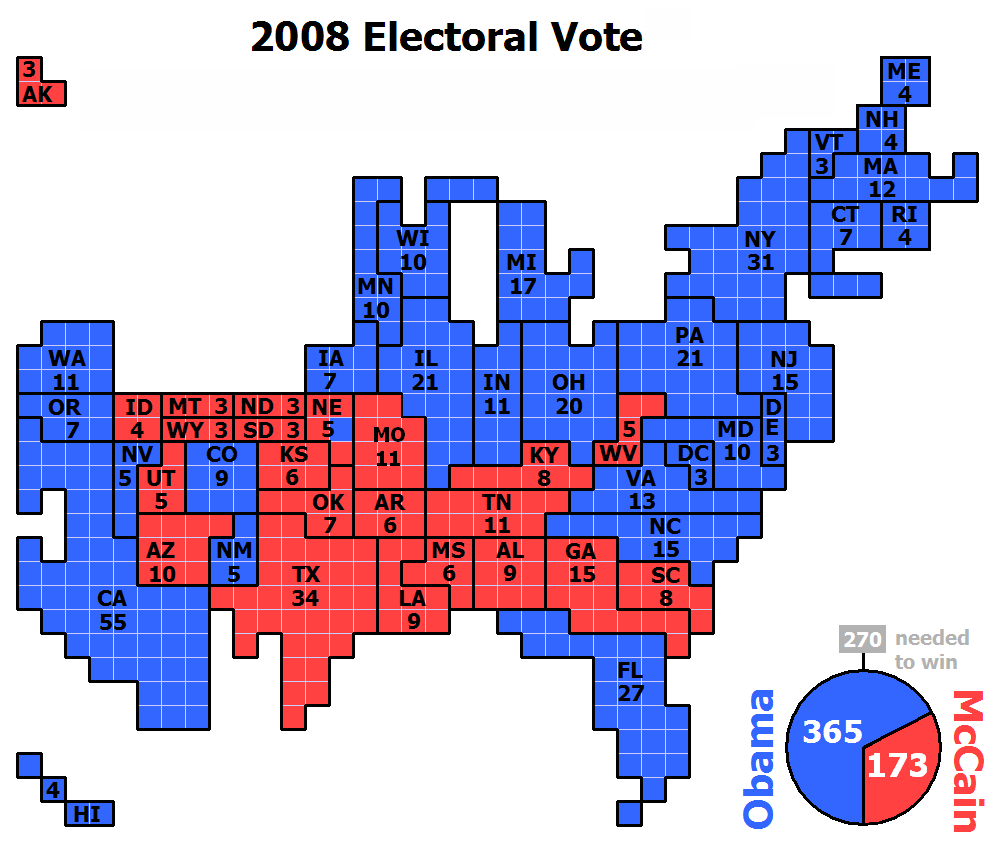
The 2008 Presidential Election Electoral College Vote Cartogram shows you which delegates voted for Candidate Obama vs. Candidate McCain. If one of these states decided to modify its laws and exercise its constitutional power, it could vest the power to determine the state electoral college delegates by any method it deemed appropriate. The state could literally allow Martha Stewart to flip a pancake or only permit delegates to be chosen from convicted felons who threw darts at a target board with names on it. Of course, any legislature used its power in that way would be booted from office but it is important to understand how the system is structured.
What makes this particularly egregious is that one of the rules I’ve always followed in my finance lessons that have made them so successful is, “when writing content for beginners, assume no knowledge and only build upon what you’ve previously discussed”. This personal blog is more of a space where I scribble out whatever is on my mind so that standard isn’t uniformly applied here as it is with my other writings.
[mainbodyad]I have cleaned up the post to better clarify my points so it isn’t as confusing to someone who doesn’t understand how the existing system works. As I said in that post, I don’t think I truly understood how vital social studies teachers were to the functioning of government. There are people who actually don’t know how this country works, or even what their constitutional rights are, which puts us all in jeopardy.
I appreciate you reading the blog =)
Joshua
Submit Your Questions or Comments for the Mail Bag Feature
To submit your own questions or commentary on the Mail Bag feature, use the site Contact form. It’s fast, easy, and the most efficient way to contact me.
Reader Comments (3)
Comments are presented chronologically, with replies indented beneath the comments to which they respond.
crabhooves
March 6, 2011
I think you were correct in your initial assumption that anyone who reads this blog is educated enough to know these things, hell even I knew this and I don't even live in the US. I'm sure everyone who reads this blog from within the states knows.
Frat Man
March 6, 2011
Joshua, along these lines of things we assume include the fact that you're insanely young for having accomplished the things that you have. Has this ever been an issue? Was there ever a time when an 11 year-old Joshua Kennon was told by the librarian "Here's Cat in the Hat. You don't need those Value Line reports. They're for grownups" or something similar? For most of your life, you've been incredibly past your age range in financial literacy, and have you ever encountered discrimination, condescension, disbelief, etc. because of it?
Joshua Kennon
November 28, 2012
Replying to Frat Man
No, but that was because I found the secret was posing the right questions.
When I was younger, I was given a short meeting with a man who controlled a multi-billion dollar reinsurance operation. You could tell he didn't want to do it but I had pulled some strings. He ended up sending everyone else away, inviting me back anytime, and spending more than an hour with me. As he walked me out, he looked at me and said, "You know more than some of my executives. I'd love to talk again." That sums up my early life experience. I also learned not to talk about these situations with my peers because a lot of people can't separate true, genuine interest and passion for a topic from hubris. The reason is fairly simple: They are in it for the money or because 'that is what you do' and can't imagine anyone else loving it.
The secret: Ask the right questions. Within a few minutes of sitting down, I think I said something along the lines of, "I'm interested in reinsurance as a capital gathering mechanism, but I don't quite understand the mechanics of how the industry is structured. I get the premium sharing transaction structures, as well as the tiered approach, taking certain bands of excess liability exposure above and beyond certain thresholds, but I don't understand ..."
And then I just got into the deep stuff.
In other words, the people who matter to what you're trying to learn will be able to tell within seconds if you are serious and knowledgable. The people who can't tell aren't worth worrying about. Why should you care if a librarian doesn't think you should be reading a particular book? He or she is no moral authority in your life. His or her opinion has no influence on whether or not you are successful.
Looking through the site archives, you are one of only a handful of readers, who in public and private, get a 70%+ response rate. Why? It's your questions. Your questions are more intelligent, and focused, than almost all of the other people I encounter. I have widows write me and say, "Which stocks should I buy?" You write and ask, "What do you consider a reasonable discount rate for pension plans, and how do you adjust intrinsic value when you consider it either too high or too low," or something meaningful.
It's the questions.