

Peter Drucker’s Compendium “Management” from 2008 Remains One of the Top Ten Most Important Works I’ve Ever Read
From time to time, the writings of legendary thinker Peter Drucker have come up on this blog. Drucker, who was probably one of the most brilliant strategic and long-term thinkers in the areas of corporate and governmental structure, incentives, and behavioral consequences, is one of the few people I think everyone should read regardless of who they are or what they do in life. Whether you are a small business owner launching a company, an executive overseeing a division of a Fortune 500 corporation, a politician dealing with constituents, a non-profit director striving to improve the world, a pastor leading a congregation, a professor teaching a course, or you simply enjoy learning, his body of work can shave decades off your journey, clarify your thinking, and make you far more effective at achieving your objectives.
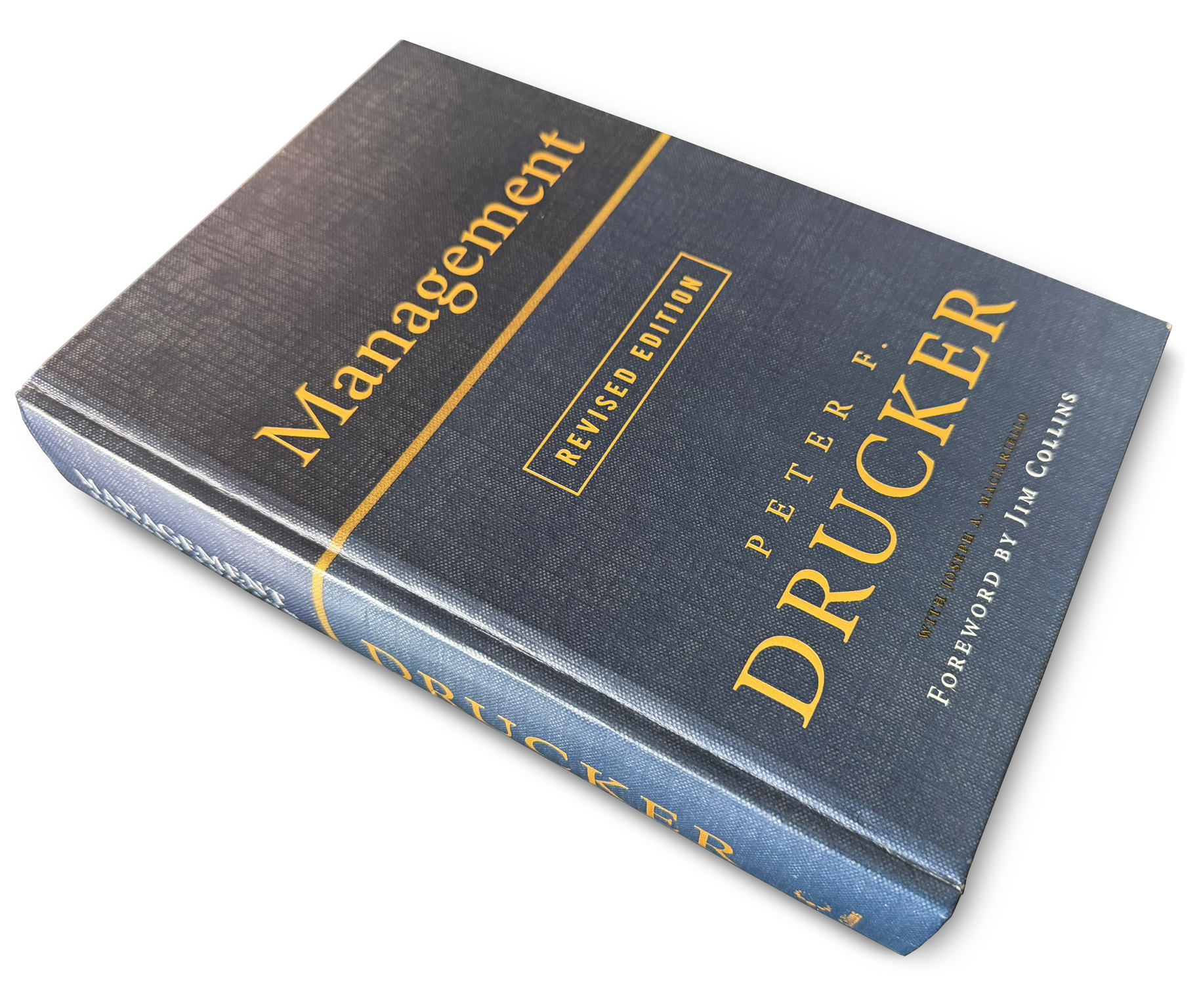
My personal favorite of Drucker’s works is a compendium called Management, released posthumously in 2008 and coming in at over 600 pages. It deals with a wide range of topics that go far beyond what most people associate with the word.
Grabbing my hardback copy off the bookshelf at home and opening it to different random pages will give you an idea of how incredible I find the value proposition. So extensive are my markups, notes, underlines, and commentary from nearly twenty years ago that it has more resemblance to a coloring book than a manuscript (you can tell I was shortly out of college and had a good chunk of my net worth in Berkshire Hathaway stock). It is one of those texts that, along with the writings of Benjamin Graham, I will continually re-read throughout my lifetime. In fact, since this particular version is out of print, I will occasionally go in (like today for example, hence this post) and buy out several additional copies from the used listings to keep a reserve of them since they might be impossible to find by the time I am much older.
I highly recommend this particular book, in this particular format, to anyone and everyone who wants to be better and more effective in the areas about which they care. I cannot imagine building a library without at least one copy.
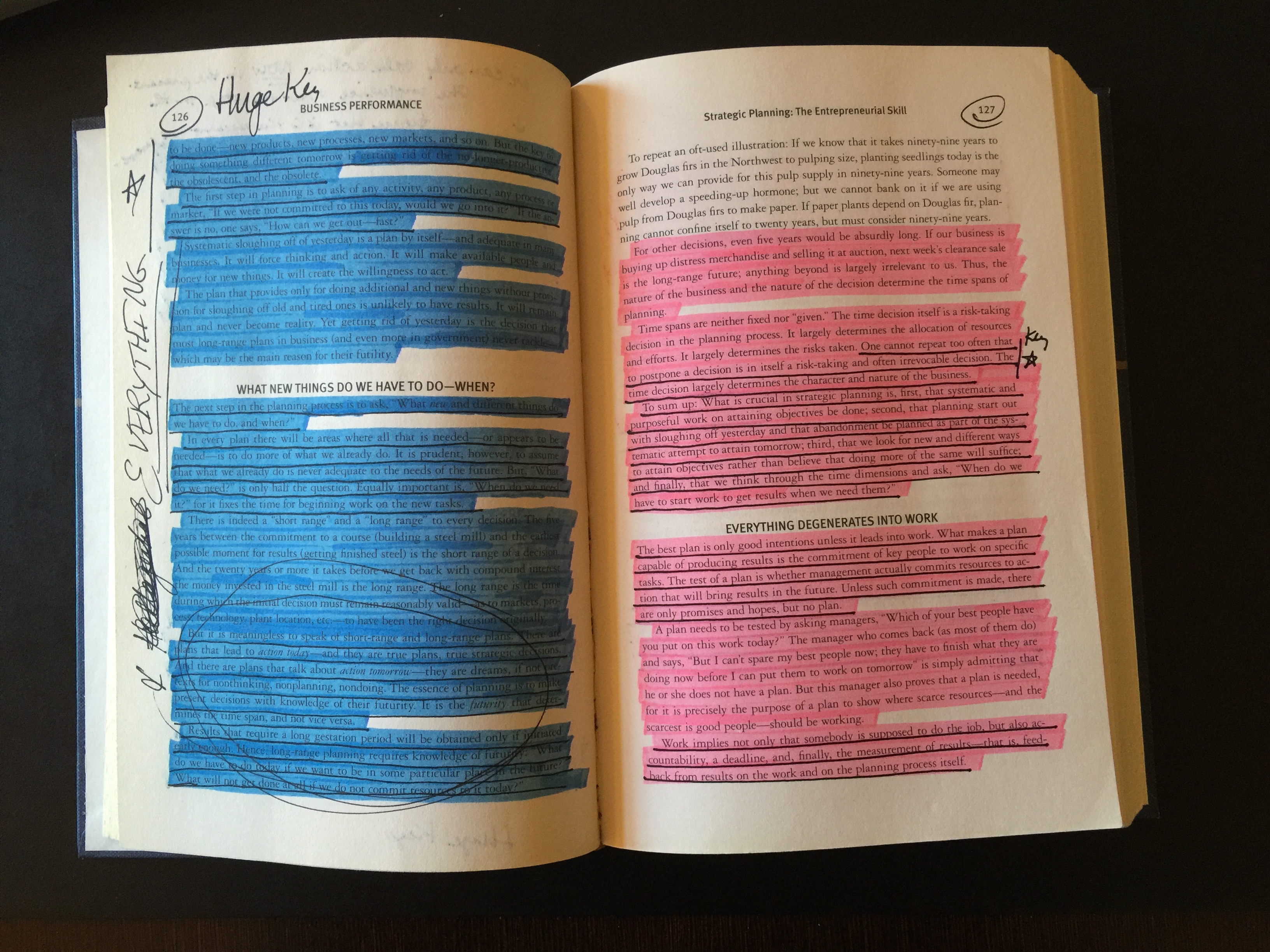
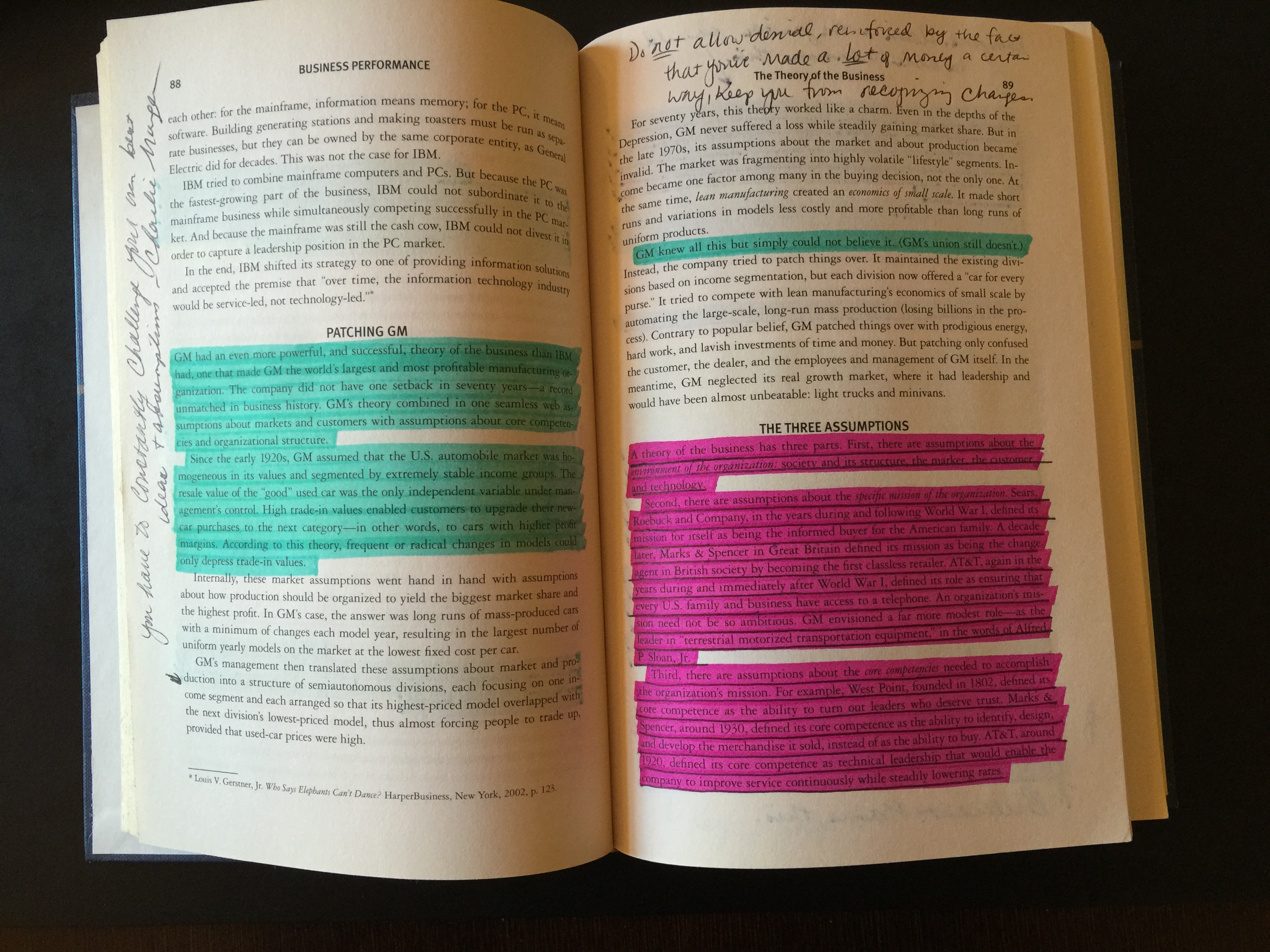
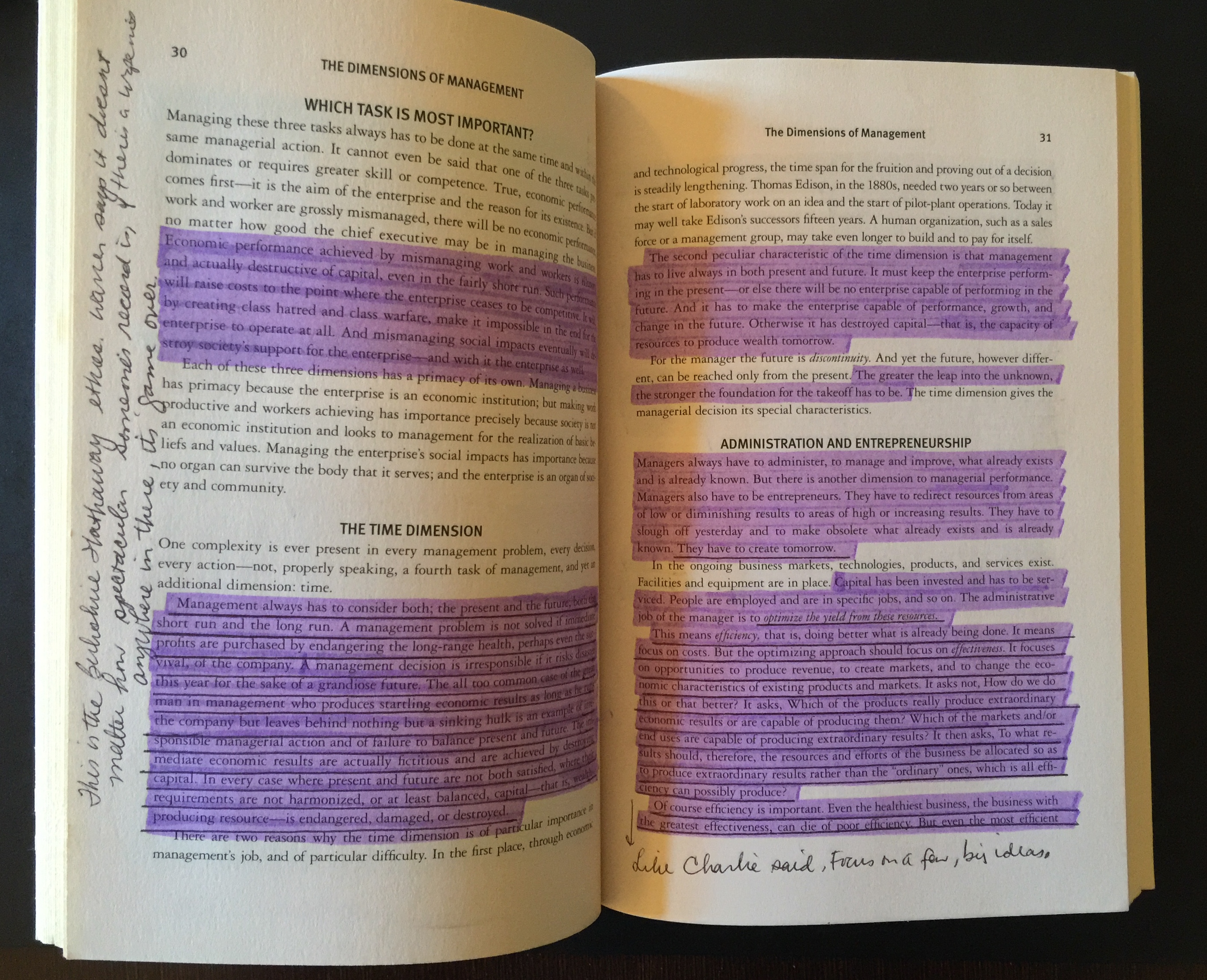
I read this thing so much in the early-to-mid days of our ecommerce era. What is interesting is that Drucker’s writings have become more relevant over time. Drucker was warning then, “The two main challenges to managing work and working are the changed psychological and social position of the manual worker (better educated and often better paid, he still sees himself as moving down from yesterday’s self-respecting working class into second-class citizenship); and the emergence of knowledge work and the knowledge worker as the economic and social center of what is the postindustrial, knowledge society.” (Page 189). The political upheavals of the past decade are among the manifestations of the forces he described; they are symptoms.
Perhaps more concerning, Drucker laid out a roadmap that he believed the United States was going to be forced to travel as a result of the rise of the productivity gains from the microprocessor and globalization; that the efficiency which made it possible for a single person to do the work of fifty or a hundred would lead to a winner-take-all society as the differences in skill set exerted their influence. It was somewhat predictive in 2008 when I read it, and now, it is the lived reality in which we all find ourselves.
I’ve used an example of this in my own writing many times. I believe it is the best, most succinct illustration of the forces at play. Namely:
- Twenty-five years ago, if you wrote a book, you’d be lucky to get paid 10% to 15% of the book’s price. The rest of the money went to the editors, marketers, printers, typesetters, the illustrators, the employees of the paper company, the loggers who cut down the trees, the people driving the delivery trucks to the bookstore, the oil and gas companies that fueled that truck, the bookstore sales staff who helped you find it among the aisles, the bookstore landlord who was collecting rent from the bookstore owner, the power company that generated electricity for the bookstore.
- Today, you could distribute that same book digitally, and other than a few data adjustments, you keep roughly 70% of the cover price and online distributors or systems keep the remaining 30%. Very little would be captured in additional overhead on either side of that split. Specific relationships and pricing differ, of course, but you get the idea. The customer buys the book and has it delivered instantaneously at a fraction of the cost to their preferred digital device. You, as the content creator, have the opportunity to reap nearly all of the reward if you play your cards right and structure your legal affairs intelligently. Amazon as the gatekeeper, to give one example, has a shot at earning far more than its old school counterparts (a fact obfuscated by their current research and development, expansion, and other costs).
The same thing is happening with media in other sectors. I wrote more than a decade ago that we were probably heading for a world in which all video games and software sales happen via digital download unless legislation forces hard copies to be available to the public as a matter of social policy. Music sales have overwhelmingly shifted to the cloud except for a handful of exceptions such as vinyl, which has enjoyed a resurgence. Movies are being increasingly delivered through Netflix, Disney+, Hulu, Paramount+, Viki, and Amazon Prime. Sure, there is variability, and there are fluctuations, in the sales patterns. The point remains the trajectory, already clear seven or ten years ago, is now the way of the world.
Those left behind are going to scream for outright transfer payments. It will be their bread, butter, and salvation despite harming the overall system long-term and causing more human misery. If you forced me to guess – and I could be wrong – I’ve been saying for the past three or four years that the most likely first-attempt policy change at the national scale will be elimination of the cap on Social Security payroll taxes. It sounds so simple it fits into a TikTok video. The problem: It will be a catastrophe. A self-inflicted harm to individuals and families en masse. It’s like rent control. It sounds good. It feels good. It ultimately will achieve none of its stated objectives. It will slow economic growth and twist behaviors. Social Security has a sense of fairness to it, acting as a last resort program that encourages labor. It is not predominately, or even materially, a means-tested welfare transfer system despite the inter-generational nature of payments, which has made it untouchable by conservatives and liberals alike. Open that door and it will be total war. It will reduce new business formation, consolidate power further into the hands of larger corporations, increase the burden on the young for the sake of the elderly (who already hold a disproportionate amount of wealth due to compounding), and increase the risk the program succumbs to political attack and ultimately privatization. It will push the U.S. towards a more ossified system of entrenched inheritance capital rather than first-generation wealth accumulation. The people espousing it have no idea how interconnected these systems are or how quickly people will adapt. They also don’t realize that it will be doctors, lawyers, accountants, software engineers, and small business owners who, before fighting back, will suffer nearly all of the brunt – which they will then pass on to their patients, customers, and employees – as there are mechanisms that would be far too complicated to undo that allow for the workaround once income exceeds the seven-figure per annum threshold. Jeff Bezos will never pay that tax in any material amount even with the cap eliminated, but your dentist will, at least for a while, and prices will go up accordingly.
That topic is too large for this post. If I ever write about it, it deserves stand-alone treatment.
Even the challenges we faced in the different markets in which we competed back in those ecommerce days … he talked about how one should, “Classify the Problem. Executives face four basic types of problems: 1. Generic events that are common within the organization and throughout the industry 2. Generic events that are unique for the organization but uncommon throughout the industry 3. Truly unique events 4. Events that appear to be unique but are really the first appearance of a new generic problem.” (Page 297) That helped make sense of a landscape that was rapidly changing; domestic factories closing, independent retail stores consolidating or liquidating, the ability to go direct-to-consumer. Even his statements of basic insight were helpful such as, “The best plan is only good intentions unless it leads into work.” (Page 127) and “To make service institutions perform, it should by now be clear, does not require great leaders. It requires a system.” (Page 134). Or the importance of focus, “… It alone can prevent the most common degenerative disease of organizations, especially large ones: splintering their always limited resources on things that are interesting or look profitable rather than concentrating them on a very small number of productive efforts.” (Page 143). His works also possess a worldview rooted in a strong internal locus of control while acknowledging “… this does not mean the manager can work for the elimination of risks and uncertainties. That power is not given to mortal man.” (Page 113); e.g., “To try to make the future happen is risky; but it is a rational activity. And it is less risky than coasting along on the comfortable assumption that nothing is going to change …” (ibid).
Find a copy of the book and read it. I cannot emphasize this enough. I know of few other tomes that, at a cost of $10 or $20 in a used bookstore, can help a person add millions of dollars to their personal net worth over a career through more intelligent behavior.
Reader Comments (4)
Comments are presented chronologically, with replies indented beneath the comments to which they respond.
Graham
September 4, 2026
Wow, 5 posts in nearly 5 days? Are you back to writing? I still check your blog all the time even though you barely write anymore. I hope this is a trend that continues!
Joshua Kennon
September 24, 2026
Replying to Graham
A couple of things are going on ... as we are settled in Ohio, I have been working on completely overhauling the backend of the block with roughly two decades of content. Barely half of the posts are still visible to the public, so I've been quietly going through as I promised and republishing things, as well as writing when I have time. I've even slowly been restoring some of the personal posts that I took down as part of the first purge ... I detailed a few earlier this month or last month on that one page I created a long time ago ...
JB
September 5, 2026
Joshua, thank you again for another great read! I could not agree with you more that Congress will move to eliminate the cap on Social Security payroll taxes. The alarm bells about Social Security running out of money are getting louder and I think this would be an "easy win" for politicians to show their constituents that they're "doing something" about the problem. Personally, I just received my latest SSA statement and have modeled out payments of 100%, 70% and 50% just to see how bad it could get (for me anyway) if Congress does nothing. I know the expected shortfall is supposed to be in the ~20-25% range but I would rather plan for the worst. This is another topic I would LOVE to read your thoughts on.
Joshua Kennon
September 24, 2026
Replying to JB
I imagine I will need to write about it quite a bit in the future. The fundamental problem is that at the end of the day, Social Security benefits should be tied to life expectancy. The worker-to-retiree ratio has become untenable and medicine means we are all living longer, healthier lives than otherwise might have been possible in the past. My best guess is that the retirement age will eventually be raised to 75 or something, little by little, with a few other tweaks.