

I’m still running several weeks behind but one of the things I’ve been working on is a response to a few of the questions submitted by FratMan, whom you’ve seen in some of the mail bag sections I believe. He’s mentioned a few times, such as in the comments sections here and here, that he likes Colgate-Palmolive as a business. In fact, it makes his list of top five stocks he’d want to hold forever.
Tonight, I was going through my library searching from some notes about bank custodians for a new family partnership I’m probably going to establish and came across a notated copy of the old Standard and Poor’s 500 guide. I flipped through it and saw the report from August 27th, 2001 and then used the 10-year data record, going back to 1991 with the most recent copy to compile a 20-year history of the stock just for kicks. It’s been a very real winner in a very real way despite the dot-com bubble, the post-September 11th market crash, and the real estate bubble, which lead to the worst recession since the Great Depression. Turns out Colgate toothpaste, soaps like Palmolive, Softsoap, and Irish Spring, cleaning supplies like Ajax, and nutrition products for dogs and cats churn out a lot of cash.
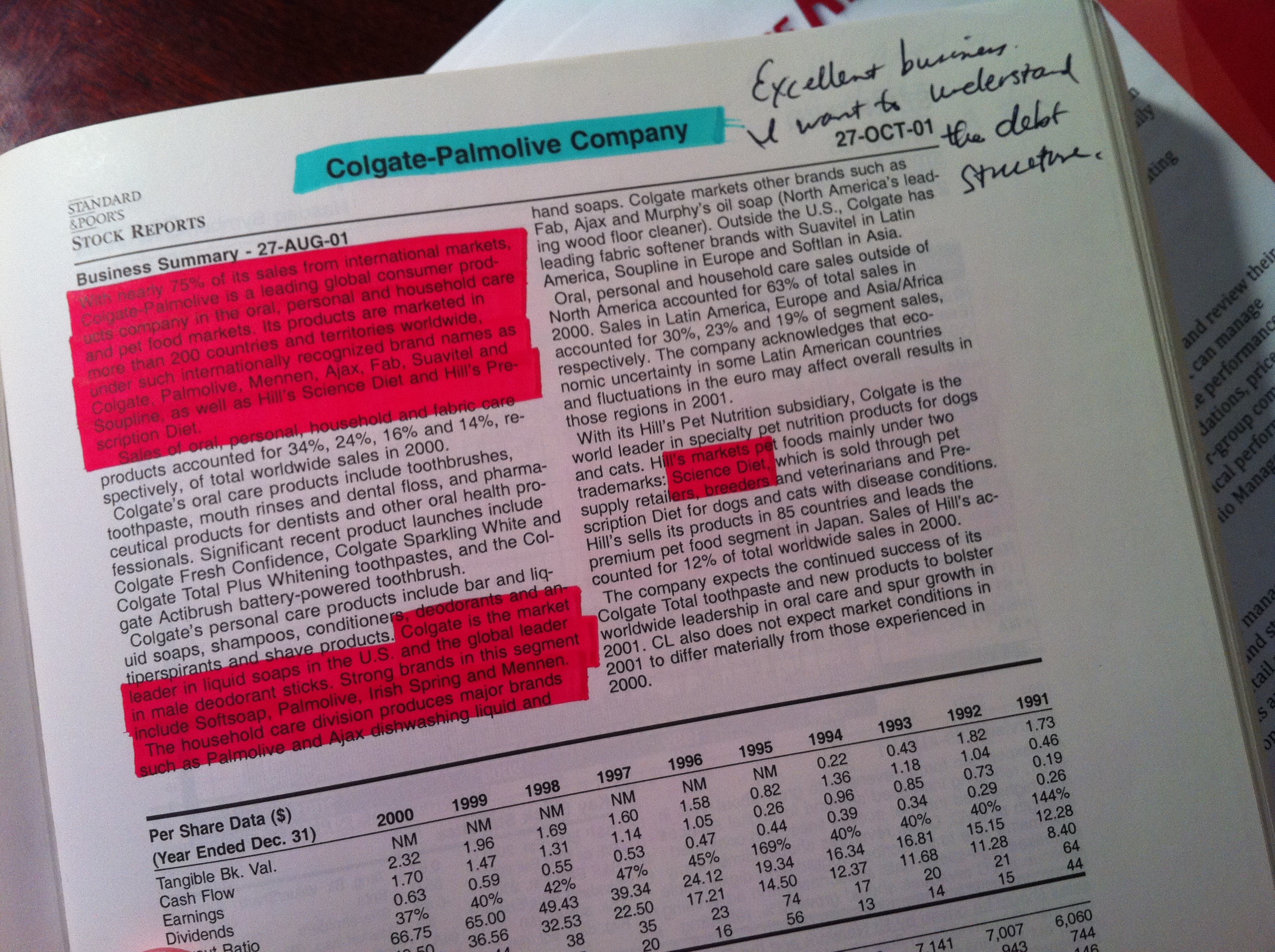
The Colgate-Palmolive report from more than ten years ago … the teal highlight on the company name meant “excellent business” and was a way for me to go back and order the annual reports of the firms I found interesting so I could study them in-depth.
Twenty years ago, you could have bought a share of Colgate-Palmolive for $10.34. Today, that share is worth $89.01. That is a capital gain of $78.67. In addition, over that same period, you would have collected $16.82 in cash dividends to spend, reinvest, or give to charity.
 That is a total return of $95.49 on a $10.34 investment, or 12.33% annually without dividends reinvested. But inflation turned $1.00 in 1991 into only $0.62 today, so the total return has a real, inflation-adjusted value of $59.20. That is a real return of 9.11% compounded for twenty years, again without dividends reinvested! You could have spent the cash all along the way.
To put it in more tangible terms, imagine that you could go back to 1991. You bought 10,000 shares for a total cost of $103,400. Today, those shares are worth $890,100 plus you would have collected $168,200 in cash along the way before taxes, which you could have spent on televisions, cars, additional investments, books, clothes, coffee, tea, movies, home renovations, or whatever else you wanted. The truly die-hard value investors among us could have used it to buy more shares of Colgate-Palmolive to get even more dividends.
 Now, is that going to make you Warren Buffett rich? Not unless you have a pool of money upon which you earn an override or you are dealing with large sums from a successful career. But it can make you rich. In fact, it can make you rank among some of the richest men and women in history, even if Forbes or Fortune never knows your name. If you go through life acquiring assets like that, it isn’t hard to end up with a giant pile of money throwing off cash for you to use. Do it for 40 or 50 years and you could end up being one of those janitors that leaves $30 million to their favorite school or charity.
That is why I love compound interest.
There were several years in there where the stock fell by 40% or 50%. But the earnings kept climbing ever-higher. All that ultimately counts is the profit you can take out of a business. Your goal is to make sure you pay a fair price for your ownership stake. Overpay, and even the best business can’t help you.
 I know it sounds somewhat crazy to those who don’t “get it”, but the idea of being 80 years old and seeing shares of a company like this on my balance sheet, knowing that the annual dividend income is more than what I paid for it, gives me the same feeling that some people describe when they see romantic comedies. Even though I plan on giving almost everything away in the end, it’s about building something and seeing it grow. That is the fun. It’s also about being intelligent, correct, and having subsequent history validate your thesis.
I still don’t own any Colgate-Palmolive – the current 18.57 p/e ratio seems a bit high to me but I can’t say that with any certainty because it’s possible owner earnings exceed reported net income. I think I’m going to order the report. It might make a good inclusion in the KRIP portfolio.
Reader Comments (5)
Comments are presented chronologically, with replies indented beneath the comments to which they respond.
FratMan
July 17, 2011
Ha Thanks! Great post IMHO. I've been meaning to send you a message about my thoughts on 'A Morning with Charlie' in Pasadena on July 1st--the Munger gathering was definitely a refreshing place where everyone gets along--it was spooky meeting so many people who were on the same wave length as me. One of his off-hand comments struck me as the most brilliant, succinct investment advice for buying an ownership stake in the business for the long-term. He said, 'Unless you have reason to suspect the business has disastrous management, you will do well to purchase shares in companies that sell low-price goods resistant to technology and have a strong brand name.' It really seems like a brilliant investment principle--if you buy shares of a luxury goods company like Tiffany that can pay $250 for a piece of jewelry it sells for $2,500, there are going to be a lot of competitors that want to get in on the action by selling that same jewelry for $2,000, and there's going to be plenty of consumers who will want to save the $500. I'm having trouble remembering his exact quote, but he said if you are earning high margins on a good you are selling at a high price, there will be 'plenty of cats that will want to take the birdie off the perch.' But, if you're selling Coca-Cola for a $1, you're not going to gain traction by offering your own soda brand for $0.75, because people have enough faith in Coke to justify that extra quarter. If you start a chewing gum business called 'Josh's Gummy Delights,' you're still going to lose to Wrigley, even if you offer your product at 2/3 of the price, which is a premise Munger calls into question because Wrigley and Coke have economies of scale a start-up wouldn't have.
Hence my love of Colgate-Palmolive, Clorox, Heinz, Campbell Soup, Pepsi, and JNJ. Speaking of which, is there anything more despicable to the capitalist name than Carl Icahn? He's trying to buy Clorox--I only own seven stocks with Clorox being one of them, and two of my friends who know it texted me on Friday about how happy I should be that Icahn is trying to buy Clorox and I 'must be making a killing'--but it's absolute crap. Your rage at the Suntrust folks for selling their Coke stock and condemning them to capitalism hell approximates my feelings for Icahn--he is an artificial hijacker that disproportionately benefits from hard work and value-building of others. I know everyone tries to resist seeing these things through a moral lens 'It's just business, they say', but there is no way you can call this guy honorable. You can tell Clorox people ain't happy--saying they'll review the offer 'in due process', not exactly what they'd say if Warren came knocking, is it?
AND PS, I can only imagine how much Berkshire you're buying these days. This $75-$77 range they've been trading in lately is absolutely INSANE. When Munger commented on the WESCO deal, he said 'Warren didn't expect Berkshire to fall this low.' I'm pretty sure that's the closest thing to a buy recommendation they've made in 30 years...I'm throwing 1/2 my summer paycheck at Berkshire this summer, and I suspect a 2040 version of myself will by happy with how I allocated my funds this summer... I also read a funny article at GuruFocus about how no one ever calculates the value of Berkshire anymore in stock commentary--it's all become 'Warren is infallible. Stick by him until I die!' people versus 'The old foggy is going to die. It's too big. It's best days are behind it. Stay away from it' people. I got a kick out of that observation. Very few people do talk about what Berkshire really is worth these days---it's all about either buying into or rejecting the cult of personality that is Warren Buffett.
Joshua Kennon
July 27, 2011
Replying to FratMan
The only outcome that I think would be perfectly okay for Clorox shareholders would be if Procter & Gamble acquired it in an all-stock transaction so that existing shareholders don't have to pay taxes on their gains and they can swap into owning an even more diversified, just as good consumer product giant. I'd imagine profitability would actually increase as a result of the economies of scale that P&G would bring to the table given its much larger size so it could be a case of 2+2=5.
If it happened, P&G should do it just like it did with Gillette, buying the company for stock then using cash to repurchase the same number of shares in the open market, avoiding dilution but giving those same tax benefits of a stock swap. That transaction was intelligently done for everyone involved.
FratMan
October 24, 2011
Sorry if this is a dumb question---What part of the balance sheet indicates to you that the owner earnings are more than the net income, and what point does the discrepancy get big enough for it to catch your attention?
Joshua Kennon
January 15, 2013
Replying to FratMan
Typically it happens when there are a lot of non-cash charges, either in the form of intangible write-offs, depreciation charges, or goodwill impairment, and there has been some change in the underlying capital needs of the business. For years, the pharmaceutical industry had certain accounting rules governing how research was expense that resulting in "real" earnings being much higher than reported net profit, meaning the p/e ratios were constantly understated. Those have been changed so that is no longer true. The same went for goodwill, which used to be expensed causing depressed earnings but the rules were changed. You might find a similar situation if ou were buying into a toll bridge and the money has already been expended with very few future cash needs in terms of maintenance, but large depreciation charges; as a new owner, your calculation is different than a founding investor, for whom those charges are very real. There are so many individual situations, scenarios, and exceptions it's hard to generalize.
The first clue would be to look at the cash flow statement. if there is a large discrepancy between cash generation and net income, with more cash than one would expect flowing into the corporate coffers, it throws up some major signals that you might be dealing with a situation where profits are higher than they first appear.
Kanad Bandyopadhyay
April 17, 2013
I own nearly 400 Colgate Palmolive India shares in India. Of late the stock is lying dogo and sliding unlike its US counterpart which very recently declared a stock split and increased dividend. In the competition is increasing with the likes of P&G coming in with oral care business as well. But it is a great stock in India with a much higher dividend yield and RoE vis a vis P&G India which is slow coach. Thought I would share it with you who writes great articles!