

How Much Money Does It Take To Be In The Top 1% of Wealth and Net Worth in the United States?
There had been some confusion about the methodology involved in calculating the top 1% of wealth in the United States. This article is updated with the “sticker” net worth for the top 1% as published by The Federal Reserve (assets – liabilities since that is what the typical American thinks of when they hear the term net worth) and clarifying that from what I consider the “true” net worth, which is a method called the estate multiplier technique, which is used by the IRS. The latter results in a far lower entry threshold for the top 1% of net worth but is more accurate, in my opinion. You are encouraged to study the data and reach your own conclusion. – November 14th, 2011
This article answers the question, “How much money does it take to be in the top 1% of net worth in the United States. If you are interested in who the top 1% of net worth is, such as demographic breakdown, educational history, and gender, you should read The New Elite: A Look Into the Top 1% of Wealth.
What does it take to be in the top 1% of wealth in the United States? Many of you write me and ask that question, hoping someday to make it into the top 1% of net worth but not sure where that line gets drawn. I thought it might be useful to provide a reference to which I could point people in the future whenever they write, as well as make for some interesting afternoon reading for those of you who are curious about the nature of the economic world in which we live.
We’re Going to Look at the Top 1% of Wealth and Net Worth in the United States, Not the Top 1% of Income
Notice that we are going to discuss the top 1% of wealth not the top 1% of income. As illustrated by our recent discussion of Terrell Owens, Jamal Mashburn, and Ulysses Bridgeman, Jr., depending upon how wisely a person’s income is invested, income may or may not result in building wealth. Hence the startling statistic pointed out in a Sports Illustrated article explaining that in the NFL alone, 78% of players went bankrupt within 2 years of retiring.
This makes our job difficult because the IRS and other government agencies release plenty of data on income distribution. Those sources showed that in 2009, the top 1% of tax payers reported $344,000 in annual income. That figure would be slightly higher because income held in tax-advantaged retirement plans or other structures wouldn’t be included. It may not sound like much on an annual basis, but to the average guy sitting at home, earning nearly $28,670 per month in reported income is a lot of money. Estimating where you fall on the income scale is easy. Net worth, on the other hand, is somewhat difficult. Where the top 1% entry level is requires a lot of math and even then, it is imperfect.
We are talking about what Dr. Thomas J. Stanley calls “balance sheet affluent” in his research, as opposed to “income statement affluent”. That might seem a bit confusing since I am a fan of the older, British method of measuring wealth wherein a person looks at the level of passive income (or “private income”) thrown off by investments. But the distinction is there because I am discussing income generated by assets that do not require your labor as opposed to that which would disappear if you failed to get out of bed in the morning.
Additionally, we are not going to discuss income inequality or wealth inequality because those are expansive enough topics they deserve their own articles. Instead, our objective is to simply focus on the data at this juncture and answer the question: How much money does it take to get into the top 1% of wealth in the United States?
What Is the Net Worth of the Top 1% in the United States? It Gets Tricky …
To find the “sticker” rate to rank among the top 1% of net worth, or wealth, in the United States, we can look at a handful of reports released by the United States Government, specifically the Federal Reserve’s Survey of Consumer Finances. To make it simple (and since people prefer visual aids, anyway), the Economic Policy Institute took this historical data and in a paper called The State of Working America’s Wealth, 2011: Through Volatility and Turmoil, the Gap Widens by Sylvia A. Allegretto, reconciled it in inflation-adjusted 2009 dollars in Table 2: Changes in the Distribution of Wealth, 1962-2009.
I call this the “sticker rate” because it doesn’t reflect any of the real world barriers that would stop you from accessing your money if you were rich. It excludes taxes due and early withdrawal penalties on 401(k), IRA, SEP, and pension assets, deferred capital gains taxes on unrealized profits on stocks, bonds, real estate, art, or other property, illiquidity discounts for closely held companies that don’t enjoy a public market for securities, inheritances taxes if you were to die and leave an estate to your children or grandchildren, liability claims (e.g., you are being sued and might owe a significant amount of money for malpractice as a wealthy doctor), money held out-of-estate in the form of trust funds that you may manage but to which you have no legal right, and all of the other things that would be accounted for and deducted if you were calculating your net worth on a GAAP basis as if you were a corporation or non-profit entity.
But the EPI data is going to be deceptive because it is average wealth, not median wealth. That is, if the sample included Warren Buffett with $40 billion and a small town millionaire with $5 million, the “average” wealth would be around $20 billion, which clearly has no value whatsoever in understanding the economic distribution.
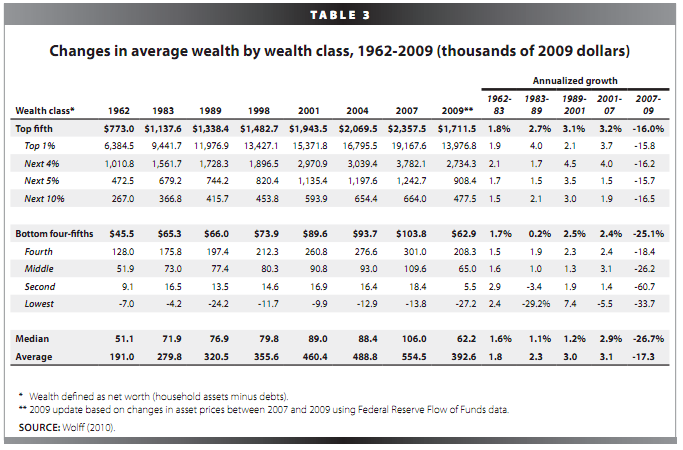
I believe the chart on the top 1% of wealth in the United States as published by the Economic Policy Institute is intellectually dishonest because it focuses on average, or mean, wealth for the top 1% instead of median wealth or the cut-off point to enter the top 1%. That is purposeful because the group has an economic left-wing political agenda.
If you used this data, again which is technically true but what I consider intellectually dishonest, the average net worth for the top 1% was $19.1 million at the height of the real estate bubble and $13.98 million at the depths of the recession. Common sense tells us we can throw this out and disregard it since average (mean), in this case, is meaningless. Add to that the failure to back out the real-world barriers to getting your hands on your money, such as the taxes you’d owe on your retirement account withdrawals, and we know the figure has to be lower so we must continue looking. (The only reasons groups like EPI use mean is to try and convince the public to raise tax rates. They can’t win when people know the real cut-off for top income earners so they frame the data in what I consider a deceptive and misleading way.)
The question remains: How much would it take to enter the cut-off for the top 1% of net worth in the United States?
Diving Into the Appendix Tables of the Survey of Consumer Finances from the Federal Reserve and Treasury
The next best place to look would be the summary data of the Survey of Consumer Finances. The most recent data we can get our hands on comes from the 2009 report. Appendix Table 1 breaks down the median net worth of different wealth groups in the United States.
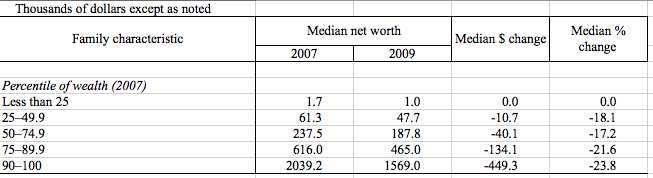
The Federal Reserve Survey of Consumer Finances 2009 Appendix Table 1 shows us the median wealth by different household groups in the United States.
Alas! We have a problem. The Federal Reserve only gives us the top 10% of net worth, not the top 1% of net worth. If you want, you can download the Microsoft Excel tables and have fun looking at the numbers; there is a lot of information in spreadsheets.
It Might Be Best to Look to the Expert Academics About the Top 1% of Wealth
The best place to go from here is to use some basic math. In 2009, the median net worth of the top 10% of wealth in the United States was $1,569,000. That is, if you had exactly that amount, half of the top 10% would be poorer than you and half of the top 10% would be richer than you. You would be standing exactly in the middle. By definition, we know that this must be the cut-off for the top 5% of net worth.
In other words, the moment you hit the top 5% of net worth in the United States on a “sticker” basis (excluding all of the things that stand between you and your money, such as withdrawal taxes on your 401(k) plans) you would have needed $1.569 million in 2009 on a simple assets – liability basis. That would make you richer than 950 out of every 1,000 Americans.
That is our lower threshold against which we can check data. From here, we can either start crunching the data ourselves or turn to academics who specialize in the complexities of the arcane. The cutoff for the top 1 percent of American households, in terms of net worth, is about $9 million, according to New York University Economics professor Edward N. Wolff. His estimate is based on his extensive analysis of the Federal Reserve Board’s Survey of Consumer Finances, which put the figure at $8.2 million in 2007, he said.
That means we know from our own analysis that the top 5% of wealth on a sticker basis begins around $1.5 or $1.6 million and, if Professor Wolff is correct, the top 1% of wealth begins at around $9 million.
If the Federal Reserve Data and Professor Wolff Indicate the Top 1% of Net Worth Cut-Off is $9 Million, Why Is the IRS Figure So Much Lower at Less than $1.5 Million?
Here is where things get really interesting. The Internal Revenue Service, the United States agency responsible for collecting and enforcing our tax system, releases a treasure trove of data on high-income tax payers through a special division known as the Statistics of Income Division, or SOI. They use this income to estimate household net worth of rich taxpayers utilizing a special technique known as the estate multiplier that was made popular more than a century ago when Congress became concerned about the disparity between the rich and poor. It is fairly complex and includes things such as a buffer for estimated underreporting of taxable income but long story short, the agency looks at tax returns, capitalizes the earnings power at a reasonable rate, makes adjustments, and values taxpayers just like a businessman might value a company.
Using that method, the IRS says that as of 2004, the last year “official” data was released, there were 1,555,000 individuals in the United States who had a net worth equal to or higher than $1.5 million. They break it down by gender and estimated net worth bracket. You can even find out how many of these high net worth individuals live in a specific state.
That doesn’t do us a lot of good because to figure out how many 1,555,000 individuals are as a percentage of the population, we need to know the population base for the same year. We can get this from the Bureau of Labor Statistics, which aggregates Census estimates in a publication known as the Statistical Abstract. In 2004, according to the National Intercensal Estimates (2000-2010), Sex and Age table column G row 40, there were 219,507,563 men and women who were legally adults. Should we include only adults? Probably not because, after all, there are some multi-millionaire child stars but we’re more likely to get close to what we’re looking for by excluding those exceptions.
Comparing the two figures, it shows that there were 219,507,563 adults in the United States in 2004, of which 1,555,000 were estimated by the IRS SOI to have a net worth of at least $1.5 million using the estate multiplier technique. That puts the probability at 0.71%. Yes, this data is several years old at this point, but that means that the entry point to the top 1% of wealth would be less than $1.5 million (probably around $1.2 million). With even minor inflation adjustments, the figure would be higher today.
The academic problems of reconciling the two methods for calculating the top 1% of wealth in the United States used by the Federal Reserve and the IRS led to Barry Johnson of the Statistics of Income (IRS) and Kevin Moore of the Board of Governors of the Federal Reserve System to co-author a paper called Using the Tax Data to Estimate Wealth for Key Segments of the U.S. Population. The paper details the problems (e.g., figures for the Survey of Consumer Finances tend to be inflated, whereas figures for the IRS are often simplified and sometimes under-reported). On the other hand, the IRS figures purposely exclude things such as rights to an income stream held in trust since the asset doesn’t “belong” to the person but they still benefit from it, as explained in Updating Techniques for Estimating Wealth from Federal Estate Tax Returns by Barry W. Johnson of the IRS in a paper that gives a good overview of the estate multiplier method.
The conclusion: Both tend to show the same trends therefore both are useful for augmenting an understanding of the top 1% of wealth in the United States but the estate multiplier technique allows for finer, more specific results than the Federal Reserve data, despite its limitations due to variability of death rates. That is why it is possible for you to hear The Wall Street Journal talk about how 8% of American households, or 1 out of every 12.5 households, have a net worth in excess of $1 million, yet turn around and get a wildly divergent statistic from another government agency that puts the figure much lower. I’m in the latter camp because taking the raw asset minus the raw liability figures is misleading and leads to gross overstatement of net worth for the top 1% of wealth.
(For those of you who are interested, the IRS SOI division also provides a lot of other great information on gift tax returns, estate tax filings, and charitable donations.)
Why I Prefer IRS Estimates for the Top 1% of Net Worth to Federal Reserve Estimates of the Top 1% of Net Worth
For reasons that are somewhat complex, I favor the IRS method to the Federal Reserve method. Not only has it been used for the past century with sound, well-established math, it more accurately reflects economic reality in my opinion. An example from the comments section, which caused the update to this article, might help you understand my preference.
Imagine that two men each own $10 million worth of Coca-Cola stock as their sole asset. Neither has any debt.
- John owns his $10 million in Coca-Cola shares through a Traditional IRA. When he takes the money out of the retirement plan, he will be forced to pay the 35% ordinary income tax rate, leaving him only $6.5 million.
- Tom owns his $10 million in Coca-Cola shares directly. When he sells the stock, he will owe only the 15% long-term capital gains tax rate, leaving him $8.5 million.
It doesn’t stop there. Offsetting Tom’s advantage is the fact that John can pay no taxes on the dividends he receives on his Coke stock as long as it is held within the account. At today’s rates, that means John, despite having a lower net worth, would be able to keep all $280,000 of his yearly Coke dividends but Tom would have to give up 15% in dividend taxes, or $42,000, leaving him $238,000 per year. Both men have the same asset with the same market value. Both men have no debt. The true net worth of each man is considerably different due to contingent liabilities, deferred taxes, and other factors.
The Federal Reserve sticker net worth data reflect none of this. To be fair, it can’t. There simply isn’t a computer large enough in the world to possess all of that information and process it in a dynamic system with countless variables and incomplete reporting. Without accounting for how much money a person could walk away with, the $9 million net worth figure necessary to enter the top 1% of wealth in the United States is simply too high, in my opinion. Perhaps the IRS figure is too low.
This illustrates why I urge you to use the older, British method of measuring wealth where you focus on how much cash flows through your hands each year. It is much harder to fake. It also gets closer to utility. If you earned $344,000 in 2009, you made more than 990 out of 1,000 of your fellow Americans. You were the top 1%. A lot of this income came from capital gains and dividends, yes, but while all those in the top 1 percent are certainly well off, the vast majority still go to work every day.
It is still imperfect – after all, if you held all of your money in a retirement account and earned millions of dollars a year in tax-free income that you couldn’t touch, not a penny of it would show up and you wouldn’t be considered the top 1% – but that is a tolerable fault because, again, it gets back to utility. What counts with money is what you can do with it. Unless you have the ability to transform an asset it into goods or services as a claim check on society, it is financially worthless. The Germans found this out the hard way following World War I.
Dividing the Top 1% of Wealth Into Two Groups
One thing I found interesting about a college department’s website on the top 1% called Who Rules America is an article written by an anonymous wealth manager who clearly disdains the nature of economic allocation currently prevalent in our nation. Among his observations are his belief that the top 1% can be divided in half. As he put it:
The 99th to 99.5th percentiles largely include physicians, attorneys, upper middle management, and small business people who have done well. Everyone’s tax situation is, of course, a little different. On earned income in this group, we can figure somewhere around 25% to 30% of total pre-tax income will go to Federal, State, and Social Security taxes, leaving them with around $250k to $300k post tax. This group makes extensive use of 401-k’s, SEP-IRA’s, Defined Benefit Plans, and other retirement vehicles, which defer taxes until distribution during retirement. Typical would be yearly contributions in the $50k to $100k range, leaving our elite working group with yearly cash flows of $175k to $250k after taxes, or about $15k to $20k per month.
He goes on to explain that beyond that, you get into people who build and sell businesses, investment bankers, corporate executives, real estate developers, and a handful of other careers. He mentions that, on occasion, a particularly intelligent physician or attorney will come in with a net worth of $15 million to $20 million as a result of wise investments but they are rare.
It is true that, using the Federal Reserve figures, almost half of the top 1% of wealth made less than $500,000 in income and 5 out 6 of the top 1% of wealth made less than $1,000,000 in income. But that only serves to strengthen the argument that the IRS net worth estimates are closer to reality. Otherwise, there are a lot of very rich people earning terrible returns on their capital. You don’t get rich by doing that.
The Wrong Focus (and How to Think About Money)
The article itself is useful but the author seems somewhat disenchanted and bitter. I don’t agree with his conclusions on the nature of the bottom half of the top 1% but I think it probably comes down to a basic disagreement about the nature of the world. How so? A scenario might help.
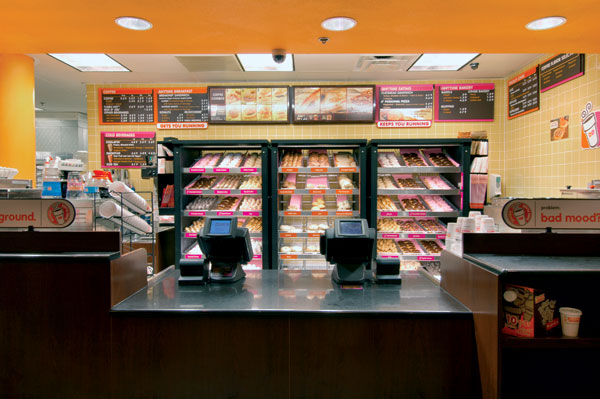
If you were 50 years old, had a net worth of $2 million, no debt, owned 3 Dunkin’ Donut franchises, loved your job, and “tap danced to work” every day, I think only a fool wouldn’t consider you a wild success.
Imagine you are 50 years old. You have a net worth of $2 million, putting you in the bottom half of the top 1% of wealth based on the IRS methodology in the United States. You own three (3) Dunkin’ Donut franchises in the town in which you grew up. You love your job. You have no debt. You wake up every morning and go in to the business to make products and oversee your operations, and to eventually experience the morning rush, which is your favorite part of the day. You serve the same construction workers, the same doctors, the same teachers, and the same retirees. You get to know them. You talk about your lives and bring a smile to their face.
According to our anonymous author, you would be nothing more than “a workhorse” for the other half of the top 1% of wealth. Those were his words.
I think that belief is asinine. You get to do what you love every day, you get to do it surrounded by people you enjoy, and you have enough money to buy the things you desire. Furthermore, you will have a chance to leave something to your children to help them build their own lives. As long as you are happy, what more could you desire?
Personally, I would consider you, the donut maker, a wild success, far more so than I would an investment banker with $10 million who spent his nights worrying about the direction of the Yen relative to the Pound Sterling, obsessing over whether his bonus was a little bit bigger than the guy in the next office, chugging Pepto-Bismol, and trying to make enough money to “get out” of the rat race.
This author seems to think that more money is always better and that those who are richer must, by definition, be happier and more powerful. It’s almost a god-like obsession with mammon. I just don’t understand it.
As I’ve said too many times to count, money is a tool. It is only useful for you depending on your own utility. That is a central theme that runs through the body of work I’ve built over the past decade. If you are the type who enjoys gold-plated dinnerware and driving a Bentley, then the admission price for success is higher. But you are no more successful than a guy who likes McDonald’s and Cokes who has everything he wants despite a fraction of the net worth. Wealth is a means not an ends. Then again, maybe the fact I understand the nature of money is why it was always so easy for me.
I also suspect that for this type of personality, the real motivation is something other than money, as I explained in an article called To Have a More Successful Life, Understand the Motivations and Motives of Yourself and the People Around You. Specifically, I told you:
If you say someone is motivated by money, it doesn’t tell you much.
- Is he motivated by a need for security due to anxiety about losing his home or standard of living?
- Is he motivated by the desire for expensive things?
- Is he motivated by the belief that money makes him valuable and desirable because he has no self-worth?
- Is he motivated by the fun of making money?
- Is he motivated by the desire to leave a legacy for his children?
- Is he motivated by money as a ranking system to help him stack himself up against his neighbors and colleagues?
- Is he motivated by the desire to build something that can improve civilization?
If you are in the top 1% of wealth and you are still dissatisfied, it’s not money you’re seeking. (By all means, continue to make it and grow your net worth – that’s my plan so I can give it all to the Kennon & Green Foundation) but don’t think that happiness expands along with the figures on your balance sheet. I’m just as content and thrilled with life as I was when I was 20 years old and studying Mozart and Beethoven in my undergraduate years despite enjoying a drastically higher net worth and standard of living.
More money is almost always better but only if the opportunity cost is one that doesn’t exact too high a toll on your true desires. For example, if someone offered me $25 million after taxes to spend the next 25 years of my life logging trees in the Pacific Northwest, physically cutting down timber, being exposed to the elements, and risking life and limb, it would take no more than a fraction of a second for me to resoundingly reject their offer. Yet, another person would be thrilled to do the same work and get paid $100,000 per year. There is a vital lesson on the nature of happiness in there. If you never learn anything else from my writings, I hope it is that money exists to serve you. You should not serve it.
A Case Study and Demographic Breakdown of the Top 1% of Wealth
Who are the top 1% of wealth? If you are interested in examining the richest of the rich, you can read more in an article called The New Elite: A Look at the Top 1% of Wealth and Net Worth in the United States. The most surprising statistic is 80% of the top 1% practice “stealth wealth” so that not even family members or friends know about the wealth.
Reader Comments (135)
Comments are presented chronologically, with replies indented beneath the comments to which they respond.
The Curious Porpoise
September 17, 2011
Joshua,
First off, thank you for all of these interesting articles. They are very helpful.
Secondly, how would you advise a friend of yours who asked for the quickest way to achieve an annual $50,000 passive income, structured to increase annually in order keep up with inflation each year? You see, I want to live life and pursue certain values and goals, but feel that the worries and cares of money hold me back from what I really want to do. As you said, I want money to be a tool for me to use, not the end all be all. I want to be served by money, not the other way around. We have simple tastes and don't want to "retire" early, but rather want to pursue more worthwhile causes without the fear and worry of not being able to pay bills hold us back. So I guess I am just looking for some practical ideas and advice from some one who seems to always have an intriguing point of view on finances.
BTW, I'm 26 and my wife is 23, have no personal debt other than a $145,000 mortgage on a house worth $175,000, have savings tucked away for an emergency fund, and have an "American" net worth of $55k. I am a Rutgers University dropout and my wife completed post high school vocational school, and we currently own and run a small service business (with minimal debt) from which we bring home $50,000ish per year.
Joshua Kennon
September 20, 2011
Replying to The Curious Porpoise
I'm running behind but I'm adding this to mail bag section; great question, it deserves a thorough response.
JoeBean
February 13, 2012
Replying to The Curious Porpoise
did this get replied to someplace else?
Joshua Kennon
February 24, 2012
Replying to JoeBean
Not yet. I will respond to it but the site's growth has overwhelmed the backlog of mail bag requests. I'm working on it. I will move it to the front of the list and try to get it up in the next week or so.
FratMan
September 23, 2011
Hey Joshua--I can't believe I haven't ever asked you about this--what are your thoughts on the ethics of the business practice known as planned obsolescence? I consider it evil on par with people who diminish food production you mentioned in your Disney posts, but I'd love to get your thoughts on this one.
Bretwebster1980
October 23, 2011
your article pertains only to the rich, what about the working class who cannot even afford to buy a McDonald burgers? Our money is tight and enough to buy day to day meals for the entire family. Those people who owns their business its either they acquire them from their parents or married their spouse who is rich. One day millionaire only exist if your family has the wealth of their own and amass them when they pass away. For some people who doesn't owe any debt, good for them. As long they will not report to the IRS that they are a good Samaritan and donated lots of money at the end of the tax year.
Gilvus
October 23, 2011
Replying to Bretwebster1980
Scientific data have repeatedly shown that over 90% of millionaires are self-made (read: they earned it through their own blood, sweat, and tears). Most people have the capability of pulling themselves out of squalor, but few choose to do so.
SecondHalf9
November 4, 2011
Replying to Gilvus
Amen to that. The 99% are the 99% for a reason. Seems to me they want to blame their lack of success on the people who have earned theirs. I was surprised to learn in this article that my husband and I are in the 1%. Are we really part of what the OWS movement is fighting against? What a joke. My husband and his three brothers were raised in a fairly poor family in New York. His dad was a NY state police officer and his mom a homemaker. I was raised in Wisconsin, five brothers/sisters, a dad who was an IRS agent, and my mom was a homemaker. We didn't have much money either. Many fights about money in our house. I made it through two years of college before having to quit because my dad stopped paying half of my college expenses (I needed his $500 a year to continue). I went to work in San Francisco and worked my way up the ladder despite the lack of a degree. My husband was able to finish college and went to work in the IT world. We have both worked our butts off our whole lives (with 14 hour days for the past 5 years--in fact, it's midnight right now and he's down at our datacenter for the fourth night this week working on a data recovery when most of the OWS lemmings are soundly sleeping) trying to get ahead and even harder ... we have done it ethically. We have a small business in the Bay Area that employs 10 people. We have 3 children including a son who is currently serving in Afghanistan. We have two broken down houses and bought a new building for our business last year, but still, because of the area we're in, we're worth over $1.2M. There are many many stories like ours for those in the 1%. If the 99% don't have the guts, determination, desire, risk tolerance, etc. to make a better life for themselves, then they should accept their station in life. That or embrace the American way, and go out there and make themselves invaluable to their employers or start their own business or whatever. I can tell you this from an employer perspective, the workplace is replete with mediocrity and it is ripe for the taking for any ambitious employee who wants to move up in the world. We're just dying for those people to walk through our doors.
SecondHalf9
November 4, 2011
Replying to Gilvus
Amen to that. The 99% are the 99% for a reason. Seems to me they want to blame their lack of success on the people who have earned theirs. I was surprised to learn in this article that my husband and I are in the 1%. Are we really part of what the OWS movement is fighting against? What a joke. My husband and his three brothers were raised in a fairly poor family in New York. His dad was a NY state police officer and his mom a homemaker. I was raised in Wisconsin, five brothers/sisters, a dad who was an IRS agent, and my mom was a homemaker. We didn't have much money either. Many fights about money in our house. I made it through two years of college before having to quit because my dad stopped paying half of my college expenses (I needed his $500 a year to continue). I went to work in San Francisco and worked my way up the ladder despite the lack of a degree. My husband was able to finish college and went to work in the IT world. We have both worked our butts off our whole lives (with 14 hour days for the past 5 years--in fact, it's midnight right now and he's down at our datacenter for the fourth night this week working on a data recovery when most of the OWS lemmings are soundly sleeping) trying to get ahead and even harder ... we have done it ethically. We have a small business in the Bay Area that employs 10 people. We have 3 children including a son who is currently serving in Afghanistan. We have two broken down houses and bought a new building for our business last year, but still, because of the area we're in, we're worth over $1.2M. There are many many stories like ours for those in the 1%. If the 99% don't have the guts, determination, desire, risk tolerance, etc. to make a better life for themselves, then they should accept their station in life. That or embrace the American way, and go out there and make themselves invaluable to their employers or start their own business or whatever. I can tell you this from an employer perspective, the workplace is replete with mediocrity and it is ripe for the taking for any ambitious employee who wants to move up in the world. We're just dying for those people to walk through our doors.
Thor
February 21, 2012
Replying to SecondHalf9
You obviously have misread this. Having a net worth 1.2M does not put you in the 1% LOL! Now, if you made 1.2M PER YEAR that would put you in 1%. Sorry dear, you are still in the 99%, maybe you should work a little harder. The lowest qualifying net worth to be in the 1% is about 5M. And for your information the problem the protester have is that the richest .1% and corporations buy off politicians! They make 392% more than the average income and pay a rate of taxes -37% of the average. This is according to the IRS. Billionaires get tax credits for being billionaires, after all they bought the people who write the tax code.
Mattjad
May 28, 2012
Replying to Thor
You just didn't read the article did you...
Steve_o
November 15, 2014
Replying to SecondHalf9
Yes! Whatever percent you fall in, this is the way to live. Strive, and work for yourself as soon as you can start your business, even on a weekend. The first 40 hours each week are worked to pay your bills, the hours after that each week are your wealth-building hours! Building wealth mainly means working longer and harder and taking more chances than most.
Jeff Herman
January 1, 2015
Replying to SecondHalf9
A great employee is worth everything.
I sold my packaging company 10 years ago, that I started out of my house, and I am now also in the 1%.
I couldn't get approved for a $500 loan to get married 35 years ago, but I did what you state in your text above. Always took on more responsibility, with or without pay. For once the learning was in me, they could NOT take it back.
When I went in to my branch managers office 40 years ago to ask for a promotion to supervisor from rep, he said, you know how many people have been in here asking for that job, I tentatively said, NO, how many. He said NO ONE, and explained that people just don't want to take on the responsibility. Well, you and I did take it one, and then folks bitch at us for succeeding because we stepping up.
I am so sick and tired of hearing the whaling.
Jeff Herman
January 1, 2015
Replying to Gilvus
I don't care if it's shining up your tin can, every environment can be improved upon. Everyone can improve their situation IF they want to. It's just that so many don't want to put in the work, but then bitch at those who do.
Joshua Kennon
October 23, 2011
Replying to Bretwebster1980
Your statements are all false. Absolutely, completely false. Inaccurate. Wrong. The government has tracked data on income, inheritance, household wealth, and a host of other statistics down to average hourly wage growth. This data is sorted by race, age, gender, household status, and geographical area.
For much of the past century, 90 out of every 100 millionaires in the United States are FIRST GENERATION rich. They did NOT inherit the money. They did NOT marry into their money. They made it on their own. (The figure is actually higher, 95 out of 100, if you include some modest inheritance.)
This is far different from when the nation was founded and the figures were reversed. Back then, roughly 90 out of 100 "rich" inherited their money in the form of real estate and land rights, including slaves.
In other words, you are 100 to 200 years to late. Your facts are wrong. Your criticisms and arguments would have held merit when Thomas Jefferson was in the White House. They are now just fantasy and illusion. A vast majority, near totality, of millionaires in the U.S. are self-made. It's not an opinion, it is economic fact.
Joe Pahl
July 14, 2014
Replying to Bretwebster1980
Wow, what negative and inaccurate opinions you have of wealth. " Those people who owns their business its either they acquire them from their parents or married their spouse who is rich." Seriously, that is probably the DUMBEST thing I have read on the internet, and that's saying something with the amount of crap to be found online. Holy cow.
Broughton
November 8, 2011
Your statistics have no credibility. $1.2 million as the entry threshold for top 1% net worth is simply too low. The Federal Reserve supplies reliable statistics on this, with a survey about every 3 years. The last published survey was for 2007, and the amount was 6.2 million---even the effects of the great recession would not have dropped this down to 1.2 mil.
Joshua Kennon
November 9, 2011
Replying to Broughton
Yes, the Federal Reserve publishes the information you mention, down to household assets. But to get into the details of actual net worth, the best source is the agency closest to the data, the SOI Tax Statistics - Personal Wealthy Study Metadata, published by the Statistics of Income Division of the IRS. Every 3 years, they release something known as the Personal Wealth Study, which uses information from the form 706, to estimate the wealth of the living population in the United States.
The IRS SOI reports use a technique called the Estate Multiplier, and break down reported assets minus liabilities by taxpayer demographics, including gender. They define the specific assets that are included here (source) and explain the data limitations of the sampling technique here source.) This is included in the Bureau of Labor Statistics Statistical Abstract publication, which is probably the most definitive easy-to-reference guide. The "official" numbers are updated less frequently, with the last being in 2004, and another set coming up soon. The IRS figures even include a 1.2% buffer for pre-audited results to account for the likelihood of under-reporting of assets and income. Their technique is sound, well documented, and the closest to the actual taxpayer of any government agency. Most importantly, it is transparent.
Looking at the last round of "official" data, rather than the estimates that are released, the IRS shows that based upon the estate multiplier technique, there were 1,555,000 individuals in the United States with a net worth of at least $1.5 million or higher. This PDF report from the agency breaks down the components of this wealth into various asset classes such as closely held stock, publicly traded stock, cash, retirement funds, business assets, real estate, etc. That same year, according to the National Intercensal Estimates (2000-2010), Sex and Age table column G row 40 from the United States Census Bureau, there were 219,507,563 men and women who were legally adults in this country (source). That puts the "high net worth" tax payer probability distribution at 0.71%. To get the figure to 1%, you have to look at a few other data sources and tables and you end up dropping the net worth entry threshold to $1.2 million, which is what the author of the original source from the article settles upon and what I, based upon looking at that data, agree with in my own analysis.
Income is not wealth. Mean is not median. Net worth is more complicated than assets - liabilities because you have to adjust for tax structures and things like the inter-generational skipping tax.
The Federal Reserve data is useful if you know how to use it. I'm not sure you do. I would caution you against making any large financial deals based upon your ability to understand the meaning behind numbers; it might be a blind spot for you given how certain you seemed of your conclusion, which are erroneous. It's that type of thinking - believing one understands numbers rather than the economic reality they reflect - that led to the creation of abominations such as CDO's squared.
Mark Diodati
August 17, 2014
Replying to Broughton
wow
Broughton
November 8, 2011
what happened to the comment I posted an hour ago?
Broughton
Joshua Kennon
November 9, 2011
Replying to Broughton
The site is on a cache and distributed through Amazon's servers. It is possible you might see your comment(s) appear and disappear until the regular updates replicate across their infrastructure. To keep the server resources high, I have the current cache scheduled to clear every four or five hours. Any comments that include third-party links not from regular site readers who have been white-listed are automatically held for review due to combat spambots, so if there is an html link reference, that might cause a holdup.
Broughton
November 8, 2011
I have to correct my stats-and looked up my own data file. I have had for some years an inclination to actually track the stats for the top 1% net worth. Here it is:
1983 Top 1% Net Worth threshold is US$1.9 million
1989 Top 1% Net Worth threshold is US$2.2 million
1992 Top 1% Net Worth threshold is US$2.4 million
1998
Top 1% Net Worth threshold is
US$3.35 million
2004
Top 1% Net Worth threshold is US$6.19 million
2006
Top 1% Net Worth threshold is
US$6.40 million
2007 Top 1%
Net Worth threshold is US$8.23 million
Broughton
November 8, 2011
I would like to have "owner" of this website publish his direct quotable source for the 1% net worth data so I can compare his stats to mine, as there is such a very large discrepancy. Cite a full published source and not some vague website (which I searched to no avail), and a person of authority on where he gets his stats from. Net worth calculations are always suspect since they have no relationship to age, gender or income. Moreover, most financial institutions such as brokers and investment banks published "wealth" stats that are limited to financial assets and do not include real property, etc. (and thereby not true net worth).
Joshua Kennon
November 9, 2011
Replying to Broughton
I'm going through the comments now and just happened to respond to two of your other messages. Out of kindness, to help your cognition, I took time out of my schedule to point you to the original source data since you seemed genuinely interested in the numbers, which I always enjoy discussing and analyzing with other people. Then, I find this demand (complete with the slightly bizarre use of quotation marks).
This is a blog that I write for reasons that have been well documented in the past. I'm not publishing academic papers, I'm not a reporter, and I have the luxury of being successful enough that I don't have to account to anybody else. It's one thing to politely ask me to point you in the general direction of my data sources or to even passionately argue that one of my positions is wrong (in fact, that is one of my favorite parts of this whole experience because I learn just as much from the readers as they do from me), but the sense of entitlement - that somehow the world should jump when you snap your fingers? It's self-defeating. It instantly makes me regret taking the time to respond to your message moments ago. If I didn't think it might be useful to other people who like analyzing data, I'd take it down and ban you from the site.
It's not my job to serve up everything I know to you on a silver platter, nor to make your life easier by providing carefully cross-checked academic-quality articles in proper MMLA-compliant essays. I write to help people, sometimes completely, sometimes in a few brief seconds from an iPhone or iPad in between meetings. This blog certainly isn't my best use of time on an opportunity cost basis. Adjust your expectations or find somewhere else to read.
Broughton
November 13, 2011
Replying to Joshua Kennon
Well, well, well. I am rather surprised that you cannot take criticism over use of faulty data. Moreover, your
position explained above is a cop-out. The Federal Reserve publishes this data every 3 years, and the intervening yours are calculated with great academic validity by Dr Edward Wolff at the Levy Economics Institute of Bard College.
As for your interest in my personal background, I am an American that moved to Canada to join the oil boom in Calgary decades ago. Married a Canadian and settled down to raise a family. Besides being a mult-millionaire investor in gold and silver for nearly 40 years, I have a Ph.D. from Cambridge in petroleum geology.
As for your comment that are considering banning from this webside, frankly I am put-off by your callousness and intellectual dishonesty. And I do not care. More to the point, it would be interesting to see if y0u censor out this reply.
Gilvus
November 13, 2011
Replying to Broughton
I don't think the issue here is who's right and wrong, it's the hostility oozing from your initial post. People tend to be more patient and receptive to your voice when you start it out with "I disagree and here are my reasons" instead of "Hey asshole, you're wrong, and here's why."
Joshua Kennon
November 13, 2011
Replying to Broughton
I know who you are. It took a few seconds to pull up your home on a satellite image and check it with the property records. What is this - 1997? Server analytics packages capable of that cost less than a couple thousand bucks a year and almost everyone on the net has them anymore. It's not like you were using an anonymous proxy router or anything that would have posed a challenge.
I have no problem with anything factual or data driven. What I have a problem with is tone and entitlement. A simple, "Would you please email me the source files for the data?" would have sufficed and most likely gotten a response.
You are free to criticize, argue, persuade, and counter-point as much as you like on this site. In fact, it is encouraged and welcomed. No one will ever be banned for disagreeing with me or other readers; I would expect it to happen regularly because that is how the best ideas win, through the tempering of discourse. Only a few moments ago, I was replying to a thread in which a regular reader, Gilvus, disagrees with my assessment for the future of the music industry. He very well may be right and I might turn out to be completely wrong. That's what I love about the site. It is one of the reasons I keep it open despite not being a great use of my time on an opportunity cost basis. If, in a few years, I turn out to be wrong, I'll be the first one to say it because that is how you improve cognition - you look at cognition failures and then figure out the flaws so you don't repeat them.
What you are not allowed to do is be a jerk. Who, for example, shows up to a site they've never commented on and posts three or four rapid-succession messages, including one asking why his commented hadn't replicated on the servers fast enough for his liking? That is asinine behavior; the type of thing you see with a guy who surrounds himself with "yes" men and doesn't like to be questioned. It isn't difficult to imagine that you're a belligerent bully. Normal people don't go around demanding to be heard and validated.If you can convince me, using logic and rationality, that the IRS data, which uses the estate multiplier effect, is somehow a sub-optimal resource or otherwise inaccurate, I'm all ears. If you think that the buffer for under-reporting of income and assets in their model is insufficient, again, that's a rational position if you can provide a better figure. You haven't done any of those things. Worse, you haven't even tried.
Go do it. Seriously. Go to the IRS site, tear apart their model, and then present your data. If you can convince me your figures are better, I'd be the very first one to say, "Let's update the numbers!". But I won't take it on faith - give me your reasoning, facts, and arguments so I can come to my own conclusion. That's what I try to do around here - make people think for themselves.
There is only one rule for the public comments: Play nice. So I'll repeat myself: Play nice, or you'll be banned. We're aiming for Gawker-quality comments, not Yahoo flame wars. Those are the terms. If you don't like them, leave.
I hate arrogant pricks
December 13, 2013
Replying to Broughton
It would seem you managed to still be a self important self aggrandizing piece of work, taking time out to mention being a multimillionaire Ph.D.
Personally I prefer the simple observation you're an arrogant prick and I don't care what your background is, seemingly the owner of the blog is more polite about it though.
Shanny
June 13, 2014
Replying to Broughton
I know I'm a bit late to the party, but please stay in Canada. We don't need you here.
Joshua Kennon
November 14, 2011
Replying to Broughton
Broughton,
I've been getting a lot of letters asking about the estate multiplier technique the IRS uses compared to the Federal Reserve raw data in the past few days so here is what I'm going to do. (Apparently there was quite a bit of discussion last night, but I've been playing Elder Scrolls: Skyrim so I haven't been paying attention as much as I should. I'll catch up and find out what you all were saying later but based upon the email messages, I think most people look at net worth the way you do - how much a guy has versus how much he owes. They don't look at it from a GAAP basis, which is how I think about everything and the reason I prefer the IRS methodology.)
Here is the solution that might help. I'm going to try to do it over the next 3-4 weeks but this time of year is crazy schedule-wise but it will get done at some point:
1.) I'm going to re-write this article with the Federal Reserve data and indicate that, linking to the consumer data
2.) I'm going to write a second article with the IRS data and indicate that, linking to the SOI data
3.) I'm going to explain the difference between the two so every reader can make up their own mind looking at the two methodologies which they think more accurately works for their own understanding
That achieves several things: 1.) Makes it simpler for people to understand, 2.) Lets people know the difference between the wildly divergent government estimates, and 3.) Lets each individual reader come to their own conclusion based upon their own reasoning about which they'd like to use for their own milestones. I'm happy with that because I don't think of my job as telling people what to do think, but instead giving them better tools to reach their own decisions.
Just as importantly, it saves me a lot of time so I don't have to write back to individual readers. I strongly prefer the estate multiplier technique because let's imagine I am 85 years old and I have a $6 million net worth, yet $2 million of it is in a trust fund for my children, to which I have no legal claim, I'll owe $1 million in estate taxes on death, I've contractually promised $2 million to my foundation (think of a binding pledge, like Buffett did with the Gates foundation for his Berkshire Hathaway shares), my GAAP net worth is $1 million. But to the layman, my net worth is $6 million. Both the Federal Reserve and the IRS are reflecting economic reality but speaking in different terms. It is clear that is confusing people so I need to do a better job of splitting the two sets and explaining each.
The reason I discount the Federal Reserve figures is because I see the world through the lens of a private investor. If I'm studying a publicly traded holding company and they buy $10 million worth of stock which grows to $100 million, the gain in book value is not $90 million. GAAP requires you to back out the taxes that would be owed upon sale and put them in a line called "deferred taxes" on the liability side, so you'd be more likely to get a net worth of $58 or so million on the balance sheet. Then, because I'm a value investor and use a modified form of the "owner earnings" calculation, I'd even back out the dividend tax that would be payable to me if I took over the company and distributed all of the earnings to stockholders. In my mind, that means the "true" net worth increase is only $49 million or so. To me, net worth is only what you can cash out, walk away with, shove in a suitcase, and flee the country with. Everything else is "good until reached for", as Charlie Munger puts it. In this scenario, both $90 million in book value gain and $49 million in adjusted book value gain are accurate, though they seem wildly divergent. The average person isn't going to understand that distinction and it was my oversight and failure to not explain that.
I'll try to get this article switched over to the Federal Reserve data sometime in the next few days, which should make you happy because you'll see the "sticker" net worth that is closer to your estimates. In the next few weeks, I'll try to get the IRS data published in a separate top 1% of net worth article, explaining why I prefer it and why I think it is how people should think about their own personal finances.
I'd starting working on it now but I have only so much free time today and I am about to make my way to a new city called Dawnstar in Skyrim.
Broughton
November 14, 2011
Replying to Joshua Kennon
Thank you for your consideration on this matter. This is fair. And I suppose that the difference between the two methods of calculation relates fundamentally to the definition of net worth. I and probably most people do not consider a future tax as a liability with the definition of net worth. By that standard, it is only a matter of definition, and that is what causes the confusion--we are operating with different definitions.
It is like my recent dialogues on what is class, which has caused a great deal of acrimony. To me it is simply a matter of classical definition and not the corrupted "modern" and erroneous usuage of the term.
It has become politically correct to label most Americans as middle class, erroneously, since that is "the
American Dream." Much like the misued and erroneous usage of actor to nowadays describe all actresses. Poliltical correctness has destroyed usage of jungle--there are no more jungles just rain forrests. Nobody dies they just pass away.
Anyway I was only seeking to resurrect correct formal usage of terminology, the English language
Above all, it sure has invoked a series of discussions.
Joshua Kennon
November 15, 2011
Replying to Broughton
No problem. I'm likely going to combine it all into one article after thinking about it, even though it makes it 4,000+ words. That way, the whole discussion is on one page and people can print it.
Ag
February 19, 2012
Replying to Broughton
Is the importance of this subject truly substantial enough to warrant such argumentative banter. This area of who falls where in terms of net worth is to gray to determine one final absolute number of the exact nature of where the 1% line lies considering the millions of factors that could be included and the amount of unknown information that would be required to conclude such a number. While much extensive research could be undertaken to possibly figure this type of statistic, the departments responsible to doing so obviously do not find its importance great enough to do so. A general understanding of this information is sufficient enough to serve for its purposes of knowing where the wealth distributions lie across the demographics of this nation whether they are slightly skewed one way or the other.
This article, in my opinion, is a great reference and is useful enough to obtain a satisfactory understanding of this subject and consider the efforts put forth, by the author, to supply the info sources in which the conclusion was drawn exhaustive enough to to justify a high level of creditworthiness.
What I find amazing, every time i read the comments of pretty much any article, is the overabundance of individuals willing to argue meaningless points for the sake of arguing. There is nothing wrong with having an opposing view on a matter but the way in which you go about presenting your opposition is disrespectful.
Josh does not owe you anything, if the conclusions of this article were being used to make major governmental decisions and to put policies into place effecting you and I then your actions would be somewhat understandable but these conclusions are not being employed for such purposes.
Your efforts to let your hostile opinions be know on this subject will have no influence on anything ever because they hold no importance. The only reason I took the time to reply to you was in the hopes of maybe having the influence of making at least one of these types think twice and and refrain from engaging themselves in such manner in the future.
Broughton
November 14, 2011
Replying to Joshua Kennon
When you go into a bank with an appointment with a loan officer, you have to list your assets and your liabilities for them to calculate your net worth as per collateral (and your income cash flow but that is another matter). They do not care about your potential future tax liability, as it does not fit into the operative commercial definition of net worth.
Joshua Kennon
November 14, 2011
Replying to Broughton
That is true, and the banks' collective financial results reflect that lack of conservatism. Had they used the more stringent method, they wouldn't have lost their collective hides and been forced to take a taxpayer bailout. 😉
For me, it is all tied to the formulas I used to calculate the intrinsic value of an asset. The tax rate directly influences how much cash I can get my hands on to reinvest, spend, or give away to charity, therefore it directly influences how much I can pay for that asset to achieve a given rate of return. The moment tax rates increase, the intrinsic value of every asset in the nation decreases (and visa versa). The same is true of inflation. They are both direct input variables. All asset classes - stocks, bonds, song rights, lemonade stands, it doesn't matter - are then compared so that I am able to buy the most net present, after-tax, after-inflation profit for every dollar invested. Then I wash, rinse, and repeat. That's the business model. It's the lens through which I view wealth.
What you said earlier was spot on the money - the definitions are different, leading to different results. I understand why you prefer the more popular sticker method; I really do. It's simple. It's accessible. It reflects how most people think. But I am, by nature, far more conservative. I always aim to conduct my life and measure my affairs as if the world went to hell in a handbasket tomorrow so my standard of living isn't affected. Today, for example, I decided not to go to the office and played Elder Scrolls: Skyrim for 10 hours. Why? Because I could.
An extreme example might help. If both you and I had one asset, $10 million worth of Coca-Cola shares with a $0 cost basis, and no debt, but mine were held in a traditional IRA and yours were held free-and-clear in a global custody registration, I wouldn't consider us having the same net worth. I know we both have $10 million in assets and no debt. But I don't think both of us have a $10 million net worth.
I operate fairly close to GAAP. My net worth would be $10 million - taxes due upon liquidation (in this case, 35% since IRA distributions are taxed as ordinary income, or $3.5 million) = $6.5 million. Your net worth would be $10 million - taxes due upon liquidation (in this case, 15% since that is the long-term capital gains tax rate in effect right now, or $1.5 million) = $8.5 million.
We both have $10 million worth of Coke. We both have no debt. But you are worth $8.5 million and I am worth $6.5 million. Contingent liabilities and deferred taxes should be accounted for in economic analysis. What counts is how much stuff you can buy, reinvest, or give away. That is all that matters.
Again, I understand why you would look at both and say, "We're both worth $10 million." On the surface, you're right. I don't disagree with that.
Alberte48
March 14, 2012
Replying to Joshua Kennon
joshua,thanks for the great insights.I take your notion of "walk a way" net worth a bit further than you; you recognize only federal taxes as a minus- factor,but shouldn't state and local taxes be calculated in as an added minus factor?I live in NYC and these taxes are substantial.
AGF
November 13, 2011
Thank you for the breakdown of the top 1%. The phrase "top 1%" is all around us these days, but you appear to be among the very limited few who have taken the step of defining that phrase.
I have searched Professor Domhoff's site, and I do not find the specificity in relating percentiles to actual net worth dollars to lead me to the estimates you reference above. Have you calculated the figures shown above, or can one independently validate them on Domhoff's site? The reason I wish to do so is that the few definitions in the public domain appear to differ by a wide margin.
Thank you again for having the courage to offer a much-needed definition for the national discourse on the topic of wealth distribution.
Broughton
November 13, 2011
Replying to AGF
Thank your for your kind consideration. As a matter of intellectual honesty, my personal net worth hovers around the threshold 1%-some year just over and some years just under. Besides, I am pround of being associated with the upper 1%. Afterall, wealth is net worth and NOT income. You can be in the upper 1% entirely by inheritance and never earned a dime other than clipping coupons, so to speak. What has changed the scene in the last decade is the volatiliy of being wealthy--a lot of this now comes from Wall Street and there you can loose it as fast as you make it. It did not used to be that way, as wealth in the old days was tied to ownership of factories and farms--now wealth is concentrated in paper accounting figures.
In addition, another widely misused term is middle class. It has a distinct definition, and Americans are lower class not middle class. ALL factory workers are lower class, all small shop keapers are middle class, all professionals are upper middle class. Upper class has nothing to do with net worth or income. It strictly defined as having social position derived from inherited wealth or lineage. An example is being a member of the Rockefeller family. You can have a net worth of $100 with the Rockefeller name and your are upper class. Worth $100 million on wall street as a broker and you are upper middle class. You boss may be upper class if he comes from an old banking family etc.
Afterall, everyone wants to be "middle class".
Alvanselow
November 13, 2011
Replying to Broughton
By your definition, Bill Gates, Warren Buffett, Carlos Slim, Larry Page, Charlie Munger, and Sam Walton weren't or aren't upper class but any of their ancestors will be despite having a small net worth compared to their net worth? That's stupid. No one cares about the Rockefeller or DuPonts anymore. Upper class is a combination of net worth and personal achievement. That is why the Hiltons are considered trash but Steve Jobs is worshipped. Heredity is meaningless.
Broughton
November 13, 2011
Replying to Alvanselow
As we live an Anglo-American society by heritage (despite the high percentaqe of non-), we inheritage usage of such terms from classical English society whether we like it or not. That is the way it is. It is why Dianna Spencer before she met and wed Prince Charles was upper class despite the fact that she had no money of her own and she taught kindergarden. It is and was her heritage. Just because you do not care for Americal cultural herritage does not make your position correct.
It is no different, for exampe, in the corruption of use of the terms formal and informal dress. Formal dress is by definition white tie, informal dress is black tie, and casual is business suit. Just because most people totally misinterpret the use of the terms do not make them correct.
Americanism is a culture that has corrupted the formal usage of correct English language. But that does not make it correct. And as for "dude, you're crazy" comment, that says it all. You obviously require a higher standand of education.
navosd
November 13, 2011
Replying to Broughton
long time lurker but i had to comment cause i'm not getting your logic. you are saying that john d rockefeller would have been lower class because he was poor and came from a disgraced family but his great-grandchildren would be upper class because they are famous for his money and his accomplishments? that doesn't make any sense. also, if all shop keepers are middle class, sam walton's family which is worth 150x the royal family in britain is still middle class? dude, you're crazy. no disrespect but you are so out of touch with the world.
Broughton
November 13, 2011
Replying to navosd
Yes, Mr Walton is upper middle class. So is Bill Gates. The Walton and Gates grandchilden may obtain the status of upper class, as perhaps the Kennedy family has. For now, they are new-rich. The are not "old money" , and they are not bespoke.
navosd
November 13, 2011
Replying to Broughton
if you actually believe that you are so irrelevant and probably have some serious self-loathing issues going on. class, which is just a code word for power, prestige, reputation, resources, and respect, depends on culture. once the world became flat with the rise of representative republics where merit rather than heredity determined worth, class reflected that. anyone who still adheres to outdated models that haven't been in effect for a couple of generations is like those people who used a typewriter once the computer came along.
i'm guessing you might just be that out of touch. you responded to the guy above me when I'm on the one who said "dude you're crazy" and you thanked the AGF commentator when she (he? i don't know) was complimenting the author, joshua kennon. you can't even understand how nested comments work on the internet and keep track of who is responding to who. you should go to a university and take lessons or something. did your grandkids set you up on the computer this weekend? you still have a lot to learn.
Broughton
November 14, 2011
Replying to navosd
Computer--I spend my days on a unix language work station modeling thermodynamics of steam injection
into heavy oil reservoirs, and thereby ascertain where to drill my next oil well
Gilvus
November 15, 2011
Replying to Broughton
What software package do you use? Are the heavy oil reservoirs you drill in related to the Athabasca tar sands? I seem to remember the oil sands are near Calgary.
Broughton
November 15, 2011
Replying to Gilvus
I live and work in Calgary and work the McMurray Formation oil sands of the northern Athabasca Basin, north of Ft McMurray. Use proprietary software in conjuction with OpenWorks data base with Landmark/StratWorks package, all of which are Haliburton products. Although I am currently migrating to EPOS, and GoCad as feed to reservoir simulation.
I am a SAGD specialist (steam assisted gravity drainage) by which we inject steam into such reservoirs for extracton. This reduced to the 8 degree bitumen to flowable viscosity. I am Cretaceous sedimentologist (Ph.D., Univ Cambridge, UK.).
Gilvus
November 15, 2011
Replying to Broughton
I see. In our department, we use Schlumberger's Petrel, though both red and blue regularly send recruiters here. We deal with conventional oil down in the Gulf, so SAGD isn't a specialty here. My focus is groundwater modeling so I use packages built around MODFLOW and MT3DS, but I lean more toward the environmental side than oil and gas.
Do you have spare samples of your 8 API bitumen? I keep several vials of crude in different viscosities to show my students. I have a 14-gravity vial of San Joaquin, a 39 WTI, a 50ish gas condensate, some oil shale, among others. I'd love to add a sample of bitumen or a small jar of tar sands to my teaching collection.
Broughton
November 16, 2011
Replying to Gilvus
Could do, but I do not know how to get it to you. What is your mailing address?
Gilvus
November 16, 2011
Replying to Broughton
Much appreciated! I'm wary of broadcasting my personal information on a public forum, so would you mind contacting me at G1lvus (at) yahoo (dot) com? Note the number "1" in place of the "i."
Joshua Kennon
November 15, 2011
Replying to AGF
The article has now been updated and re-written to better reflect and reference the source, including a discussion as to the reasons for the wildly divergent sources of net worth for the the top 1% of the United States population. I hope that answers your questions.
Broughton
November 17, 2011
Replying to Joshua Kennon
You have done a good job and rewriting and presenting both sides of the issues.
Broughton
November 13, 2011
Let me make this clear. Class distinction has little to do with net worth. Class is by definition what you do and your family ties. Most Americans are, I suppose, factory workers, mill workers and in the service industry. This is all lower class or working class by definition. It has no relationship to net worth or income although I may presume that such workers have low relative pay and net worth. Middle class are those who own their means of production--they are the shop keepers and the farmers and the small factory owners, and they are acutully
lower middle class. Upper middle class is defined as those who are the large land holders, large factory owners and the professionals such as doctors, lawyers, bankers etc. Upper middle class MAY evolve into the Upper Class and are the aristocrats in the historical sense of the work such as the multi-generation large land holders, the very wealthy socially connected generations whose social connections originated with the large fortunes---but also became a recognizable family lineage over time. Steve Jobs and Bill Gates are upper middle class new-rich, and not upper class at this time. A hundred years from now all lineage connections with these much admired personages may not have been fostered or created because they gave away all their money or had no children Evolution into the Upper Class is an evolution! It is why the Rockefellers are upper class as they are "old established family." That is not to say Gates gradchildren will become upper class, but for now, he is not.
navosd
November 13, 2011
Replying to Broughton
that's idiotic. this has to be one of the stupidest things i've ever read on the internet. that says something.
Pembrandt
November 13, 2011
Replying to Broughton
Where do I even start with this? No one can be this foolish, can they? The idea that your occupation determines your class instead of what you do with your life and what you achieve is completely mad! To even suggest that a man like Ray Kurzweil, who has changed the world and made a lot of money doing it, isn't upper class and that Diana Spencer was despite being a broke kindergarten teacher is only possible if you belong to a group of people who have completely failed to distinguish themselves in anything meaningful in life and want to create a system that allows them to exclude others. All nobility can be traced back to someone who clubbed someone else on the head and took their land.
Consider this a friendly piece of advice: You sound like a fool. No one is going to respect another person because of their birth. The type of people who would are fools themselves who haven't accomplished anything on their own. I guess if you need approval from other non-producing parasites on the system who are living off other peoples' accomplishments, heredity matters. Thank God your lot lost and is now dying off. No one with half a brain would choose having dinner with someone of nobility over having dinner with the world's best scientists, business leaders, or even chefs.
You are saying full of pride that if you have dinner with an oil tycoon that came from nothing he is not upper class, but his worthless grandchildren living off his money can transform themselves into upper class. There are so many logical fallacies there it is clear you are not a rational person. You sound bored and silly.
Distinction and accomplishment matter. The only people who think otherwise are those who are incapable of distinction and accomplishment. I suspect that's you.
Broughton
November 13, 2011
Replying to Pembrandt
As I said, distinction and accomplishments are of great admiration but have nothing to do with the definition of class position. It is afterall a matter of definition whether you like it or not, or who one individually fits in that scheme of things. And by the way, it is not "my lot dying off." I am only trying to
resurrect correct usage of the English language.
Dude
November 15, 2011
Replying to Broughton
This is America, Broughton, the country that gave the world James and Pragmatism. There is no "correct usage" of English. Hell, the Supreme Court ruled that tomatoes are vegetables citing "common speech." Quixotic you are. Neurotypical you are not. Dude, you're crazy.
Broughton
November 13, 2011
Replying to Pembrandt
You can read Das Kapital by Marx and find the same definitions if you wish to. Ponderous, but I have.
Broughton
November 14, 2011
In further, one often hears the use of the term "ruling class" or "elite". This is a combination of the new rich, which are generally the wealthy upper middle class--and the upper class. Often this is referred to as the upper classes (in plural).
Rich. What is rich? There is no formal quantitative measure--but I personally view it as upper 1% net worth.
The real rich are the "super-rich" whose net worth are in terms of hundreds of millions of dollars. But again that is not formally related to the definition of class. Generally these are new-rich, often movie stars and industrialists, and of course rock stars. But often their wealth fails to be carried down several generations, and those decendants fail to establish the necessary social connections attributed to a family dynasty--thereby this wealth does not evolve into the upper class structure--which is 100% family structured. These first generation new-rich remain upper middle class by definition. This is as true of American today as it is of England today.
There is no direct 1:1 correspondence between class and wealth, although there is often a strong relationship. The formal definition of class is not related to net worth but to you and your family relationship to means of production or control thereof (in the sense of the lower and middle classes), but family establishment necessitates evolution into the upper class.
America has been long admired to class mobility, unlike most of Europe--but class mobility in the classical sense is what you do for your children and grandchildren for they to have a better life than yourself. That is the essence of the American dream. That you could turn your small shop into an industial empire--that was a move from lower middle class to upper middle class, and MAYBE someday your successive generations and that future society will look back upon your as a patriarch--that becomes evolution into upper class. Much tougher to do in Europe, than historically in America.
Joshua Kennon
November 15, 2011
Replying to Broughton
That's an interesting way of thinking about it. I don't approach the question of "rich" as being relative. I think it is absolute.
For me, a man or woman is rich the moment he has the ability to afford the lifestyle he desires while spending his time doing exactly what he wants to be doing. A man who wants nothing more than to live in a small apartment and build model trains all day might be rich with a $75,000 per year income from real estate holdings. He has everything he could ever want and does what he loves every moment of every day. In contrast, another man who earns $5 million a year but hates his job, hates his life, and has to answer to others isn't rich to me because he is still a slave who has to run whenever his masters call or face the threat of losing his home, comforts, and reputation. He has no control over his own life.
That is actually one of the big themes of the blog. Some of the long-time readers with whom I regularly correspond manage nine or even ten-figure pools of assets yet don't have control over their time. Others earn only six-figures but have no debt and basically play all day. Money is only useful for the utility it provides; in this case, the latter person is getting far more utility making him or her financially richer.
Rich, in other words, is the moment at which a man has bought freedom over his time commensurate with his lifestyle preferences. If you make it a relative metric (e.g., the top 1%), you get into the paradox that he might be poorer if, next year, his neighbor makes more money, even though our guy has the same standard of living, the same income, the same wealth. It's a logical inconsistency. It's the contrast principle mental model that causes a trader at Goldman Sachs to be happy with a $1 million bonus until he finds out the guy next to him earned $2 million. That is an insane way to go through life.
Like your definition of net worth, I understand why you see things this way. A lot of people do. It's not a criticism at all. Looking through some of the comment posts I've missed since being away (I'm still not fully caught up so this could be a misreading) I think your temperament is focused more on appearance and relativeness - dollar amounts compared to other people, family lineage, titles, etc. - whereas my temperament is more focused on the underlying spirit of things. That is, you seem interested in how things appear, whereas I am only interested in what they are; the implications and substance.
Again, that is not a criticism. It's as if we are both looking at a mountain from different perspectives. Everything I say and write is going to be filtered through a screen of utility for the reader. Money, sex appeal, fame, family title, all of it is only useful in so much as it provides utility to a person. That, in my world, is the real wealth. After all, if you are in the middle of a battlefield, it doesn't help that you own more guns than anyone else in the world, you need a weapon in your hand right then. The guy with a big stick is richer than the guy with the guns who can't access them because big stick guy has more utility.
It isn't surprising that I view class differently, too, since we are operating from different perspectives. Looking at history, class and family lines were only useful to our Anglo ancestors because they represented access to food, shelter, land, and money at a time when starvation was a very real threat.
Once the industrial revolution came along, those connections began unraveling to the point of almost non-existence by the modern era. Today, America still has a class title but heredity no longer plays a major role. The social prestige, access to corridors of power, respect, and influence of being "a Rockefeller" pales in comparison to being a dot-com millionaire or a successful television chef, to build off what another commentator said. In some cases, hereditary can be a detriment (again, as one commentator pointed out, Paris Hilton's children are going to have a horrible time being taken seriously in the world despite the family name). The new titles are "CEO", "Senator", "
What you consider corruption in the language, I see as evolution and adaptation. Language evolves to reflect the society which it serves. Just as "to pen" a novel once meant to take a quill to parchment, then became typing on a giant hunk of metal, then became rapidly pressing plastic buttons on a personal computer system, the word "class" has evolved, likewise. The English language you and I are using to communicate right now didn't exist 2,000 years ago. It evolved because words took on different meanings and transformed with society. In the Western world "class" did that a few generations ago. I'd be hard pressed to see how it could ever change back, just as the word "gay" no longer means "happy" or the word "cool" no longer means simply cold but "neat". They are so firmly embedded in the lexicon that attempting to extricate them is a wishful thinking. The conditions that led to their original meaning are no longer in place - and everything goes back to food, shelter, reproduction, and status. When heredity was severed from favored access to those franchises, it would doomed to be associated with class status.
Broughton
November 15, 2011
Replying to Joshua Kennon
Rich has to be "relative" because it is society dependant. The working class American would be "rich" if he was compared to say those in the Sudan. Therefore, the only way to evaluate is relative within the culture.
Of course language evolves, as does grammar. Nonetheless, there are still formal reference points of what is correct vs slang and vulgar. Write formal technical, peer reviewed, scientific papers in technical journals and one quickly learns what acceptable or not to the editors. Write a legal brief for a court and the same.
"Cool" does not muster.
Joshua Kennon
November 15, 2011
Replying to Broughton
Though I enjoy conversation, from a resolution standpoint a conclusion is impossible because the temperament from which and perspective lens through which we view the world are fundamentally different. On the face, I don't disagree with many of your positions because they are or were, in the past, technically true. I just think they are terribly incomplete and lack a deeper understanding of the nature of what is going on or the systems underlying the phenomenon. You are an extreme example of a worldview conservative author Thomas Sowell calls "the constrained" view of humanity in his book A Conflict of Visions. I am a John Stuart Mill.
For example, for economic analysis, I do compare the working class in America to the people of Sudan, which is why I take our poverty numbers with a very large grain of salt. The "poor" in America typically have two vehicles, multiple televisions, a DVD player, a smartphone, central air conditioning, and central heating.
In terms of wealth, I believe once someone has met their own threshold absolute desires for lifestyle, it shouldn't matter what their neighbor makes, whether less or more. It's irrational. I was "rich" a long time ago but from a utility standpoint, that moment happened not when I had more than 99% of my other fellow Americans but when I was 21 or 22 and earning $100,000+ working a few hours a week from a college apartment because I could do what I wanted all day, keep virtually no debt on the balance sheet, save a good amount of money each year, and still live very comfortably. I did not know, nor did I care, how much my neighbors were earning.
Based upon what we've discussed thus far, it would seem as if you would only consider someone truly rich if his family were in the top 1% of wealth, his home bigger than his neighbors, he had the prestige of a hereditary link to a family line associated to money, and enjoyed the imprinteur of a prestigious education. Those are "badges", tokens, or symbols, much like a gold star on a report card that represent something.
I think that is an irrational way to look at the world that reflects a core, deep-rooted need to feel valued or respected by other people. Instead of focusing on personal utility, it's all about the perception of other people; the desire to be admired, to be emulated, to feel worthy. It is a fundamentally different motivation. It makes no sense to me whatsoever. Honestly, it's completely foreign to me because my scorecard is entirely internal.
Dr. Stanley, one of the preeminent scholars on wealth in the United States, has published some research on the types of people who behave that way and without exception, virtually all experienced some sort of poverty or shock during childhood that caused them to seek symbols of wealth rather than wealth itself to overcome internal shame (whether it be a disgraced family name, reduced family resources, the belief that one isn't getting his or her 'due' in life or isn't recognized for his or her accomplishments and talents). These sub-set of the rich are preoccupied with knowing where they stand compared to others, feeling a constant need to "display" that they are richer. Anything that threatens their perceived status or beliefs is an existential attack.
That is, on one end of the spectrum you have a guy who builds a huge home in the middle of an ordinary neighborhood so his property looms over his neighbors or who talks about his ancestors coming over on the Mayflower. He has something to prove and is using class and money to try to compensate for feelings of internal worthlessness. He'd rather have the biggest house in a small neighborhood than the smallest house in a big neighborhood. On the other hand, you have people like Grace Groener, who died firmly a member of the top 1%, yet didn't own a car, traveled to see the world, and resided in a tiny bungalow in one of the richest neighborhoods in America to the point people thought she was one of the local poor folk. She had nothing to prove. She knew herself. If someone said to our first guy, "You aren't really rich", he would be offended, upset, or angry. If someone said the same thing to a Grace Groener, she would smile and go about her business, never giving it a second thought. I'm incapable of understanding the first guy.
Again, none of that is a criticism at all. Your positions either are, or were at some point in time, technically true. I think they are incomplete and don't reflect the "how" or "why", which is the only question that interests me.
Broughton
November 16, 2011
Replying to Joshua Kennon
“Rich” has many
dictionary definitions other than monetary. When I refer to rich per se, I use
strict sense of the word as it relates to negotiable assets convertible into a
medium of exchange. Other forms of “rich” are various aspects of contentment,
well-being, happiness and various states of mind— all of which are admirable
but are NOT relevant to a discussion that started with definition of how to
quantify the top 1%. Your theme is to merge all of these aspects into a unified
theme, in contrast to my way of thinking as to not confuse the two. To me, they
are two separate entities, even though with the same semantic designation. This
is word play, nothing more, and invites confusion. Since the social movements
of the 1960s, there has been this counter-culture theme, now gone main stream,
to equate personal satisfaction or simply put, joy in life, as being richly
rewarded and find you own path, so to speak. This removes the objectivism of
the monetary base for wealth, as promoted by your blog theme. Fine, but I do
not accept this premise as being fundamentally related to wealth in the
monetary sense.
I do agree that a
fundamental aspect of rich/wealth (monetary) is that it buys you degrees of
freedom in a capitalist culture. Yes, one can seek to find their own level on
contentment relative to any sum of monetary funds. But let us not confuse this
with what does it take to be monetary rich. This is no different than those in
religious orders who take a vow of poverty. They have been “blessed with
richness beyond wealth”. But that is not the rich semantic for which I
definitively comment upon. I live in the objective world, and if that makes me
a neo-conservative, all right. Motivation to be rich is the motive
to be free, and these persons strive for personal freedom. It is not striving
for status per se as you would suggest. For those in any specific economic
strata associate with others on that level for all kind of reasons such as
business contacts, marriages, similar interests and so forth. People wear
labels as to whom they wish to associate with. This is human nature. One can be
a multi-millionaire and live in a slum if one chooses but this is choosing to
disassociate yourself from your peer. How boring, really boring. That person is
deeply, deeply expressing a total lack of self-worth. Funny that you and I
should view this circumstance with different and opposite perspectives. It
reminds me of a decades old WKRP sit-com show when this mousy little guy, poorly
dressed, sat in a bar and no girl would give a second look. Then he approached
a young attractive lady and introduced himself as “I am Joe, I’m rich,” and
they stayed with each other. We live with labels of all kinds that distinguish
ourselves as proclamations of our individuality and where we belong, whether
such labels be clothes, cars or houses. These are profoundly not motivated by I
am better than you, but by “this is who I am”. To do otherwise is being a jerk,
and all that does is distance you from your compatible fellow friends and would
be friends. That is my observation in life. I have a Ph.D. but it is very
seldom that I ever use it the title, other than try to get a better seat in a
restaurant. In the oil patch, it is a rarity and no one cares. If I used it, I
would stick out. In my former university academic life, fellow Profs do not
refer to each other as Prof or Dr this and that. They are all on equal footing
so there is no pretense.
But let us examine
that a little closer, for the “rich” are not really pre-occupied with status as
much as you may think. The really successful wall street traders, those with
their soul in it, view mega-million bonuses as simply a way of keeping score in
one of the greatest games on earth. No different than keeping golf score. They
are self-interested, self-assured and are in it for the love of the game and
not, not, because it is a way to accumulate money for the sake of accumulating
and hording money (money is merely symbolic logic). It is all about being good
at the game--call it a highly skilled game of life. Otherwise it is psychotic
hording, and I know of none at that level. Let me illustrate. If I had $10,000
in my wallet and lost the wallet on the bus, I would be very upset. But if I
lost $10,000 buying a bad stock option, I would shrug the shoulders and
say that’s life—I took a bad score but I am back tomorrow to the play the game
again. The fundamental difference is control of your own decisions (i.e.
freedom of choice). This is the fundamental difference between objectivism and
altruism. They are both 10,000 dollars but one is real and personally
emotional—but the other is unemotional and score keeping and involves rational
choice/decision making-good or bad, it is under your control. After all, in your
own company, do you really enjoy selling just another T-shirt or fountain pen,
or it all about the game of marketing? How do you keep score--is it all about
return on capital employed? Mother Teresa was the ultimate symbol in altruism –
but believe me, there is no greater internalized ego trip in the world then
being holier than thou.
As for me personally
my interests are inclined elsewhere, into science and a natural world
curiosity. I do what I do because I am challenged by it intellectually—as a former
academic since joined the oil patch. Nor for the greater pay than a univ prof,
but because the research I was interested necessitated greater funding
available from the corporate world. I predate the great oil boom of current
generation and the money that came with it was relatively late in life ($8-10
oil versus $100 oil today).
I am a follower of
Ayn Rand objectivism, and find Ron Paul politics attractive. But, I am
objective in the real world that dictates we do live in a capitalist class
structure as an inherent characteristic of our society. We can play mental
games to cope with real world class position/wealth have/have-not hardships
inherent within such a society. One way, your way, is find happiness in
altruism and accepting one’s limitations such as I have all the money I need
because I am doing what I want to do in life. My contrary position is that
there is never enough need for money—it is unlimited for one does not know
future needs of your family. Suppose you need $300,000 for a cancer operation
or life support in a hospital. Unending pursuit of money buys that freedom
otherwise you become a parasitic burden on someone else (government/welfare and
other altruistic ways of expropriating others’ resources). There is no
specified monetary goal in life, but only a process of accumulation that is the
game of life unto itself. How you play the game is your choice in life.
I am interested in
self-interest, for self-interest is the objective path to freedom
(anti-altruism). As Gordon Geko once put it, greed is good (although there are
legal fair and level play aspects). This has nothing to do with internal
self-worthlessness, and if fact, it is the opposite. It is coming to terms with
the objective world with a positive self-worth image and self-esteem attitude
that I am worthy and I can do this for myself and my family. This is in tune
with the real commercial world of today, and not some ancient past history. I
have nothing to prove to others outside of myself and my family, for I am at
peace with knowing that I would strive not to be exploitive of others. It is
the self-reliant character that made America great, but somehow got lost on the
way as we became more and more reliant on what society/government can do for
me. Here is a real test of this philosophy: promote the flat tax and very
limited government in our lives. We are now so socialized that few support
these positions as true individual freedoms.
Finally, I am
interested, passionately, in the theoretical foundations of capitalism –
the essence of what it is and how/why did it evolve from mercantilism, as well
as its deviants such as economic fascism and socialism. I bridge all this
together as an inquiry as to the nature of money, and the quantitative theory
of money’s role in mercantilism/capitalism. My positions, so to speak, are not
incomplete but are holistic and well grounded in economic reality, and not some
hippy generation wishful thinking like “I’m OK, You’re OK” and “do your own
thing”. It is said that most men live a life of quiet desperation. I strive not
to.
Broughton
November 17, 2011
Replying to Joshua Kennon
An interesting comment in your essay above about the status seeker guy who built a large house in a small neiborhood so he could display his ego. This is a much ballyhoods fallacy in our culture. I actually know of a single example in the real objective world of such a building situation--by a friend of friend here in my home town of Calgary. This house builder eventually went on to become our mayor, manny years later. Now, he had a very very large family and could not afford the size of the house that this necessitated in a suitable neighborhood--so he build a large house in a much poorer area with small houses. His house stuck our like a sore thumb. BUT his motivation was to build a usable house where he could afford the land. Nothing more, nothing less.
AJ
April 24, 2012
Replying to Joshua Kennon
Joshua,
First let me thank you for your article/blog as I found the information you presented (as well as some of the discussion that followed) quite interesting. I found your writing while searching the web out of curiosity on the definition of the Top 1% as this has been a topic of considerable political discussion framed around a class warfare debate. As you have pointed out so well, this topic evades absolute definition as there are simply too many variables to consider. That's okay. To the average person just getting a ballpark idea your discussion serves the purpose of establishing a baseline foundation for trying to understand exactly who is under attack in the current U.S. political arena. I realize there is a difference between the top 1% of income earners and top 1% of net worth and I realize that your discussion focuses on net worth and not income per-se, but in the world of political talking points and sound bites, those nuances are often lost.
"WE HAVE MET THE ENEMY AND HE IS US" (Walt Kelly). I never considered myself a "rich" guy. I have never inherited a penny. According to Broughton's comments I guess I'm a; commoner! I live in an average house and drive an average car etc. but am quite surprised to learn that I easily fit the top 1% definition for net worth (based on the IRS model/data you discussed). I suspect that the average person does not realize who that 1% number really represents and how broad of a net is being cast upon the people. Be careful what you ask for because you might just get it! Perhaps I am out of touch with reality, but it seems to me that when the average person thinks of the top 1% they are likely envisioning in their mind those that are more likely in the top .1%. This is an interesting discussion of reality to say the least and I only wish more people would take the time to understand the parameters more accurately even though an exact definition of the 1% may be foggy. What is "rich"? Not to get off-topic but given the very low current rates of return on investment these numbers would mathematically suggest that in order for the average person to retire and earn a passive income comparable to the average US household income, they would need to obtain the level of investment assets/capital and thus by default, a net worth, which would put them in the top 1% (not withstanding the fact that if more people did that, it would change the averages and thus the definition of what the top 1% is).
Further, I tend to agree with your premise that money is merely a tool and the point where you control your own time is the critical apex. To a simple, non college graduate, guy like me everything else seems like academic mental masturbation.
"Being rich is having money; being wealthy is having time." (Stephen Swid)
Keep up the great discussion and thank you for your analysis. I found it very insightful.
Joshua Kennon
April 28, 2012
Replying to AJ
Welcome to the site! Thank you for writing; look forward to seeing more comments from you in the future.
Broughton
November 16, 2011
The
Black Sheep Phenomenon
The
notorious life style of that young lady named Paris Hilton seems to be a common
tread woven throughout various discussions on class, what it is and what it is
not. As pointed out earlier, upper class membership corresponds to long
established multi-generational family ties. This is as true today as it was
hundreds of years ago. What of scandalous members in the upper crust
families? My position on this does not change, as it is a self-correcting
mechanism in upper society. It is useful to compare and contrast three notable
personages on this matter: Hilton, Gates and Sarah Ferguson, the Duchess of
York. Upper class family ties have for
hundreds of years, in both England and the U.S., made allowances for the
wayward. In America we term them black sheep or skeleton in the closet, and in
England such persons become “remittance men.” Such individuals remain technically
a member of the upper class but become increasingly isolated or otherwise
ostracised, and become dead branches on a tree. They are not able to maintain
the vital social connections in “society.”
The traditional English way was to ship such an individual to the
colonies on a generous stipend that flowed as long as he stayed away from the
home society.
For
a couple of hundred years the American way for the nouveau riche first
generation created endowments for the arts, funded museums and art galleries,
and generously became patrons of the arts. The succeeding generations cemented
their family social position with control of such non-profit funding
mechanisms. Examples abound in our culture from the Rockefeller and Vanderbilt
endowments to universities, Mellon and Guggenheim art museums, Ford Foundation
and so forth. Such philanthropic trusts avoid death duties but at the same time
allow for the family descendent to yield enormous power and the highest social,
often political, levels. This perpetuates the upper class affiliation. But
alas, this also leaves dead branches on the tree such as poor Paris. She has no
control over endowments for public funding, and no connected children to marry
into such connected families. She will remain technically a member of the upper
class, but eventually no one will care since she squandered her birthright. The
Duchess of York is different. She as an individual is totally ostracised by the
British establishment—but she has two children that are 100% connected, and
thereby that single fact makes her totally relevant as a member of the upper
class regardless of being a black sheep. Gates is the smart one in our society.
He has established a foundation of enormous wealth that will be perpetuated for
generations. His children and grandchildren will retain control and they will enhance
their society connections. They will become upper class. In contrast, the much
admired Steve Jobs seem to be a dead end family wise. I am not aware that he
has established any institution that will endure multi-generations. I do not
refer to his company, but to the path into established “society” by the time
honored public benefactor route. He will remain in history as a great industrialist
but his family will likely be forgotten and have little to no social connections.
It is the return of great wealth to the greater good that cements family
dynasties. This is a matter of choice and not repressive altruism. It is a
choice of freedom and not confiscation by society/government taxation. And yet,
therein the paradox for even that stingy old Rockefeller saw the light and
funded numerous public institutions that endure to this day. Patron of the arts
is a traditional mark of upper society that dates back to the Ancient World,
pushed to new heights during the Renaissance, and is just as true today as ever.
In England, many are deeply involved in charity fundraising. As I said, this is
the necessary evolution for a family to make over the generations. Until and
unless this to happen the great first generation industrialist, movie star or
whatever remains upper middle class individual—for it is family connectivity to
these tax sheltered institutions of the future that evolves this great family into
the dynastic upper class. There is no other definition of upper class than
family connection in “society” and that is hallmarked by influence and control
of non-profit foundations, in addition perhaps to the industry itself (such as
the Ford family).
Now
one can attach my position as being ridiculous and out of touch and not
respectful of great accomplishment. Not true for this is objective reality of
our culture. Great accomplishment is almost always associated with the upper
middle class. Such individual can and are nonetheless very powerful, but they
are not upper class per se.
Sugarsail1
August 2, 2012
Replying to Broughton
Great insight to the human condition, status, society and wealth!
TropicalMontana
August 25, 2012
Replying to Broughton
A brilliantly written example of what i was trying to say. The wealthy have opportunities that they take for granted, which pave their way for success if they follow the path. The rest of us can try to blaze a trail through wilderness, but upon arriving, find that we don't have the social status to grant us entry into the select few who wield historical power.
Joshua Kennon
August 25, 2012
Replying to TropicalMontana
If you find yourself unable to access those you need to access there are only two possible conclusions:
1. You have a personality problem that makes it difficult to like you. Most people, not all but most, enjoy helping people. They like giving someone a leg up and advancing their career. In many cases, you have to give them a reason not to, and this is almost always due to personality.
2. You aren't nearly as accomplished or talented as you think you are, vastly overestimating your own effectiveness, productivity, or achievements.
The good news is both cases: You can change it. Just make different choices.
Too many people take those ideas personally, when instead they should be focusing on how to change.
Alternatively, if you find yourself shut out of a particular network for whatever reason, bypass it entirely. Benjamin Graham, the father of value investing, Warren Buffett's mentor, and one of the best professors ever to come out of the Ivy League, couldn't get hired on Wall Street because he was Jewish. His solution? He started his own firm. Many of the greatest businesses and careers in history were forged by men and women who were told no, or cast aside, and decided to do it on their own.
If society won't recognize your value and hire you, then hire yourself. If you are good as you think you are, the results will follow because money doesn't know anything about you. Money doesn't know if you are male or female. Money doesn't know if you are old or young. Money doesn't know if you are educated or not educated. Money doesn't know if you are black or white. Money doesn't know if you are gay or straight. Money doesn't know if you are Christian or atheist. Money doesn't know if you are married or single. Money doesn't know if you are pretty or ugly. Money doesn't know if you are tall, short, fat, thin, a virgo or addicted to classic rock. Money is basic mathematics. If you provide a product or service for less than it costs to produce it, generating a surplus, you get richer. It's that simple. There is no magic to it.
Do some people have an advantage by being born into resources? Sure. But others have an advantage of being attractive, or more intelligent, or having a personality that draws people to them, or being clever, or having enough charm to sell ice in the middle of a blizzard, or a beautiful singing voice, or incredible athletic ability. All are various advantages that can be transformed into financial capital, if that is what you desire. Worrying that someone else happened to have a head start in some area completely useless. It does no good, and poisons you because you spend your time miserable over factors you could not control. Envy is a stupid way to go through life. Would my journey have been easier if I were born into wealth instead of being self-made? Sure. Did I worry about it? No. You only focus on the things you can control and then make the best decisions from there. Anything else is irrational and pointless.
TropicalMontana
August 25, 2012
Replying to Joshua Kennon
I am neither miserable nor envious. I chose a path long ago away from a path that let to wealth (but misery), in favor of a less lucrative career that makes me happy. I was lucky enough to get a good public education; I studied hard and got good grades, I got into a great private University with scholarships, grants, work study and loans. I paid back all my loans. Your own example, Benjamin Graham, got an Ivy League education. Did he get into the ivy league without help from his family connections and wealth? Did he leave college and start out life in debt? Yes, in an ideal world, someone born into a disadvantaged situation can make something of themselves. But let's not pretend that the deck is not stacked and the elite are an inclusive equal-opportunity club.
Joshua Kennon
August 25, 2012
Replying to TropicalMontana
Benjamin Graham's father died when he was a young child, leaving him to sole breadwinner to his impoverished widow mother, who lost everything in the crash of 1907 and had to turn her home into a boarding house just to make enough money to eat. As a teenager, he worked non-stop to support his family despite being destitute, got into Columbia, continued working during his time there, and was offered three spots in three different departments as a faculty member upon graduation (Mathematics, Philosophy, and English). Oh, and he graduated second in his class, in less than two years, while achieving all this. He was 20 years old.
So, no. He didn't have help from anyone.
Even if we weren't talking about Graham, five seconds on the blog would have told you I graduated from a private university, self-made, on a music scholarship. My spouse and I had $140,000 in student loans, yet I was earning $100,000+ from my dorm room and, later, college apartment. If I had sat around and demanded someone pay me for my time as a 22 year old with little job experience, yeah, I wouldn't have become wealthy.
Regardless, you are making a mathematical error. Look around on the site. Even under the most extreme cases of wealth inequality the United States, 70 out of 100 millionaires came from the poor or middle class. The 30 remaining out of every 100 came from upper crust parents. Yes, they have a statistical advantage because they are overrepresented in the sample as a result of the financial advantages, but more importantly, the understanding about how money works they are given from childhood. However, those who inherit any money are a minority because capitalism works. If you leave a child a couple million dollars and he or she doesn't know how to manage it, they are going to lose it all. The moment wealth became detached from tangible, hard-to-transfer real estate, it became far more less stable than it had been for centuries, making it very difficult for inheritance to become a guaranteed ticket to the top, as it was in the 1700's and 1800's.
TL;DR: As detailed in extreme depth in the 1,200+ posts on this site discussing various studies and economic source data, only a small percentage of millionaires in the United States inherited any amount of money. Of those who are rich, most live in normal houses, and practice something known as "stealth wealth" so that not even their children realize they are the 1%.
TropicalMontana
August 25, 2012
Replying to Joshua Kennon
you said " they have a statistical advantage because they are overrepresented in
the sample as a result of the financial advantages, but more
importantly, the understanding about how money works they are
given from childhood. However, those who inherit any money are a
minority because capitalism works. If you leave a child a couple
million dollars and he or she doesn't know how to manage it, they are
going to lose it all. The moment wealth became detached from tangible,
hard-to-transfer real estate, it became far more less stable than it had
been for centuries, making it very difficult for inheritance to become a
guaranteed ticket to the top, as it was in the 1700's and 1800's."
I agree with this. But what if parents don't leave their child a couple million dollars? What are the odds that child will make it into wealth? It would be interesting to see the mobility data. What are the odds someone will move from the bottom 50% to the top 1%. Because that is the gist of your opinion: that the odds of getting rich are the same as the odds of staying rich.
You also neglect the fact that if everyone made the right choices and succeeded in making it to $1.5 million net worth, they would not all be in the top 1%. The standard moves. And those in the top 1% will nearly always use their money and influence to protect and preserve their foothold. They aren't going to step aside and let millions of hard working persons pass them by.
you said "I was earning $100,000+ from my dorm room and, later, college apartment." How common is that? And those who didn't make $100,000 out of their dorm rooms must not have been talented enough, charming enough, intelligent enough, or hard working enough? Go ahead, say it.
Imagine a footrace where 1% of the people have a huge head start. If
someone with a head start doesn't run (Paris Hilton) or runs the wrong way (NFL player) you might beat them in
the long run. If you are Jesse Owens, you'll be able to catch them.
But if you are about to catch them, they can buy a faster car than you
can. The game is rigged. Stop trying to imply that the masses have a fair chance. They
have a chance, but it's not a fair chance. It's not a level playing
field. And it's why i chose not to play a game with a stacked deck and
followed my heart instead.
My indignation has nothing to do with me or my station in life (though because I am not rich you assume that i am miserable, envious, and lazy, none of which is true). I simply have compassion for those who DO want to be in your shoes who will never have the chance through no fault of their own. I know military families that deserve to be rich more than you, whatever you believe your worth is to the world. Just because you can monetarize your skills doesn't make you more deserving, hard working, or charming (evidently) than anyone else. For every Graham I'll show you ten Madoffs.
Joshua Kennon
August 26, 2012
Replying to TropicalMontana
You said: "Stop trying to imply that the masses have a fair chance. They have a chance, but it's not a fair chance. It's not a level playing field."
Please forgive the language but there is only one response to this: Bullshit.
It contradicts virtually every study, paper, and analysis of who make up the rich in the United States. You can't just make up facts and pretend that it is that way because of anecdotal evidence. That is not how life works.
To quote a man far richer than myself: If you are born poor in the United States, there is no shame it in. If you die poor, and you wanted to be rich, it is your own fault.
Not everyone wants to be rich, or even tries to be rich, which is perfectly okay. I have no desire to play in the NFL or win a Peabody. Some people do. Being rich doesn't make you necessarily smarter, or wiser, or kinder, or more attractive. However, the idea that it isn't worth trying because sometimes life is hard is pathetic. To quote one of my childhood heroes: Too damn bad. I've made my position very clear on that point.
There is no society on planet Earth, through all of recorded human history, where the average person has the living standards that are now taken for granted, nor the opportunity to amass wealth on a scale anywhere remotely what we see now. If it's still too hard, again, too damn bad. The idea that things worth having should be easy to achieve is juvenile. The real world does not work that way.
P.S. Please realize that none of this is an attack on you. You've mentioned now several times how I must assume you are envious or lazy or whatnot. That is not true. I may look at certain actions or belief and ascribe probable motive behind them, but that doesn't necessarily carry over to your entire personality since I don't know you. You could be Jesus Christ incarnate, feeding the poor, helping the suffering, and walking around with millions of dollars in cash that you hand out to homeless people on the side of the road. I have no idea. Not reading the site before commenting on it? That's lazy. That does not mean you are inherently a lazy person.
Joshua Kennon
August 26, 2012
Replying to TropicalMontana
P.S. As to your assertion, "You also neglect the fact that if everyone made the right choices and succeeded in making it to $1.5 million net worth, they would not all be in the top 1%." Again, no I haven't. It's been discussed to the point of exhaustion on the blog. You just didn't look.
Gt92102
November 16, 2011
"The most surprising statistic is 80% of the top 1% practice “stealth wealth” so that not even family members or friends know about the wealth." If this is true, isnt' it possible that even the IRS does NOT know about these people's wealth?
Gilvus
November 17, 2011
Replying to Gt92102
"Stealth wealth" generally means you live below your means so that no one ever suspects you have lots of money. In other words: dress like a normal person, drive a normal car, act like a normal person, all while sitting on top of a huge net worth. It's a lot easier to hide your net worth from your neighbors because you don't have to show them your statements and tax filings.
I'm sure there are lots of people who hold their money in untraceable, illiquid forms (e.g. guns or illegal drugs), or hold piles of cash in tax havens all over the globe. If that's the case, they wouldn't be counted in the top 1% anyway, and this 80% statistic doesn't apply to them.
Jeff
March 3, 2012
Joshua,
First, thank you for this very informative site and your service.
I've been struggling with the significant differences between the Fed and IRS methods for calculating net worth for some time and was glad to find your site. A few questions.
Is your criticism of the Fed's method based on belief that the statistics are inflated, or just because they do not account for the costs/taxes involved to get to after tax cash? Also, how should one calculate net worth differently if wishing to provide an "apples to apples" comparison to the Fed-based Statistics vs. the IRS-based Statistics?
I read a short article on cnnfn (http://money.cnn.com/2012/03/02/news/economy/wealth_in_America/index.htm?iid=HP_LN) that stated the IRS just updated in net worth estimates this past Friday. The update is based on 2007 data. Does this mean the estimates are to be considered valid as of today, or as of the 2007? This same question applies the 2004 data that I believe you used for this article.
Thank you for your consideration of a reply.
Thanks,
Jeff
Nomad
March 3, 2012
As usual this fails to include public employee retirement benefit wealth, and that should indeed be counted as wealth.
Joshua Kennon
March 26, 2012
Replying to Nomad
I responded to this in your second, related comment. See it for my thoughts.
Nomad
March 25, 2012
2009 average wealth by group
Top 5% = $2,734,300
Top 10%= $908,400
As far as I can tell only private retirement accumulations are added to the calculated wealth possession. Those of public employees are not counted towards their personal wealth.
Average age of public employee retirement = 60
Average lifespan of public employee = 83
Average yearly public employee pension payout = $40,000
Average total retirement plan payout (guaranteed wealth) of public employee = $920,000
(since it counts as wealth for private retirement fund worker)
It seems to me that this puts the average public employee solidly into the top 10% group.
Joshua Kennon
March 26, 2012
Replying to Nomad
Politely: No; for two reasons.
1.) Freshman year college finance: Cash flows must be discounted at an appropriate rate to calculate the net present value. The $920,000 outflow over 23 years at an average discount rate equal to the underlying return of even a moderately successful pension plan split evenly between equities, real estate, and fixed income securities would be a mere fraction of cumulative total of total distributions on a net-of-inflation basis. You cannot use that figure, the $920,000, as a proxy for the capitalized value of the wealth indirectly held by the pensioneer; it is mathematically flawed and fundamentally inaccurate.
2. The IRS estate multiplier technique is based on total income filings and then applying an appropriate capitalization rate factoring in a wide array of complex variables, which would result in money from a pension being included into the ultimate estimate of household wealth.
In other words, distributions from pensions and other assets are counted using the estate multiplier technique because a capitalization rate is applied to household income, which includes pension checks.
It isn't being ignored. Public service employees do not, typically, rank among the top fraction of income and assets. It is true they are often much better paid than their private sector counterparts; however, they are still relatively poor compared to doctors, attorneys, business owners, and corporate executives. The private sector dominates (as it should) the top 1%, 5%, and 10%.
AndrewW
September 22, 2012
Replying to Nomad
Yes and that's lower paid public employees who have $920,000 pension payouts. Around me, suburban NY, they get twice that. Cops retire with pensions of $60,000 to $80,000 by age 43, so they collect even longer, say 40 years $70,000 per year plus health care benefits, they are clearly worth $3 million each in top 5%, each grabby public employee.
Joshua Kennon
September 22, 2012
Replying to AndrewW
Please forgive me, I don't mean to sound critical, but it is clear you do not understand basic freshman finance. If you collect $3,000,000 over a 40 year period, you are not collecting 3%. The discounted cost, using historical inflation only and not even accounting for any returns or opportunity cost, would mean the payouts had a net present value of $624,867.
If someone worked 30 years to receive those benefits, and the pension plan assets returned 7%, the employer (the tax payer) would have only had to kick $551 a month into the employee's pension asset, or $6,600 per year the entire time they worked.
This is one of the reasons discussing pension accounting is so frustrating on both sides. People who don't understand it see a sticker rate of $3,000,000 and think they are being screwed with when someone explains that the real cost is only an extra $551 per month during the lifetime of the employee, after which compounding does the rest. They think you are lying to them. On the other hand, those of us who understand it want to bang our heads against a wall because it is like an aerospace engineer explaining how a multi-ton metal bird can go fast enough to fly through the air with people on it. If people didn't see it for themselves, they wouldn't believe it.
Mike
December 1, 2012
Replying to Nomad
In Clarkstown, NY recent WSJ article said average cops were making total compensation of $180,000. I'm sure it must be a quirk in the law (overtime, small police force, etc) but what a quirk !!!
miserableoldfart
January 18, 2013
Replying to Nomad
Without the actual discounting for present value, to mention ACUTE INTELLECTUAL DISHONESTY of the FIRST MAGNITUDE, and so typical of right wing business types, who damn well know better, because they actually once took a finance or economics course when they were kids..
Also, of course, not taking into effect the huge amount that public employees PAY into their retirements of course. But then dishonesty is what your type is all about, ISN'T IT?
Typical of the kind of analysis by those who are promoting the TOTAL FRAUD (not failure by any means) of right wing economic policies, which have SUCCEEDED in doing exactly what they set out to do - enrich the few and screw everyone else.
Joshua Kennon
March 26, 2012
My major disagreement with the Federal Reserve data is the lack of real world parameters; namely, the barriers in the form of taxes and penalties that stand between people and their money. If you have $100 million in an IRA, to give an extreme example, but upon withdrawal you would owe $35 million in taxes plus a $10 million early withdrawal penalty, leaving you $55 million, I don't think you're worth $100 million; I think $55 million more accurately reflects your liquidation value, as it would be shown on a GAAP basis.
The best way to look at how to reconcile the two data sets is the paper referenced in the body of the post, authored by staff at both the Federal Reserve and the IRS.
When it comes to government data, it is almost always delayed. If the data states it is from 2007, then it is from 2007. We (obviously) know that there was a huge net worth dip for most of the population in the 2008-2009 period, and we'll see that in a few years when those data sets are collected and analyzed. Though inconvenient, older data comes with the territory; it's imperfect, but it gets the job done.
The big problem with analyzing net worth, rather than income, is net worth requires agreement upon appropriate capitalization rates, discount rates of future cash flows, liquidation values, etc. Those are all necessarily subjective. No two analysts are ever going to come up with exactly the same intrinsic value figure and I think the bottom 90% doesn't realize that when someone is "worth" $25 million, that money isn't sitting anywhere ... it is in the form of a $2 million office building generating $20k per month in rental profit; a $5 million hotel pouring out $40k per month in operating profit; $3 million in blue chip stocks; $1 million in gold; $4 million in song rights, etc. Is the office building worth $5 million or $5.1 million? Maybe $4.9 million? You get my point.
Michael Starke
January 24, 2013
Replying to Joshua Kennon
I think that recognition of the point of the last paragraph is the great dividing line between those who work to build wealth, rather than those who hope to accumulate wealth. The difference between the people who work to improve the trajectory of their lives, rather than simply accepting their trajectory. Active vs. Passive. I don't think that many people have the ability (or training, or education) to wrap their heads around what net worth truly means.
I think for a lot of people the calculation of their net worth stops at reading a number off of the statement that comes from their retirement plan administrator. "Net Worth" is a *number* to most people, plain, simple, and one-dimensional, and they don't grasp that that number is simply an aggregate taken over many dimensions and facets. They don't understand what went in to building and growing that number. They cannot conceive of the notion that a person might take an active role in shaping their own future. They don't recognize that the businesses around them are owned by people, and ownership in those business is where (in part) that mysterious net worth figure comes from. They don't seem to be able to pierce the higher levels of abstraction to see the constituent parts below. Being unable to see the trees but for the forest, if you will.
They cannot conceive of their financial picture as anything but a "black box" where their paycheck goes in, bills go out, and in the future, (hopefully) money continues to flow out to fund their retirement. They don't seem to make the connection between their efforts and their wealth. For them, their retirement account is like a lottery ticket or a trip to the casino. Their notion of wealth seems to be divorced from work and savings, instead being based on the whim of some grand controlling force (God, fate, "the market," or the government). I would suspect that the average person likely has fewer than a dozen assets and liabilities to manage (a house, a mortgage, two or three automobiles, a retirement account, etc.) and they still cannot conceive of wealth and net worth as anything other than a "big pile of money" a la Scrooge McDuck.
They seem unable, or unwilling to find the truth behind the number. At that point, jealousy and other emotions come into the picture. "Their number is bigger than mine, therefore: they must have been luckier... they must have cheated... they must have had rich parents and a trust fund..." Perhaps all I'm pointing out it is simply an illustration of asymmetry with regards to ability/training/education. The knowledge and tools exist, but their ignorance of their ignorance prevents them from even seeking the tools in the first place. I don't have a problem with that ignorance per se, where the problem exists for me is when people are manipulated into action by people exploiting that ignorance. That's largely what I see when I look at the 99% movement: a few skilled individuals manipulating the emotions and ignorance of a large group of people, and I view that as a dangrous development in the politics of this country.
rsdent
April 30, 2012
Wonderful and thought provoking analysis, highly insightful and educational, and, in my opinion, as accurate and authentic as anything else I've read regarding said issue. Thank you very much for your time and dedication!
Joshua Kennon
August 22, 2012
Replying to rsdent
I'm glad you found it useful. Welcome to the site =)
JJ Furman
May 2, 2012
Given all the talk about the top 1%, its interesting to see where the cutoff really is. Thanks for the analysis and commentary.
I believe you have misread some of the data from your IRS sources, resulting in slightly wrong results. The 1,555,000 is the number of _males_ with _gross_ assets > $1.5M. I think instead you want to use the gross total number (2,728K) and subtract the number whose net worth < $1.5M (531K) to get 2,197K. Then dividing by the total individuals 219,507,563 you get a number very close to 1%. So $1,5M was probably the cutoff in 2004.
Harry Bennett
August 14, 2012
Joshua, Thank you for this. You are now bookmarked!
"
For me, a man or woman is rich the moment he has the ability to afford the lifestyle he desires while spending his time doing exactly what he wants to be doing."
So here's a question and admittedly I ask it somewhat facetiously. None the less, the quote implies the possibility of "welfare rich".
What say you?
Joshua Kennon
August 22, 2012
Replying to Harry Bennett
Although the "welfare rich" would be immoral and unethical in my opinion, you are asking about pure, raw economics, so the answer to your question is: Yes. It is not only possible, I'm sure it is happening somewhere in this nation of 300,000,000+ people. I couldn't live with myself behaving that way, but some people can.
Henry J Antolak
August 22, 2012
Nice article and love your response to broughton. I am in the 1% and the only relationship to Rich or Weathly that I can think of is Having an acceptable Quality of life and doing what you want.
To all the young ones out there that have the goal or milestone of 1% in their head, There is nothing like waking up and deciding what you would like to do today. We all must decide how much of our time are we willing to sell. If we sell all our time, we will have no life.
Joshua Kennon
August 25, 2012
Replying to Henry J Antolak
Welcome to the site!
TropicalMontana
August 24, 2012
In theory, someone who is happy with their life, doing a job they love is as 'rich' as someone with a high net worth. Nice theory. It goes along with the theory that everyone has the opportunity to do what they love and make enough money at it to do more than subsist and still have money left aside for making investments. Did i say theory? I meant bedtime story!
Joshua Kennon
August 25, 2012
Replying to TropicalMontana
No one said you are guaranteed to make enough money to satisfy your own desires following your passion. Sometimes, you can monetize a passion (e.g., someone who is great at fly fishing and becomes a professional) and sometimes you can't, in which case you turn it into a hobby to provide personal fulfillment. Personally, I think virtually anything can be monetized but not everyone has the skill for that.
If you aren't doing what you love with your life, it is your fault. Every day you choose to wake up and go to a job you don't like, it's your decision. All of life is opportunity cost trade-off.
Your opportunity cost may be different than someone else's but, ultimately, if you don't have the things you want in your life, it is your fault. You make choices. Those choices have consequences. The quality of your life, even in the face of horrific tragedies such as cancer, is ultimately the sum culmination of the decisions you make.
TropicalMontana
August 25, 2012
Replying to Joshua Kennon
I do what I love. I made that choice, and I am happy with it. I am a teacher. Do you really believe that teachers are in a position to 'monetarize' their skill to the point of making it into the top 1%? How many teachers were in your top 1%? The flaw with your assessment is that everyone can get into the top 1% if they try hard enough and make the right decisions. Math check: only 1% can be in the 1%. And i can't believe you are seriously blaming the victims of disease and misfortune for their own problems. I guess you have never known anyone severely injured in a car crash that wasn't their fault (or is it their fault for being out in public where they got hit?) or who got breast cancer because of family genetics. You must live in a perfect world, quite unlike the one most of us live in.
Joshua Kennon
August 25, 2012
Replying to TropicalMontana
Teachers are the #1 occupation for working women in millionaire households in the United States, vastly disproportionate to their percentage of the general population and far overrepresented among the wealthy according to the research of Dr. Thomas J. Stanley, professor at the University of Georgia who is an expert in the field of affluence in the United States. So ... yes.
And monetizing your passion does not mean solely selling your time to a local municipality in exchange for a paycheck. A teacher, presumably, has a passion for helping understand a topic and educating them. That is what the PhD who developed Rosetta Stone did; a perfect case of monetizing the teaching profession itself. Alternatively, you can monetize something else so you can still enjoy a comfortable lifestyle while teaching, such as the elementary school teacher who created Airborne dietary supplements. She is now extremely rich, so she could teach to her heart's content without worrying about money. Either, again, is a viable strategy if you have the skill set for it.
The rest of what you wrote? It's lazy. You clearly haven't read the site. At all. Hell, you haven't even browsed it if you think what you wrote in any conceivable way represents my world view.
TL;DR: You are convinced that you are never going to be the 1% because of your educational background. You are correct in that you will likely never be the 1%, or even the 10%, but it isn't because you are a teacher. It is because you know nothing about money or how it works. There is nothing inherently mutually exclusive about being a teacher and being rich. It's all in your head; artificial, arbitrary barriers you've developed because your family background and cultural influences.
TropicalMontana
August 25, 2012
Replying to Joshua Kennon
So now we are resorting to being insulting? I read your entire article, and I found it to be interesting and informative. However, I found some of your examples and inferences myopic and condescending.. All your examples of wealth vs non-wealth were people with $2 million in franchises or $10 million in stocks and Ivy League educations and huge inheritances. Yes, if you are in those positions, then making it to the top 1% depends on whether you worked hard enough, were nice enough, smart enough and charming enough and, as you pointed out in another reply, whether you learned as a child how to handle money and investments.
That is exactly my point.. Nearly half of americans do not have stock investments. Most americans' investment will consist of a retirement plan (if they are lucky) and home equity. Many who are educated, charming, hard-working and helpful will not succeed because they have life situations that preclude the opportunities you so idealistically believe everyone has.
What about the ones who support family members in the military? Care for sick parents or children? Became victims of crimes or accidents? Go to work to support a family instead of continue their education? I think you have dismissed the importance of Luck and Circumstance that figure in to whether you make it into the top 1%
So while I agree with you that the ones that make it are the charming, hard working ones, I would expand that to the charming, hardworking, lucky ones. 80% of us will never have the luck or the circumstance to make it into the top 1% no matter how charming or hard working or intelligent we are.
You are making basic assumptions about me which are not true. I have no desire to be in the top 1% and don't even care if I make the top 10%. Had you read more carefully, i explained that i AM one of those who had the opportunity for a good education, and a wealth-directed job, and i chose not to take that path. Yes, for me it was a choice, and i do not regret it. But for many it is NOT a choice, nor a matter of how charming and hard working they are.
That attitude smacks of the condescension of "let them eat cake!".
Joshua Kennon
August 25, 2012
Replying to TropicalMontana
Summary: No condescension intended at all. Everything you address, I've already discussed in depth, to the point of exhaustion, elsewhere in other posts, including the role of luck, health, circumstances, ad infinitum.
If it came off as dismissive, I apologize. I'm trying to wrap some things up as I work at my desk and your comments came up on a monitor when I happened to be going over some documents so I may have sounded more terse than I intended.
retrievegold
February 2, 2014
Replying to Joshua Kennon
But, you did not respond to her most important point: only 1% can be in the top 1%. If we all became billionaires, there would be mass inflation, and being a billionaire would leave you average, at best.
Joshua Kennon
February 2, 2014
Replying to retrievegold
Namely because I've written about the scenario to the point of exhaustion elsewhere it isn't necessary to reiterate it for the 10,000th time.
To summarize it yet again: The disparity of outcomes doesn't bother me nor should it bother you (the entire universe is structured in a way where accretion of benefits of disutility tends to compound on itself; a phenomenon that is fairly foundational in understanding the workings of any complex system). As long as there is a constant move toward equality of opportunity, and the society keeps beating backs attempts to limit free markets (e.g., the cable companies in Kansas at the moment are trying to outlaw Google Fiber, creating artificial monopolies) the only metric that matters is the absolute standard of living enjoyed by the bottom 10% of society. That's what matters. King Solomon demonstrated it in action when it was remarked that his servants were better clothed than the princes of other nations, and silver was so common it was treated as dirt.
Perhaps it is the economist in me, but the absurdity of a family in the United States with two kids earning almost $45,000 per year qualifying as living in "poverty" under the "multiple of poverty line" rules for certain government benefits offices proves the point. That "poor" family is in the top 0.44% of global income. But even that is inconsequential. The bottom 10% of the world lives better now than it ever has at any time in human history.
Just as everyone can't be a Super Bowl winner, not everyone can be an economic "winner" in the top 1% if you define winning by your relative position compared to your neighbor, which I don't.
Therefore, the question itself is flawed. It presumes the highest primacy of any value system is simply having more than the guy next door, rather than constantly shifting the curve itself so that everyone lives better than they did. The U.S., for example, despite its occasional failures, is fantastic at this. The typical "poor" family today, using the government guidelines, now lives in a house that is significantly larger than it was in 1950, owns two cars (rather than one), has both central heating and air conditioning, running water (which was still rare in many parts of the country), much longer life expectancy, at least one smart phone, broadband Internet access that allows information retrieval the likes of which even the President of the United States couldn't enjoy back then, and a host of other improvements.
It also assumes that there is a way to peacefully manage different outputs. Economic equality is impossible because humans are not identical robots. Each has different skills, work ethics, intelligence levels, family networks, and a host of other variables that make resource accumulation more or less likely. Again, as long as the trend is toward greater equality of opportunity, this isn't an issue.
retrievegold
February 9, 2014
Replying to Joshua Kennon
Well, the concern is not inequality, it is INCREASING inequality, and it's potential effect on the stability and governability of this country. And the simple fact that there are all sorts of jobs that need to be done, and always will need to be done, and the people who do them need to be able to get by. Yes, people in other countries generally live much worse than Americans do. But instablility occurs not when people compare themselves to others far away, but when they compare themselves to their own bosses. Why should Americans continue to work for the prosperity of this country if they do not share in that prosperity?
On a more immediately practical level, why should taxpayers have to subsidize retailers low pay/low hours policies by providing food stamps etc. for their employees? Isn't that "interference in the free market"? Wouldn't it be more "market-driven" if the retailers had to charge higher prices so that their employees wouldn't need to be on public assistance?
Joshua Kennon
February 9, 2014
Replying to retrievegold
This contains the implicit assumption that the previous level of inequality was somehow optimal or ideal. Upon what do you base this? That particular level of inequality seemed to come from the equilibrium achieved after the country had adjusted to the industrial revolution. Now that we have entered the knowledge economy, where things are largely automated and scalable (e.g., a steel mill doing the same volume now requires 100 workers instead of the 900-1,000 workers it did 30 years ago), why isn't the new level of inequality just as ideal?
Now this is a good argument. If large accumulations of financial capital can lead to a disproportionate amalgamation of political capital, you can get a oligarchy that then begins to make upward mobility impossible.
I think the economic data is still crystal clear in this department it hasn't happened yet (e.g., the paper "Family, Education, and Sources of Wealth Among the Richest Americans, 1982—2012," by Chicago Booth Professor Steven Neil Kaplan and Joshua Rauh of Stanford found that the Forbes 400 list is made up of more self-made people than at any time in the past, with inherited fortunes becoming smaller and smaller percentages of the upper class), but I do think the seeds have been sewn if the population isn't careful about protecting against it. The Citizens United decision could cause some significant problems, as can "regulatory capture", an economic phenomenon when the agencies meant to oversee an area of an economy are hijacked by the companies they are supposed to govern - e.g., look at the cable companies trying to ban Google Fiber in Kansas at the moment by writing special interest legislation that gives them a monopoly.
You're absolutely right. This is one of the most interesting things about economics. People who get a $1,000,000 bonus are happy unless they find out their coworker received a $2,000,000 bonus. The reasons are rooted in our evolutionary biology - those who were selfish and wanted to get a bigger piece of the resource pie survived longer and had better chances at reproduction.
From a purely economic perspective, taxpayers don't "have" to subsidize low-wage retailers, they have made a moral decision, through their legislators, that they don't like the standard of living retail employees earn so they are voting to reallocate other taxpayers' dollars to these people in the form of benefits by interfering in the free market.
Personally, I think the entire "living wage" debate is one of those things misguided people argue about on both sides. If it raises the cost of doing business sufficiently, the task will be automated so that the investors can still earn a decent return on capital. If, for example, Congress suddenly declared Wal-Mart must pay $18 per hour, there would be no checkout people at the stores. Every Wal-Mart in the country would have top-of-the-line self-checkout lanes with no exceptions as the cost/benefit would make it practically non-avoidable. The bigger problem is one of a skill mismatch. The United States population, despite being the most educated in history, is largely split among high-skill and low-skill workers. The typical American now reads at an 8th grade level, with 1 in 5 reading at a 5th grade level. The nature of work has radically changed to require cognitive ability more than was the case in the past; e.g., you aren't likely to assemble lightbulbs, anymore, you're likely to need an engineering degree to put together a precision industrial tool that can mass-produce lightbulbs at 100x the rate humans could, requiring much higher mathematical dexterity.
The moral question society is going to have to answer going forward is, given the paradigm shift in the economy that is every bit as drastic as the industrial revolution was, how are we going to go about fairly distributing the benefits of economic activity among people? It's a real quandary. If you've spent a huge chunk of your life going through medical school and working yourself ragged for 18 hours a day, you're not likely to be happy paying 50% taxes to give a decent standard of living to someone who can barely read and has no skills other than screwing toothpaste caps on tubes. That may sound horrible, but it's human nature. If you're on the other side of that, as you point out, you're not going to want to contribute to a country where you can't eat, yet your doctor has a vacation house in Palm Springs and drives a car worth more than your home.
The next 50 years are going to be interesting.
retrievegold
February 9, 2014
Replying to Joshua Kennon
Nothing in this world, that I can think of, is or ever has been ideal. It's not a very useful word, really.
The irony of the changing nature of work is that work is bifurcating. There are jobs that demand the sort of education you write about, and jobs that require virtually no education whatsoever (and those jobs still need doing!), and less and less in between. If we all went to medical school, we'd have MD's cleaning toilets and waiting tables and watching the self-checkout lines at WalMart. The question is, how do we keep a consumption-driven economy going under these terms? The concept of living wage is not merely a moral one, it is also a practical one. Henry Ford understood that mass production requires mass consumption and did what he could to drive wages up for factory workers. Many today seem to have forgotten the simple arithmetic of one product sold = one product bought, and don't understand that businesses need customers as well as investors.
YoDude12
February 20, 2017
Replying to Joshua Kennon
Yes, rather than living under a bridge in some SE Asian nation, farming dogs for meat, and still having a cell phone, motorcycle, and television, while your 3 children don't have a "roof" (other than the bridge), over their heads. I taught the kids English, twice a week for a while, hoping that they would see some positive outcomes. Then the father put them to work and wouldn't let me continue. But he loved his whiskey.
Missy Lieberman
July 26, 2014
Replying to Joshua Kennon
Nice return, Joshua.
YoDude12
February 20, 2017
Replying to Joshua Kennon
Teacher here. Grew up poor - single parent family. Dad was a PNW logger - 32 yr. old pickup. I got a "massive" $20K inheritance at age 30. Put it to work, saved, sacrificed - tomato sandwiches and rice. Now 55 - net worth of approx. $3m. and growing. Just bought 2 new rentals in the last 3 months. Making 10% return. Wise choices, personal responsibility, and like I said, "sacrifice." I appreciate Mr. Kennon's wise counsel.
Implosion
August 28, 2012
Give me a break!.....who the heck really "loves their job and tap dances to work every day" unless maybe they're Warren Buffett 🙂
1EDWARDRMORROW1
March 6, 2014
Replying to Implosion
That's not true.
Feliks
October 14, 2012
just read your interesting & pretty in-depth article here. on thing though, the IRS table clearly shows that in 2004 there were 2.7 some million people with a net worth >1,5M, whereas the 1.555 million figure u cited were for Males only...
Joshua Kennon
October 14, 2012
Replying to Feliks
I'll look into that sometime this upcoming week when I have a chance. If it turns out to be correct, I'll fix the figure. Thanks for the possible heads up!
XanderJay
January 5, 2013
We could get everything except lumber itself from industrial hemp and one wouldn't have to risk life and limb for money as much. Remember save the trees , grow the weeds.
miserableoldfart
January 18, 2013
Actually, the AVERAGE is a very good number to work with, much preferable to the median, because, for example, if we enacted a 10% wealth tax on all Americans with a net worth of over, say $1 Million to pay for the idiot-boy-warlord-emperor dubya's insane spending spree on useless wars and tax giveaways to his rich pals, the amount we would COLLECT would be based on the AVERAGE, and actually have no relation whatsoever to the median.
Joshua Kennon
January 18, 2013
Replying to miserableoldfart
If you were attempting to create tax policy, this would not be the data set you would use for it.
In other words, this "average" would still be nearly useless to you.
The reasons are somewhat complex but the short version is because this particular set of figures does not address asset placement - where, specifically, and how, legally, individual assets are held or structured. If you had a $25 million net worth but it consisted entirely of tangible property (non-developed real estate, gold bullion, and famous works of art), making projections based on transaction-based taxes (e.g., income taxes, payroll taxes, sales taxes) would yield wildly inaccurate results. You would owe 0% and pay $0 to the treasury.
Instead, you would most likely start with Gross Domestic Product, which was $15.094 trillion last year, then break down the various economic sectors that generate each part of that (e.g., personal households, corporations, trusts, partnerships, non-profits, government entities, etc.)
From there, you would have to try and craft a tax code and then make modifications for the Laffer Curve and its influence on the velocity of money, which would increase or decrease GDP. For example, raising the estate tax to 60% probably won't hurt tax receipts (contrary to what some politicians on the right would have you believe), but raising the payroll tax on the poor and working class would (contrary to what some politicians on the left would have you believe). Put bluntly, not all taxes react the same to increases or decreases in statutory rates because the incentive system is different for each.
It gets a lot deeper than that, but the bottom line: No, you could still not use this data set, nor the average shown here, to craft tax policy. It would result in significantly less revenue than might be projected, leading to short falls and ultimate funding cuts. It would be bad accounting.
Budd Smith
January 21, 2014
Replying to miserableoldfart
Let's not forget to credit vacation boy for not bothering to take the time to end any of the wars.
Thanks
March 13, 2013
Absolutely outstanding article. Thank you.
Clark Magnuson
June 12, 2013
$9M.... I am not going to get there.
Samir
October 27, 2013
Fantastic article and amazing responses to comments Joshua.
Boreas
January 1, 2014
You're a great man Joshua. You've clarified my own thinking a great deal. Thanks.
Boreas
Kara
February 20, 2014
Um, not sure if you read this anymore but one of your calculations is off.
"released, there were 1,555,000 individuals in the United States who had a net worth equal to or higher than $1.5 million."
The 1,555,000 figure is not correct, that is only males. The total population with wealth over $1.5 million was 2,728,000.
Using the same population number 219,507,563 would be 1.24%. Given inflation increases, population increases, and wealth increases in the last 10 years being in the top 1%, would definately be higher than $1,500,000.
Dave Nadir
August 10, 2016
Replying to Kara
It's "calculations *are* off". . . Not to mention that data "are," and forums are fora. Oh wait, I just mentioned those. Rats.
Luigi Borde
June 28, 2014
I don't think I need to worry about this problem.......
Missy Lieberman
July 26, 2014
I have learned even more from the comments section than the article. I sincerely appreciate the tone with which you respond, Joshua Kennon. There is something here in this discussion which is lacking in many sites and forums online today. Thank you.
Steve_o
November 15, 2014
Hi Joshua. In your example of the two men with Coke stock, I have a small bone to pick. The man who has the stock in his retirement account won't withdraw it all at once, so he won't pay the top tax rate on quite a bit of that money. Also, the typical person with a retirement account that size typically has other wealth not in retirement accounts. It's not unusual for the wealthy take only the minimum required distributions and leave the bulk of retirement accounts to their heirs.
Joshua Kennon
November 15, 2014
Replying to Steve_o
Think about the mathematical implications of your statement. Congress requires mandatory IRA withdrawals for anyone over 70.5 years old. Under the current formula, a person with a $10,000,000 IRA this year is going to be forced to take out $364,963.50 or face even higher tax penalties. As he or she gets older, the distribution amount might grow substantially larger as they draw closer to the mortality assumption.
Let's assume you lived in a state like I do, Missouri. If you had no other source of income, and took only the minimum amount required, your effective tax rate under this scenario would be more than 31%. You might be able to get that a bit lower if you retired to a tax-free state such as Florida or Texas but most people don't. But that's the best you're going to get because your distributions must get bigger with each passing year under most reasonable assumptions.
However, as you point out a person with $10,000,000 in an IRA almost certainly has a lot of money outside of the IRA, too, meaning other sources of taxable income, pushing the effective tax rate even higher.
Regardless, that doesn't even really matter. The point of that particular passage is not so much the specific numbers as understand the idea the estate multiplier technique attempts to measure wealth by looking at the net dollars you can actually get your hands on if you try to reach for the money. No matter how you cut it, and no matter which tax rate assumption you use, $1 held in a legal structure that triggers a penalty when you try to spend it is less valuable than $1 exempt from the confiscation, meaning the latter dollar has a greater capitalized value.
Steve_o
November 15, 2014
Replying to Joshua Kennon
Thanks for the response, point taken. I was wondering also about the utility of a wealth distribution stat that doesn't take age into account. Is it meaningful to include people who are 19-35 and are in their own households? Very few have built much wealth and shouldn't be expected to have built much. Have you put out anything similar since this article?
Cheers.
Ken Sagi
March 22, 2015
Well, according to the table , I am among the top 5%, not bad !
See my networth breakdown here
http://www.fsuccessful.com/my-networth-details-update/
Porkopolis
May 24, 2015
All that Glitters is Sold
Sisyphean pursuits of all that’s fluff
Can sometimes lead to a bit of guff
Just because the road is rough
The Golden Rule do not rebuff
Or make like it is but a bluff
For time comes and goes in just a puff
Antisthenes once said get rid of your stuff
A wealthy man knows when he’s rich enough
Jack
November 5, 2016
Excellent article. It's well thought out and offers the perspective that most people need in regarding financial matters. I know lots of people who are very wealthy. They don't understand the real value of what they have and more doesn't necessarily translate to happiness.
It all so nicely shows that wealth can be his complex or simple as you care to make it. I think the analogy with a guy who likes to eat at McDonald's as well put. Some of the happiest people I know would never even have approached what is called Rich. My father was poor his entire life. He raised a family of seven kids. But he had a great many friends people he could rely on without question. When he finally retired on the small pension and Social Security he was still able to do all the things he liked in life. I'm not sure if it gets any better.
Dale
November 11, 2016
In two places the author describes 1% as being 1 in 1000. I think 1% is 1 in 100
Bill B.
March 30, 2017
Excellent article! Helps me to envision myself in the top 1%, it's not entirely impossible. I read over & over the book by Charles F. Haanel .. The Master Key System
Will Szal
April 21, 2017
Thank you for this fascinating investigation Joshua! With all the discussion of the 1% these past years it's unfortunate that there's not a clearer consensus on what that actually means. I too would side with your preference for the IRS numbers.
tedshepherd
April 27, 2017
In considering how much money someone can get his hands on, Joshua wrote: "Tom owns his $10 million in Coca-Cola shares directly. When he sells
the stock, he will owe only the 15% long-term capital gains tax rate,
leaving him $8.5 million." That is so if Tom's basis in the shares is $10 million. Alternatively, if Tom acquired his Coca-Cola shares for, say, $4 million, then when he sells, 40% of his proceeds are tax free return of capital. He will pay the 15% long-term capital gains tax rate on the other 60%, or $6 million. His tax then is $900,000, leaving him $9.1 million. The numbers are made up but the point is that money is taxable accounts can be much more accessible than money in tax-deferred accounts, even more than Joshua wrote. Financial advisors commonly say to put every dollar into a tax-deferred account at least to the point of exhausting an employer's partial match funds. I did that with the results that funds in my taxable accounts are worth more, dollar for dollar and after tax, that funds in my IRA. The assets in my taxable account grew over the years without minimal capital gains taxes (index funds don't realize a lot of capital gains) because of my investment method -- long term buy and hold, no trading. I may have overdone my contributions to my IRA. It is, of course, too late for me to do anything about that. YMMV
Mike
February 8, 2018
A very informative piece, Mr. Kennon, especially with the addition of the linked article and its 2014 update. The distinction between income and net worth seems a bit artificial, and either can be misleading because of spikes in income, saving habits, taxes, estate value, etc. I would be interested in hearing your thoughts (or those of the financial adviser cited in the UC Santa Cruz site) about a blended measurement that weights net worth and average income over a 5-10 period. Setting aside for a moment the extremely wealthy, how do financial advisers and sociologists gauge when a household is solidly in the upper 10%, 5%, or even 1% in terms of financial security with a high standard of living?