

How We Used Shares of Coca-Cola to Teach
My Youngest Sister About Investing
(and Why the Cycle of Consumption and Financial Stress Starts as a Teenager for Most Americans)
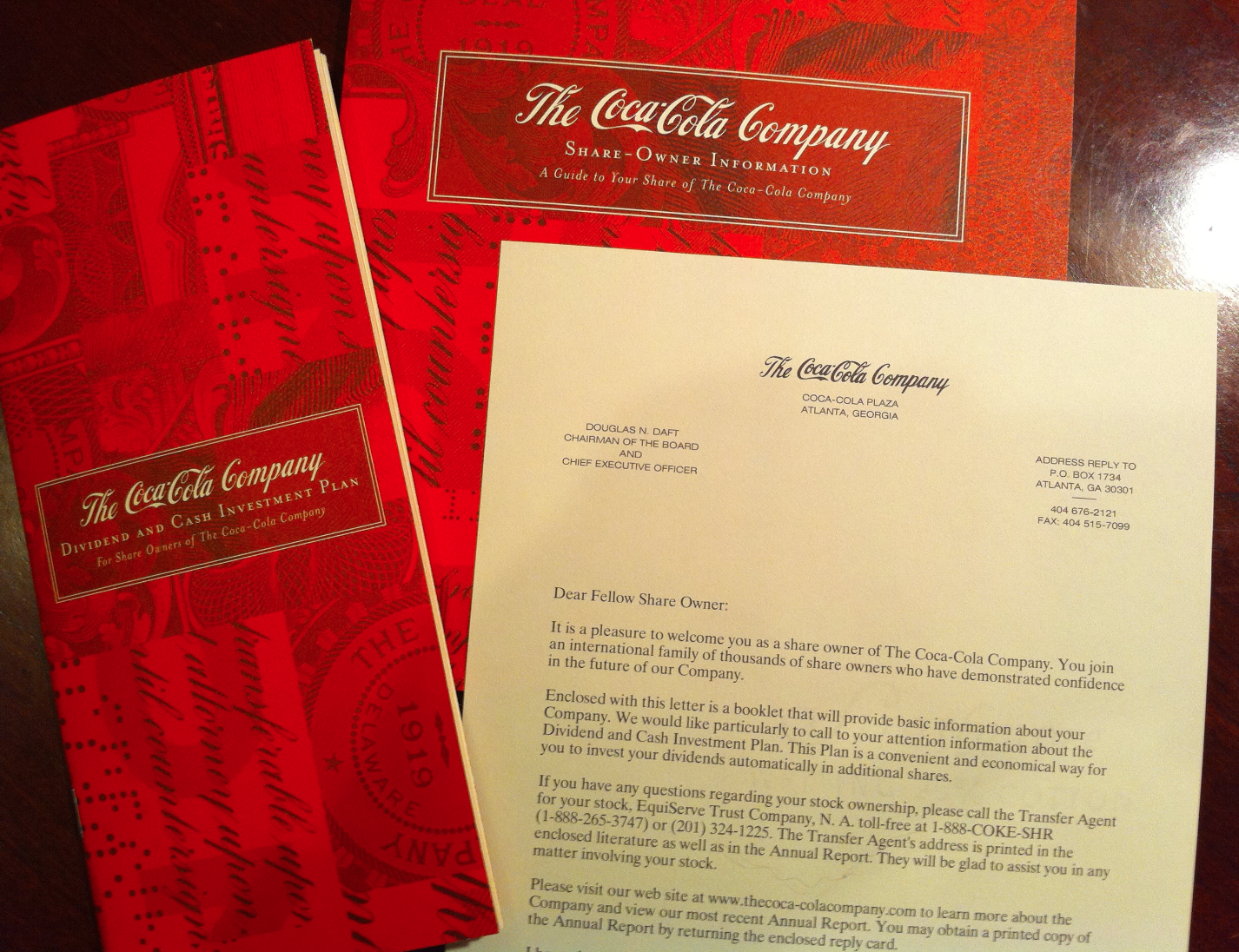
These are the documents that were mailed to my then-six-year-old sister welcoming her as an owner of The Coca-Cola Company, explaining how the direct stock purchase plan and dividend reinvestment plan worked, detailing how she could buy more shares, and much more. They are still kept in my office today, where I’ve preserved them for her until she is an adult.
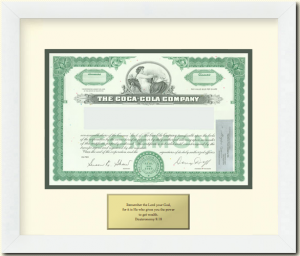
When I was a senior in high school, I bought my youngest sister a single share of Coca-Cola common stock for her 6th birthday. I had it framed with an engraving of the first part of Deuteronomy 8:18 placed under it, “You shall remember the Lord your God, for it is he who gives you power to get wealth”; a message that I thought would resonate being raised in a religious family in the Bible Belt, tying it to other things in her life to result in reinforcement.
I registered the ownership by setting up a Uniform Transfers to Minor account, having my father serve as the custodian until her 21st birthday, at which point the ownership in Coca-Cola would be turned over to her. He and my mom began a small amount of money in regularly. A few years later, they increased it to $50 each month, which was taken out of their personal checking account and used to purchase additional shares of stock for my sister through the Coca-Cola direct stock purchase plan / dividend reinvestment plan (DRIP). By that point, this tiny amount resulted in $600 per year getting transferred to the Coca-Cola DRIP. Instructions were given to the plan sponsor to reinvest all dividends to buy additional shares of Coke stock. (Why Coca-Cola, especially when I told you how our grandpa could have made millions by investing in Pepsi due to his cola habit? When she was six, my sister preferred Coke to Pepsi and we let her choose between the two businesses. The goal was not about investing per se, but, rather, to create a mechanism through which we could introduce concepts about owning productive assets, how the sustainable cash flows from those asset rely upon operating results, how dividend growth can reward you over time, and a host of other lessons.)
In the decade that has passed, we have experienced the dot-com collapse, the September 11th terrorist attacks, subsequent recession and further stock market collapse, the rise and fall of the housing bubble, two wars waged halfway around the world, expanding federal deficits, staggering trade imbalances and near double-digit unemployment.
Today, the Account Has Beat Inflation By 3.5% Compounded … Even Though Shares of Coca-Cola Stock Are Still The Same Price (Really)
Despite all of these problems, and the fact that Coke still trades at roughly the same price it did when the first share was purchased, the account has grown at roughly 6% compounded. How is that possible? Through the power of reinvested dividends and the influence of dollar cost averaging where falling stock markets allow your regular contributions to buy more absolute shares, lowering your cost basis over time.
The Coca-Cola direct stock purchase and dividend reinvestment plan account has had only a little more than $6,000 contributed to it, consisting of that original share of Coke stock I purchased and the $600 my parents saved for my sister each year (roughly $1.65 per day). Yet, the account is worth nearly $8,000. The $2,000 profit resulted from the underlying strength of the company’s brand, plain vanilla savings, dividend reinvestment and dollar cost averaging. That represents not only keeping pace with inflation but also earning a a 3.5% real return even though the stock price hasn’t budged. At the same time, many Americans call the past ten years the “lost decade”.
 The most important lesson from the entire experience, though, came from the ability to educate my sister about the power of compounding, the importance of owning assets and how businesses worked at such a young age. When she was a kid, and we would go to the grocery store, she was taught that every time someone bought a case of Coca-Cola, the company generated sales from that benefited her. The store would buy more Coca-Cola from the bottler, which, in turn, would buy more syrup from The Coca-Cola Company. She learned that the more shares you own, the bigger the cut of the profits you get, which is the reason Warren Buffett, through Berkshire Hathaway, was able to have his holding company keep the earnings for 1 out of every 12 cans of Coke sold.
The purpose was for her to see stocks as businesses just like the one our parents owned (which was still a small start-up in its relative infancy as a stand-alone, full-time business at the time) and not electronic blips on a computer screen that just moved around in some arbitrary fashion. You focus on the business and pay a rational price; over time, the market should reflect that value in most cases, even if it takes years.
What the Future Holds for the Coca-Cola Direct Stock Purchase Plan and DRIP Holdings
If the account continues undisturbed until she graduates college and continues earning the same rate of return, my sister will have roughly $15,400 as a gift along with her degree, of which $9,700 will represent money saved by my parents on her behalf and $5,700 will be profit. Is that spectacular? Of course not. But in a decade when everyone else lost their shirt, to keep all of your savings and beat inflation is still fairly impressive. But the real and most valuable gift? That would be the knowledge that she gained from years of understanding that saving money by spending less than you earn, buying ownership of assets that generate cash, and pouring your money back into those assets so they can grow over time is the path to wealth.
How These Savings Can Transform Her Future
Given that she wants to be an artist, this knowledge means she won’t ever be forced to experience the unnecessary distraction of having the word “starving” as an adjective in front of her chosen profession. It doesn’t guarantee that she will end up rich – she has to choose to work and put money aside on her own to do that – but her family has given her the best education we could so the ball is in her court. The results she enjoys will flow from her own life choices in the future.
The Cycle of Poverty and Wage Slavery Can Start During the Teenage Years If You Aren’t Careful
One of the things that is most emotionally painful for me to watch is to see well-meaning parents give their child a depreciating asset such as a car or a motorcycle without the child or the parent having any notable savings or investments. Why? I know based upon human behavior and psychology that it is perpetuating a horrible mis-education from one generation to the next that will keep the next younger offspring in poverty. They will come to expect that you work hard for your money and then you use that money to buy toys and gadgets that are soon worth nothing. Then, you have to work more to afford more. It’s a vicious cycle that puts you at the mercy of the economy and employers because you can’t get off the consumption treadmill without losing everything you have.
If they were able to teach their kids to save and invest, the kids would be far more likely to buy much nicer toys paid for in cash without debt by the time they were 25 or 30. Then, instead of squandering their wealth and shipping it to banks in the form of interest on credit cards and installment loans, they would avoid financial stress and experience the joy of the bank paying them, either in the form of interest on their deposits or ownership of the bank’s bonds or dividends from their ownership of the bank’s stock. It’s just a better way to live. Credit card debt is poison. Financial stress is misery. They are not mandatory parts of life. Our actions result in us suffering under their weight, most of which starts with buying a car at 16 years old. It is the thing that kicks off the chain reaction of working to make payments.
I hate seeing people experience this, mostly because it happens to good, hardworking men and women who just got the wrong examples early in life.
Reader Comments (13)
Comments are presented chronologically, with replies indented beneath the comments to which they respond.
Frat Man
September 9, 2010
Joshua- dumb question. Can Buffett choose to reinvest his KO dividends if he wants? I feel like with 200,000,000 shares having 44 cents reinvested, that would either drive up the price of the stock, or dilute the shares if new ones have to be created. Because theoretically, if Buffett chose to reinvest the Coca Cola dividends and put that on autopilot for a century, wouldn't he eventually own 99% of the company from dividend reinvestments alone?
Joshua Kennon
September 9, 2010
Replying to Frat Man
He doesn't reinvest the dividends. You can tell from the company's SEC and insurance disclosures. The only reason Berkshire's absolute ownership of KO has increased over the past 25+ years is Coke constantly repurchases its own shares lowering the total outstanding year after year on average.
Once you get to that size, you wouldn't use a regular reinvestment program. Instead, you would just have the cash deposited at a bank or custody agent and if you wanted to increase your investment, you would have your prime broker acquire shares on the open market just like fresh cash from any other source. It's the only way to do it at that size.
Jason S
February 22, 2012
Joshua...I currently utilize all of my dividend reinvestments via Sharebuilder (synthetic drip). Technically, none of the shares I own are in my name, since it's handled via Sharebuilder (street name). I believe the expenses of new purchases are cheaper this way.
Is their any type of risk growing your wealth this way, without direct ownership? Or is it more advantagous to have the shares directly in your name?
Thanks for your insight
Joshua Kennon
March 26, 2012
Replying to Jason S
It depends on how much money you have. As long as you have less than $500,000 in a brokerage account, and are protected by SIPC insurance, holding the shares in a street name should be fine. If you don't plan on selling for decades (e.g., an investment in a blue chip like Coca-Cola or Procter & Gamble that you think will still be around because dish soap and carbonated beverages aren't disappearing anytime soon), direct registration offers a significant advantage in that there is no broker that could go bankrupt. You own the shares, directly, on the books of the transfer agent.
Let me put it this way: If you woke up tomorrow and had only $5,000 to your name, I would say go with the easiest option, which might be the broker or it might be the company's direct stock purchase plan, depending on who has the best web interface. If you woke up tomorrow and had $10,000,000 to your name, I'd tell you to have it all directly registered, gold medallion signature guaranteed, kept with the transfer agent for safekeeping, and duplicate, or triplicate copies of your ownership on file in a safe deposit box, with your attorney, and with your accounting firm. That way, even if the stock market shut down for three years and most of the nation's brokers went bust, you wouldn't have to deal with the mess of a defunct intermediary between you and your money.
Of course, this isn't an all-or-nothing proposition. The best solution (this is personal preference) is using a broker to execute trades and then having your trades settled by a third-party global custody agent who enrolls you in the direct registration system so your securities are listed in your name, giving you the best of both worlds. You need a decent sized portfolio before that is an option, though, so I'm not sure if that is viable at this point for you but keep it in mind.
Jason S
April 2, 2012
Replying to Joshua Kennon
Thank you for your response. This is very helpful insight for long term planning.
Jason
Mickey Cashen
February 18, 2013
Most DRIPs are excellent ways to invest - but NOT Coca Cola. I sold the Coca-Cola stock I had to pay cash for a new car in Jan. 2013. I immediately began saving for my next one (probably 2030! - I keep my cars long!) my typical way: I set up automatic deposits in DRIP's and mutual funds - $50 or $100 in each one to diversify, and after I while I think of those a "bills" I have to pay, and it becomes a painless way to live beneath my means! My FIRST look was the Coca-Cola DRIP and I don't recall EVER being more disappointed in a DRIP!
KO (through their DRIP agent Computershare) charges $3 for each cash purchase -$2 if you have automatic monthly purchases set up. And where most companies charge $0.00 for reinvesting dividends unless they've got something like a 5% yield, Coca Cola charges 5% of the dividend (up to $2) plus a nickel-and-diming $0.03 for each share purchased for each dividend reinvestment. They charge a setup fee of $10 and a redemption fee of $15 plus a $0.12 per share nickel-and-diming fee. That's AWFUL! You're better off buying Coca-Cola for less than $10 (and eventually selling for less then $10) through a brokerage, getting them to set up their free dividend reinvestment program. If you want to continually buy, you're better off with another DRIP.
Note that it's KO, not Computershare making those charges: I've got Abbott Labs, Abbvie, AT&T, Hillshire Brands (used to be Sara Lee) and a couple other DRIPs that Computershare manages and they don't charge anything for reinvesting dividends - except AT&T which is small and acceptable, since they pay over a 5% dividend.
Joshua Kennon
February 18, 2013
Replying to Mickey Cashen
I saw that the last time I reviewed the paperwork. It appears to have gone into effect the same time they stopped publishing annual reports for stockholders and just threw the 10K up on the site.
Cuts like that are the type that anger me most because they are specifically designed to discourage small investors (who, over time, can become large investors). Some other DRIPs actually offer a 5% discount to market value and no-commission purchases. Coke's DRIP now only makes sense if you are putting aside $400+ per month so the cost would drop to 50 basis points. For 1 out of 2 families in the United States, that's too high a burden.
I still don't understand their refusal to publish an annual report. They are the most iconic brand on the planet. I would think they would want to get elementary school students signed up for the DRIP and hand out reports to help people think of them as a permanent long-term holding. It's so much easier to teach a child about a company if the paperwork has pictures. That
"welcome owner" packet that Coke sent was a huge psychological key to making it real for a then-kindergartener. Every annual report should look like it. But then again, the firm was a disaster up until the most recent CEO took over. The botched / aborted Quaker Oats deal, the managerial turnovers, Buffett firing the head guy in a secret meeting in an airplane hanger ... they probably didn't even notice this happened. Some manager just made a dumb decision. It was the pure power of the business itself that kept the profits rolling in during that period. That's the type of firm I love owning.
Alexis C
March 28, 2015
Replying to Mickey Cashen
This isn't a recommendation as I don't fully understand what's going on with Loyal3, but you can buy KO there in a batch-purchase way for free.
loving aunt
March 30, 2014
Hello Joshua
I'd like to do this for my nieces who are graduating college this year and have no idea how the financial markets work. My husband and I regret wasting so many years before we finally got ourselves educated and became investors, and I would like to help them get started now. We'd probably do a one-share certificate for presentation purposes but the welcome letter would also be a great element to give them. I've never received anything like this from any stock I've held (always through brokerages) - how do know which companies offer this? what are the mechanics to making a purchase of this type? And given the comments you've received about KO, it may no longer be the best purchase for this type of thing - what would you recommend as a company that is recognizable, tangible, pays regular dividends, and could be purchased in a reasonable volume for about $500?
Thanks
Mr. Misfiler
February 14, 2017
How can I find out how much $375 of coca cola stock, if purchased in May of 2001 and all dividends reinvested in more coca cola stock through the company's DRIP plan, would be worth today? I recently found in my files a check that my dad gave me back then to deposit in the coca cola DRIP plan for my son (his grandson) that I misplaced and never sent in, so I figure I owe that amount to my now 15 year old son. Any help appreciated.
Joshua Kennon
February 14, 2017
Replying to Mr. Misfiler
For the most accurate answer, you can build a spreadsheet by hand and do the calculation. If you want to save yourself the time, a good back-of-the-envelope estimate can be calculated using this tool, though, and it's close enough it should suit your purposes. The answer: at today's stock price, you'd need to gift your son somewhere between $975 and $1,000 to make up for the lost opportunity cost, which would be approximately 24 shares of Coca-Cola.
TheSplash
February 15, 2017
Replying to Joshua Kennon
That is a depressing calculator! Had me doing a lot of "if only" (if only I'd bought shares of AAPL in 2001!) On the other hand it's a great tool to show how easy it is to make money from just a small initial deposit and twenty years of patience. I'll have to show it to my family. Thanks for the link!
Lizbeth Graniela
December 27, 2017
Mr. Kennon, where do I start? I don't want to go through a broker.