

American Manufacturing Profits Are the Same After Inflation As In 1960
The manufacturing sector in the United States generates the same inflation-adjusted profits it did in 1960. Surprised? Consider this:
- In 1960, the United States manufacturing sector generated total profits of $23.8 billion.
- In 2008, the United States manufacturing sector generated total profits of $175.5 billion.
If we adjust for inflation, 2008 profits from manufacturing should have been $171.17 billion, so we are actually ahead of the game a bit. The problem is, at the same time, manufacturing jobs have disappeared.
Unions and politicians have loudly blamed global trade policies (and make no mistake, the trade deficit is a very real problem), but the true trouble behind the manufacturing sector is that technology from automation, better software, and more powerful processors has resulted in most manufacturing jobs becoming unnecessary. Workers in auto companies and production plants are the 21st-century equivalents of whalers decrying the loss of their livelihood after whale populations declined in the 17th century. These jobs are never coming back.
Part of this pain has gone unnoticed by the masses because other sectors of the United States economy have blossomed and prospered in the past 50 years. Even though manufacturing still earns the same inflation-adjusted profits it did at its much-glorified height, other parts of the American economy – such as the Internet, which didn’t even exist in its current form – are so much more profitable that manufacturing now represents only 10% of so of the economy, down from the 28.3% peak high hit right after World War II.
As a result, when people talk about “rebuilding manufacturing”, they aren’t actually talking about manufacturing because it is still generating the same profit for “America, Inc.” as it did half a century ago. They are talking about manufacturing jobs that put a worker with only a high school diploma in the top 20% of household income. It will never happen again, people. It doesn’t matter who you put in the White House, what trade policies you put in effect, and what laws you pass.
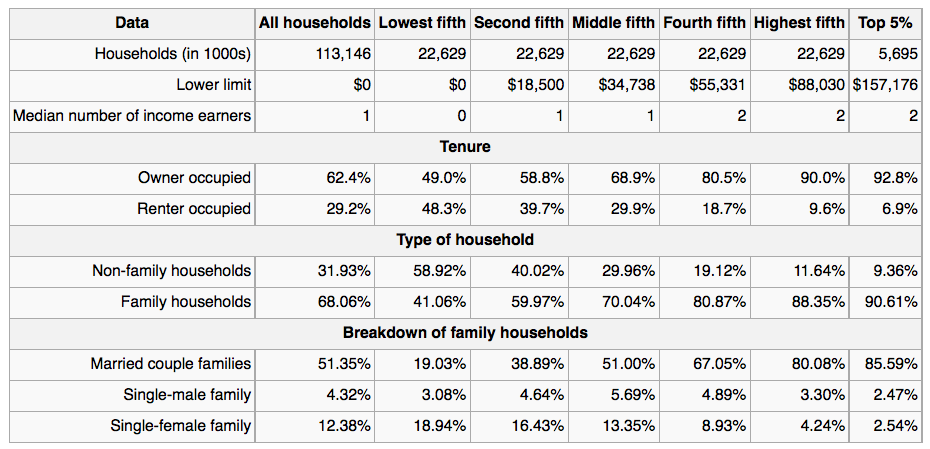
“Top 20%! No, we just want good jobs!” I hear the chorus screaming. To be in the top 1 out of 5 households in the United States in terms of income only takes $88,030 per year.
A Look at the American Manufacturing Sector Through the Domestic Auto Companies
Take the major American car companies. According to The New York Times, “The base pay is about $28 an hour. If health care cost per worker average $12,000 per year, that adds in another $6 an hour. If the pension payment takes up 25 percent of base pay (an extremely high pension), that gets you another $7 an hour, bringing the total to $41 an hour.”
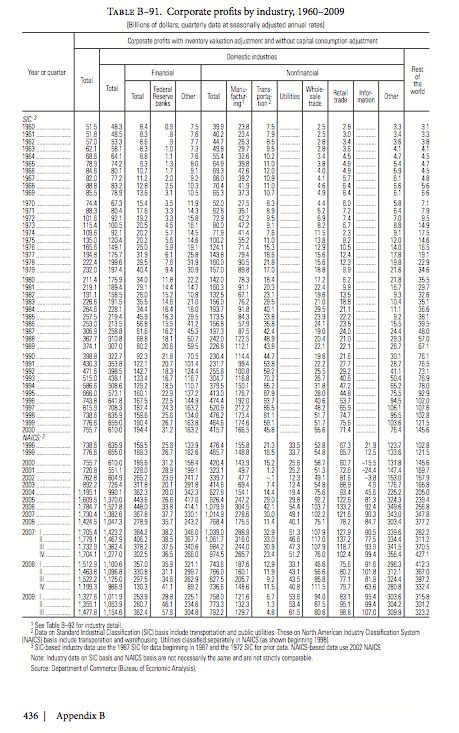
This is a table detailing the profits generated by each part of the economy of the United States of America. Click it to download the data as a PDF file.
With paid vacation, that is $85,280 for a job that requires only a high school education. A husband and wife working at one of these plants would make $170,560 putting them far above the top 5% of household income! It isn’t hard to see that is why Toyota is kicking the crap out of GM … and we didn’t even discuss the legacy pension costs, mostly because they were solved by the trust that was established a year or two ago (I’m not going to go into it, but it effectively closed off the past pension and health care benefits for a multi-billion dollar payment from the company).
The world economy has matured to the point that individual workers will never be able to earn income like that in the manufacturing sector again unless they have specific, hard-to-acquire skills such as in aerospace engineering. Now, if you want that type of income, you need to go into law, investment banking, become an executive at a software firm, or be a nurse anesthetist.
As I pointed out in an earlier column, if you are a white, average male with only a high school diploma, you not only have to struggle against technology improvements but also compete with China and Japan abroad and, here at home, women, African Americans, Jews, gays, lesbians, non-Christians and a host of other people who were denied fair and equal access to the workplace because of the irrational prejudice they experienced only decades ago. For civilization, this is good because we can tap everyone’s brain power so the best ideas win. For you, who previously enjoyed preferential treatment, your prospects are lowered unless you invest in yourself and make your skill set attractive to potential employers.
Reader Comments (3)
Comments are presented chronologically, with replies indented beneath the comments to which they respond.
Blue collar class
February 12, 2012
Average working man here; I don't compete with foreign countries for my work, yet my wages still do not rise comparative to inflation. What you have shown here is how Corporate America has continued to make excellent profits while denying the blue collar class their portion. We don't choose the cost of healthcare, it is required of us by the health care companies who are also making enormous profits. whether or not the industrial jobs are being run by better machinery does not mean those jobs no longer exist, and as technology advances more jobs are created building the equipment used that eliminates jobs. No matter how you see it your investments all run down to the abilities of the working class where you will find that eventually, no matter how you run the numbers, work will cease and your investments will no longer produce income if you do not recognize that we don't care about numbers. We care about home ownership and a decent life without the endless debt problem which we consider to be a form of slavery.
PaulB
October 14, 2013
US isn't manufacturing powerhouse of the world today as it was in 1960s. China is. Japan is. Germany is. I hardly can find anything made in USA. What are you talking about? And then using Government inflation numbers. Do you comprehend that if we used inflation formula from the Reagan years, the inflation rate would be at 10% today? Who cares about the Inflation number provided by the Government? No serious investors trust US inflation numbers. Seriously, take formula from 1980s. The inflation properly calculated, i.e. not confused with technological progress, is at 10%. Just go shopping for groceries, gas and health insurance to find this one out. Instead of repeating blindly BS from CNBC.
Gold in 1960s? 35 usd / ounce. 23.8 billion in 1960s / 35 = 600 800 000 ounces
Gold in 2013? 1300usd / ounce. 175.5 billion / 1300 = 135 000 000 ounces
5 times difference! Gas price in gold since 1960s? Flat line! Health insurance cost in gold since 1960s? Flat line! Average US salary in gold since 1960s? 5 times lower exactly as the manufacturing base.
Joshua Kennon
October 14, 2013
Replying to PaulB
Let's presume that your concerns about the change in the inflation calculation are justified (they're not, for reasons that would take half an hour to explain - ignoring the fact that you reference a base gold price that was not set by the free market but the result of artificial price fixing by the government, after which it was rescinded gold was free to reflect its actual value in the open market - but we'll say for now that they are to keep it simple).
As a rough, quick-and-dirty test to check whether the United States had retained its manufacturing power, you would simply have to choose any other currency as a baseline (or, heck, use gold - artificial price and all), then add up the total economic output of the United States and the world in both the 1960's and today.
You'd then calculate the percentage "market share" the U.S. had of total economic output - measured in your preferred yardstick (gold, Pounds sterling, U.S. dollars, or rare baseball cards) back then and then compare it to what it held today.
If you do it yourself, you'll see it's roughly the same. No need to trust anyone else. No need to rely on someone else's judgment. You can run the figures on your own, at your own kitchen table. There is no question, by every conceivable metric, that the United States is still exactly the manufacturing powerhouse it has been for the past 50 years. The difference is all the rewards now flow to owners as low-skill labor is not needed. Machines and software can do most of the work.
A perfect example: My family owns a manufacturing plant here in the Midwest. We had an opportunity to visit and older competitor who was horribly out of date and behind everyone in terms of facilities and equipment. They were still using the same structure they had in the 1960's and 1970's. It was shocking. They had eight employees on payroll for every one employee we had. If someone were to renovate the factory and upgrade its capabilities, laying off 7 out of every 8 employees, the overall manufacturing output wouldn't change one iota. In fact, the company would have a much higher value as it now generates bigger returns on equity and assets. Yet, I'm sure the non-economically literate members of the community would be talking about the "decline" of manufacturing. What they really mean, though they don't know it, is the "decline of manufacturing jobs for low-skill workers".