

A Technique for Comparing the Intrinsic Valuation of Two Stocks
One technique I find helps a lot of investors act more rationally is one I developed during my late teenage years. I would convert all companies I was analyzing to $100 per share to make comparison of the figures and yields easier. In essence, this allowed me to ask the question, “How much profit am I buying for every $100 I put into this company?” If I paid a high multiple for a particular business, it forced me to justify the higher valuation by writing down my reasons for my belief.
It might be useful if I show you how I do this. I’m going to take a solid, staid energy company, ConocoPhillips, and a legendary jewelry store, Tiffany & Company, and show you how you could compare the two businesses in a sort of first-pass analysis.

Tiffany & Company is a fantastic business. It has the sort of brand equity that takes a century to build, having turned the “little blue box” into one of the most powerful emotional symbols in the world. ConocoPhillips is also a great business but it has almost no emotional capital – after all, it is harder to get excited about energy than it is a diamond watch given to you on a wedding anniversary. But an investor’s job is to make money, not feel warm and fuzzy about his holdings. That is why I chose these two firms.
Convert Both Companies to a Base Share Price
To make the comparison easier between two potential investments, let’s take the data and adjust it as if each stock traded for $100 per share. This helps make the mental process of selecting good investments easier because it forces you to put things into a comparable format. This technique is especially important for investors that have a hard time understanding how a $300 per share stock can be cheaper than a $10 per share stock (if this describes you, head over to the Investing for Beginners site I run for About.com, a division of The New York Times and read “How to Think About Share Price”).
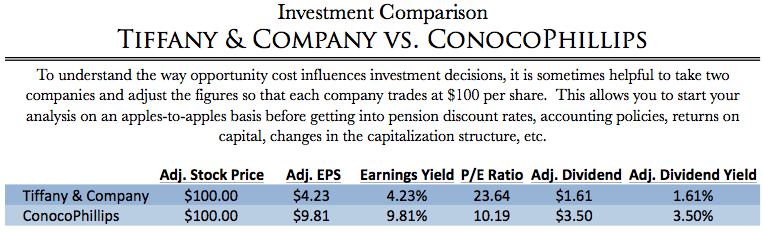
It is easy to make an adjustment like this in a spreadsheet. In my example, I adjusted the figures to see how two unrelated companies stacked up against one another if they were each trading at $100 per share. This allows me to see the data more starkly. (You can use any number for comparison – you could have converted them into $50 shares or $100 million shares – but I prefer $100 because you can just convert the earnings yield percent and the dividend yield percent into the adjusted EPS and adjust dividend yield by changing the % sign to a $; it saves a lot of time.)
On this adjusted basis1, I am faced with a choice:
- I can buy a $100.00 share of Tiffany & Company and get $4.23 in look-through profit, of which $1.61 is going to get sent to me as a cash dividend each year with the remaining $2.62 retained by management to grow the company, pay down debt, repurchase shares, etc., or
- I can buy a $100.00 share of ConocoPhillips and get $9.81 in look-through profit, of which $3.50 is going to get sent to me as a cash dividend each year with the remaining $6.31 retained by management to grow the company, pay down debt, repurchase shares, etc
Always Look at the Underlying Assumptions In the Market Price of a Stock
The “market”, which is really just a way of describing the collective actions of millions of individual investors around the world, is indicating one of a handful of things:
- It believes that Tiffany & Company will grow at a rate that is 132% faster than ConocoPhillips, giving them both the exact same intrinsic value today (e.g., if ConocoPhillips grows at 3%, then Tiffany & Company must grow at nearly 7%), or
- It believes that ConocoPhillips will experience a decline in profitability on a per share basis, resulting in a more comparable valuation between the two firms. This could be due to falling crude prices, a liability the company has incurred (e.g., BP and the Gulf Oil spill), expected dilution in the shares outstanding, or any number of other things that would result in a lower EPS figure in the future, or
- It believes that Tiffany & Company has higher “earnings quality”, meaning that a higher percentage of the reported profits can be converted to cash to benefit the owners instead of being reinvested in lower-returning projects, or
- Some combination thereof
As an investor, it is your job to try and figure out if any of these possibilities is probable. Then, you need to decide whether you think you are being fairly compensated for the risk you are taking by becoming a partial owner in the business.
Develop the Whole Story Before Making an Investment
You would still need to dive into the figures to see if the story was more nuanced than it might first appear; for example,
- Are you falling into the peak earnings trap?
- Does one company have a more conservative capitalization structure?
- Does one management team consistently destroy shareholder value by pursuing high cost acquisitions?
- Are the pension discount assumptions comparable?
- Does one firm generate higher “owner earnings” than the reported profit would indicate?
- Are there any hidden liabilities you aren’t considering?
- Are there any opportunities you are overlooking?
The list is pretty long but the more experience you get, you’ll develop your own list of items you want to check before you commit precious capital to an investment. After all, ten years ago, Apple wouldn’t have looked like a bargain on an earnings yield basis but those with the foresight to see what Steve Jobs would do with the company when he returned to the helm would have adjusted the future earnings for the success of the iPod, the company’s first non-computer consumer device with widespread success that ushered in the rebirth of the company and one of the greatest investment performance runs in history.
The point is, this approach would have helped you avoid the mistake of buying companies like Microsoft ten or eleven years ago when the earnings yield reached an almost unfathomable 1.1% despite being one of the largest companies in the world.
Footnotes
1. Clearly, the readers of my personal blog are far more intelligent than the average Internet user, judging by your choice in reading material, comments, and letters. But just in case you are too embarrassed to ask how the math of such a conversion works because it’s been a few years since you did a lot of math, I’ll walk you through it briefly. (Don’t ever be embarrassed to ask a question, no matter how stupid it may make you feel. Otherwise, you are sacrificing your long-term objectives to your temporary pride. That is a horrible trade-off.) If you have a stock that is trading for $35.00 per share and earns $2.07 in earnings per share, you would take $2.07 and divide it into $35.00. This would give you 0.059142857, which is 5.91% (you just move the decimal point over two places, which is the reason I used a $100 base for the comparison). Switch out the % sign for a $ sign and you the earnings per share for your $100 conversion is $5.91. Repeat this for all of the stocks on your comparison list and put them in a spreadsheet.’
Image Copyright By Bjoern Wylezich / Licensed Through Shutterstock
Reader Comments (15)
Comments are presented chronologically, with replies indented beneath the comments to which they respond.
Austin H
March 22, 2011
Joshua,
This is exactly what I do for my 'watch list. I've had a dozen or so stocks that I thought looked like good buys at the time but wasn't exactly ready to pull the trigger. I purchased a hypothetical $1,000 of the company and have watched how it performs. Some have done really well, others poor.
I've been using that youtual fund that I messaged you about previously and just saw that it accounts for dividends in the 'share price.' Pretty cool feature that I haven't seen in other phony online portfolio tools.
I finally bought Poor Charlie's Almanac and have had a hard time putting that massive book down. Since I read your blog first, his writing/thoughts remind me of yours, although I would assume the opposite. Have you found anything that you disagree with him about?
Always a pleasure,
Austin
Joshua Kennon
March 25, 2011
Replying to Austin H
Frat Man
March 22, 2011
Hey Joshua, along the lines of embarrassingly stupid questions, this is one I've never been able to ask an economics professor without coming across as an imbecile. One of the most elementary aspects of economics is understanding inflation, and the conventional wisdom states that if if your stock earns 10% in a year and inflation is 10%, that is the same as if you earned 0% in a year wherein inflation was 0%. Seems straightforward enough. But I've always tried to make the argument that it's preferable to experience 10% stock market returns with 10% inflation to the alternative. My point is that, in real life, inflation doesn't move perfectly symmetrical. Heck, we've been experiencing inflation over the past two years, but McDonalds still has their dollar menu. People get locked in at rates for rents, leases, etc. I know inflation indices try to account for this by noting that if beef prices go up x and chicken prices stay stagnant, people will buy more chicken, but based on my observations in life, I can think of quite a few places where inflation doesn't 'seem to happen.' For instance, at the barber I go to when I'm in St. Louis, they hiked the price up from $10 a haircut to $15 a haircut in say, 2003, and the price has been the same since then (even though we have experienced inflation). So you if you had to choose between 10% returns with 10% inflation and 5% returns with 5% inflation, I don't necessarily see them as equal in real life because measured inflation is an average and I'd like to allocate my 10% gains to the areas that experienced under the average rate of inflation. Is this really goofy, or am I on to anything at all?
Aeritus454
March 22, 2011
Replying to Frat Man
Areas that experienced under the average rate of inflation - in what terms? Geographical or industrial? 'Inflation' is usually in reference to the cost of living increases, not necessarily the exact cost of every little item in the world, but let's roll with it. The $15 dollar haircut, more likely than not, has remained the same to promote customer loyalty. Same example but in a different industry (because a barber shop is primarily labor) Let's say a pancake house offer's the same plate for $15 bucks for 6-7 years. Inflation has gone up, but the cost to the customer remains the same. Some business owners will make the decision to allow their profit margin to drop temporarily to ensure an uninterupted customer base. That $15 dollar plate might have cost them $8 dollars to make, 7 years ago. But $11 dollars today. They have two choices - push their higher expenses on to the customer to keep their original profit margin. Or allow the profits per plate to drop, in a strategy to promote a bigger customer base, based on offering customers a budget place to eat (compared to other local diners, that have pushed their higher expenses onto the customer). Life is a habit, get someone to come eat at your diner for 4-5 years, unless you really screw up, it's easy to keep that customer. It's become a habit for them. Now your customer base has climbed, while profit margin per plate has declined. Though your making a pretty penny now, through quantity of plates sold.
In time, they'll have no choice but to hike their rates up like the rest of the industry, due to inflation. But by lagging behind some of your competition in the immediate area, you can promote a budget-minded customer base to make your diner the new place to go. When the time comes for your prices to get pushed up. They'll see other local places are just as, if not more expensive... but now you have the customers habit of coming to your resturant. It's a strategy.
Inflation effects everyone, everwhere in every industry. How they manage their company during these times, is completely up to them. Just my 2 cents. Hope this helps.
Joshua Kennon
March 25, 2011
Replying to Aeritus454
I'm not sure if were notified of my response to FratMan (the specifics of the comment notification system aren't yet entirely familiar to me since it was installed last week).
Joshua Kennon
March 25, 2011
Replying to Frat Man
It seems that what you are asking is whether or not there is opportunity for increasing your real, inflation-adjusted net worth and, if so, whether or not those opportunities are more present in situations with relative high inflation rather than relatively low inflation.
For society as a whole, inflation much beyond the 4% range tends to be a problem. But for intelligent people who are rich enough, and who own the right type of assets, it is possible to make money from inflation.
Inflation is essentially a transfer or wealth from savers to debtors. If you have acquired a portfolio of assets that will keep pace with inflation because the utility of those assets is independent of fiat currency (e.g., a hotel in a busy city, a gold mine, or an advertising business that earns a cut of ad budgets), and you have financed the purchase of these assets with fixed-rate, long-term debt, then yes ... You would be better off, and richer in real terms as a result of higher inflation rates. Of course, if you are wrong and the currency appreciates due to deleveraging, like what happened in the 1870s, you are going to get financially slaughtered so that approach is not without risk.
For the average citizen, which must be the concern of the central bankers, economists, and politicians in a fair civilization that hopes to maintain internal stability, inflation should be contained and kept reasonable.
This is no great hardship. There are always intelligent things for intelligent people to do to achieve whatever ends you desire, including growing richer.
Frat Man
March 22, 2011
I agree. I guess what I'm getting at is that investors, especially self-made investors, have a pretty intuitive understanding of capital allocation, especially in the rudimentary sense that they spend less than they earn. So even if inflation is running at 15% and a stock returns 15%, I am arguing that that may be perhaps better than earning 8% with 8% inflation because you can take that 15% return and apply it to these places that seek out customer loyalty or what have you, and allocate your dollars to the places that choose to live with smaller profit margins.
Aeritus454
March 26, 2011
Replying to Frat Man
I see what your getting at a bit more now. Simply put, the rich/poor gap is increasing more and more, so if you can get on board with compound growth and start working your way towards the stars, 15% at a time, one could argue that you'll tip-toe towards the rich side, while the poor are struggeling with higher costs of living. Therefor, effectively reducing their ability to save/invest (yes there's ways around that, but we're speaking general public's actions) so the gap between you and them would grow. Your value, dollar-per-dollar would be a different subject. Is this what you were going for?
Guest
April 30, 2012
Josh. Please would you be so kind as to explain the calcs behind:
"
It believes that Tiffany & Company will grow at a rate that is 132% faster than ConocoPhillips, giving them both the exact same intrinsic value today"Thank you
Joshua Kennon
April 30, 2012
Replying to Guest
In that bullet point, we are saying that if earnings quality is the same (e.g., both companies are such that $1 in reported profit is $1 in real, economic income; no playing games with the pension fund or whatever), the earnings yield would be precisely the same in a rational world. That is, if investors demanded a 10% return, the earnings yield would need to be 10% so all companies would trade at 10x earnings.
However, we see that the two earnings yield are *not* the same. Therefore, the market must be assuming something. We have to figure out what it is assuming.
The first place to look is expected relative growth rates. The earnings yield for ConocoPhillips was 9.81% but 4.23% for Tiffany & Company. The figure 9.81% is 2.32x, or 132%, higher than the figure 4.23% [You take (9.81 / 4.23 = X = 231.9). I rounded up to 2.32, or you could call it 132%.]
That is, 1.) if earnings quality is the same, 2.) if there are are no outstanding mitigating factors such as expected share dilution, etc., the market would be implicitly assuming that Tiffany & Company's growth rate would be 2.32x higher, or 132% higher if you prefer percentages, than the growth rate of ConocoPhillips.
That is, to generate roughly the same return (I'm simplifying here), you could know that the growth rate of Tiffany & Company would need to be a full 2.32x higher than whatever it was for ConocoPhillips. If the latter was growing at 3%, you could apply our factor (in this case, 3% x 2.32 = 6.96, or round up to 7%).
The next step would be for you to figure out if you thought that was rational. If you didn't, you'd look for other justifications. Perhaps Tiffany & Company's reported earnings were artificially low due to some quirk in the accounting rules, like what happens with Berkshire Hathaway, which owns 8% of Coca-Cola but can only report a tiny fraction of its income because only dividends count when you own less than 20% of a business according to GAAP accounting. Perhaps ConocoPhillips has artificially high earnings due to accounting quirks. That would be the next place to investigate.
***Again, this is somewhat of an oversimplification because of how the compounding math works. I'm trying to get you to think about the idea behind different earnings valuation so you can identify the implicit assumptions. In the real world, if one stock grew 2.32x faster for an extended period of time, the valuation gap could be justifiably much larger than 2.32x. But that is beyond the scope of what we are talking about here. We'd have to get into how to calculate future value of single sums and future values of annuities, then compare the two based on whatever time frame we expected, then calculate a terminal value for the perpetual growth rate thereafter, discounting it back to the present. That is an entire series of posts that would take a lot of pre-planning to break down into easily digestible chunks for the average person, who has never had a finance course, to understand.***Note: I'm using these two companies are examples. You could swap in any two companies you wanted. In the real world, your analysis of ConocoPhillips would be complicated by the firm's impending breakup and spin-off.
Mario
May 9, 2012
Replying to Joshua Kennon
I love this kind of replies, Joshua. Sometimes it feels like most of what you write is the simplified version of what you're actually thinking. We can handle the real thing 🙂
Joshua Kennon
May 25, 2012
Replying to Mario
You just articulated the struggle I face every time I write a post; trying to balance a simplified, to-the-point explanation that is accessible to the masses, including beginners, and delving into the minutia of a field that I love with all of my heart.
If I gave you the real thing, I'd probably get myself in trouble. You should hear some of the off-the-record conversations we have at the office.
Joshua Kennon
May 25, 2012
Replying to Mario
You just articulated the struggle I face every time I write a post; trying to balance a simplified, to-the-point explanation that is accessible to the masses, including beginners, and delving into the minutia of a field that I love with all of my heart.
If I gave you the real thing, I'd probably get myself in trouble. You should hear some of the off-the-record conversations we have at the office.
Joshua Kennon
April 30, 2012
Replying to Guest
You know, that was probably too confusing. I'm in the middle of cleaning my desk and getting a fresh cup of coffee so you got the answer as it appeared in my head in real-time since I typed without thinking or editing.
Here is the for-public-consumption-user-friendly-Joshua-Kennon answer:
1. I took the higher earnings yield and divided it by the lower earnings yield.
2. In the real world, it wouldn't be that simple because small differences in growth rates, over long periods of time, can result in wildly divergent terminal (end) values.
Maybe I'll write about that someday. I chose to include it to force people to think about growth rate assumptions and making themselves explicitly write down how quickly they expect earnings per share to grow when they purchase any investment, be it a public stock or a privately held business.
Guest
May 1, 2012
Replying to Joshua Kennon
Superstar. Thanks Josh. Much appreciated.