

A few hours ago, I finished writing a piece about global investing through a Roth IRA, which was published to the About.com network. It got into some of the complexities of foreign investing, including the differences between share classes domiciled in various markets and currency translations. As I was thinking about whether there was anything I could change to make it clearer, I decided to bake some fresh bread for this week, and split the massive loaf into multiple smaller and mini-sized loaves to test various ingredients and flavors. The end game is to completely replace all store bought bread with fresh, homemade bread. I also decided to make fresh strawberry jam for this week to have during breakfast.
[mainbodyad]As I was mixing ingredients, listening to the Playstation battles being fought in the next room, I was being me. In that, I mean my mind was running three or four different processes at the same time. If you’ve read the blog for long, you know I have a habit of knowing the history of the people, business, products, political bodies, and religious institutions around me; there are countless small examples of this in my writing expressed over and over. I love history. I’m curious to know how the things around me came into existence.
When I picked up the Quaker Oats box of steel cut oats, I thought about Henry Parsons Crowell, who was born sometime in the 1850’s, buying the bankrupt oat mill and turning it into Quaker Oats, giving away 70% of his annual income and his entire fortune in death, which still exists in the form of a $100,000,000+ trust that funds evangelical causes in the United States (here is a PDF of the most recent tax return). He was born extremely rich but decided to become an obsessive workaholic with all of his labor going back to society because he believed that he, personally, owned nothing, but rather that it was simply held in stewardship for God, who would judge him based on how he used the funds.
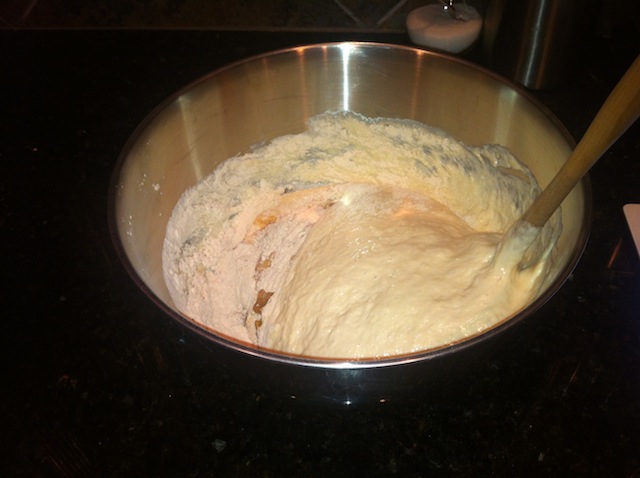
Mixing a few natural ingredients that were grown from the ground can make bread. There is something fundamental and awesome about it.
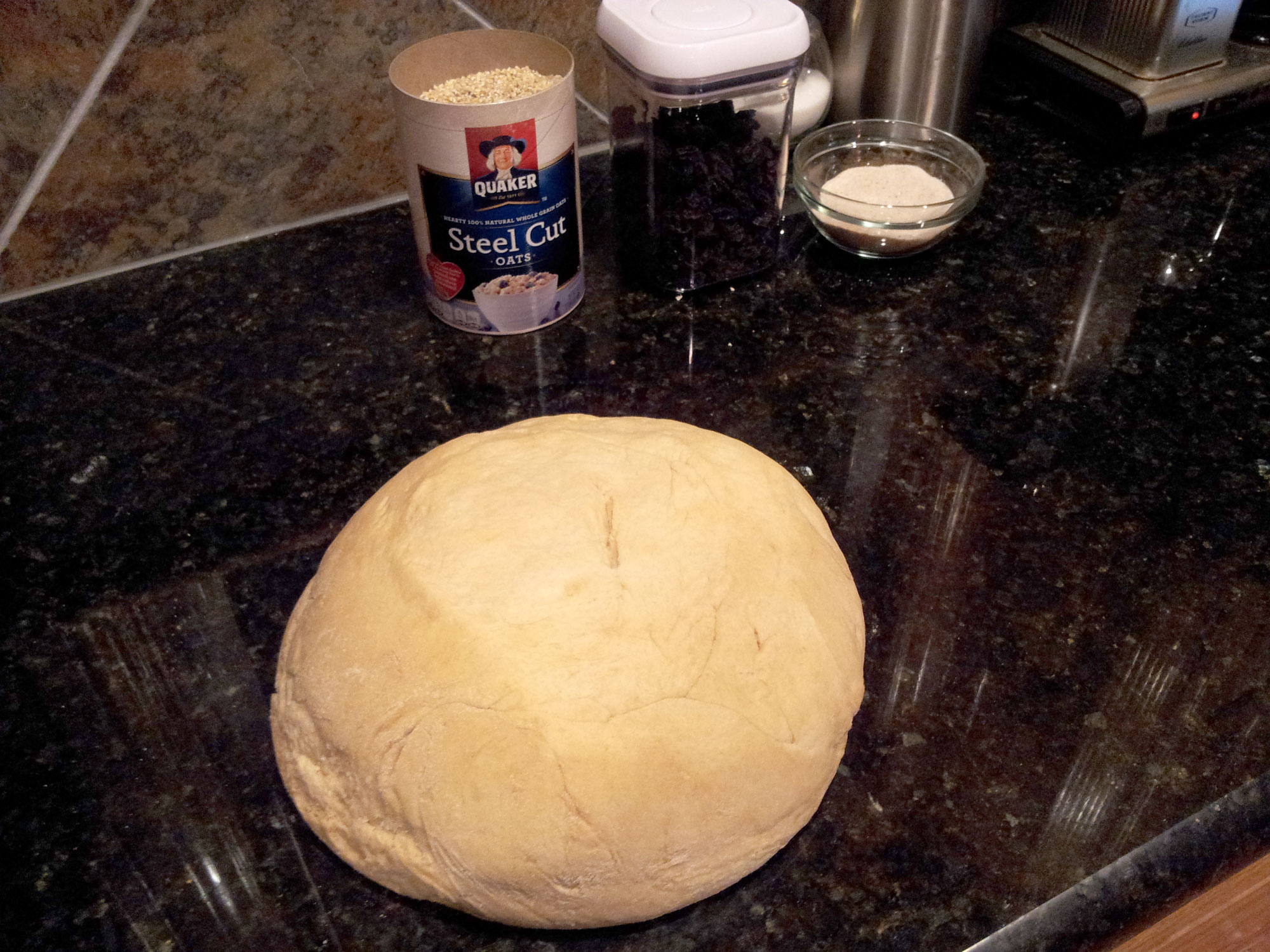
I spent the evening publishing all of the December content for About.com, and thinking through some new ideas for next month as I experimented with bread recipes. I split this giant bread dough loaf into four miniature bread loaves and one normal size loaf, some of which were cinnamon, sugar, and raisin, others of which were traditional whole wheat honey-infused oat bread for sandwiches.
I thought about one of his business partners, Ferdinand Schumacher, who was called The Oatmeal King in his Ohio home town. Schumacher left Germany as a 28 year old man and came to the United States to make a new life for himself. He ended up in the grocery industry and owned one of the founding mills that became part of Quaker Oats. The courage it takes to pick up and leave everything to start a new life is inspiring. This was a real man. He had to get on a boat and start over, yet he ended up a founder of a simple but prosperous business.
I thought about the fact that for decades, this oatmeal giant owned Fisher Price toys and was responsible for the Willy Wonka movie, which was really just an extended advertisement to launch new products. I thought about how Warren Buffett killed Coca-Cola’s attempt to buy Quaker Oats based on valuation (that was an entire soap opera in the financial press at the time) and it ended up part of PepsiCo.
And I thought about how I now own shares of PepsiCo and cash from all of that history gets deposited into my account. It’s all just interconnected. It’s life. It’s people. As I stand in my kitchen baking with this product that stretches back a century and a half, the company that manufactures it is shipping some of the funds to my brokerage and retirement accounts, which I then use to enjoy life. Why? Because I used my own money, earned through my own past efforts and contributions to society, to write checks and become an owner.
These were real people. Quaker Oats represented their hopes and dreams. It changed American history. Nothing you do is unimportant. It’s all connected to everybody else.
That is one of the things that was going on in my head. It’s not really words, it’s just this entire pipeline of thoughts, images, and feelings that encompass those things all at once. It’s hard to explain.
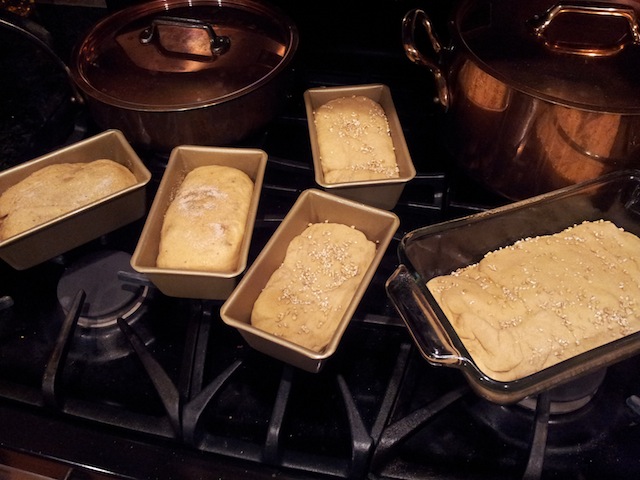
Right now, as I type this, the bread loaves are sitting on the stove rising. They need to be around 1 inch above the top of the bread pans before I can put them into the oven.
Anyway, as I baked, or rather as I switched to making strawberry jam, I also thought about farming. I think the United States has lost a tremendous amount of important values and virtues that came from a society tied to the land.

Fresh strawberries,which I had to mash down into a pulp.

Adding the strawberry pulp to sugar and lemon juice to make the jam …

Cooking down the strawberry jam to the point it could be cooled. It will all be used this week so there is no storage jar or preservatives. It’s as fresh as it can get and will be used during breakfasts.
Don’t get me wrong – things are still great. In my lifetime alone, we’ve gone off the charts and I am only 30 years old. We talked about it several years ago – prosperity is at an all-time high for most demographics, education levels are at an all-time high, longevity is at an all-time high, free time per week is at an all-time high, individual freedoms continue to expand (despite the setbacks of the surveillance state, which I consider an enormous risk to the survival of humanity in the long-run), and a person born today is generally more able to pursue his or her passions, and make a go of whatever they desire in life, than any other people, at any other time, throughout all of recorded history. Murders are at multi-decade lows. Teen pregnancy and abortion rates have been plummeting for decades. The list goes on and on, with only a few dark spots, the most worrying for future demographics being the fact that a majority of children are born into broken homes, which correlates very strongly with lower achievement, lower opportunity, and lower life outcomes. Exceptions exist, but that is the data.
If Things Are So Good, What Did We Lose?
So when I say we lost something, I mean the lessons that are inherent to living in a situation where you see cause-and-effect play out, you learn about delayed gratification through the concepts of sewing a crop today to reap a harvest a season from now, putting up provision for the future by storing surplus food, money, and supplies to make it through the winter, and learning that if you want something, you have to do it yourself or work in cooperation with your neighbors.
Humans are wired so that much of the lessons we learn – and the scripts we play out in our heads throughout life – are absorbed through osmosis during the first 15 to 16 years. How you feel about money, politics, music, and so much more is absorbed into your psyche, just as chemicals in the water can be absorbed into your bloodstream. Sometimes people escape their childhood indoctrination, more often than not, they don’t. It is those lessons – what could have been picked up through osmosis – that I think are valuable.
[mainbodyad]If I had lived on a farm back in the 1850’s and wanted strawberry jam, I would have had to grow, or trade for, strawberries in the summer, and then put in a day of working, preserving them for the winter. This is basic operant conditioning. If you want something worthwhile, you have to make the investment today and wait. I don’t think it is an accident that some of the most successful investors I’ve ever met firsthand or heard about second hand have farming backgrounds. One of the most famous mutual fund managers of the past few decades, Ronald Muhlenkamp, has even written about this phenomenon.
But it’s more than that. It’s a general awareness about the world. It used to be that if you wanted meat, you had to go out and slaughter the cow yourself. Now people just pick up packaged beef and have no idea where it comes from, how it is made, or the conditions under which it is brought to market. There is a strong moral case that if you are incapable of picking up a shotgun and shooting a cow, you shouldn’t be eating meat.
It used to be if you wanted the bank to loan you money, you had to be an upstanding member of the community, with a reputation people could trust, and assets to back your signature. Now, people lie on credit applications and get pieces of plastic that let them borrow cash at 30% interest rates.
For all of the advancements we’ve made – and there is no time I would rather be living – the people who don’t have some sort of family connection to the farm are poorer because of it. Some of my friends were born, live in, and have never left a major metropolitan area. They are clueless. If society were to ever fall apart, or any period of extended hardship happen, they wouldn’t be physically, intellectually, or emotionally prepared. They have no idea how to make hot cocoa or mayonaise from basic ingredients – if there were no grocery store, they would be lost. They have no idea how to write in cursive (this isn’t a joke – do a quick search about the ability of the 20-and-younger crowd to write long-hand). They have no idea how to start a fire or navigate by the stars.
It reminds me of that scene in The Avengers when the sky fortress is going down and the crew is panicked, saying they can navigate. Samuel L. Jackson yells, “Is the sun in the sky?” and you suddenly see it dawn on them that they have the knowledge necessary to function. People don’t make those connections. I don’t understand it. It’s right there, in front of all of us.
It’s one of those nights where I’m examining who we are as a nation and thinking about how history will view this time in which I live. We have achieved so much but we let some very important things fall by the wayside at some point during our journey.
Who knows? Maybe Teddy Roosevelt was right. Maybe Frontier Theory really was accurate and it was at that point, when the west was conquered, America’s soul changed. People haven’t changed, though. The moment we can colonize the moon or Mars, that same spirit will once again burst forth and you’ll have people setting out to establish new communities and try new things. It’s in our DNA.
Sometimes I think I have the soul of a New Hampshire farmer who lives on the land passed down to him for eight generations; sitting at home, reading by the fireplace, spending time with family, cooking excellent food, and thinking.
I’ll stop now … it’s 3:11 a.m. and I should be in bed. My bread just came out of the oven so I should be winding down for the evening.
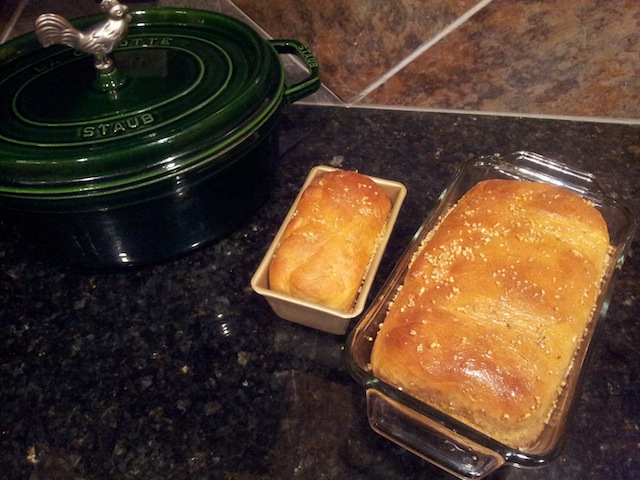
The bread turned out beyond my expectations. It is a whole wheat, honey-infused sandwich bread that has only a handful of ingredients that include two types of flour, honey, water, salt, yeast, and oats. I just buttered the top and need to let it cool so it is ready for tomorrow. The alternative, cinnamon-sugar-and-raisin versions also turned out excellent, though I needed to increase the cooking time due to a change in chemistry.
Update: For breakfast this morning, I had some of the cinnamon, sugar, and raisin honey wheat bread covered in the strawberry jam. It was amazing. I am going to tweak a few more things and I might post the recipes in the coming months.
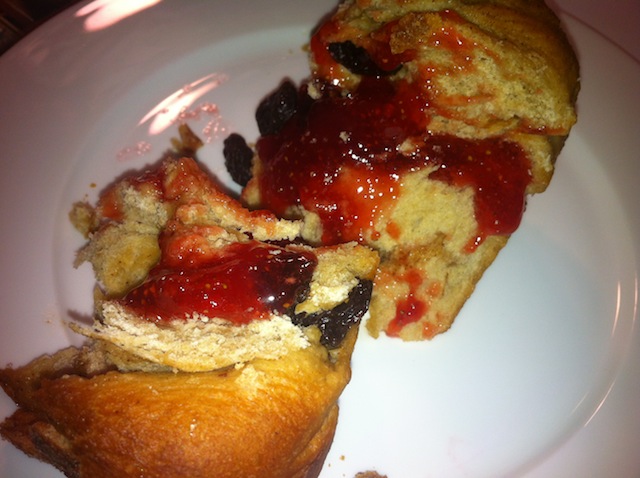
The cinnamon, sugar, and raising honey-wheat bread covered in strawberry jam was on my breakfast plate this morning. It is fantastic. I am going to double and triple check the process and then probably write about how to make it, like we did with the cinnamon rolls everyone loves.
Reader Comments (19)
Comments are presented chronologically, with replies indented beneath the comments to which they respond.
khorton
December 30, 2012
Joshua, very good article but with all due respects the reference to "right wing" gets old; not to mention confusing. What is right-wing? I find it refreshing that and individual as successful as MR Crowell funds what he believed in. The mission of the trust is "The teaching and active extension of the doctrines of Evangelical Christianity ".
Otherwise your post was very interesting.
Ashly
December 30, 2012
Josh, after you master your bread recipes I would love to see them. Once Evan is here and starts sleeping through the night I plan on doing the same. Making as much as possible in the home. It is something I think is important for him to see from a young age.
Joshua Kennon
December 30, 2012
Replying to Ashly
Will do! In this recipe, a lot of the flavor and texture (both of which are amazing) come from the honey and I know you can't give a baby honey until after 12 months old but I'll still send you the finalized instructions if you want to try it on your sandwiches or for breakfast. Once I get this one down, I am going to try to find a really thick bread that can stand up to the panini press to make those perfect autumn panini sandwiches we developed back in October. Any other bread type requests? If you think of any, let me know. I'll see if I can add them to the research list.
Ashly
December 30, 2012
Replying to Joshua Kennon
A nice sourdough, and a cheese bread would be amazing. I have played around with a cheese and jalapeño bread, kind of a pull Apart bread and they can be wonderful as well.
Heath
December 30, 2012
I just finished baking a pizza with the same dough ingredients, plus a few choice spices and a little olive oil. Understanding the basics on how to make dough unleashes quite a few possibilities
Joshua Kennon
December 30, 2012
Replying to Heath
I haven't gotten to pizzas, yet, but I'm excited about it! I'm hoping once I figure out pizzas, a lot of the basic knowledge will transfer directly to calzones. Those would be great to make for family get-togethers and nights when friends came over to watch a movie.
Ed
December 30, 2012
Josh,
I have one quick question; as a college investor what brokerage account did you start with? Any suggestions on what you consider the best would be much helpful.
Regards,
Ed
Joshua Kennon
December 31, 2012
Replying to Ed
Ed,
Sorry it took a couple of days to respond to you. I wanted to check some things to make sure I was correct.
I've used a lot of different brokerage firms throughout my life. Back when I was in college (18 to 22 years old), some of the firms that were prominent aren't even around anymore; they've merged, re-merged, spun-off, renamed, and consolidated into much larger institutions. The one account that I kept constantly up until earlier this year, when it was closed to be consolidated with my other holdings, was a plain vanilla brokerage account at E-Trade Financial. I ended up with them because my original account was opened there when I was 15 or 16 (the late 1990's) and needed someone who had very cheap trade executions. I was studying how to invest on my own and just wanted someone to take my money and buy what I told them to buy.
Now, things are more complex. There are some assets held through the Direct Registration System, some which are kept at brokerage firms, some which are held through pension plans, some which are in brokerage accounts owned by limited liability companies that I control, etc.
But if I were 18 years old again and saving whatever money I could earn making lattes or waiting tables or something, I would just open a rock-bottom trading account at E-Trade, Charles Schwab, Interactive Brokers, or some other firm. When the account grew large enough to worry about things like SIPC insurance, then I'd look for another solution.
Joshua Kennon
December 30, 2012
Given that 1 of the 5 causes my foundation supports is Christian ministry, I think it is safe to say you and I probably don't have the same connotations when the phrase "right-wing" is used.
Whenever I mention a radical "left-wing" or "right-wing", I am always referring to a small faction of people who, in the horseshoe political theory model, attempt to force other people to abide by whatever their particular beliefs are and / or in reference to the origin of the phrase during the French Revolution.
Under this model, the phrase "right-wing" in an article about Iran, for example, would be radical Islamic clerics who wanted to force everyone else to live according to their beliefs. Likewise, the phrase "left-wing" would refer to someone who, in the United States, suddenly wanted to come in and exert influence over others by taking all of their guns and making it impossible or illegal to own many types of firearms.
To me, those terms are specifically referring to forced control of others.
The Crowell Trust actually isn't that bad, with the exception of a few grants to some really untenable political ministries that have a long history of trying to force compliance with belief through changes in the government laws.
I studied the history of England, France, and Spain as a child. No thank you. It never ends well. We go down that route and suddenly my neighbor and I will be arguing about transubstantiation and communion.
The government exists to deliver the mail, protect others from individuals who would infringe on their freedoms, and keep the streets clear. That's it. Everything else in history devolves into bloody civil wars and extremist takeovers of civil life. It's human nature. I will not cede the dividends our forefathers earned for us during the Enlightenment. The entire United States governmental model was built on it.
Also, realize this was a conversation in my mind in the middle of the night. It didn't occur to me to clarify that.
TL;DR: When I say "left-wing" or "right-wing", it is based on horseshoe political theory. It sounds like (I could be wrong) you are conjuring up all sorts of personal associations with the phrase that probably aren't accurate in this context.
I, for example, do not consider it a radical right wing position to strongly protect gun rights because it doesn't involve controlling others. I don't consider a devout religious person living in seclusion on a farm to be radical right-wing. I don't consider a hippy pot-smoking feminist lesbian living in San Francisco to be radical left-wing. The moment that "radical" part happens is the moment they attempt to use force - either physical or through the ballot box - to require everyone else to live how they want. There are some gray areas (e.g., public accommodation laws) that require more nuanced positions, but that is the heart of it.
Edit: I just had my first cup of coffee and realized that with the blog once again doubling its daily visits and page views, there are a lot of new readers that have no idea about those topics we discussed in-depth in the past and for whom that phrase would immediately become a distraction because they would associate it with their own subconscious beliefs. I just deleted it. It was a distraction to what was on my mind last night and politics were the furthest thing from my mind when I wrote this post.
Michael Starke
December 30, 2012
Replying to Joshua Kennon
*smiles*
oh, and looking forward to that bread recipe.
Gilvus
December 30, 2012
Another way to look at this: "China is forgetting many valuable lessons as it moves from the farms to the cities."
Conspicuous consumption is endemic in my generation. My cousins are buying houses, luxury cars, and getting cosmetic surgery, all with economic outpatient care. One of the junior scientists my dad just hired drives a fancier car and lives in a nicer house than my dad - all on borrowed money. And these are typical examples. There's a kid who sold his kidney for an iPad 2 a few years back.
I don't have anything against designer handbags or Veblen goods in general. I'm against the principle of paying for them today with tomorrow's money, or with parents' money.
Joshua Kennon
December 30, 2012
Replying to Gilvus
This is the face I had throughout reading your entire post.
Then I got to the cutting-out-a-kidney-part that I had forgotten about from the news and my expression changed to this.
My concern comes if and when the whole thing ever goes south. A person who hasn't had to deal with adversity, and who doesn't know what hard times are like, doesn't cope well. Then again, humans are adaptable. Maybe I'm not giving enough credit to the human spirit.
Gilvus
December 30, 2012
Replying to Joshua Kennon
Yes, you make an excellent point about adversity. But I don't think it's "human spirit" as much as it is "personal temperament and fortitude." Some people grow stronger in reaction to a crisis by drastically changing themselves to adapt to the situation. Other people point fingers and don't change, possibly because of fear or denial.
I'd guess that most of your regulars come in the former category. I found I4B while I was unemployed, and followed the links to your blog. Judging from the comments and mail bag questions, many of your readers are also looking for a way to improve their lives. As for people in the latter category...I'd guess they call you a puppy-kicker via the contact form and never visit the blog again.
TheLonelyHumanist
January 1, 2013
Replying to Joshua Kennon
I have lived through that. People adapt. It all went south here in 2007. We went from full employment to over 20% jobless in three years of downward spiral as the housing slammed to a halt which then killed the restaurants and consumption just collapsed. And then the financial crisis and ensuing global recession pounded us further. At one point I found my neighbors cooking for their children in a hole in the ground and I ended up running 300' of extension cord down and across the street so their girls could have a light and fan at night. I wept. Everybody pointed fingers and everybody did what they could to survive. There were A LOT of people who had never experienced adversity who were bankrupted. For two decades, when the rest of the country had a downturn (Dotcom crash) capital poured into our housing sector. Many had finished school in the 80s and never really experienced a recession. And suddenly local businesses started to collapse as every jobless Joe in the State was suddenly a tree cutting, lawn service, or housecleaning company. My older siblings, many of my cousins, and a number of my friends went bankrupt. For millionaires who were making 6 figures in sales and business, moving in with their parents or inlaws was tough. But I don't know one single person who gave up.
No one.
Did it hurt extra because of our expectations? Yeah, it did. It hurt like hell. I will give you that. But people coped. What alternative did we have?
Michael Starke
December 30, 2012
I have renewed my interest in grilling and have picked up smoking (meats) recently, and just today knocked out a set of baby back ribs (that I would put up against any restaurant around here), a barbecued beef brisket, and some chicken drumsticks. Despite my spouse being the predominant cook in our household, I am responsible for the grilling and now that I've discovered smoking, it really is becoming one of my favorite ways to cook. Despite the limitations imposed on me by the cold and snow, the meat ends up delicious and flavorful. The prep tends to be a bit involved, but the "cooking" is rather hands-off, and I've enjoyed playing with sauces, and the chemistry of brines and marinades.
Joshua Kennon
December 31, 2012
Replying to Michael Starke
That sounds awesome. I have always wanted to learn how to smoke meat so it is on the "someday" list. When I was really young (1st-2nd grade), I attended this little Christian school in a tiny town near Central / Southern Missouri and they would have a picnic day where these long trailers would show up and serve smoked meats as everyone's families got together and celebrated. If I recall, they served us these loose meat buffalo burgers that had been roasted in this amazing sweet BBQ sauce. It was so cool to see and smell the smoke coming out of those smoking trailers.
Michael Starke
January 2, 2013
Replying to Joshua Kennon
If you're really interested, I would recommend taking it off the "someday" list and just jumping into it. A smoking unit of sufficient size for small to medium family gatherings is rather inexpensive.
If you're looking for a recommendation, I'd check out the Weber Smokey Mountain, at ~$300 it's a solid, well recommended unit in the "pro-sumer" range. You have to manage your own fire, because it uses charcoal for its heat, but the results seem to be better (IMO) than with the electric or pellet units.
Additionally, check out http://amazingribs.com/. The gentleman that runs that site is a master, and offers not only great, easy-to-follow recipes, but bits of science (a la Alton Brown) about the whats and whys of barbecue and smoking.
FratMan
January 6, 2013
Hey Joshua, I don't get to ask you to many questions about being "an author" and I was hoping to get your vantage point here. If I can read you correctly, I'm willing to bet that you included the line "exceptions exist, but that is the data" not so much because you thought it completed your point, but rather, because you wanted to forestall someone from griping in the comments section about a personal anecdote that goes against statistical evidence. Kind of like the people who show up on a post noting Coca-Cola's 50 year performance with, "What if you bought a bankrupt company?" even though that had nothing to do with your post. To condense my ramble into a question: (1) Is that why you included the line, and (2) how obnoxious is it dealing with people that argue with one of your posts in a way that doesn't respond to what you wrote about at all?
Joshua Kennon
January 12, 2013
Replying to FratMan
1. Often, yes. Twelve or thirteen years of experience doing this has taught me this is necessary.
2. After awhile, you begin to recognize patterns. A few days ago, someone showed up to the site and began posting rapidly on several articles. Unfortunately, most of the stuff he discussed was specifically addressed and, looking at the server logs, I could tell he didn't read the article (you can't click on a 2,000 word essay and read it in 30-45 seconds, then comment). He had never been on the site before and his posts were poorly formatted, rambling, and contained errors. In a case like that, do not engage. I blocked him from commenting and changed the server permissions so that any attempt to access the site from his computer will be returned with a 404 error - site doesn't exist. Most of the time, the server does this automatically based on behavior patterns (e.g., someone tries to log in several times incorrectly or attempts to browse through certain directories) but I use it to my advantage in cases like this and manually add to the list. Since I began posting content on the site in 2009, there have been, I think, six to eight cases where this has happened so it is less than a fraction of a fraction of a fraction of comments.
Sometimes, the community takes care of bad commentators before you even see it through use of the down vote button or the flag inappropriate feature. If something is triggered a certain number of times, the post is temporarily suspended until a moderator can look at it.
Generally speaking, at this point, it is easy to immediately recognize when someone is going to act like an idiot. There are certain behavior patterns that manifest themselves, one being the rapid, incomplete posts as they think of new bullet points, another being their formatting, a third being the tone of their message. For the most part, I just ignore them. In rare cases, I delete them - like the commentator who showed up on one of the economic or political articles and went on and on about how we Americans have been brainwashed by "the Jews" to do their bidding.
In order of escalation:
1. Ignore
2. Delete
3. Ban from commenting
4. Banhammer, including breaking the site entirely for them
Just be careful: Never confuse someone who has a legitimate point and is passionate about a topic with a troll. If the conversation is relevant to the post, and it is civil, you have to draw a strong ethical boundary and not moderate it. That's my approach, anyway, because it is the discussion that interests me. I want the best data, and the most useful variables, so if someone can prove something wrong, I welcome it. I get the dividends from their work and improve my thinking on a particular area. Don't have sacred cows.
Also, the tone and content of your writing will influence the type of people you attract. Appeal to people's intelligence and rationality. Be genuinely interested in finding the truth and not just having an opinion for the sake of having an opinion.