

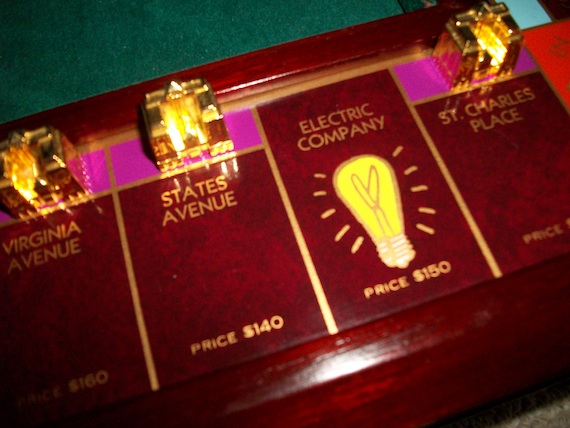
Following the calculations I did last week, adjusting Monopoly for inflation as if it were real life, I began to speculate about what it would take for the average, regular, typical American citizen to “feel” rich.
[mainbodyad]I think the average American would feel really, really well off at the equivalent of a light purple Monopoly with hotels. That would generate $37,128 in monthly pre-tax income, or $445,536 per year. Of course, the government takes a big chunk of your money. If you lived in a no-income tax state, that should leave roughly $300,000 per year or $25,000 per month in cash income (that figure would be much higher if you were smart enough to use tax-sheltered retirement accounts, etc.) That is the same annual income as a brain surgeon who is considered in the top 20% of his field. If you didn’t have the medical background, it would take a net worth of $4,500,000 earning 10% annually, which is reasonable, to achieve that level of passive income.
If you wanted a new Mercedes, you’d just wait a few months and the cash would be in your checking account. Want to drop $10,000 at Bergdorf Goodman or Saks? No problem – just wait 12 days and your investments would have generated it for you. You would never need any debt. You could do things like buy the uniforms for your kids’ little league team or a new grand piano for the church choir without feeling any hit to your personal budget.
To take it one step further, I think the average American would feel “rich” – as in truly wealthy – at a net worth of $10 million because it would generate $1 million in annual income before taxes at a 10% rate of return. After taxes, you’d be looking at roughly $650,000 without using tax shelters such as a SEP-IRA or pension.
[mainbodyad]That means someone with a $10 million net worth would earn nearly $54,200 per month in cash after taxes. It’s enough to afford the payment on an $8 million sea-side mansion in Newport Coast, while still building your personal investments every day without working a single hour. You’d be driving a Bentley, eating on solid-gold rimmed china, and wearing the finest cashmere if you were really good at managing your personal finances and knew how to get the most value for your dollar. Of course, if you knew nothing about budgeting, it wouldn’t be nearly enough to afford that lifestyle because you’d be stupid enough to pay retail for everything.
Even better, if you’re like Warren Buffett and live in a nice house in a normal neighborhood, drive a normal car, and avoid debt, you’d be able to grow your net worth sky high in ten or twenty years!
I could be totally wrong but I think that is the point at which a lot of people just don’t want to focus on making more money. The people who continue to compound, like those who end up on the Forbes list, are motivated by building something rather than cash. The money is just the scorecard.
What interests me is that is the point a which the capitalist class begins. It is also the point that is the same as the 1950’s millionaire, back when being a millionaire was a big deal (to be precise, it would take $8 million today to equal $1 million back then).
Reader Comments (5)
Comments are presented chronologically, with replies indented beneath the comments to which they respond.
Frat Man
October 26, 2010
Hi Joshua. One thing you have consistently said, and I have agreed with you, is that you should get the best tax lawyers and accountants, period. But how would you handle this when you're first starting your business up, or during the first couple years when the costs would be crippling? Would you still hire the "best of the best," or would you merely find someone affordable and adequate to hold you over until you have, in your estimation, some "serious" money coming in?
Joshua Kennon
November 4, 2010
Replying to Frat Man
Early on, I went with economies of scale. Two of the first companies, I did Turbo Tax for the tax filings and everything else by hand. Only when we got big enough did we hire advisers. Also, it depends on the type of company. If, for example, I do end up starting a mutual fund or hedge fund, I'd hire the very best right out of the gate because it is a regulatory nightmare otherwise. If I were starting a small mall vendor, I have enough experience I would set it all up myself, spend less than $200 to $500, and be done with it until the business could afford to turn it over to our accounting and law firms.
So, it depends on the type of business and most of it is easy to do yourself unless your needs are complicated. That is, if you started a blog that earned money from advertisements, had no employees, and made $100,000 per year, it should take you less than 30 minutes to do your tax filings and other required paperwork each year. It probably wouldn't be smart to hire someone for $5,000 to do it for you. You just don't need them for a business like that.
Kwame
October 26, 2010
Joshua you made a statement " The people who continue to compound, like those who end up on the Forbes list, are motivated by building something rather than cash". Many times i have read about great business people and one thing i hear which so far seems to be common to all of them is this "Dont do it just for the money". Sometimes i wonder if that is completely true.
Joshua I consider you a great business person and i will like to put the question to you.
Would you advise someone not to get into business just for the money?
And what really motivated you to get into business was it just about increasing your personal wealth or just your deep love for the whole process of building businesses?
I ask all of this because as a child seeing MATERIAL WEALTH was what always got me excited and was what caused me to start my journey to seek knowledge on succeeding in business up till this very day.
It seems like i am asking you too much but if it will take you a day a two to write a reply or if you will like to put it into an article i will patiently wait for your reply.
All the best Josh.
Joshua Kennon
November 4, 2010
Replying to Kwame
Kwame,
I have written a response to you here:
http://www.joshuakennon.com/does-successful-investing-mean-you-have-to-live-like-a-pauper/
Vassily Tester
May 3, 2017
So I'm just curious... what would you invest in to generate 10% a year?