

Dealing with Business Rejection, the McDonald’s Franchise Disclosure Document, and a $114 Million Coffee Fortune
From time to time, I get messages from business owners or entrepreneurs who are discouraged and upset. Their family, friends, colleagues, bank officers, or suppliers don’t believe in what they are trying to do and they take it personally. This afternoon, as I sat in a McDonald’s restaurant having coffee and revisiting an excellent book called McDonald’s Behind the Arches that details the historical rise of one of the world’s largest real estate portfolio masquerading as a hamburger chain, I was reminded of a story I first read back in college that I think has a lot of powerful lessons.
In 1955, Ray Kroc needed to come up with $25,000 for his new franchise business to buy out the last holder of territory rights for McDonald’s. Adjusted for inflation, that was around $222,000 today. After being turned down by multiple banks, he offered everyone around him a chance to buy a 50% ownership stake in his business if they gave him the money. No one took him up on the deal. Today, those shares would be worth tens of billions of dollars and would have transformed the family that held them into one of the richest in the world.
The moral? You could be sitting on one of the best business ideas in history and people will still turn you down or reject you. Don’t take it personally. It has nothing to do with you nor does it have to determine your future. Don’t get angry or burn bridges, either, as you never know when they will come back around and want to partner with you. Plenty of people who passed in the early days ended up with their own McDonald’s franchise and / or shares of the company following the IPO. Nobody owes you anything. In the words of one of the leading fashion personalities of the past generation: Make it work.
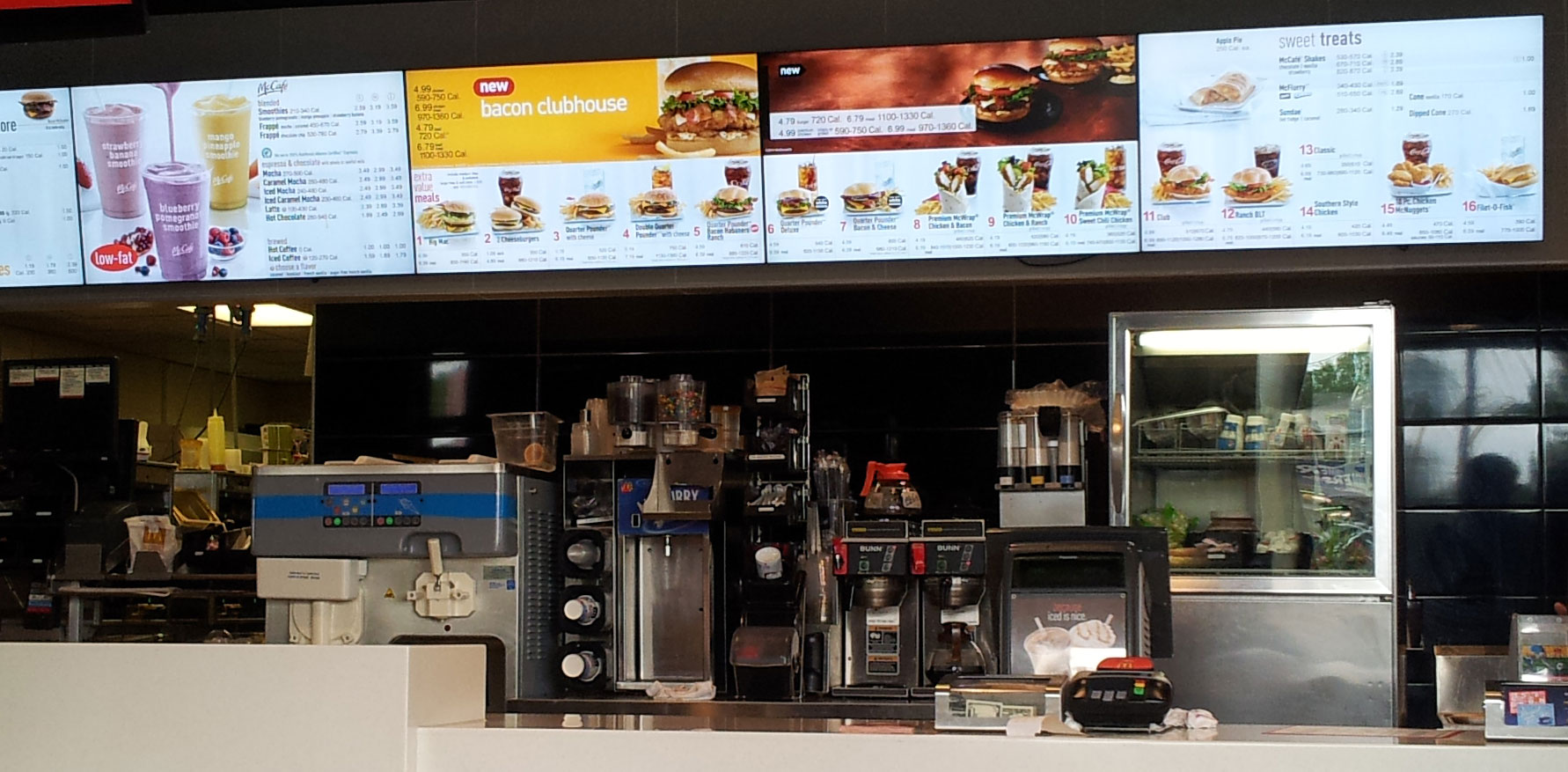
In the past week, we’ve visited McDonald’s four or five times at various parts of the day to watch the operation. I’ve been reading one of my favorite books about the history of the company that is so good, I have a couple of copies in my library. You could teach an entire college course on the lessons in it. I took this photo of the counter when the staff wasn’t around so I could study the layout. I also have begun tracking all of the suppliers and that has been a fun adventure. One example: For decades, Gaviña Gourmet Coffee has supplied McDonald’s with its beans. This business is still family owned out in California and they are one of the top selling coffees in the Los Angeles market. It roasts 40 million pounds of coffee a year and does $114,000,000 in annual sales with 20% of that revenue coming from a combination of McDonald’s, CostCo, and 7-Eleven. It supplies Wal-Mart, Safeway, and other grocery store chains, as well. It’s a silent empire hidden in plain sight and next on my list of case studies. This is the great thing about investing – one idea can lead you to many, many others.
If the idea is good, and if you are as talented as you think, you will find a way to make it work. You are never dependent on a single investor or a single bank loan to launch your career (in fact, you should avoid being in that position at all costs as it is dangerous). You are the asset and you need to remember it. Feeling dejected is a waste of both time and energy. In less than a few days, Kroc negotiated an innovative solution that involved getting a rebate from the original McDonald’s brothers, which gave him the collateral to secure the remainder on a loan; collateral that didn’t exist before he figured out how to manufacture it out of thin air by structuring a mutually advantageous deal that worked in everybody’s favor.
If you’ve never read the book, I highly recommend you stop what you are doing and go buy a copy. It will be the best $12.87 you’ve spent in awhile. Kroc was a genius. He broke all of the rules of franchising at the time by aligning the incentives of the restaurant owners and his parent franchise organization so they were on the same team. He didn’t take kickback rebates from suppliers. He didn’t sell food or equipment to the restaurants. He only wanted to win by making his franchisees successful so he lived and died on the annuity stream he created in the form of rent for the property and a cut of sales. As the system grew bigger, he used the combined purchasing power to buy ingredients, signage, refrigerators, etc. for cheaper and then passed all of those savings onto the local owners so their margins increased. This, in turn, allowed him to attract an army of entrepreneurs who were working day and night to build the system that sent him ever-increasing monthly checks.
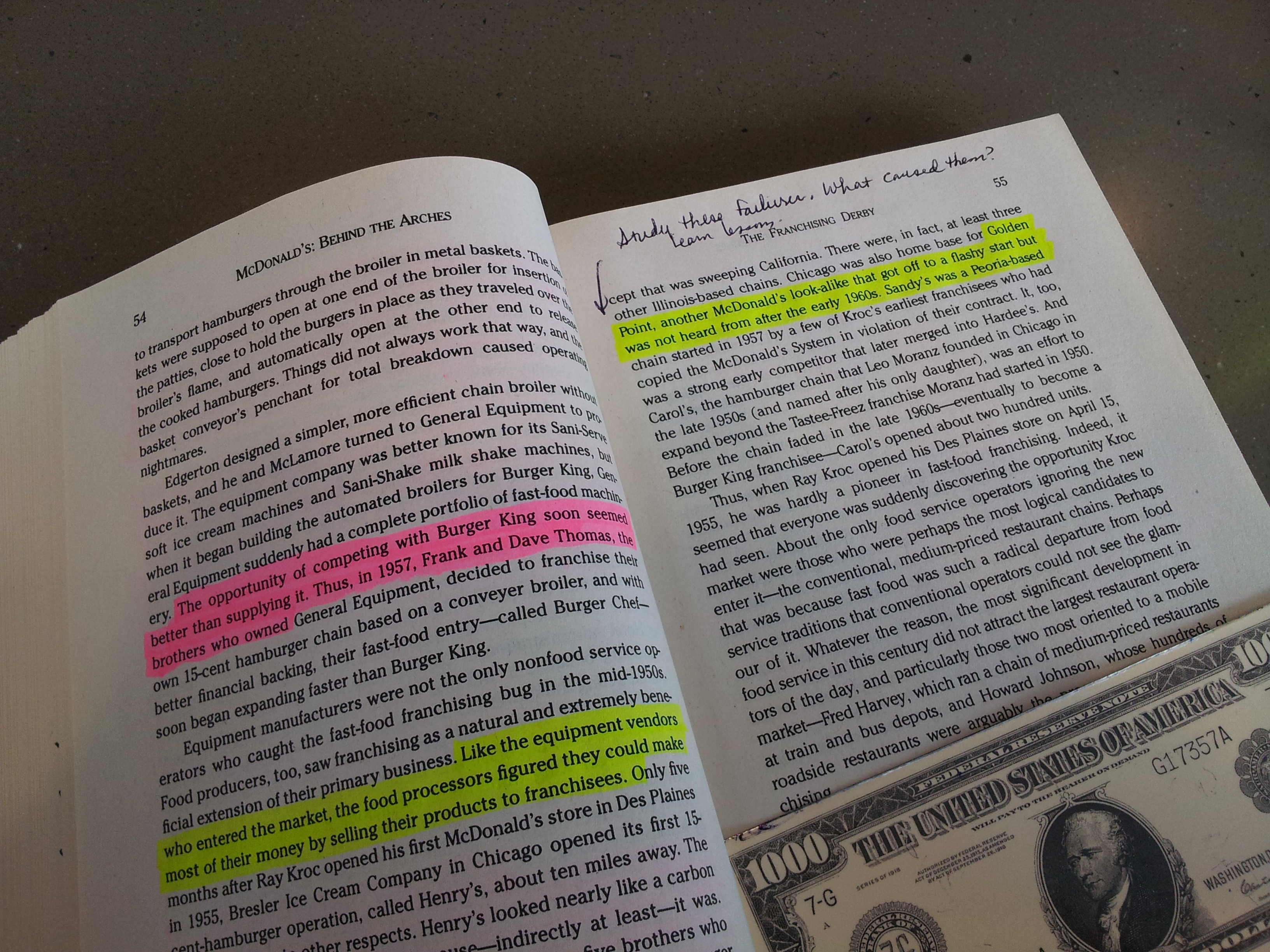
Buy the book! Buy the book and read it! New copies are only $12.87 and used copies are $0.01 on the Amazon used marketplace.
Also, those of you who are interested in the operational side of a business like McDonald’s need to thank Tyler L. He sent me a message after I wrote about McDonald’s two weeks ago, explaining how the Minnesota CARDS database is publicly accessible and the state requires companies to publicly file their franchise disclosure documents. It turns out that California, Washington, and Wisconsin do the same thing and it is much more convenient than filling out non-disclosure agreements and requesting them directly from the company. If you want to see the numbers, contracts, rent schedules, fee schedules, and other behind-the-scenes information for a McDonald’s franchise, you can download the filing here. Brace yourself for a business geek out because it’s 383 pages of information. It makes me love the company even more and proud to be a stockholder.
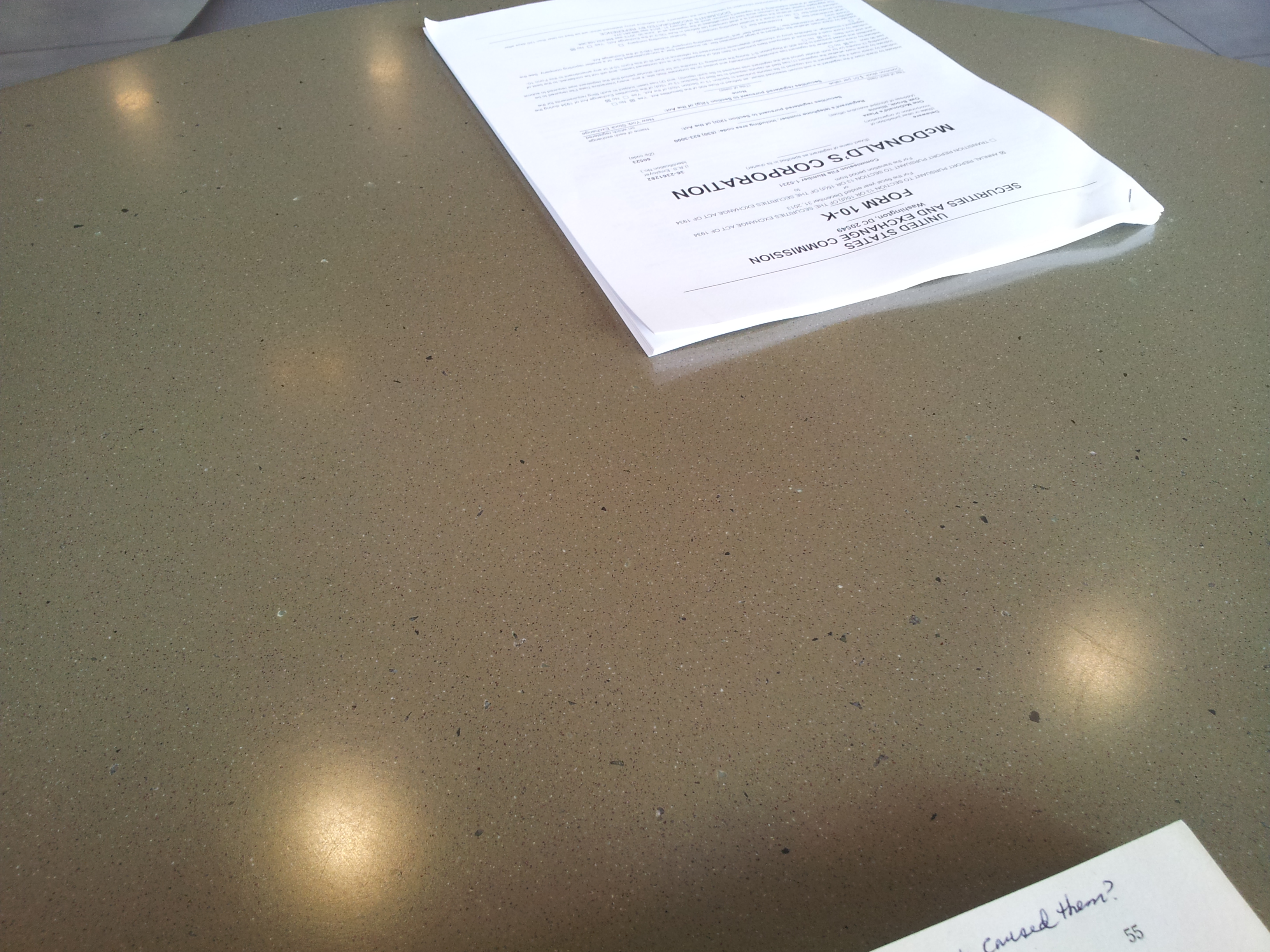
Between the 10K filing / annual report and the franchise document, you can learn almost everything you need to know about the business. I love the economics. I know it’s in a period of slow growth right now that makes Wall Street hate the firm but I can’t help but be seduced by the returns on capital and streams of money generated from more than 35,000 properties around the world.
I have a lot to get done tonight but I find myself wanting to study McDonald’s more. It’s like a family tree that ties into dozens of other companies that also need their own case studies; fortunes built out-of-sight by suppliers (there is one family that sold a business generating more than $100,000,000 in annual sales as the supplier of shortening!). I need to breakdown and analyze the entire system. I can’t think about anything else. It’s what is on my mind in the morning when I wake up and before I go to bed in the evening. I even have a set of vintage McDonald’s coffee mugs I’ve been drinking out of for the past week.
Reader Comments (10)
Comments are presented chronologically, with replies indented beneath the comments to which they respond.
Paarthurnax
July 21, 2014
Very awesome post, Joshua! I love when you share this sort of content. I actually thought about your fondness of McDonald's on the drive home today, and started making comparisons of McDonald's extensively planned and implemented daily operations plans. How it's been built up to be almost fool-proof for the daily workers to do their jobs, and that of Walmart's. Walmart too, though not quite as in-depth as McDonald's, has quite a system set in place for it's workers. Have you ever made comparisons between the two, or other large corporations? Thoughts?
-Bill
innerscorecard
July 21, 2014
Really excited to read more about McDonald's from you on this site. As I said on an earlier comment, a family member has recently joined McDonald's in a corporate role, so I've been hearing about this stuff from the internal perspective to some degree as well. Fascinating stuff.
innerscorecard
July 22, 2014
Replying to innerscorecard
http://online.barrons.com/news/articles/SB50001424053111904780504580043273324546574?mod=BOL_hp_highlight_1
I think this article expresses the consensus opinion on MCD pretty well. (Not to say that I think it is accurate, but that it concisely summarizes why the market feels the way it does).
By the way, any thoughts on the current China food scandal, which obviously is the main headline of the above article? My thoughts as someone who lives here is that it is par for the course for any company doing business here - it is only that the government-controlled media investigates foreign companies more. It's of course terrible, but it's well-known how bad food safety is here - there are many, many stories of rat meat being used as fake lamb meat, or of melamine in milk, or gutter oil being used in restaurants, etc. That's China for you. By the way I'm sure Disney will also encounter similar problems at Shanghai Disneyland.
But even when it does, Disneyland is just so much better than the crappy local competition that I'm sure it'll do well. Just like how McDonald's, with all its problems in China - is far, far safer than local restaurants. Munger always said he had no misgivings about the local general store - I think people in China have no misgivings about the local family-owned stores or restaurants here, unlike many urban elites in the US who romanticize those.
joe pierson
July 22, 2014
Reddit recently had a Mcdonalds owner talk about his business, he had three McDonald's, average about 200K/year/restaurant.
http://www.reddit.com/r/IAmA/comments/2aks3h/i_just_sold_my_mcdonalds_that_i_build_and_owned/
Andrew
July 22, 2014
In my area of southwest Michigan, on any given street with a McDonalds it is usually the nicest-looking-building. Not sure if that denigrates my area or shows how much quality they put into that brand image 😉
Gilvus
July 22, 2014
Replying to Andrew
Kalamazoo?
markeee
July 22, 2014
Hey Joshua, that coffee company also makes La Llava Espresso, which is my favorite. Unbelievably, it's the cheapest espresso in my grocery store, but my wife and I love it. Maybe I shouldn't disclose this, so that they don't mark up the price! Amazon and a bunch of other sites carry it.
joe pierson
July 22, 2014
Agree with Munger. Local family own stores of all types were terrible when I was growing up. Hardware stores never let you return anything, high prices and poor selection, I was glad to see them go! Yet they are returning with high prices and poor selection under the guise of specialty shops.
segfault
July 23, 2014
One of the things I like to do to research a company is to go to Brightscope and pull up the information on their retirement plan(s). You can see the employee and employer contributions for the past several years. It doesn't correlate 100% with the profitability of a business, particularly if there is a union involved, but you can see the employer and employee contributions there. If the employer makes a substantial match or profit-sharing contribution, it may suggest the company is in a lucrative business. If the employer seems stingy with the matching or profit-sharing, I don't make any inference (the company might be broke, or the management might simply not want to provide that benefit to employees).
Gavina's 401k is interesting in that they provided much more in employer contributions than their employees contributed in 2006 and 2007. Employer contributions stopped in 2008, which correlates to the recession. They resumed in 2009 through 2010, and stopped again in 2011 (why?) and made no contributions in 2012 (again, why?). 2013 data was not available.
Abe
May 25, 2015
Joshua, you stated that California had something similar to the Minnesota CARDS database, but I've yet been unable to locate it. Could you shed some light on where I can look? I already searched the California.gov website, but perhaps I'm overlooking something.