

Earlier this year, The Economist did a nice write-up on a topic we discussed in depth back in 2011 in a post called “How much money does it take to be in the top 1% in the United States?“. Although the most recent data available is from 2008, applying a modest inflation factor, it seems safe to say that to rank among the top 1% in income this year might require $400,000 per year, or $33,340 per month. It is at that point you would be generating more money than 99 out of every 100 families.
The most important lesson for most of you to learn is that 50¢ out of every dollar the top 1% earns in the United States comes from self-employment income, business profits, dividends, interest, capital gains, and rents. The other 50¢ comes from selling time to an employer for salary and wages. Put in economic language, half of the income the top 1% generates comes from human capital (the value of selling skilled labor for a paycheck) and the other half comes from financial capital (the returns earned on invested money).
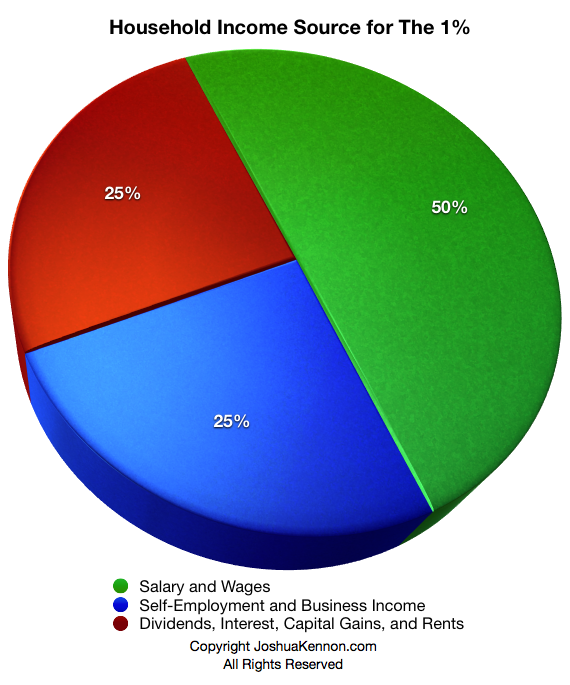
Even if you aren’t the 1%, strive to add those other components to your personal household income pie. You need to consider collecting business income and / or dividends, interest, capital gains, and rents. Those sources of income can be producing cash when you are asleep or on vacation. If you are young, it isn’t hard to harness the power of compounding. The difficult part is getting off the consumer treadmill of materialism that enslaves a lot of people so that they spend cash before it has been earned.
[mainbodyad]
Reader Comments (6)
Comments are presented chronologically, with replies indented beneath the comments to which they respond.
Stable Investor
December 3, 2012
So true Joshua...
If one wants to become rich and wealthy, one must understand that rich dont work for money. Its money that works for the rich.
TheLonelyHumanist
December 7, 2012
I am skeptical that 50% of the INCOME of the top 1% is from salary as the article seems to read. I think it more likely that the original study found that 50% of top 1% HOUSEHOLDS get to 400k+ via salaries and wages. And I would expect most of them to be on the lower side.
Joshua Kennon
December 7, 2012
Replying to TheLonelyHumanist
The economic data almost always refers to household income, not individual income, because that better reflects how most people live.
The salary and wage proportion sounds about right if you are looking at the 1% (not, say, the 0.10% or the 0.01%) because the rankings at that level are dominated by:
1. Doctors,
2. Small business owners,
3. Executives at corporations, and
4. Financial service professionals
In other words, a guy making $400,000 is a member of the 1% but so is Bill Gates making $4,000,000,000 in a year. There are a lot more of the former than there are of the latter, by several orders of magnitude.
As your net worth climbs higher, wages become a smaller and smaller percentage of the pie in almost all fields except professional sports or entertainment (which is a minority of the 1%, anyway, so it's not important enough to matter to the general rule). But if you're looking at a typical member of the 1%, it would look something like a middle-aged heart surgeon married to a teacher who, after twenty years, also owns several apartment buildings in town, a portfolio of blue chip stocks, and maybe a couple of medical patents. The checks the doctor earns from the hospital are still important to their income but are equal to or exceeded by their investment income. They are richer than 99 out of every 100 of their fellow citizens. They can spend Christmas in Paris and establish trust funds for the grandchildren to go to college.
TL;DR: The higher your household income, the greater the likelihood of a larger and larger percentage being generated from non-human capital sources such as dividends, interest, rents, capital gains, licensing income, royalties, copyrights, patents, etc.
TheLonelyHumanist
December 7, 2012
Replying to Joshua Kennon
That is what I was getting at. A pie chart of all the income that the top 1% collectively earn would probably have a very small salary slice.
Joshua Kennon
December 7, 2012
Replying to TheLonelyHumanist
Ah! Yes, if you aggregated the total income and earnings as a class, rather than looking at individual households, you are absolutely correct. Sorry I wasn't understanding.
disqust101
January 20, 2013
Always interesting to see where one falls in the scheme of things. Wife and I (DINKs) eek into the 1%, but we hardly feel wealthy here in high cost California. Still have a mortgage (although 7 figure equity), still drive 8-10 year old cars. Still obsess over our portfolios. Stil do our own yard work. Still wonder if we could retire early and maintain comfortable lifestyle for 30 years. FWIW, I don't think you can feel wealthy unless you have 8 figure assets. And even then, need mid 8 to not really ever worry about your money. But I suppose it's all relative to one's expectations.
That said, a decade ago, it seemed we'd be destined to remain upper middle income. However, with a nice 10 year return on our self-managed portfolio (over 30% compounded annually), we've moved up to a place where we feel we'll live a comfortable (but not extravagant) life. It has allowed us to help our parents in their retirement with very little stretch - which is an interesting dynamic. No longer do we get those quips about "be good or you will be cut out of our will". I know my father-in-law was speechless when he advised me that we'll need $5MM assets to live comfortably in retirement and I told him we already had that (I'm in my late 40s). Our portfolio increased more last year than their entire net worth.
The old saying "your first million is the hardest" is so amazingly true. First million took 15 years. Second took 5. Third million took 3. Last million, 1. I like the trend...