

Mail Bag: Will The Business World Look Down On Me?
There was an interesting question sent to my inbox dealing with what are perceived as societal handicaps or disadvantages, and whether or not it will influence your career. I thought it might be a good chance to talk about the theory of interchangeable capital, which should be in your mental model toolbox.
It can also be useful because each of us is likely to face some situation in life when certain character traits or beliefs cause us to be at a disadvantage, whether that’s being a Christian living in Egypt, a Pakistani living in Great Britain, a women living in Oman, a white person dating someone from a traditional Chinese family who disapproves, or any number of permutations.
Joshua,
… frankly, I’m an African-American gay guy and wonder do you think the financial/business world would look down on me?
Robert
Before I get to the good stuff: You’re in the United States, so, no, I can’t imagine it being a problem unless you’re trying to open an Edward Jones franchise in the middle of a farm town where most of your clients are going to be octogenarians. Then you’d face a demographic challenge, I suppose.
Beyond that, there really isn’t such a thing as a “business world”, in the same sense as “there is no such thing as society” – there are just individual people, individual businesses, and individual corporate cultures. Life is going to be very different living in Southern California than it is Arkansas. I take it the heart of your question is whether or not a substantial percentage of the population is likely to be antagonistic due to your race and / or sexual orientation to the point it harms your livelihood?
Let’s take a step back and put this into a broader perspective. Think of capital as something that represents a claim check on society. There are many forms of capital – financial capital is one, strategic asset capital is another, knowledge capital, beauty capital, reputation capital, military capital, athletic capital, ad infinitum.
In the right circumstances, and depending upon your skill at knowing how to utilize it, you can use this capital to get something else you want; convert the various forms like an alchemist. Societies develop complex social pacts about what it considers acceptable when it comes to converting one form of capital into another. A beautiful man or woman could use his or her attractiveness to secure financial capital by entering a relationship with an older, wealthier man or woman. A very knowledgeable person could sell that knowledge to others on a freelance basis (e.g., consulting) in exchange for financial capital. Some forms of capital cannot be acquired other than by sheer effort – athletic capital is something you have to make yourself; you can’t receive it from anyone else, as is musical capital, artistic capital, and skills capital. Mozart wanted a paycheck and a lot of easy women, so he traded in his musical capital for money and ladies. Michael Bloomberg wanted political capital so he cashed in financial capital to support his now-ended, long-term reign over New York City. When an oil services giant hires an engineer, it is trading its financial capital for the skill and knowledge capital of the new worker. In free societies, it’s all just people negotiating amongst themselves to get more of the goods and services they find enjoyable or necessary to their own lives.
Each person has a unique capital scorecard. The range of values you can amass are dependent to some degree on genetics, but the actual values – where you fall along those Gaussian and non-Gaussian distributions – depend on your efforts and ingenuity. Furthermore, the value of your capital will vary from time to time, moment to moment, situation to situation.
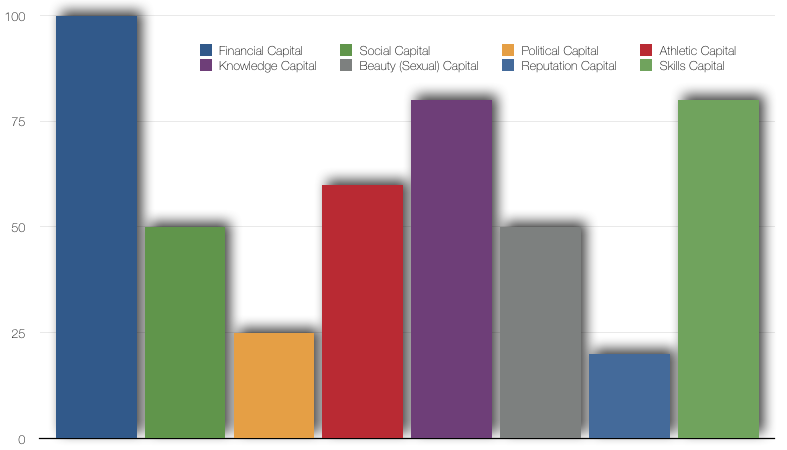
Those interested in sociological studies focus on one particular form of capital – social capital – which they shorthand as “privilege”. Certain privilege is conveyed by merely being a member of the majority, whether that be race, religion, sexual orientation, political affiliation, or supporter of a given baseball team. Often, what is privilege in one situation is a handicap in another set of circumstances; a 35-year old white man walking around in an expensive store alone is going to be treated much better than most people, yet that same man sitting on a playground bench thinking is likely to be viewed with suspicion if he has no woman or child around him, which is itself a form of misandry; his privilege came to be a source of disutility when the external variables changed solely due to his gender.
Here is an excellent example of social capital differing based on skin color and how you can actually “lend” your social capital to others:
In this sense, it is true that you are going to occasionally deal with crap other people don’t have to experience. And it sucks. And it’s not fair. If you want to sell your time for a paycheck as your primary means of generating cash for your household, it is a possibility that you might encounter a boss, colleague, or client who simply doesn’t like you for who you are. This should be no great loss as you wouldn’t want to be around a person who would be so irrational, anyway.
The important thing is, those traits aren’t the only thing that determine how hard life will be for you. Humans are a complex mix of abilities and capital that create some interesting dynamics. Let’s go back to one of the first forms of capital I mentioned, beauty capital. Based on every psychology paper I’ve ever seen, I’d bet a heck of a lot of money that someone who was black and gay – things that should put him at a disadvantage relative to the general population – would actually do much better than the general population if he looked like Tyson Beckford.
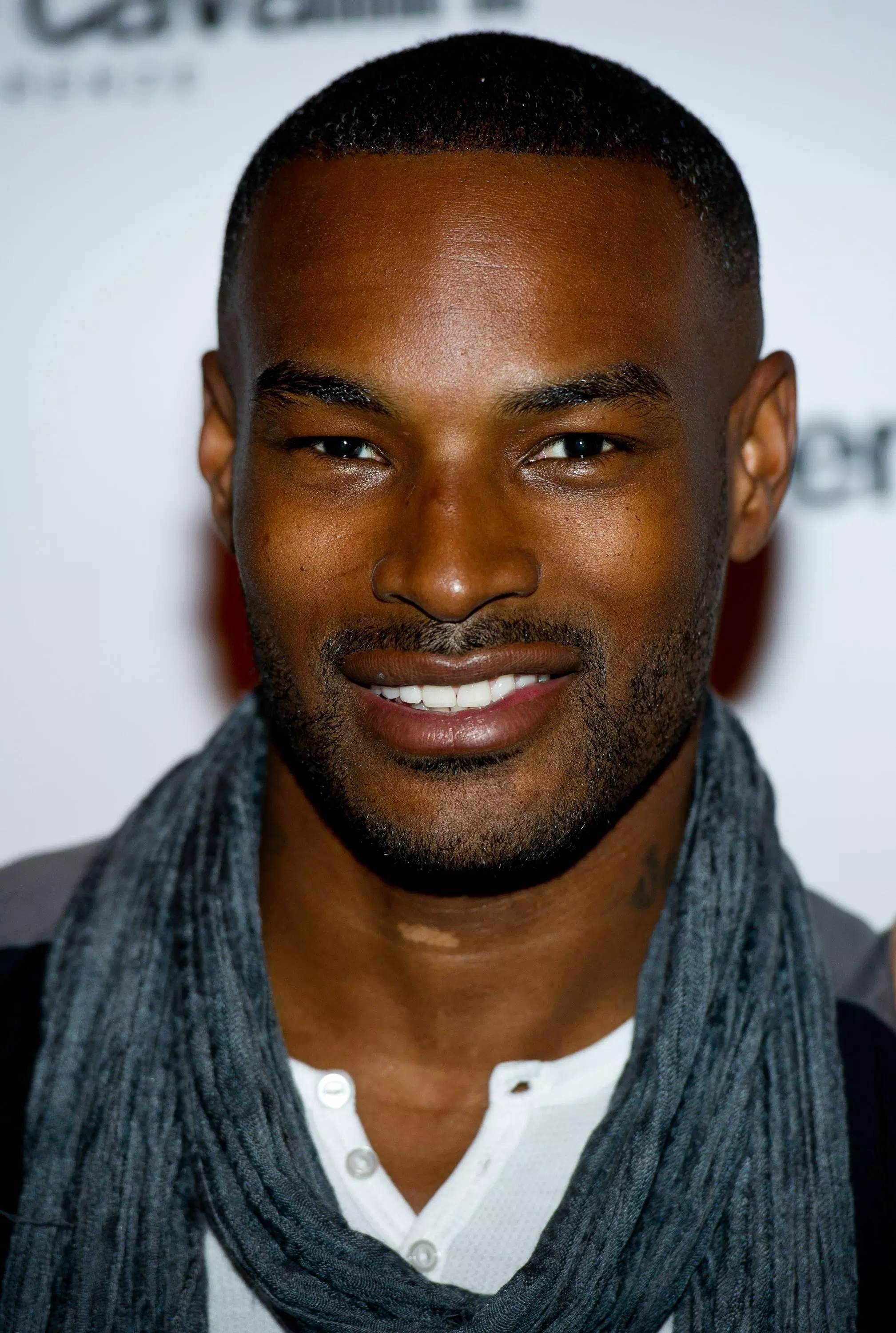
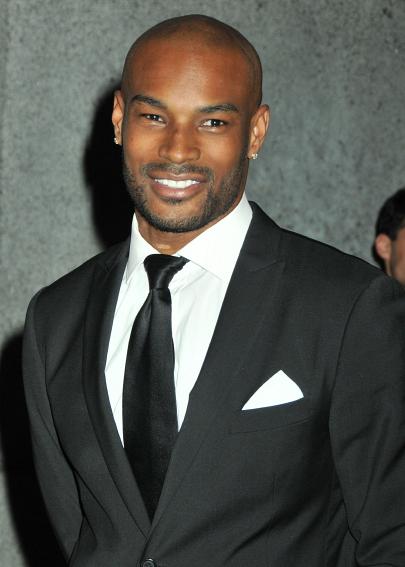
Why? The level of beauty capital far exceeds other factors, creating a net advantage, and it is one of the most powerful forms of capital known. Yes, our theoretical person would still face unique forms of discrimination he otherwise wouldn’t have faced – and it is not fair nor okay – but the advantages he would receive from his physical appearance are extreme because beauty capital does crazy things. Social experiments on the topic have induced some models, who are disguised to look “ordinary”, to tears when they realize how differently they are treated. It even influences whether you are likely to get help if you have a flat tire. Beauty capital is important for men, but it is exponentially more powerful for women, both in the present and historically.
(To tie this in to our earliest examples, Beckford is a case of converting beauty capital into large amounts of money. He traded one claim check in for another, which he could use for his family. His estimated net worth is now more than $14,000,000, plus he can still earn a very high income that puts him in the top 1% by booking jobs independent of the cash his wealth produces. He is able to lend his beauty capital to clothing companies, putting a halo around the garments so that people desire them, leading to an increase in sales.)
Beauty capital makes compliance for even the most mundane of requests go through the roof. People like looking at attractive people; it rewards the brain, and the person who wields the beauty gets the dividend. (Beauty capital changes based on the situation – the clothing you wear, the hairstyle you choose, and the other signals you broadcast – and often declines with age.)
Obviously, very few people have that level of beauty capital, and even if their raw genetics were capable of it, they don’t exploit it by constantly working out, dressing the part, and maintaining their skin tone, manicure, and teeth whitening levels. (Note that an inheritance of potential beauty capital requires maintenance and development the same way an inheritance of financial capital does.) Instead, your advantage is more likely to be found in things like being more competent, more diligent, harder working, more knowledgeable, and developing better connections. Those types of factors can offset other handicaps so you end up at the top of your field, or at least do very well. There are a million different paths to the prize; these days, anyway (this was not the case if you had been gay and black in 1945, so thank God).
But this is all meaningless if you are talking about investments, rather than selling your time for money to a financial institution as a stock broker, trader, analyst, or what have you (getting paid for your investment knowledge). If you own $1,000,00 worth of Royal Dutch Shell plc ADR (Class B) at today’s valuation, you’re getting $53,000 per year in cash dividends. The stock doesn’t care if you’re black. The stock doesn’t care if you’re gay. The stock is totally agnostic. It will pay you the same reward it does an old, straight, white man. The money is green. That’s what makes it so wonderful.
In the event you find yourself at a disadvantage due to being black or gay when working for others, you could always take the strategic road Aaron and I chose in our own careers: hire yourself. Nobody gave Ray Kroc a job. He saw McDonald’s, negotiated a buyout deal, took it over, and started selling hamburgers. Nobody gave Bill Gates a job. He started Microsoft, bought an operating system, and started selling software by licensing it to IBM. Warren Buffett hired himself when he started some investment partnerships (and not everyone told him, yes; some people just didn’t like or trust him). If it were truly a problem (again, I don’t think it is enough to matter, not anymore in Western democracies), there are ways around this. A classic case study is the leading bank to the nation’s 400 richest Americans, Northern Trust. It setup specific practice groups focused on attracting clients who want to deal with people like themselves; they actually have a cadre of gay private bankers who do nothing but work with gay families. That’s a very intelligent way to handle the problem. They knew that their bank was at a disadvantage if all of their bankers were straight, white men. They needed someone else with whom a broader group of clients could identify.
(Personally, I think it’s all a bit stupid as my personality lends itself to only being interested in ability and honesty. If I were designing a skyscraper, and the best architect on the planet were an androgynous retiree who wore steam punk clothing and claimed to be in a relationship with a Japanese pillow person, I wouldn’t care. It’s meaningless to me. I’m hiring them for their skill. I don’t care if my banker is Christian or atheist, gay or straight, white or black – I just want competence and integrity; that they do the job with excellence.)
So, no, even though discrimination absolutely exists, in terms of personal strategy for getting ahead, I don’t think it’s worth worrying about at present if you choose your geographic location and employer wisely. But even if it were, why would you let that stop you? Have you chosen a career based on what you love to do? Because you find it rewarding? Because you’re willing to live with the trade-off of effort and time for money? If so, why would you let a few bigots stop you from your dream? They shouldn’t have that kind of power over you. Half the time they aren’t even thinking of you, anyway, and before long, most of them will be dead. That’s impolite to say, but it’s true.
Don’t worry about it. Follow your heart, do the best work you can, and amass surplus capital, in all its forms and manifestations, so you have more claim checks you can cash in down the road. Even if you don’t use them for yourself, you can pass them on to your children and grandchildren, give them to charity, or pick worthy strangers whom you want help.
Reader Comments (14)
Comments are presented chronologically, with replies indented beneath the comments to which they respond.
Austin from TX
November 13, 2013
Josh- Great post.
Have you come across Lincoln Electric Company in your studies? I just read through the case for school and it almost brought a tear to my eye. I'm sure you can find the case somewhere on the web and think you would really enjoy the culture, incentive structure and profit sharing.
HBS The Lincoln Electric Company
Also, we spoke about signalling in financial markets a couple days before your post. Really interesting stuff.
Joshua Kennon
November 13, 2013
Replying to Austin from TX
I had not but this is going to the top of the reading list ASAP. Thanks for sharing it!
Jeff
November 13, 2013
Great post Josh.
Honestly, unless he is in a small town where everyone knows each other, I don't think people will even realize he is gay unless he specifically points it out. Not that he should have to hide it, but most people probably would notice enough to care.
But I have found that the best way to guard against this sort of thing is to be very, very good at your job. You would be amazed how much leeway you get when you display a lot of competence.
Good luck to this gentleman! I think he will do fine.
Joshua Kennon
November 13, 2013
Replying to Jeff
That is so true; regardless of field, excellence in occupation forgives a lot of sins. It takes almost an extreme degree of obscenity or irresponsibility to offset it. (One of the most famous examples I can think of where the line is finally crossed involves the alleged Bloody Battle at the Met. Her behavior destroyed what would have been one of the greatest careers in all of classical music history. Her interpretation of Strauss still gives me chills.
Odai
November 13, 2013
For mental tidiness, I like to sort capital into three groups: Financial/Material, Human, and Social.
Joshua Kennon
November 13, 2013
Replying to Odai
I like that. I may adopt that for my own files!
My favorite thing about it is how certain tasks build multiple forms of capital at the same time; e.g., there is a reason that a lot of professional athletes also end up becoming models - when they are working on their skill set for their profession, it happens to not only increase their athletic capital, but their beauty capital as well as humans, at least in this culture, are wired to perceive physical prowess as more attractive. This exposure, in turn, gives them more fame, which is a form of social capital. That allows them to charge more for their time, generating more financial capital. If it's arranged well, you get these circular effects where a single advantage can result in some amazing things. (On the downside, a single disadvantage can also create a loop of despair.)
Edit: For some reason, writing the phrase "loop of despair" makes me pronounce it in my head like Homer Simpson.
Andre
November 13, 2013
To answer Robert's question,
Live in a big, diverse city! I live in San Francisco. Anyone who discriminated against someone based on race or if they were gay would lose their job and their company would be probably subject to a lawsuit.
In the end success is all about talent and persistent hard work. I know plenty of straight and gay people, caucasian and everthing else. If you kick butt at work I don't think anyone can stop you. The workplace is about respect. Even if other people don't share the same personal views as you, if people respect you and your work product, that is what really counts. Good luck!
Aditya
November 13, 2013
Hi Joshua!
Kind of a random question, and perhaps I am missing something basic, but is the RDS.B example a typo? If not, how did you come up with 10,000 RDS.B ADRs with a $3.60 annual dividend yielding $53,000 cash dividends annually?
Thanks in advance!
Aditya
Joshua Kennon
November 13, 2013
Replying to Aditya
Thank you! Yes, it should have read $1,000,000 worth of the RDS-B. Halfway through writing it, I changed from a share-based focus to a round number ($1,000,000) and applied the dividend yield to it as of the most recent closing. I must have missed the first part when I needed to switch it back over or I could have grabbed the wrong draft when the site went down for 10 or 15 minutes last night in the middle of me working on it and I had to pick the revision I wanted. I just fixed it and refreshed that cache; I appreciate you letting me know.
Aditya
November 13, 2013
Replying to Joshua Kennon
Thanks, and I apologize for calling it out - just a simple mistake. It caught my eye only because RDS is coming up in my reading queue soon and I found that example quite eye-catching!
Nicholas Archer
November 14, 2013
As always, J Kennon, you nailed it!!!
I love coming to your site for a mental reboot.
This reminds me of a perfect example of "privilege," a discussion I had in the past
with a black professor. I'm white, late teens/early twenties at the time.
We wrongly classified this as an argument about diversity vs. ? monoculture...
Anyways, the privilege aka social capital mental model is way better.
Ok, here is the little story:
I go to a movie theatre to see a new film I am excited to see. (I'm white).
I lived in Washington, D.C. at the time I believe.
These early-teens, badass little black kids where kicking the seats behind me,
talking, texting, the whole freaking movie.
If I had been in Connecticut, I would have turned around, and told the badass little white
kids, to shut the hell up and quit ruining the movie for everyone else.
But, since they were black, and I didn't want to seem like a racist asshole,
I suffered through the movie and let them act like misfits.
I thought of my Grandmother growing up in German section of New York City.
Kids in a movie theatre back then would have been grabbed by their ears, humiliated in front of the whole audience, and dragged all the way home to their moms; who would then proceed to whip their ass for being punks. It is important for people, when they are in the right position,
to stand up and do the right thing when they have social capital?
Which brings me to another story that is on the same theme.
An older pal of mine told me a story where he, his wife, and young son went to a state park to go hiking. Everyone parked in a dirt lot. On the way out, some guys in a suv, were doing donuts in the dirt lot, spraying everyone's parked cars with gravel and dirt, really causing a scene and risking people's safety, damaging property, etc. My friend and his family are leaving the lot, and on the way out see a police officer. My friend rolls down his window, and says, "Sir, there are some guys back their burning out in their trucks, spraying all the other parked cars with gravel." The police officer says, "Can I see your license and registration." My friend says, "Uhh. Why do you need my license and registration?" The police officer says, "Sir, what is your name?" My friend replies, "First name is Concerned, last name is Citizen."
Long story short, the police officer takes down my friends license, registration, looks up his driving record etc, and doesn't go drive 100 meters down the road to stop the yahoos tearing shit up.
It is situations like this, or worse, that make people afraid to speak up. That's why most of the time people notice trouble, or a bad situation, they put their heads down and stay quiet. Because they don't want their heads cut off for poking their turtle necks out.
Help me out here Joshua.
PS. The one guy I know who works on Wall Street is a Sr. Executive Manager of a Manager of a Manager and he's black and gay lol. You'll be fine buddy! Just show up to work on time in a good mood and they'll be happy to have you!
lokgp
November 14, 2013
Your police story reminded me of the Chinese culture in Malaysia.
Malaysia on its on is a 58 years old country. Relatively young to most countries.
Very early on, while tin mining was the rage in Malaya back in the 1900s, the Southern chinese from the Guangdong, Xiamen, Hainan, Hakka moved from China to Malaya to find work in the tin mines to send money home, or to bring their whole family to start a new life in Malaya. Some of them have to sell their children to pay for the ship's fare to Malaya.
To kick start them further, China under Mao was having incredibly poor life, and famine and starvation. Some records says that 80 million people died due to starvation alone. Naturally, human seek a better life for themselves and family.
In Malaya, the British were in power, and as history tells its, they were there to reap all natural resources to power their industrial revolution at home. These migrated chinese worked as paid slaves, and accepted lower quality of living, which to them is much much better than China where you just starve and die.
Gradually they built up capital, and build up their community, hence the famous ChinaTown all over the world. Some of them started trading with whatever capital they had, and some went on to own the tin mines. Those mines are the unprofitable mines for the British as the cost is too high. But for the Chinese, they developed water pumps to get the tin ore out, and by reducing their standard of living. Obviously they live in sweat homes and not mega houses with servants like the British. Through these mines, they made a fortune to go on to buy even more mines, or to uncover more mines, and then move on to other agricultural projects: next stop rubber.
Certainly these Chinese immigrant were 4th class citizens, and truth be told, their aim is to simply earn some money to send home for the brothers and sisters back home in China. But like everyone in the world, their roots grows and they became permanent residents. As a 4th class citizens, the chinese have to face harassment, and every trick in the hat from the Brits from moving forward. The chinese refrain from minding others business, and try to contain whatever anger or humiliation within themselves. For them, life in Malaya is incredibly good compared to life in China. And as long as they can live, they can be wealthier. They avoided confrontation and resorted to bribery to get whatever they want. Lucky for them, bribery helps them to solve their problems. Be it getting a family member out of jail. Getting a lease for a tractor or lorry. To get opportunities for contract. You get dealt with poor cards and just get on with it.
Then comes World War 2, the Japanese took over Malaya in 3 days, using their bicycle and military tricks. The mainland Chinese have been fighting against the Japanese and many died in Nanking. Because of this, the Japanese bore hatred against the Malaya Chinese. The chinese were killed, harrassed, punished, tortured etc. That chapter is one of the worst they have had. There are grandmothers now still living that remembers how their father were beaten and have their hands chopped off by the amazing samurai swords.
This further reinforced the need for the Chinese to stay quiet, stay away, mind our own business, don't complaint, stay alive, and work damn hard through whatever small opening they can get to break free. This is social culture that got ironed in to the Chinese. For them the tales of harassment lives on. Mind you, these are not verbal or mental abuse that the gays are facing. These are closer to what the blacks were facing before Lincoln. And very close to what the Jews were facing back in Germany when Hitler rules.
These memories being vivid, shapes the Chinese. Koreans faced very harsh punishment under the Japanese invasion too. And the Japanese faced hard retribution from the Americans with the Hiroshima and Nagasaki events. All these Asians, generally fairer skin, had to dig themselves out of the holes. That explains their incredible drive for excellence in education. Education is the only way out, and still right now, education is still the only way out for many Indians in the slums of Bombay. If you are to glance back, these struggles and memories has not exceeded 100 years yet.
Just like the African horse : the zebras. They are wild and faster, and they blend in better with their environment. Not due to choice, but due to natural selection. These traits and personality that you witness in Asian: shyness, do-what-you-are-told, etc became solid basses for whatever are to grow out of them.
The Chinese strive for economic independence and freedom, made them concentrate on trade, and in many ways corrupted many in the process through their bribery-best-practices. It worked. And soon the Chinese in Malaya overpowered the locals and the Brits in total wealth. All economic engines falls into the hands of the Chinese. Wealth is hardest and at its smallest stage, and that where the local Malaya Malays gave up their tiny economic engines. The Chinese took away the sugar and rice trace and worked them to mega sizes today. Up to this day, the Chinese are still repressed in an independent and democratic Malaysia.
Is that poor governance from the local ethnic of Malaysia. Not exactly. While the Chinese work on getting rich, the ethnic Malays work on political and governmental powers. So, we have 2 classes of powers by 2 classes of ethnicity. The Malays were always favoured by the Brits and the Japanese. Both economic and political powers must work together. No car runs on a single wheel. With that, a social contract lives on. While the economic gap between 2 ethnicity grew and widens.
It is obvious to the Malays that, were free enterprise be left to its fullest potential, it will be a winner takes all. Affirmative action were then implemented to help grow the economic power of the Malays as a check and balance against the now local Chinese. When any affirmative actions is taken, it just means discrimination. If a corporation is to take on affirmative action to recruit more blacks, then more white will get discriminated. If a firm aims affirmative action to have more gender diversity to get more females into the board, it just means, more males get discriminated against.
Affirmative itself is not bad. The government takes a major role in shaping the society, and to a government in the hands of Malay, it is necessary to divide the wealth as equally as possible among all ethnicity. Else the local Malays will end up as the paupers on the lands of their fathers eg: American Indians, Australia Aboriginals.
But in all natural history, the grass takes over the land, then the meadows takes over the grass, then small plants take over the meadows, and then forest take over the meadows. That is mother nature at work. Attempting to divide the wealth evenly is akin to making sure that the grass, meadows, small plant, forest, grows evenly all at the same place. Artificial selection works too. But its really hard.
Is it fair to the Chinese? Well, the answer is: Nothing is ever fair. You don't deserve fairness. You just live with it. Suck it up. And move on. It didn't stop the Chinese earlier, it wouldn't stop them now.
Is it fair for Indians to live in slums while the American drives a SUV? No, but it wasn't worth complaining. They either move on with their life, or move to USA. 🙂
So for the gays who feels discriminated in the work environment, the same mentally would help you just like how they helped the Asians in general. I wouldn't be surprised to find gays working harder than the norm. 🙂
Nicholas Archer
November 15, 2013
Replying to lokgp
Time for me to open up the CIA Worldfactbook and read up on Malaysia!
Thanks for the interesting contribution!
Frankie
November 15, 2013
This articule beautifully articulates the attitude and ability to persevere found in very successful people. It also brings cause-and-effect to the forefront of the mind: Successful people are not positive and strong-minded because of their past success; rather, they are successful because of their positive and strong minded nature.