

Reading the Johnson & Johnson Annual Report to Stockholders
After answering a mail bag question about investing in dividend stocks for the long-term, I happened to be reading the Johnson & Johnson annual report. As a business, I love this firm. I mean, I adore it in the way a lot of people like kittens or cute babies.
When the Johnson & Johnson stock report shows up each year, I get excited like a kid who receives a new XBox at Christmas. In the coming decades, if I were to decide to build a consumer products business or some other germane company and sell it to JNJ, I’d want to entire transaction in stock instead of cash so I could hold the investment. That is how much I like the underlying earning power, culture, and decentralized business model. Unfortunately for me, it spent the last decade (almost) priced to perfection so I never really bought a lot of shares. A value investor overpaying for a stock is like a nun with a sex addiction; the behavior just isn’t compatible with the job.
My First Impressions of the Johnson & Johnson Annual Report
What fascinates me is that between 2000 and 2010, sales rose from $29.172 billion to $61.587 billion, or 111%. During that same decade, net earnings grew from $4.764 billion to $13.334 billion, an increase of nearly 180%. That means profits grew faster than sales at a rate of 69% for the decade.
On a per share basis, the figure is more impressive because diluted shares outstanding have fallen from 3,075.2 billion to 2,788.8 billion, a reduction of 286.4 million shares, or 9.3% since the beginning of the decade. Dividends per share grew from 62¢ to $2.11, representing a 340% increase. Book value per share has expanded from $6.82 per share to $20.66 per share, an increase of 203%.
All in all, it’s been a great decade for Johnson & Johnson. The stock trounced the S&P 500 and would have done even better except that ten years ago, shares ended the year at $52.53 on earnings per share of $1.55 for a p/e of 33.89 and an earnings yield of 2.95%. At the same time, you could have bought an intermediate United States Treasury bond with a 5.07% yield.
Compare an Investment to the Opportunity Cost
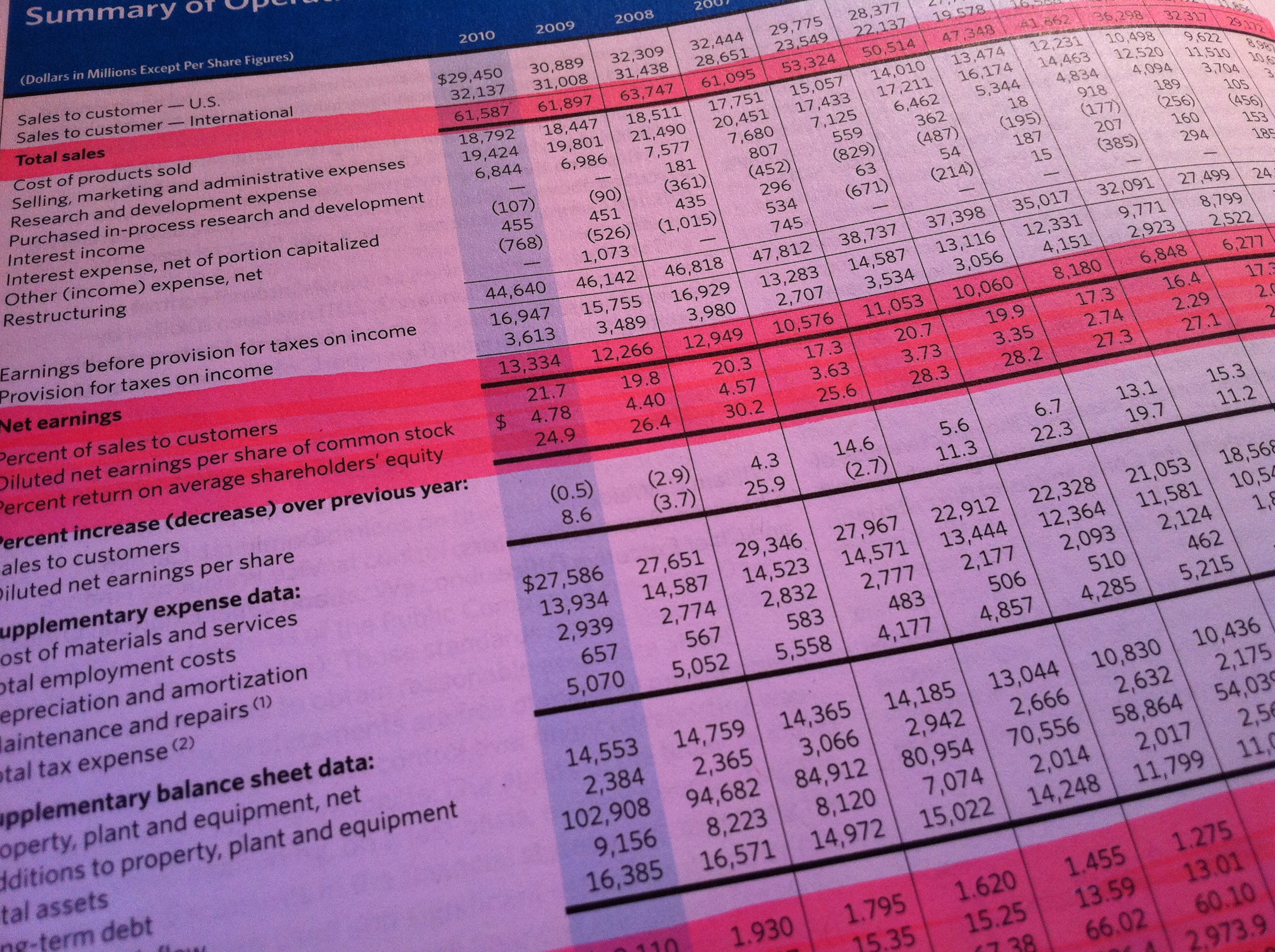
The summary of operations and statistical data 2000-2010 from the most recent Johnson & Johnson annual report … I know I said I am going paperless with the iPad but that is a six-month process. I still get paper reports delivered to the office and haven’t gotten everything switched, yet.
Think about that for a moment.
Ten years ago, you were offered a piece of ownership in one of the world’s greatest businesses at a 2.95% earnings yield. Of course, if Johnson & Johnson paid all of that income out to you, you’d have had to pay dividend tax on it so the real yield was lower unless you were buying through a retirement account. Alternatively, you could have parked your money in a Treasury bond, collected 5.07%, and not worried about the enormous fluctuations that happen in the stock market short of an interest rate crisis. Anyone who says that stocks are “loaded” and that they just “rip people off” and who cites the past decade as an example is an idiot. The return you earn on your money ultimately depends upon the price you pay relative to the cash generated by the investment.
This is not rocket science. You cannot buy stock in a giant corporation with good, but less than spectacular, growth rates when 10-year Treasury bonds are yielding 172% more and expect to do well. If you do, great, but you had no right to demand that outcome. It is a testament to Johnson & Johnson’s underlying earnings power that investors still managed to be up almost 48% for the decade. That is only 4% compounded annually but when the obscene price that was paid is considered, that is a miracle.
That alone is the reason that up until recently, I wouldn’t open my wallet to buy shares of the company even though I recognize that it is one of the most powerful brands and profitable enterprises in history. Today, the firm is trading at $59.22 on earnings of $4.78 per share, for a p/e of 12.4 or an earnings yield of 8.06%. That is still nothing to do cartwheels about but it is a far different calculation. An investor acquiring a share of Johnson & Johnson today is buying 273%+ more “look-through” profit than he or she could a decade ago.
Understand What Drives Profit and Thinking About Johnson & Johnson as an Archetype for a Long-Term Stock
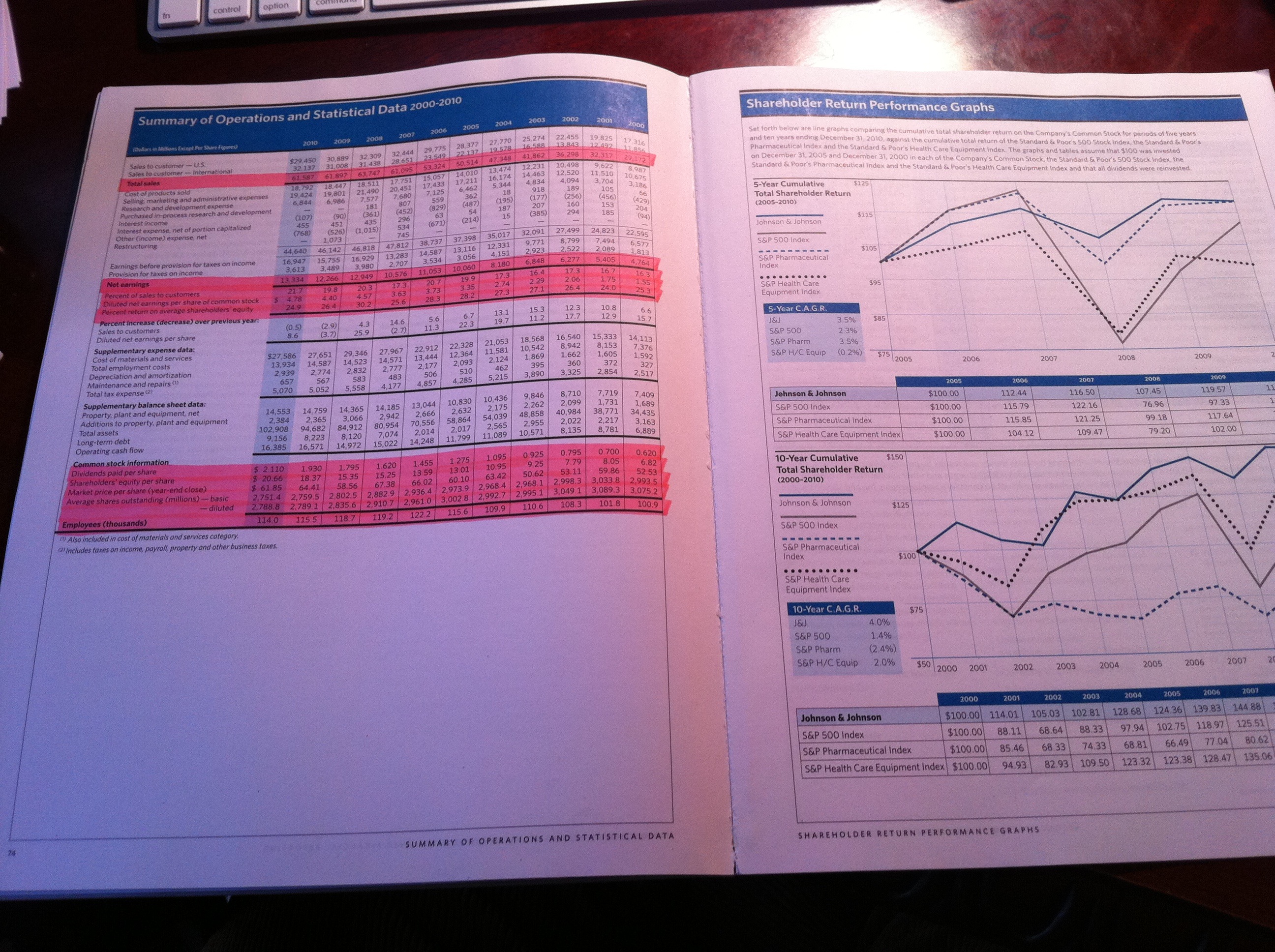
I don’t think anything gives me as much joy as a stock report, a highlighter, a pen, and cash to deploy.
The question I set out to answer was, “Where did all of this extra profit originate and is the trend sustainable?”. Johnson & Johnson makes a big deal out of the fact that price increases for their products have been lower than the rate of inflation, so this improvement didn’t come because of higher prices. Gross profit margins are almost identical. There was a 5% or so improvement in SG&A expenses, depreciation and amortization almost doubled but was lower on a relative basis, helping a bit. The company took advantage of historically low interest rates and expanded borrowing from $3.2 billion to $9.2 billion. You also had the Pfizer consumer division acquisition a few years ago, which added to Johnson & Johnson’s retail product line with brands like Listerine, Nicorette, Lubriderm, Visine, Neosporin, Sudafed, Zantac, and Benadryl.
Last week, I added some shares to what I internally refer to as my “retirement insurance plan” since those are the stocks that I treat differently than everything else I manage given that I won’t touch the money for another half century. I’d like to add more in the next few weeks.
Projecting Future Compounding Rates for a Stock
Don’t get me wrong – I certainly don’t think Johnson & Johnson is something that can make an investor rich overnight; it’s just too big. That is the only reason I’m writing about it. I never tell you the names of companies that we are buying because we think they are undervalued … I only discuss the Wal-Mart’s, Coca-Cola’s, and Johnson & Johnson’s of the world because virtually everyone already owns them through an S&P 500 or Dow Jones index fund. In fact, if you are reading this, the odds are statistically likely that you already own Johnson & Johnson stock even if you don’t know it.

Johnson & Johnson has been in business for 125 years. That doesn’t guarantee success by any means. But it is a reasonable bet to assume that people will still want face wash, Band-Aids, baby powder, prescription drugs, medical devices, and more for the next 125 years. That alone isn’t enough – you have to buy when shares are attractively valued.
If you forced me to guess, I’d assume that the company would generate a real, after-inflation rate of return of somewhere between 6% and 7% per year over the next 50 years, which would turn $1.00 today into somewhere between $18.42 and $29.56. Or it might not. Who knows? That is what makes investing fun – you have to make educated guesses.
This is assuming, of course, that you put it in a Roth IRA, 401(k), or other tax-sheltered or tax-free account, reinvested the dividends, and ignored it through bull and bear markets. (My guess is that the increase in underlying earnings growth will compensate for inflation and you will be left with the current earnings yield as your compounding base. I’d hope the company would do slightly better – remember that over 50 years every percentage point counts; if Johnson & Johnson could pull off 8% instead of 7%, you’d be looking at $46.90 for every $1.00 invested – but I wouldn’t bank on it. It would just be serendipitous if it did. Hope for the best, plan for the worst.)
The problem is, inexperienced investors don’t realize that the stock might be down 70% tomorrow if the United States suffered a terrorist attack or went to war (wait – we are involved in 3 armed conflicts right now so pick another disaster such as a major earthquake in California) and the stock exchange closed for 6 months. Or worse. What if the company created a pharmaceutical product that turned half of the Eastern seaboard into flesh eating zombies? Can you imagine the product liability on that one? I suppose at that point it wouldn’t matter since you’d be running down the L.A. freeway with a limping hoard moaning behind you in half-torn shirts.
The point: There is a saying – and even though I personally hate to curse it is the most succinct way to put it: S**t happens. It has always happened. It will always happen. You cannot plan for everything. Your job is to look at the data and make the most rational decision you can based upon what is presented to you and what is appropriate for your own situation.
Short-term market price is not always an indicator of intrinsic value. Most people just don’t have the emotional and financial fortitude to own shares, even though history has shown that businesses produce more than fixed assets in the long-run; the volatility scares them and they panic.
Reader Comments (4)
Comments are presented chronologically, with replies indented beneath the comments to which they respond.
crabhooves
March 30, 2011
When you said you adored their stock reports the way you adore kittens, I imagined you seeing it sit on your desk and talking to it in baby talk like people do with kittens, maybe starting a blog and telling ALL your friends what your stock report did today and where it was. Not to mention taking a dozen pictures each hour to upload and force feed to everyone you know.
Frat Man
March 31, 2011
Joshua, I remember when you wrote about the bail-out (way back when) you agreed that it was necessary on the grounds that you philosophically objected but recognized that it was necessary to save our economy from falling off a cliff. But I was wondering if you agreed with the premise of 'too big to fail.' Obviously, if a single bank controlled 95% of deposits, that would be problematic. But do you think 'too big to fail' adequately describes the largest banks today? I've heard someone compare Bank of America to the glob from the 1950s that just rolled over everything, consuming it, without having any backbone structure. Are things at the big banks like Bank of America and Citigroup that out of control?
And two interesting news items today--what do you make of Paul Allen's critique of Gates, and the Sokol mess with the Lubrizol stock at Berkshire?
Joshua Kennon
March 31, 2011
Replying to Frat Man
1. Yes. Banks are that out of control. I'm a bit concerned about media companies, too. I think the nation would be much better served by putting restrictions on ownership back in place so that you can have small, regional concentrations of power. I doubt it will happen. I'd rather the nation have 50 banks like Northern Trust than a handful like Citigroup and Bank of America. On the flip side, having a few major institutions makes it easier to enact policy broadly and quickly in an emergency if the law is changed to dismantle the companies easily.
2. I'm baffled by Paul Allen's critique of Bill Gates. The man worked for only 5 years at Microsoft, a fraction of the time the other two founders put into the operation, he accepted the terms at the time (which he had no obligation to do), he became one of the richest men in history, and he didn't have to worry about growing the business or any day-to-day operations. It's just pathetic.
3. I was truly shocked by the David Sokol news today. I don't think the Lubrizol stock deal was against the law - but I'm not a lawyer - simply because you have a guy buying shares in a company he likes, he is a *great* executive in his own right, he has made Berkshire a ton of money, and he has a relationship with Buffett, who obviously likes to talk about stocks. It seems normal to say, "Hey I own this company, you should look into it." That is true especially considering, as Buffett pointed out, Sokol couldn't possibly anticipate how Buffett would respond, Sokol had no say in whether Berkshire made a bid, Sokol apparently had no way of knowing if Lubrizol would be open to being taken over by Berkshire, and Sokol doesn't sit on the Berkshire board, so he wouldn't have even known if the deal would have been approved. Plus, the total gain was not a lot of money to this man.
My guess is it is one of two things. Either 1.) They expect the SEC to investigate because it *looks* bad even though it makes no sense that something like this, or Martha Stewart's conviction, happens when things like Madoff, Worldcom and Enron get by, or 2.) Sokol really does want to build his own family version of Marmon, Alleghany, The Marcus Corporation, or Berkshire Hathaway. He has a track record that would make it easy for him to raise billions upon billions of dollars. Even if he took a tiny cut, he could make tens of millions, or even hundreds of millions of dollars a year in profit sharing on the deal. If his ambition burns as bright as Warren's, it is a rational course of action.
Frat Man
April 1, 2011
Agreed. I've got a conspiracy theory on this one--even though Sokol may not have technically done anything illegal or even anything of the sinister intent that some media outlets suggest, it still looks boneheaded superficially. I mean, could you imagine Munger's reaction when he heard about this? But I digress. My theory is that Buffett had previously told Sokol that he was next in line to succeed him (perhaps that was the ammo Buffett used to talk Sokol out of retiring in the past), and after this error in judgment, Buffett and Munger sat down and told Sokol they were going to reconsider and re-evaluate the successor position...Sokol, who may be a humble enough guy but a man nevertheless who still has his pride, took it as a slap in the face and left, figuring he could build his own empire. Any chance that's plausible?
On a side note, I was reading the article about the Goldman guy that told a billionaire hedge fund manager named Rajaratnam about Buffett's purchase, and the ensuing trading scandal that ensued...One thing that struck me about the article was it said 'one minute after ending the phone conversation, Rajaratnam purchased 175,000 shares of GS." My question is how--what would be an example of a broker that allows you to buy hundreds of thousands of shares of stock at night in less than a minute? This doesn't strike me as something you can do on Charles Schwab haha. And how much would having an access service like that cost?
And on a more light-hearted note, what percent of the S&P 500 do you think you have the ticker symbol, headquarter location, and dividend memorized for? As in, if I said Exxon Mobil, you could say "Exxon-Mobil, Irving TX, .44 per share per quarter."