

The Economic Tragedy of Ed Toman and the McDonald’s Fortune That Could Have Been
The biggest mistakes are often not seizing the huge opportunities that are right in front of you. One of my least favorite stories of this economic tragedy involve a man named Ed Toman, who lived in Southern California back in the 1940s and 1950s and played an important role in the early days of the McDonald’s restaurant empire.
He was a local machinist and craftsman. The original McDonald’s brothers came to him to design some of the restaurant equipment they needed to run their hamburger stand more efficiently. They would pay him to come up with designs, and buy the products he manufactured. He did very well. One of his inventions was a “hand-held stainless pump dispenser that required but one squeeze on a trigger to squirt the required amount of ketchup and mustard evenly onto the bun.” [Love, Page 17]
In fact, that one, individual invention generated sales of $500,000 for him. Adjusted for inflation, that is a lot of money today. However, Toman never filed a patent on his product. The same basic idea is still used in the 33,000 McDonald’s restaurants around the planet. Had he setup a business named Toman Restaurant Supply, Inc., and used it to sell the exclusive design, he would have been worth perhaps many hundreds of millions of dollars.
He did all of the work. He didn’t cash it in for the reward that should have, rightfully, belonged to him. That was mistake number one.
Mistake number two was being around during the early years in which he saw, first hand, the enormous success of this business. He saw how much money his friends were making. He understood the product. He was behind the scenes in seeing how it was prepared and delivered to the customer. Yet, later, when McDonald’s were rolling out across the country and had an IPO in 1965, he was never listed among the early large investors in the business.
He had two opportunities – one through creating his own firm as a vendor and one through investing in the hamburger chain as an owner – to take advantage of something he saw right in front of him, that was simple, that had nothing ambiguous about it. He had two opportunities to build a fortune of astronomical heights that would have left his great grandchildren sitting with trust funds stuffed with blue chip stocks, gilt-edged bonds, and top shelf real estate, collecting dividends, interest, and rents. He had two opportunities to cash in from his experience and knowledge. But he didn’t. Toman left all of the money on the table and other people got to enjoy the fruits of his labor.
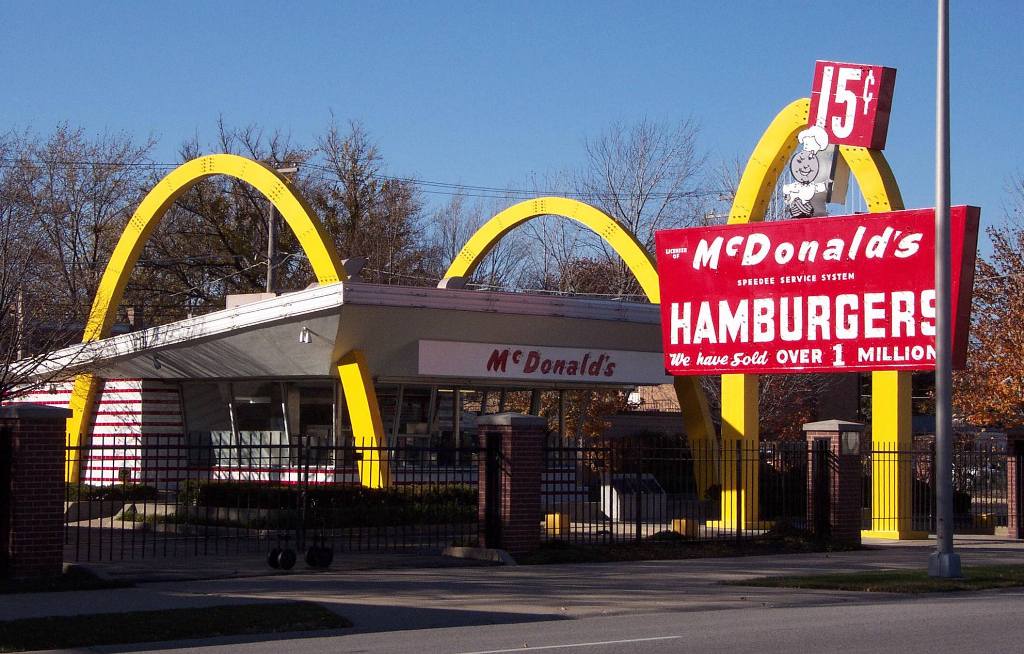
When Toman worked with the McDonald’s brothers prior to the days of Ray Kroc buying the business and taking it national, the single hamburger stand was producing inflation-adjusted sales of $3,000,000 with inflation-adjusted annual net profits of $850,000. This was achieved on a capital investment of only 1/3rd of the typical restaurant of the day.
Photo By Bruce Marlin Under Creative Commons Attribution-Share Alike 2.5 Generic
When something is plainly obvious, do something about it. By the mid-1950’s, McDonald’s single hamburger stand generated sales of $350,000, which is almost $3,000,000 today. It was producing net profits of $100,000 per year, which is almost $850,000 today.
Everyone who pays attention will be presented with a few good ideas in life. I told you about my own extended family, who watched first hand the rise of some of the greatest consumer stories in United States history, but never did a thing a about it. When you see something that is plainly in your sights, and you understand it, do something. Don’t just sit around passing the time. Life will go on without you. You will be left behind. And, unlike Walter White, who seems to blame others, you have only yourself to thank for the situation.
Be like Miller Gorrie. Avoid the sad fate of Ed Toman. If you are going to do the work, anyway, you may as well go for the richest reward.
Reader Comments (9)
Comments are presented chronologically, with replies indented beneath the comments to which they respond.
JSG
April 4, 2013
Josh I don't understand why Toman's fate was sad. He generated a half million in sales. There is no mention of his life being any worse off because of it. Did he suffer because of this? You even say that "he did very well". A lot of what you are saying is speculative. He could've had this. He could've done that...with all the millions that he should've had. Do we know that's what Toman even wanted? Some people don't want huge piles of money. Based solely on what you've said here you make Toman sound like a failure because he didn't capitalize as well as he could have. It's easy to look back and say that. To me it seems like he did great. He invented something that's still in use today and he got paid for work. We don't know what it was like to be in his shoes in those times, the people he was surrounded with or even Toman's personality.....so why is this a tragedy? Because he didn't become extremely rich and leave a huge legacy of money behind?
Joshua Kennon
April 5, 2013
Replying to JSG
The moral isn't that he was a failure (I don't consider him to be at all). The underlying lessons are:
1. A lot of things in life can result in 10x or 100x the outcome with only 1% more work. The difference between being successful, and changing your life forever, isn't always a Herculean task. I would argue that even if he, himself, had no interest in the excess money, he could have transferred the patent to a soup kitchen in his home town and used it to feed countless homeless families for decades. It would be like running a marathon and not finishing in the last ten feet. I want people to be aware of when situations like this arise so that they can make an informed decision.
2. The biggest costs in your life are most likely going to be opportunity costs, not explicit costs. To paraphrase several great business leaders, it is the things you didn't do that have the biggest influence on your scorecard (personal, business, financial, educational, charitable, experiential). It's the investments you don't make, the vacations you don't take, the people you don't meet that often hold you back far more than mistakes ever could. There are always exceptions, but as a general rule, it works.
weixiluo
April 5, 2013
Replying to Joshua Kennon
Truer words were never spoken.
Jacek Janiszewski
April 5, 2013
A pump that dispenses a set amount of sauce per individual squeeze is a trivial invention and shouldn't be patentable. In fact, every pump, unless it's broken, should, by design, dispense a consistent amount of liquid with each cycle. The "innovation" here was to adjust the parameters so that the output of a single cycle is to the customer's request - something smaller chains didn't really care about and would rather get a generic, cheaper device.
That's just good engineering and optimization. Patenting this kind of crap that's just a reworded description of the generic principle of action is wrong and the only thing it creates is wealth for patent lawyers, the sleazeball who first pushed it through the office and barriers to innovation. Just look at the smartphone industry. Half of it is _X_ BUT ON A MOBILE DEVICE!
Joshua Kennon
April 5, 2013
Replying to Jacek Janiszewski
The patent industry in the past 10 to 15 years has gotten out of control, in my personal opinion. Some of the fights between Apple, Samsung, and the other technology giants is beyond ridiculous - the idea of owning the concept of "rounded corners", for example. Perhaps Google's recent announcement that they are throwing their weight behind the movement to stop patent trolls will do something about it?
Jacek Janiszewski
April 5, 2013
Replying to Joshua Kennon
I don't think so. Companies can gain a lot by gaming and abusing the system. Google's movement here is not because of moral responsibility, you know this of course, but because they used to be a company run by geeks and didn't engage in those practices previously. This is why they're buying out companies with valuable patents like Motorola - not because they need expertise but as a deterrent in a sort of mutual destruction patent war.
Google at least has the resources to fight a patent war, but startups don't. Young startups are the prey of small patent trolls and the successful ones, rumors suggest, have been pressured into selling their IP or the whole company under threat of lawsuits by major corporations interested in their tech.
Either way the patent system, particularly in the US, favors big patent holders over small innovative startups and is pretty bad for the economy. Having an iphone in your hand and all the patent documents you wouldn't be able to replicate the tech on a commercial scale, not without a very significant investment. And even then the lack of experience would result in an inferior product - like chinese knockoffs.
I wonder if we just left the copyrights and abolished the patent system altogether, wouldn't that lead to growth in the economy?
TheLonelyHumanist
April 6, 2013
Replying to Jacek Janiszewski
I know almost nothing about intellectual property. I know that a patent only amounts to the right to try to sue someone for copying your work. For small startups there just isn't enough money to grow the business and fight court battles. Between watching family members in small startups and growing up during the RIAA-Metallica-Napster thing I am left with the impression that notions of intellectual property needed to evolve with the times.
Joe Pierson
April 5, 2013
I can think of a handful of opportunities that I passed by that ultimately would of made a lot of money, BUT I can think of 10x the number of opportunities that I passed on that ultimately failed, even though they looked great at the time. In both cases I couldn't figure it out, so I passed.
Joshua Kennon
April 5, 2013
Replying to Joe Pierson
"In both cases I couldn't figure it out, so I passed." - In my opinion, that is always the right answer. Never buy an asset you don't understand, nor sign a contract you can't explain to a six year old on an index card.