

The Valuation on Tiffany & Company Common Stock Continues to Perplex Me
I am working from the office today – the first time in nearly six weeks I’ve actually shown up since I’ve been in New York and before that preferred to work from my home study or from other locations – and happened to be going through the news stories when I see the big controversy regarding Newt Gingrich (which I think is ridiculous – I don’t want the man in the White House but this whole outrage over his line of credit at the jeweler is absurd). That, of course, led to me being me and I pulled the Tiffany & Company stock quote up as of the closing of The New York Stock Exchange this afternoon. The last time we bought any Tiffany & Company was when I had one of the operating businesses purchase a single share to be framed for the office wall years ago so I was curious.
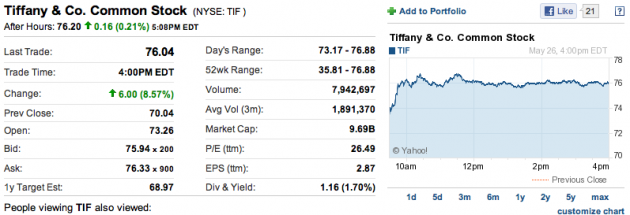
What are people thinking?! The company is currently trading at an earnings yield of 3.775%. If you were holding these shares through a brokerage account and the firm paid out all earnings as dividends, you would have to give up 15% to the IRS (let’s assume you live in a tax-free state like Texas), which would cut the earnings yield even further to 3.21%.
Don’t get me wrong – I love Tiffany & Company. It is a great business with huge brand equity. In fact, I am thinking about buying a set of sterling silver flatware as my Christmas-gift-to-self this year (the English King pattern, if you’re interested). But the government continues to run deficits that, at some point, are almost certainly going to have to lead to a long-term inflation rate comparable to that which we experienced between 1900 and 2000 (4% for those who aren’t versed in financial history). This would indicate that someone buying part ownership in Tiffany & Company today is getting a net look-through return of less than the rate of inflation, meaning all actual gain in intrinsic value is going to have to come from earnings growth.
 To earn a decent return – 7% to 10% – you have the believe earnings are going to increase at that rate for the foreseeable future. I understand a good deal of Tiffany’s earnings come from overseas, especially Japan, so there could be a play against a weakening United States dollar. Plus, management has proven particularly adept at managing tax law and international capitalization structures so I think they are doing a good job. But this seems like an incredibly optimistic price for a business more than a century old. You’d have to believe that it was going to become the dominant retailer in China and India, as well, to justify it.
I’m not saying it won’t happen. It might. I’m just pointing out that there is no margin for error at this price. The 10-year Treasury bond is yielding 3.06% right now, barely less than Tiffany & Company stock. That leaves no equity risk premium. My goal is to sleep well at night without worrying about money and this is not a price that would allow me to do that. How could someone commit to becoming an owner on these terms? I just don’t understand people sometimes.
(Theoretically, one could believe that earnings were going to double next year and then grow normally from there on out and the current valuation would be justified, too. There are a lot of ways to get there. I just think all of them require a lot to go right. If I were getting a sales pitch on the stock, I would want specifics as to how the earnings get from “A” to “B” over the next few years, especially in light of soaring inputs costs like gold and silver.) My biggest concern would be the following, as illustrated in a story published on Yahoo Finance after pointing out profits were up 25% for the quarter:
However, excluding the stronger yen, sales fell 3 percent. Still, that was better than Tiffany expected.
Revenue in stores open at least one year, a key industry metric, also fell 3 percent. Tiffany said all stores closed due to the earthquake have reopened.
The company expects, at best, $3.55 in per share earnings. That still only gets you to a 4.67% earnings yield, or 3.97% adjusted for the taxes that would be owed if all profits were distributed as dividends. Again, these folks are banking on significant earnings growth over the next 3-5 years. Short of the continuing destruction of the dollar, what is the catalyst? Where are those earnings originating?
Reader Comments (5)
Comments are presented chronologically, with replies indented beneath the comments to which they respond.
J. Daniel Wright
May 29, 2011
Joshua, I think I can be of some help here. At the Ira Sohn conference on Wednesday, Peter May of Trian Capital spoke about Tiffany & Co, where he sits on the board. One of the catalysts for the late-week appreciation may be the post-conference bounce. If you look at some of the other stocks touted at the conference (e.g. FDO, BPI, WBC, and XTXI) you'll see similar reactions.
May spoke about same store sales growth as well as new store openings in Europe and Asia. He also talked about new product lines, including a line of watches that they have begun to sell outside of their own stores. And a share buyback program combined with a rise in the dividend. I think he estimated 2012 per share earnings should be around $4.50 a share and a share price close to $100. His presentation was not even close to being the best presentation of the day, mostly because it seemed more self serving than all the others.
Joshua Kennon
May 29, 2011
Replying to J. Daniel Wright
That might explain it; thanks! I still have a hard time understanding how, even assuming his prediction is correct and earnings are $4.50 in 2012, a $100 share price could be justified. After backing out the taxes that would be owed if you controlled 100% of the business and took every penny of earnings out as a cash dividend, that would still only provide an earnings yield of 3.825%, which is less than I think inflation will run over the next decade. If he is going to be mathematically rational, he must believe earnings are going to continue to accelerate on a per share basis even from there. But stock repurchases can't have nearly as powerful effect when a company is buying back its own shares at a high valuation multiple. One of the reasons AutoZone was so successful for so many years, growing from $25 per share to nearly $300 per share, was because management very rarely paid more than 10x to 12x earnings and they were incredibly opportunistic, only buying back stock when they thought it was undervalued.
That type of valuation for TIF is banking on someone else paying more down the road, not depending upon the underlying earnings power of the business in case the stock falls 50%. If I bought Tiffany & Company at $100 per share with $4.50 in earnings and it fell 40% to $60, that is very likely "permanent capital impairment" because $60 is a much more rational valuation. The only way I can see it still being a bargain at that price is if it takes over China and India and those two nations continue to expand their middle and upper classes.
I look at life on an opportunity cost basis. If I had no assets and were responsible for managing at $1,000,000 partnership for friends and family, the best earnings-supported profit I can get from Tiffany & Company in 2012 after adjusting for taxes would be $38,250. In comparison, I could buy shares of Johnson & Johnson, which would provide almost $71,500 by that same date. Even better, I could study one of the suburbs around Kansas City, build a few townhouses, use $500,000 in debt (for a 2-1 equity-to-debt capitalization structure) and probably earn at least $110,000 after taxes with adjustments (depreciation would be incredibly high in the first year but cash would greatly exceed reported earnings so you'd need to factor in those types of differences due to the underlying asset and the accounting / tax implications of owning it).
And those are simple, easy things that wouldn't require much time. It's almost as if people want to overpay for companies because their adrenaline gets pumping, causing them to act like they are hunting buffalo on the plains.
Alex Lee
June 7, 2011
This morning on CNBC, they mentioned a rumor on someone (name escapes me at the moment) thinking of buying TIF for 130 dollars a share. Thoughts?
Joshua Kennon
June 7, 2011
Replying to Alex Lee
The same thing I thought when Cisco systems traded at 150x earnings, or a 0.66% earnings yield (a 0.56% earnings yield adjusted for dividend taxes if all earnings were paid out), back in the late 1990's: Morons.
That price ($130 per share for Tiffany & Company) would represent nearly 37x forward earnings, or a 2.3% earnings yield adjusted for dividend taxes if all profits were distributed. It would take a lot to go right just to earn 10% compounded on capital at that price level, which you can almost get right now from shares of Wal-Mart, Target, Microsoft, or Cisco Systems since the valuations are so low relative to profits.
People forget that $1 of earnings is $1 earnings. It doesn't matter if you made it from hot dogs or software, it spends the same. I just want to collect the most earnings so I can redeploy the cash, spend it on upgrading my lifestyle, or give more money to my foundation. That's my entire philosophy.
Andrew
July 5, 2013
This was an incredible article on providing a quick cost evaluation for stocks! I never thought "if all earnings were paid out as Dividends" ... but that is an awesome new perspective to consider things from. So today Tiffany's is $73.44 with 3.27 EPS. If I'm doing the math right, that's a 4.4% yield. After taxes, 3.8%, so still below the historic rate of inflation while trading at a 22.48 P/E. So in the last 2 years, earnings have gone up and the stock price has gone down - but it still looks too expensive. Especially compared to IBM which is yielding 6.3% after taxes or Shell which is yielding 10.72%. Cool!