

We Are Living in the Midst of One of the Biggest Bond Bubbles in History
Today, I was sitting at the dining room table, drinking a cup of coffee wearing the Brooks Brothers pajamas I picked up on my birthday a few days ago, and watching the stock market skyrocket when it occurred to me that, given the project we are working on right now and some other things going on at the business, I want to build some cash and bond reserves at one of the individual operating companies; maybe put aside money a little at a time, let it build and do something fun with it three or four years from now, like design and build a row of townhouses or whatever.
 Honestly, I can’t explain it but it was a strong enough inclination that I called Aaron and had a conversation detailing my thought process and, a few minutes later, was on the phone selling off some Berkshire Hathaway, Campbell Soup Company, shares of a sugar refinery, and stock options that were held in the account of this particular business. Then, I set out to find a place to park the money. I wanted to take very little risk with the capital, avoid interest rate sensitivity (so virtually no bond duration), and high liquidity.
It took about three seconds to realize that interest rates really are effectively zero. Obviously I knew this. But I don’t think I truly grasped it since I’m a long way away from my fixed income days given how relatively young I am.
There is no way, short of massive deflation (which I think is unlikely) that bond prices aren’t going to suffer on a real inflation-adjusted net-of-tax basis at some point in the future because interest rates must rise (meaning bond values must fall) if there is even a modicum of inflation. It is just a function of the bond valuation model. There is no margin of safety built into the system at all at current levels, which means someone holding Treasury bonds, municipal bonds or corporate bonds with 20+ year maturities is going to get hit hard, perhaps experiencing double-digit drops in the market price of the bond. The real net purchasing power declines will be even more painful. The only exception would be a bond such as a savings bond, which can be sold back at par value any time the investor desires.
Ultimately, I bought a series of brokered certificates of deposit from an FDIC insured bank in the South that had a Tier 1 capital ratio of somewhere north of 33% (in the banking world, a Tier 1 of 8% or 9% is considered strong so this is Fort Knox-like). I figured until I knew exactly what I wanted to do, I’d tie the money up in a laddered maturity system with rolling maturities coming due every 30 days for the next few months.
A Look at Actual Bond Yields on the Market Today
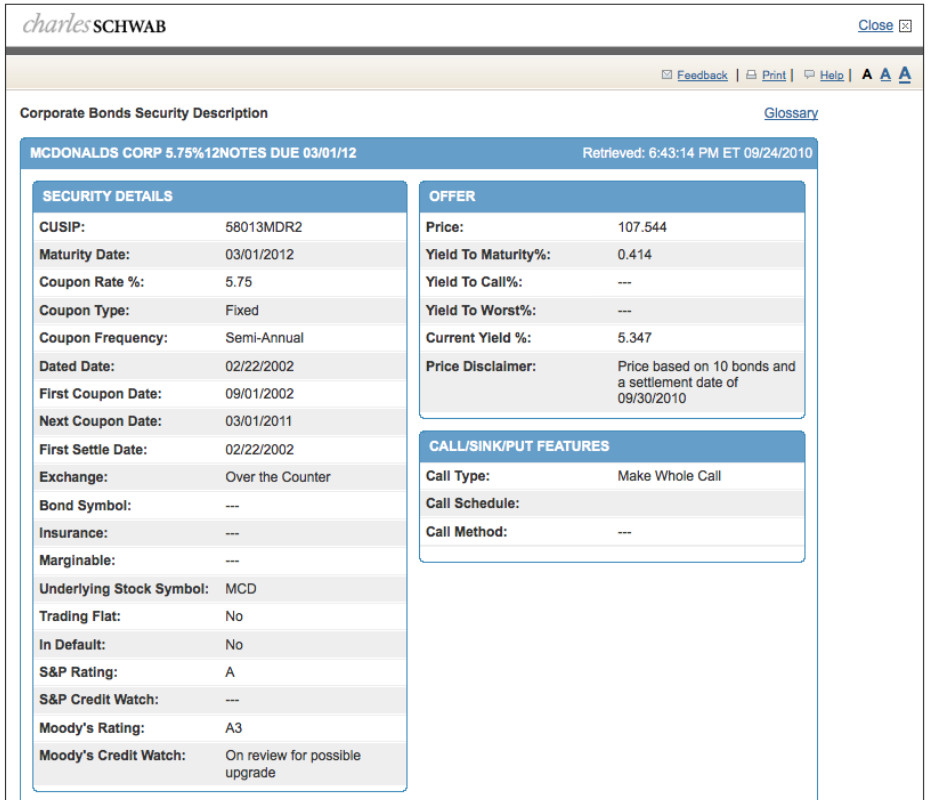
Here is one of the bond issues I considered today – McDonald’s Corporation 5.75% notes that mature in March 2012. The bonds had a face value of $1,000 and paid $57.50 in interest to the bond holder each year, divided semi-annually (so $28.75 every six months). To explain the bond valuation, I will run a scenario where we purchased ten bonds with a face value of $10,000.
The bonds mature in March of 2012, or roughly 17 months away. The last interest payment was made on September 1st so you have three payments of $28.75 per bond remaining remaining, or $287.50 for ten bonds. That is, you will receive the following interest income from the bonds:
- March 2011 = $28.75 interest income x 10 bonds = $287.50
- September 2011 = $28.75 interest income x 10 bonds = $287.50
- March 2012 = $28.75 interest income x 10 bonds = $287.50
- plus bond maturity = $1,000 for the par value of the bond, which is returned to you. The bond then ceases to exist. That means you’ll get the entire $10,000 back on this date.
Put simply, if you buy the ten McDonald’s corporate bonds today, your scheduled cash flows consist of $862.50 in interest income plus $10,000 returned to you for the par value of the bond 17 months from now. Your total cash flow generated will be $10,862.50 over that period.
The Bonds Don’t Trade at Par Value
When the McDonald’s bonds were issued in 2002, they were originally issued at $1,000 each and yielded 5.75%, or $57.50 every year. In the years since, interest rates have fallen. Investors saw the rich yield McDonald’s offered and bought the bonds, driving the price higher. As the price increased, the yield fell until it finally reached a level that was approximately the same as other corporate bonds issued today.
As a result, it would now cost you $10,800.72 to buy the ten McDonald’s bonds, not an even $10,000 (10 bonds x $1,000 each). Here is a look at the proposal sheet from one of the brokers:

In other words, you are going to buy the bonds today for $10,800.72 and then cash them in for $10,000 in 18 months. That is a loss of $800.72 on the par value of the bonds.
At the same time, you are scheduled to collect $862.50 in interest income during that time period. If you offset the interest income with the scheduled capital loss on the bonds, you are left with an estimated pre-tax profit of $61.78 [$862.50 interest income – $800.72 capital loss on par value of bond = $61.78].
What Is Your Yield to Maturity, or Compound Annual Growth Rate if You Buy the Bonds?
How much does that work out to on a compounded annual growth rate basis? What is your APY? That is easy. First you calculate your total gain:
$61.78 pre-tax gain ÷ $10,800.72 cost basis = 0.00572, which is 0.572%
Next, you raise the total gain to the X-Root, which is the total compounding period divided into 1. We were compounding for roughly 17 months, or 1.5833 years so we take 1 ÷ 1.5833 years = 0.63159. We can raise our total gain to this power to calculate our annual percentage yield.
(1+.00572) ^ 0.63159 = 1.0036088.
We drop the 1, and get 0.0036, which is the equivalent to 0.36% compounded
You can even check your math using the FV of a single sum formula:
PV(1+i)^n
$10,800.72 investment(1.0036)^1.588 years
= $10,800.72(1.005722847673468)
= $10,862.53
(Note, the 3 cent difference from the actual future value of the bond, $10,862.50, is due to rounding)
In other words, for tying up your money in McDonald’s corporate bonds today, you can expect to earn an APY of 0.36% on your money. That works out to a whopping $61.78 for every 10 bonds you buy. This factors in all the purchasing costs, so it is the “real” yield to maturity for the bonds, not the 0.414% that the broker shows.
Money Costs Nothing Now
This leads to the point that for all intents and purposes, from a macroeconomic point of view, I am convinced that money has reached an effective cost of zero. The problem is, not everyone can access money because no rational investor is willing to loan it out for 30 years. In fact, the 30 year bond rates are anemic at only 4% to 7% depending upon the issuer.
Only huge companies such as many of the blue chip enterprises that make up the Dow Jones Industrial Average and/or S&P 500 components can take advantage of the situation with one notable exception – real estate mortgages. Someone who is financially strong and can afford the risk of further declines in the market, in theory, could lock in 30-year rates on mortgages to build, develop and / or acquire properties such as apartment buildings and hotels. This would give them a massive funding advantage if and when rates rose down the line.
The other side of the coin, though, is that someone who has a high bond duration, or high interest rate sensitivity, is going to get royally screwed. I mean, devastating, horrific losses. If you own nothing but bonds that mature 20, 25, or 30+ years from now, when interest rates rise, you are going to get your financial ass(ets) handed to you on a platter because the bonds must, in a rational market, fall far enough below par to result in the yield-to-maturity matching other fixed income investments of comparable credit and liquidity quality.
Explaining the reasons, though, would make this article too long so I’ll write a new one focusing on the potential dangers of long-maturities in a bond portfolio at some point in the future.
Reader Comments (11)
Comments are presented chronologically, with replies indented beneath the comments to which they respond.
timmerjames
September 25, 2010
Hi Joshua,
Do you have any thoughts on the Vanguard High Yield fund (VWEHX)? Just started putting money into it but it's money I'm not looking to use for 20 years. The average maturity of the bond portfolio is about 6.5 years and they seem more conservative than most high yield funds. I'm 39 now and I'm hoping by the time I'm 60 it'll be a resource for income since I won't have a pension. Do you think the fund is going to get killed as interest rates rise or do you think their average maturity will allow them to adjust?
Thanks,
James
Joshua Kennon
September 27, 2010
Replying to timmerjames
James,
This question deals with bond duration, which will require a few days for me to answer. It's a complicated subject and I want to do it justice. I'll get back to you on the concept.
Joshua Kennon
October 8, 2010
Replying to timmerjames
James,
I just responded to your question about bond duration:
http://www.joshuakennon.com/bond-duration-and-your-bond-portfolio/
You can read the article here.
Frat Man
September 27, 2010
I never understood why someone would choose corporate bonds over stocks (unless the interest spread is noticeably greater than the dividend), and I don't think I ever will. Why would anyone buy a Johnson & Johnson bond yielding 1% over the stock yielding 3.5%? I know bondholders are in line ahead of common stockholders, but it seems to me companies do one of three things: (a) grow (b) stagnate (c) go down in a blaze of glory that wipes everyone out, and you get just about nothing in bankruptcy proceedings. I've always believed buying corporate bonds over stock meant you took-on essentially the same risk, but limited your upside. Am I failing to consider anything? Is there a reason to ever buy a corporate bond that is yielding less than a series I bond?
timmerjames
September 27, 2010
Frat Man - For a retail investor you are probably correct. I would venture to say that the people that are purchasing the high quality corporate bonds today are certain institutions and insurance companies that are forbidden by their charters to buy equities.
James
Thanks Joshua for taking a look at my comment.
peterpatch
January 16, 2011
Joshua,
In your article you wrote "interest rates must fall if there is even a modicum of inflation". I don't understand what you mean here, I thought that lowering interest rates causes more inflation by encouraging looser lending and discouraging saving. Can you please explain your thinking on this?
Also I checked out the pricing supplement (http://google.brand.edgar-online.com/EFX_dll/EDGARpro.dll?FetchFilingHtmlSection1?SectionID=1771871-936-9920&SessionID=Cx2VHv6UTlKsQP7) for this particular bond and part of the bonds terms are that the issuer can force redemption at the greater of
"(1) 100% of the principal amount of the Notes, or
(2) as determined by the Independent Investment Banker, the sum of the present values of the remaining scheduled payments of principal and interest on the Notes (not including any portion of the payments of interest accrued as of the date of redemption) discounted to the redemption date on a semi-annual basis (assuming a 360-day year consisting of twelve 30-day months) at the Treasury Rate, plus 15 basis points;
plus, in each case, accrued interest thereon to the date of redemption."
I have been reading The Intelligent Investor, I am about half way though, and Graham mentions how the call provisions on bonds can cause "a serious but little noticed injustice to the investor". He goes on to give examples of how corporations have used redemption terms that are biased in their favour to force the redemption of bonds at prices far less then those trading in the market. This bond is trading above par so how would you mitigate the risk of being dealt a "serious injustice" if MacDonald's called the bonds at a price favourable to them?
Thanks,
Mike
peterpatch
January 16, 2011
Replying to peterpatch
Joshua,
After ruminating on this one a little and doing a little more research I assume your answer to the second question I posed will be that the redemption risk is mitigated somewhat by the low/non existent cost of money which cannot go any lower thus holding a fairly effective stopper on further price increase/ interest rate decrease situations. Also bonds with a short duration typically trade at close to par and will trade closer and closer to par as the maturity date gets closer, this is almost a mathematical certainty on bonds because of the smaller swings in present value inherent in near term coupon payments vs. coupon payments further in the future. Therefore MacDonald's probably won't redeem the bonds because it won't be in their best interest to do so.
I would still be interested in knowing your thoughts on the interest rate/inflation question I asked.
I really appreciate your time, I have looked over your site and have been reading all the articles etc and I know you are busy and that the financial opportunity costs of doing this blog for you are probably very high.
Thanks Again,
Mike
Joshua Kennon
January 25, 2011
Replying to peterpatch
Mike,
Very smart man. It was a transcription error. The original essay I wrote had the phrase, "interest rates must rise (meaning bond values must fall) if there is even a modicum of inflation" but not all of the text got pasted in correctly. Thank you for catching that. I just made sure it was fixed.
Your second follow-up analysis was correct, though. It shows you are looking at the underlying reason things happen to securities values, which means you should have much better success than those who simply try to divine from the stars whether stocks or bonds will be higher at some indiscriminate date in the future. I enjoyed your thought process a lot.
Stick around and comment in the future. Anyone dedicated enough to pull up the pricing supplement is someone I want on the site! =)
Andrew
July 5, 2013
Amazing! It's been 3 years and only now are we starting to see interest rates rise.
Joshua Kennon
July 5, 2013
Replying to Andrew
Even though I've avoided bonds entirely due to the overvaluation, my hope is that the Federal Reserve can manage to keep interest rates in check long enough to let them rise slowly. If that happens, many small investors will be fine because they own bond funds or individual bonds with average durations of 8 years or less. In such a scenario, the maturities would act as a strong enough force to keep the capital losses to a minimum until the day when the principal is returned in full. It's possible that the bond bubble could be deflated without the average main street investor even realizing how much danger he was in at the time. I think that is the best case outcome, and the one I'm rooting for personally.
Andrew
September 25, 2013
Replying to Joshua Kennon
May I how you invest your 2-5 year cash positions?