
February 10, 2012

People Who Are Drowning in Student Loan Debt

Victims of the Student Loan Industry or Irresponsible Borrowers?

I was reading a site called Student Loan Justice as well as a piece at the Huffington Post where people are talking about their “overwhelming” student loan debt that is – wait for it – $15,000 or $30,000.  Basically, less than the value of a car.  Or a couple both of whom smoke a pack of cigarettes each day for five to ten years. Or 4 to 8 months of pre-tax income for the average American household.

Rational, full-grown legal adults who have the power to vote actually made a decision to borrow money, pay interest for the cost of “renting” that money, and then when it’s time to repay, want the government (read: everyone else, including you and me) to pony up the money because it’s cutting into their standard of living.  One guy on the site, not that long out of college, complains that he has a $1,250 per month payment and can’t live in New York City.  Then get the hell out of one of the most expensive cities in the world! I read a study a few weeks ago that showed New York was the single most difficult metropolitan area for a new college graduate to build wealth.  If you choose to take on a situation where the odds are against you, don’t complain when you don’t win.  Choosing your battles is the first and most important part of coming out ahead in life, just as it is in war or any other undertaking.

Maybe I’m not sympathetic because, as you know, both Aaron and I, as well as most of our friends, were first-generation college students that had to pay our own way through school (complete with a $140,000 price tag for each of us over four years).

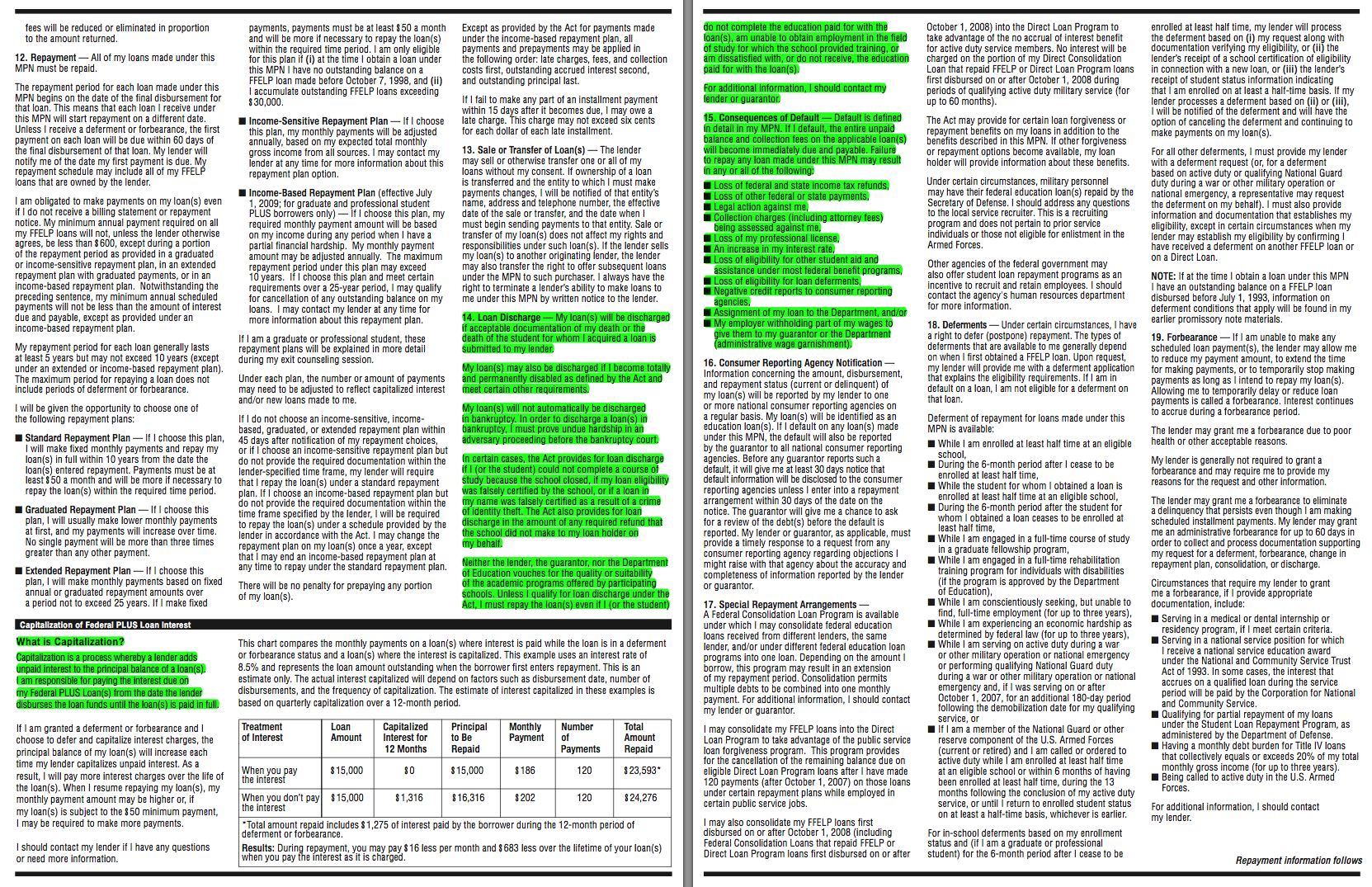
Sallie Mae Master Promissory Note

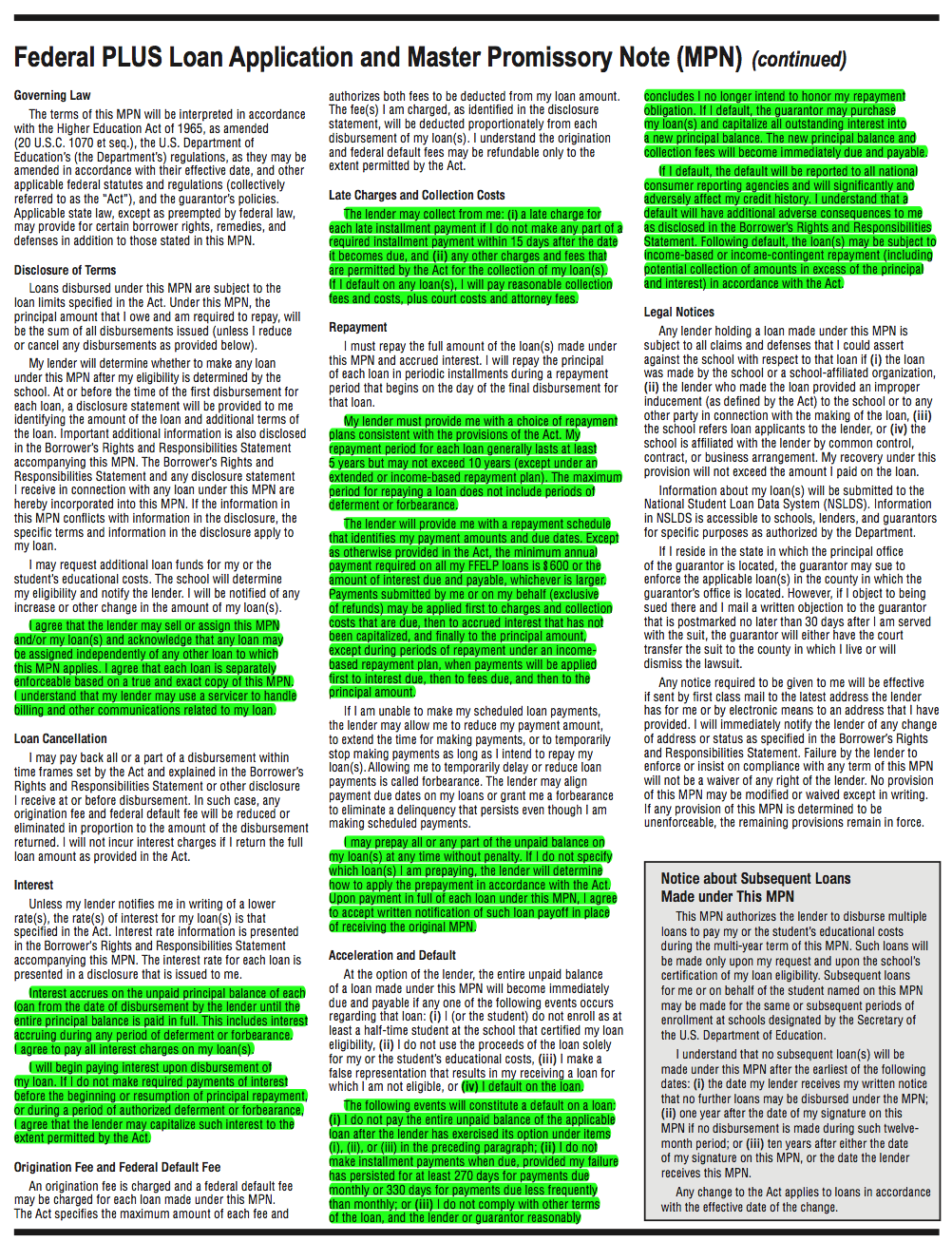
The master promissory note from a typical Sallie Mae loan is ONLY TWO PAGES! I went through it and highlighted the sections that clearly spell out all of these "predatory" policies that "cheat" people out of their money. It's clear, in black and white, exactly what will happen if you don't make your payments. I'm sorry, but if you're too freakin' lazy to read two pages and you sign your name to the document without understanding it, how can anyone feel sorry for you (unless you had health problems because then you get a pass because you didn't do anything wrong)? You agreed to the terms and it explicitly explains how it will happen. You can click the image for the full-screen, highlighted version of the Sallie Mae Master Promissory Note. If you don't pay the balance, and interest is capitalized (added to the principal) so that you start to pay interest on interest, of course the balance can go from $25,000 to $300,000 over 20 years, just like an investment account can compound. It even says in plain English that they will apply any payments to the interest and penalties first before paying down your balance. If you didn't like those terms, WHY DID YOU TAKE THE MONEY?!
I was able to cover at least half of the cost with a vocal performance scholarship in classical music, as was Aaron (which took years of practice and study).  But before I signed a single loan document, you better believe I had read through all of the fine print so I understood the terms, conditions, and pitfalls.  Even so, we were all incredibly frugal.  You all saw the picture of the 1993 Ford Escort Aaron drove with 150,000+ miles long after we had started our first company and he was financially self-sufficient. I mean, he didn’t have heat or air conditioning and drove it during Midwestern winters with ice and -20 degree windchill and summers at more than 100 degrees even though he could have written a check for a new car, while a lot of people we knew bought new cars on credit despite not having any savings or investments.  (I’m going to offer the usual disclaimer here: People who develop health problems get a clean pass because if you are hit with something really bad, it can hurt your finances badly and at that point, staying alive and healthy is more important than you credit score.)


I guess I just don’t understand the mindset that if a full grown man or woman agrees to take something (money) in exchange for something else (the interest rate), why they think they shouldn’t have to live up to the deal to which they agreed.  Now, if the contract were breached, not paying may be a rational form of protest.  In the case of a company insisting on money to which it isn’t entitled, many sane, responsible people wouldn’t cut the check.  But these people acknowledge that they borrowed the money, that they agreed to a contract they didn’t understand, now expect someone to fix it for them.  It seems like they want their cake without the calories (maybe I’m wrong).  They want to have two cars, a decent house, nice clothes, a couple of cell phones, and an X-Box, and they think it’s the bank’s problem they can’t have that because of their student loan payment to which they agreed! Why should anyone else be responsible for managing your life?

Student Loan Debt information

I have a hard time understanding how someone can spend $20,000 to $30,000 on a car but then complain about the same amount of student loan debt given the advantages of a degree. Image © Jupiterimages/Comstock/Thinkstock

In the interest of fairness, I should point out that the student loan debt market is a complete scam because Congress made private student loans virtually non-dischargable in bankruptcy a few years ago, which is utterly and completely indefensible.  Why should one type of loan be protected from market forces?  Sure, costs would rise if defaults could occur, but the pricing mechanism would reflect true economic reality and you wouldn’t get people locked into what become lifetime handcuffs engraved with the words “Sallie Mae” or “Citibank” on them.  However, every student was warned about this before they borrowed the money.


Full Disclosure Sallie Mae Master Promissory Note for Student Loan Debt

Even if you didn't understand the master promissory note, the loan applications have to include a section called "Borrower's Rights and Responsibilities". This spells out exactly what will happen to you, explains what interest capitalization is, explains that they will take your tax refunds, garnish your wages, ruin your credit, and that you can't declare bankruptcy on the balance. This document, which every student has to receive, is only a few pages, as well. None of this should come as a surprise to anyone who borrowed money for college student loans. If it does, you probably shouldn't have gone to college in the first place. (I don't mean that to be inflammatory - I'm being serious.)

The Interest Expense Isn’t That Big of a Deal if You Structure Your Student Loan Debt Correctly

Even with my student loans locked in on long-term, fixed-rate programs, I used a technique I learned from reading Peter Lynch back in elementary school when I used to hide his books behind my textbook in class.  I forgot what he called it I always referred to it as a “dividend trust account” because that concept made the most sense to me; it basically involves setting us a self-paid trust fund.  Here’s how it works.

One of my student loans is a consolidated $26,019.36 private note, guaranteed by the New Jersey Higher Education Student Assistance Authority, with a 4.25% tax-deductible fixed rate.  The loan will be paid off over the next 211 months, or 17.58 years.  By the end of that period, the total amount paid will be nearly $40,000.

The 4.25% is tax-deductible for most households, meaning that the after tax cost is roughly 2.77% (the student loan tax-deduction phases out after a certain income level but for most people, this won’t apply so we are going to factor the tax deduction it into the math since it would be available for most people).  Inflation is going to run much higher than the historical 3% it has for the past couple of decades due to the massive government budgetary and trade deficits.  Nevertheless, let’s presume that inflation does remain low at 3%.  With inflation running at 3%, I’m effectively being paid in real “wealth” 1.48% per year to not pay the debt off early.  If I could invest this money at, say, 7% per annum on an after-tax and inflation basis, I would effectively be growing 8.48% richer on the $26,019.36 balance each year in real purchasing power.  The family’s collection of businesses earns a much higher rate of return than this, so the numbers are even more impressive.  I would have to be an idiot to pay off the balance.

So, on my 30th birthday, I am going to establish what I am calling the University Dividend Trust.  I am going to contribute $30,000 in cash to the account and sign a margin borrowing agreement (you’ll see why in a moment).  I will divide the money into three piles, putting $12,500 into a basket of high quality, hand selected blue chip stocks that pay dividend yields of 4.25% or higher, another $12,500 into high quality bonds or other fixed-income-like securities, such as preferred stocks, and the final $5,000 into real estate investment trusts and publicly traded limited partnerships, both of which traditionally feature extremely high cash dividend yields.  My weighted average targeted yield will be 6% per annum on the $30,000 balance, resulting in $1,800 annual cash income for the account plus any changes in the market value of the holdings.

Each month, I will have the fixed-rate consolidated loan auto-debit the payment from this specialty brokerage account.  Otherwise, there will be no transactions.  Each month, if there isn’t enough cash in the account, the difference will simply be covered by an immediately-created small margin loan, held against the account balance.  For instance, if the account had $30,000 in investments in it the first month and no cash, a $189.38 payment would still be covered and the account statement would show $30,000 in assets and $189.38 in margin debt, which results in a bit of interest expense the brokerage account.  As regular dividends and interest are earned in the account, however, they are immediately applied to this debt, wiping out the balance.

dividend checks

At some point, the value of the dividends earned on the dividend trust will exceed the amount withdrawn from the account for debt repayments. Over time, the account value should begin to expand as the dividends go to buy more dividend paying stocks (which pay - you guessed it - more dividends so the cycle can repeat). This is not rocket science. And for those who say they can't afford the $30,000 - my younger sister made more than that in a year waiting tables at Perkins, working from 5 p.m. to 2 a.m. several nights a week! She was in HIGH SCHOOL, a full-time cheerleading captain, and still managed to get decent grades.

Each year, the absolute value of the dividends increase as companies raise prices to keep pace with inflation.  Even if the dividends didn’t increase in real, inflation-adjusted terms, I’d still end up being richer because the debt to is fixed-rate.  That means I can use more absolute dollars to pay a debt that isn’t increasing with inflation. If you don’t understand that concept, let me simplify it.  Let’s imagine that the entire University Dividend Trust brokerage account consisted of shares of Johnson & Johnson yielding 4%.  In the first year, I’d collect $1,200 in cash dividends and roughly $2,272.56 would be taken out of the account, meaning the balance would decrease by $1,072.56 on December 31st if the stock price stayed the same ($2,272.56 withdrawals for student loans – $1,200 cash dividends = $1,072.56 total decrease in account value).  So, I’d have a margin debt of $1,072.56.  Now, the only way I’d get a margin call is if Johnson & Johnson’s share price collapsed by 92.67%!  Spread out across a diversified basket of stocks, this shouldn’t be a concern because if the entire United States stock market loses more than 92% of its value, we have bigger problems than student loan values; people are starving in the streets and there are probably riots.


Anyway, if inflation increases by 3%, it’s likely that Johnson & Johnson will increase prices by 3% and the dividend by 3% as well.  There will also likely be some real growth, say, 2%.  That means that the dividend grows by 5%, even though only 2% represents additional purchasing power because prices have increase for everything from milk to car tires.  That means that next year, though, the account will generate $1,1260 in cash dividends.  The payment on the Sallie Mae debt is still the same.  There is a spread differential that is opening up – the dividend income keeps increasing, even though it’s not all real purchasing power increases – but the debt payment stays the same because it’s fixed rate.  Thus, I’d make money off inflation.

To see this, let’s use an extreme example.  Say that inflation was 100% overnight.  Thus, the price of everything doubled.  The dollar menu at McDonald’s was now the two dollar menu.  A $10 movie ticket cost $20.  The dividend at Johnson & Johnson would go from $1,200 in year one to $2,400 the next year.  Obviously, I’m not richer because it now takes $2,400 to buy the same amount of stuff that $1,200 bought only a year before but – and here’s the kicker - my debt is in fixed-rate terms. That means that the account would earn $2,400 in dividends and still have the same $2,272.56 payments for Sallie Mae.  There would actually be more cash in the account at the end of the year because the dividend income would exceed the debt outflow ($2,400 dividend income – $2,272.56 Sallie Mae payment = $127.44 surplus).  That surplus can be reinvested and start earning dividends and interest.

The result is that over time, through growth in the underlying value of the investments, the dividends distributed to owners, and the nature of fixed-rate debt, the account will “switch” somewhere between 7 and 10 years out in the future so that the outflows are less than the in-flows.  By the end of the 17.58 years, when the $40,000 has been repaid on the $26,019.36 debt, the account will have at least $70,000 and be generating a few thousand dollars a year in cash income.  I can then liquidate the University Dividend Trust, or continue to hold it and take the dividend distributions to buy televisions, or buy clothes each year.

The point is, it is possible to make money off the stupidity of the Federal Government’s fiscal policies.  If the Congress is going to wreck the country’s balance sheet, our first duty is to try and stop it.  If we can’t, we may as well position ourselves to make money off it.  This is one of the reasons I used a fixed-rate mortgage to purchase my primary residence despite my general dislike of debt. With a 5% fixed (5.5% APY) tax-deductible 30-year loan, I am willing to bet that most of the cost will be borne by the nation thanks to the Federal Reserve printing money.  Thus, my money is better spent growing my businesses and investments, rather than reducing debt.  Given that I don’t use debt for consumer purchases, and I avoid it for the most part overall, this doesn’t represent a threat relative to assets, cash flow, and income.

The flip side of the Janus coin is that if I had variable rate debt that was currently low and affordable, I’d be working as quickly as possible to pay it off or convert it to fixed-rate debt because you’re going to get hurt badly when rates skyrocket.  I mean, I’d be putting in double-duty overtime to wipe out the balance.

Related posts:

  1. Is It A Good Idea to Take Out a Home Equity Loan to Pay Off Credit Card Debt?
  2. Understanding Credit Card Debt and Negative Amortization
  3. Credit Card Debt Advice
  4. Credit Card Debt Is Poison
  5. Even I Am Not Always Perfectly Rational When It Comes to Money … I Paid Off a Nearly Free Car Loan This Morning
  6. Virgin Money Social Lending – a New Revolution in the Debt Markets
  7. Credit Card Debt Declines for the 25th Straight Month
  8. 14,182 People Out of 14,250 Couldn’t Answer 6 Questions About Financial Literacy
  9. Credit Card Debt Isn’t a Problem for Most Americans
  10. The Real National Debt Figures

  • http://ianfrancis.wordpress.org Ian Francis

    While the blame could probably be divided between the creditor and the borrower, most of it has to lie on the shoulders of the borrower. The creditors certainly go out of their way to make it seem like free money, but the borrower has to be smarter than that. The creditors are relying on the borrowers to ignore the small print so that they don’t weigh all their options before applying for a loan. That, however, doesn’t mean it is their fault. The borrower has the responsibility to read what they are getting into before they do.

    Additionally, there seems to be this sense of entitlement that is ingrained within our society. It is certainly justified if you work hard for what you have, but I get the impression that many people are thinking in the back of their minds that credit cards and loans are deserved simply on the basis of existing. The idea of actually having to pay back that money and follow the rules that they signed is insulting to their personal image. I think this is the most serious problem with people defaulting on loans.

    That being said, most 18 year-olds are not rational, nor are they adults mentally. There is a common argument that if a person has the right to smoke, vote, and die for our country, they should be able to drink. I agree completely. The only difference in my argument is that I feel the age of majority should be raised to 20 or 21. the idea that a person is ready to be a full member of society at 18 is outdated and based on an agrarian economy. Today’s society requires some type of education in addition to high school to be successful. It seems logical to me that raising the age of majority to 20 would make it easier for teenagers to get some sort of technical education while allowing for their immature brains to grow. By 20, if an adult wants to be reckless with student loans without a cosigner, I have much less sympathy. At 20, with 15 years of education, the idea of interest and living within your means should hopefully be well ingrained in their minds. If not, then we are all doomed. People have never failed to surprise me with their stupidity before, however.

  • Marvin Lee

    I see great insight in this blog. I believe in investment and saving money to decrease the use of debt. Of course, I’m a first generation college student in my family, so I had no choice but to take out loans due to immigrant parents.

    Many families that have money don’t have enough to help their college-age kids. Why? Retirement funds are the forte for anyone after emergency savings has been built. There are no scholarships for retirement. Hence, many students are forced to borrow money and work on the side. The other reason is that most parents are middle-aged (ever so close to retirement) by the time their first child attends college. I believe marriage is fine when both parties are ready. Also, a late marriage is a plus too if done correctly because both spouses will marry without excess baggage (debt). That means money is available to save money for emergencies, college funds for kids, retirement and other goals.

    Even for a college graduate without that dream job, a part-time job is not enough to cover expenses during college. Scholarships and grants helped me out. I even earned money writing for the school newspaper. However, all that free money and hard work were not enough to cover the rest. Hence, loans are a reality for many.

    I like the idea of a dividend portfolio. However, the main problem with the global recession is the cutback on dividends by companies. Banks realized that paying high dividends were the main reason why they didn’t have the money when the economic crunch came. It is smarter for companies to reinvest investor’s money so that it grows. Otherwise, what’s the whole point of investing in a company? So you can receive money from its profits. Nonsense, the money is for the company to grow and operate for years to come. Plus, a shareholder does not grab too much of the profit pie unless you have at least 10% ownership (you need a lot of money to reach this level). If you want a huge profit earning ratio, it’s better to be an all-right owner without executive and/or managerial duties of a company. In other words, it makes more sense to be a founder of a company and grow it to a size worthy of a place in the stock market with a management firm so you don’t have to be a part of it anymore.

    This blog is great, but it can be improved by fusing it with other personal financial topics such as how to build wealth while tackling debt, establishing an emergency fund, save for retirement, buy insurance policies and meet day-to-day needs. In other words, the bigger picture scenario is more effective and helpful to others in the same boat.

    On a good note, I expect more interesting topics from your blog.

  • Landon Jacobsen

    Sorry this question is so long after you wrote this post, but it’s an easy one! How did you come up with the amount $30,000? Is that an arbitrary number or the result of a calculation?

    • http://www.joshuakennon.com Joshua Kennon

      Landon,

      The site I referenced had stories from people who said they were drowning under their debt load. A lot of the posts were talking about how they just couldn’t handle $15,000 in debt. Some were about $30,000. Those seemed to be the range I came across the most back when I read it (It’s been awhile so the site could have changed by now) so I stuck with it. I also know the average student loan debt is roughly $21,000 so that range fit within the typical experience.

      Joshua

      • http://www.joshuakennon.com Joshua Kennon

        P.S.: The actual number as of 2010:

        Two-thirds (65.6%) of 4-year undergraduate students graduated with a Bachelor’s degree and some debt in 2007-08, and the average student loan debt among graduating seniors was $23,186 (excluding PLUS Loans but including Stafford, Perkins, state, college and private loans).

  • Landon Jacobsen

    Joshua,

    I’m sorry, I guess I wasn’t clear in my question. The $30,000 I was referring to was the amount that you will contribute to your so called “University Trust Fund.” Sorry for the confusion.

    Landon

  • http://www.joshuakennon.com Joshua Kennon

    Ah, right. Because the loan itself was $26,019.36 and I didn’t want to go to the trouble of making a deposit for that bizarre amount so I’d rather just round up and say $30,000.

    I could have just as easily created a perfectly offsetting trust of $26,019.36.

    In terms of specific math:

    It is going to come down to an interplay between the dividend yield and the effective debt yield on your debt. Ideally, you’d want the two figures to be identical but that isn’t going to happen in most cases.

    Say you had $35,000 in student loans and your interest rate was a fixed 8.5%. That means you are paying $2,975 in interest annually.

    If you could earn 4% in dividend yield from a widely diversified collection of low-risk blue chip stocks that were stable enough it wouldn’t matter to you if they fell 50% or went up 50% (you are interested in the dividend payout), you would take:

    $2,975 divided by 0.04 = $74,375. So, in this case, if you wanted them to perfectly offset each other in year one, you would need to deposit $74,375 into an account instead of paying off the $35,000 debt. Most people don’t have that kind of money available so it isn’t an option for them.

    But, if you expected the dividend rate to grow at 3%, you might be able to do a quick and dirty version by taking a 7% discount rate (4% yield + 3% growth = 7%), and going $2,975 divided by 0.07 = $42,500.

    In that case, you could either pay off your debt at $35,000 or you could create a dividend trust with $42,500 and use it to make the debt payments each month. At some point, they should reverse out so the dividend income exceeds the debt payment each year. This might not happen if you have another great depression and the companies cut their dividends and collapsed, so some people prefer to mix in some corporate bonds or other assets depending upon their tax bracket.

    If you happened to consolidate when rates were at 3.25% and you could earn 4% in dividend yield, then you would have the happy fortune of being able to deposit less into the dividend trust than the debt balance. For example, your interest cost would be $1,137.50 and not $2,975 ($35,000 x 0.0325 = $1,137.50).

    $1,137.50 divided by 0.04 = $28,437.50 or you could do the quick and dirty 7%,
    $1,137.50 divided by 0.07 = $16,250

    So, in normal market conditions a $16,250 dividend trust today with 4% yield and 3% growth in dividends should, over time, be enough to pay off the debt itself and then start growing on its own. It’s like a self-created trust fund.

    The actual calculation is a bit more complicated than that (you can’t just take 4% + 3%) but it is going to get you almost the same answer you need. It is a paraphrase of a technique Graham used to calculate maximum p/e ratios on stocks.

    For most people, I would tell them just to wipe the debt out completely because they can’t handle watching their stocks and bonds fluctuate. The average person just isn’t equipped for it emotionally, even if it has a higher probability of making them richer in the end. That “emotional” risk must be factored into the decision.

    Hope that made sense …

    • Cbord777

      Yes.  This is the best post in the thread.  Earning a tiny spread yield on your debt is just not worth the mental anguish of continuing to carry debt–especially debt that is nondischargeable in bankruptcy.  Disasters can happen to the best of us (large income reduction, huge increase in medical expenses, etc.). 

      If disaster hits your personal life AND your stock portfolio (ie:  JNJ implodes like many formerly “safe” stocks) and your income tanks, the student loan debt will still be there.  I have student loan debt at 3.75%, but I would pay it off in a heartbeat if I received a windfall.

  • Spingus

    What about some dumbass who has $200k in student loan debt?  (not saying I know anyone like that….)
    the current availability of the Income Based Repayment will get their monthly payments to an ‘affordable’ amount based on poverty level calculations and at the end of 25 years the remaining balance would be forgiven.

    Is there any reason to try and pay the loan off?  Or should the person just think of their monthly payments as stupid tax and put any disposable income they have into retirement investments?

    • Joshua Kennon

      If there were no hope of earning a high enough income in a chosen profession to satisfy the loan so that income based repayment was necessary, and we know that Congress has now limited the ability of bankruptcy restructuring or discharge on student debt, the most rational course of action would be to make the minimum payments possible and have the loans forgiven after 25 years.  Thinking of it as a stupidity tax on youthful indiscretion would probably make it more tolerable.