

The velocity of money is one of the most important economic concepts you can ever learn. It isn’t perfect, and it doesn’t fully capture vital influences on the way a nation’s money supply behaves as driven by behavioral economic considerations such as mass panic, fear, overoptimism, et cetra, but it does have very important implications for determining an appropriate taxation policy to generate the optimal amount of governmental revenue from the population. This is meant to be a very basic, simplified explanation so beginners can grasp the velocity of money, and how it interacts with the so-called Laffer Curve.
What Is the Velocity of Money?
Simply defined, the velocity of money is a measure of the economic activity of a nation. It looks at how many times a unit of currency ($1 in the case of the United States) flows through the economy and is used by the various members of a society.
All else equal, the faster money travels (the higher the velocity of money) and the more transactions in which it is used, the healthier the economy, the richer the citizens, and the more vibrant the financial system. The velocity of money tells you how efficient $1 of money supply is at creating economic activity.
How to Calculate the Velocity of Money
Without getting into the breakdown of the individual components, the bottom-line calculation for the velocity of money can be expressed as:

Vt = The Velocity of Money for All Transactions
nT = The Nominal Value of All Transactions
M = The Total Average Amount of Money in Circulation in the Economy
An Example of How to Calculate the Velocity of Money
Imagine that a farmer, a grocer, a doctor, and a scientist live in the world’s smallest country. Between all of them, they have $1,000 in money supply. Over the course of a month, the following transactions take place:
- The farmer sells $500 worth of food to the grocer.
- The grocer marks up the price and sells $700 worth of food, split among the doctor and scientist who are his two customers.
- The grocer falls and hurts his knee. He goes to the doctor and pays $200 to the physician.
- The scientist needs fertilizer for an experiment. He goes to the farmer and pays him $300.
- The physician is working on a liquid band-aid product with the scientist. He pays him $300.
The total value of the transactions in our time period is $2,000. We have $1,000 in money in our economy, so the velocity of money is 2.
Using the Velocity of Money to Determine Taxation Policy
In our discussion of the Laffer Curve, you learned that there comes a point at which raising tax rates results in lower tax revenues. This is mostly due to how confiscatory tax rates slow the velocity of money. If you are going to be taxed a very high rate for buying something, earning money, or partaking in an economic activity, you may decide that the payoff – the net amount you get to keep – isn’t worth the effort. Humans are in a constant fight against laziness. From an evolutionary perspective, this makes sense because it preserves metabolism, calories, and stores energy for periods of famine.
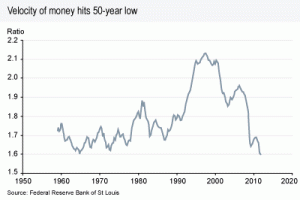
One of the reasons the United States economy is stalling is because the velocity of money has hit a 50-year low. Chart published by the Federal Reserve Bank of St. Louis.
The idea behind lower tax rates resulting in richer governments is a simple one. By lowering some taxes (not all taxes have the same influence on the velocity of money, which we will discuss in a moment), people see less of a disincentive to do something – work, save, shop, build, or give. Every time they do one of these things, the government gets a bite at the apple.
Imagine we have two governments in two countries. The first is Greenville, the second is Bluetown. Both nations consist of a handful of citizens. We look at two factory owners, both of whom earn $100,000. We are going to use a simplified example, ignoring things like accelerated depreciation tax benefits, et cetera, because on a net basis, those really serve to lower the tax rate and would bolster the point, anyway.
- Greenville has low taxes. For every $100 you earn, the government takes $20. The factory owner sends $20,000 to the government. He uses $40,000 to support his family by purchasing food, clothing, shelter, and furniture. The remaining $40,000 gets reinvested in his factory so he can make more money in the future. He buys equipment, raw materials, and hires new employees.
- Bluetown has high taxes. For every $100 you earn, the government takes $75. The factory owner sends $75,000 to the government. He is left with $25,000 on which his family can live. He has no money to reinvest in his business and really feels no incentive to grow. Why work harder if the government is just going to take all of the fruit of his labors, anyway?
Greenville is going to have a much higher velocity of money. A citizen in Greenville gets to keep more of his money, which he can then save, invest, give away, or spend. Even if he is saving his money, that represents someone, somewhere spending more (e.g., if he buys municipal bonds, it may represent a local village building an elementary school). Very few people take money out of circulation by buying gold, silver, or burying wads of cash in coffee cans in their backyard. Thus, money moves faster; or, rather, the velocity of money is higher.
[mainbodyad]There is also a much more important consideration. Ultimately, standards of living are driven by individual men and women who create things that make life better – indoor plumbing, air conditioning, microwaves, wrist watches, automobiles, airplanes, light bulbs, perfume, mattresses, etc. If you are a self-motivated person, a Thomas Edison or a Steve Jobs, it isn’t hard to guess which country is going to appeal to you the most. Over several generations, if Greenville has a reasonably accommodating immigration policy, it is going to soak up a vast majority of the intellectual human capital of Bluetown. The technological difference between the two will widen into a chasm, and then the structural advantages will result in Greenville becoming a superpower.
Doubt it? Go back and look through the history of the United States during the Industrial Revolution and through World War II when it took its place at the head of military, scientific, financial, and political power. A substantial percentage of the people who created the ideas, products, services, and devices permitting this to happen were not born in the United States, but rather moved here attracted by the political and economic freedoms that were available to the common person.
If You Still Have Trouble Understanding the Velocity of Money …
If you still have trouble understanding the concept, think of it this way: Every time $1.00 moves in Greenville, the government gets 20¢ of it. Every time $1.00 moves in Bluetown, the government gets 75¢ of it. In basic, simplified terms, human nature being what it is, the lower taxes are, the higher the velocity of money tends to be.
Imagine both Greenville and Bluetown have a total average money supply of $10,000,000. In Greenville, the velocity of money is 10. In Bluetown, the velocity of money is 2. How much money will be collected by each government?
- Greenville = $10,000,000 money supply x 10 velocity of money = $100,000,000 GDP x 20% taxation rate = $20,000,000 government budget
- Bluetown = $10,000,000 money supply x 2 velocity of money = $20,000,000 GDP x 75% taxation rate = $5,000,000 government budget
Due to a higher velocity of money, Greenville is collecting 4x as much in tax receipts as Bluetown despite having a much lower tax rate. Greenville has much more money to give away to the poor through social programs, students through college programs, and spend on defense, through the military.
The Velocity of Money Argument Has Been Hijacked By the Radical Right in the United States
That simple economic truth is absolute beyond assault. Unfortunately, the way it has been implemented is downright criminal. A radical wing of the Republican Party has essentially re-written the basic mathematics dealing with the velocity of money and used it to argue that tax rates should only be cut for the rich, which will then “trickle down” to everyone else. That is not true. In fact, those who are ignorant of economics now see supply side taxation arguments as essentially synonymous with policies designed solely for the rich.
The truth is, when the velocity of money is high, and tax rates are low, everyone prospers. This explains, in part, one of the reasons the United States has now found itself in the ridiculous position of defining a family earning $45,000 per year as being below the poverty line when that very income puts the household in the top 1.72% of income globally.
It is not tax cuts per se that result in expanding government revenue. The name of the game is to increase the velocity of money. Tax cuts are merely a means, a mechanism, to achieve that end result.
[mainbodyad]Since 1950, the tax rates levied on the poor and middle class have skyrocketed in a lot of ways. Consider the payroll tax for a self-employed person. When Warren Buffett was in his 20’s, a self-employed person would have had to send $2 for every $100 he earned into the Federal government before paying a penny in income taxes, state taxes, property taxes, or sales taxes. Today, that same self-employed person would have to send $15.30 into the government before paying any of those other taxes; it comes right off the top. Any party that was actually interested in increasing the velocity of money would address the 700% increase the poor and middle class have seen on the very first tax burden they face. It is going to have a far more profound influence on the metric than shaving another few percentage points off the capital gains tax rate paid by the wealthiest Americans. Yet, the average American doesn’t have a lobby in Washington fighting for him or her.
Many of the Democrats are no better. Instead of lowering the tax burden on the poor and the middle class, their proposal is to simple raise the tax burden on everyone else to the same level! Ultimately, economic growth is the result of consumer demand. Thus, you want money in the hands of people who will spend it, in turn, increasing the velocity of money. Tax cuts that only benefit the rich, rather than the average school teacher going into Target to buy a box of cereal or a video game for her child, are a failure.
Raising Taxes Very Rarely Results In As Much Revenue As One Expects
The best way to increase governmental tax receipts is to increase the health of the underlying economy so the velocity of money is higher. Countries often find this out the hard way. In the United States, individual states find it out the hard way, as well. A few years ago, the Maryland legislature passed a special tax on millionaires. The government expected an additional $106 million in revenue. However, it didn’t account for human behavior. Roughly 1 out of every 3 millionaires left the state, and instead, tax receipts were $200 million less, resulting in a $306 million gap from expectations.
If you want to live in a rich civilization where the standard of living is expanding for the average person – which is the only metric that counts – you need as much human capital as you can attract. The human capital needs to feel valued, respected, and above all, believe that it is being treated fairly. Thus, all taxes are not equal. Wise tax policy is as much about emotional psychology as it is raw mathematical figures. In the end, you are dealing with people.
Raising tax rates to the point a negative feedback loop is established and the human capital feels abused is one of the surest ways to drive off the top contributors of ideas, products, and services. In the end, everyone ends up poorer.
My personal opinion? The perfect economic system is one that rewards entrepreneurs by making it easier to amass wealth, puts money in the hands of poor and middle class consumers who create demand-driven increases in the velocity of money, and, over time, raises the standard of living for even the least successful, not as the result of transfer payments, but as a by-product of opportunity for the workforce. The United States has veered too heavily in the direction of favoring one group of people over another from time to time, but by and large, we’ve gotten the equation right. Or, at least, gotten closer than most of the other nations on the planet, which explains our having 50% of the world’s wealth despite only being 5% of the global population.
Reader Comments (20)
Comments are presented chronologically, with replies indented beneath the comments to which they respond.
Jacek Janiszewski
May 21, 2012
Thanks for explaining this.
The only question I have:
Since changing the velocity of money doesn't affect the amount of money in the system how does if affect wealth distribution among different income segments?
Joshua Kennon
May 21, 2012
Replying to Jacek Janiszewski
Haha ... I'm actually working on a post about that right now. I'll try and get it published in the next few days.
Gilvus
May 21, 2012
Great explanation. Wikipedia articles on finance and economics tend to be poorly edited and formatted.
There are disconcerting consequences to this concept. You routinely tell your readers to learn the tax code and live frugally over at Investing for Beginners, even though both would (marginally) decrease the velocity of money and overall health of the economy. Therefore, "playing good defense" is a sure-fire way to get rich, but if everyone does it, entire sectors would crumple as people stopped buying vacations, entertainment, and non-basic goods. I don't think this is hypocritical, however; I see that you are using your accumulated wealth to create jobs, buying high-quality goods, and support charities.
On a side note, I would NOT trust a scientist who uses fertilizer in the development of liquid band-aids.
Joshua Kennon
May 21, 2012
Replying to Gilvus
Mad Scientist, then?
TheLonelyHumanist
June 19, 2012
Replying to Gilvus
I have thought about that too, Gilvus. IIRC, Keynes' big concern was that consumers tended to exacerbate the business cycle by practicing fiscal responsibility in the face of economic uncertainty. Sometimes, everyone acting in their own interest is actually not in their self interest. The world is full of Nash's Prisoner's Dilemmas; one could think of many situations in which irrational altruism would be in everyone's self interest. E. O. Wilson, anybody?
Home7
January 28, 2013
Think there's a typo:
"Bluetown = $10,000,000 money supply x 2 velocity of money = $20,000,000 GDP x 75% taxation rate = $5,000,000 government budget"
Wouldn't it be $15,000,000 government budget?
Financial Apocalypse
October 29, 2013
This article is completely off-base, and the "for beginners" in the title will simply lead beginners down an incorrect road of thinking.
You are correct that increasing cash/wealth in the hands of the middle class or bottom 90% of the country will lead to an increase in velocity of money and an increase in tax receipts, resulting in an ability to lower tax rates across the board. Where you go wrong, however, is not realizing where this decrease in velocity of money over the past 40 years has come from. You are also incorrect in your assumptions about government taxation reducing velocity of money.
First, lets address the government. Your article essentially presumes that the government is a money sink, taxing and then not spending thus not contributing to the velocity of money. In fact, the government is currently increasing the velocity of money because it spends every cent of revenue it gets, and then some, every year. The money it spends is income for businesses and individuals who in turn pay taxes on that income, spend that income, and save that income, resulting in some of those tax receipts. The real question to look at is if the velocity of money in the hands of the government is faster than the velocity of money in the hands of the individual, and at the current time I would argue that it is, by far. Is this a good thing? Probably not, but that is for an entirely different discussion.
Now, your article correctly states that increasing velocity of money should be our goal, in order to increase tax receipts. Where you go wrong is presuming the way to do this is by taking money away from the government via lower tax rates. All this would do is give a temporary boost to the economy by providing a band-aid solution to the real problem which is the ever-increasing wealth and income inequality in this country. Sure you can lower payroll tax by 20% but the system we have in place which has been increasing wealth disparity for the past 40 years would be unchanged, so you would get a small bump in velocity of money as the payroll tax helps the W2 earners vs the investor class... but over time that velocity would decrease again as the system continues to shift the 'new' wealth of the middle class to the investor class.
The REAL issue is the wealth & income disparity. We need a nationwide self-evaluation of what we need to change to return this country to one that rewards EVERYONE who participates, not just those at the top. My proposal is that we provide tax breaks to corporations who distribute a certain percentage of profits to ALL of their workers. This would result in decreasing wealth/income gaps, rev up the economy by increasing disposable income of the bottom 90%, and allow for lower overall tax rates via increased velocity of money. At first it will reduce the rate at which the ultra wealthy accumulate wealth, but as the economy improves and tax rates drop they will benefit as well, if not even more than in the current situation, as we would truly have a situation in which a rising tide raises all boats.
Steve Wright
December 3, 2013
Many thanks for this great post. I am trying to understand how we can build the right incentives in to our economy to encourage the right behavior to make a healthy economy and build more vibrant communities. In our current wealth maximizing economy, I believe we incentivize separation via wealth and de-emphasize the value we get from each other in our communities. The idea of velocity of money is interesting as a counter weight to GDP and maybe an interesting analog to vibrancy in a community? I would love to see maps of some of the new alternative currencies and how they are being spent! Anyway, thanks again! Here is a talk I gave recently on this subject: https://www.youtube.com/watch?v=63iE7IJbSJE&feature=youtube_gdata_player
Elcid
December 10, 2013
Velocity, by its very definition is a time function.
However, the "velocity of money" is given as Total value of transactions (or GNP) divided by the total money in circulation. This means $ divided by $ = a unitless number. So this cannot be a velocity!! If economists want to use the term velocity, it should be measured in something like $/person/hour,
If I wish to determine the velocity on any given day I first have to go figure out the GNP, and then try to find out how much money is in circulation! The problem is, most transactions are conducted with credit, where money that does not exist is used to chase goods that do.
What a crock!!! it is RUBBISH!!!
Leon
December 8, 2014
I have some problems with the association between taxation and the velocity of money. You appear to be arguing that higher taxation = lower velocity of money, But the Greenville/Bluetown argument is flawed. First, you assume that money taken in tax is lost from the economy. This isn’t true. That money gets spent on a variety of public sector enterprises that employ people, who subsequently spend it, leading to an increase in the velocity of money. Second, you assume that all private sector profits are reinvested in a company, creating jobs, rather than allowing a rich business owner to buy, for example a second home in Costa Rica and a yacht to get there, possibly exploiting an offshore tax haven in the process. Third, you assume that if there isn’t that much left over to invest in the company, the company owner will just think “oh screw it, I can’t be bothered to invest anything at all because of these high taxes, it’s sooo unfair”, and then flounce out of the room and slam the door like a teenager. I don’t think I even need to unpick this third assumption.
Rich business types are far more likely to accumulate money in ways which decrease the velocity of money than governments are. In fact, the Greenville/Bluetown example will likely have exactly the opposite effect on the velocity of money as you conclude.
Joshua Kennon
December 8, 2014
Replying to Leon
I don't disagree with much of this. It's not covered in this particular post for one specific reason: The word 'beginner' is in the title. Trying to muck it up with a discussion about which tax modifications seem to have influences on the overall velocity of money (e.g., cutting payroll taxes on the poor is a fantastic thing to do because they are more likely to spend it and put it back in the economy vs. cutting the estate tax, which isn't nearly as helpful) would have only obfuscated the basic concept, some of which has been discussed elsewhere on the site.
The only thing I think you are underweighting is the third objection, which you don't even think is worth evaluating. When you look at some of the things in behavioral economics and psychology - the sub-optimal, irrational actions people take, even if it hurts their own interests - I think you have too rosy a world view that ignores human nature. The perception of unfairness absolutely influences personal opportunity cost calculations and thinking men and women will overcome these as perfectly rational agents at all time is wishful thinking.
Case in point: I'm trying very hard right now to convince someone to implement a retirement plan for their workers, who currently have no benefits, and the owner of this firm refuses because the government regulations limiting the contributions of higher paying individuals seem unfair to him. Even though he'd be absolutely richer by doing it, he still refuses out of some sense of spite or feeling of injustice being told what he can and can't do.
I've personally passed on a limited partnership for an infrastructure construction project that would have been great for the community because it was too close to the end of the year, it would have made my taxes more complicated, and I didn't want to deal with the additional IRS paperwork even though my accountants handle it all. I'd have been richer, sure, but in the time between deciding whether to hoard cash or put it out there in the economy, it was the perception of government interference that caused me to say no so I could get back to my latest book or whatever it was I'd have rather been doing.
gh79
January 30, 2015
Why not abolish all taxes (Including Payroll, Sales, Income, Customs and corporate taxes) and replace with a 2% Wealth tax on net worldwide assets. It would force folks to use capital to generate income instead of letting it lie unused in unproductive assets like Mansions, paintings, yachts. Given that the Net wealth of America is 100 trillion and the GDP is 12 trillion and the govt budget is 2 trillion we can replace our current system of getting 16% of all economic output by a system of getting 2% of all economic wealth.
The only other tax which would be needed would be a tax on foreigners - any time money is brought in or out of the country a 1% tax would be imposed. That would take care of the problem of capital flight. People would still put money into USA because USA with 100 trillion wealth produces 12 trillion in revenue a better ratio than any other country.
This would also put the tax on people with net assets so the folks who are first generation climbing out of the Middle class (Doctors with 300000 in salary but negative assets due to loans) would not be taxed but Doctor's children with million in the bank but 0 salary (because they are lazy layabouts) would be taxed and their inheritance whittled away till they are forced to work.
Joshua Kennon
January 30, 2015
Replying to gh79
It would be way too easy to manipulate. An overwhelming, vast percentage of wealth in the world is in assets that require some sort of valuation model to estimate. Depending on growth assumptions, inflation assumptions, tax assumptions, discount rate assumptions ... an asset that produces $1,000,000 a year can be valued anywhere between $3,000,000 and $50,000,000.
The amount of tax cheating, corruption, and tax dodging you would invite would be intolerable. It would take someone like me all of five minutes over a cup of coffee to find a way around it. It'd be fairly devastating for society and create all sorts of bizarre incentives that manipulated human behavior in the way that led to sub-optimal outcomes.
For example, you'd have people take a lot more corporations private instead of them being publicly traded and available to everyone, including pension plans, on the stock exchange. The exact same business held in an illiquid LLC is valued at a much lower rate by the IRS due to that lack of control and illiquidity. Same cash flows, same profit, same everything.
It could never work. I, and millions of people like me, could break it without even trying and our micro-level rational decisions would be bad on a macro-level.
gh79
February 2, 2015
Replying to Joshua Kennon
You also of course take away all the bogus exemptions in the tax code favoring the wealthy like valuing a privately held firm at less value. Instead you value it as if it was publicly held. If you still want to hold it privately and pay the higher tax AND lose the opportunity to raise capital YOUR problem.
Joshua Kennon
February 2, 2015
Replying to gh79
I don't think you could, though. It's plainly clear that $10,000 worth of stock you can sell immediately is worth a lot more than $10,000 on paper that you might not be able to sell for years, and if you can, you certainly can't get the full $10,000 for it. That has some necessary degree of estimation which is what causes the problem to begin with ... there are far more assets in the world than there is income. The problem would become much more difficult.
You could design an income tax system that even someone like me could not get around if it is simple and transparent enough. You could not design a wealth tax that could survive assault. I, and people like me, would be able to break it in an afternoon. I guarantee it.
Dingo
April 29, 2015
Excellent description of velocity of money. It has helped me to understand better how economics.
I do have one concern. You say the following at the end:
Or, at least, gotten closer than most of the other nations on the
planet, which explains our having 50% of the world’s wealth despite only
being 5% of the global population.
Can you please explain to me how this is a good thing?
And can I also ask you, how all economists define wealth?
Cinclow20
October 9, 2015
While your definition of the velocity of money is correct, your description of its relationship to taxation and the economy is way oversimplified in that you treat government as an external agent that sits on its money. In fact, the majority of the money the government takes in is used in transfer payments - for such things as Social Security payments to the elderly or infirm, or Medicare and Medicaid payments to healthcare providers on behalf of seniors and the poor, etc. The bulk of the remainder goes to national defense (salaries, equipment procurement, etc.), with lesser amounts going for infrastructure construction and maintenance (which makes the economy more productive), research & development (also adding to productivity), inspections, justice administration, etc. -- in essence, paying people, buying things, and investing, just like any other agent.
Because our taxation system is progressive --with the more affluent paying a higher percentage of their income in taxes than the less affluent, though arguably not as much as they ought to pay -- the government's taxes and spending redistributes money from those who are more well-off (and having a lower propensity to spend, and higher propensity to save/invest), to those less well-off (having a higher propensity to spend, and lower propensity to save/invest). And since spending drives demand, which in turn drives investment, government taxation and spending, within limits, adds to the velocity of money and generates positive economic activity.
Just what the limits are before the government's taxing and spending, through a misallocation of resources, becomes a drag is a matter of vigorous debate. However, looking back in history (e.g., the 1950's through the early 1970's, when marginal tax rates on the most affluent were several orders-of-magnitude higher than they have been since, and economic growth was more robust), as well as various analyses of the non-partisan Congessional Research Service and Congressional Budget Office, indicates that tax rates on the affluent can be quite a bit higher than they are now without having a negative influence on the willingness of the affluent to work and produce, or the overall economy to grow. Indeed, the CRS has an analysis indicating that the affluent are more likely to invest if their marginal tax rates are higher than they are now, due to their need to overcome the negative impact of taxes on their income.
All of this is merely to say that the realities are quite a bit more complicated than you laid out above, and that your reference to the Laffer curve -- a concept that as used by right wing politicians has generally been discredited -- can be misleading.
Joshua Kennon
October 9, 2015
Replying to Cinclow20
Yes. Of course they are. Not to make light of your (mostly reasonable, intelligent, well-articulated) comment but shouldn't common sense have made this self-evident given the phrase "for beginners" is prominently displayed in giant letters at the top of the post?
Generally, if one wants to enjoy any traction when introducing a complex real-world concept with innumerable second and third order effects, it requires a reduction to its most basic form, building block by building block so the person can then go on and learn more about the topic themselves or it can be revisited in the future. The entirety of the academic experience is built around this construct; the reason we don't throw a college geology textbook at a 3rd grader when they are painting styrofoam models of Earth and learning about the difference between the crust and the mantel or why there isn't one, giant college course called "Economics" that covers the all economic theory, but, rather, "Principles of Microeconomics", "Intermediate Economics", et cetera.
Cinclow20
October 9, 2015
Of course you're right. The purpose of my comment was to point out that a person unfamiliar with the concepts might misconstrue your explanation and conclude that all or most government taxation and spending is inimical to economic growth -- a belief that most conservative politicians, and all current Republican presidential hopefuls, constantly promote. That's clearly not your purpose, but without the clarifications it might be a reasonable conclusion. Just my suggestion...
Lawry
April 3, 2016
You counted the farm produce twice?