

I’m going to regret that title tomorrow. I know it.
Two of the books I’ve been meaning to delve into sometime this year are about evolutionary biology; how the incentives that lead to reproductive and social success (which itself is a facilitator of reproductive success) shape everything from our government institutions to the popularity of dating profiles. The first book is Sex at Dawn: How We Mate, Why We Stray, and What It Means for Modern Relationships by Christopher Ryan and Cacilda Jetha. The second book is Sex and War: How Biology Explains Warfare and Terrorism and Offers a Path to a Safer World by Malcolm Potts and Thomas Hayden.
I decided to try and get into them sometime next week, if I can fit them into the schedule, after the post on the Culture Code mental model. In that post, I included a few embedded videos of Dr. Rapaille talking about his research. In one of those videos, at around the 25:40 mark, he spoke about the “code” for biological reproduction when it came to men who wanted to sire children; the number that arose in his research regardless of what a man said he found attractive as the man couldn’t lie about his body’s response in a laboratory.
[mainbodyad]That code: 0.7. It’s the key if you want to unlock the reptilian mind in most men and manipulate it for your own advantage because over time, evolutionary pressures have resulted in a very specific, narrow waist-to-hip ratio that signaled to the primal part of the brain, “This female is genetically superior to others”. She’s going to have a higher probability of successfully reproducing, she’s going to live longer, she’s going to have lower rates of cancer … all sorts of things that were self-selecting, creating a feedback loop causing it to proliferate over thousands upon thousands of years.
This waist-to-hip ratio code is so ingrained in the deepest recesses of the brain that it even shows up in pornography consumption patterns. It is shaping the free market. Case in point: Someone looked at the top 100 adult film actresses of 2014-2015 based on page views generated at pornography giant Pornhub. He or she then cross-referenced the actresses featured with body measurements from the Internet Adult Film Database, along with secondary sources, to build this handy chart. The author then analyzed the body proportions of each actress to see how the distribution patterns looked, building a page of charts to make visualizing the numbers easier. This allowed the viewer to see what people actually wanted in a naked woman when they were left entirely on their own, in private.
Here is an annotated screenshot of the passage that caught my eye. The person putting the information together actually said – and I’m quoting here – “I had trouble finding a number for the average female waist-to-hip ratio. The number .7 came up a lot as ‘ideal’.” So powerful was this effect that around 90 out of the top 100 most desirable women in the adult industry were within striking distance of it.
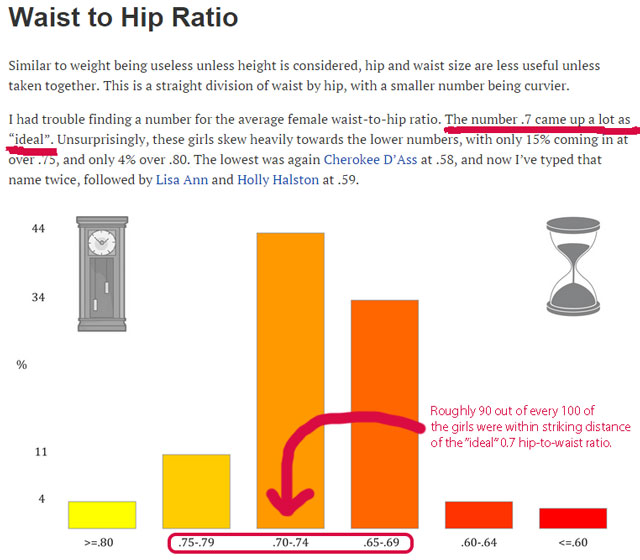
Click the image to go to the page of charts. This is a screenshot of the relevant passage, where the person who put it all together noticed the 0.7 ratio number appearing over and over, with nearly all “attractive” women within striking distance of the magic figure. [Source]
Even here, though, men are more demanding. The doctors go on to examine the findings of a study (see: Swami and Tovée 2008) and talk about how gay men seem to respond more positively to a lower waist-to-chest ratio in other men, indicating a more muscular upper body with a smaller, more athletic waist.
Men, in other words, are visually wired regardless of sexual orientation to have higher standards of physical beauty. For a man, you could have the greatest personality in the world, have a kind heart, volunteer at an animal shelter, feed the poor … and if you are ugly or overweight to the point it throws off your ratios, your sexual capital will plummet in his eyes. (It’s one of the reasons that movements such as “all bodies are beautiful” are ultimately doomed to fail. The social construct cannot compete with something so fundamentally intertwined with human nature.) You might have an out if you hit the genetic lottery: Rapaille found that the minority of overweight women who had a disposition to store fat in the 0.7 ratio were still deemed attractive. Good luck with that because almost nobody does.
To provide some perspective on how important this 0.7 preference is, men consistently rate some derivation of “being tricked into going out on date by an obese person” as their greatest fear when it comes to trying to find love through online dating apps or websites. Women, in contrast, say it is something like, “meeting a serial killer”, which doesn’t make much sense when you consider that a man is vastly more likely to wind up a murder victim than a woman is, all things considered. As per Table 311 of the U.S. Census Bureau, Statistical Abstract of the United States [PDF], in a huge country with more than 300 million people, there were 13,756 murder victims, a mere 3,158 of whom were female. If you’re a white woman, the odds are even lower because black men and women represent roughly half of all victims despite accounting for only 12%+ or so of the population!
This Has Some Interesting Connections to Obesity Research
Reading through all this sent me down a path of obesity studies. Few people who look at the data should have cause for doubt that obesity is going to be one of the defining economic, social, and medical issues of the next 25 to 50 years. Current projections put the rate of obesity at more than half of the population by 2030 (almost 80% will be overweight or obese when you combine both categories), with the estimated lost productivity topping $500 billion per annum due to disease, death, sickness, and pain. It even shows up in unexpected places. Disneyland has already had to renovate the Pirates of Caribbean ride because people are so much fatter than they were when the park opened, costing shareholders money. Hospitals, schools, and businesses have had to replace beds, desks, and chairs to accommodate expanding girth. Retailers have had to stock wider ranges of sizes, while manufacturers have needed to use more raw materials per garment. It’s much the same in other Western Countries. Ireland is expected to be the worst with 90% of the population fat, whereas in Britain, it will be 75%.
In the end, surplus consumption of calories has the potential to do more damage than tobacco did in the 20th century. In fact, being obese has already become a stark line of demarcation when it comes to social class. Percentage wise, the odds of being overweight if you have a college degree and make six-figures per year are much lower than if you are in poverty. I’d go so far as to bet money in another decade or two, being fat will be the equivalent among certain affluent groups as having meth face; a signal that will put a glass ceiling above the station to which you can rise in life until the situation is modified. No one will say a word but your resume will go right in the trash.
This is absolutely relevant to your investments. Your weight directly influences your salary levels, which directly funds your securities purchases. This is because, as pointed out here:
Various studies have shown that overweight people are seen as less conscientious, less agreeable, less emotionally stable, less productive, lazy, lacking in self-discipline, and even dishonest, sloppy, ugly, socially unattractive, and sexually unskilled; the list goes on and on.* The stereotypes run so deep that even obese people hold these same discriminatory beliefs about other obese people. Therefore, it may come as no surprise that research has provided strong evidence that obese people are paid less than their slimmer counterparts.
The effects are worse for women than men. Zero. Point. Seven.
The connections between obesity research and the biology of reproduction don’t stop there. Knowing that men have higher physical standards and stronger arousal reactions to certain defined mathematical relationships has value when testing theories. The United States Government noticed that gay men, as a whole, were so much less likely to be obese than other demographic groups that they spent $3,000,000 through the National Health Institute on Project Number 5401HD066963-04.
What was the cause? Was it genetic or biological? It was possible it was somehow in the gene expression given some earlier research that shows gay men’s bodies function in different ways that can be identified even against their will. For example:
- Researchers at the Monell Chemical Senses Center in Philadelphia conducted a study in which they took a group of men and washed out their scent over nine days by having them refrain from eating certain foods, using only scent-free soap and shampoo. They then had these men wear sterile cotton pads under their armpits for a day, with the material stored in a bottle. A panel of 82 men and women, some gay, some straight, were exposed to each scent and asked to rate the attractiveness of the mysterious, unknown man that produced it. Straight women overwhelmingly chose the scent of straight men. Straight men overwhelmingly chose the scent of straight women. Gay men overwhelmingly chose the scent of gay men. There is something happening in the chemical markers that the conscious brain isn’t picking up on with the eyes, ears, mannerisms, or other signals that give us away to others of our tribe. [Source]
- Researchers at Cornell University used a specialized infrared lens to measure involuntary changes in pupil dilation to determine the sexual orientation of test subjects who were shown naked photos and videos of different people, allowing them to quickly determine the way someone’s brain is wired regardless of what they say or will admit publicly. [Source]
- The BBC aired an interesting documentary hosted by actor John Barrowman, who was sent to a series of scientists and subjected to a number of tests, demonstrating how modern technology can “see” gayness or straightness on brains scans (Barrowman demonstrated no arousal to women whatsoever, whereas his brain lit up like a Christmas tree in the “right” areas for a gay man) and then, based on differences in scores on other exams, can predict when the brain became wired that way (current hypothesis: mid pregnancy as most of the test differentials involve areas of the brain itself that are mapped during that period).
Given all this clear evidence there is some neurological difference between gay men and the rest of the population, it might be possible that gay men are simply less likely to become, or stay, fat because of how they are wired. Perhaps the same thing that makes them score better on linguistic fluency also causes them to feel satiated with food at lower caloric intake levels.
Nope.
The research thus far has found gay men have a “greater desire for toned muscles” than straight men, presumably to be attractive to other gay men who, like straight men, have higher standards of physical beauty than women so they modify their behavior by putting down the fork. That’s it. They eat less so they can look hotter. It is entirely cultural pressure. Since men are shallow, you improve your dating odds if you are in better shape. If you start putting on weight, they’re much more likely to look at you and say, “You’re getting fat. It’s not attractive. Stop it.” Therein, funnily enough, may rest the secret to ending the health crisis. Incentives. Feedback. Social pressure.
Of course, Asian mothers have known this since the dawn of time.
Seriously. Asian mothers are the reigning queens of cultural fat shaming. So much so that Asian Americans are 1/3rd as likely to be obese as their white peers (and even that is somewhat overstated because it lumps ethnically diverse groups into a single category when Filipino men and women are way more likely to be obese, dragging up the figures). They don’t play around when it comes to this topic. You put on weight, they will call you a pig, beat your hands with a wooden spoon when you reach for seconds, and put a lock on the refrigerator. It might sound harsh, but if you’ve ever seen the images of what diabetes can do to your body, it’s not hard to see they are motivated by love. No good parent wants that for their son or daughter.
(This very well may get me in trouble with some of you but I’m going to say it, anyway: I think the HAES movement is misguided for this reason. What began as a motivational tool to give people the strength to begin exercising has been twisted into something that is little more than the equivalent of drug users posting pictures of their needle-marked arms, demanding praise or acceptance for behavior that will kill them, that will cause them to live in chronic pain, that will burden taxpayers and insurance customers with unbearable costs, that will affect those around them as they are unable to do things a healthy person should be able to do. My own family suffers from severe obesity so it hits home hard – even I, personally, while away at college, had to break a lifetime of bad habits and completely re-learn how to eat, dropping a ton of weight in the years that followed leaving home – but never once have they demanded it be looked upon as a virtue. It’s acknowledged as a failure. Nobody deludes themselves about it.)
Right about now is when someone brings up a single study highlighted by the media, oft-twisted, seldom-read, and used to claim the contrary. The September 11, 2014 Perceived weight discrimination and changes in weight, waist circumference, and weight status has been trumpeted as if it found that fat shaming actually causes weight gain, rather than loss, despite some fairly severe methodology criticisms. It’s not true. It’s a case of lies, damned lies, and statistics. Worst among these, the researchers admit in the notes. They point out the study had several limitations including, “We cannot be sure whether discrimination preceded weight gain or vice versa. It is therefore not possible to establish causal relationships; i.e. whether people gain weight as a consequence of experiencing weight discrimination, or whether gaining weight makes people more likely to experience weight discrimination or attribute experiences of discrimination to their weight.” (Emphasis added) In other words, it’s practically useless. Remember that the next time someone says, “Studies show …” No. They haven’t. They really haven’t. The hypothesis might be true but you cannot quote that study and insist that it is. The evidence isn’t there.
The Role Social Proof Plays in All of This
One of the interesting things I came across was the role social proof – which, most of you know, is probably the most powerful mental model – seems to play in all of this. One useful study that was done attempted to get to the root cause of the obesity epidemic among black Americans, who suffer disproportionately compared to other groups. The results are almost hilarious in their simplicity: People legitimately don’t know what a healthy weight looks like. It’s social proof. It’s all social proof.
The researchers showed this image to black girls and asked them to identify which women were healthy. Give it a try yourself. Which do you think are “normal”?
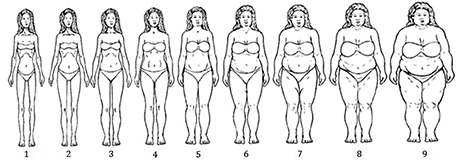
Say it out loud so you can’t cheat. Or better yet, write it down. The answer is at the end of this post.
Perhaps this isn’t so surprising. The New England Journal of Medicine published a study that found how obesity spread through social groups. The fatter your friends become, the more likely you are to adjust your framework for what is normal and expand yourself (it actually shows a higher correlation than the weight of your spouse! I wonder if that indicates there is a gender comparison going on since most people are heterosexual so they are more likely to visually identify, and compete with, their same-gender friends when it comes to appearance). Weight loss shows the same effect. Start dropping weight, your friends will find themselves declining in size, too. We rank ourselves by those with whom we surround ourselves.
Beyond that, “normal” seems to elude some people. If you’ve ever watched shows like My 600 Pound Life, you see these 600 pound, 700 pound men and women talk about how they want to get down to a “healthy” weight … of 280 pounds. The first time I heard that, I didn’t even know how to process it. The frame of reference is so broken that severe, morbid obesity is considered normal. It’s bonkers. The whole thing is bonkers.
Completely Non-Related 5:25 a.m. Thoughts …
It’s even more odd when you stop to ask yourself, “Who wants to live like this?” And then the incapacitated spouse is always shocked that the normal-sized spouse ends up either leaving them or having multiple affairs because they haven’t had any physical intimacy in years despite the relationship having devolved into patient/nurse long before the breaking point.
I don’t even understand the mentality of the caretakers, either. I’ve tried, over and over, to put myself in their position and understand their motivations. Other than the sexual fetishists (who seem relatively rare and get off on watching a person gorge themselves), I just don’t get what they are thinking. They are helping this person commit extended suicide. How can you do that to someone you love? I think, secretly, some of them want the spouse dead so they can escape guilt-free.
If you were going to do that to someone, why would you manually wipe them after bowel movements? Or buy them a Comfort Wipe? That seems so primitive. Just … look at it. LOOK AT IT! Does this seem like a civilized society to you? Wiping your poop with paper on a stick? We have landed a man on the moon. No. No. Not okay. If you are 600 pounds and reading this, do not take this as a criticism. I care for you. You deserve a better life.
Have some self-respect and order a Japanese Toto. Then lose the weight. In the meantime, you’ll have a clean backside and won’t have to have a loved one towel you down like a zoo animal. Don’t do that to them. It’s selfish beyond measure.
What gets me is they always show these folks with Coca-Cola and McDonald’s, two of the stocks I love. It’s making me dislike the brands even though it’s irrational. You don’t get to order 4 or 5 McDoubles plus a chocolate shake and apple pie for a single meal. Humans don’t do that. I’ve found myself talking to the television sometimes … the doctors have to be so frustrated. You can tell some of them have just given up.
This post needs to stop now. It began in the afternoon, a serious discussion of reproductive biology and its influence on society. Coming back to it at almost 5:30 a.m., it has devolved into poop sticks and Japanese toilets. What have I done … I cannot evaluate this at the moment. I will return tomorrow afternoon and decide whether to delete the whole thing. If, before I get a chance to re-read it in the daylight, I have deeply wounded or offended anyone, I apologize. I’ll fix after I’ve had a chance to have my morning coffee.
Answer: Number 1 is underweight with a BMI of 16. Each subsequent woman’s weight increases by a BMI of 3. This means numbers 2, 3, and 4 are normal, healthy weights. That is what a person should look like based solely on medical risk if you want to live a long life expectancy and enjoy lots of compounding. Number 5 is overweight. Numbers 6 and 7 are obese. Numbers 8 and 9 are severely obese. You can read more about this topic, with references to the studies themselves, here.
[mainbodyad]
Reader Comments (121)
Comments are presented chronologically, with replies indented beneath the comments to which they respond.
Joseph Doss
April 18, 2015
Was the healthy female number 3?
I missed your answer at the end of the post.
Joshua Kennon
April 18, 2015
Replying to Joseph Doss
Sorry about that! I accidentally deleted the postscript before hitting publish last night. I just edited the numbers to include it. Number 1 is underweight with a BMI of 16. Each subsequent woman's weight increases by a BMI of 3. This means numbers 2, 3, and 4 are normal, healthy weights. (The woman you chose, 3, was right smack in the middle of the healthy range so good job!) That is what a person should look like based solely on medical risk if you want to live a long life expectancy and enjoy lots of compounding. Number 5 is overweight. Numbers 6 and 7 are obese. Numbers 8 and 9 are severely obese. You can read more about this topic, with references to the studies themselves, here.
stegner
April 18, 2015
My money's on 4.
One note Joshua: I know a man who thought giving his overweight daughter feedback would help. Instead he helped precipitate her Anorexia.
I have a friend who was overweight in junior school, he was teased mercilessly. His response was to basically starve himself. He's thin to this day.
External pressure does NOT produce healthy, rational approaches and results. It produces sham diets, starvation diets and further unhealthy behaviour. The cottage industry of quackery is already bad enough..
IMO: Education is the only long term, sustainable fix. It's also an impossible Gordian knot.
IlovePi314159265359
April 18, 2015
Replying to stegner
Do you have data on this? I love this post because it highlights major issues and brings data into the picture. I see many claims about obesity and rarely is data in the mix. Most times it's simply about temporary feelings of emotional satiety.
Snakes on a Car
April 18, 2015
Replying to stegner
This is fat acceptance nonsense.
stegner
April 18, 2015
Replying to Snakes on a Car
Wrong. This is about understanding that not everybody experiences the world the same way you do. Furthermore, even if all adults were entirely rational, not everybody is an adult - teenagers and children behave in fundamentally different ways to external societal pressures. If you really want to get in to it, we should think about it from a public policy perspective. How do you craft a public sector response to obesity? Relying on socio-cultural pressure is a dangerous thing (IMO), especially because it probably nips any nuanced public policy response in the bud.
I have no data IlovePi314159265359, I'm just throwing out my thoughts.
Zaphod
April 19, 2015
Replying to stegner
You let me know when you see a nuanced public policy approach to any subject.
Joshua Kennon
April 18, 2015
Replying to stegner
I just updated the post to include it (sorry about that!). Number 1 is underweight with a BMI of 16. Each subsequent woman's weight increases by a BMI of 3. This means numbers 2, 3, and 4 are normal, healthy weights. That is what a person should look like based solely on medical risk if you want to live a long life expectancy and enjoy lots of compounding. Number 5 is overweight. Numbers 6 and 7 are obese. Numbers 8 and 9 are severely obese. You can read more about this topic, with references to the studies themselves, here.
ChocoTaco369
April 19, 2015
Replying to stegner
It is very difficult to educate when the educators don't have a clue as to what constitutes a healthy diet. The Food Pyramid was the ruination of this nation's health. Junk food made the foundation and real, healthy foods were cast aside. You're going to tell me steak and eggs, the foundation of the human diet for tens of thousands of years, is going to clog my arteries but Nutrigrain bars which have an ingredients list 2 inches thick, none of which are possible without chemical solvents, giant hulling machines and miles of conveyor belts, is heart healthy? Yea.
That is the ironic part. Nestle, Procter and Gamble, Kellogg's, General Mills, Coca Cola, Kraft and Pepsi are shining beacons on investment websites. However, their food products are what has created the obesity epidemic. Even if you were to closely monitor calorie intake and keep your weight in check, if your diet consisted of these food products you'd be a health nightmare. Yes, for America to TRULY get healthy would mean the ruination of these companies. They could innovate all they want, but processed food is the issue, and these companies are...food processors. The obesity epidemic is what has made these companies so lucrative. And that's why I keep searching for good entry points for these stocks. I know as America gets fatter, so will the quarterly EPS of these companies. I'm hoping JNJ comes down into the 15x multiple range as well. Someone has to medicate after the diets of these folks.
galacticduck
April 18, 2015
I recommend the book, 'Mean Genes' before you get to your more in-depth reading. You can read the whole thing on a flight. Sex, Money, Eating...it's all in there.
Female figures 4-6 look normal to me.
I love the Japanese toilet on 'the Simpsons' that says, "I am honored to receive your waste."
Joshua Kennon
April 18, 2015
Replying to galacticduck
Thanks for the book recommendation!
Sorry about forgetting the answer key. I updated the post with the information. Number 1 is underweight with a BMI of 16. Each subsequent woman's weight increases by a BMI of 3.
This means numbers 2, 3, and 4 are normal, healthy weights. That is what a person should look like based solely on medical risk if you want to live a long life expectancy and enjoy lots of compounding.
Number 5 is overweight.
Numbers 6 and 7 are obese.
Numbers 8 and 9 are severely obese.
You can read more about this topic, with references to the studies themselves, here.
Ang
April 18, 2015
Going a little deeper, I feel the reason a percentage of the overweight populace relies on media validation (and hashtags) is because of the pervasive entitlement attitude bestowed on current society.
Now that the country is richer than ever before, and opulence is more visible than ever before (tv, media, social media), you have a wider case of people wishing they were better than their neighbor (in everything, money of course, but here body image as well - you addressed this in the social proof section). Because biology blesses some portion of the populace, some people, due to upbringing or the mental circuitry they were born with, write off achieving the standard of beauty as "impossible" and "too hard". This is no different than a fast food worker or factory worker demanding that they are paid an arbitrary salary number because "they have rights too".
What's frustrating is that if they listened to themselves, they would realize that yes, they DO have the right to better themselves and thus increase the value of their labor time, and yes, they DO have the right to eat right, exercise, and thus giving themselves more energy and brain power to improve other aspects of their life. It just takes effort and action - don't consume the average 5 hours of television a day and put that time into reading about your goal, whether it's weight loss or finance
In a way it's a form of compounding, those who get it and take the steps towards self improvement will continuously to pile on that improvement their entire lives. The others, who are so set on entitlement and handouts, lacking the mental fortitude to take action, are doomed to forever be stuck
Joshua Kennon
April 18, 2015
Replying to Ang
This is so true, especially the part about continuously piling on improvements throughout life. Once you start a virtuous cycle, it self-reinforces and you get all these surplus benefits that, in turn, feed upon themselves. A person decides to live healthier, stops smoking, loses 50 pounds, gets regular checkups, and all of that, not only are they going to be happier in their day-to-day experience, it's going to pay dividends (literally) if they own productive assets.
Person A starts saving $10,000 a year at 25, earns 10% on assets, and dies at 65, leaving a portfolio worth $4,425,926.
Person B starts saving $10,000 a year at 25, earns 10% on assets, and dies at 90. That one difference means he or she leaves a portfolio worth $48,937,073. All of that excess, beautiful wealth was a function of living longer. It took no more work in the sense most people use that word. It was just time. Time did the heavy lifting.
As someone else pointed out in the comments section of the post on janitor Ronald Reed who left behind $8,000,000, it isn't an accident that most of the secret millionaires who are uncovered in this country, who amass these seven, eight, and nine figure caches of stocks, bonds, and real estate often from modest means, also live to be 70, 80, 90, 100 years old.
Gilvus
April 18, 2015
Replying to Ang
Well put. It's becoming too easy to compare our "behind-the-scenes" with everyone else's "highlight reel."
Snakes on a Car
April 18, 2015
@the 600 pound person video.
Fat proles are gonna prole.
Snakes on a Car
April 18, 2015
I liked females #2, 3, and 4.
Joshua Kennon
April 18, 2015
Replying to Snakes on a Car
Those were the correct answers. #1 is underweight. #5 is overweight. #6 & #7 are obese. #8 and #9 are severely obese.
Andrew
April 18, 2015
Replying to Joshua Kennon
Thank you so much for talking about WW3 going on in Texas right now.
Mark Bright
April 18, 2015
that title though...
mikecrosby
April 18, 2015
Really enjoyed this Joshua. My pick was #2. You didn't say which number obese people would pick.
Stayed at a hotel in Vegas, they had a gay gathering and all were obese. Sitting by the pool and seeing some of these guys in thongs was not too appealing.
I might be wrong, but it seems to me if you eat SAD, the standard american diet, you'll eventually will look like the standard american. Highly recommend Dr McDougall.
Joshua Kennon
April 18, 2015
Replying to mikecrosby
1. You're right! Great point! I'll quote from the Guardian article that summarizes the study itself to save time:
2. It seems you stumbled upon a statistical unicorn - wild pack of chubs - which is the gay, male equivalent of the female "fat acceptance" or "big is beautiful" movement that has become inexplicably, maddeningly, somewhat popular in certain niche corners over the past decade or so. The whole thing is insane to me.
Imagine having a "Smoker's Pride" convention where everyone got together to celebrate the "tobacco lifestyle", huffing on cigarettes while they insist that their lungs are just as healthy as everyone else's lungs. It's death. It's disease. Why should it be celebrated? Maybe I feel that way because obesity has hit my family so hard and I had to work to overcome a lot of bad lessons once I was out on my own, losing weigh myself, but it seems insane to be holding up as a virtue, or desirable, something that is inherently destructive.
3. You very well could be right. It would be worth investigating. The easiest way to change it would be financial incentives because people respond to cost and convenience. To go back to tobacco, look at what obscenely high cigarette taxes do to consumption rates.
The problem is, should we really tax everyone, including those who can handle an ice cream cone, due to the failures of those who can't? Should you spend $15 extra in surcharges the one time a year you want a cookie dough blizzard from Dairy Queen or a corn dog at a fair even though you're perfectly capable of managing your own diet and exercise program? Even if it is okay, I do not relish making the size of the government bigger, giving politicians more resources to squander. We already raise higher tax revenues per citizen than France and can't even manage to get free-at-the-point of use healthcare of higher education so I'm not inclined to trust them until they demonstrate they can intelligently manage their existing revenue stream.
Worse, you'll have all of these modifications taking place to get around the tax, which is how we got here in the first place. ("Really, your honor, it's not candy since we developed ACME Sugar-Like No-Calorie Substitute 3000 and engineered the product, even though we have no idea the long-term ramifications). It was nutritionists attempting to take out fat that led to this massive sugar dump, turning almost all packaged food into nothing but refined carbohydrates since fat-removed food tastes like cardboard. The people complaining about the fact McDonald's french fries have, what, 12 or 20 ingredients, forget that it was the health nuts who caused it in the first place because they didn't want potatoes dunked in animal fat from the burgers so now you have this frankenproduct.
It's a tricky, tricky thing. Nestle sponsored a study I have somewhere around here that showed you could actually manipulate the gut bacteria of people so they craved chocolate, which could presumably work in reverse. Imagine Johnson & Johnson develops a probiotic pill or something that causes you to crave steak and vegetables rather than sugar ... of course, people can do it themselves, organically, but it takes something like 6 weeks for the old bacteria to die off and the new ones to develop, which is why most people fall off the dietary changes, never reforming themselves. If they could just make it past six weeks, they'd be golden. (This is one of the reasons, if you eat healthy, you get sick when you try and eat "bad" food, again. Your gut literally lacks the necessary bacteria to break it down efficiently so it struggles.)
What gets me about all of this is that, once enough people are morbidly obese, social proof will kick in and it will become completely, totally unacceptable to have honest conversations about the health ramifications. In some corners, the word "fat" is even a pejorative. Imagine meeting someone 350 pounds. If you said, "That is a very fat man", people would take it like you had just called his mother a whore. I don't think it can be solved unless they treat it like tobacco use. Total societal shunning. Public service announcements. Targeted financial incentives that make it too expensive to maintain (one option that has been floated is taxing families based on their body fat but, again, that's a scary amount of power to give the government).
I have no acceptable solution, at present, even though I think about it fairly frequently. Aaron and I have had discussions about making a handful of investments in specific businesses that will profit heavily from the trend, though, so at the very least, we'll make money off it; e.g., as long as no cure is developed, diabetes pharmaceuticals and supplies might be a goldmine relative to the past.
RapmasterD
April 18, 2015
Don't. Don't. Don't delete this post. (To be rapped rhythmically to the tune, "Don't Believe the Hype," by Public Enemy.)
Such a great ramble from you! I look forward to re-reading it.
For some reason, the 600 pound life show is going a bit viral right about now at my gym.
"Social Proof." Well, I've got some of my own research to conduct now.
As for that awful, crap-hole company known as MCD, my wife and child will be out of town for 10 days in the next few weeks. I plan on eating all my major meals at MCD for seven of those days.
Given that I'm on a quest to get five or more pounds below my maximum BMI weight of 179 (I am 5'11"), I am confident this will not screw me up at all. Oatmeal for breakfast, salad for lunch, burger or chicken patty for dinner -- complemented by steamed vegetables at home. Should be a snap. Right now I'm 185.
Yes, of COURSE I'm a MCD shareholder And although you didn't ask, let me just say that I'm lovin' it.
Alex
April 18, 2015
I just don't understand what's so difficult about losing weight. Of course some people have actual medical issues and certain biological predispositions that make gaining weight easier/ losing weight harder. And I understand that some people have different body types ranging from ectomorphs, mesomorphs, and endomorphs that naturally affects the difficulty of remaining fit. But the way everyone acts it seems like some herculean task that can only be accomplished through some trendy fit craze. I just don't get it. It's not like you're trying to grow taller or change your eye color. Weight is a characteristic that is easily manipulated. Just change your lifestyle. It seems so simple to me. (Do a Rigorous but Entertaining Exercise Regimen Daily) + (Eat a Healthier Food Congruent with your Max Daily Caloric Intake) = A Healthy Body Mass. What's the big deal here? And then I hear people who aren't fit complain about how the world is set up against them. If you don't like it, JUST CHANGE! Wake up the next day and begin a new lifestyle pattern that will lead to your desired level body mass and stop complaining. Some people have real societal issues that they have no power to change. And yet here is a desirable trait that's easily attainable and instead of just doing the work necessary to achieve it, some people just sit around complaining about. I honestly can't understand the thinking behind this.
* This rant of course excludes people with genetic/medical conditions that forces them into a certain BMI because they, for all practical purposes, can't willingly change their body mass as easily as others.
Gilvus
April 18, 2015
Replying to Alex
It's because a simple concept isn't automatically easy. I like to compare weight loss like wealth accumulation: the former is "calories in money out." Both are simple, yes? But simple ≠ easy. Look at all the people struggling with obesity, and look at all the people living paycheck to paycheck, or worse: negative amortization on their debt. Simple ≠ easy.
Personally, I find both weight loss and wealth accumulation both simple and easy, owing to my upbringing (I'm Asian-American, and yes, I was fat-shamed like Joshua's article says), my experiences, and my temperament. Both my emotional and logical selves are aligned toward fitness and wealth accumulation, 95% of my waking hours (I have moments of weakness, but I try to minimize them).
I'm thankful for this mentality. I'm one hell of a lucky bastard, so I try not to disparage people for not being dealt such a good hand at birth.
Alex
April 18, 2015
Replying to Gilvus
It's interesting how you compared it to wealth accumulation and I mostly agree. However I do think that the reason why most people aren't good at accumulating wealth is that they simply don't have the basic knowledge necessary. Whereas it's not like weight loss is some great secret. The effects of a bad diet/sedentary lifestyle has been publicized well enough for everyone to know the consequences and the basics of eating healthy, and regular exercise has been touted enough for most people to know how to become fit. Therefore, I think there's some other deeper and more visceral reason as to why people simply won't take action to improve their health if they have the basic information necessary to do so. I don't know that reason and I'm stumped. I also think it goes past addiction as Joe Pierson suggested. The warnings of an unhealthy lifestyle are comparable (and some would argue even more publicized) than that of smoking. Yet society was able to decimated smoking rates, but is still vulnerable to obesity. Why is it that telling someone "there's a significant chance you will get lung cancer if you continue with this lifestyle of smoking" so much different than saying "there's a significant chance you will have diabetes and have to have some body part amputated if you continue with this lifestyle that is leading to excessive body mass." Again, I just don't get it.
Alex
April 18, 2015
Replying to Alex
By "basic knowledge" in reference to accumulating wealth I meant financial literacy. If people don't know that (money in > money out), then society has much bigger problems.
Jeff
April 19, 2015
Replying to Alex
I would argue that it's not an issue of knowledge. It's an issue of the emotional value attached to the knowledge. Everybody knows credit card debt isn't good. But those of us with good money sense know that credit card debt is closer to being a "THE HOUSE ON FIRE" level problem than a "I burned the toast" level problem.
Gilvus
April 19, 2015
Replying to Alex
I understand your frustration. It took me years and years just to formulate an amorphous, vague idea of why certain behaviors (overeating, smoking, gambling) are so prevalent. It's a complex issue because there are so many variables involved, and I'm still refining my hypothesis as the data trickles in.
First off, have you considered why smoking rates have gone down over the past couple of decades? Smoking rates were fairly steady 1945-1970 (even though we knew about the adverse health effects during that time), and began to decline around 1970. Ask yourself: when's the last time you saw an eye-catching billboard for a cigarette? or a TV ad? Back in the 1950s through 1970s, there was a jingle that accompanied the slogan "Winston tastes good like a cigarette should." It was as catchy as "Break me off a piece of that Kit Kat bar!" or "Bah-da-bah-bah-bah...I'm lovin' it!" And then the Public Health Smoking Act axed all radio and TV ads starting 1971. The Surgeon General's admonition had to be printed on every tobacco product's packaging around that time. The Tobacco Master Settlement in '97 quashed print and billboard ads over most of the U.S.A. And today, some states and various countries have implemented or are considering plain packaging legislation, which has been shown to be effective at reducing smoking rates.
The lesson I took from this is that only telling people "smoking is bad for you" makes logical sense, but utterly fails in practice. The advice, while making perfect sense, is lost in a sea of emotional drivers, including peer pressure, camaraderie and bonding with fellow smokers, snazzy advertising, association with unrelated good feelings (Marlboro Man made cigarettes rugged and sexy), and of course: the pleasure you derive from using the product itself. Cigarette use declined because the government implemented heavy-handed legislation, thereby draining a huge portion of that "emotional sea." First, they severed a vital link between Big Tobacco and its customers by banning tobacco advertising. If plain packaging legislation proliferates in the next couple of years, then another emotional driver is destroyed: brand equity. I recommend Joshua's other blog posts about brand equity if you haven't read them yet.
So what about fast/junk food? Turn on your TV, open up YouTube, open your mailbox during "ad/coupon day," or drive down any billboard-lined road, and you're inundated with all kinds of brightly-colored ads, recognizable logos, memorable jingles, and catchy slogans all advertising fast food and junk food. I recall Joshua making a post or a comment about how some people in the UK
"feel like it's Christmas" when Coca-Cola puts out its wintertime
commercials with cute fuzzy critters with scarves and Coke bottles. The "emotional sea" is still deep in regard to fast/junk food.
You seem to be very logically-driven, so even if your body desires fast food (leftover preferences from our hunter-gatherer days), a voice in your head booms "No, I don't want diabetes." For people who aren't as logically-driven as you, that voice becomes a feeble whisper when it's drowned in a vast sea of emotional drivers. The little voice's reprimands are easily waved away with various excuses: "It's just this once." or "I worked hard this week; I deserve a reward" or "I don't want my friends to think I'm a health nut."
If you didn't catch it, I strongly recommend this Super Bowl ad by Weight Watchers. It's masterfully done because it targets the viewer's emotional centers directly without lecturing about the ills of overeating. It's like an "anti-commercial" for fast/junk food.
joe pierson
April 19, 2015
Replying to Gilvus
Gilvus,
Better examples are
"It's 2 in the afternoon I got to get a bunch of work done, but this food craving is like a lion yelling in my head, I can't concentrate" Get junk food from vending machine.... "Ahh, now I can work again"
Or
"It's 2AM, in bed trying to sleep, snowing out, early meeting tomorrow, but food craving won't let me sleep" Go out in blizzard, buy junk food, go home, eat. "Ahh, now I can sleep and get on with my life"
Joshua Kennon
April 19, 2015
Replying to joe pierson
If I had to bet money, I'd bet that the gut bacteria hypothesis is going to turn out to be true when it comes to explaining this sort of thing, at least for a considerable percentage of people. A couple of years ago, Nestle paid for a study to look at was different about those with chocolate cravings versus those with none and the answer came down to bacteria in the gut.
Recently, there was a case in which a formerly thin woman had a faecal microbiota transplant (it's a medical procedure to rapidly change the gut bacteria; doctors take feces from a donor with certain characteristics and inject it into your colon so it can begin replicating). They were surprised when the woman began eating like crazy, packing on 36 pounds of fat in less than 12 months! She described it as if a switch had flipped in her body. Her daughter, from whom they took the stool sample, was overweight/borderline obese.
If this turns out to be one of the biological drivers - that the bacteria living in our digestive systems actually have the power to induce cravings to increase their own survival rate in a case of symbiotic evolution, it would explain a reason changing dietary habits is so hard. It takes at least 6 weeks for an overhaul in your digestive system if you were to begin immediately - say you cut out all refined sugars, flours, starches, etc. and ate only protein and vegetables - to the point the cravings would be horrific while the "bad" digestive bacteria died off en masse and was replaced with the now-replicating good stuff. It also explains why people tend to get into certain eating habits. Certain choices become self-reinforcing over time.
This same phenomenon had been observed in mice prior to humans; change the gut bacteria, it modifies cravings so people put on or take off weight without a lot of conscious thought.
In your analogy, the lion is the gut bacteria. It is roaring because if it doesn't get fed certain types of food, it's going to die. It may turn out that the secret all along was killing the lion, replacing it with something that screams for steak and peppers or green tea and broccoli.
It's far from conclusive, but it's among the most convincing things I've seen in a long time. Even knowledge of it might make it easier to change lifestyle patterns. If you know the cravings will be over in 1-2 months, and you just have to hold on until you've rebuilt your digestive tract, it could be tolerable, even drive you more since you see the light at the end of the tunnel.
Ang
April 19, 2015
Replying to Joshua Kennon
That's fascinating - a quick addendum on this - a lot of Asian cultures have a lot of fermented (pro gut bacteria) foods in their diet, Koreans with their kimchi, Japanese with their natto, etc. I feel this helps their diet and general slimness. After all, the base of the east culture diet is heavily starchy - rice or noodles, which usually contribute to weight gain, so the gut bacteria must be at least a contributing factor to why Asian cultures are slim (perhaps helping with portion control)
Gilvus
April 19, 2015
Replying to Ang
True, but India and Pakistan eat large quantities of yogurt, which is also heavy in probiotics. They're facing rising obesity rates too. Sadly, obesity in Asia is somewhat understated because only three (and a half, if you count Taiwan) countries in Asia are fully developed, and the data are heavily skewed when large portions of the population still live agrarian lifestyles. And you'll see from that link that Japan's BMI scale is different from ours.
An interesting thing about the starchy East Asian diets: it may contribute to a high susceptibility to type 2 diabetes. A family friend was just diagnosed a few months ago, and her BMI is probably somewhere in the mid-20s - definitely not obese by Western standards. I don't know if it's a genetic thing, or if it's because many Asians-Americans haven't changed their white-starch-based diets which were fine when laboring in the rice paddies 10+ hours a day, but are horrible for a sedentary lifestyle. In any case, the American Diabetes Association now recommends that Asian-Americans be screened for diabetes at a BMI of 23 rather than 25.
Joshua Kennon
April 19, 2015
Replying to Ang
My favorite food-related quirk in history in the past decade or two is the Asian bird flu epidemic. If you look at infection rates in Korea, there's a theory it was almost entirely spared as a country because of its mass consumption of kimchi. Kang Sa Ouk, the microbiologist at Seoul National University who ran the experiment, found that 11 of 13 infected chickens fed the food recovered, while 13 out of 13 in the control group (no kimchi) died. He thinks it has something to do with the fermentation process given that kimchi basically kills bacteria and can be kept forever compared to other foods. There were 200 bacteria that might be responsible but they weren't sure which, specific one or combination, was responsible.
Kang thinks that German sauerkraut might have the same power due to the same process, which would be funny since one of the more famous mental model stories Charlie Munger talks about involves Captain Cook tricking his men into not dying by getting them to desire sauerkraut, which they hated, by only allowing it as a perk for the officers, then slowly "rewarding" the crew with it. It prevented scurvy.
Gilvus
April 19, 2015
Replying to Joshua Kennon
"Fecal microbiota transplant" is such a sterile, clinical term. I prefer Freakonomics's terminology: "transpoosion." Or for the doctors who didn't gargle with soap: "sh*t swap."
Eric
April 20, 2015
Replying to Joshua Kennon
The first thing I think of is maybe this explains the French Paradox? A lot of fermented pro gut wine with good bacteria "living" cheeses...
Adam
April 20, 2015
Replying to Joshua Kennon
I found the story of the woman's actions/weight changing from a change in gut bacteria fascinating. It made me picture the Weight Watchers of the future that started with a fecal transplant from a health person at the same time a person is put on an exercise and diet regiment.
stegner
April 21, 2015
Replying to Joshua Kennon
This is absolutely the case. Gut microbiota can sense the the epithelium and the epithelium can sense the Gut Microbiota. The gut will protect the Micobiota during illness, and can sense the composition of Microbiota - releasing antimicrobial peptides..
For anybody who's interested:
http://www.nature.com/nature/journal/v489/n7415/full/nature11552.html
http://www.ncbi.nlm.nih.gov/pubmed/24169517
http://sciencelife.uchospitals.edu/2014/10/02/gut-bacteria-are-protected-by-host-during-illness/
Gilvus
April 19, 2015
Replying to joe pierson
I'm not disagreeing with you; I was trying to tailor my response in a way that Alex would better understand. Trying to frame it like the start of a slippery slope in the eternal contest between "what you should do" versus "what you want to do."
It's why discipline so often fails: it starts with a small excuse.
Alex
April 19, 2015
Replying to Gilvus
@Gilvus
You made some pretty interesting points. I think I'm starting to understand the issue a bit more. It seems to be that although people know how to change, and some decide to do so, they are bombarded by gluttony in all forms of media. Because they either don't have a lot of self control or the media gluttony is so pervasive and powerful, they end up not being able to properly stick to their healthier lifestyle for a significant period of time OR results happen so slowly that most just give up before most of the benefits begin to show. This is also probably why all the trendy quick weight loss schemes are so popular. I guess after all weight loss attempts eventually fail is when they become bitter about the concept of weight being such a decisive factor in society since, from their perspective, they effectively can't change their body mass. Interesting. Now I guess the question is how to deal with this issue on a society-wide scale. I'm doubtful the government could regulate the media problem away as it did with cigarettes, and even if they could I don't necessarily think they should. Any thoughts?
P.S. I can't wait for a forum because as this comment thread is growing it's getting more difficult to discern between the different responses and conversations.
Gilvus
April 19, 2015
Replying to Alex
@Alex
Yup. It's a simplified view of things, but I like to use the "motivation vs. discipline" model to evaluate any sort of non-optimal behavior whether it's a population trend or a behavior of my own that I'd like to change. So when you want to change or make a change, you can target the motivation that drives the undesirable behavior, or reinforce the discipline that keeps the urges in check.
Have you heard of Mischel's delayed-gratification experiments? He conducted them on children, generally younger than 10, to see which ones would immediately take a small reward and which ones would wait 15 minutes to accept a larger reward. Over several decades, he found that the kids who were willing to delay their gratification generally did better in all walks of life, from educational achievement to weight control.
I find this implication rather alarming, because it shows a clear difference in self-control from a very young age...which doesn't seem to change much with the onset of adulthood. Whether it's genetic or a product of upbringing (nature vs. nurture all over again) isn't clear, but it does pose a huge challenge to public policy: how do you deal with the people who literally cannot wait for a bigger reward down the road?
For me, this goes on the "too hard pile" for now. Because while I like my personal freedom, sometimes the best practice is to treat people like petulant children. But the only entity capable of implementing such a thing is the government, and the entire premise of the United States was founded on the fact that a powerful government is likely to abuse its power and dominate its citizens. When New York tried to limit the size of sugary drinks and the court of appeals struck it down, I felt like it was a victory for keeping the government from overreaching its power, but a loss for common sense.
Brendan
April 19, 2015
Replying to Alex
As my grandfather told me when I was a kid, "Booze and cigarettes are not necessities, and in my experience, cigarettes were not alltogether that hard to give up. You need to eat, however, and that's why I feel a lot more compassion towards those who can't control their eating habits: because they fight a battle every time they go to the table." His comment was directed towards folks who were very obese, and not the person with an extra 10 or 15 to lose. I always found that to be an insightful observation.
Joshua Kennon
April 19, 2015
Replying to Brendan
Great point. This is what my dad always said to us kids regarding his own struggle. He could quit anything cold turkey but the fact that you have to eat three times a day would be like an alcoholic having to live, work, and recreate within a bar for the rest of his life. There's no escaping it.
Alexis C
April 20, 2015
Replying to Joshua Kennon
Darn I saw this yesterday but wasn't signed in and now you've beaten me to the "cold turkey" joke.
joe pierson
April 18, 2015
Replying to Alex
It's difficult because people are addicted to junk food, you probably aren't and thus won't understand.
Guest
April 19, 2015
Replying to joe pierson
Exactly, it's an addiction. That is why the most
important thing Josh wrote was "In the
end, surplus consumption of calories has the potential to do more damage
than tobacco did in the 20th century." We
really have to treat obesity no different than cigarette or any other
addiction. Problem is, with such high numbers of obesity, no one will
listen. Junkies want their fix, and food
is arguably the easiest fix out there to get. How on earth do you
regulate junk food to the consumer? You have to be 18 to buy junk food?
I think not. I think this one you put in the "too hard"
pile, though it is a fascinating yet sad topic. I think humans just
evolved from scarcity to abundance too quick and our brains did not have the
couple hundred thousand years to adapt and naturally select the self-destructive
behavior of overeating out of the gene line. Oh first world problems, in 2013 according to
The World Health
Organization, 6.3 million children under the age of five died…and about 45% of
all child deaths are linked to malnutrition.
J. Dias
April 19, 2015
Replying to joe pierson
Exactly, it's an addiction. That is why the most important thing Josh wrote was "In the end, surplus consumption of calories has the potential to do more damage than tobacco did in the 20th century." We really have to treat obesity no different than cigarette or any other addiction. Problem is, with such high numbers of obesity, no one will listen. Junkies want their fix, and food is arguably the easiest fix out there to get. How on earth do you regulate junk food to the consumer? You have to be 18 to buy junk food? I think not. I think this one you put in the "too hard" pile, though it is a fascinating yet sad topic. I think humans just evolved from scarcity to abundance too quick and our brains did not have the couple hundred thousand years to adapt and naturally select the self-destructive behavior of overeating out of the gene line. Oh first world problems, in 2013 according to The World Health Organization, 6.3 million children under the age of five died…and about 45% of all child deaths are linked to malnutrition. (http://www.who.int/mediacentre/factsheets/fs178/en/)
joe pierson
April 20, 2015
Replying to J. Dias
Maybe we will just evolve our way out of it, become hippo like in the future, with only the ones that can survive high weight reproducing. Technically speaking our genes can make us healthy and fat if they want to.
Joshua Myers
April 20, 2015
Replying to joe pierson
I think that medicine, technology, and the free market will probably have a greater impact. Regrowing organs, joint replacements, and treatments for managing obesity related illnesses are going to make being fat less of a death sentence in the future. I wish that it wasn't the case, but there is going to be a ton of money made off of obesity related treatment. Oddly enough, it will most likely be relatively healthy people using the dividends to fund their active and healthy lifestyles.
Chris Hope
April 19, 2015
Replying to Alex
It's really easy to understand what is so difficult about loosing weight. It's the time element. Forgetting about the 600 lbs people and concentrating on the "normal" overweight American, it probably took decades to become obese. It's rare that a 6' tall man would weigh 170 one year and 12 months later would weight 250. The weight starts to go on, for most people, right after high school. Since we tend to surround ourselves with people of our own age group, that weight gain seems "normal". Sometimes a bit of gain is even desirable, as you don't want to look like a scrawny kid when you enter the adult job market. This slow accretion continues and you start to become aware that your weight gain is no longer within acceptable limits. But what took years to develop isn't likely to go away overnight. To loose 50 lbs in one year (in contrast to gaining 50 in 20 years) is a major accomplishment. It would require lots of effort and lots of willpower. Also lot's of attention. Most people stay on a diet a few months, then they just give up because the results don't come fast enough. You can't undo 20+ years of over eating in a few months.
Do not despise the day of small beginnings.
Adam @ AdamChudy.com
April 20, 2015
Replying to Alex
This feels like a really arrogant post. You clearly have no problem staying in great shape. And I don't say that out of any personal bitterness. I'm in very good shape as well. But clearly, if you've ever had fat/obese friends who are making a genuine effort to loose weight and are struggling mightily, you would realize it's not quite as easy as eat less / move more. JUST CHANGE Is not helpful advice.
I think a great article on some of the nuance of weight loss is here, but a fantastic trainer who has transformed hundreds of people.Clearly it takes deciding to make a change, but it's not near as simple as you are stating.
http://dicktalens.com/why-its-so-hard-for-women-to-lose-weight/
Gilvus
April 18, 2015
Joshua, I have a few things:
1) When I researched this several years ago, I turned up the Golden Ratio φ = 1.618 and its reciprocal 1/φ = 0.618 as the "ideal" for both men and women. I'm a little surprised to see the histogram indicating that the ideal Waist-to-Hip ratio is 0.65-0.74 instead. I can't find my sources anymore, and it's pretty hard to argue with the methodology and population size, so zero-point-seven it is! Plus, a WHR of 0.618 might be approaching corset territory.
2) I heard very little about the chest-to-waist ratio for men, so I always used the Shoulder-to-Waist ratio instead. My understanding is that φ applies here: an "ideal" SWR for men is pretty close to 1.618. Again, I don't remember where I learned that so I'd be interested if that book of yours presents research on how the exact numbers that women and gay men prefer.
3) Have you read the actual article on body odor preference vs. sexual orientation? The link you provided goes toward a news article - and I don't trust it. I found the original article in Psychological Sciences but it's paywalled >:(
4) I want to point out that BMI is an awful measurement for people with significant quantities of lean muscle. Pretty much all the obesity issues you described above, with special emphasis on obesity's role over the next 25-50 years, is generally predicated on BMI being a valid measurement.
For example, as of today my BMI is 27, which is smack in the middle of the "overweight" category. However, I'm nowhere near overweight: my SWR is 1.57 and my resting heart rate is around 50 bpm. I haven't measured my body fat % (w/w) in a while, but an eyeball estimate puts it somewhere in the 10-15% range. From the photos I've seen of Aaron, I'd guess he's also "overweight" (or he's on the high side of "normal weight"), which is ridiculous.
My issue with BMI is that people who eat healthy and exercise diligently may be improperly lumped into the "overweight" or "obese" categories for data-crunching purposes. Ratio measurements (WHR for women, SWR for men), which can be done via photographs, are a far better indicator of "true" obesity. I'll admit though, that bodybuilders and fit people who fall in the high end of the BMI scale are a minority in the population, so I don't know how inflated our obesity statistics truly are. Thoughts?
Joshua Kennon
April 18, 2015
Replying to Gilvus
I'll try and circle back around to #1-3 when I have a chance but I saw this at the grocery store on my phone so quick reply on #4.
I totally agree with the limitations of BMI for athletes and those who are in shape / take care of themselves. It was largely pushed by the insurance companies - one in particular out on the East Coast if I recall correctly, as that very limitation allowed them to increase premium rates by making perceived risk increase. The regulators allowed it and profits increased. It looks like the study that used the visual images was assuming a normal fat/muscle distribution so you could visually spot what underweight / normal / overweight / obese / severely obese looked like; i.e. if a normal, non-weight lifting person walked in the door and looked like this in their underwear, where would they fall on the health chart?
The problem is people who are delusional hear that and think, "Oh, I'm the exception, too". LeBron James has a BMI of 27+. I think the last time I saw you was in that video you sent me from that (undergraduate?) course you taught and if memory services me right you are 1.) way more jacked than the general population, and 2.) don't have hardly an ounce of body fat on you. In contrast, somebody who looked like a gumdrop shoved into a pair of tight yoga pants but who works out twice a week for twenty minutes at Planet Fitness would go, "Oh, see? BMI means nothing because look how athletic they are and we have the same BMI so I'm not that bad." The level of self-deception is really crazy I'm finding the more I read some of these people's online blogs. Part of me wonders if the mirror trick would work - years and years ago, I remember reading a bunch of research that talked about the psychology of mirrors. If mirrors are everywhere, people are far less prone to lie, far more likely to be kind, far more likely to lose weight ... they see themselves from a third-person perspective and it does something to their thought patterns.
If you really want to see how completely self-deluded someone can be spend some time reading this blog ... it's ... something else. It's the obesity equivalent of a pro-cutting or pro-anorexia blog. She actually seems to believe the things she writes, which is sad. She talks about being "betrayed" by friends who go on to push weight loss. Worse, people lie to her and feed the delusion. She is a "dancer" - and apparently insists that dancers can remain fat and perfectly healthy, which defies the laws of thermodynamics and everything we know about the human body. These enablers tell her that her moves in videos such as this one are beautiful and graceful. How they can lie to her, I'll never know. She has abused the instrument she needs to perform the art to the point it's a cruel farce. (Have you seen what real dancers look like? Their legs are so incredible they could do a WWF chokehold on you with them and send you to an emergency room. It's the nature of the art. They are freaking beasts, with raw athleticism that enables them to move like butterflies or launch themselves into the air like a work of art with lines that defy description).
She will die younger than she should have. She might lose limbs. Her entire quality of life will be a pale imitation of what she should have enjoyed. Her behavior is far more dangerous than smoking. Yet, these fundamentally terrible people praise her for saying she doesn't need to change or confront the fact that she's committing extended suicide.
Gilvus
April 19, 2015
Replying to Joshua Kennon
Here's an interesting take on fat acceptance: there have been periods in human history when being obese was actually desirable (Leblouh in Mauritania comes to mind as a modern example). And in the context of the vast majority of human history, it would make sense to pursue someone who clearly has access to excess resources in a harsh, uncertain environment. And back then, the life expectancy was nominally 30, but functionally 45 if you survived adolescence. Generally, obesity-related diseases come later in life after living many years with the condition. So maybe being overweight or obese in an agrarian society wasn't so bad since you didn't have to outrun a cheetah every other day, and it probably didn't cut your life expectancy below that of a starving peasant.
That's not me trying to make excuses for the Fat Acceptance Movement, of course. The conditions under which obesity would be desirable are long gone. I just think it's interesting that social proof can be so powerful that it can overcome hardwired desires. It was one of the few things I stumbled upon when asking myself why fat fetishism even exists.
Also, when you mentioned a "WWF chokehold" I got a hilarious mental image of the World Wildlife Fund panda doing a wrestling move on another panda.
Alexis C
April 19, 2015
Replying to Gilvus
I noted that flaw in the studies mentioned. The problem with calling it a "fundamental" part of human nature is that all we have to study are human beings alive in the current time period.
Gilvus
April 19, 2015
Replying to Alexis C
Good point. Originally, I used statues and paintings from various cultures through the centuries as proxies for what those societies considered "ideal." But looking back, all I can think of is Michelangelo's David or the kouiri of Greece. It's almost like my mind cherry-picked the artwork that conformed to today's standard, while discarding the rest (like the Venus de Milo or prehistoric Venus figurines). If the Venus de Milo was a real person today, she wouldn't go far in Hollywood. And when I think of it, many portraits of pre-modern aristocrats don't conform to today's beauty standards either.
So while symmetry is a known factor of physical attractiveness, I'm starting to wonder if body ratios are more social proof than hard-wiring in our DNA. Hm....
Alexis C
April 20, 2015
Replying to Gilvus
Ah, one of my favorite topics, the view of history from different periods of history. People are fully aware that pop music is trendy but few realize that different classical composers are more or less popular from one era to the next. Read an introduction to an ancient philosophy text printed today and it will highlight quite different characteristics and virtues of the material than one from an edition published in the 50's.
The conclusions may be entirely correct. But when people use "fundamental" or "evolutionary" to support their argument, I get nervous. It is sometimes used to circumvent discussion, because, hey, you can't argue with nature! Not just rational argument but moral as well, conveniently ignoring that history and science show violence, adultery, theft, etc., to be integral parts of human nature but people won't so easily brush aside the idea that culture should control those.
I never named my mental models before because by the time I realized it was a mental model it had, well, already become a part of my thinking. And when communicating in real life rather than through a blog, sometimes a personal shorthand would get in the way. But now I'm trying it to see if it allows me to think more quickly and integrate new ones more quickly. Maybe I'll call this one the "thin veneer of civilization" error after a bit I just read in The Left Hand of Darkness by Ursula K. LeGuin. She uses it in reference to a would-be dictator trying to stir up the populace through emotion.
"He talked a great deal about Truth also, for he was, he said, 'cutting down beneath the veneer of civilization.'
It is a durable, ubiquitous, specious metaphor, that one about veneer [...] hiding the noble reality beneath. It can conceal a dozen fallacies at once. One of the most dangerous is the implication that civilization, being artificial, is unnatural: that it is the opposite of primitiveness... Of course there is no veneer, the process is one of growth, and primitiveness and civilization are degrees of the same thing. If civilization has an opposite, it is war."
I also sometimes call it "appeal to the past" to parallel "appeal to authority." Both political sides use it. Obviously humanity has always lived by its wits and modified nature to survive, so some group wants to dam a river. But equally obviously to some other people, older civilizations lived in harmony with nature and everything was better then so we shouldn't dam a river.
Gilvus
April 20, 2015
Replying to Alexis C
I mostly agree with you. I do want to point out that the "fundamental/evolutionary" argument is so often used because in many cases, it is the most plausible explanation supported by evidence, and Occam's Razor makes it the best solution we have based on the currently available data, but not necessarily the correct one. The fundamental Popperian view of science is that every scientific fact is falsifiable - it can be modified or completely invalidated as new data come in. The theory of gravity (and by extension, relativity) can be disproved, but we have yet to do so.
The reason because I backed down from my view that 0.7 (or 1/φ) is the "ideal" ratio is precisely because of a conspicuous data gap: the 200,000 years of human history for which we have no consistent measurements on what ratios were considered to be "ideal". However, facial and bodily symmetry being a "fundamental/evolutionary" ideal IS supported with reams of data: infants barely out of the womb will stare longer at symmetrical faces. Symmetry can be found throughout the natural world, whether it's axial symmetry in the body of a cow or radial symmetry across the the petals of a flower. So in such a case, we can confidently say that we humans are hardwired to find symmetry and order more appealing than dissonance and dischord.
I do agree wholeheartedly that the "evolution" argument shouldn't be used to quell further argument. I have a good one to refute that, though: the second law of thermodynamics effectively states that the entropy (disorder) of the universe will naturally increase over time. Are we not defying that law by constructing skyscrapers and building intricate microprocessors? If we are to follow the basic laws of thermodynamics like we do the laws of biology and evolution, we should let our buildings crumble and grind our immaculately-grown silicon crystals to dust. So next time someone says "it's in our nature to do X," you can counter with "it's also in the nature of the universe to trend toward chaos, but we defy that law every day we build new things and construct new systems."
Is the "civilization - war" comparison by LeGuin? I'm having a hard time wrapping my brain around it, and I'm leaning toward disagreement with that statment.
Alexis C
April 21, 2015
Replying to Gilvus
Totally, I have no beef with evolutionary arguments. It's just watching it become popular and misused that makes me nervous. It's in that sweet spot of being authoritative but also accessible, a sort of shiny folk wisdom. I do like your second law of thermodynamics argument and will remember that 🙂
Then there's the fact that people misunderstand that evolution is a mechanism that's just doing the best it can but isn't ideal. Like, if we're saying that .7 is somehow ideal or desirable because it's where evolution has brought us, then we ought also to accept that unthinkingly stuffing ourselves with sugar and fat with no braking system is a natural good because that also is what evolution has brought us to.
Another issue is that insofar as evolution is a system, it can be gamed. Men like boobs because they're a secondary sex characteristic. Some women developed bigger boobs and it seems to be just to attract men, not because big boobs are any better able to provide nourishment to offspring. (I remember reading this somewhere, might not be the current view any more.) So that's not an indication that just because men like bigger boobs that they're healthier or better. (Reminds me a little of the signaling experiment that showed that baby birds would ignore a parent's beak in favor of a geometric model that mimicked the features.) (Though I do understand the argument behind the ratio. I.e., possibly men who preferred small hips would favored breeding with women who then were more likely to die in childbirth, so we don't see so many men with those preferences alive, something like that.)
Then there's the fact that there are competing needs for different characteristics. Big boobs might be more attractive to men but small ones might have the benefit of making running easier. In fact due to the imperfections of sexual dimorphism and the fact that more typically "male" bodies make better athletes, women carrying great athletic genes might not have great ratios. But the advantage of those genes to her life and in male offspring outweighs the hit to her visual attractiveness.
And as comments on the article point out, the actual characteristics of the general population aren't presented. We might be interested in that in order to see the competing needs. I would guess it's the existence of something rather than the desire for something that's more direct proof that it's useful--we would have no evidence from men's desires that life after menopause is useful, for example, yet it appears to be enormously useful.
Oh, yes, the civilization-war was part of the quote. It's from a sf novel and written by a character who's part of the centralized Ekumen quasi-government-university-thing who supposedly have higher insights into the various species that make up sentient life. So take that for what you will.
Gilvus
April 22, 2015
Replying to Alexis C
Heh. I like how you characterize evolution as "trying to do the best it can," like it's an entity with a purpose or motivation. I've never heard of anyone anthropomorphizing evolution :p
I'm not sure what you mean by the "gaming the system." Yes, boobies are primarily milk factories, but secondary sexual characteristics play vital roles in mate selection: they're "honest indicators." The existence of boobs is an indicator that the woman is somewhere in between menarche and menopause (i.e. fertile) and her hormone levels are balanced. Breast ptosis (sagginess) is an indicator of age, previous pregnancies, and/or declining health due to drugs, disease, or malnutrition. So basically, honest indicators serve as "at-a-glance" advertisements of your genetic and physical health, almost like a Rolls-Royce is an at-a-glance advertisement of your wealth. You can look at a man's broad shoulders tapering down to a narrow waist and immediately conclude that he's well-nourished and has ample testosterone. Likewise, he can take a single glance at your firm, symmetrical breasts and low waist-to-hip ratio and conclude that your body is awash in estrogen and your hips are capable of cloning 50% of his DNA. I should mention that these are involuntary snap judgements that happen in the primal parts of our brains - the "conclusion" isn't a logical resolution as much as it's pattern recognition.
You're absolutely correct in saying that a D cup doesn't necessarily indicate higher fecundity compared to an A cup, which is why there's a broad spectrum of preferences for cup size (personal example: Sir Mixalot can have his voluptuous women; I prefer slender gals). But natural selection likes to play weird games with sexual dimorphism: over time, secondary sexual characteristics become exaggerated, leading to the male peacock's tail, the ruminant's horns/antlers, and the alpha orangutan's flanges (I think it's hilarious that as soon as a male orangutan establishes a territory and gathers a harem, he grows a vulva around his face).
On an evolutionary time scale, human bust size as a secondary sexual characteristic is a relatively new development, which is partly why apple-size boobs exist alongside melons. Like you mentioned, our ancestors had to draw a balance between exaggerated breast size and athleticism, but who knows what the future holds? Assuming our technology remains static and we don't die off in the meantime, maybe in a million years, women will have ZZZ-cups adorned with brightly-colored feathers in the never-ending arms race to attract mates.
Here's a pair of boobies to illustrate.
Jeff
April 20, 2015
Replying to Joshua Kennon
Joshua,
I agree that there is certainly issues with her arguments, but you are missing something here. I think when you say "real dancer" I think you mean "professional dancer". I think this is the wrong scale of judgement.
In my opinion the video of her you posted shows some good moves and some bad ones. But I don't dance this style, and frankly don't like this style, so I don't think I'm a great judge of it.
But I have danced social swing and blues for several years. Take a look at this video: https://www.youtube.com/watch?t=77&v=YFRwR2TlHYY
In my experience she is an *above average* skilled social dancer. Certainly better than me. By "social dancer" I mean someone who goes out and dances non-competitive partner dancing.
Given her performance in the video I suspect her cardio exercise capability is within the average range for Americans. Let's assume that, and that she knows that. If she eats healthy (I doubt it, but it is possible) and she is still fat is her claim (article of faith?) that fat shouldn't be used as a indicator of health that radical?
I suspect she is radically overestimating the athletic capability of OTHER fat people based upon her capability. Either way, she is encouraging people of all sizes to be physically active. That is a good thing.
Karen
April 28, 2015
Replying to Joshua Kennon
Hi Joshua, those were interesting videos. I think it is *very* important to find a balance with what's said about this lady's videos. Here's the cool thing about her -- she is dancing!!! Many people who are biased against fat people would tell her to go home, NOT to dance, NOT to live the life she has now. She is big, but she is still living, she is still enjoying life! How many people would say, go away, I don't want to see your obesity, stay off the beach fat people, you don't belong here. Go home and eat your ice cream where I don't have to look at you.
I think this is part of the fat pride stuff, that people can and should be free to participate!
But these are people -- they are living and should live and get out and move and dance and go to the beach and play sports and go to the gym!! This lady can move, thank God! Good for her!
Now, I'm not going to say that she has no room to improve her life -- but I admire that she is "out there" and inspiring other heavy people to go and be active with dance.
I have to admire that. She's not a bad dancer! She has a big body. She is getting cardio exercise and she moves a lot better than many obese people. (She is probably young). I wish her happiness, fat or not. If dancing brings her joy -- huzzah, hurray!
If she prefers not to lose weight that is her choice. I don't think we should force it on people.
Mr.owenr
April 18, 2015
I thought number six was average. Then I reasoned that one was probably too skinny and two three and four were probably fit based upon how their stomach looks. Number five is the first woman who has a tummy sticking out like you're supposed to have due to standard body fat. Even after reasoning like that I came back to this deep underlying thought, that number six is average.
I remember my Freshman college professor. I had decided to get this stuff down so I took a health class. He taught that eating increases metabolism and that if you just continue to eat that eventually the number of calories burned off by your metabolism will overtake the number of calories you gain by eating. This is the key to good health and fitness. Thirty five pounds later I realized he was full of it, but alas I still kind of believe him. One of my earliest memories of eating was my father taking me to a buffet. He told me to eat as much as I can. In fact it is only acceptable if you eat everything set in front of you. Eating two or three McChickens and a large fries plus the largest coke available is pretty normal for a single meal.
So what I'm trying to say is that after reviewing your last few posts I'm not sure if someone can change their first impressions (but I won't give up the search!). For example my parents taught me a fundamental law of the universe, that if I want anything in life I have to wait for God (the universe, a higher power, etc) to manifest it into reality. If it doesn't manifest into reality then it wasn't meant to be according to God's (fate, fundamental forces of nature) will. For example a girl I was dating decided to leave me. I was comforted by others with this fundamental truth when they tell me that "If God (etc) wants it to happen then she'll come around again, however if it doesn't happen then it wasn't meant to be and there's nothing you can do about it anyway so stop worrying." Dissatisfaction with my code has driven me to seek outside answers such as your greatest advice you ever received. It has caused me to write down my 6 major and minor goals, and stumble around trying to figure out what a decision tree is. But at the end of the day I still haven't found any information out there that can change my 'first impressions' and allow me to take productive action towards achieving my goals. I hope this culture code thing finally lets me take to heart that noone else is gonna achieve my goals for me, that if I want them then I"m going to have to get up and do them. Its a lesson I know in my head but cannot seem to take to heart no matter how much I struggle with it.
Well anyways that's some of what I've got from these last two posts. I'm going to think tonight about how I can make lifestyle change more reptilian in nature.
Jeff
April 19, 2015
Replying to Mr.owenr
You may want to try weight lifting as an gateway drug to healthier living. As you start to move heavier weights, your confidence and your interest in maintaining your body goes up. You think "I just worked out. If I eat that chicken breast I'm going to gain more muscle than if I eat that muffin." Also, if you are numerically inclined, the graph of improvement is a big help in motivation. The fat loss can come later.
Gilvus
April 19, 2015
Replying to Mr.owenr
I agree with this. Since you're hanging around this site and you make thoughtful comments, it's a good bet that you have the logical part down. But attacking the emotional side is much harder, precisely because it doesn't listen to your goals and wishes. I've taken to calling it the "instant gratification monkey" from another blog - it has its own set of needs, and wants them fulfilled NOW.
Removing yourself from advertisements promoting junk/fast food would decrease the positive association you have toward those types of food. Joining a supportive community is also a great step forward, because it'll provide you with role models, advice, motivation, and start to rebuild your "code" from the ground up. Just like this site is (hopefully) your support for bootstrapping yourself into a better financial situation, maybe you can find a similar community dedicated to healthy living.
Ang
April 19, 2015
Replying to Gilvus
Ah wait but why, it's been a bit barren lately though
joe pierson
April 20, 2015
Replying to Mr.owenr
You have to make big changes to change big problems in your life.
1) Find friends that are healthy, they will peer pressure you into getting healthy.
2) Move closer to a gym, where you can walk to it, much easier to go to the gym and be around healthy people.
3)Move to a warmer climate, much easier to get healthy if many things to do outside.
These are all huge changes though.
JB
April 19, 2015
I thought #3 was average, but I'm an American whose been living in Asia and the Middle East for the last ~10 years so my perceptions may be a bit skewed.
I did want to mention about the Philippines; I lived there for 4 years and my wife is from Manila. She (and a lot of her friends) think chubby kids are "cute". Do a Google Image search for Ryzza Mae and you'll see one of the popular kid actresses on TV in the Philippines now. We have 2 young kids together and Its been a real battle to make my wife understand that kids that grow up "chubby" like Ryzza Mae will have real issues later in life. I think it boils down to how widespread poverty is there and that if you are "chubby", that is a visual way to show that you are successful and have money.
Zaphod
April 19, 2015
This subject is so difficult. Its just hard to approach it rationally without offending people or seeming like a jerk. Its not as if you do not sympathize/empathize with certain aspects but we should not be overly accommodating to dangerous behavior. That doesnt mean shaming or treating people poorly, but theres definitely a place between that and the flip side of total acceptance.
The amount of people that can rationally discuss these issues with you and remain intellectual and impersonal are just so few as to avoid it overall. BMI isnt the best tool, especially at the individual level but its fine for generalizations at a population level.
There is likely a wide band of weight/activity that falls into healthy, but at a certain point it just certainly is not the wisest choice. I find the shaming the shamers mentality similar to the everyones opinion is valid and should be treated equally camps...theyre the embodiment of paving a way to hell with good intentions. You understand where theyre coming from but...it comes out all screwy. Nowadays I feel our anchor bias is moving up the bmi scale to where normal body types 2/3 are thought of as too skinny and abnormal.
I love the biology aspect of things, cant fight it even though we'd love to think we're above it (I think of it as the other side to dont fight the fed). My profession is luckily a benefactor of this, even if it is misunderstood for a variety of other reasons...I should continue to benefit from an innate drive to desire what I offer, even if they dont understand why that is.
Joshua Kennon
April 19, 2015
Replying to Zaphod
Reading your comment, this ...
... made me realize it's really a hyperbolic discounting and/or proximity bias mental model responsible. Humans overweight that which is near and underweight that which is far away, even if that which is far away is more important. It shows up in behavioral economics all the time (e.g., think of the tendency for a lot of men and women to under-prepare for retirement).
If a person overeating to the point of morbid obesity had the same immediate, direct effect of snorting anthrax or sawing off their own leg, people would intervene but because the consequences are so delayed relative to the action itself, that response isn't triggered. We have police offers who try and stop folks from jumping off the Golden Gate bridge but one wouldn't dream of stopping a 500 pound woman from ordering four McMuffins at McDonald's even though deaths from suicide are tiny compared to deaths from obesity-related disease.
We ignore the later, largely, because the danger isn't clear and present.
Chris Hope
April 20, 2015
Replying to Joshua Kennon
Not present, but fairly clear.
Joshua Kennon
April 19, 2015
Oh! I came across a couple of things related to that when I was writing this post. It's a real phenomenon I didn't even know existed a few days ago; at any given BMI level, Asians have higher risks for obesity-related disease than their Western counterparts (Source PDF). I read one paper that I can't find now that hypothesized it had to do with fat storage patterns (e.g., Asians were more "skinny fat" as certain sub-groups packed pounds on in between internal organs where it was less visible but more dangerous) but it wasn't conclusive. As far as I know - and I just started reading about the topic so I could be completely wrong - there's no answer, yet.
Gilvus
April 19, 2015
Replying to Joshua Kennon
...Dammit.
Well, hopefully this will help me convince my parents to continue changing their diets. It's also good to know that if you punch me in the kidneys, they have slightly more padding. And of course, we'll always have this.
Joshua Kennon
April 19, 2015
Replying to Gilvus
Haha! That is fantastic!
Joshua Kennon
April 19, 2015
Replying to Gilvus
Related: I don't know how Westernized your parents' diet is but on the off-chance they still consume lots of rice, did you see that food science discovery about altering cooking methods, creating a chemical reaction, and causing a food to have fewer calories with the same volume?
I'll just quote from the Time piece:
The article goes on to explain the chemistry of what is happening and say that it might work for potatoes, too. It also has the added benefit of increasing "good" gut bacteria.
Gilvus
April 19, 2015
Replying to Joshua Kennon
I did see that - I don't know if I stumbled across it in the news, or if you posted it somewhere else on your blog. And yes, my parents still eat lots of white rice - their diets are still predominantly Chinese.
I appreciate the concern, but my primary focus isn't reducing their caloric intake, but rather adjusting the nutritional content of their meals. For example, it's only in the past two years that I convinced them that white potatoes cannot and should not be treated as a leafy vegetable, to be eaten alongside a large bowl of rice or noodles. My parents were taught that potatoes fall in the cài (vegetable) category, which is botanically correct...but in nutritional terms it's like comparing apples to hand grenades. So I've been trying to wean them off of outdated modes of thinking and outdated diets based on the days that they performed manual labor for 12+ hours a day when they were kids. Fewer empty calories, lower glycemic-index starches, more dietary fiber to promote satiety, more fluids in between meals, etc.
I should mention that my parents are already in pretty good shape to begin with - they both exercise regularly, don't drink, don't smoke. But they're approaching the age where the human body starts to break down like an old car, so I'm doing my best to help them put the right fuel in the tank, so to speak.
Joshua Kennon
April 19, 2015
Replying to Gilvus
This keeps making me laugh out loud at my desk because it seems so sweet and innocent (genuine filial concern for parents' health) but hilarious at the same time. "Mom, dad, potatoes are not leafy vegetables!" "No, no, they're good for you. Have another potato." [dramatically plops whole, baked potato on your plate]
I understand where you're coming from, entirely, on the parental worry. Caleb (my brother) is at the end of his proverbial rope, especially given what he's seeing in medical school, because my dad is easily 200 pounds overweight and has been to some degree for almost 25 years (at his height, weight, and age, my dad should be 160 pounds but even then, he doesn't get that because he was super athletic in his youth - he was so muscular with little to no body fat when my mom met him to the point he didn't even have much of a neck - and thinks 200 (which, again, used to be solid muscle) should be his target weight. The body composition changed and he hasn't adjusted what's ideal in his head.). The only saving grace is in his direct line of ancestors, that wasn't too unusual and so, as of now, it has not had any effect on his blood work or test results as there seems to be some genetic adaptation to it. The German side of the family was mostly these enormous 6'1" or taller hulking beasts of men but we aren't out logging trees, anymore or hunting wild boar. Modern life is not adapted to that kind of caloric intake.
The problem is, when old age hits (he's in his mid-50's now), the deterioration can be rapid so he won't be able to rely on that, anymore. Caleb is pushing for gastric bypass at this point, which is usually antithetical to the way we think but it's probably the only hope at this point. I work very hard to make sure their securities portfolio is safe and well-diversified as a contingency in case my mom has to spend 30+ years as a widow (technically, at his numbers, my dad is already past his life expectancy but if you even bring up anything about mortality, it instantly becomes a conversation about how God has promised long life in the Bible; they're going to live to be 100+ years old. That's great and all but the actuarial tables have a better record on statistical outcomes so I go with the superior data. It's the only intelligent way to behave.).
It caused me a lot of anxiety earlier in life. There probably wasn't a day that went by in my early twenties that I didn't wonder if it was the day I'd get a phone call or walk into his office and find him gone. I dealt with it by finally accepting, 1.) We each have to make our own choices, and 2.) The best I can do under the circumstances is try and protect my mom. If I can make sure her net worth gets higher with each passing year, have her strengthen her balance sheet in other ways, and generally spend the next decade or so supercharging her equity and real estate holdings, I can at least make sure she she will be so far above the typical retiree, she won't have to worry about anything while dealing with her grief. It's not a particularly great consolation prize, but it's at least something.
Ang
April 19, 2015
Replying to Joshua Kennon
Joshua I know that was a very personal story, if I may, it's never too late to start for your father. There will probably need to be some event to cause him to make changes ( much like how a lung cancer diagnosis might scare a smoker into quitting), but there is quite a bit of research out there that indicates you can reverse the effects of type two diabetes or heart disease with the proper low carb diet (eat food, not too much, mostly plants). You have probably read several of them already, but really, it's never too late so I hope that at least eases some of your anxiety.
Additionally, the hardest part is that six week "incubation" period where ones body is getting used to the new diet, but once he is, it'll be that he actually craves the healthier alternative and the fried nachos will make him queasy. Your family seems to be very good at cooking so I'm sure they will be able to find the right seasonings and recipes to accommodate the taste buds. In fact, there's a movement right now in my friend circles to eat more mashed cauliflower instead of potatoes (a good recipe with some grass fed butter tastes just like the real thing) and spiralized veggies/sphagetti squash instead of pasta. There's lots of options out there, just let me know if you want some links/samples too pass along to your parents
Gilvus
April 19, 2015
Replying to Joshua Kennon
🙁
I can't see any better way to handle the situation than you are right now. Would your dad respond better if Caleb told him something along the lines of, "I want you to be alive to see me pass my boards?" If your dad still has his tough-guy mentality, it might take a direct shot to the feels to foment change, because his emotional armor is almost certainly impervious to data.
Not to trivialize your situation, but to inject some levity into the situation, as per my MO: your dad kind of reminds me of "overly manly man."
Andrew
April 19, 2015
Replying to Gilvus
Speaking of Chinese, how do you feel about Jade Helm, Gilvus?
Duane
April 20, 2015
Replying to Joshua Kennon
Joshua,
I recommend you get the book Younger Next Year by Chris Cowley. It is an extraordinarily easy read and is designed for people exactly like your dad. Reading your dad's story reminded me of my own dad. He passed away at the age of 52 after having 2 heart attacks in 8 days. He was a former college offensive lineman who never stopped eating like one.
Hope the book can motivate him.
Jeff
April 19, 2015
Joshua,
When you said "Women, in contrast, say it is something like, “meeting a serial killer”, which doesn't make much sense when you consider that a man is vastly more likely to wind up a murder victim than a woman" I don't think you are analyzing the numbers correctly as you aren't taking into account that you have a difference in gender in heterosexual dating. Take a look at:
http://www.fbi.gov/about-us/cjis/ucr/crime-in-the-u.s/2012/crime-in-the-u.s.-2012/offenses-known-to-law-enforcement/expanded-homicide/expanded_homicide_data_table_6_murder_race_and_sex_of_vicitm_by_race_and_sex_of_offender_2012.xls
That indicates to me that on a male / female date that the chance of the woman being murdered is *four* times as high as the male being murdered.
Now, I don't think it is a particularly high risk... but I have heard from enough women who do internet dating that there is a non-negligible risk of violence or other bad behavior.
ChocoTaco369
April 19, 2015
I come to this website because I think it's one of the best sites on the entire internet for investing insights, yet this post - which has virtually nothing to do with investing - is one of the most insightful things I've read in awhile. The irony. I really hope this post doesn't get removed or modified. It's perfect the way it is. Modifying it would be censorship. It is great because it is written as an honest reaction to the various topics at hand. It is a post written organically as a path was traveled. It is raw and it is real. To modify it would be to lie to us. It wouldn't tell the true journey. I love it. Don't change it.
Joshua Kennon
April 19, 2015
I know what you mean so the quickest way to answer this will be to walk you through the broader numbers (stay with me because you'll have an objection in the first paragraph) so you can understand the conclusion. Note that I used the broader murder rate from the 2012 Census Bureau statistical report, which pulled the 2008 FBI database figures. You're using the 2012 FBI data set for single victim / single offender murders, which excludes things like spree killings or office shootings. Your data set is more germane to the context of dating so we'll go with yours for the sake of focus, as well as the fact you were kind enough to include a convenience link so it's handy.
Of the 6,018 people murdered that year in one-on-one murders, 1,751 were known women, with 4,206 being men, and 59 being unknown. Let's assign the same proportion gender difference to those unknown and add another 17 victims to the female category.
This puts us at 1,768 female victims out of 6,018 total victims, or 29%. That means 81 out of 100 victims that year were men, while 29 were women.
With a population of 313,914,040 people + (?) tens of millions of inbound tourists who could have ended up a murder victim (the actual number of people is hard to pin down but you can pull the monthly inbound arrival figures from the government for that same year, some of whom would have been repeat visitors and shouldn't be double counted), we know the probably of being murdered that year, excluding inbound visitors, could not be more than 6,018/(313,914,040 + inbound tourists).
When you dig through the other murder data sets, you realize that, of these, we can throw out all sorts of things. We know people 18 years or younger aren't going out on dating sites by their own. We can largely exclude people 50 or older since they are disproportionately likely not to use online dating sites compared to their younger peers and most are already married or partnered, meaning far fewer people in the group dating in the first place. This means, looking at females 18-49 years old, we get down to 1,707 murder victims.
So now, for a girl who is meeting a guy for coffee for the first time, we're down to a probability of being murdered in a one-on-one crime of 1,707/(313,914,040 + inbound tourists).
When you dig through more of those data sets, you see that the circumstances were often unrelated to the scenario we're discussing. We know that 262 of those female murder victims were killed by their husbands as a result of an argument, but we don't know the age of that group and since we are restricting ourselves to 18-49 year olds, we can't come to a precise figure at the moment but, mathematically, it almost certainly has to lower our 1,707 figure further.
Keep going down the list, keep going down the list, and you can easily make an argument that you're probably looking at a 1,300/(313,914,040 + inbound tourists) probability of being one-on-one murdered if you are a female. But! Not if you are a white female. Your odds are way lower when you cross-check it with racial victim crime numbers. (People don't realize this because it is almost always only young, white, affluent female victims that make the news so you get a spotlight effect in folks' minds.)
Meaning you can almost assuredly argue that for a majority of American dating-aged women, who are white and between the ages of 18-to-49, the probability of a one-on-one murder meeting a person online is now in the three digits, or xxx/(313,914,040 + inbound tourists). I doubt most people couldn't even express those risks in scientific notation.
It is utterly, completely, and totally statistically insignificant. The fact that tens of millions of women consider it their biggest risk when going on a date is an evolutionary survival quirk. The Taco Bell she eats for lunch or the drive to the movie theater is a bigger risk than the date itself. You can make an argument that if women weren't so vigilante, opportunistic crime would increase, pushing up the rates but we live in a world of 24/7 cameras and tracking devices everywhere so it's very, very hard to get away with a murder like that.
All of this is to say: The fact that women are more likely to be murdered on a date than men - and you are correct, they are - means nothing since the risk of being murdered on a date is practically non-existent, both on an absolute basis and relative to the past as crime rates have nosedived for decades.
I certainly could have worded it better, that's for sure.
Jeff
April 20, 2015
Replying to Joshua Kennon
I agree the chance of actually being murdered is exceedingly low. I'm not sure that is what the women are stating when they state their fear. I suspect that they really mean "I am afraid of meeting some variant of predatory man".
I do believe that to be a *rational* fear based upon experiences relayed to me, but I don't have quantifiable evidence at this time.
Engineer7006
April 20, 2015
NPR has had a whole series of stories on nurses getting back injuries due to obese patients.
http://www.npr.org/series/385540559/injured-nurses
The only way for them to avoid them is through machinery as 120lbs women have difficulty lifting the 75lb legs of their patients let alone roll over 200+lbs people.
Alexis C
April 20, 2015
The "all bodies are beautiful" slogan is supposed to express the idea that, to be blunt, beauty isn't solely determined by what makes a guy's dick hard.
We know this from other areas, like, when you see beautiful architecture, you're not like, 'Man, I have such a hard-on for the brutalist style!' Or consider a 50-year-old woman. She's far less sexually attractive to a straight man than an equivalent 50-year-old man is to a straight woman. Yet that's no reason to think she's less healthy. So beauty, health /= dick response.
Now I'm familiar with what you may be talking about which is the insistence that men ought to find women sexually attractive based on politically correct standards (basically joining beauty and dick response again) and yes I think that's silly. And groups concerned with this also use the slogan.
Have you considered that the .7 ratio, though, is still more forgiving than most casting and magazine cover decisions? Betty Page wouldn't be popular, now, and Jessica Alba might have been too slender to make it in that era. And note that the Dove beauty campaign rarely features women over 40. So to the extent that the "body beautiful" movement encourages women to understand what's actually attractive to men rather than the narrow band you see in pop culture, I think it's good. Problem solved: we should be showing porn in girl's health classes to give them better self-esteem.
I've noticed with studies like this, though, that they don't differentiate between men's and women's goals. Dick response /= win for women, because their ultimate goal isn't just to have sex, it's to have a committed, supportive relationship. Sure, sure, a higher visual attractiveness gets you a larger dating pool and therefore better shot at a high-value mate, it's just not everything. My completely unscientific personal experience suggests there's not a direct correlation between sexual attractiveness and a successful relationship. There are a lot of other factors that determine a girl's marriageability, but society's focus on the visual ignores them, leading to unnecessary hopeless on the part of women who miss the .7. So perhaps the slogan ought to be, "all bodies are marriageable."
(Also my internal feminist hates this "all bodies are beautiful" slogan because it contradicts its supposed message by still prioritizing the physical. Plenty of men don't think of themselves as handsome but they still manage to leave the house in the morning feeling good about themselves and I'd like us to make that normal for women too. Instead, this slogan just emphasizes that women have to feel like pretty pretty princesses 24/7 in order to have self-worth. It's like when I see plus-size models on a magazine cover and this is hailed as feminist for some reason. It's like, they're still just being put on a magazine cover because of their appearance rather than their personality or accomplishments.)
Sorry, didn't realize when I started I had a book to write about this.
Joshua Kennon
April 20, 2015
Replying to Alexis C
While the goal is laudable, wouldn't an observer have to consider the campaign an abject failure if the practical, real-world effects are severe, measurable harm to women? No matter the intent, the "All Bodies are Beautiful" movement results in a culture that celebrates, encourages, and promulgates behavior leading to early death, diabetes, amputated limbs, blindness, loss of mobility, financial sacrifices (lower income, higher insurance premiums, food costs, medical supplies), being a burden on those around you, and elevated fertility risks. Doesn't that, for all intents and purposes, make it about as anti-woman as it can get? The most dedicated misogynist in the world would have a difficult time crafting a more ingenious campaign in terms of outcome because it convinces women, through social proof and delusion, to destroy themselves.
In the past, I've written about various levels of personal capital using The Sims video game as a construct. Each of us, at all times, is walking around with different status bars over our head. Skills Capital (Cooking, Painting, Music, Writing), Financial Capital (Net Worth, Income, Cash Flow), Sexual Capital, Athletic Capital, Health Capital, Social Capital ... it goes on but there are really around a dozen different characteristics, some of which are interdependent to some degree with changes in one causing changes in another. We start out in life with a certain genetic range available to us and where we fall within that range depends on how we allocate our "two buckets" - the 525,600 minutes each of us is given a year, and every dollar of capital that flows through our hands. Every single decision, no matter how small, adds or subtracts from those attribute bars. The goal, as the CEO of your life, is to make trade-offs that maximize your own personal happiness within a moral framework that lets you sleep at night.
If a woman is 5'4" and weighs 190 pounds, putting her squarely within the obese category, the relative decrease in sexual capital should not be her primary concern. Yes, it's a real (completely unnecessary and totally avoidable) loss of capital but that is just one of several attribute bars. Those who advocate for this "big is beautiful" movement are so obsessed with the fact that men, as a whole, don't find her nearly as attractive as her healthier counterpart would be, they ignore all of those other capital losses, which do her more harm than a smaller dating pool ever could. She is both the victim and the perpetrator. Who does this benefit? It spares the person temporary emotional pain at the cost of her quality of life and, ultimately, life itself. It's borderline evil because it elevates manners over kindness. Nobody would dream of treating a heroin addict or an alcoholic the same way.
I think there is a strong argument it's tied to the cancer of entitlement culture. "I don't have to change. I'm good enough. We all deserve a trophy." On some level, I'm surprised more feminists don't find it offensive because it infantilizes women. It says, "We're not disciplined, dedicated, or smart enough to take control of our own health so we're just going to lower the bar and demand you accept it." By insisting that an obese woman (or man, for that matter, you just don't see it as often in the wild) is equally beautiful, it takes away from the hard work, dedication, and relentless efforts of other women who care about themselves. Imagine if a few generations ago, a campaign like "All women are pilots even if they can't fly" took off because Amelia Earhart made less accomplished women feel bad about themselves. What sane person wants to live in a civilization like that? We're all improved when the bar is set higher; when we have to strive through effort and sacrifice to become the best versions of ourselves we can be. Why shouldn't a woman like Camille LeBlanc-Bazinet be held up as a paragon? Why pretend like she, through her choices and actions, isn't inherently superior to someone who makes worse decisions?
Setting all of that aside for a moment, I'm fascinated by what you write about women's ultimately goal not being "just to have sex" but to "have a committed relationship". Why the disconnect? Practically every study, research paper, and psychology examination looking at this topic confirms that men, as a group (individual exceptions exist), largely express and experience intimacy through physical touch and the act of sex itself. You could pour out your heart to a man, open up the deepest recesses of your soul, and it will never say, "I love you" to him, in his mind, as much as making love to him spontaneously on the kitchen floor because you can't keep your hands off him. It doesn't matter how good of a mother you are; how good of a friend you are; how good of a partner you are; how successful you are.
To say that, as an equal partner, a woman shouldn't be primarily concerned with remaining as sexually attractive as possible for him is akin to saying a man should never have to make any effort to listen or communicate about his feelings with a woman. How many straight females would be happy in a relationship like that? How fulfilled would they be if their husbands never hugged them, never cuddled with them, never listened to them about their day? There is a real, scientific difference between how the two genders experience intimacy that cannot be waived away.
There is a reason healthy couples are warned to pay attention if the frequency of sex drops below 2 to 3 times a week and why the medical profession says alarm bells should be screaming if it drops below once every 6 weeks, at which point the marriage qualifies as "sexless" and is probably ultimately doomed for failure. The emotional damage is profound. The resentment is real. If you doubt it, go read this support group. A "hard dick" is not a physical act, it's a gender-specific way to experience love. Denied it, otherwise happy, successful people are willing to throw away their entire lives, careers, marriages, and families just for that one moment of intimacy.
(I'd also be wary of saying weight doesn't play a role in successful relationships. Though it would require further investigation, practically all successful long-term marriages are concentrated in the top 20% of income, which we've discussed a lot in the past on this site. The top 20% of income is also the most in-shape quintile, with far fewer spouses becoming or staying overweight. Correlation is not causation but at first glance, the anecdotal evidence would indicate there is a strong congruency.)
Finally, I find myself wholeheartedly agreeing with your criticism of the "all bodies are beautiful" campaign. I have never understood why role models for women aren't drawn from multiple disciplines the same way they are for men. Aaron and I have talked about, if we have a daughter, we want her growing up learning about people like Elizabeth Holmes alongside Steve Jobs. She is a year younger than me and - forget the $4.7 billion she's amassed - she made a scientific discovery that will save countless lives, improving the world. She had a vision and she made it happen. That is beautiful. That is worthy of praise. That is the kind of role model I would want her to have.
As her fathers, we'd want her to be equal in every way to our sons; to have the same opportunities, be treated with the same respect; be valued based on her decisions and character. Lying to her and telling her that severe personal failures and self-destructive behaviors are virtues is not something we could do because we loved her. Though, in our case, I can all but guarantee the focus will be on health, with beauty just being a dividend check she gets to cash as a by-product.
Alexis C
April 21, 2015
Replying to Joshua Kennon
Per my comment with Gilvus below, I'm naming my mental models now, having been inspired by you, and I have something called the "point of origination" error. Okay, I'm not very good at naming them yet. But consider you're given a map and told that two people are somewhere within that territory, you don't know where, but you have to give them directions. It's problematic. You can't give relative directions like, "go left," "head west," etc., because that may send one person up a mountain and the other into a lake. Well that's how a lot of messages in our culture work. What I'm pointing out is that the original target of the "all bodies are beautiful" phrase wasn't, and isn't, overweight women. I've always been under a 19 BMI thanks to ectomorphic genetics but even I could tell growing up in the waif-worshiping 90s that normal women who simply had hips and butts were being demonized as fat. (I would be really interested in a study that tried to determine if most people can tell the difference between someone with the outline of a 6 because they're overweight vs. because they have a bigger build. Because that was the crux of the problem was confusing body type vs. body composition.)
In other words, you're tackling the extreme end of the attitude, and I'm just pointing out the fact that the extreme is bad doesn't negate the validity of the more moderate position. Plenty of women who are perfectly healthy need the message. And the the slogans "big is beautiful" and "all bodies are beautiful" are not actually interchangeable, so your use of them that way suggests to me you're simply not aware of the contexts.
Often it's easier to find a greater volume of extremist opinion online because that's the only place these people can find each other. Whereas more moderate opinions are taken for granted or more part of a person's real life social scene so they opt out of the internet discussion. Like that thing you posted a couple weeks ago about people being afraid of applause clapping. I'm sure you can find lots of chat rooms where people talk about how scary clapping is for them, but probably won't find any evidence of anyone talking on the internet about how they don't mind clapping and in fact enjoy it.
I didn't say anything about sex being important or not. I talked about visual sexual attractiveness. In fact, I'd argue sex is one of those factors other than .7 that's important. A woman who's sexually attentive and interested is going to do better holding onto a partner than a perfect .7 who's frigid.
I'm actually really surprised you're so sure I was saying sex was unimportant. I must have expressed myself badly. Okay, reading back, I see. What I'm saying is in evolutionary-based debates, it's a given that a guy getting to have sex is the winning scenario for him. Sometimes this then is rather lazily translated for women as: if a man has sex with her, that's a winning scenario. But in fact the winning scenario for her is getting him to stay with her long enough to help raise and protect her young. These are not mutually exclusive, which is apparently what I came across as saying, just not identical. We know plenty of women who are attractive enough to get guys to have sex with them, yet can't hold onto one. While we know plenty of women in long marriages who are over 40 and particularly who have had children who can't possibly maintain the .7 ratio and yet their husbands don't leave them. There are a constellation of qualities that go into achieving the woman's actual goal, not just hotness.
(By the way, have you heard of the idea of assortive mating as it applies to obesity? Thin people marry thin people and fat people marry fat people, meaning genetics and behaviors now conspire against the latter's children, widening the gap.)
As to the whole sexual capital thing, yes, some of this does strike me as cultural change by committee where a message that would actually accept and support the importance of sexual capital to women was lost.
But the attitudes towards women's beauty is not a nuanced message of, "This is the most important tool in your toolbox," it's more of a, "This is the only tool in your toolbox and without an amazing tool that's better than 90% of the population's you're better off dead." It's a self-defeating message. That is the attitude the "all bodies" message is trying to counteract. Like, I said, I don't like the use of "beauty" as a catch-all term for worthiness, but it deals with more surface problems, such as feeling bad because you don't match a certain phenotype, not being blonde, for example. Being black at a time when all the movie stars are white, etc. Betty Page when Twiggy was in and vice versa. (Contrary to your understanding of it--understandable given the context you've encountered it in--it's not restricted to issues of weight.) Or ignoring other assets that you could work with--if you're not great at picking stocks, you learn to run a business, or if you're not good at either of those you gain skills to to sell your time for more money/hr, etc., whereas many women get the message that if their beauty isn't in a high percentile, it's all over for them. Sure, since weight is, ah, weighted so heavily in the average for women, that's low-hanging fruit if you're very overweight and can lose some. But many women get obsessed with losing the last ten pounds as though it made the same difference as losing the first 70. They go on yo-yo diets that are bad for them and deplete them of energy, making them less fun to be around. They get obsessed with certain body measurements rather than realizing their ratio is fine. They develop weird emotional issues around eating and develop disorders that scuttle their chances at intimacy. They think they're unattractive so they put less care into their grooming while less attractive women who have more confidence and verve and put care into their appearance pass them by.
In a world where everyone is screaming that you have to be a stockpicker, you want to send the message that, no, actually, not everyone has to be a stockpicker, indexing is okay. When you realize some people are mindlessly worshiping indexing to the point they think stockpicking is impossible, that's bad, but your response isn't to say, 'okay, maybe those statements that "not everyone has to be a stockpicker" are bad and destructive.'
But aside from my "all bodies are marriageable variation," what if a woman is just not attractive? What if she's amazing like Elizabeth Holms and healthy and smart but for some reason guys don't dig her? What if it's a woman past menopause and therefore a hopeless case in terms of sexual capital? What if she could get a guy but just doesn't care to? Society has some pretty harsh messages for these people. Sure, these messages are irrational and people ought to just brush them off. But so too are the delusional messages you're complaining about in this post and people ought to just brush them off; but you also think it would be good if they didn't exist. And this is also what the campaign is fighting against. There's just the general good message to feel good about yourself regardless of attractiveness to the opposite sex. Nobody denies that guys want to maximize their social capital in part because it gets them a better shot at chicks, but we generally find it sad if a guy is obsessed with getting money solely to impress women. We might be like, hey, buddy, maybe your self-image shouldn't live and die by your bank balance or number of chicks you've banged.
Yes, I agree that crazypants messages are crazypants, but when I see things like the examples you've posted, because of my own experience, I immediately understand the context. I don't think your points are wrong, I just think there's some tunnel vision that exaggerates how many people this effects in the way you're concerned about. Then again, I live in a pretty fit part of the country, perhaps my viewpoint is the one that's skewed. I only ever see the morbidly obese when someone needs the easy butt of a joke.
Gilvus
April 21, 2015
Replying to Alexis C
How about the "Road to Hell" or "Good intentions underfoot?" From the old adage that the road to hell is paved with good intentions. I think what you're getting at is the "all bodies are beautiful" campaign, which was originally meant to empower women who didn't possess "ideal" body types, has now become the rallying cry of the Fat Acceptance movement. So what was a originally conceived with the best intentions in mind is now contributing to a public health "hell" of sorts.
The same thing can be said of the Tea Party (originally a movement favoring small government and self-sufficiency, now an organization of radical conservatives) and the Red Pill (originally for empowering men by teaching them the basics of male and female biology, now dominated by misogynists and man-children).
Am I understanding you correctly?
Alexis C
April 21, 2015
Replying to Gilvus
Absolutely, similar, but I think people are interpreting the situation as the fat acceptance movement having completely co-opted a message and the original message having withered--a la confederate flags being perceived as symbols of racism to the extent that they can only problematically act as symbols of southern pride. What I'm pointing out is there's still a large audience for the original, moderate message, while the minority group remains an insular, marginal group you mostly don't hear about unless you seek it out.
In terms of communicating more effectively by knowing the audiences involved, if the tea party takes the slogan "small government is good!" you don't defeat the tea party by saying, "no, small government is bad." It offends the larger, legitimate group and doesn't identify what's actually wrong with the tea party.
I would again direct people's attention to the Dove Beauty campaign which pushes the body positive attitude yet is aspirational in nature, given that, while preaching acceptance, it's nonetheless encouraging women to buy products to take care of and improve their appearance. As a woman, I assure you I see a lot more about the campaign on my facebook feed, and from normal women who aren't all in the same clique, than I do about the fat acceptance movement. I take the fact that the campaign has continued for some time to mean that it's selling products meaning it's reaching a broad base of women who are responsive to this attitude without its having insidiously shut down all their ambition or desire for improvement. The campaign started with accepting larger sizes but has moved into mostly general self-esteem.
Gilvus
April 22, 2015
Replying to Alexis C
Ah, now we're getting into the horns-and-halo mental model. The original message or symbol, regardless of what it stood for, now elicits a different response from people, so it essentially stands for something else. Two more examples immediately came to my mind wherein a symbol or logo has been "sanctified" or "demonized" by the horns-and-halo mental model:
- The swastika, a centuries-old symbol sacred to several prominent religions, has been vilified due to its association with the Third Reich.
- The caduceus, symbol of Hermes (the god of commerce, thieves, and liars) is now a recognizable medical symbol, supplanting the Rod of Asclepius in many logos.
In both cases, the original symbol is still used. Jains aren't going to give up the swastika, which has represented one of their core beliefs - the four paths of reincarnation - for centuries. The Rod of Asclepius is still used instead of the caduceus by EMSs and the American Medical Association. But weaning the general public out of sanctifying or demonizing a particular symbol is generally more trouble than it's worth.
I visited a historic Buddhist temple several years ago in China, and I was momentarily bewildered at seeing manji (swastika with arms pointing counterclockwise) inscribed prominently on the walls. My immediate, visceral reaction was "what's a Nazi symbol doing all the way out here?" followed a few seconds later by the explanation when my rational mind finally caught up.
So yeah, you're right: the fact that the Fat Acceptance Movement has commandeered the "beauty at every size" slogan doesn't invalidate its original meaning and its use for other special-interest groups. In summary: it's not a validity problem; it's a credibility problem. If you wanted to, you could launch a campaign to reclaim the "beauty at every size" slogan and restore it to its roots. Bear in mind, though, that the FAM is also one hell of a vocal (almost
evangelical) minority, and based on obesity statistics they'll still be around long after you're gone. Calling it an uphill battle wouldn't be accurate, because it implies you could win at some point; it's more like trying to fill a glass with a jagged crack at its bottom.
Regarding the Dove campaign, the "body beautiful" campaign seems to be doing exactly what they set out to do: assuage women's fears, empower them, and make lots of money for Unilever. It's one example where the original message hasn't been commandeered.
Joshua Kennon
April 20, 2015
Yes, I would consider her view radical (and moreover, delusional) because there is absolutely zero room for negotiation in the medical evidence: She is still, without question, destined for an earlier death, greater complications, and lower quality life than she otherwise would have been were she not obese. The fact she is able to function, at present, is like a person who jumps off the Empire State building and says on the way down, "Things are going fine so far ..."
Even if, somehow, by some miracle, she were a statistical aberration and possessed some sort of gene mutation that allowed her to avoid the well-documented fate of nearly every other severely obese person on the planet, to advocate her way of life as acceptable given it couldn't possibly work for others is beyond irresponsible, it's complicit in self-destruction, That makes her a fundamentally bad person. It speaks to a broader character defect.
(P.S. You're right on the "scale" of judgment in the ballet video. I probably should have chosen something else. Aaron pointed out the same thing last night and I considered swapping it with another video but the point I wanted to make was that, if you are burning a lot of calories through physical movement, it is mathematically impossible to remain morbidly obese unless you are consuming ungodly amounts of calories every day, having totally abdicated all sense of self-control. No one gets to defy the laws of thermodynamics (or, to paraphrase the oft-repeated, completely inappropriate medical joke among certain obesity doctors, "If you insist you're eating right but you're still fat, remember that there were no fat people in Auschwitz. That means you either suck at math or you're not human). That is a vice. That is a character flaw. That is not worthy of praise. If anything, given her physical activity levels, it demonstrates how out of control her food addiction is and is more damning, not less.)
Adam
April 21, 2015
Replying to Joshua Kennon
My girlfriend recently showed me that blog and she couldn't understand it for the life of her. She pointed out many of the same things you did and thought it was delusional.
I asked why she read it and she called it motivation to not be fat.
Joshua Kennon
April 23, 2015
Replying to Adam
I have a mail bag I need to post where I'm answering all sorts of questions en masse so I can clear out part of the inbox. One of the questions was, "What do do you do when you're feeling masochistic?"
I wrote that I, "Lurk and analyze extremist blogs and forums. It doesn't matter what kind - left-wing, right-wing, secular, religious, racist, conspiracy theorists - provided it gives me a chance to study rationality breakdowns because I feel like if I can learn more about where thinking goes wrong, I can try and spot it in my own life and business. The level of self-deception people are capable of exercising never ceases to amaze me, no matter how many times I see it. I find the self-referential systems particularly interesting, when people go so far down the rabbit hole they've lost all sense of reality. It's really a modern day manifestation of intense arguments over how many angels would fit on the head of a pin; same forces at play that cause it."
Sometimes, there is a motivational aspect, too, so I definitely get what your girlfriend is saying. For whatever reason, I'm wired to respond both to positive and negative input and some seem to work better for certain causes than others. If I need to clean, by way of example, a single episode of Hoarders on Netflix is going to turn me into an organizing machine. I get viscerally disgusted, on a primal level in my gut. I have to bring order to the things around me after seeing the chaos.
In this case, with the blog we're discussing, if I'm being totally, brutally, completely, unreservedly honest without pulling any punches, I have a hard time believing that someone so delusional can exist in the world while still appearing neurotypical. It's like a window into a life I don't understand; a value system that baffles me. Her inability to separate intrinsic characteristics from severe character defects or behaviors, elevating her own vice to a virtue or something to be praised or accepted is crazy. I'm simultaneously fascinated and repulsed. I want to understand it. Is it a defense mechanism? A case of the denial mental model kicking in for self-preservation? Is it entitlement culture gone awry, the logical end result of telling sub-par people with sub-par behavior their behaviors are just as valuable as everyone else? It is ... I don't know. There has to be an explanation. I want to find it. It's like a puzzle. I want to turn it over, examine it from different angles, and try to figure out how such an undesirable, self-defeating outcome can take root so deeply in one's mind.
If you really want to see a case of extreme motivation, check out (prepare yourself - it's seething) a Reddit community called Fat People Hate. These are people, some formerly obese themselves, who loathe gluttony. It's doctors who secretly post pictures of the amputations they had to perform that morning. It's nurses who have to treat immobile people. It's family members who are watching loved ones kill themselves. They have 100,000+ subscribers and even invented their own vernacular borrowed from astronomy. An overweight person is a "ham planet", while someone 600 pounds or heavier is a "ham hole". These are interchangeable with "butter golem". They refer to sugary drinks as "Beetus Juice" and the lies morbidly obese people tell themselves as "Mah Condishuns". For awhile, it was almost a daily occurrence for people to post things like, "I was 40 pounds overweight but found this community. I've lost the weight in 5 months thanks to your horrible comments and owe you all so much." If someone isn't, yet, thin, though, they are immediately banned until they "return to orbit as a human, no longer ham planet" and submit a photograph for verification.
I don't know, I just like studying what people think when they are unfiltered. Perhaps because Aaron and I are so boring, and grew up so sheltered, I really didn't understand folks were so ... different, maybe? ... when I was younger. I mean, I didn't realize until my twenties that people lied about small things. Truly, I was utterly clueless. Reddit made me realize that. I grew up in a household where that was rule #1: Don't lie. Not for social lubrication. Not for job performance. Not to extract yourself from a bad situation. If someone asked if they were fat, you didn't lie. If someone asked you to tell them a situation would be okay but you didn't think it would be, you didn't lie. There was never an excuse to lie unless it would save someone's life. Even if it broke up marriages, don't lie. It was the rule. "You are your character" was the message. "You should love yourself to believe your honest opinion is worth giving, at all times." The only major rule. I think that's one of the reason the older three kids in my family are so politically adept. When you don't go for the easy solution, you learn to work your way into or out of almost anything. It builds a muscle you don't even know you had. You also end up a lot happier because most of these ridiculous situations people get themselves into don't happen. People sometimes say, "What if you work for a business that there would be blowback for that kind of honesty?" and I think how lucky I am because that early lesson meant I never would have found myself in that position. I jumped ship on the music industry after my internship at Warner Records because of some of the moral, ethical values I witnessed in casual conversation. I wasn't going to be happy around that sort of thing.
So just observing others is entertaining and interesting to me. For about 10 years, I've been watching the slow, insular breakdown of Free Republic, for example. They began a series of pogroms that slowly, surely, weeded out anyone who didn't exactly politically align with the founder and owner of the business, a man who hates the government with a visceral passion and is so right wing he is beyond a stereotype. They eat their own over there. Even more interestingly, there's this huge disconnect in behavior. The guy screams about the government but the moment his own legs had to be amputated, he signed up for a government-paid wheel chair.
I'm a knowledge junkie (which also has its downsides - I have 60+ tabs open most of the time whenever I'm on a computer). I like observing, and amassing. I think it's probably also a by-product of being able to abstract myself and view situations like a third-party so it doesn't emotionally effect me. That's a really useful tool. I'm not always successful - the recent firestorm around these parts about "religious liberty" as people argued about whether they had a right to throw Aaron and me out of a restaurant or turn us away from a hotel in the middle of the night were we traveling was too hard to deal with so we had to shut off the news because these people - including our friends and extended family - were talking about us, right here, in our own backyard and they didn't seem to make that connection. It wasn't some abstract theoretical. It was our lives. Springfield, Missouri, one of the largest cities in the state, went so far as to repeal a human rights ordinance protecting gay people from discrimination thanks to a voting drive by churches, which went largely unnoticed, because Indiana was taking the spotlight. The video of the pastor of a 9,000 member congregation telling his congregants that we didn't deserve basic protections, like not being thrown out of an apartment or business lease, or not being fired if someone found out we were married, is online. Since it was right here, right next to us, I couldn't disassociate. It was too personal, too raw, too unbelievable like I was living through the 1960's. It had too large an impact on our day-to-day lives to be able to think about some bigger lesson or study the behavior of those who hate us so much simply for existing. But most of the time, it's not hard.
That ... was a longer response than I intended to write.
dave (nestle)
April 24, 2015
Replying to Joshua Kennon
Do you know that I almost lost my job once over calling out a coworker over lying? We were being questioned in the manager's office and she was blatantly lying to protect herself(which meant throwing a bunch of us under the bus, even though we had nothing to do with the issue). I asked the manager if she was going to continue to allow the girl to lie and lie like that?(the manager already knew the truth, cameras you know) This became a huge issue and the facts of the case were dismissed. But I had to "pay" for calling the hysterical girl, a liar. (the same thing I would have said to my own daughter, had she done the same thing). The movie Animal House comes to mind... Belushi: Ahahchoo(bullshit).
Ruger huh? Your mind amazes me man! You know, a few years ago I went to buy an old school target 22 cal Mark III from one of the busiest, most connected dealers in NJ. I had to be put on a waiting list with an unknown delivery date. Ammo was brutal to get also, but I managed to get a large block from an importer.(Obama/DHS b.s.). He told me the reason for Ruger having manufacturing troubles was that there was a shortage of firearms grade stainless steel, with no signs of getting better.(Ruger was operating at something like 95% capacity/and they also have some kind of rule about not overworking their employees(I forget the exact specifics)) I thought about buying the stock, as well as Smith/Wesson but decided that the shortage would probably be shortlived after all the frenzy died down. I guess I have been wrong(however there HAS been earnings/production fluctuations which cause large price% ups and downs SWHC)
dave (nestle)
April 24, 2015
Replying to dave (nestle)
Hey,please strike that last comment about SWHC, as this stock appears to warrant a new look.(I have not looked at it's financials in a bunch of years, and maybe without the knowledge I have today)
Eric
April 24, 2015
Replying to dave (nestle)
I looked at OLN (winchester ammo) around that time, noticing at the gun stores that any ammo they put on the shelves was immediately purchased. But surprisingly, apart from the past few months, OLN has been kind of a dud. In hindsight, glad I didn't pull the trigger on that one 🙂
dave (nestle)
April 24, 2015
Replying to Eric
The overriding deciding factor for me not to purchase either of the above two companies' stock, as well as a few others, was that I felt that 1. the future of firearms in the US was and is uncertain, 2. any burst in earnings would be short lived once the issue died back down, as it usually does (now I am not opposed to making short term bursts of money with educated investments(yes, I admit that)(ie. taking advantage of market stupidity) but this was just too uncertain for me), 3. I felt that the safer bet with my money would be in companies that supply huge contracts to the US and other countries' militaries/police (companies like Remington aside(I dont care for their ethics/culture)) (if they were public), and 4. since there are foreign companies supplying good ammo/arms worldwide(like in Germany, Italy, and even Mexico), I might be better off researching them before making any investment in the sector(I have yet to do that,hah)
dave (nestle)
April 24, 2015
Replying to dave (nestle)
Oh and I meant to research the suppliers to the firearms industry (ex. who supplies firearms grade steel/metals?) but I was too busy elsewhere.(crappy excuse) After reading about Joshua's investment above, my interest is alive again!!
Adam
April 27, 2015
Replying to Joshua Kennon
That was quite the response. All I can say is that you sent me deep deep down a rabbit hole. I think I killed about 3 hours of my Saturday morning working my way through the first 600-700 top all time posts of FPH. I didn't know that sub existed.
That's not a group of people I'm really exposed to. I certainly know obese people, but none of them are so delusional as to find it attractive or believe it's healthy.
I'm certainly a knowledge junky myself and understand what you mean. My RSS feed gets unmanageable as does my twitter feed and the list of things I've saved to get back to eventually.
I can't say I spend a lot of time on either far right or left wing blogs. I briefly got very in to politics (I was a Ron Paul fan), but found it demoralizing after a while. Beyond staying generally informed, I try to stay away.
I'm sorry about what your dealing with in Missouri. I think we have similar family backgrounds (I'm from Arkansas) however as a straight male, I never had to deal with the more regressive parts of the southern Christian religion.
I would be interested in your thoughts on the libertarian view of property rights (the right of a business to discriminate) versus the rights of individuals to not be discriminated against.
Jeff
April 21, 2015
Replying to Joshua Kennon
(I'm sure you've read more medical studies on this than I have. Did the studies control for physical fitness separate from weight?)
I read more of her stuff and I think I see what you are getting at. I'm not convinced you can judge her impact yet though.
She is arguing to be more healthy that you should *ignore* bodyweight and instead concentrate on activity level. She usually speaks as if bodyweight were irrelevant.
She does concede (in at least one article) that all other things being equal that fat indicates lower health but makes the argument that it is not the *best indicator*. She points to http://jama.jamanetwork.com/article.aspx?articleid=209641 that indicates that exercise capability is more important. I didn't look for further studies either way, but would read them if someone else found them.
*If* true, it seems reasonable to me that society should concentrate on physical activity rather than size. We can, and do, fixate on size because in part because it is such an obvious indicator.
Where I can see her damaging others is her encouraging others to avoid dieting, and avoid losing weight, which she does quite often. If she is correct that activity is more important and her readers actually DO become more active, then they will be healthier even if they don't eat right either.
To know if her approach is net helpful you need to know more about her audience and the impact.
1) Do they only see "It's okay to be fat" and don't become more active?
2) Do they become active and more healthy, but don't optimize their potential by losing weight?
3) Do they become active and more healthy and lose weight without trying to?
4) Would they have gone on to lose the weight as well if they didn't follow her approach?
5) Does focusing on activity level improve weight better than focusing on weight? Human behavior is weird.
6) Is this the only message that will change their behavior?
If 1) or 4) then yes, she is harmful.
Adam
April 21, 2015
It's worth noting that in the Japanese "blue zones" (high number of people in good health in their 80's and 90's and unusual numbers of centenarians) their diets were not rice based, but on a type of sweet potato that was low glycemic and high in nutrients.
EL
April 21, 2015
I used to dance. I agree with Joshua in that it's hard not to lose weight when you're dancing all the time. If you are using proper form, it uses your entire body and builds your muscle mass. I'm talking about expending a lot of energy, though, for 3-4 hours a day. I'm not sure she is? Probably more like 1-2 hours a week, if I had to guess.
Yeah, she's pretty good in that dance, though it might be the most subdued west coast swing that I've seen (admittedly, I haven't seen much). She's got really good musicality. Pretty mediocre in the prior jazz dance. Her body is definitely limiting the movements that are possible for her, and her range of movement as well. It's better that she dances than not, that's for sure. If it encourages others to get up and try dancing, all the better. Something is better than nothing, but it doesn't get you all the way there.
Alexis C
April 21, 2015
Not really related, but your reference to Sex At Dawn reminded me of an article that I'd meant to post before. http://jayporter.com/dispatches/observations-from-a-tipless-restaurant-part-1-overview/
It's some thoughts by a guy who ran a restaurant with no tipping allowed. It's written from the perspective of an Operator, which you've said you're not, but it has some interesting insights into motivation and (un)intended consequences of legislation.
For example:
"Now, let’s say that on a typical shift, a restaurant sells $1000 in food and drink. It would be reasonable that, to make that revenue, a restaurant has 2 cooks who work 8 hours each, a dishwasher who works 8 hours, and two servers who work 6 hours each. We can extrapolate from standard industry models that, of the $1000 in sales, there will be $300 available to cover the 36 hours of labor. It just so happens that this math means that everyone in the house will make $8/hour, which is of course both minimum wage and a poverty wage. But that’s just how the pie divides.
And yet, wait! We’ve forgotten something. There are also 220 extra dollars paid by the guests as tips. (This 22% is typical for restaurants like ours in San Diego — the exact amount will change with restaurant style and location.) This tip money could add another $6/hour to everyone’s wage, getting everyone up to $14/hr. While $14/hr isn’t enough to live well in San Diego, it starts approaching realistic money.
However, to give the tip money to every worker would be illegal. The law is historically very clear — the $220 in tips belongs to the two servers only, and cannot be distributed to any other employees. So, the two servers make a total of about $26/hour each, while everyone else in the restaurant is stuck at $8/hour."
He goes on to address how this is handled differently by the law depending on the area and the less than optimal outcomes that resulted in him deciding a tipless system would be the best.
He references Sex at Dawn in talking about sexual behavior patterns when male patrons got angry about not being able to tip female staff, though I wasn't sure how I felt about the interpretation and haven't read the book myself.
Eric
April 22, 2015
Replying to Alexis C
There is a really good argument to be made for abolishing the restaurant tip system. Just look at Europe, where standard practice is not tipping. In general, you could say food and drink in Europe is on a higher level. Because of the more equal distribution of capital, restaurants there can pay more for skilled cooks, which in turn encourages cooks to become skilled and make an honest career out of it, leading to better quality food and a superior experience for customers.
Joshua Kennon
April 23, 2015
Replying to Alexis C
I loved part two of that article! Thank you for sharing it. The idea of two competing, parasitic businesses distracting focus from the core enterprise is spot-on based on what I saw when one of my siblings worked at a restaurant in high school.
Alex
April 21, 2015
It wasn't meant to come across as arrogant. I was genuinely flummoxed and was seeking an explanation. Reading my post back I can definitely sense frustration in my words, and I can see how someone may view it as arrogant, especially during the second half of the post, since it's not possible to perfectly convey tone through the internet. After reading the responses I now have a better understanding and some new perspectives which is what I was seeking. Yes I am fit, and no I don't currently have any obese friends. I do know some people who were fat, but became fit though certain lifestyle changes. I only know one person who is seriously obese and has not made efforts to become fit. I've met another person who is obese due to a certain medical disorder. But on a day to day basis, I'm typically surrounded by people who are naturally thin and/or very athletic. I understood that based off of my perspective fitness is something that's intuitive and so I wanted some explanations and perspectives on why it's a big difficulty for most people. Thanks for the link, it gave a scientific approach to some of the
difficulties with losing weight which I love since I respond well to
more technical explanations.
Adam
April 22, 2015
Replying to Alex
You must work in a really health industry. I don't think I've yet to work for a major corporation that didn't seem to have a serious weight problem.
Thanks for the further explanation. I've read the whole comment thread and get what you were trying to say. I think Dick Talens from that article has a lot of interesting posts similar to that on his site if you want to read further.
FratMan
April 22, 2015
Joshua, you mentioned that it bothers you to see enormously obese people toting around Coke products and McDonalds bags. I agree. How does this effect your cause-and-effect understanding between companies and customers?
I mean, if Coke and McDonald's didn't exist, would it merely be Burger King and Pepsi in their hands? Do you see this in a "but for" way where, but for the existence of Coke and McDonalds, these people would otherwise be healthier? In C.S. Lewis terms, are these companies handing a suicidal man a gun?
Or, will there always be a segment of people drawn to unhealthy vices, and Coke and McDonalds are being penalized for being particularly successful at providing value to this demographic? I walked by some Jones Soda blue fizz in a market that didn't look like it had been touched; aren't they just as effectively harmful but merely less successful in building connections with customers? As platforms for fulfilling desire, it seems that Coke and McDonalds respond to their customers (if a salad and water craze truly overtook America, McDonalds could have chicken bacon salad right there for customers and Coca-Cola would have Dasani to give people). Isn't part of the fun of investing that we see people as they are rather than how they should be, or should corporate duties include efforts to improve the well-being of the country rather than peddle the most widgets in a transaction between consenting adults (to borrow a phrase from a Klarman interview with Charlie Rose)?
Also, does your P/E multiple for Coca-Cola go down as it makes each successive acquisition? For instance, if Coca-Cola existed as a standalone brand stock, I understand why someone would pay 35x earnings for it--people would riot if it wasn't on shelves. But if a grocery store doesn't carry Dasani, there are no riots. Business hums along throughout the world in places of commerce that fail to include Dasani. This is true for many of Coca-Cola's other 500+ brands. As Coke (and its offshoots like Cherry Coke, Diet Coke, etc.) become a smaller portion of Coke's overall earnings, should the P/E multiple compress for the stock to reflect the lower insatiability of market demand for the portfolio at large?
Joshua Kennon
April 23, 2015
Replying to FratMan
Absent across-the-board regulation, I think there will almost always be some firm that is superior to its competitors at delivering a product or service that is destined to become synonymous in the public mind with the product or service itself. The nature of the world is such that you get these virtuous cycles started with positive feedback loops; economies of scale attract lower cost capital, increasing profits, allowing you greater resource aggregation. This, in turn, makes you a target (rightfully, in some cases, wrongly in others). Wal-Mart is an excellent example when it comes to low-skill work. Before Wal-Mart, all of these folks were spread out among hundreds of thousands of tiny retailers. The fact they are all employed by a single firm, now, makes it seem like that firm is the root cause, putting a giant target on its backside. Think of it like ants in the jungle. You might not spot a ton of ants spread out in a large area but if they swarm, your eye is going to be drawn to the clearly visible, writhing mass.
One of the fundamental problems of obesity is that it is not a personal problem. It now absorbs a staggering cut of GDP, taking health care dollars, human capital, and research priority over other matters. Pharmaceutical giants that should be studying rare diseases or figuring out how to augment the human machine are, instead, trying to come up with pills that wouldn't be necessary if someone could refrain themselves from consuming 3,000+, 4,000+, 8,000+ calories per day. It is a financial and intellectual black hole sucking down a lot of civilization's productive assets. That's why I believe anyone who looks at the numbers is going to have a hard time concluding that by the time it is done, at the current trajectory, obesity is going to make the tobacco problem of last century look "cute" in comparison.
The question becomes: At what point do a significant percentage of voters decide that they are not going to tolerate a group of owners profiting off a product that is costing them, through their tax dollars, huge amounts of money? It is not beyond the realm of possibility that, fair or not, rational or not, Coke gets taxed like cigarettes under the theory people can't control themselves. I think it's ridiculous because it punishes those who can handle themselves. Should a 165 pound, 6'0" male with a 32" waist have to pay more for a moment of refreshment because his neighbor guzzles the stuff like water from a fire hydrant down what can only be described as a gaping maw? I'd say no. It's not fair he be penalized for their choices. (Seriously, some of the people on "My 600 Pound Life" walk around with a 2 liter bottle of Coca-Cola like normal people would a 7.5 ounce mini can!" Just give in and watch the show. It's like a train wreck. You can't look away because these people are real.)
A much fairer solution would be the raise marginal tax rates slightly, then offer anyone who was a healthy weight a rebate on their tax bill as a reward for keeping system costs low. We know incentives work. Just incentive the behavior you want. This has the exact same effect as taxing fat people directly for the vastly disproportionate percentage of health care expenditures they represent but would be far more politically palpable because it's framed (framing mental model) as an incentive available to everyone - a gift, a treat - rather than a stick meant to punish overweight folks even if the effects are exactly the same. It also would be more difficult to repeat because healthy people would fight for its retention as you'd trigger their deprival reaction tendency; promise them a discount on their taxes and then try to take it away, they'll fight for it, whereas they'd be less likely to be confrontational on a repeal of a fat tax.
As for Coca-Cola, there must be something in the water because I had folks write me asking about it recently, I just haven't had time to post the mail bag response. I think in general, yes, your premise is correct. You do have to offset that by the advantage of the low cost distribution system. If Coke can deliver Dasani cheaper, and earn a better profit in the process, than other firms can, there is some advantage there. Almost nobody can raise the $100 to $150 billion it would take to replicate their existing system. Graham, of course, said that advantage shows up in the profits themselves so you shouldn't be wiling to pay much more for that business since the applied multiple is being calculated on higher-than-they-otherwise-would-be-EPS, effectively double counting it, but others like Philip Fisher, Charlie Munger, and (now) Warren Buffett disagree since the stability of the latter's economic advantages are often better, providing some degree of insulation against risk and a greater probability of future superior performance, making it worth a higher price.
Coke itself is interesting right now because, although not the cheapest stock in the world, it's on the low end of its fair value figure. The situation with the strong dollar has caused earnings to appear lower than they are in economic reality, which has resulted in an artificially inflated p/e ratio.
For newer investors who don't know much about valuation, one old school trick that is almost deceptively easy is to look at the dividend payout ratio then compare it to the dividend yield. If the payout ratio is the same or lower than it was in the past, but the dividend yield itself is higher than it has been in the past (we're talking long stretches of years here), unless you're coming off a major 1990's style bubble (which you can check by comparing the dividend yield to something like a 10-year Treasury bond yield), then you can be fairly certain something is going on with reported EPS that has caused it to be understated. It's not foolproof but it works probably 9 times out of 10 when you do an actual deep-dive into the numbers.
Decades ago, a woman named Geraldine Weiss used a related strategy to create an investment system she wrote about in a book called Dividends Don't Lie, which was recently updated by her protege in a book called Dividends Still Don't Lie. She was basically taking advantage of what academics now know: If you break out stocks into quintiles sorted by dividend yield, you can almost fairly accurately predict the subsequent return rankings they'll generate over long periods of time. It has to do with the difference between dividend yields and the risk-free rate, with the dividend yield acting as a floor while signaling undervaluation. If I woke up tomorrow with no knowledge of finance but had to start managing my money, it'd be the only thing that would let me sleep at night. It's almost ridiculous how often it reaches the same conclusion as detailed analysis of the 10-K. I'd go so far as to say if you forced me to bet half my net worth on a single strategy that a total novice could adapt, executed with ruthless discipline, and that would ultimately beat the S&P 500 methodology over the next 25 years, it would be the one. That could change, obviously, but it's held true for generations and the reason it works is because it gets to the heart of economic reality.
innerscorecard
April 24, 2015
Replying to Joshua Kennon
"For newer investors who don't know much about valuation, one old school trick that is almost deceptively easy is to look at the dividend payout ratio then compare it to the dividend yield. If the payout ratio is the same or lower than it was in the past, but the dividend yield itself is higher than it has been in the past (we're talking long stretches of years here), unless you're coming off a major 1990's style bubble (which you can check by comparing the dividend yield to something like a 10-year Treasury bond yield), then you can be fairly certain something is going on with reported EPS that has caused it to be understated. It's not foolproof but it works probably 9 times out of 10 when you do an actual deep-dive into the numbers."
It would be so funny if you ran a value investing column on Buzzfeed or Business Insider (or if you ran ValueWalk).
One Weird Valuation Trick That Mutual Fund Managers HATE!
Karen
April 22, 2015
I'm a part time fitness instructor, and exercise can help people so much. A heavy person who exercises regularly is going to have improved heart health and increased longevity. However, you will notice that obesity absolutely affects longevity… in a recent senior exercise training, I was told that you will not find obese older 70- and 80- year olds because they just don't live as long, because the weight and inactivity negatively affects heart health and disease.
Guest
April 25, 2015
Freedom of joshua.. < www.Jobs234.Com
Karen
April 25, 2015
I think I would just edit "poop sticks" from the title to be more in line with the overall caliber of the blog.
Just came across this NPR article about obese women working for less, in more physically demanding jobs:
http://www.npr.org/2014/11/08/362552448/obese-women-make-less-money-work-more-physically-demanding-jobs
P.S. I was working in a school in a chic suburb all day Friday, and it was very noticeable that all the moms who were volunteering were skinny. This is different from the nice but more "average" school where my kids go (where yes, I see one mom taking her kids to school while she is wearing pajama pants.. doh!)
TheLonelyHumanist
April 25, 2015
This is one of your better, and certainly more honest posts.
I Question Things
May 1, 2015
I agree that number #3 and #4 are normal, and have been considered healthy and attractive in Western culture for many, many decades. I'm in between #3 and #4 body-wise and I admit I naturally incline to "embonpoint". The ideal figure for a woman, in my opinion, is a slightly plump, curvy, but slender one - like Betty Brosmer, Betty Paige, Marilyn Monroe, ect..
Routa
May 3, 2015
Just 3 mint with joshuak- < my co-worker's step-sister makes $78/hr on the laptop . She has been out of a job for 7 months but last month her payment was $16844 just working on the laptop for a few hours.
more tips here > < www.Jobs-Cash.Com
llll------------------->
Si
May 15, 2015
First of all, I've been following your blog for a few months now, and I think this is one of your best posts (though you've had some serious gems).
As far as the women in the picture--#2, #3, and #4 look normal to me, and I'm closest to a #2 (BMI of 19). Most of my friends are overweight, yet I am not visually conscious of this unless I spend some time in a less overweight state or country.
I have to be honest. The obesity epidemic scares me on a gut level, and it always has. I've always seen obesity as a death sentence...or at the very least, something that seriously diminishes the quality of your life. Eating enough to be 300, 400 (or more) pounds...it's like daily binge drinking to me. Or chain smoking. Or shooting up heroin.
Yet for many, many people, it's normal. It's nothing. It looks like almost anything can be considered acceptable as long as it is a norm, regardless of the consequences.
I cringed (in empathy) when I read that men were afraid of being tricked into dating obese women through online dating websites. I'm a woman and I stopped online dating for the same reason. Too many men used the same "tricks" that overweight/obese women are known to use.
I don't agree with "hating" fat people (I've seen some dehumanizing statements made about people who are overweight or obese)...but I absolutely hate obesity and what it's done/doing to many of my loved ones. No movement is ever going to get me to accept obesity as an ideal.
Sarah M
March 20, 2016
I honestly feel like being overweight/obese is bad, but I also feel like society is pressuring people too much to be thin. Many women are at perfectly healthy weights, but aspire to reach Kate Moss levels of thinness. This desire for thinness, I feel, is just as big a problem as obesity. While it does not have as much of an impact physically, it has just as big of an emotional and mental impact. What you are saying about men having more 'self control' I would definitely disagree with. After all, is the diet industry catering more to women or men? And which gender is the one you would stereotypically consider as having more members constantly dieting?
Also, I am always noticing how it is women that people are talking about on sites like these as being fat and unattractive, while men actually have higher rates of obesity.
Finally, I would like to note how many of the people who tell fat people to lose weight are quite cruel and not acting like proper human beings. As a former quasi-recovered anorexic, I have frequented blogs that are both fat accepting and fat deprecating. I have seen many people saying things like 'you are a fat, delusional loser' if someone was making a comment contradicting what they said about how fat people aren't human beings and are pigs. One comment that responded to me said 'remember to cut the long way next time'. It's just sick.
Anyways, what I am trying to say is that whilst obesity is most definitely unhealthy, we also should not idealize stick thin bodies with huge racks. Starving oneself is just as harmful as gorging oneself, and both should be discouraged, and one should not treat fat people as inhuman and congratulate people of perfectly normal weights of unnecessarily losing weight to conform with ridiculous beauty ideals.
Hunter
April 27, 2016
Fat people are addicted -- mostly to refined sugar and flour. It is as serious as cocaine and heroin addiction, or more so. Coca Cola and McDonalds are the drug dealers. Investors are funding the drug lords, and then complaining about the addicts and telling them they just don't use their will power. Something is wrong with this picture.