

Girl Scout Cookies, Capitalism, and Cookie Dividends
A family member of mine has a daughter who is selling Girl Scout cookies. To help, I decided to buy half-a-dozen boxes of cookies.
I figured I’d stick them in the break room at the office or in the pantry at home even though, honestly, the only ones in which I have an interest are the Lemon Chalet filled ones, which will go great with black coffee (seriously, lemon or banana flavors make me very happy). Aaron will probably eat all of the Thin Mints in a single afternoon because he is crazy about chocolate and mint combined (I don’t get it. Really, I don’t.)
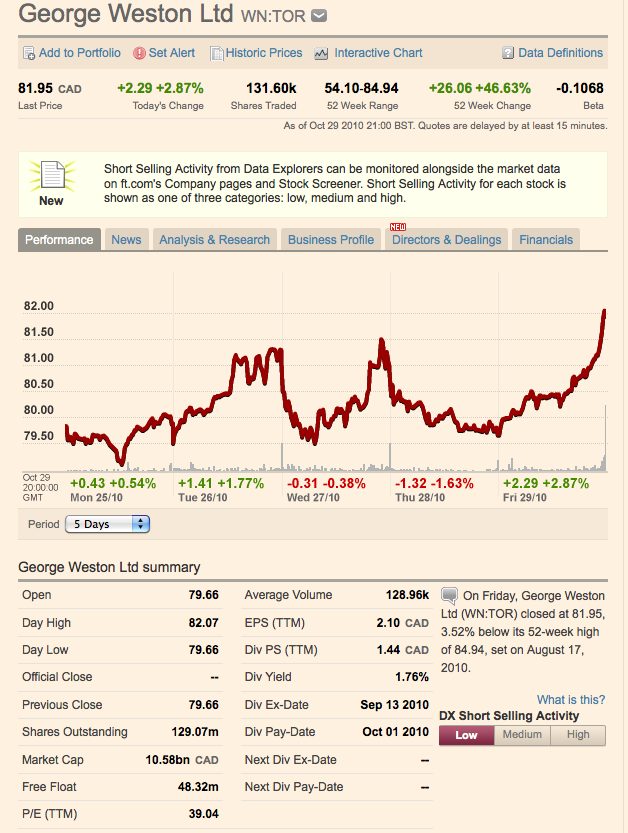
Because I am … well, me … I wanted to know who profited from the purchase on the baker side. A few business filings later and it turns out, Girl Scout Cookies are mostly baked by a company called ABC Smart Cookie, which is a subsidiary of Interbake Foods LLC, which is a subsidiary of Weston Foods U.S., which is owned by (sound of trumpets) George Weston Ltd., a publicly traded Canadian company with shares changing hands on the Toronto stock exchange, currently priced at $81.95 Canadian dollars with annual dividends of $1.44 Canadian. The company has a market capitalization of $10.58 billion Canadian dollars so it’s big. But, I supposed if you’ve been baking cookies for almost 100 years, that certainly is enough time to compound your shareholders’ capital into something meaningful.
 Here’s what I love. Somewhere out there, some guy owns 1 million shares of George Weston Ltd. Each year, he gets a dividend check for $1,440,000 Canadian dollars. And part of that came from baking girl scout cookies so he is, quite literally, making a profit each and every time someone buys a box of those delicious treats. It’s almost so beautiful it makes me want to sing. How can that not excite you? To collect almost $4,000 per day from cookies!?
That is what I love about capitalism and free market economies. If you have the cash to buy a share of the stock, you get the dividend. The stock doesn’t know if you are male or female, rich or poor, black or white, gay or straight, a Ph.D. or high-school drop-out, attractive or ugly, thin or fat, old or young, American or Chinese. YOU own it and YOU get the profit because YOU decided to put your money to work instead of squandering it on alcohol or cigarettes like everybody else. (Okay, wait … now that we own cigarette and tobacco stocks, maybe that isn’t the best example to use.)
The stock can’t say, “Sorry, but we don’t think you get along well enough with people” or “You know, maybe next year you’ll get that promotion”. The stock may rise or it may fall. It may double or it may go bankrupt. But it is up to you and you alone to determine whether you think the risks of ownership, at the current price, are attractive or not (frankly, the high p/e ratio makes me do a double take on this one but I haven’t read the report to see if there is something else going on like artificially depressed profits or a one-time write-off of goodwill or something).
Capitalism is the great equalizer, sorting people through meritocracy. A plumber who saves his money and regularly takes his cookie dividends, using them to buy more ownership of his cookie factory, would be able to do well, while an upper-class cocaine addict who failed out of law school will be dodging bill collectors. Sure, there are some exceptions, but in an imperfect world anything that works a vast majority of the time is certainly worth keeping.
Reader Comments (9)
Comments are presented chronologically, with replies indented beneath the comments to which they respond.
Frat Man
November 1, 2010
Hi Joshua. First of all, loved the Kipling post. My grandpa gave me four framed poems before he died, and one of them was "If." Whenever I'm home from school, I always look at it for a few seconds each morning- great way to reorient yourself as to what "really matters."
Also, I'm still stuck on the morality of owning tobacco stocks. I guess my concern is that I understand that people are making the choice to buy cigarettes, and they are free and consenting adults who can do as they like, but you often talk about the concept of "advancing civilization forward" (as a life objective) and it seems hard to think that by owning tobacco stocks, you are doing that. I spent a lot of time talking about this with any econ professor last week, and I got to the point where I could concede that you can justifiably subscribe to a moral theory that owning tobacco stocks is a "neutral" moral action, but I don't see how you could ever argue that owning a tobacco stock is a "good" moral decision-although I'm sure there are still some sides of the argument I have yet to consider.
Joshua Kennon
November 4, 2010
Replying to Frat Man
You're right. The is nothing "advancing the civilization" about owning tobacco stocks unless someone were buying the shares and donating all the profits to anti-smoking campaigns, effectively neutralizing the institution.
But I'm not doing that. I'm approaching it this way: If (A) smokers are stupid enough to smoke of their own free will, and (B) tobacco companies are going to exist regardless of my actions, and (C), the returns are higher than other stocks, and (D) I'm using the money to build something that does focus on building the civilization, then owning the shares is morally neutral. In contrast, I could never own stock in a company that made money selling children into slavery or forced labor camps by mining conflict rubies because I'd be profiting off of coercion. In that case, even though the product may be benign (jewelry), it would be morally reprehensible.
But make no mistake - there is nothing virtuous about the firms in this industry unlike Microsoft selling Microsoft Office, which improves productivity and gives people more time in life or Nintendo selling entertainment in the form of Super Mario Brothers.
But on the same note, for most of our lives, anyone who bought an Oreo cookie was sending their money directly into the same corporate Treasury as those who bought Marlboro cigarettes. I used to tell my mom, "You can't eat Oreo cookies and complain about tobacco companies. The profit ends up in the same place." (It did until the relatively recent Kraft spin-off.) Me owning tobacco stocks is no different than a family buying Kraft macaroni and cheese.
Patrick T.
November 1, 2010
Great blog Joshua!
I rate it 6 stars out of 5...
Joshua Kennon
November 4, 2010
Replying to Patrick T.
Thank you, Patrick. =)
Austin H
November 1, 2010
Joshua-
Yes- it makes me very happy! I love the feeling I get pulling into a Costco and not being able to find a parking spot because the entire lot is full of customers spending hundreds of dollars on high quality products, many of them Costco's private Kirkland label. On top of that, each customer pays 50-100/yr for the ability to shop there.
Yes, I love capitalism.
-Austin
Sue
November 1, 2010
Hi Joshua. I don't get Thin Mints either. It's like the poison and the antidote were rolled into one.. Makes no sense whatsoever.
Love your blog! Best wishes.
Joshua Kennon
November 4, 2010
Replying to Sue
Thanks, Sue! Now I can tell Aaron that my blog readers agree with me, LOL. (His response will probably be, "Good! More Thin Mints for me.")
FratMan
February 17, 2012
Now that Weston's down to $64, is it catching your attention? You might have to do what you did with Disney, and buy the Gentleman's 100 shares haha 😉
Joshua Kennon
February 17, 2012
Replying to FratMan
I hadn't seen that; I'll have to add that to my reading list. Between the secret project going live this week and the home renovations, I've only managed to read a dozen or so annual reports this month. (Speaking of the Gentleman's 100 shares - I love that title, by the way - I happened to log into that out-of-the-way brokerage account for the first or second time since the Disney vacation six months ago as I reviewed my household investment portfolio and did a double take. Those 100 shares I bought for memories during the trip are up more than 25%, not counting the dividend. It did exactly what I was hoping - it reminded me of the trip and brought a lot of joy.)
It's an oddball thing, but I really do like the program as a form of nostalgia. Going through the lists of "reserved" securities, there are shares of Berkshire Hathaway that I requested from my parents as a graduation gift, there are shares of Goodrich and EnPro from my freshman year of college, there are shares of American Eagle Outfitters from my sophomore year of college ... etc. There is a certain irony in the fact that my financial version of a scrapbook should end up being bigger than most people's retirement funds simply due to basic compounding.
Then again, that is why millionaires become millionaires. As Thomas J. Stanley said, we are, by nature, accumulators. Looking at furniture and accessories, I only want to own stuff that holds and appreciates in value. It's a by-product of our personalities; a symptom, not a cause, if you will.