

Are you in the mood for a case study resource for your own investment policy manual? If so, brace yourself because this one is heartbreaking. You can learn a lot from it, and save your own family a great deal of tragedy, but it’s going to involve surveying the ruins of the lives of others so you might want to steel yourself.
I found it courtesy of one of you – thanks Andrew! – who sent this to me in the contact form. I happened to see it while following up on a promise I made to a few of you to check if your messages were getting through (I’m still working on that, an update later). It’s incredible both from a practical, financial standpoint, and a human psychology standpoint. The night I followed the link, I spent the entire evening going through the 535 or so pages, mesmerized by the delusion. It’s a living, breathing embodiment of the opposite of everything I write about in terms of risk management, capital allocation, tax-efficient compounding, and fundamental analysis. It is a testament to the power of temptation, and proves that individual investors, including those who are poor, are frequently just as greedy, and no more moral, than the most avaricious investment banker so demonized in the popular culture over the past few years.
Before we get into studying it, and I publish the link for you to begin your own case study, I have a request: Please do not go onto that forum and comment. Look, but don’t touch. The people in there have lost huge amounts of money, in some cases, their entire life savings. While we can do a post-mortem analysis for our own purposes, causing them to feel more regret is not only cruel, it is unlikely to do any good considering they just learned the most painful lesson of all.
Ready? Let’s dive into this.
The GT Advanced Technologies Bankruptcy
The forum in question was for “investors” – and I do not use the Benjamin Graham definition of that word in this case – in a company called GT Advanced Technologies. GTAT was supposed to be the primary supplier of sapphire glass to Apple, which everyone thought was going to include it on the iPhone 6 and iPhone 6 Plus. Plans changed as GTAT management was unable to execute on time, so the sapphire glass, instead, was going to be used on the upcoming Apple Watch and then in later generations of the iPhone.
What should have been a small bump in the road lead to a shocking, out-of-the-blue Chapter 11 bankruptcy filing and the near total decimation of the common stock with practically no warning. The company had a positive net worth, hundreds of millions in cash at the last quarterly filing, a good probability of making a lot of money in the future, and management reiterating earnings guidance only a few weeks ago.
How could such a thing happen? It was a Lehman Brothers / AIG mistake. GTAT management had not only made poor capital structure choices, it had signed legal agreements that required it to come up with huge amounts of liquidity on little to no notice under the wrong circumstances. Primarily, they funded long-term operations with short-term capital, negotiating a nine-figure, multiple-installment working capital loan from their most important customer, Apple, and then gave Apple the right to demand accelerated payment at virtually any time. Even issuing zero coupon junk bonds on a long-term basis would have been preferable to such a make-it-or-break-it contract.
There were several warning signs that should have been visible to anyone familiar with forensic accounting or basic security analysis. There was an over-reliance upon a single vendor, which requires a huge discount to intrinsic value to justify in most cases if you are going after risk-adjusted returns as you are inherently dependent upon the financial health, goodwill, and continued support of an entirely separate firm. The auditors warned shareholders in the SEC filings of a material deficiency in the internal accounting records, which is one of the handful of things that will make me walk away from a company no matter how good everything else appears (if you can’t trust the numbers, you can’t value the firm). There was a note in the SEC disclosures that the financing arrangement could make it impossible to continue as a “going concern” due to a cash short-fall (if you ever see those words, your eyebrows should shoot up). There were no major contingency plans or back-up capital sources available if the iPhone 6 and iPhone 6 Plus launches were missed. The CEO allegedly had a history of what seems to be a near megalomaniacal desire to swing-for-the-fences, already having run one business into the ground. Apple had no minimum purchase commitments, and no exclusivity contract, so demand projections were entirely speculative.
Given the capital structure and lack of purchase commitments, under no circumstances could a position in GTAT be considered an investment operation as defined in Security Analysis or The Intelligent Investor. It was a speculation and, to be frank about it, not a terrible one. This was a case of the right idea being in the wrong hands. Had management been less reckless, a lot of people could have ended up obscenely rich. Were one inclined to gamble, there were worse ways to do it. It just didn’t work out this time. However, this forum is full of people who didn’t make the distinction. Every imaginable portfolio error can be found in its pages. People taking speculative positions in tax-sheltered accounts (almost always a bad idea as you lose the huge benefit of tax loss credits that would make recovering much easier in the future); buying stock on margin; risking more than they can afford to lose in the event of a total-wipeout; not keeping certain types of capital piles, such as college savings, exclusively in investment operations.
When Andrew sent me this link, he first pointed to this page, about a month before the bankruptcy announcement, when people were talking about how foolish it would be for them to own index funds or invest in a traditional sense. Then, he points to this page, on the morning they realize the stock isn’t trading. You follow their reaction upon discovering the shares have been halted. That bankruptcy has been declared. That the conference call they were expecting had been cancelled. Between it (page 499) and the end of the forum (535 when I read it), you see all five stages of loss and grief – denial, anger, bargaining, depression, and acceptance.
Some Excerpts on the GT Advanced Technologies Forum That Stand Out for the Lessons They Can Teach Investors
Here are a few excerpts, among many, that caught my eye …
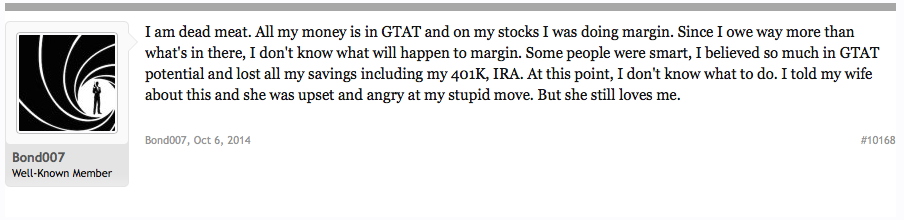
He later breaks down his losses, which amount to $750,000 in stock and $140,000 in options. Because he used borrowed money to fund part of the transactions, he not only lost everything, wiping out 15 years of savings, he owes his brokerage firm $107,000, which they are going to demand or else they’ll throw him into bankruptcy court.
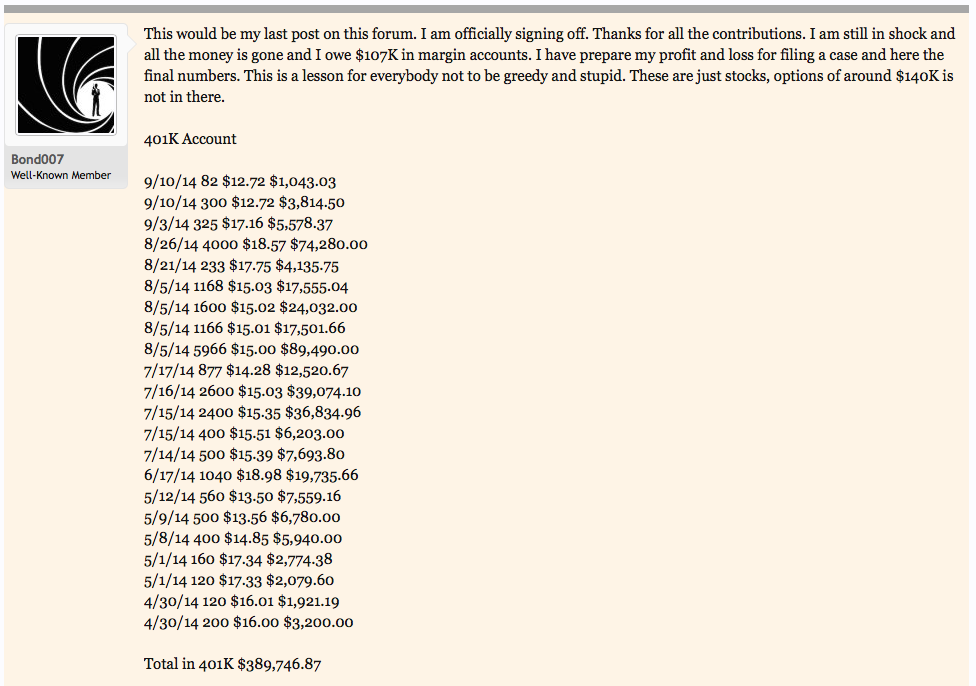
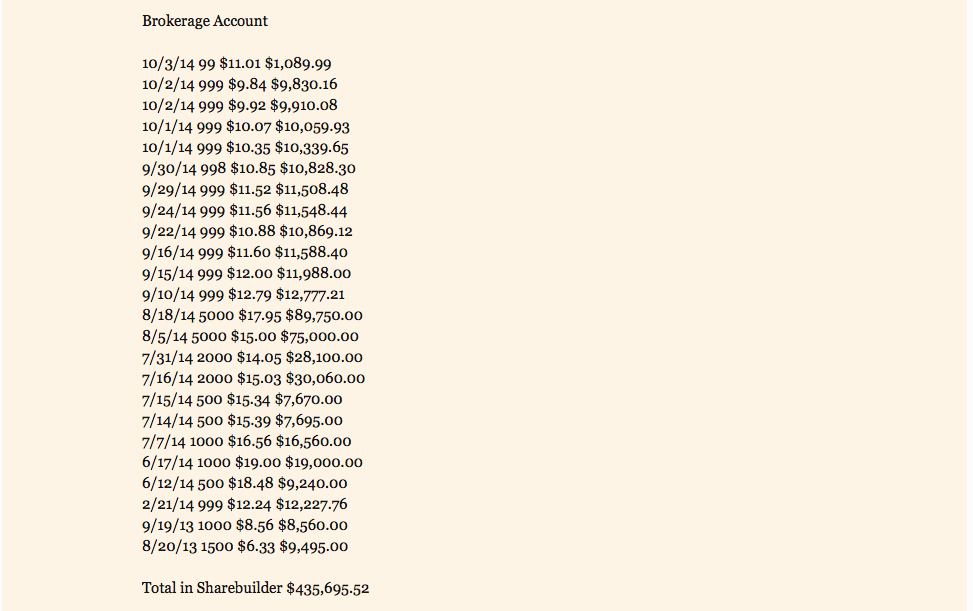
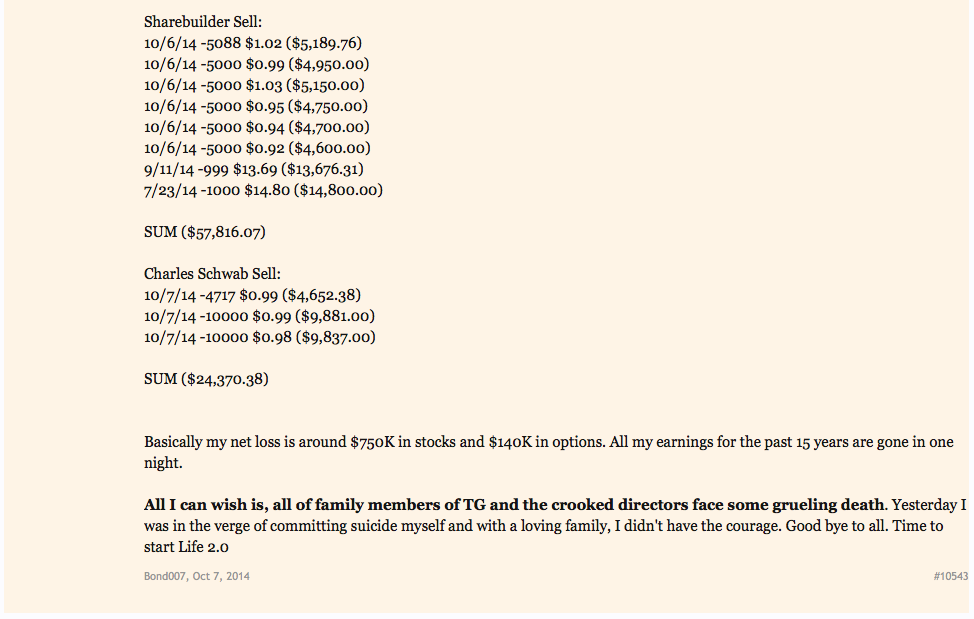
We can reasonably surmise that his accounts held approximately $783,000 in fully-paid, non-borrowed assets. According to his profile, he is 44 years old. Even if he had never saved another penny in his life, at average rates of return, he could have retired at 65 with $5,000,000 to $6,000,000 in tax-sheltered assets. At that point, he could have rolled everything over to a self-directed IRA and used it to buy apartment or office buildings at a 10% cap rate (which are still very easy to find in much of the Midwest), living off between $500,000 and $600,000 in gross rents per year. There was no reason for this gamble. He had won. He could have spent every one of the rest of his paychecks for life on luxuries and still ended up okay. Yet, now he’s facing a very real probability of personal ruin because of a desire for more, quicker. It’s devastating.
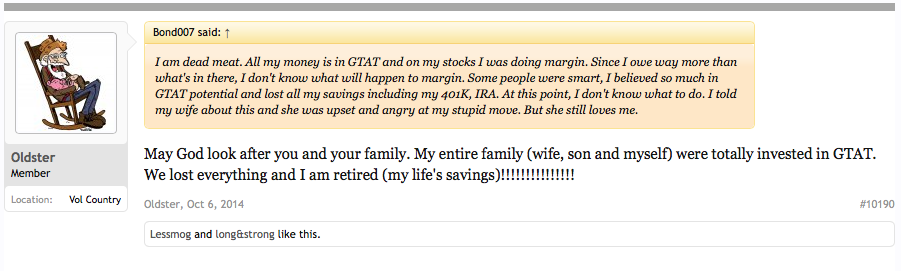
Here’s another one … this guy not only went “totally” in on GTAT, but so did his wife and son!
This person lost his or her entire retirement fund …
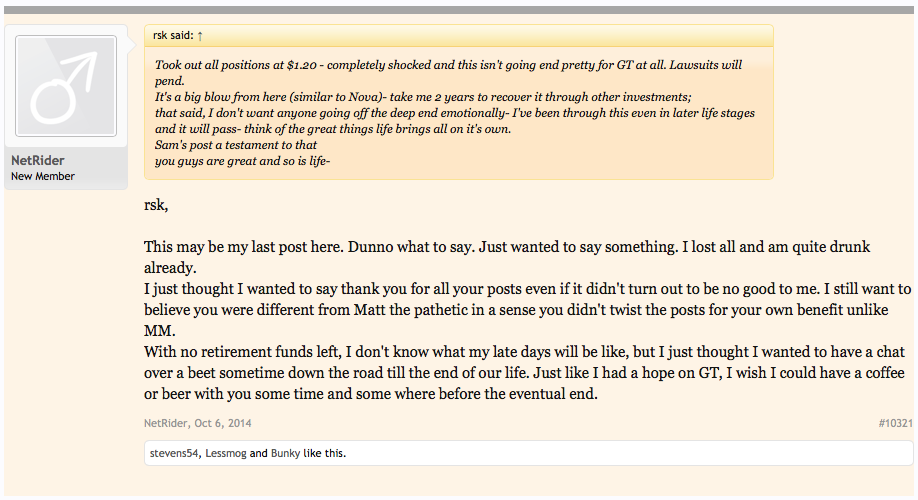
This father just lost his daughter’s college tuition …


This person is hiding the losses from his family …

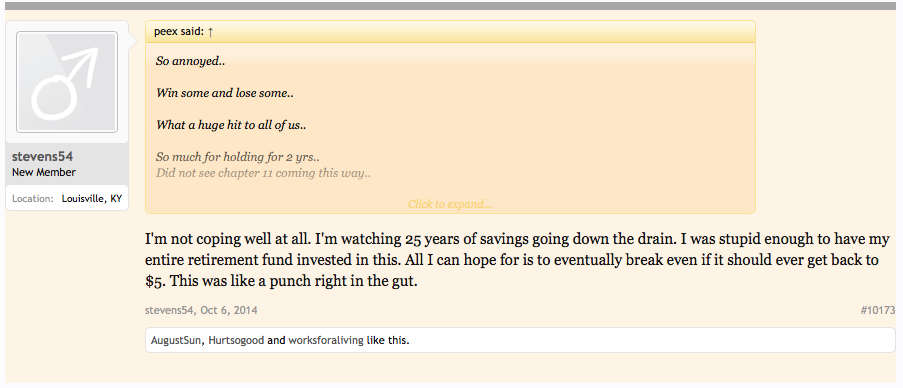
Another guy who lost his entire retirement account, 25 years of savings gone …


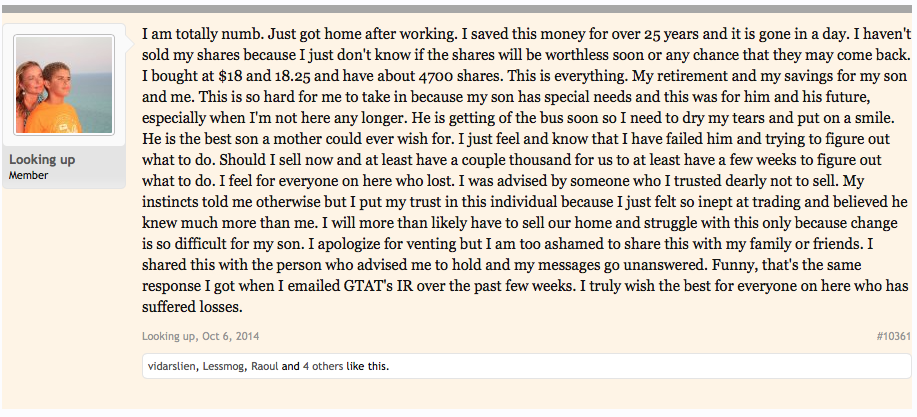
This woman is having to put her house on the market because she had taken her entire life’s savings and used them to buy 4,700 shares of the company, which she sold for next to nothing …

This person discovered he or she had lost everything while still at work …
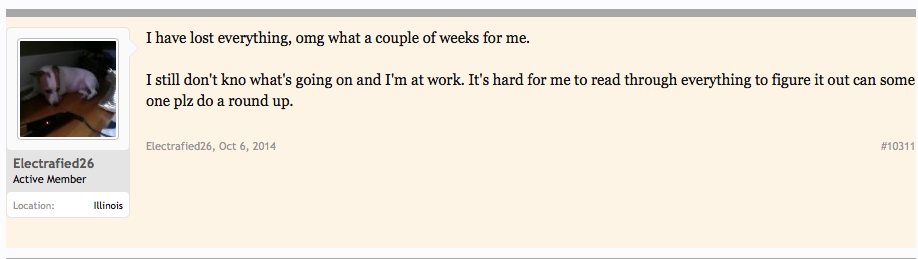
Another who lost all of his savings …
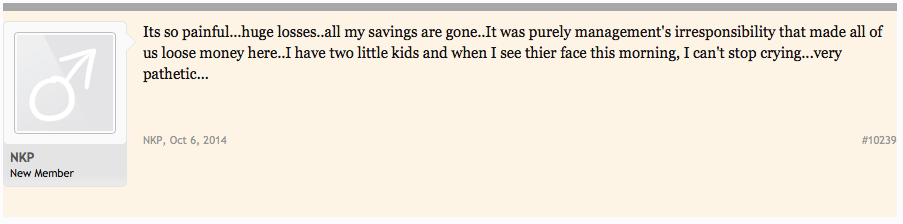
There are too many. You need to go read them for yourself. There is enough here, both in the GT Advanced Technologies filings and the forum response, to teach an entire semester course at university.
I’ve said it before, and I’ll say it again, but I think the do-it-yourself retirement system in the United States has been a social policy disaster. It works so well for rational, disciplined people. Meanwhile, others who work hard and are good folks but lack the temperament or experience to manage capital, lose everything. In the old days, everyone drew a pension check. I worry that as more and more of the country reaches retirement under the non-pension system, you’re going to have a very vocal minority of families screaming they can’t survive because they have no savings, no 401(k) funds … and somehow expect the government to pay their bills, which really means taxing everyone else who did behave responsibly even more to fund transfer payments; e.g., higher Social Security benefits. If this were 1970, none of these people would have had access to their retirement money in the first place. It would have been pooled, and managed, by the pension portfolio officers, who were bound under restrictive laws to put the cash to work in blue chip stocks and gilt-edged bonds at huge economies of scale. The workers never saw the pension plan assets fluctuating like crazy so they didn’t lose any sleep over the 1973-1974 stock market crash. It was a better system for most men and women, I think.
Just like Senator Roth introduced the Roth IRA, were I a Senator, my primary objective would be to introduce the Kennon Pension. I think it is possible to create mobile, portable pension plans that move from company-to-company with workers. It would take only a slight tweak to the tax code, and very draconian rules for financial institutions that offer them (e.g., maximum statutory limits on promised returns). You could make contributions and buy additional income for life. It’d be a superior system for a lot of people who would never have to worry about running out of money, while offering a huge new market for Wall Street. Annuities should fit the niche, in theory, but they fall short at present.
Reader Comments (70)
Comments are presented chronologically, with replies indented beneath the comments to which they respond.
Ian Francis
October 19, 2014
Wow. What is fascinating is multiple people on there have done this before and learned nothing. Lost their entire savings on one company, recovered, and put all their eggs in one basket again. These people absolutely have a gambling addiction, and are causing their families as much heartache as someone working the slot machines every night. I am just in utter disbelief that people can have such a poor grasp of risk and risk management. I'm not judging them, I just don't understand. At all.
I may have mentioned this before, but this reminded me of one of my coworkers. Definitely nothing like the people in this forum, but every day he talks about what the stock market has done for the days session. Way up, way down, not quite panicked, but certainly concerned. I keep telling him he has at least 5 years left until retirement, so it really means nothing until he is ready to start spending that money. Doesn't seem to get it. I tell him he should be glad stocks are lower until he is ready to retire. Doesn't get it. He is an engineer. He should know better.
I really like the personal investment savings system over pensions. I like knowing that my savings exist as long as the US government is still around. I always fear that my pension could be decimated if my company were to go bankrupt. Obviously most people aren't equipped to manage their own finances, but is it a problem of poor financial education, or something more inherent to how people think? I know that I (and hopefully most people who read your blog) don't think so irrationally, so it can't be impossible. Can it?
SDisho1985
October 19, 2014
Replying to Ian Francis
Anyone who needs more, I can highly recommend this. I started doing this for 2 yrs and it helped me when I was in depression. I've 2500 in 1 week. Now I have fullfilled my many expectations. I am doing this regularly and I can say it's a great source. You can check it out here just by click on**************
check4₄.com
check4₄.com
check4₄.com
Joshua Kennon
October 19, 2014
Replying to Ian Francis
I used to think it was merely an issue of education (and for a lot of people, it is, which is one of the reasons I write so much). Over the years, seeing a certain group of people with a certain temperament never learn anything, repeating the same mistakes over and over, I'm convinced there's some neurology involved. For people like you, me, and most of the readers of this blog, the personal savings system is far superior because we can tailor our retirement allocations to specifically what we want to accomplish, taking other considerations, including our non-retirement assets, into account.
Under the portable pension system plan I'd like to see created, you wouldn't have to worry about your employer going bankrupt because I'd simultaneously expand the Public Benefit Guaranty Corp, which serves as a government backstop to failed pension plans. (This is why it would be so vital there be strict regulations on promised returns - you'd have to make it almost impossible for a pension to go bankrupt or come up short by limiting the total promised return for every dollar invested to some conservative formula. You could probably do it by borrowing from Australia's model of having certain authorized institution for certain retirement products; e.g., the government grants a license to Wells Fargo or Berkshire Hathaway to run an isolated pension under strict supervision like the FDIC does bank deposits.) You could even borrow the FDIC model and assess a certain, tiny fee to all pension plans to fund bailouts in the rare case of a failure so the taxpayer didn't have to cover any of it.
Odai
October 27, 2014
Replying to Ian Francis
Still processing all of this, but this post has an interesting insight:
"...I probably shouldn't bother to take any more risk and should sell all my GTAT but that is not who I am and will never be. When I buy a bond fund or a blue chip, it is like somebody punched me in the gut, as I feel any idiot can do that. I recently bought a boatload of HIMX at 6, and that is totally unnecessary and probably should play it safe, but it is hard to change who you are and what has got you to this point."
The poster seems to get an ego high from profiting off risky stocks, maybe because he feels like it proves how smart he is to everybody. Sensible investments don't give him that high, because you don't have to be especially smart to make those investments.
If that's what's going on, it explains why these investors keep taking the same risks over and over.
JJ
May 14, 2015
Replying to Odai
It's probably to feel thrill rather than to feel smart. A lot of smartness comes from thinking, and enough thinking usually reaches a "boundary", where the unreachable is filled with "awe". For investing, I find the law that "a perfect market's price follows Brownian motion" intuitive. It basically hints the utter difficulty, if not impossibility, to speculate, and points to like index funds as a common sensical tool. Therefore I just put money in index fund, spending very little time, and harness the results of the economy. By doing this, I feel very smart. So, yes, buying blue chip, anyone can do that, but, no, buying index fund and knows exactly why, not anyone can do it.
Ashley Pomeroy
July 16, 2016
Replying to Odai
"When I buy a bond fund or a blue chip, it is like somebody punched me in the gut, as I feel any idiot can do that."
A few pages after the bankruptcy hits, one of the posters suggests that people could recoup their losses by going short on GoPro.
"I see GPRO dropping into the 40's by the end of the year", he says.
Ironically his advice was correct - I haven't run the maths, but GoPro peaked at roughly the same time that GTA went bankrupt - but (a) he had no way of knowing this in advance (b) as another poster points out, anybody following his advice would be just piling on risk on top of more risk. It's as if these people were making a series of last desperate throws of the dice.
RogerMKE
October 19, 2014
I have friends -- otherwise smart business executives, who do this sort of thing all the time. One of them loaded up on RSH (Radio Shack!) at $8 a share because some article he read on the Internet said it was poised to "break out" and rise to $15.
Two more of them went 100% to cash because they are convinced the market is going to tank.
Oy vey.
dave (nestle)
October 19, 2014
So when is the Kennon Pension opening?
A few thoughts...
Yes, the tax loss credit thing is nice. I personally, with the help of my sharp accountant, have been taking these for many years against a business/investment loss. It doesn't relieve all the pain, but it's something. It's more mental now, than material to my life.
Also, I recently watched an interview with Mark Cuban on you tube where he talks about people being idiots for using old "Warren Buffet" styles of investing. He said diversification is also idiotic. He proclaimed to the masses how stupid that is. He says to keep your money in cash and then buy puts and calls,etc. when volatility is high.(paraphrased)
Now to me, Cuban is an example of what is wrong with investors mindsets. He is a cowboy(literally, a maverick). Now, he is a billionaire, and I'm not trying to take that away from him. His attitude and style however seems more about luck than brains and reason.
But, as with most things in America, the majority follows his type of sensationalism, and ultimately will rely on luck (and government) for their future.
Allen Jarboe
October 19, 2014
Replying to dave (nestle)
If I remember correctly, I think I saw an article stating that Mr. Cuban recently acquired a large block of NFLX, due to him writing puts on it. I'm sure he acquired them for a large initial loss, and NFLX to me is very speculative in nature as well. So in short, it seems to me Cuban is taking some risks that I don't find suitable for myself, but on the other side of that his financial situation is obviously much different than mine and it is hard to completely judge without a full picture.
dave (nestle)
October 19, 2014
Replying to Allen Jarboe
It took me a long time to actually form an opinion on Mark Cuban. I just think that alot of people idolize celebs that speak like he does (and I'm only talking about investing, as he has good things to say about other things). The more I saw him being interviewed (about investing in isolation), the more I said to myself, wow I wouldn't be surprised to pick up a newspaper some day and see that he lost his entire fortune.
Case in point: how many people may have gone out and bought Netflix the other day after he was on twitter and cnbc? Now 50,000 additional shares of netflix to Mark Cuban is like me spending a hundred dollar bill, so he can afford to absorb a loss. But it's all relative to the message that many people will get when seeing that tweet.
I cringe when I see this stuff as "breaking news". That's where I truly feel bad for people, including the GTAT investors.
Steven
October 19, 2014
Replying to dave (nestle)
Cuban made his fortune through starting and selling tech companies - and I respect him for that. I also find him very entertaining - especially as the Mavs owner.
That said, I wouldn't look to him for investment advice...well maybe if I owned a tech startup, but not as a regular joe investing my salary.
Bruce Brunken
October 31, 2014
Replying to Steven
He made it big on one deal. That's it.
Scott McCarthy
October 20, 2014
Replying to dave (nestle)
A quick googling, and I believe I have found the interview you're talking about: http://www.wsj.com/video/cuban-on-investing-diversification-is-for-idiots/233AE43E-9DA3-40A3-8F6B-9DC23DD82BEF.html
I don't take that the same way you seem to have. For instance:
reminds me of Peter Lynch, if anything. Invest in what you know.
And this:
seems very reasonable, indeed.
Keeping cash on hand (rather than being 100% invested at all times), and focusing on guaranteed returns (have a budget, and pay off any credit card debt you may have) rather than trying to beat an increasingly efficient market is pretty much boilerplate, I think.
I mean, this is a guy who was famously interviewed on CNBC after he sold Broadcast.com to Yahoo, when being asked if he felt like he made a mistake by selling his Yahoo shares as soon as they vested, given that it had gone up a few dollars per share in the few weeks since then, told the anchor that it's hard to feel like an idiot when you sitting in your G-V. He's always been a guaranteed returns guy.
innerscorecard
October 19, 2014
First of all, I was very sad to read about this. Life often doesn't turn out well, and there isn't always a way out, especially once you near retirement age (some may argue there's no huge way out for even younger people who may incur $200,000+ in loans to go to law school, but at least the passage of time and inflation will help somewhat so that these people may "only" be set back by a decade or so).
One thing that always puzzles me is the fascination with Apple suppliers. A friend of mine made the analogy that always trying to find the next hot Apple supplier is like being fascinated with the people who supply onions to the Michelin-rated restaurant. That can't possibly be where the economic value will accrue, especially with a company like Apple that is known for being merciless in negotiating with suppliers. I mean, if you think mobile is eating the world, why don't you just invest in AAPL? It, like other blue-chip stocks, should make you rich eventually with dividend reinvestment. I suppose the appeal of getting rich quick blinds people to the possibility of getting rich slowly.
Stanley
October 19, 2014
Imagine delaying consumption for over decade(s), only to lose it all. It's nauseating to read that someone scrimping and saving could have lost it all in a wipeout.
But surprisingly, some of them handled the loss pretty well. Well, better than I would have in their shoes. How money, although lost, is just money (Not to minimize their suffering - painful as it was). And that in the grand scheme of things, there are still other important things that they have not lost like their family and friends. Trite as it sounds, I think that's one of the most important lesson, at least for me, personally.
---
P.S. On a side note though, (I sincerely hope this is not inappropriate to ask - if it is, I hope you could delete this), I've read Snowball: Warren Buffett and the Business of Life. There, in detailing Warren's life, there is a paragraph: "After his first year, he finally found a class he liked, Professor Hockenberry’s Industry 101. “It was textiles, it was steel, it was petroleum. I can still remember that book. I got a lot of stuff from it. I can remember talking about the laws of capture in petroleum, and the Bessemer processes in steel. I devoured that book. That was really interesting to me”"
Anyone here know which book Warren was referring to, as it seems like a pretty good text on introduction to industry.
Roundball
October 19, 2014
What a sobering read. The Intelligent Investor should be mandatory reading for anyone investing in the stock market. At the very least, people should be able to recognize the difference between an investment and speculation.
Doug
October 19, 2014
Fantastic post, Joshua. And I, a card-carrying Republican/small-l libertarian strongly agree with the "Kennon Pension." Most people are not wired to invest rationally. I think 401(k)s have improved a lot, with target-date funds and "opt out" plans (i.e., your money is automatically invested unless you specifically say "no"), but there are still fatal flaws. People are wired to buy high and sell low.
William Bernstein recounts a great story about this issue. He is sitting in a conference room talking to the CEO of a company which is terminating its pension plan. While they are talking, the catering staff comes through and cleans up lunch. When he leaves, Bernstein turns to the CEO and says (I'm paraphrasing) "I have a great idea - why don't you have those caterers manage your retirement funds for you?" The CEO snorts and says "of course not, haha." Bernstein turns back to the CEO and says "then why are you forcing them manage their own money?" Touche'.
On a darker, more cynical note, this post made he think of commodities speculator Ed Seykota's famous saying "Win or lose, everyone gets what they want out of the market."
Joshua Kennon
October 19, 2014
Replying to Doug
That anecdote is perfect! Thank you for sharing that.
Steve Roberts
October 20, 2014
Replying to Joshua Kennon
As the owner of a pension that is only 68% funded and withdrew from the stock market in 2009 (I'm not sure what it's $30B is invested in besides T-bills), pension managers do not necessarily make the right choices either.
I'm at a loss for what the right solution is though. Forcing everyone to purchase a Vanguard total stock market fund?
Joshua Kennon
November 1, 2014
Replying to Steve Roberts
That sounds exceptional (and certainly not in a good way, particularly if it were a public plan governed by the newer ERISA rules). If you don't mind, would you send me the name of the pension through the contact form so I can pull any regulatory filings and/or information I can discover on it to look at their asset allocation practices? I'd appreciate it very much.
Brendan
October 19, 2014
Sobering. I can hear Charlie Munger narrating those messageboard posts with bits from his lecture on Cialdini that I have listened to countless times. I personally have several thousand dollars in a very risky company, but thats a tiny, tiny fraction of my net worth (the rest being in various index funds) and if this particular holding went to zero tomorrow, I wouldn't lose a wink of sleep. However, on a particular messageboard I follow, there are folks who have their entire life savings riding on this company and I cringe. I repeatedly warn people to not take such stupid risks, but they have long since fallen prey to the fallacies and biases that helped cause such irrational behavior in the first place.
Brendan
October 19, 2014
Replying to Brendan
I'll add, the above mentioned high risk equity is risky due to its dependence on commodity prices and was very undervalued at my time of purchase. I have seen my holdings tank and soar since 2011 all while holding. During the same timeframe, others buy high, sell low and burn the midnight oil, hoping for a moonshot. One person risked their house down payment and sold it at a huge loss because they were speculating. Had this individual held for another year, instead of a week, they would have profited handsomely. Human folly...
Samuel Smith
October 19, 2014
Unbelievable. Thanks for publishing this. I'm going to start reading your blog more now.
mikecrosby
October 19, 2014
So many ways of looking at this story and lessons to draw.
While reading, I thought, "how would I handle this?". Honestly, at the beginning it would be tough, in the future it would linger in my mind, but I would get on with life.
Joshua Kennon
October 19, 2014
Replying to mikecrosby
I really liked the response of a user named Sam Gidwani (post #10260). In the face of total ruin, I think his reaction is the only way to recover in the quickest possible timeframe. You realize you made a mistake, take responsibility, allow yourself to grieve, appreciate what you have left, come up with a plan, and move forward toward rebuilding.
Sometimes, mis-steps can turn into the greatest blessings or opportunities in life. Sam Walton lost one of his first businesses when he didn't know to include a lease renewal provision in the contract he signed for the store. The owner of that building then kicked him out at the end of the term and turned over the property to his own family, who opened a store that thrived upon the traffic that Sam had built. While he had his savings, he lost his primary cash generator and had to start over again. Starting in middle age, he ended up building one of the greatest retailing empires in history and his heirs are richer than Bill Gates and Warren Buffett combined.
There was one billionaire on the Forbes list I remember reading about years ago. He was fired or laid off from his job during the Great Depression and decided to go to work for himself. It was the company he founded, with practically nothing, that ultimately made him his money. (I wish I could remember his name but it escapes me at the moment.)
Warren Buffett was rejected from Harvard Business School. He talks about how hard of a blow it was, emotionally. Yet, it was that rejection that ultimately led him to New York, to studying under Ben Graham at Columbia, to tapping into Graham's network of investors when he started Buffett Partnership, and now, modern day Berkshire Hathaway.
Those are just the high profile examples of people who hit the proverbial jackpot. Even if you end up a small town business owner who never makes the newspaper but enjoy financial independence, sometimes, the things you think are your greatest failures can turn out to be the foundation of everything you ever wanted in life. It depends upon how you react to it.
Edit: Disqus is being weird, again, this afternoon. If the attached screenshot of the response I mentioned appears broken, click the broken image box and it will load.
S
October 19, 2014
I took a job working for a city public works. When we (the new hires) were gathered to go over our retirement, we were told we have an irrevocable choice to make between a pension-401k hybrid, and a 401k (the p-401k hybrid invests money beyond the citys cost of the pension into a 401k).
I don't know the reasons the others opted for the 401k but my reasoning was I was sure I could achieve better returns on my own. When polled, ALL new hires, myself included, opted for the traditional 401k. I remember thinking at the time, "There is no way we can all be better than average". It goes against the very definition.
Gambling? Misguided sense of ability? Could be a big problem.
Alexis C
October 19, 2014
The lesson I take away from this is that I shouldn't join an internet forum about anything that I need the ability to quickly change my mind about. Limit your exposure to echo chambers.
Aditya
October 19, 2014
Thanks for the links - it'll make good research material. Another example to study is the fallout of the Mt. Gox bankruptcy; tons of reddit threads on how devastating that was to "all in" people.
lnt90
October 19, 2014
Absolutely Humbling........It's one thing to read about a bankruptcy and see a little blip fall 95% on a screen, its another to see peoples lives fall into the abyss. Yet this so called "Investment" had all the hallmarks of a classic gamble. And anyone with just some basic knowledge could understand why.
-It's one thing to buy a company like Clorox which sells 25% of its products to one customer with a well established and predictable relationship ( i.e. WalMart). It's a totally different ball game when the customer has the supplier (GTAT) wrapped around there finger. The stockholder and management virtually have no control of the company, they are at the mercy of the customer in this case Apple Inc.
-GTAT had completely changed its business portfolio from a few years ago, and used all free cash to convert to the new glass tech. In other words this business had done a complete 180. Originally the company was a solar company going back to 2011. The profits/FCF was NOT predictable under any circumstances. Going from solar energy to sapphire glass tech is not exactly synergy. This would be like Coca-Cola selling its soft drink portfolio to into the auto industry.
-The company has not turned a profit for over the last year. Clearly putting the company into the realm of speculation on that note alone.This was not due to temporary asset impairments, one time legal fees, or minor accounting settlements, this was due to core structural reasons.
-The CEO has had a questionable at best track record at previous companies, even seeing one fold over on his watch. TG's track record certainly didn't yell out this is the next Alfred Sloan or Ray Kroc.
-To validate a investment in a company in the technology industry requires AT BEST a significant margin of safety, due to the fact (more so than any other industry)a company can be on top one year & go the way of Bethlehem Steel the next. While people love iphones today, it was only a few short years ago Blackberry's were all the rage, than Nokia phones, than it was beepers, etc. Point is I sincerely doubt we will be using iphones 10 years from now. And GTAT would go as quickly as it came in.
-The valuation left no margin of safety at all, no traditional metrics could be used because the company was not profitable and had completely change industries so the former years could not be used either.
Point being, you did not have to be a college professor or the next John Templeton to figure out this was not a investment. Just do your homework or stick to non-equity investments or buy a S&P 500 index fund and get rich slowly. It's a million times better than buying high, selling low and holding your head.
lokgp
October 19, 2014
Replying to lnt90
It is interesting to note that, GTAT was priced around $ 5 Billion in common shares plus $ 1.1 Billion on warrants and convertible notes. So, about $ 6 Billion price tag for a company that is losing money. And that was the sort of average price for 2013. Shareholder's equity was only $ 300 million. And looking at the volume traded in the past 2013 at peak price between $15 to $19, there must be someone who is making a large profit from the selling their shares. And internet forums can be manipulative and can create a monkey see monkey do effect, eg: "' I've invested all my retirement savings into it. I am going to hit it rich!" - I don't want to be left behind. If he is doing it, he must have done enough research to have the guts to do it. I'll do it too. Then.... everyone is placing huge bets, they must right. I'll do the same! Let's get rich together. Independence of thought, and ability to just change your mind is tough to practice. 🙂
lnt90
October 22, 2014
Replying to lokgp
Mr Kennon was right to point it out & I did not, although share owner equity was 300 million, YOU CAN'T TRUST THAT NUMBER!! the company had amde it clear in the risk factors they had found there reporting of financials was inaccurate in certain items, meaning the balance sheet, income statement and cash flow are all untrustworthy.
In other words it's 300 million dollars worth of garbage.
Russell Kuo
October 19, 2014
Heartbreaking. Hope this can serve as a wake-up call for some people out there (not anyone that's a regular on here of course).
Adam
October 19, 2014
Holy crap. I've never read a forum like that. I just worked my way through about 50 pages and feel awful for these devastated people.
They should certainly not be managing their own retirement money. I'm all for portable pensions.
Connelly Barnes
October 19, 2014
Great post. Also frightening!
I will use this as a reminder to myself to read all the auditors' statements and risk factors in all recent 10-Ks and 10-Qs carefully before investing. Some of the key sentences were buried after long blocks of legalese.
Furthermore, it seems it's important to read each 10-Q promptly after filing, because the "going concern" issue only occurred in the 10-Q filed August 8, 2014. This gave the alert business owner less than 2 months to recover capital before bankruptcy.
I usually see conference calls show up as news items on SeekingAlpha or Google Finance, so I should make sure to get the 10-Qs each time these show up.
lnt90
October 19, 2014
Replying to Connelly Barnes
While I 100% agree that reading the Q's is always good to do - Don't stress out too much over it either, any of the problems at GTAT could have been seen just by reading into the annual ONE TIME during the year, and several fundamental investing no-no's would have been noticed just by glancing at the story behind the company. But yes, there were red flags at every level.
Thoughts & prayers to all who got affected in negative ways by what occurred.
Paul
October 19, 2014
Well, why don't you run for office?
SB
October 20, 2014
Very sad. I was reminded of my own education. In 2011 I lost ~50k in options (to make it worse, some of that loss was in IRAs so no tax benefit as well) when I made some crazy decisions after just few discussions I had with person I know. I was just so naive. That loss (plus having a death in a family just around that time) kept me depressed for few months. However now I see it as great education after 3 years. I started extensive reading on investment, frugality etc. Found great blogs like Joshua's, MMM etc. Also having a very well paid job, promotion in 2012 and frugal spouse helped me. Lucky for me I hit seven figure net worth just recently. I am 100% in index funds now. I am so careful now that I immediately sell any RSUs or ESPP shares from my employer as soon as they vest and invest immediately in index. Reading posts above, many people lost much more than I did in 2011, very sad.
jeb
October 20, 2014
Replying to SB
I also had a shaky up and down record when I first started investing out of college. Then I realized that short term profits and a quick, risky buck was not investing. I created a personal investment policy statement based on this site and bogglehead. There are now rules I've put in place for myself that I read over before any buy.
I still have to mentally train myself to avoid a similar circumstance to the one above. Once I buy shares in a certain stock I feel so good about the decision that I want to pile more and more into it. But that's against my diversification policy so I can't. After a short time my feeling fades so I know it is just irrational thinking.
Jake Thomas
October 20, 2014
Joshua Kennon for senate just rolls off the tongue so easily.
Jay Mack
October 20, 2014
Wow....just wow. And I thought it was bad when my Mom sold off a good chunk of her 401k at the bottom of the recession. There are no shortcuts, it is a real crime that people are not forced to take basic investing skills in high school. If we are to be expected to manage our retirement, the average Joe who is not going into the world of finance should be given the basics needed to make sound decisions with their money. My heart breaks for these people but anyone who would put all of their eggs into a "going concern" basket should not be managing their money.
dave (nestle)
October 21, 2014
So last night I got some chicken tortellini soup, shrimp marinara over spaghetti, garlic bread and a raspberry lime seltzer(sorry shareholders, I dont drink coke), and proceeded to rewatch the Cuban interview. You see, I am usually more easy going and agreeable on a full stomach. haha
Anyway, with my post I was trying (maybe terribly)to parallel the sad feelings I had when I read about the gtat investors' losses with my own reasoning behind it. To me, when investors act irrationally it seems to stem from emotion(greed,fear,even love), rather than sound reasoning. These people usually get their idea from somewhere. Take the lady with the special needs child. Do you think she did an in depth financial analysis in gtat after stumbling across the company while searching for solid blue chip stocks? I would bet that she got the idea from someone "knowldgeable" spouting off about it. All she was thinking about was securing a future for her so after she dies. A noble cause!
One of my hobbies is following self made wealthy people who made their money in this/my generation. Then I want to see what other paths they follow after they made obscene amounts of money. People like Phil and Willie Robertson, Carl Icahn, Kevin Oleary, Vanilla Ice, and on and on into people diversification.
A wise man once told me to stick to what I do well with mynown talents, AND leave the "shoemaking to the shoemakers" This is key to my mistakes in life.
So just like I see a man like Mark Cuban touting a cookie company he invested in on Home Shopping Network by saying he doesnt eat meals, just an average of 22 cookies a day(yes he said it repeatedly and the cookies sold out),or Regis Philbin pushing Micron Technologies stock ,for months and months, I think that they should just leave the shoemaking... They are doing more harm than good. They are great at building brands but bad at other things.
Ultimately though , people are responsible for making up their own minds, however unfortunate that is for many.
But I will continue to rethink my position on Cuban because his pretty and seductive smile is loved by so many. (i say this just for levity)
Peace everyone.
dave (nestle)
October 21, 2014
Oh and Scott, I only offered the previous post as a better explanation of where I was coming from. My joke at the end was not directed at you personally. I respect your opinion and see where you are coming from. Thanks!
Scott McCarthy
October 22, 2014
Replying to dave (nestle)
Oh no worries. I didn't take it as being directed towards me (and frankly, even if I had, I doubt I would have been offended or anything).
Bryin
October 21, 2014
On a human level I feel for those that lost money. On a economic level, they were greedy and stupid and those two traits have terrible consequences when mixed. I wont waste pity on someone that put all of their savings into one, very speculative stock. Just having the knowledge to open a brokerage account that allows you do something this moronic means it is almost a sure thing you have been exposed to advice not to even contemplate this sort of investment.
AL
October 22, 2014
Replying to Bryin
Google the Galveston Plan for a neat alternative to 401-K and Social Security
ImperatorMachinarum
October 30, 2014
Replying to Bryin
It was a lack of knowledge that did most folks in. The majority clearly didn't understand the nature and statistics of risk and diversification. This alone would have spared any of them from a high odds catastrophe associated with an emergent company devoid of earnings, proven products, and credible management.
As other noted, confirmation bias prevailed. It wasn't only on TCI, but also Yahoo and Seeking Alpha message boards. Authors of articles also made overly optimistic projections.
Let's cut to the chase. Most investors should invest in 1 of 2 ways:
1) Dollar cost average into index low cost funds.
2) If you have the time and arithmetic skills, apply value investing in individual stocks.
3) Use a small % of your money to occasionally speculate...but even here, don't lose money easily.
The biggest red flag of all with GTAT? It wasn't even the lack of earnings, profits, & meaningful shipping of products. It was indeed Tom Gutierrez selling 2 million shares since October of 2012. He treated himself to generational wealth, all while earning a high salary...off of shareholders left with nothing...imploring investors to invest in a company he wouldn't.
Interestingly enough, a good number of GTAT posters defended Tom in this. That spoke volumes about risk and imaginations gone wild. In the aftermath, I really hope GTAT management at least gets stripped of their unfairly earned wealth.
I'm not holding my breath. Unfortunately the law gives wide berth to these things. But in the future, retail investors should be aware of these kinds of scams. In the end, that's what GTAT was...a scam.
kamins
October 25, 2014
It almost seems like there was this shared delusion on that forum. I suspect many of those people were exclusively getting their info from that forum, where everything was being spun to a positive light. Like an extreme form of confirmation bias, combined with system 1 thinking. Looking at the other stuff followed there, its mostly speculative tech companies, something like this was bound to happen. Still can't help but feel bad for them.
Mr.owenr
October 29, 2014
I have a question, are people allowed to choose what investments they hold in their 401ks? I read statements like "I lost all of my retirement" but it is difficult to understand because I know I can't choose what I get to hold in my 401k, but maybe its different for others.
Joshua Kennon
March 27, 2015
Replying to Mr.owenr
There are many, many different types of retirement accounts. The 401(k) used by most workers is only one of them.
There are SEP-IRAs, which allow (often business owners and the self-employed) to put away $50,000+ per year into a tax-shelter.
There are Roth IRAs, which allows you to avoid all taxes, forever, but only contribute $5,500 per year ($6,500 if you are 50 years or older).
There are SIMPLE IRAs, which are used at certain smaller businesses that want to offer a retirement plan but avoid the hassle of a 401(k).
There are Traditional IRAs, which are like Roths only not as attractive.
There are Rollover IRAs that you use to deposit your 401(k) money after you've left a job or retired.
If you open these accounts with a firm such as Charles Schwab, all of them can invest in individual stocks, bonds, mutual funds, ETFs, REITs, MLPs, or whatever. There are even so-called "self directed 401(k) plans" that allow you to buy individual stocks within a 401(k) but those are comparably rare.
Mr.owenr
March 30, 2015
Replying to Joshua Kennon
Thanks for answering this.
ImperatorMachinarum
October 30, 2014
I have a GTAT story to tell. Hopefully it offers something instructive. Here it is.
It will never cease to amaze me how so many folks disdained diversification and ignored the extreme risk with GTAT. I experienced this as an active participant and investor on GTAT forums. Suffice it to say, I had disagreements with GTAT thought leaders on many fora.
Don't get me wrong. I really thought my $27k basis could turn into a 5x-10x-15x bagger. The pieces were coming together in a seemingly causal chain of positive catalysts: the deal with Apple; grandiose assertions about Merlin and Hyperion; an earnings miss but guidance at least to the low end of $600 - $800 million in annual revenue. Not to mention a serious return in a relatively short period of time. I too was a believer, waxing lyrically at times about my impending fortune.
Nevertheless, I stayed true to value investing. My $27k GTAT basis was a small % of a $650k portfolio otherwise diversified in quality companies bought at value. I heeded risk. I heeded that any emergent company without a track record of top line revenue growth, earnings, and products had a good chance of going belly up...that it was a bet based purely on deduction applied with a positive bias.
In this defensive investing context, Sept 9th was still to be my day of triumph, when Apple was supposed to announce GTAT sapphire shipping on their products. It was the remaining catalyst that would forecast growth and earnings. Obviously, as is now infamously known, it just didn't happen.
That was all I needed to dispel the illusion. It was one thing to be a dreamer, but I wasn't going to throw away even money earmarked for gambling so gratuitously. So I angrily sold within 2 days for a $14k profit. I was gutted that I wasn't going to hit a home run...something I came to be ashamed about, as GTAT soon enough petitioned for bankruptcy and destroyed the net worth of legions of investors.
As this article attests, a lot of folks lost everything when GTAT asked for bankruptcy. A lifetime of savings. Money for taking care of loved ones with disabilities. Simply gut wrenching. To make it worse, all along, To make it worse, CEO Tom Gutierrez & other GTAT insiders sold all along for massive wealth generation.
Hence, I come full circle to GTAT online thought leaders. A good number of them actively encouraged over concentration. They used their social media stature to ignore risk. Some boasted how they themselves were all in. Believe me, they catalyzed action. They moved markets. They all got sucked in...and badly lost.
It's these thought leaders for whom I have mixed feelings. Many disappeared. I feel they should return and clear the air. At least come clean that they were wrong.
Let's acknowledge that this indeed was group think gone wild. Group think overrode simple truths about investing risk, diversification, and that price must track earnings. As a consequence, a lot of families have been devastated.
It didn't have to be this way. Trite as it sounds, it really didn't. Once again...it never ceases to amaze me how often this happens in the investing community.
peterpatch79
October 30, 2014
Some of these people were speculating, knew the risks and when they lost it all they accepted it knowing that it was factored in as a form of gambling. I can sort of relate to that even though I hate gambling because it's like their way of buying lottery tickets and their real wealth is locked away in something risk averse.
However it's difficult for me to relate to an adult who was somehow entrusted with their families wealth and invests it all (sometimes on margin) in one super high risk stock. Sometimes I wish I were a bankruptcy trustee so I could get firsthand insight into a meaningful sample of people who have trouble financially. You would get these people occasionally that were otherwise normal except they made one huge mistake which had wipeout risks that came to full fruition. They probably hold down full time jobs, have a family that loves them and you see them at work/church/sports etc. and don't even know they are doing this. What is it that causes some of them to become Sam Walton's and some of them to be wiped out for the 3rd or 4th time on something like GTAT without learning any lessons? Is it a trait that one cannot fix or is it something they could have fixed if they tried. I used to think, in most cases, that the latter is the case but after reading all those posts I am starting to think I was wrong.
Jorge
November 8, 2014
I read TCI's comments on this article. They are angry, lol. When did helping other people learn become a bad thing?
Joshua Kennon
November 8, 2014
Replying to Jorge
Someone told me about it the other day in the contact form so I happened to read some of the posts, too. One of them said something about "profiting from other people's mistakes" or something along those lines, which is just incredible to me. I was tempted to write back: Yes, absolutely! I think it's a good life philosophy to seek wisdom wherever you can find it so good comes from bad situations. If you want to know how to avoid failure, it's generally a good idea to study failure.
I even run case studies on bankrupt businesses, an idea I stole from some of the best universities in the world and from the old Washington Post Company, which would analyze their acquisitions several years after the fact to see what, if anything, they had done wrong. I run model portfolios using Great Depression assumptions. I read bankruptcy listings in the newspaper. I pull the regulatory filings of delisted stocks. Learning from failure is just as important as trying to emulate success. They act like that it some sort of indictment but it's one of the best dispositions you can have in life if you want to be successful.
In essence, they are essentially saying, "Let's not talk about this, or learn anything from it, because it might hurt someone's feelings." Which means the same mistake, and same destruction, can repeat itself over and over again in the future. It's not a very intelligent way to behave.
The funny thing is, they were talking about, "Where was he a month ago before this happened, talking about wipe out risk" or something like that. It was a month prior, I was writing comments like this one, repeating the same thing I have been for the past 14 years. Nobody ever learns. They believe what they want to believe.
As odd as it sounds, I still find their situation heartbreaking even though they are entirely to blame for it. The motivation for posting about it was not to make them feel stupid but help even one person - a single person - avoid the same sort of disaster. If that happens, and one family is spared, I'll consider their wrath well worth the price as I'm more interested in minimizing damage than having them like me.
Dheeraj
May 13, 2015
Replying to Joshua Kennon
Thank you for writing josh.
Sting McCoy
May 10, 2017
Replying to Joshua Kennon
I know I'm coming upon this late, but this is a great site and article.
Thank you for it.
Steve
November 17, 2014
Hey Josh,
Fantastic post. It gave me the chills. I remember reading a blip about GT going out of business but didn't know this side of the story.
This was my first introduction to your blog and I have been obsessively devouring posts since yesterday. You've got yourself a new fan and regular reader.
Joshua Kennon
March 27, 2015
Replying to Steve
In case I forgot to say it officially when you made your first post: Welcome to the site!
Steve
March 27, 2015
Replying to Joshua Kennon
Much appreciated! Who knew that 4 months ago, this post would make me an addict to this site.
speedgraphic
February 2, 2015
As a 27 year old, I find these posts hilarious - these (mostly Boomer) folks had the economy made for them. As Joshua pointed out, many of them already had FU money. Yet, they were greedy and wanted more, more, more.
And I sit here saving 40%+ of my post-tax income, realizing -1% gains on my index funds and 1% gains on my target retirement fund through my employer.
I'll save the crocodile tears for the cohort who never got to make the FU money in the first place. Do you cry for gamblers who bet it all and lose? I sure as hell don't.
Steve
February 3, 2015
Apple to make a global data center at the former GTA Mesa, Arizona Sapphire Factory: (via Macrumors) http://www.macrumors.com/2015/02/02/apple-building-global-command-center/
Joshua Kennon
February 3, 2015
Replying to Steve
I swear sometimes there is ESP or just bizarre coincidences because about five minutes ago, I was thinking, "I need to check that old thread and follow the link because I wonder what ever happened to those poor people ..."
Learned my lesson
February 5, 2015
I'm one of the guys "featured" in this article. Many of us knew this was a calculated risk, it wasn't gambling just because we lost, it was gambling because of the concentration of our portfolios that we had. I broke a cardinal rule that no equity would represent 40% of my portfolio. I was willing to accept a 50% loss from my basis because I believed in the company long term. Go listen to the conference calls, the CEO lied repeatedly to investors. It's my fault I lost the money but I was investing in what I believed to be a truly unique opportunity. Every day small business owners but Thier life savings on the line to start a company. When they succeed we call them geniuses and when they fail we say that is expected. They went "all in" just like the shareholders like myself who did Thier DD and were lied to. i truly have learned from the experience, I'm done with individual securities. I averaged an annual return of 33% for 5 years before this happened, I should have cashed in my chips, I was greedy and I learned my lesson. Thanks for the open autopsy.
Gob
May 14, 2015
Replying to Learned my lesson
Don't blame the CEO. He may lie, but numbers do not. Too many people gamble on a story and don't actually think as an investor.
Jorge
May 25, 2015
Future case study? http://mnkd.proboards.com/thread/2558/refreshed-update
This stock is unbelievably hyped with a massive following. Many "investors" seem to be emotionally attached to this, without considering possibility of downside. The tech is interesting, but everything rides on one product, which has been selling very slowly.
Jorge
November 11, 2015
Replying to Jorge
MNKD- based on recent events, this would make a nice case study!
Jorge
January 10, 2016
Replying to Jorge
Another one bites the dust! Who knows if MNKD ends up bankrupt, but that forum I linked serves as another case study in the pitfalls of crowd psychology and the importance of recognizing cognitive biases
HAHAHAHAHAHHA
July 11, 2017
Replying to Jorge
MNKD's product has $<10M/yr in revenue w no growth, $120M/yr of losses, no new products on market, and a valuation that is still $120m as of 7/2017. Even my 10 yr old niece could tell the company is worthless. Zero sympathy for MNKD longs and they deserve to lose every penny for their stupidity
Ashley Pomeroy
July 13, 2016
This is one of those classic blog posts that I return to every now and again. I remember watching GT Advanced at the time and wonder if I was missing something. My worry was that even if they had managed to produce sapphire glass, their only buyer was Apple, who would have them by the short and curlies. I remember when Apple used to make its laptops out of titanium, and when the G5 was touted as the best CPU ever; almost in the blink of an eye those things were history, and what if Apple fell out of love with sapphire glass? Etc
What happened to all those people? The case histories are depressing. They are like lighthouses, their role is to warn the rest of us. Overall the story would make a fascinating book or long-form magazine article.
TheSplash
July 14, 2017
I got hit by the whole RAD situation that played out this year. But, thanks to this article, I didn't have my entire life savings invested...