

How a Holding Company Works
A holding company is a special type of business that doesn’t do anything itself. Instead, it owns investments, such as stocks, bonds, mutual funds, gold, silver, real estate, art, patents, copyrights, licenses, private businesses, or virtually anything of value. The term holding company comes from the fact that the business has one job: to “hold” their investments.
History is filled with examples of amazing holding companies, such as Allegheny, Loews, Berkshire Hathaway, The Marcus Corporation, Cascade Investment, and Walton Enterprises. Many modern day corporations such as General Electric or Bank of America are really holding companies because they own a bevy of smaller businesses; e.g., Bank of America is actually a bank holding company, owning control of the stock of other private companies including the eponymous bank, insurance businesses, asset management companies, securities underwriters, and more. That is, when you buy shares of Bank of America on the New York Stock Exchange, the company you are buying doesn’t do anything itself. It is merely a conduit through which it controls and owns the stock of underlying businesses.
Personally, I like to think of holding companies as coming in two forms:
- Holding companies that serve as investment vehicles for investors
- Holding companies that serve as risk management tools for large corporations
Although they have some similarities, they are different. It is important you understand which you are thinking about and why both types are used.
How a Hypothetical Holding Company Could Be Formed
For investors, a holding company provides the ability to make investments in a wide range of assets, including taking minority stakes in businesses. It would be easier to just provide a fictional example to illustrate how this would work.
Imagine you were part of a rich family that decides to invest together. You think a holding company is your best vehicle so you decide to form one. You incorporate a new business called Arlington Investment Group LLC by filing the documents with the Secretary of State and paying a lawyer to draw up the operating agreement, all of which costs less than a few thousand dollars (and it can even be done or less than $200 if necessary).
There are 10 family members, each of whom writes a check for $1 million to the new holding company’s bank account in exchange for 10% ownership. Once everyone’s contribution is received, the holding company has the simplest balance sheet in the world:
Assets: $10,000,000
Liabilities: None
Member Equity (Book Value): $10,000,000
I’m going to show you how the holding company could use that $10 million to control $500 million or more without a lot of risk. This is an extreme over-simplification but the idea is to teach you how holding companies work so we can ignore the details for now.
Holding Companies Allow for Structural Leverage Opportunities
First, say the family decides they want to build a $6 million apartment building in town, but they only want to invest $1 million of their own plus receive a management fee. The new holding company is the perfect way to achieve this. They create a new company, Oak Lane Apartments LLC, and contribute $1 million in cash and write the operating agreement so that other investors can buy $2 million in ownership (2/3), and the bank can provide $3 million in debt financing through a secured non-recourse mortgage. The operating agreement requires that 5% of rents be paid to a business called Arlington Property Management LLC, which is another new subsidiary the holding company formed.
In effect, the family is using only 10% of its assets, or $1 million, to control a $6 million apartment building. They are receiving 33.33% ownership in the building, plus 5% of rents, giving them a form of “synthetic equity”. But if they wrote it correctly, they would only have $1 million at risk. They have achieved 6-1 leverage with a relatively small amount of debt; it is the structure that did it for them.
Then, they could start making investments in other companies, taking minority stakes in businesses, buying stocks, launching new companies, etc. They could even create a mutual fund adviser and manage hundreds of millions of dollars on a tiny investment, earning fees on that giant pool of capital.
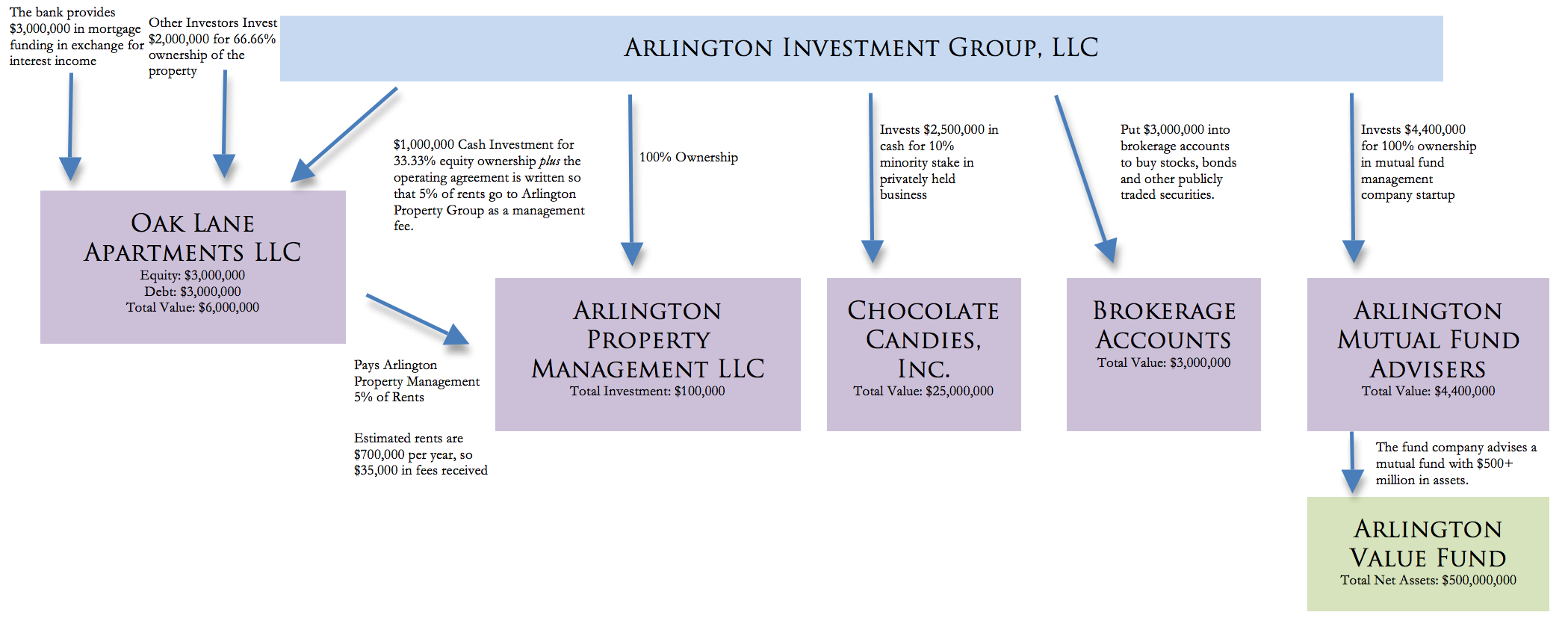 The result is, the family is now controlling more than half a billion in assets, with very little risk to itself, on only $10 million.
Assets In a Holding Company Can Be Put in “Silos.”
Just as important, if one of the investment fails, the others are isolated. Say the Arlington Property Management LLC business had an employee embezzle all the money and it went bankrupt. The parent holding company could put it into receivership, create a new property management group the next day, and the only loss would be the $100,000 they put into the business to get it off the ground. Their investment in the chocolate candies company, the mutual fund adviser, and the apartment building itself were beyond reach.
Money managers often refer to this as putting assets in self-contained “silos” because if one is destroyed, it burns to the ground in the middle of a field without taking down anything else of value.
Consider Dunkin Donuts. It is actually a holding company. All of the intellectual property, such as the Dunkin Donuts name, logos, etc., are owned by a subsidiary known as DD IP Holder LLC. Take a look at the side of one of the cups …

Get it? It stands for Dunkin Donuts Intellectual Property Holder Limited Liability Company.
This subsidiary will license the brand name assets to the franchisees or company owned locations. They may hold the real estate in another subsidiary, which rents the storefronts to the business. They may have the equipment owned by another company that leases it to the business. Then, they may have the actual operating company that sells the donuts called “101 Main Street Donuts LLC”, but it is paying fees to the other subsidiaries to rent the Dunkin’ Donuts name, rent the real estate, rent the equipment … you get the idea.
The result is, if someone walks in, falls, sues the company and bankrupts it, only that location that operated is going down. Within 30 seconds, a Dunkin Donuts could open a new restaurant at that same location called “101 Main Street Donuts Version II LLC”, with the sister subsidiaries leasing all of the assets right back to it. The person who sued may walk away with little or nothing.
To put it another way, if you were going to own a manufacturing business, you might consider creating a parent holding company structure like this:
- Acme Factory Holding Company LLC
- Acme IP Holder LLC (brand names, trademarks, etc.)
- Acme Real Estate LLC (the building and real estate)
- Acme Equipment LLC (the equipment)
- Acme Human Services LLC (the employees)
- Acme Manufacturing LLC (the operating company)
All of the subsidiaries would be owned by the holding company, but Acme Manufacturing LLC would be the business in the traditional sense. It just that it would pay a fee to lease employees from the human service subsidiary, equipment from the equipment subsidiary, the building from the real estate subsidiary, and the brand name from the IP Holder subsidiary. If an employee sued the company, only the human services business should be at risk. (Obviously, it is much more complicated than this but, again, the point is to give you a general idea of how these structures are intended to work.)
A lot of multi-national mega corporations use this structure and then have the IP holders located in very low tax rate countries because the income paid to it by the operating companies, which may be in high tax rate areas, will be charged a lower rate. Bloomberg ran a story today about how Google had gotten its tax rate down to 2% or 3% in some jurisdictions by using companies in the Cayman Islands and Ireland. Imagine that Dunkin Donuts charged each location $100,000 per year to use the name, shoving all of that income in the DD IP Holder LLC subsidiary, which may be in the Isle of Man. This is why the big accounting firms can be so lucrative. People who do this stuff and know the tax code spend their whole lives studying it.
Likewise, British American Tobacco has an entire page of its major subsidiaries. It would be almost impossible for someone to bankrupt it unless they went after the parent holding company. You couldn’t just sue the local cigarette factory. It’s like a lawyer’s dream. Keep in mind, each of these main subsidiaries may have dozens of subsidiaries of their own.
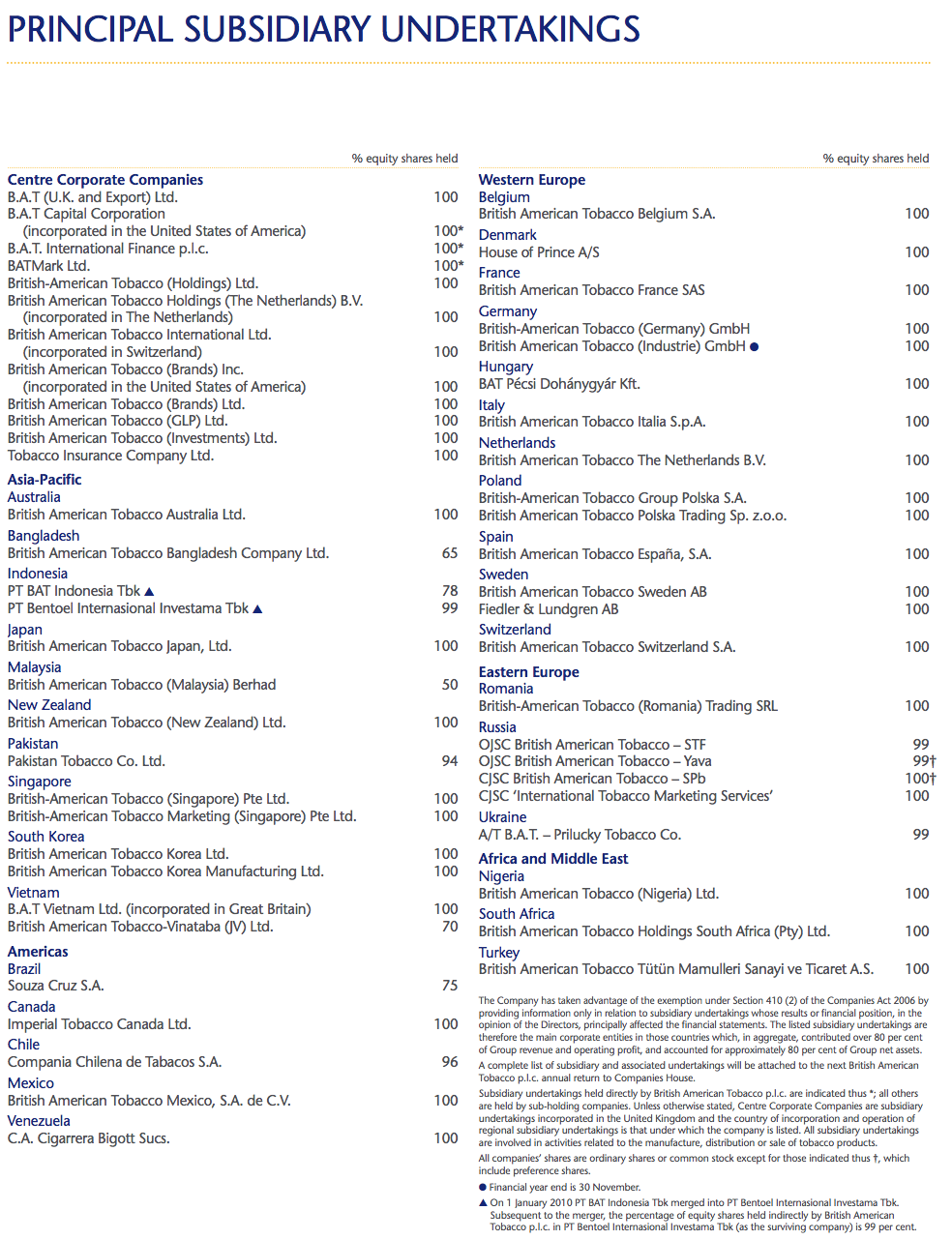
Now, to be perfectly clear: The rules are so incredibly complex that this is just a theoretical, incredibly simplified broad overview example of how something like this would work. It probably wouldn’t be worth the effort to setup a structure that complicated unless your business were generating massive annual profits. In most cases, a guy running a little bakery in a small town is going to be covered by his insurance policy. To him, the odds are good that a holding company would be an expensive, mind numbingly painful paperwork nightmare.
Transferring and Pooling Assets Through a Holding Company
Another big advantage of a holding company is that it allows families to pool their assets or transfer wealth in a far more efficient way. Imagine trying to give shares of each of the above businesses to dozens of grandchildren. It would be a logistical nightmare. With a conglomerate structure, you could just issue shares of the holding company to your grand kids and they would indirectly own part of everything. They would only have to deal with one tax filing, one stock, and one shareholder meeting. Plus, you could write the holding company operating agreement so that you retained 100% voting control.
Holding Company Taxation
It is extremely important that you use the best, most respected and most qualified accountants, attorneys, and advisers because the rules surrounding investments can be complex when using a holding company. In the case of taxes, there is a special holding company tax that is only applied to regular c-corporations in the United States that have 50% or more of the stock held by five or fewer investors! It is a double-digit surcharge tax that could be devastating to your profits.

A holding company is a type of investment company that owns other assets and investments. A holding company itself doesn’t do anything. It owns things. Image © Comstock/Thinkstock
That is the reason so many families seem to be opting for holding companies structured as limited liability companies, also known as an LLC, or limited partnerships, also known as an LP. By employing these legal entities, you can elect pass-through taxation, just like an old-fashion partnership, so that no holding company tax should apply. Each partner reports his or her share of the pro-rata gains and losses after receiving a Schedule K-1and pays tax on his or her personal filing with the IRS.
For regular c-corporation holding companies, it becomes highly advantageous to acquire at least 80% of the stock of another c-corporation because the double taxation of dividends doesn’t apply on distributions made from the subsidiary to the parent company. That is, That is, if your holding company owns 65% of the stock in another business, and that other business pays dividends at Christmas, your holding company would owe regular corporate tax on those dividends. However, if your holding company owned 80% of the other business, it should not have to pay corporate tax on the dividends it received from that other business it was already taxed once at the subsidiary level.
The Reason Tycoons and Investors Prefer Holding Companies
In addition to all of the above reasons, a holding company is often the preferred vehicle of a true investor because it allows you to open an office and have that office devoted to nothing but finding places to put your money to work.
Once you have the capital, all you need is a good fireplace, some nice paintings, a cup of coffee, and a stack of annual reports. Or, if you’re Walter Schloss, a desk next to a water cooler in a space the size of a closet.
You show up each day, try to do intelligent things, avoid stupidity, and keep costs low. As I’ve said a million times, compounding will do the rest. You can pay yourself a salary and watch your net worth, through the holding company’s book value, grow higher each year if you run it well.
Holding companies are as diverse as their owners. Some specialize in hotels and other real estate, some own restaurants, some build coffee shops, some invest only in publicly traded stocks, others focus on making investments in high-tech start-ups, some fund movie projects, while still others acquire silver mines or mineral rights.
The point is, a holding company is worth too much effort and doesn’t provide enough benefits for most small investors. You should never add an extra layer of management unless it is necessary. There are some expenses involved, such as preparing another set of tax returns, that must be taken into account. If those are even a rounding error, you probably should wait until it is going to be worth the expenditure. You should never want a holding company simply for the sake of owning one. They have very specific purposes. An exception might be a family who has a few hundred thousand dollars and wants to invest together through a single entity.
Summary of a Holding Company
A holding company:
- Is any regular corporation, LLC, or LP that owns investments in other companies but doesn’t engage in any operations itself. That is, Berkshire Hathaway is a holding company because it doesn’t do anything. Instead, it owns 100% of the stock of GEICO, which is an insurance company. It owns 80% or 90% of the stock of Nebraska Furniture Mart, which is a huge furniture retailer. It owns more than 8% of the stock of Coca-Cola through its insurance holdings. But Berkshire itself just has a handful of employees and a bank vault full of stock certificates. That is it. Any money it has comes from dividends paid by the subsidiaries on June 30th and December 31st of each year.
- Can be used to silo investment assets and protect them, such as Dunkin’ Donuts putting its intellectual property into its own LLC.
- Can be used to transfer wealth to friends and family. If you own a collection of businesses, rental properties, or other valuables, it is far more convenient to transfer shares in a parent company than it is in each individual asset.
- Can permit you to structure deals so you control far more money than you otherwise could afford. If you had $10 million and used it to buy control of a $20 million insurance group that had $70 million in float, you would be controlling $70 million from your holding company.
In essence, a holding company is in the business of providing capital and people. That is it. Some don’t even do that (Berkshire Hathaway refuses to provide management to the subsidiaries it purchases; they don’t run businesses. General Electric, on the other hand, is one of the greatest machines of all time and can have someone else running a company within 12 hours.)
I hope that helps you understand the concept and why they are so useful.
Reader Comments (100)
Comments are presented chronologically, with replies indented beneath the comments to which they respond.
lilly
June 30, 2011
What a great article, thank you for sharing.
Joshua Kennon
July 27, 2011
Replying to lilly
I'm glad you found it useful =)
Nalron
September 5, 2011
I'm trying to start a holding company LLC, and this wonderful amazing article just inspired me to go for it. Thanks for the information and encouragement, if the big guys can do then so can I. The Walton article is so inspiring also. Love it!!
PS. I bookmarked this page Mr. Kennon
Joshua Kennon
November 20, 2011
Replying to Nalron
Thank you. Welcome to the site!
Sean Leder
November 18, 2011
do you have a clean copy of the Arlington Investment Group org chart that you could send out....had trouble reading the notes...thx
Joshua Kennon
November 19, 2011
Replying to Sean Leder
Click on the image in the article load the big picture. Once the new page has loaded, if your browser shrunk it to fit, click again to see it in the original size. The image is huge. Massive. You will be able to see every dot.
http://dkl3fnj1o5loa.cloudfront.net/wp-content/uploads/2010/10/sample-holding-company.png
k-pra
November 19, 2011
Good article.. one question. I am thinking of using a holding company to take a more strategic view of my business investments and also limit risk exposure. In this case do you think it is worth having a dedicated holding subsidiary that employs staff to oversee the holding company (eg Arlington Holding Management LLC, or something) so that the holding company never has employees which obviously come with risk?
Gilvus
November 19, 2011
Replying to k-pra
It depends on how much extra overhead you're capable and willing to take. I've also been looking into this, and it seems that in order to qualify as a personal holding company, the company's gross income for any tax year must be 60% passive income (dividends, rents, royalties, etc.) (search for "26 USC Sec. 543").
Naturally, I'm eager to hear Joshua's input on this.
Wil 'Chilli' Schock
December 27, 2011
Replying to k-pra
Not that I am an expert on this issue, but think about it for a second; The way of corporate business in the US today is saturated with hiring employees who are not employees. They are, across the board, seeming to for force employees into becoming contractors in order to get the job. Then, when they want to fire them, they just do. And then they don't worry about paying unemployment benefits or being sued for discrimination, giving them proper severances, etc. The insulation afforded the corporation from this is significant. So if you were to have a K-Pra Staffing LLC subsidiary of the K-Pra Holding LLC company that supplied staff to manage that parent company, you may even want to make them contractors. It gets complicated, but clearly adding layers to the equation is all more doorways that someone ultimately would have to unlock to get back to the real cash itself that is what anyone is looking to protect. And of course, forming the holding company somewhere like Wyoming and not having your name associated with it in any public record, adds that much additional insulation. Depending on the level of investment we are talking about, it may even be worth it to form the holding company in Seychelles or another foreign country with laws that make law suits almost impossible to launch. So your money may be in a Seychelle's bank, or it may be owned by your Seychelles LLC, but is actually held inside 20 different banks in the US, none of which are identifiable to anyone anywhere without paying massive court fees in advance to launch the suit, all blind and guessing at who the rightful owners of the LLC even were. Again, all levels of insulation. Do we need that many levels for a lawful business? Well, I have lost a lot of money not having a holding company to insulate my operating liabilities, so I am open to all ideas of insulation now.
Jojo Florendo
December 28, 2014
Replying to k-pra
good idea!
Knowledge Seed
February 12, 2012
If you are not an Accredited or Sophisicated Investor, is it against the law for you tostart a holding company that invests in privately-held businesses?
Joshua Kennon
February 12, 2012
Replying to Knowledge Seed
The accredited or sophisticated investor rules deal with certain types of securities issuance if you are raising money (e.g., issuing shares of stock or bonds to investors in exchange for cash or goods). I guess, theoretically, you could start a holding company with nothing but $1,000 and buy a couple shares of stock but I don't much see the point. In that case, a simple brokerage account would have been more effective or, if you own a family business, keeping the family operating entities separately owned until the economies of scale and organization benefits of bringing them under the same roof justified it.
Knowledge Seed
February 13, 2012
Replying to Joshua Kennon
I have a several family members (siblings and cousins) that own a variety of businesses that, as I accumulate substantial savings, I would like to invest in.
I was under the impression that, because I don't meet the requirements to be an Accredited or Sophisticated investor, I can't invest in those companies. The holding company was just a way to skip those requirements - if possible.
But you're saying, whether I meet those requirements or not, I can invest in those companies without a holding company, right?
Joshua Kennon
February 14, 2012
Replying to Knowledge Seed
No, that is different. You asked if you can *start* a holding company. Sure, anyone can. But neither you personally, nor your holding company, could invest in a private offering (e.g., private stocks or bonds) if the business issuing them only allows accredited or sophisticated investors because it is relying on something like Regulation D as a safe harbor. You can't get around the requirements, if that's what you're trying to do.
Technically, there are a few ways a non-accredited or sophisticated investor can buy shares of a privately held business, such as Regulation D Rule 506, which allows up to 35 non-accredited investors in an offering of private securities (reference: http://www.sec.gov/answers/rule506.htm) but a lot of smart people won't even take advantage of that. There is too much liability exposure if you start letting in a lot of non-accredited investors. A few years ago, I point blank had a securities lawyer tell me that even if I loved the family member with all of my heart, it would be patently stupid to allow anyone who didn't meet the accredited status into a business I was considering launching, even if they wanted to buy several hundred thousand dollars worth of shares. I listened to him and scrapped the idea of allowing them in until I could come up with a better solution. No one wants to hear, "Sorry, but you aren't worth the liability exposure" but that is what it comes down to in the end.
I'm not a lawyer so take this with a grain of salt, but it's just not worth the trouble for the business owner to admit anyone, family or friend, who isn't accredited. No matter how hard you try, it sounds like your family members are going to find a reason not to let you invest and, frankly, they should. They are being wise given the current state of regulation in the country. You may not want to hear that, but the gist is, move on and find somewhere else to put your money. It isn't worth the trouble and it sounds like your family is trying to be polite because they don't want to use one of the Regulation D rules to make an exception for you. They are being rational.
msmbjohnson
May 2, 2012
This is a great article! Very informative and very useful. Thanks for sharing!
Obert
May 7, 2012
Replying to msmbjohnson
wow!I have been going through all the details here and find them interesting,but,can you guys advise me ,Say one registers a holdings company without even huge amounts of monies as some statements suggest,Do you guys think its wise to start a Holdings company with a notion of raising funds for it through loans from the Banks and then Open Subsidery Companies to Operate the Businesses and pay the Dues to it as should the case be,Do you think its a wise idea?
Tyson
June 26, 2012
So I’ve got a question for you, that I hope you can shed
some light on in regards to possible conflict of interests, etc.
Example:
Fact: Arlington Family
runs and owns a construction company structured as a sole proprietor.
Fact: In addition to running the construction company, they
also own several pieces of property that they lease.
Problem Assessment: They are currently researching changing
the company over to an LLC for increased liability protection for all their
assets and seeking future expansion into other ventures. If they create a holding “Arlington
Enterprise LLC,” then create operating “Arlington Construction LLC” and operating
“Arlington Real Estate,” can they actively manage either of the operating LLC’s? I.E. Father Arlington being the primary
manager, bidder, operator, etc. of “Arlington Construction,” but all other
assets remaining in the holding LLC. The
question arises for me is does this cause a conflict of interest and negate the
purpose of the holding & operating LLC setup if Father Arlington is also
part of the holding LLC? My hours of
research can’t seem to address this situation.
Any ideas or help? Location for
hypothetical is California. Thanks for the article and website!
Joshua Kennon
June 26, 2012
Replying to Tyson
There is no clear cut answer. The concern is whether or not "Father Arlington" in your question treats the company as a de facto extension of himself; that is, whether or not he "pierces the corporate veil". That ("piercing the corporate veil") is what you are asking me about whether you realize it or not.
Research that phrase and you will learn everything you want to know about your question. There is no clear line. It is a judgement call when litigation arises. The safest way would be to avoid it entirely but that isn't always practical or desirable.
If a concern arose in that department, I would unquestionably be speaking to attorneys in the respective state(s) rather than trying to figure it out for myself.
Tyson
June 28, 2012
Replying to Joshua Kennon
Thank you Mr. Kennon for getting back to me. Its pretty much as you said, there isn’t an exact guideline or ruling to follow in this situation. The best answer I’ve been able to find for limiting PCV follows this:
Abide by the rules of an LLC
Submit all required documents (quarterly statements etc.)
Follow the operating agreement
Do not co-mingle personal & business assets (i.e. good
accounting practices, etc.)
Limit possibility of “alter-ego” accusations
However, like you said, there isn’t a clear cut response for
it and if this were to be happening bring in an attorney(s). Thanks again for your feedback, this was a good exercise in future planning for me.
phiston
July 1, 2012
Thanks for sharing this great article Mr. Kennon. I was wondering if you can address Obert's question from 2 months ago about starting a Holding Company through bank loans. Thanks in advance.
Tayler
July 4, 2012
Hi. I really appreciate the information in this article--very helpful. Many articles discuss how to start a holding company, however, rarely do I see articles that discuss how to manage a holding company, such as the daily operations. Could you share some light on that please? Thanks so much.
Danesh Narayanan
October 29, 2012
Hi..Great article..thanks for the info..I have an excellent investment opportunity to invest in agricultural land. Iam planning to invest my own funds and also use funding from a couple of my friends. Is it advisable for me to say start a Holding company in an offshore country, pool in the funds, then start a locally registered company in the country where we plan to invest, and the holding company buys the shares of this company..am I getting your point right..Would appreciate your advise..Tks Dan.
Andrew Knight
November 16, 2012
Wow, amazing site, amazing article amazing everything. This is the best read regarding this topic I have ever read. Now I have a question. I read the article and I understand you pointed out not to start a Holding company just because you want to or unless you have a lot of funds to manage. But what about starting one for security of assets and planning for the future? I'm not a big wig or in any of those categories, but I've always been fascinated about Holding companies and how they can be used to own/invest in other assets, companies, stocks etc...but never really understood at what additional cost to me I guess. But it's something I've wanted to do for the long haul, thinking ahead for the future just trying to put things in place. I know most of the big guys do it, so I guess my question is, is it just for the big guys, is this something to do as planning for the future going on the assumption that I'll have successful investments and ventures?
PEE JAY
January 3, 2013
I am extremely glad to have come across this well laid out article, I shall be forever grateful to you Joshua keep up the good work
Dyan
January 24, 2013
Great job!!
Tremayne
March 3, 2013
I had to take a second to tell you how useful this article was. I google alot of articles on this subject matter and you were the only article that explained that a 2 year old could understand. (Which is my capacity for finances.lol)
James Smith
March 11, 2013
Never invest in any idea you can't illustrate with a crayon. -Peter Lynch.
Too many parts to be able to put something like this together. I could see me making the lawyer and accountant rich and me being broke because I cant figure out who gets what. On to a new plan.
Wayne
April 10, 2013
Inorder to attract investors to new business opportunity if we formed a group of construction planning, designing company, general builder, heating and air, electrical etc. Would this new formed co-operation of individual companies become a partners in a holding company. Or is there a different entity formed by co-operations. If the group decided to build a medical building and wanted to invest into the a medical building to sale or rent. Would a holding company be a proper entity to offer stocks to outside investors.
Fab
April 22, 2013
formed a c-corp and I have a real estate llc. I am partnering on a restaurant deal and will be creating another llc to operate it. The c-corp was set up to "own" both llc's and large amounts of income from coming onto my personal tax return.
My question is, how do I make the llc's subsidiaries of the corp? I'm assuming you change the ownership of the llc's with the state, update the ein's and also update the operating agreements....to reflect only the corp name and info (100% real estate llc, 50% restaurant llc)?
Also, I would like to know how to handle future income of llc's....does the money go straight into the llc account then get disbursed at intervals to corp, or does it go directly into corp bank acct as it's made.
Thanks
Fab
April 22, 2013
I know this is an old article...but, I understand how to set up companies...I just formed a c-corp and I have a real estate llc. I am partnering on a restaurant deal and will be creating another llc to operate it. The c-corp was set up to "own" both llc's and large amounts of income from coming onto my personal tax return.
My question is, how do I make the llc's subsidiaries of the corp? I'm assuming you change the ownership of the llc's with the state, update the ein's and also update the operating agreements....to reflect only the corp name and info (100% real estate llc, 50% restaurant llc)?
Also, I would like to know how to handle future income of llc's....does the money go straight into the llc account then get disbursed at intervals to corp, or does it go directly into corp bank acct as it's made.
Thanks
James Smith
April 29, 2013
Ok maybe I made the wrong comment. Let me try again:
Lets say you are new to this concept and will need help along the way. Where does someone with no investment dollars find the resources to compete with lottery winners and athletes who can afford to #1 Put up their own money and #2 hire an superstar advisement team to look over virtually every aspect of their holding company portfolio(s).i.e. tax accountants/attorneys, management firm, numbers crunchers, researchers the whole gamut.
Lastly, Joshua whats your background. i.e. Business MBA grad, math major, financial planner?
and....
What resources do you recommend?
A great cheat sheet would be to just give out stock to talent but there is that thing of not knowing( how much to give them in i.o.u.
fast track help would be appreciated. GULP, HELP!!!
Abdi
May 17, 2013
Informative article. Thanks. Now my only question is can i form the subsidiary before the holding company? @CabdiSomali
Alena
June 12, 2013
Very nice simple article! I wish all academic books were that simple! Thank you
Prashant
July 1, 2013
Wow that was incredibly useful. Thanks!
Ronald Ragan
August 17, 2013
After hours of research(I might be wrong), in order to avoid personal holding company tax( c corp) is to have 12 or more share holders with equal shares. So no 5 share holders or less will have more than 50% interest of the company.
Also have not found any information regarding multiple C corporation to lower tax bracket.
So for 12 people, they can form multiple Whyoming C Corp and pay 15% fed tax and reinvest their profit forever(the tax bracket will be raised in future time when profit increased which would be another research.)
The purpose of this is to grow dividend investment with minimun Fed tax and zero state tax.
For controlling purpose, one can have a master LLC lending $$ to them and defer/arrange interest payment.
Please correct my rookie plan.
Marilyn
October 1, 2013
This was very interesting. I am wondering if this is the correct business structure to setup. I have come up with a name which is the Brand Name for business 5 different business that wants to be under the umbrella brand but will still have their own name. Its the link to bring all the businesses together. However, the business underneath would be owned and operated by those individuals. The types of business are just services, IE health, fitness,life coach etc, People providing services not product but we all want to come together under a brand. Potentially we see bringing other businesses underneath so we have a network of trusted business to offer clients. However the brand would not money from the original service providers but if we allowed others to come under the brand, then it would have income.What kind business structure would you recommend? I was thinking its a franchise but looking at that seems really expensive when really this is just a company name that brings everyone together to provided different services. Any help or suggested on where to research would be great.
Mscott
January 28, 2014
Very Helpful Josh. I learned a lot from this article
John Nash
February 23, 2014
Josh great article ,do you think a holding company is best layout for small chemical company that deals with toxic product or stand alone LLC in case of legal problems? About 2-3 million dollar business
Legaci1
March 20, 2014
If someone already owns companies, can you create the holding company afterwards or must the holding company always come first?
Saleh Adel
March 20, 2014
thanks a lot 🙂
lillianwalker789
March 20, 2014
For Investors, a holding company provides the ability to make investments in a wide range assets,including taking minority stakes in business.
mwaka
March 26, 2014
It a great simplicity of what a holding is and very clear and simple to understand what it is.
Raylan Smith
April 29, 2014
Great article...explanation and example is perfect and simple. I know what I want to do but waiting a couple of years may be best to ensure a significant benefit. THANK YOU!!
ryan
April 30, 2014
i want to start a holding company in CA, to just hold stocks/options/funds/etc. I want it to be owned by my wife and I, which type do i open? an LLC, LP, LLP?? i want us to share equally but for no shared liability to be help, i.e. if she got sued by someone then my stake isn't at risk and vice versa. thank you
Havoc Wreaka III
May 20, 2014
Finally understand everything
Alfred
May 30, 2014
I am a SME investor already but want to start my Holding company soon, really enjoyed the article. Thank you Joshua Kennon....are you on twitter so I can follow?
sebastian
June 3, 2014
wow thanks a lot, I'm from SA and your article has really given me closure on what route to take.
anonymous_economist
July 6, 2014
Question: If an LLC operating as a holding company of real commercial property uses your identity without your permission or knowledge to list you as a member and sends you monthly checks for about $6,000.00, what legal recourse would you have to protect your identity and stop the LLC fraud. This has actually happening at this time.
JB
July 17, 2014
Great article! Thanks for making it understandable to the layperson.
mohamedalthaf
July 19, 2014
very well explained, easy to undesratand .thank you
HB
July 29, 2014
Can my holding company own 100% equity in XXXXX, Inc. which I am also the founder/ceo? Or would I need to appoint someone else?
Terrance A. Collins Jr
February 24, 2017
Replying to HB
It's possible. Fudiciary Judy is that executives put the interest of their company above the interests of the holding company. If you're unable to prove this to be actual application in court you may allow for piercing of the veil and lose liability protection of holding company, defeating purpose of having holding company.
remember I am not a attorney or a CPA. This comment is not meant to be taken as legal, investment or financial advice.
To get your questions answered and before making a determination for yourself it's always highly recommended you speak to a licensed attorney
with the authority to practice under the jurisdiction of the formation of your business entity AND a CPA.
Luis
September 5, 2014
can
hallyburton be considered a holding company
Nick
September 18, 2014
This is a great article.c: Easy to understand the concept. Thank you.
equityshark
October 18, 2014
Well-written and conceptually sound. Great insight, glad I rolled across this thread.
Daniel Lee
December 8, 2014
great information for those who are thiking to start HC
geraldine
December 26, 2014
Replying to Daniel Lee
Okay, my question leads elsewhere. If you think you have been bilked, how do you recover your $50,000.00 from a holding company?
Ronald Ragan
December 27, 2014
Was trying to form a 10 person equity holding company to grow my money. Found out, jut buy BRK and save all the troubles. Problems solved. One can also buy SP500 etf, but need to pay tax on 1-2% dividend payout.
Jojo Florendo
December 28, 2014
Thanks for this article, I've learned a lot.
ABK LLC
January 23, 2015
Thanks, I found that very educational.
BenjaminButler
February 11, 2015
Thanks a bunch. this article has really helped a lot. i actually read it all the way through too.
sameer musa
May 26, 2015
thanks i have just read your article and to me it deserve not just one time review. I hope you would do more of its kind in the future
Sahar
July 13, 2015
Hi Joshua, thanks for this introduction to holding companies. i found it very useful. Are there currently any books you recommend in the area of setting up a holding company?
Denise Treusch
July 14, 2015
i have a very confusing question. my father had his house (which was paid off) listed as a LLC Holding Co.
he passed away leaving the holding co to the 4 children as members. The 4 children decided to sell the house.
my question is..... Do we have to pay capital gains taxes on the income? or is the house considered an inheritance and not taxable??
Sean Foley
September 19, 2015
Replying to Denise Treusch
Depends on the papers by which the LLC is formed. It can run as a C or S Corporation or Partnership. S/Partnership do pass through to the owners. C would completely shield you, it wouldn't be considered and inheritance because the property is owned by an entity that cannot die. (The LLC...) LLCs can behave weirdly if the operating documents specify them too. It's important to study them in detail.
donna
August 3, 2015
I own shares in an unlisted company and have just received an offer from a private equity holding company to indulge in share swop .I have no idea what to do as does anybody know if I have a better chance of selling my shares if I take part in this ?
Jim Mino
December 11, 2015
Joshua... this information is great. In your opinion should you start a separate holding company for assets and for IP or can one holding company have both?
Danny
January 27, 2016
Question.
Let's say I want to start a company that I will fund from day trading and other investment activities and then use the funds in the holding company to purchase other businesses and real and real estate. How would you structure the holding company legally? LLC or corporation.
What I am trying to do is have a place where I initially fund with profits from day and swing trading until I've accumulated a certain amount of capital and then incorprate another entity where the funds will be transferred to from the main holding company to purchase the an initial investment that generates cash flow and do that all over again. And the funds from the investment will stay with that specific new entity and accumulate while transferring additional funds from trading to purchase more cash flow generating investments. That initial new entity will be separate from the main holding company and i want to do that for several different types of investments (real estate, software/hardware, business acquisition)
Terrance A. Collins Jr
February 24, 2017
Replying to Danny
It depends... review the laws and codes in the area in which you wish to form your entity and see what it entails. Corporations pay tax on the corporation and then the individuals pay tax on the income they receive thus "double taxation". LLC's are disregarded entities and are not taxed at the business level so the owner(s) "member(s)" are taxed on the business a whole on their personal taxes. Some juristictions allow the minimum number of corporate board members and officers to match the number of shareholders of the entitiy. You could be a 1 person private corporation however as mention in Joshua's wonderfully worded articles... you may become subject to additional taxation meaning you risk potential triple taxation at the federal level, not counting state or local taxations as well. However if you plan to level money in the entity to grow you aren't paying taxes personally on income you aren't receiving. In LLC's even if you take $0 out of the entity you are still taxed on the entire profit/loss of the entity, but you are only taxed once. Personal taxation on corporate dividends are lessor than personal taxes from LLC distributions at the highest tier.
There is no perfect right or wrong answer for this. Bill Gates has the Cascade LLC, Warren Buffet had Berkshire-Hathaway Inc. Both deal in the Billions of dollars in business. Coca-Cola and GE are incorporated and have hundreds of subsidiaries each (even though Coca-Cola has holding companies as large percentage shareholders). Both Bill Gates and his private Cascade LLC have shares in Microsoft, Coca-Cola & Berkshire-Hathaway (which has shares in Coca-Cola). Technically Bill sees 4 lines of income from Coca-Cola plus the income he receives being a board member of Berkshire and his salary as CEO of the LLC, both of which are partially afforded by dividends from Coca-Cola. Warren meanwhile does everything from the confines of Berkshire-Hathaway and has almost zero corporate staff.
These two gentlemen are the 2 most influential figures of the evolution of American Economics over the past two decades. Warren and Bill best friends and business partners and one does his holdings from an LLC and the other a Publically Traded corporation.
Remember I am not a attorney or a CPA. This comment is not meant to be taken as legal, investment or financial advice.
To get your questions answered and before making a determination for yourself it's always highly recommended you speak to a licensed attorney
with the authority to practice under the jurisdiction of the formation of your business entity AND a CPA.
Lennox
February 8, 2016
very informative. Thank you.
Andre
February 29, 2016
Hey, how do I actually go about building something like this?
Say I have $ 2 million can I used $800,000 and buy a $100 M mutual fund and used the rest for real estate investments and franchises?
M
June 10, 2016
Can a trust fund own a holding company?
Terrance A. Collins Jr
February 24, 2017
Replying to M
Yes.
remember I am not a attorney or a CPA. This comment is not meant to be taken as legal, investment or financial advice.
To get your questions answered and before making a determination for yourself it's always highly recommended you speak to a licensed attorney
with the authority to practice under the jurisdiction of the formation of your business entity AND a CPA.
John
July 11, 2016
Very helpful. Thanks, Josh.
Michael Christopher Shimkin
September 6, 2016
Very well done especially with the use of examples. I also particularly enjoyed your humor.
Jordan
November 12, 2017
Replying to Michael Christopher Shimkin
Did you send him a dick pic?
amos
September 10, 2016
thank you
Nate Di Cenzo
October 8, 2016
I'm still trying to get my head around an effective model using holding companys. So if holding company A owns 80+% of two subsidiaries also acting as holding companies B & C, which both have their individual subsidiaries, how would I move funds from subsidiary B to subsidiary C? Subsidiary B will be the revenue driver to create the startup capital holding company A infuses into other startup ventures. I'm trying to figure out a way to move B's capital throughout the network without extreme tax ramifications.
Terrance A. Collins Jr
February 24, 2017
Replying to Nate Di Cenzo
This is simple. If they are LLC's LLC's are pass through entities and aren't taxed at the company level. You personally (and your other members/owners of the Holding LLC) are responsible for taxes on the entire structure of your operations. Therefore you can transfer the money to Company A from Company B and transfer the money back down to company C... just make sure your book keeping is on point and accurate because the more transfers you make the more complicated it becomes. If you transfer directly from B to C then in the event of a lawsuit you lose liability protection for company A, B & C and all of the assets they own are subject to the suit. It makes it easy to then say that your operation is not really several companies but 1 company (company A) doing business as a whole and can thus be sued as one such company. The exception would be loans from company B to company C.
If it's a corporation you can file a consolidated tax return in which your Company A is responsible for the taxes of the entire group like example above for LLC's. This means you aren't taxed for distributions & dividends between the companies just the overall profit/loss for the group but itemizing the group on reporting means you're going to need a team to handle reporting and tax prep and filing. Still you'll want transfer the money upstream then back down stream.
In both of these structures losses from one company can offset the profits of another so there is no real need to transfer money from company B to company C as the holding company is responsible for the group's taxes. The capital accounts and contributions from parent company to subsidiary and the dispersments to the parent company from the subsidiary need to be kept up to date in very pristine manner.
In order to do this the corporation must own at least 80% of the vote and percentage interest in the subsidiaries. In the LLC model the LLC is only responsible for their ownership interest in the subsidiary for tax purposes. So if the ownership percentage varies between subsidiary to subsidiary the potential for a book keeping nightmare exists and the ability to properly report or defend an audit decreases. The real risk is book keeping and accounting and as mentioned in the article... the cost of the required services to keep the engine running smoothly and recorded properly can become very pricey and time consuming.
I hope this helps.
remember I am not a attorney or a CPA. This comment is not meant to be taken as legal, investment or financial advice.
To get your questions answered and before making a determination for yourself it's always highly recommended you speak to a licensed attorney
with the authority to practice under the jurisdiction of the formation of your business entity AND a CPA.
The lawyer will help you protect your ASSets and the CPA will focus on how to preserve the maximum amount of your capital.
Therefore to get the answers you are looking for in depth with applicable information you should consult with both.
Quilan Foster
December 18, 2017
Replying to Terrance A. Collins Jr
Can a holding company be publicly traded and own privately held companies ?
Duc de Richleau
October 14, 2016
Speaking as a Trader, let's assume with the werewithall to do this. Would there be an incentive to become a Holding Company allowing others to invest in my project? That is, I would not be part of some familly group like you used in your example, but pretty much the boss of what I am doing investing my own initial cash. What legal pitfalls would I face?
Nick
March 10, 2017
In order to transfer money tax free from the Operating Company to the Holding Company
A: does the Holding Company have to be a C Corp or an LLC electing to file as a C
OR
B: can it be an LLC NOT electing to file as a C?
In essence I would like to have the Operating Company a C Corp and the Holding Company as an LLC not electing to file as a C owning 100% of the Operating Company.
Thanks for this awesome post making me think!
Mohammad Ali
March 21, 2017
I have come cross some information that classified holding companies into three models: Operational Management, Strategic Management, Financial Management but I did not understand how this is related to your Holding companies that you presented in this article? I look forward to your clarification about this classification
Jordan
November 12, 2017
Replying to Mohammad Ali
Not really related to structuring.
Mary Flowers
April 2, 2017
Very informative. I appreciate you!
annabanana
May 12, 2017
Very helpful! Thanks! 🙂
Ryan
May 16, 2017
If I wanted to start an LLC to only hold stock in other companies with the purpose of giving it to my son to take over down the road, what are the pros/cons of this?
Red Elle
May 16, 2017
Replying to Ryan
Your question is too vague and broad.
For example, If I want to retain income and reinvest income of a holding C-Corp LLC of pure stocks, I need to find 10 equal share share holders(including me) with absolutely no family ties to avoid holding company tax. The solution turns out to be just buy SPY or BRK to solve this problem.
Ryan
May 17, 2017
Replying to Red Elle
Is there still a holding company tax if its considered an S-corp? This holding corp would other assets besides stocks. Instead of setting up trusts for kids, i could add them as members to my LLC down the road when they become middle aged?
Red Elle
May 17, 2017
Replying to Ryan
There would be no "holding company tax" other than C-Corp/C-Corp LLC. You need to focus on gift/estate tax(Fed/State/Local). You also need to consider "families by law" problems. Sometimes it would be better to create debt for "families by law" problems. It would be uncomfortable to see "were families by law" you hate sitting at the board meeting of your LLC.
Ryan
May 17, 2017
Replying to Red Elle
Thank you for your replies. Consider that I would also be holding other assets under the LLC, this would be ok?
Red Elle
May 18, 2017
Replying to Ryan
Can not comment on your situation. I would try an example.
Let's say I setup 18 Wyoming LLCs. Each of them own a piece of beach front Calif RE.
20 years later the buyers can choose to buy LLC with extreme low RE tax or buy RE with extreme high RE tax. This works perfect if Trump get rid of tax deduction.
Raymond Tyson
July 5, 2017
Hi, Looking for a debt consolidation loan, unsecured loan,business loan, mortgage loan, car loan, and so on! I am a private lender, I grant loans to companies and individuals,, our minimum loan offer is $5,000.00 USD and a maximum of $100,000.000.00 USD To any choice of loan amount at a low and affordable rate of interest rate of 2%. Contact us today via Email: [email protected]
Inester Ohlin
October 10, 2017
Do you need a loan email : [email protected]
Steven Goodman
October 31, 2017
Hello Everyone,
What are your financial needs?
We give loans to a low of $ 2,000.00 to a maximum of $ 100,000,000.00 lasting comfort, from 1-30 years at a very low interest rate of 3%. contact us by email: [email protected]
You need a business loan?
You need a personal loan?
Do you want to buy a car?
Do you want to refinance?
You need a mortgage?
You need a huge capital to start your business or expansion? Have you lost hope and you think that there is no way out and financial burdens remain?
Please do not hesitate to contact us for possible business cooperation.
Please contact us by email: [email protected]
Best Regards
Steven Goodman
dotdash
November 22, 2017
If I wanted to start a holding company LLC into which I would put my professional services LLC (currently ineligible for pass-through rates in the new GOP tax bill), would that mean the income from my professional service LLC would be eligible for pass-through rates in the new GOP tax bill? (Now coming from a holding company rather than a professional services LLC?)
Vikram Sharan
November 28, 2017
Simply wonderful Joshua! Clean and simple explanations on holding company organisation design - structure, process and the linkages. I am currently handling this subject for my rapidly growing holding company with new business entities popping every now and then. Very helpful to design, especially the finance function of the holding..great help, thanks.
luchibay
December 5, 2017
So how would you record the following on the holding company and it's subsidiaries - a holding company taking the loan to purchase 3 subsidiaries and in return the 3 subsidiaries will be transferring funds (their portion of the liabilities) (principal + interest) to the holding company to repay the loan
Daniel S-G
December 14, 2017
I am looking for a software to allow me to oversee all assets (100% owned business -LLcs & LPs-, Private equity funds, Stocks, mutual funds etc) owned by my holding. There seem to be many options for funds and stocks but these do not have owned business modules.
On the other hand there are many available software that allow only for single standalone entity entries which in turn need to be downloaded individually for consolidation, presentation and analysis.
By any chance do you know of such software?
Eve Qian
January 11, 2018
Really really good article that helped me to understand why company does holding structure in 20 mins. Amazing writing. Thanks a lot!