

How to Manage Your Cash Using The Central Collection & Disbursement Account Method
When I was first starting out, I found the world was full of general philosophy articles, essays, and commentary about finance, investing, saving money, and starting a business. Very few people offered nuts-and-bolts here-is-how-we-are-structured explanations, though, which is what I valued more than anything else. As I began to approve my monthly banking transactions this afternoon, I thought it might be useful for some of you to see how I setup our cash management system in the early days. The basic structure stays with us, even though it is necessarily more complex.
The Central Collection & Disbursement Account Cash Management Method
If any of you gamers played Fable III, you are already familiar with what I call the CCDA method of cash management, which is short-hand for Central Collection & Disbursement Account. The entire cash management system is based around this account. Your goal in creating a CCDA is to have all direct cash income in your life flow through into, and be disbursed out of, it. Think of it as a central clearing house. It makes auditing, tax preparation, accounting, and cash management far easier than you could ever imagine.
I developed the CCDA cash management system for myself based upon a modified form of the one used by the insurance company where I interned during college. One of the reasons was to protect against powerful mental model that causes people to treat $1 differently depending upon the source that generates it. People might use a $500 gift differently than $500 they had earned mowing lawns. This leads to sub-optimal long-term capital allocation decisions. By creating a CCDA and having every penny flow through it, you can remain more rational and improve the chances of avoiding the mistake most people make, which is sacrificing what they really want for what they want right now.
The CCDA cash management system can also help you grow your net worth faster because it becomes easier to apply the two-lever test to all cash disbursements.
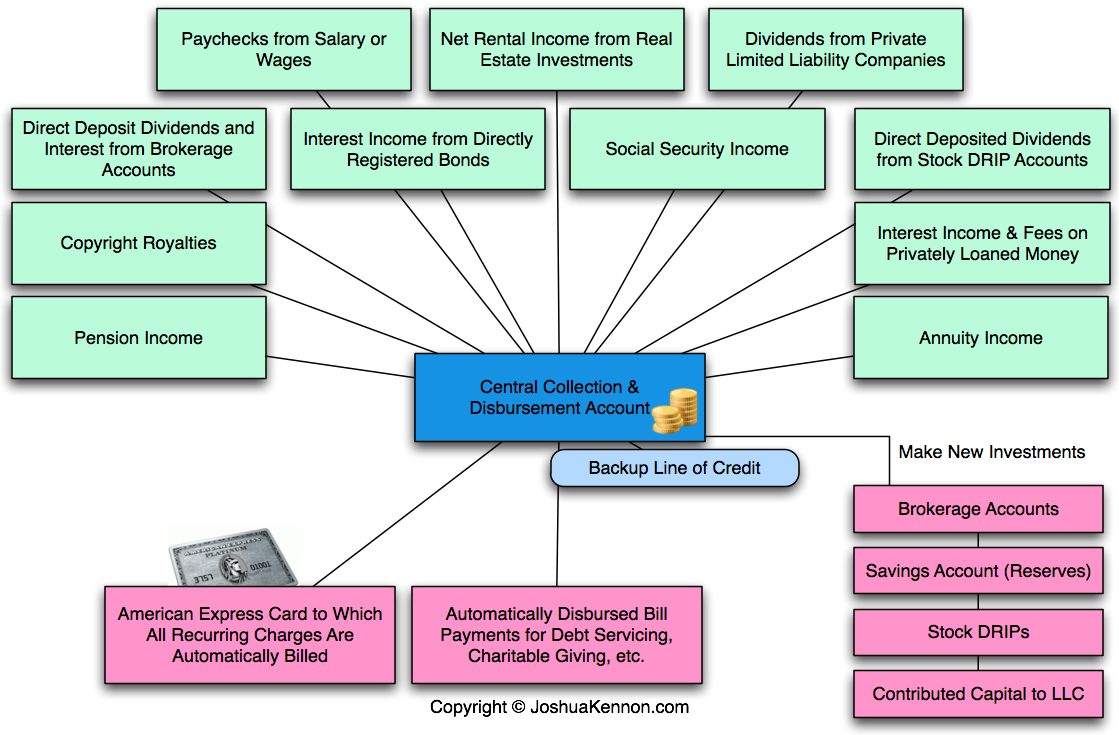
Here is a simplified visual overview of how a CCDA cash management system could be setup.
Part A: Setup the CCDA System
Step 1: Create the Central Collection & Disbursement Account: The first step is to create your CCDA. For most people, a simple checking account at a local bank or credit union will do. If you regularly exceed the $250,000 in FDIC insurance limits, there are several ways to protect your excess working capital. We’ll get to that later.
Step 2: Establish a Backup Line of Credit and Tie It To the CCDA: Then, you create a backup line of credit tied to the CCDA. This can be used in the event of short-term funding needs (e.g., you need to write a check for $25,000 but only have $22,000 in cash sitting around with another $10,000 on the way in direct deposits). Think of it as a flexibility safety net. You should never carry a balance on it and it should only be used for a few days, at most, as different balances settle. I had mine tied to my CCDA so it is automatically tapped if I write checks in excess of the current cash balance.
Part B: Manage and Consolidate Inflows
Step 3: Instruct Your Stock Brokers, Direct Stock Purchase Plans, and Other Sources of Income to Direct Deposit All Future Payments to Your CCDA: You can tell a broker, such as Charles Schwab, that you want all of your dividends automatically deposited in an external bank account. You don’t have to let the money pile up in individual brokerage accounts, spread out among your various holdings. This will take a bit of work, initially, but when it is done, you should see your dividends, interest, rents, copyright royalties, paychecks, pension checks, annuity checks, Social Security checks, wages, salaries, and everything else you earn automatically deposited into your CCDA.
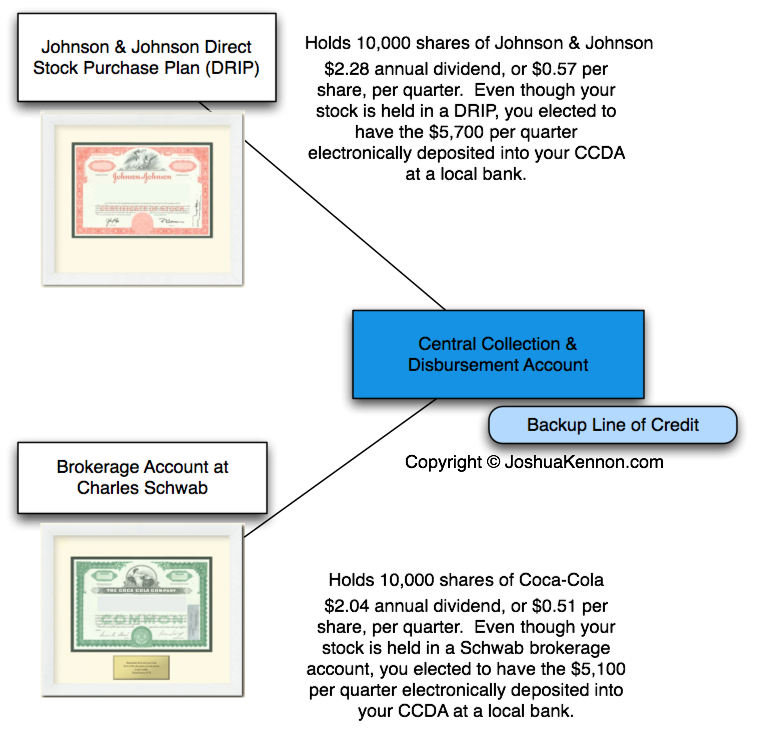
Most financial institutions can setup your account to automatically deposit dividends in an external account, in this case your CCDA. That way, you can hold your investments through whatever methods you prefer (direct registration through a DRIP, held in a street name through a brokerage account, in certificate form down at a local bank’s safe deposit box, etc.) and still have all of your dividend income from stocks, bond income from bonds, and rental income from managed real estate properties deposited into your CCDA.
There are several benefits to doing this:
- As we already discussed, humans have a mental bias that causes them to treat $1 differently depending on how they acquired it. If you found $1 on the street, you might say, “Hey! Free money!” and spend it. Using the CCDA, you wouldn’t do that. All money, regardless of source, must be deposited into it, even if you turn around and make a withdrawal. This self-discipline technique can reduce a lot of foolish behavior.
- You get to experience the “rewards” of investing in a powerful way. Psychologically, someone who is just starting out investing might be discouraged to see $12 in dividend income in this brokerage account and $4 in dividend income in that DRIP account. If, instead, all of the money flows to a CCDA, you can see, throughout the year, that the more cash generating assets you own, the more money flows into your coffers. Suddenly, you see $100 and think, “I can buy an extra $4 in annual income with this.” I’ve said it too many times to count but that is what investing is: Buying income and profit.
- You drastically reduce the accounting burden on your household. A central account, through which all income sources flow, make it far easier to reconcile and compare your taxes, financial statements, and cash flow projections.
- Your bankers become much friendlier. The consolidated power of a lot of cash flowing through an account creates some interesting dynamics. Suddenly, you get phone calls like, “Do you need any money? We are trying to write new loans and we’d love to lend you some.”
Part C: Manage and Consolidate Outflows
Step 4: Establish an American Express Gold, Platinum, or Centurion Card: Sign up for the maximum points programs you can. Have all of your monthly expenses put on the card, including recurring payments such as health insurance. Never carry a balance under any circumstances! The entire statement due amount must be paid in full each month! Otherwise you defeat one of the primary reasons for using the CCDA method. There are several reasons for doing this:
- At the end of every month, you can review all of your charges, match them with your records, and authorize one payment, disbursed from your CCDA to American Express, drastically reducing the transaction volume count in your primary bank.
- The American Express charge-back program is very well run. If you are defrauded, it is far easier to recover your money through the procedure at American Express than it would be if you used a debit card. If the card is lost or stolen, they can get a new one to you in as little as 24 hours, and in most cases, you aren’t responsible for the fraudulent charges, whereas with a debit card or cash product, the money would be out of your bank account.
- You can accumulate a ton of excess points and get free merchandise. In the past few years, I’ve redeemed points to get thousands upon thousands of dollars in free gift cards to Bergdorf Goodman, Saks, Banana Republic, Barnes & Noble, Brooks Brothers, etc. It’s completely free money for doing no additional work!
- The end-of-year statement that breaks down your family’s purchase history by vendor type and individual card member is a useful analytic tool to use in conjunction with your accounting system.
- You can get access to all sorts of bonus discounts and programs.
Step 5: Setup Regular Bill Payments To Vendors Who Do Not Accept American Express: Most banks now offer free bill payments. You fill out a list of pre-approved vendors and review the list of disbursements each month. You can establish one-time or scheduled payments (e.g., the second Tuesday of every month). Once established, the bank mails checks for you to the people and institutions on the approved list. I use mine for the couple thousand dollars a year the Homeowners Association requires for the neighborhood in which I live, for example.
You could have checks regularly sent to an elderly family member who needs financial assistance, creating your own private pension system. You could have checks automatically mailed to your child’s college to help them with living expenses. Do it right and there are no stamps, envelopes, remembering addresses, or forgotten disbursements.
Step 6: Instruct All Debt Service Payments to Automatically Draw Upon Either the CCDA or a CCDA-Linked Account: If you have student loans or mortgages on real estate investments, you could have the debt payments automatically deducted each month from the CCDA or a secondary checking account linked to the CCDA. The reason? Sometimes, financial institutions include hidden provisions in their debt agreements that allow them, under certain conditions, to accelerate your payments and take as much money as they can get from you.
I know one older woman who was on an automatic payment plan for some merchandise she bought from a retailer. Their system made a mistake and took her entire checking account balance. It took them weeks to sort out the mess. If you have a secondary checking account tied to the CCDA, and then transfer enough money into it each month for automatic withdrawal payments, you have one level of defense against this sort of problem.
In this case, think of the second checking account as a sub-disbursement account of the parent CCDA account. That way, no money is ever direct disbursed from the parent CCDA account. If a mistake like that happened, the vendor couldn’t get any money because the sub-CCDA-linked account should only have enough to cover that month’s payments in it.
A Few Important Notes About Using the CCDA Cash Management System
Reserves: The CCDA itself should not be used for savings. You do not accumulate excess capital there. If you want to build surplus liquidity and reserve levels, you either open additional savings accounts, park the money directly with the United States Treasury and buy short-term Treasury bills, or acquire short-term cash equivalents through money market funds, accounts, certificates of deposit, commercial paper, etc., depending upon your risk profile, expertise, and balance sheet size. Then, any money added to those reserves would be distributed out of the CCDA. The goal of the account should be to contain enough working capital to survive several months, or even a year if you prefer, without additional income.
Spending Money: If you want spending money, you can setup an additional checking account tied to your CCDA, into which you transfer specific sums each month. That way, you can build up cash for the things you want to buy. For example, if you like collecting things, you could automatically sweep $500 per month into a side account, letting the cash pile up for the future. In three years, you’d have $18,000 sitting there if you wanted to, say, go to Christie’s and bid on a set of antique candlesticks or go buy groceries for struggling single parents.
FDIC Limits: If you routinely need more in your CCDA than the $250,000 in FDIC limits cover and you aren’t willing to entertain asset classes such as money market funds, you have several options. The first is directly linking an account at the United States Treasury where surplus cash is stored in short-term t-bills (a few days to 30 days) and using a larger line of credit to fund day-to-day operating needs, constantly wiping out the balance (a sort of do-it-yourself zero-balance account without exposure to commercial paper). A Bloomberg article by Margaret Collins on August 12th, 2011 points out another interesting technique:
A husband and wife could each have $250,000 in individual bank accounts, the maximum covered by FDIC insurance, and $250,000 each in retirement accounts such as IRAs invested in bank products rather than mutual funds or annuities. They also each can set up $250,000 trust accounts naming each other as beneficiaries and deposit another $500,000 in a joint account, where each co-owner is insured up to $250,000. “That total comes to $2 million fully insured,” said FDIC spokesman David Barr.
Another line of defense is to only bank with the strongest banks in the country. Start with lists of the strongest banks in the world and then research from there. Look at funding sources, tier capital levels, reserves, earning assets, and the exposure book buried in the 10K. If you don’t know what any of that means, consider sticking to the FDIC limits and parking excess in Treasuries.
You also can’t use the CCDA cash management system for non-distributed earnings. For example, retirement accounts and pension funds cannot have cash distributed to them since you are not able to take withdrawals without tax penalties in most cases. That means the cash must build up in those respective accounts. My accounting system allows me to track total cash levels across all accounts so this isn’t a problem. Those cash balances would be denoted as “restricted”, since they can’t be easily accessed.
Accounting Limitations: Likewise, if you own 100% of a limited liability company that earns $100,000 but you only take $20,000 in dividends, $80,000 of your taxable income will show up on your taxes and as profit in your financial statements (assuming you elected for pass-through partnership taxation status), but not flow through your CCDA. That is fine. It is not a replacement for good accounting, merely a technique to simplify your financial life, consolidate your resources, and run your household like a business.
As for dividend reinvestment, in an arrangement like a CCDA cash management system, you can still elect to reinvest all of your dividends. All of my dividends combine into central accounts that are then pooled and redeployed based on what I find most attractive at the time. Other investors prefer to have dividends automatically reinvested into the stock that distributed them in the first place (e.g., if Coke pays a $50 dividend, you reinvest $50 directly into Coke). That is the approach I take with my younger family members and siblings. Both are valid approaches, but once your accounts become sizable, the latter becomes an accounting nightmare. There is a reason large and institutional investors only buy in round lots (blocks of 100 shares). It makes life so much cleaner.
Scale: The biggest advantage of the CCDA cash management system is it scales nicely. Once your assets are large enough to justify switching to a global custody arrangement for most of your securities, not a lot needs to change. If you set it up correctly, a good CCDA should be able to keep on rolling regardless of your level of dividends, interest, rents, royalties, wages, and salaries.
Bottom Line: The CCDA cash management system makes it easier to focus on the British method of measuring your wealth, the ‘private income’ approach, which I prefer from a utility standpoint. With it, you see the money flowing into your coffers. You have to actively make decisions about where it gets disbursed.
Reader Comments (17)
Comments are presented chronologically, with replies indented beneath the comments to which they respond.
Aewilliamsceo
March 2, 2012
Hi Josh,
How would the DRIP plan regularly deposit dividends into a CCDA? I thought the idea was that the dividends won't reach you (are reinvested automatically) so long as you continue the DRIP program.
Austin
Joshua Kennon
March 2, 2012
Replying to Aewilliamsceo
There are two approaches you can take to reinvesting dividends.
Approach #1: Have all dividends automatically reinvested in whichever stock paid them, buying fractional shares. Both brokerage accounts and DRIPs can be setup to do this. If you started with 1,000 shares of Pepsi, you would slowly watch the total share count increase at regular intervals. As your total share ownership combined with the increase in per share dividends that comes from running a successful business with higher profits, your total income should increase with each passing year, adjusting for volatility in the stock price.
Approach #2: Have all dividends automatically pooled in cash balances and then reinvested based on what you believe offers the best value. Just as in the first case, you are reinvesting all of your dividends. The difference is, you are buying only whole share amounts to keep the accounting clean, and you can selectively increase your ownership of specific businesses. Think of this like Berkshire Hathaway, where the cash profit and dividends pile up for Warren Buffett to reinvest. When he pays for a new investment, like acquiring the Burlington Northern Santa Fe railroad, the purchase price was covered by dividends from Coca-Cola, American Express, Dairy Queen, Nebraska Furniture Mart, etc.
The first is probably a better bet for someone who can't calculate the intrinsic value of a business and wants to increase their long-term ownership of specific businesses over time. I have almost all of my siblings and extended family members setup in such arrangements. The second is best for someone who has the ability, temperament, and track record of making very good capital allocation decisions, who won't be influenced by the stock market even in the midst of a meltdown like the Great Recession, and who isn't prone to taking unnecessary gambles.
The appeal of the first method is the autopilot nature of it and the fact you know once you wrote a check to buy shares, anything above that cost basis is either profit from dividends or capital gains. The appeal of the second method is flexibility in being able to deploy resources; e.g., if I wanted to design and build a set of townhouses to rent out to people, the cash flowing into the CCDA from dividends could be distributed to a reserve account, parked in Treasury bills, until I had enough built up to fund a down payment or pay for the development in full. In essence, my dividends from blue chip stocks would have been combined with other sources of cash and then reinvested into real estate.
It doesn't have to be all or nothing. One of my family members uses the first approach to buying shares of certain banking stocks, which he acquires each month through a DRIP and then reinvests all of the dividends. Everywhere else in his life, he uses the CCDA cash management method. It isn't necessarily binary, though I tend to prefer things that way because I like simplicity and structure for the sake of efficiency. For the average guy on the street, I am inclined to think the first approach is the better one because it offers a form of isolation; e.g., if his dry cleaning business failed, he wouldn't have sunk all of his Johnson & Johnson dividends into it ... they'd still be compounding over on the side by themselves.
P.S. If you are asking a technical question - as in, how, literally, would a DRIP distribute its dividends to a CCDA - you fill out a form with the plan and tell them you want your dividends electronically deposited into a bank account. From there, it would be your responsibility to reinvest them in whichever stocks, bonds, real estate, or other investments you wanted. You could turn around and disburse money from a CCDA into one or more stock DRIPs using the "one time cash purchase" option almost all make available. In such a case, if you thought Coke was cheap, you could pool all of your dividends, interest, rents, etc. for the month and then have the CCDA issue a check for $50,000 to the Coke DRIP to buy more Coke stock. The accounting would be cleaner because you wouldn't be tracking all of these fractional shares everywhere, just cash flowing into one account and blocks of stock in whole numbers. This isn't a consideration until you get into several hundred, or several thousand, transactions per year. Once you are there, reinvesting dividends using the first method is a paperwork nightmare.
If I were teaching a nice, nephew, son, daughter, or grandchild about money, I would use the first approach without question. Some people have strong preferences for one approach over the other. Do whatever makes you happiest.
KansasKate
March 6, 2012
Thank you for this very helpful post. I can use this info to make some positive changes in how we do things, if I can figure out to modify it for a couple who wants to keep some finances totally separate but also wants to commingle some funds for shared expenses.
Two options come to mind. One is that each spouse would have his/her own individual CCDA and from there each would transfer money into a joint account to pay shared expenses. Another is that both spouses run all their money through a joint CCDA then each one transfers some of it back out to put in "mine" and "yours" accounts. Any thoughts on the pros & cons of either of these?
Joshua Kennon
March 15, 2012
Replying to KansasKate
I think it depends on the level of trust implicit in the relationship. If both people maintained their own, respective CCDA's, then transferred money into a joint account, you could never get into a position where, say, one person cheated on the other and then cleaned out everything in the bank. Though, if that is a possibility, I think the relationship had much bigger issues.
On the other hand, maintaining dual systems requires more work, eliminating some of the benefits of the CCDA in the first place.
Me? I vastly prefer the second option (both spouses run everything through a joint CCDA then gets some transferred back into "mine" and "yours" accounts). That way, everything is seen on a macro-level view for better planning but, at the same time, you could have each spouse build up their own cash resources to spend, or invest, however they wanted. It still provides a very real sense of independence for those to whom that matters.
One way to partially protect yourself in the second situation (a joint CCDA) would be to have certain assets or securities held by each spouse, individually. That way, no one could steal the "wealth", just the cash balance. For example, the wife could have 10,000 shares of Coca-Cola held in her name, in a sole ownership DRIP account. Even though the dividends are deposited into a joint CCDA, if something happened, the stock is still hers and hers alone, meaning she could always setup a new sole CCDA and re-route future dividend income to the new, sole CCDA. She'd just need to contact the transfer agent and fill out the paperwork.
Michael Starke
January 22, 2013
I can speak as to the usefulness of such an array of accounts. A few years back I set up a similar hub-and-spoke arrangement on my own, and it has worked to make management of my finances dead simple (it even streamlined things when my spouse and I combined finances prior to getting married). An added bonus is that if you use personal finance software like Quicken, it makes it super simple to auto-classify and put transactions into categories because the Mortgage payment is the only thing ever withdrawn from the Mortgage sub-account. I spend about fifteen minutes per week (usually on paydays) managing the flow of cash through the system and queuing up payments, and though I could likely automate more of the transfers, my current level of involvement is at a level of granularity with which I'm rather comfortable.
At the online bank that I use, setting up additional accounts is a breeze, and I set up an account for each recurring payment (the ones I cannot pay by CC) so institutions with "sticky fingers" like described in the article cannot ruin my day. I call this the "firewall" method because it puts a barrier between the core accounts (behind the firewall) and the account they know about and have permission to access (in the DMZ). This is one of the major benefits that I can see of this model, and it leads to incredible peace of mind.
The point at which I deviate from the CDDA model is with my cash distributions from my investments. Since all of my investment assets are held at a single brokerage, and I don't have sufficient assets under management to begin worrying about SIPC coverage limits (though I'm hoping to have to worry about this soon), I just allow cash distributions to accumulate in the cash settlement account rather than routing them through the hub of the CDDA. When I have new capital to allocate I have my brokerage transfer the funds (from the "firewall" account assigned to them) into my settlement account. Usually once a month or so I find something attractive, and the prior distributions "come along for the ride" being lumped in with that purchase (mainly to reduce the frictional cost associated with commissions and fees). In my experience so far, I get as good or better performance with a selective reinvestment as with reinvesting a distribution with its source.
Connelly Barnes
May 8, 2014
Replying to Michael Starke
This looks far too complicated for me. But it reminds me that I should get a credit card :-).
Austin
July 25, 2014
I've been working to set this into motion, what company gives you the back up line of credit? I bank with Schwab and like their checking accounts but can't find anything about a LOC. Or are their 3rd parties that will supplement any account? I want it to be seamless as you describe.
Guest
July 25, 2014
Replying to Austin
Looks like they just do not advertise it, after a call to them - it is available. Thanks for nothing.
Cody A. Ray
March 30, 2015
Replying to Austin
I was just wondering the same thing. Also with Schwab. Joshua or others - any insight here? 🙂
Austin
March 30, 2015
Replying to Cody A. Ray
Hey Cody,
I talked to Schwab and they do offer it with credit approval
RentalLLC
July 4, 2015
Dear Joshua,
Your CCDA diagram has a "Net Rental Income from Real Estate Investments" inflow. Assuming that all rentals are conducted through an LLC (as they should, in case a structure catches fire or collapses on the tenant, etc.), wouldn't the "Net Rental Income from Real Estate Investments" remain inside the LLC's own bank account, and thus remain as retained earnings? The only way to move that money through the CCDA would be to declare a dividend from the LLC.
My understanding is that if a dividend isn't properly declared, then an adversarial lawsuit could easily pierce the veil by arguing that the LLC owner is treating the LLC as an extension of their personal affairs. Therefore, funneling rental income through a CCDA seems to be a poor choice, negating much of the impetus for establishing an LLC in the first place. If anything, the LLC (as a separate legal entity) should have a CCDA of its own and keep its finances separate except during tax season.
Please advise if I've misunderstood your writing, or if I missed some crucial memo regarding LLC rules and regulations. The only other explanation I can think of is if you meant distributions from a partnership or REIT.
Joshua Kennon
September 24, 2015
Replying to RentalLLC
I'm having a hard time understanding, exactly, what your line of thought is here. No, you wouldn't be taking rental checks from real estate held in LLCs and depositing them into your personal household-level CCDA. That would be foolish and, among other things, pierce the corporate veil as you mentioned. Why would that even cross your mind?
The real estate operating company would conduct business as normal - it would have its own bank accounts, financial statements, et cetera - the members or managers (depending on how it was structured) would meet regularly and declare distributions to owners for whatever surplus net rents had been generated from time to time; the surplus that wasn't necessary to build reserves, pay for repairs, or whatever and could be kicked out the door without resulting in insolvency so they couldn't be challenged later.
Let's say you setup Acme Rentals, LLC. You infuse $1,000,000 and go buy an apartment building in a small suburb. You collect $10,000 a month in rent. You spend $2,500 a month in repairs and upkeep. At the end of each month, you have $7,500. You decide to retain $3,000 to build the LLC's cash reserves and pay out the other $4,500 so you can cover your own tax bill (in this scenario, you opted for the LLC to be taxed as a partnership rather than a corporation) and reinvest the money elsewhere. Once a month, you declare the distribution of the surplus net rental income and cut yourself a check, payable to you as the owner of 100% of the membership units.
Whether you take the surplus rent distribution from the rental LLC once a month as $4,500, quarterly as $13,500, or annually as $54,000, it doesn't particularly matter in most cases; it's that check that would be appearing in your household-level CCDA to be reinvested as you saw fit; to fund other investments, whether that be buying shares of Coca-Cola or setting up a new, different LLC that you slowly infuse money into to develop storage units.
In other words, from a mechanical perspective, the process would look little different at a household level than receiving distributions from a REIT (though there are tax differences). Everything is done at the entity-level with the surplus net rents sent out as a distribution from time to time.
(From the diagram perspective, there are people - who for whatever reason despite the total disaster waiting to happen - who opt to hold investment real estate personally. There's one couple in my hometown who have quietly amassed a not-insignificant seven-figure real estate empire fairly early in life and it's all held directly, in their name. Every time I look through the property records, I get this feeling of apprehension because I don't know what they're thinking (perhaps they maintain some enormously broad, negotiated insurance coverage or something). That very well could have been on my mind when I put it together.)
Cody A. Ray
September 24, 2015
Similar question to RentalLLC below. You discuss "Dividends from Private Limited Liability Companies" here, but as far as I can tell there's no tax benefit to taking your income as dividends as opposed to salary or owner's draws since you're already paying ordinary income taxes on the income as an LLC member.
The only thing I can think of is... are you electing to have your LLC treated as an S Corp for tax purposes? Then you can pay yourself both payroll/wages (with FICA/SECA taxes) and dividends (without the SECA 15.3% tax) or a non-dividend distribution (which I believe would be a tax-free return of capital and, once your basis reaches zero, then taxed as capital gains).
Joshua Kennon
September 24, 2015
Replying to Cody A. Ray
You're reading too much into it. It's like a textbook illustration. It could have just as easily read "Dividends / Distributions" to reflect multiple tax setups but didn't because that wasn't the point out of the post. For whatever reason, our theoretical investor holds stakes in LLCs that have opted to be taxed as corporations, which does happen in the real world for a variety of reasons, almost always specific to the unique situation in which that particular investor finds himself/herself/itself.
As for your question: The premise seems to contain an implicit assumption that the person whom we are discussing (our theoretical CCDA owner) also owns 100% of the operating LLC; that he could take everything as a salary, for example. Even if you did, there could still be reasons you opted for distributions over salary.
One quick example: Let's imagine you build a successful restaurant through an LLC. You're taxed as a partnership so everything flows through to you. You get it to the point that it's iconic in your hometown - one of those places that becomes an institution, like Hoagie Haven in Princeton, New Jersey - and you're pulling in $800,000 a year in income from it. You have two adult children, in their early twenties who are in a much lower tax bracket than you are. You could gift shares of the LLC to them, using liquidity discounts to get around the gift tax limits to some degree, so an ever-increasing share of the income flows to them. More of it is going to stay in their hands since they are at a much lower tax rate than you. Your family as a whole benefits with the family itself keeping a higher percentage of the earnings, the government getting less (sadly, you couldn't use this for minor children because you get into the "kiddie tax" loophole that was closed a few decades ago).
You'd need to talk to the tax attorneys and accountants to make the determination about what was ideal. For example: There was one LLC years ago where we had certain distributed to Aaron structured as "Guaranteed Payments" under the Treasury Department definition of the phrase because that's what they told us to do. There was another where Aaron and I owned the real estate that was leased to the LLC and extracted money in the form of rental income, not from the LLC itself, because we got some sort of tax advantage that way based on whatever was going on in the rules that year. It's all situation-specific.
Cody A. Ray
September 24, 2015
Replying to Joshua Kennon
That's really helpful. Perhaps I intentionally read into it too much since this general question was already on my mind. 🙂
I just acquired my first small operating company and am still working toward a better understanding of the basics. Plus I completed my first real estate investment in July—a small multi-unit building. In the process of interviewing accountants right now who can advise on both matters, in addition to general household accounting questions. (This summer I got married and I've just accepted a new software engineering job at a financial/trading firm.)
Lastly, as a new commenter here, thank you for putting so much time and effort into sharing your knowledge and answering our questions. We really appreciate it.
Joshua Kennon
September 24, 2015
Replying to Cody A. Ray
It sounds like you have a lot to celebrate! Congratulations!!!
Mr.owenr
September 24, 2015
This looks vaguely like my two account project. Basically I'm moving toward having a savings account with a years worth of savings and then have a checking account where all other money, bills, and income is managed.
My problem is that I'm concerned about wipe out risk. If someone got my information and cleaned out my account then I"d have nothing. Its why I carried four or five debit cards with me but it'd be a lot simpler to only carry one.