

In recent months, I’ve found myself reflecting upon what I consider to be one of the most important and moral documents written in the history of civilization, Dr. Martin Luther King Jr.’s “Letter from a Birmingham Jail”. It comes up at the most unexpected of times; something in the back of my mind that makes itself known, turning it over and over again until I put it on the shelf. I’m not sure I want to get into the full extent of the reason I find it so apropos in the current climate in which we find ourselves – that may be another essay for another day – but given that, here in the United States, today is a national holiday set aside to recognize Martin Luther King Jr., it seems an ideal time to highlight this masterpiece. Suffice it to say that the words he wrote not-so-very-long ago give voice to something I’ve been struggling to articulate; a feeling of exhaustion and weariness after being confronted with the realization that many people have no broader principles than “do not disturb my peace” and “you can be as evil as you want to others as long as you do it with a smile and don’t harm me”. I believed, up until recently, that most people were capable of acting beyond their own self-interest; that most people had an actual desire to do good in the world and see justice done. I no longer believe that. At least not to the extent I once did.
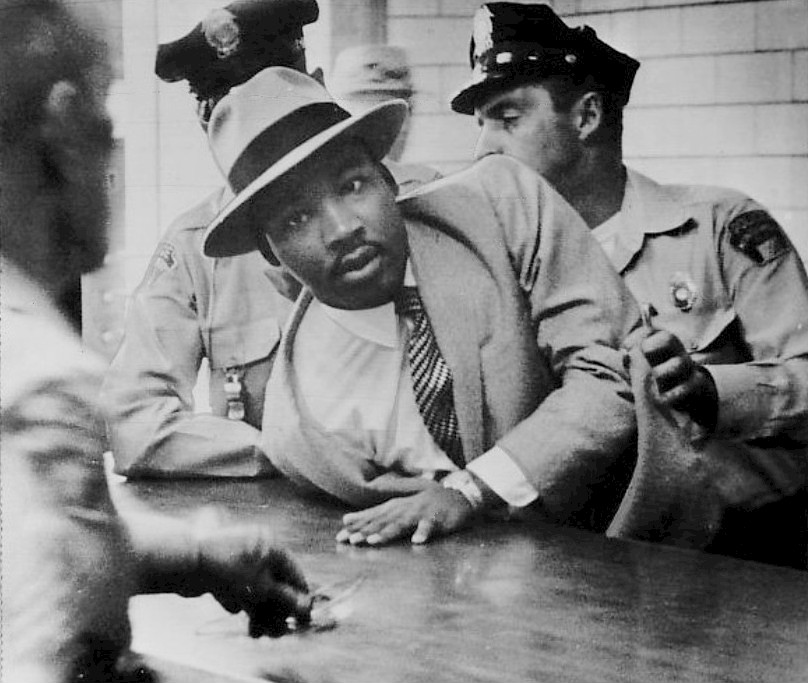 To fully appreciate the beauty and depth of the work, a bit of backstory is necessary if you weren’t fortunate enough to have studied this in school or to have come across it on your own. Dr. Martin Luther King Jr. and various civil rights leaders had been engaged in a series of non-violent protests meant to boycott and disrupt businesses until they were granted full equality and dignity under the law, including the right to be served equally by business owners even if those business owners considered doing so to be against their religious beliefs; to convince the public, after being rejected time and time again by the courts, that the inherent indignity of being denied service for an intrinsic characteristic was so morally egregious that it could not be tolerated in any just and righteous society; that the business owners were not entitled to do whatever they wanted but must, instead, serve everyone regardless of characteristic or serve no one at all. This, of course, was anathema to white southerners who took it as an attack on their religious liberty and political sovereignty. These men and women were not going to give up their bigotry without being forced to do so, kicking and screaming all the way – after all, they insisted, look at all the rights “those people” had compared to the past so why should they complain about being unable to get a cup of coffee when they can just walk down the street to another cafe to buy a cup of coffee there? They felt that their restaurants, their theme parks, their swimming pools were all private property and, as such, they could do whatever it was they wanted. This extended to public services, too, under the theory that a majority of voters could opt to implement segregation and therefore it was not only permissible, but consistent with democracy to respect the rights of voters even if those rights were not based on logic or fact.
While Dr. King was sitting in a jail cell in Birmingham, Alabama, as a result of his leadership and participation in these demonstrations, a group of eight white clergymen published an open letter entitled “A Call for Unity” or, alternatively, “Public Statement by Eight Alabama Clergymen” urging a return to “law and order”; saying that the actions of outside agitators were simply leading to a greater racial divide by inciting resentment and riling up emotions; that these protesters were making the problem worse, not better.
The open letter, released on April 12th, 1963, was the second published by this particular group, the first coming in January of that same year when they wrote an essay called “An Appeal for Law and Order and Common Sense”. This monotonous refrain, echoed among, particularly, lower and middle class whites like a security blanket – “law and order”, “law and order” – was nothing more than insidious patina meant to obfuscate the fact that those advocating for it were perfectly content to sit back and allow injustice after injustice to occur because civil rights, and equality, was nothing more than an abstract concept to them; something that was fine to debate on the merits but whose denial thereof was not something with which they could emphasize. After all, it’s easy to advocate for patience when you aren’t the one who suffers the consequences. It’s easy to ring up the bill when you aren’t the one who has to pay the charges. Additionally, aside from being patronizing, the phrase “law and order” was also disingenuous. Where was the law and order the night Black Wall Street was burned to the ground?
Upon seeing a copy of the essay, which was clearly aimed at him, personally, as well as his tactics for peaceful-yet-intentionally-disruptive protests including economic boycotts, Dr. King began writing his response on the edges of a newspaper. When his attorneys would visit, he would give them parts of his missive, which they took back to Dr. King’s secretary, Willie Pearl Mackey, and the Reverend Wyatt Walker for the task of editing and assembling. While various excerpts and abridged editions of the letter were published, the full text appeared in Dr. King’s 1964 book, Why We Can’t Wait and has since been shared, republished, and reproduced so many times that it is considered a moral, political, theological, and philosophical classic. It is not only rational and logical, it is passionate and emotional. It is the weary cry of a man who sits in lonely isolation, paying the price so generations of Americans could collect the dividends from his efforts. That price ultimately ended up including his life as Dr. King was assassinated only a few short years later on April 4, 1968, in Memphis, Tennessee.
Here is the letter, reproduced in its entirety. What follows is so perfect, do yourself the favor of reading it without distraction. Turn off the music. Go someplace quiet. Put yourself in the shoes of this man – try to emphasize with what he has experienced and how he must feel sitting locked in a jail cell while being called an “extremist” for pushing for basic recognition of his human dignity. It is a document of pain. It is a document that indicts the reader by asking, “Where were you? Why didn’t you come to my side and help when I was being attacked?”. It is a document of perseverence and hope; one that looks out to a future that did not, yet, exist and demonstrates that men and women, acting in deep conviction and righteousness on their side, can bend the world to their will even while they are attacked and called immoral. They are pages in the journal of our nation’s history and the history of “We the people”.
Letter from a Birmingham Jail
Written By Dr. Martin Luther King Jr. April 16, 1963
My Dear Fellow Clergymen:
While confined here in the Birmingham city jail, I came across your recent statement calling my present activities “unwise and untimely.” Seldom do I pause to answer criticism of my work and ideas. If I sought to answer all the criticisms that cross my desk, my secretaries would have little time for anything other than such correspondence in the course of the day, and I would have no time for constructive work. But since I feel that you are men of genuine good will and that your criticisms are sincerely set forth, I want to try to answer your statement in what I hope will be patient and reasonable terms.
I think I should indicate why I am here in Birmingham, since you have been influenced by the view which argues against “outsiders coming in.” I have the honor of serving as president of the Southern Christian Leadership Conference, an organization operating in every southern state, with headquarters in Atlanta, Georgia. We have some eighty five affiliated organizations across the South, and one of them is the Alabama Christian Movement for Human Rights. Frequently we share staff, educational and financial resources with our affiliates. Several months ago the affiliate here in Birmingham asked us to be on call to engage in a nonviolent direct action program if such were deemed necessary. We readily consented, and when the hour came we lived up to our promise. So I, along with several members of my staff, am here because I was invited here. I am here because I have organizational ties here.
But more basically, I am in Birmingham because injustice is here. Just as the prophets of the eighth century B.C. left their villages and carried their “thus saith the Lord” far beyond the boundaries of their home towns, and just as the Apostle Paul left his village of Tarsus and carried the gospel of Jesus Christ to the far corners of the Greco Roman world, so am I compelled to carry the gospel of freedom beyond my own home town. Like Paul, I must constantly respond to the Macedonian call for aid.
Moreover, I am cognizant of the interrelatedness of all communities and states. I cannot sit idly by in Atlanta and not be concerned about what happens in Birmingham. Injustice anywhere is a threat to justice everywhere. We are caught in an inescapable network of mutuality, tied in a single garment of destiny. Whatever affects one directly, affects all indirectly. Never again can we afford to live with the narrow, provincial “outside agitator” idea. Anyone who lives inside the United States can never be considered an outsider anywhere within its bounds.
You deplore the demonstrations taking place in Birmingham. But your statement, I am sorry to say, fails to express a similar concern for the conditions that brought about the demonstrations. I am sure that none of you would want to rest content with the superficial kind of social analysis that deals merely with effects and does not grapple with underlying causes. It is unfortunate that demonstrations are taking place in Birmingham, but it is even more unfortunate that the city’s white power structure left the Negro community with no alternative.
In any nonviolent campaign there are four basic steps: collection of the facts to determine whether injustices exist; negotiation; self purification; and direct action. We have gone through all these steps in Birmingham. There can be no gainsaying the fact that racial injustice engulfs this community. Birmingham is probably the most thoroughly segregated city in the United States. Its ugly record of brutality is widely known. Negroes have experienced grossly unjust treatment in the courts. There have been more unsolved bombings of Negro homes and churches in Birmingham than in any other city in the nation. These are the hard, brutal facts of the case. On the basis of these conditions, Negro leaders sought to negotiate with the city fathers. But the latter consistently refused to engage in good faith negotiation.
Then, last September, came the opportunity to talk with leaders of Birmingham’s economic community. In the course of the negotiations, certain promises were made by the merchants–for example, to remove the stores’ humiliating racial signs. On the basis of these promises, the Reverend Fred Shuttlesworth and the leaders of the Alabama Christian Movement for Human Rights agreed to a moratorium on all demonstrations. As the weeks and months went by, we realized that we were the victims of a broken promise. A few signs, briefly removed, returned; the others remained. As in so many past experiences, our hopes had been blasted, and the shadow of deep disappointment settled upon us. We had no alternative except to prepare for direct action, whereby we would present our very bodies as a means of laying our case before the conscience of the local and the national community. Mindful of the difficulties involved, we decided to undertake a process of self purification. We began a series of workshops on nonviolence, and we repeatedly asked ourselves: “Are you able to accept blows without retaliating?” “Are you able to endure the ordeal of jail?” We decided to schedule our direct action program for the Easter season, realizing that except for Christmas, this is the main shopping period of the year. Knowing that a strong economic-withdrawal program would be the by product of direct action, we felt that this would be the best time to bring pressure to bear on the merchants for the needed change.
Then it occurred to us that Birmingham’s mayoral election was coming up in March, and we speedily decided to postpone action until after election day. When we discovered that the Commissioner of Public Safety, Eugene “Bull” Connor, had piled up enough votes to be in the run off, we decided again to postpone action until the day after the run off so that the demonstrations could not be used to cloud the issues. Like many others, we waited to see Mr. Connor defeated, and to this end we endured postponement after postponement. Having aided in this community need, we felt that our direct action program could be delayed no longer.
You may well ask: “Why direct action? Why sit ins, marches and so forth? Isn’t negotiation a better path?” You are quite right in calling for negotiation. Indeed, this is the very purpose of direct action. Nonviolent direct action seeks to create such a crisis and foster such a tension that a community which has constantly refused to negotiate is forced to confront the issue. It seeks so to dramatize the issue that it can no longer be ignored. My citing the creation of tension as part of the work of the nonviolent resister may sound rather shocking. But I must confess that I am not afraid of the word “tension.” I have earnestly opposed violent tension, but there is a type of constructive, nonviolent tension which is necessary for growth. Just as Socrates felt that it was necessary to create a tension in the mind so that individuals could rise from the bondage of myths and half truths to the unfettered realm of creative analysis and objective appraisal, so must we see the need for nonviolent gadflies to create the kind of tension in society that will help men rise from the dark depths of prejudice and racism to the majestic heights of understanding and brotherhood. The purpose of our direct action program is to create a situation so crisis packed that it will inevitably open the door to negotiation. I therefore concur with you in your call for negotiation. Too long has our beloved Southland been bogged down in a tragic effort to live in monologue rather than dialogue.
One of the basic points in your statement is that the action that I and my associates have taken in Birmingham is untimely. Some have asked: “Why didn’t you give the new city administration time to act?” The only answer that I can give to this query is that the new Birmingham administration must be prodded about as much as the outgoing one, before it will act. We are sadly mistaken if we feel that the election of Albert Boutwell as mayor will bring the millennium to Birmingham. While Mr. Boutwell is a much more gentle person than Mr. Connor, they are both segregationists, dedicated to maintenance of the status quo. I have hope that Mr. Boutwell will be reasonable enough to see the futility of massive resistance to desegregation. But he will not see this without pressure from devotees of civil rights. My friends, I must say to you that we have not made a single gain in civil rights without determined legal and nonviolent pressure. Lamentably, it is an historical fact that privileged groups seldom give up their privileges voluntarily. Individuals may see the moral light and voluntarily give up their unjust posture; but, as Reinhold Niebuhr has reminded us, groups tend to be more immoral than individuals.
We know through painful experience that freedom is never voluntarily given by the oppressor; it must be demanded by the oppressed. Frankly, I have yet to engage in a direct action campaign that was “well timed” in the view of those who have not suffered unduly from the disease of segregation. For years now I have heard the word “Wait!” It rings in the ear of every Negro with piercing familiarity. This “Wait” has almost always meant “Never.” We must come to see, with one of our distinguished jurists, that “justice too long delayed is justice denied.”
We know through painful experience that freedom is never voluntarily given by the oppressor; it must be demanded by the oppressed. Frankly, I have yet to engage in a direct action campaign that was “well timed” in the view of those who have not suffered unduly from the disease of segregation. For years now I have heard the word “Wait!” It rings in the ear of every Negro with piercing familiarity. This “Wait” has almost always meant “Never.” We must come to see, with one of our distinguished jurists, that “justice too long delayed is justice denied.”
We have waited for more than 340 years for our constitutional and God given rights. The nations of Asia and Africa are moving with jetlike speed toward gaining political independence, but we still creep at horse and buggy pace toward gaining a cup of coffee at a lunch counter. Perhaps it is easy for those who have never felt the stinging darts of segregation to say, “Wait.” But when you have seen vicious mobs lynch your mothers and fathers at will and drown your sisters and brothers at whim; when you have seen hate filled policemen curse, kick and even kill your black brothers and sisters; when you see the vast majority of your twenty million Negro brothers smothering in an airtight cage of poverty in the midst of an affluent society; when you suddenly find your tongue twisted and your speech stammering as you seek to explain to your six year old daughter why she can’t go to the public amusement park that has just been advertised on television, and see tears welling up in her eyes when she is told that Funtown is closed to colored children, and see ominous clouds of inferiority beginning to form in her little mental sky, and see her beginning to distort her personality by developing an unconscious bitterness toward white people; when you have to concoct an answer for a five year old son who is asking: “Daddy, why do white people treat colored people so mean?”; when you take a cross county drive and find it necessary to sleep night after night in the uncomfortable corners of your automobile because no motel will accept you; when you are humiliated day in and day out by nagging signs reading “white” and “colored”; when your first name becomes “nigger,” your middle name becomes “boy” (however old you are) and your last name becomes “John,” and your wife and mother are never given the respected title “Mrs.”; when you are harried by day and haunted by night by the fact that you are a Negro, living constantly at tiptoe stance, never quite knowing what to expect next, and are plagued with inner fears and outer resentments; when you are forever fighting a degenerating sense of “nobodiness”–then you will understand why we find it difficult to wait. There comes a time when the cup of endurance runs over, and men are no longer willing to be plunged into the abyss of despair. I hope, sirs, you can understand our legitimate and unavoidable impatience. You express a great deal of anxiety over our willingness to break laws. This is certainly a legitimate concern. Since we so diligently urge people to obey the Supreme Court’s decision of 1954 outlawing segregation in the public schools, at first glance it may seem rather paradoxical for us consciously to break laws. One may well ask: “How can you advocate breaking some laws and obeying others?” The answer lies in the fact that there are two types of laws: just and unjust. I would be the first to advocate obeying just laws. One has not only a legal but a moral responsibility to obey just laws. Conversely, one has a moral responsibility to disobey unjust laws. I would agree with St. Augustine that “an unjust law is no law at all.”
Now, what is the difference between the two? How does one determine whether a law is just or unjust? A just law is a man made code that squares with the moral law or the law of God. An unjust law is a code that is out of harmony with the moral law. To put it in the terms of St. Thomas Aquinas: An unjust law is a human law that is not rooted in eternal law and natural law. Any law that uplifts human personality is just. Any law that degrades human personality is unjust. All segregation statutes are unjust because segregation distorts the soul and damages the personality. It gives the segregator a false sense of superiority and the segregated a false sense of inferiority. Segregation, to use the terminology of the Jewish philosopher Martin Buber, substitutes an “I it” relationship for an “I thou” relationship and ends up relegating persons to the status of things. Hence segregation is not only politically, economically and sociologically unsound, it is morally wrong and sinful. Paul Tillich has said that sin is separation. Is not segregation an existential expression of man’s tragic separation, his awful estrangement, his terrible sinfulness? Thus it is that I can urge men to obey the 1954 decision of the Supreme Court, for it is morally right; and I can urge them to disobey segregation ordinances, for they are morally wrong.
Let us consider a more concrete example of just and unjust laws. An unjust law is a code that a numerical or power majority group compels a minority group to obey but does not make binding on itself. This is difference made legal. By the same token, a just law is a code that a majority compels a minority to follow and that it is willing to follow itself. This is sameness made legal. Let me give another explanation. A law is unjust if it is inflicted on a minority that, as a result of being denied the right to vote, had no part in enacting or devising the law. Who can say that the legislature of Alabama which set up that state’s segregation laws was democratically elected? Throughout Alabama all sorts of devious methods are used to prevent Negroes from becoming registered voters, and there are some counties in which, even though Negroes constitute a majority of the population, not a single Negro is registered. Can any law enacted under such circumstances be considered democratically structured?
Sometimes a law is just on its face and unjust in its application. For instance, I have been arrested on a charge of parading without a permit. Now, there is nothing wrong in having an ordinance which requires a permit for a parade. But such an ordinance becomes unjust when it is used to maintain segregation and to deny citizens the First-Amendment privilege of peaceful assembly and protest.
I hope you are able to see the distinction I am trying to point out. In no sense do I advocate evading or defying the law, as would the rabid segregationist. That would lead to anarchy. One who breaks an unjust law must do so openly, lovingly, and with a willingness to accept the penalty. I submit that an individual who breaks a law that conscience tells him is unjust, and who willingly accepts the penalty of imprisonment in order to arouse the conscience of the community over its injustice, is in reality expressing the highest respect for law.
Of course, there is nothing new about this kind of civil disobedience. It was evidenced sublimely in the refusal of Shadrach, Meshach and Abednego to obey the laws of Nebuchadnezzar, on the ground that a higher moral law was at stake. It was practiced superbly by the early Christians, who were willing to face hungry lions and the excruciating pain of chopping blocks rather than submit to certain unjust laws of the Roman Empire. To a degree, academic freedom is a reality today because Socrates practiced civil disobedience. In our own nation, the Boston Tea Party represented a massive act of civil disobedience.
We should never forget that everything Adolf Hitler did in Germany was “legal” and everything the Hungarian freedom fighters did in Hungary was “illegal.” It was “illegal” to aid and comfort a Jew in Hitler’s Germany. Even so, I am sure that, had I lived in Germany at the time, I would have aided and comforted my Jewish brothers. If today I lived in a Communist country where certain principles dear to the Christian faith are suppressed, I would openly advocate disobeying that country’s antireligious laws.
I must make two honest confessions to you, my Christian and Jewish brothers. First, I must confess that over the past few years I have been gravely disappointed with the white moderate. I have almost reached the regrettable conclusion that the Negro’s great stumbling block in his stride toward freedom is not the White Citizen’s Counciler or the Ku Klux Klanner, but the white moderate, who is more devoted to “order” than to justice; who prefers a negative peace which is the absence of tension to a positive peace which is the presence of justice; who constantly says: “I agree with you in the goal you seek, but I cannot agree with your methods of direct action”; who paternalistically believes he can set the timetable for another man’s freedom; who lives by a mythical concept of time and who constantly advises the Negro to wait for a “more convenient season.” Shallow understanding from people of good will is more frustrating than absolute misunderstanding from people of ill will. Lukewarm acceptance is much more bewildering than outright rejection.
I must make two honest confessions to you, my Christian and Jewish brothers. First, I must confess that over the past few years I have been gravely disappointed with the white moderate. I have almost reached the regrettable conclusion that the Negro’s great stumbling block in his stride toward freedom is not the White Citizen’s Counciler or the Ku Klux Klanner, but the white moderate, who is more devoted to “order” than to justice; who prefers a negative peace which is the absence of tension to a positive peace which is the presence of justice; who constantly says: “I agree with you in the goal you seek, but I cannot agree with your methods of direct action”; who paternalistically believes he can set the timetable for another man’s freedom; who lives by a mythical concept of time and who constantly advises the Negro to wait for a “more convenient season.” Shallow understanding from people of good will is more frustrating than absolute misunderstanding from people of ill will. Lukewarm acceptance is much more bewildering than outright rejection.
I had hoped that the white moderate would understand that law and order exist for the purpose of establishing justice and that when they fail in this purpose they become the dangerously structured dams that block the flow of social progress. I had hoped that the white moderate would understand that the present tension in the South is a necessary phase of the transition from an obnoxious negative peace, in which the Negro passively accepted his unjust plight, to a substantive and positive peace, in which all men will respect the dignity and worth of human personality. Actually, we who engage in nonviolent direct action are not the creators of tension. We merely bring to the surface the hidden tension that is already alive. We bring it out in the open, where it can be seen and dealt with. Like a boil that can never be cured so long as it is covered up but must be opened with all its ugliness to the natural medicines of air and light, injustice must be exposed, with all the tension its exposure creates, to the light of human conscience and the air of national opinion before it can be cured.
In your statement you assert that our actions, even though peaceful, must be condemned because they precipitate violence. But is this a logical assertion? Isn’t this like condemning a robbed man because his possession of money precipitated the evil act of robbery? Isn’t this like condemning Socrates because his unswerving commitment to truth and his philosophical inquiries precipitated the act by the misguided populace in which they made him drink hemlock? Isn’t this like condemning Jesus because his unique God consciousness and never ceasing devotion to God’s will precipitated the evil act of crucifixion? We must come to see that, as the federal courts have consistently affirmed, it is wrong to urge an individual to cease his efforts to gain his basic constitutional rights because the quest may precipitate violence. Society must protect the robbed and punish the robber. I had also hoped that the white moderate would reject the myth concerning time in relation to the struggle for freedom. I have just received a letter from a white brother in Texas. He writes: “All Christians know that the colored people will receive equal rights eventually, but it is possible that you are in too great a religious hurry. It has taken Christianity almost two thousand years to accomplish what it has. The teachings of Christ take time to come to earth.” Such an attitude stems from a tragic misconception of time, from the strangely irrational notion that there is something in the very flow of time that will inevitably cure all ills. Actually, time itself is neutral; it can be used either destructively or constructively. More and more I feel that the people of ill will have used time much more effectively than have the people of good will. We will have to repent in this generation not merely for the hateful words and actions of the bad people but for the appalling silence of the good people. Human progress never rolls in on wheels of inevitability; it comes through the tireless efforts of men willing to be co workers with God, and without this hard work, time itself becomes an ally of the forces of social stagnation. We must use time creatively, in the knowledge that the time is always ripe to do right. Now is the time to make real the promise of democracy and transform our pending national elegy into a creative psalm of brotherhood. Now is the time to lift our national policy from the quicksand of racial injustice to the solid rock of human dignity.
You speak of our activity in Birmingham as extreme. At first I was rather disappointed that fellow clergymen would see my nonviolent efforts as those of an extremist. I began thinking about the fact that I stand in the middle of two opposing forces in the Negro community. One is a force of complacency, made up in part of Negroes who, as a result of long years of oppression, are so drained of self respect and a sense of “somebodiness” that they have adjusted to segregation; and in part of a few middle-class Negroes who, because of a degree of academic and economic security and because in some ways they profit by segregation, have become insensitive to the problems of the masses. The other force is one of bitterness and hatred, and it comes perilously close to advocating violence. It is expressed in the various black nationalist groups that are springing up across the nation, the largest and best known being Elijah Muhammad’s Muslim movement. Nourished by the Negro’s frustration over the continued existence of racial discrimination, this movement is made up of people who have lost faith in America, who have absolutely repudiated Christianity, and who have concluded that the white man is an incorrigible “devil.”
I have tried to stand between these two forces, saying that we need emulate neither the “do nothingism” of the complacent nor the hatred and despair of the black nationalist. For there is the more excellent way of love and nonviolent protest. I am grateful to God that, through the influence of the Negro church, the way of nonviolence became an integral part of our struggle. If this philosophy had not emerged, by now many streets of the South would, I am convinced, be flowing with blood. And I am further convinced that if our white brothers dismiss as “rabble rousers” and “outside agitators” those of us who employ nonviolent direct action, and if they refuse to support our nonviolent efforts, millions of Negroes will, out of frustration and despair, seek solace and security in black nationalist ideologies–a development that would inevitably lead to a frightening racial nightmare.
Oppressed people cannot remain oppressed forever. The yearning for freedom eventually manifests itself, and that is what has happened to the American Negro. Something within has reminded him of his birthright of freedom, and something without has reminded him that it can be gained. Consciously or unconsciously, he has been caught up by the Zeitgeist, and with his black brothers of Africa and his brown and yellow brothers of Asia, South America and the Caribbean, the United States Negro is moving with a sense of great urgency toward the promised land of racial justice. If one recognizes this vital urge that has engulfed the Negro community, one should readily understand why public demonstrations are taking place. The Negro has many pent up resentments and latent frustrations, and he must release them. So let him march; let him make prayer pilgrimages to the city hall; let him go on freedom rides -and try to understand why he must do so. If his repressed emotions are not released in nonviolent ways, they will seek expression through violence; this is not a threat but a fact of history. So I have not said to my people: “Get rid of your discontent.” Rather, I have tried to say that this normal and healthy discontent can be channeled into the creative outlet of nonviolent direct action. And now this approach is being termed extremist. But though I was initially disappointed at being categorized as an extremist, as I continued to think about the matter I gradually gained a measure of satisfaction from the label. Was not Jesus an extremist for love: “Love your enemies, bless them that curse you, do good to them that hate you, and pray for them which despitefully use you, and persecute you.” Was not Amos an extremist for justice: “Let justice roll down like waters and righteousness like an ever flowing stream.” Was not Paul an extremist for the Christian gospel: “I bear in my body the marks of the Lord Jesus.” Was not Martin Luther an extremist: “Here I stand; I cannot do otherwise, so help me God.” And John Bunyan: “I will stay in jail to the end of my days before I make a butchery of my conscience.” And Abraham Lincoln: “This nation cannot survive half slave and half free.” And Thomas Jefferson: “We hold these truths to be self evident, that all men are created equal . . .” So the question is not whether we will be extremists, but what kind of extremists we will be. Will we be extremists for hate or for love? Will we be extremists for the preservation of injustice or for the extension of justice? In that dramatic scene on Calvary’s hill three men were crucified. We must never forget that all three were crucified for the same crime–the crime of extremism. Two were extremists for immorality, and thus fell below their environment. The other, Jesus Christ, was an extremist for love, truth and goodness, and thereby rose above his environment. Perhaps the South, the nation and the world are in dire need of creative extremists.
I had hoped that the white moderate would see this need. Perhaps I was too optimistic; perhaps I expected too much. I suppose I should have realized that few members of the oppressor race can understand the deep groans and passionate yearnings of the oppressed race, and still fewer have the vision to see that injustice must be rooted out by strong, persistent and determined action. I am thankful, however, that some of our white brothers in the South have grasped the meaning of this social revolution and committed themselves to it. They are still all too few in quantity, but they are big in quality. Some -such as Ralph McGill, Lillian Smith, Harry Golden, James McBride Dabbs, Ann Braden and Sarah Patton Boyle–have written about our struggle in eloquent and prophetic terms. Others have marched with us down nameless streets of the South. They have languished in filthy, roach infested jails, suffering the abuse and brutality of policemen who view them as “dirty nigger-lovers.” Unlike so many of their moderate brothers and sisters, they have recognized the urgency of the moment and sensed the need for powerful “action” antidotes to combat the disease of segregation. Let me take note of my other major disappointment. I have been so greatly disappointed with the white church and its leadership. Of course, there are some notable exceptions. I am not unmindful of the fact that each of you has taken some significant stands on this issue. I commend you, Reverend Stallings, for your Christian stand on this past Sunday, in welcoming Negroes to your worship service on a nonsegregated basis. I commend the Catholic leaders of this state for integrating Spring Hill College several years ago.
But despite these notable exceptions, I must honestly reiterate that I have been disappointed with the church. I do not say this as one of those negative critics who can always find something wrong with the church. I say this as a minister of the gospel, who loves the church; who was nurtured in its bosom; who has been sustained by its spiritual blessings and who will remain true to it as long as the cord of life shall lengthen.
When I was suddenly catapulted into the leadership of the bus protest in Montgomery, Alabama, a few years ago, I felt we would be supported by the white church. I felt that the white ministers, priests and rabbis of the South would be among our strongest allies. Instead, some have been outright opponents, refusing to understand the freedom movement and misrepresenting its leaders; all too many others have been more cautious than courageous and have remained silent behind the anesthetizing security of stained glass windows.
In spite of my shattered dreams, I came to Birmingham with the hope that the white religious leadership of this community would see the justice of our cause and, with deep moral concern, would serve as the channel through which our just grievances could reach the power structure. I had hoped that each of you would understand. But again I have been disappointed.
I have heard numerous southern religious leaders admonish their worshipers to comply with a desegregation decision because it is the law, but I have longed to hear white ministers declare: “Follow this decree because integration is morally right and because the Negro is your brother.” In the midst of blatant injustices inflicted upon the Negro, I have watched white churchmen stand on the sideline and mouth pious irrelevancies and sanctimonious trivialities. In the midst of a mighty struggle to rid our nation of racial and economic injustice, I have heard many ministers say: “Those are social issues, with which the gospel has no real concern.” And I have watched many churches commit themselves to a completely other worldly religion which makes a strange, un-Biblical distinction between body and soul, between the sacred and the secular.
I have traveled the length and breadth of Alabama, Mississippi and all the other southern states. On sweltering summer days and crisp autumn mornings I have looked at the South’s beautiful churches with their lofty spires pointing heavenward. I have beheld the impressive outlines of her massive religious education buildings. Over and over I have found myself asking: “What kind of people worship here? Who is their God? Where were their voices when the lips of Governor Barnett dripped with words of interposition and nullification? Where were they when Governor Wallace gave a clarion call for defiance and hatred? Where were their voices of support when bruised and weary Negro men and women decided to rise from the dark dungeons of complacency to the bright hills of creative protest?”
I have traveled the length and breadth of Alabama, Mississippi and all the other southern states. On sweltering summer days and crisp autumn mornings I have looked at the South’s beautiful churches with their lofty spires pointing heavenward. I have beheld the impressive outlines of her massive religious education buildings. Over and over I have found myself asking: “What kind of people worship here? Who is their God? Where were their voices when the lips of Governor Barnett dripped with words of interposition and nullification? Where were they when Governor Wallace gave a clarion call for defiance and hatred? Where were their voices of support when bruised and weary Negro men and women decided to rise from the dark dungeons of complacency to the bright hills of creative protest?”
Yes, these questions are still in my mind. In deep disappointment I have wept over the laxity of the church. But be assured that my tears have been tears of love. There can be no deep disappointment where there is not deep love. Yes, I love the church. How could I do otherwise? I am in the rather unique position of being the son, the grandson and the great grandson of preachers. Yes, I see the church as the body of Christ. But, oh! How we have blemished and scarred that body through social neglect and through fear of being nonconformists.
There was a time when the church was very powerful–in the time when the early Christians rejoiced at being deemed worthy to suffer for what they believed. In those days the church was not merely a thermometer that recorded the ideas and principles of popular opinion; it was a thermostat that transformed the mores of society. Whenever the early Christians entered a town, the people in power became disturbed and immediately sought to convict the Christians for being “disturbers of the peace” and “outside agitators.”‘ But the Christians pressed on, in the conviction that they were “a colony of heaven,” called to obey God rather than man. Small in number, they were big in commitment. They were too God-intoxicated to be “astronomically intimidated.” By their effort and example they brought an end to such ancient evils as infanticide and gladiatorial contests. Things are different now. So often the contemporary church is a weak, ineffectual voice with an uncertain sound. So often it is an archdefender of the status quo. Far from being disturbed by the presence of the church, the power structure of the average community is consoled by the church’s silent–and often even vocal–sanction of things as they are.
But the judgment of God is upon the church as never before. If today’s church does not recapture the sacrificial spirit of the early church, it will lose its authenticity, forfeit the loyalty of millions, and be dismissed as an irrelevant social club with no meaning for the twentieth century. Every day I meet young people whose disappointment with the church has turned into outright disgust.
Perhaps I have once again been too optimistic. Is organized religion too inextricably bound to the status quo to save our nation and the world? Perhaps I must turn my faith to the inner spiritual church, the church within the church, as the true ekklesia and the hope of the world. But again I am thankful to God that some noble souls from the ranks of organized religion have broken loose from the paralyzing chains of conformity and joined us as active partners in the struggle for freedom. They have left their secure congregations and walked the streets of Albany, Georgia, with us. They have gone down the highways of the South on tortuous rides for freedom. Yes, they have gone to jail with us. Some have been dismissed from their churches, have lost the support of their bishops and fellow ministers. But they have acted in the faith that right defeated is stronger than evil triumphant. Their witness has been the spiritual salt that has preserved the true meaning of the gospel in these troubled times. They have carved a tunnel of hope through the dark mountain of disappointment. I hope the church as a whole will meet the challenge of this decisive hour. But even if the church does not come to the aid of justice, I have no despair about the future. I have no fear about the outcome of our struggle in Birmingham, even if our motives are at present misunderstood. We will reach the goal of freedom in Birmingham and all over the nation, because the goal of America is freedom. Abused and scorned though we may be, our destiny is tied up with America’s destiny. Before the pilgrims landed at Plymouth, we were here. Before the pen of Jefferson etched the majestic words of the Declaration of Independence across the pages of history, we were here. For more than two centuries our forebears labored in this country without wages; they made cotton king; they built the homes of their masters while suffering gross injustice and shameful humiliation -and yet out of a bottomless vitality they continued to thrive and develop. If the inexpressible cruelties of slavery could not stop us, the opposition we now face will surely fail. We will win our freedom because the sacred heritage of our nation and the eternal will of God are embodied in our echoing demands. Before closing I feel impelled to mention one other point in your statement that has troubled me profoundly. You warmly commended the Birmingham police force for keeping “order” and “preventing violence.” I doubt that you would have so warmly commended the police force if you had seen its dogs sinking their teeth into unarmed, nonviolent Negroes. I doubt that you would so quickly commend the policemen if you were to observe their ugly and inhumane treatment of Negroes here in the city jail; if you were to watch them push and curse old Negro women and young Negro girls; if you were to see them slap and kick old Negro men and young boys; if you were to observe them, as they did on two occasions, refuse to give us food because we wanted to sing our grace together. I cannot join you in your praise of the Birmingham police department.
It is true that the police have exercised a degree of discipline in handling the demonstrators. In this sense they have conducted themselves rather “nonviolently” in public. But for what purpose? To preserve the evil system of segregation. Over the past few years I have consistently preached that nonviolence demands that the means we use must be as pure as the ends we seek. I have tried to make clear that it is wrong to use immoral means to attain moral ends. But now I must affirm that it is just as wrong, or perhaps even more so, to use moral means to preserve immoral ends. Perhaps Mr. Connor and his policemen have been rather nonviolent in public, as was Chief Pritchett in Albany, Georgia, but they have used the moral means of nonviolence to maintain the immoral end of racial injustice. As T. S. Eliot has said: “The last temptation is the greatest treason: To do the right deed for the wrong reason.”
I wish you had commended the Negro sit inners and demonstrators of Birmingham for their sublime courage, their willingness to suffer and their amazing discipline in the midst of great provocation. One day the South will recognize its real heroes. They will be the James Merediths, with the noble sense of purpose that enables them to face jeering and hostile mobs, and with the agonizing loneliness that characterizes the life of the pioneer. They will be old, oppressed, battered Negro women, symbolized in a seventy two year old woman in Montgomery, Alabama, who rose up with a sense of dignity and with her people decided not to ride segregated buses, and who responded with ungrammatical profundity to one who inquired about her weariness: “My feets is tired, but my soul is at rest.” They will be the young high school and college students, the young ministers of the gospel and a host of their elders, courageously and nonviolently sitting in at lunch counters and willingly going to jail for conscience’ sake. One day the South will know that when these disinherited children of God sat down at lunch counters, they were in reality standing up for what is best in the American dream and for the most sacred values in our Judaeo Christian heritage, thereby bringing our nation back to those great wells of democracy which were dug deep by the founding fathers in their formulation of the Constitution and the Declaration of Independence.
Never before have I written so long a letter. I’m afraid it is much too long to take your precious time. I can assure you that it would have been much shorter if I had been writing from a comfortable desk, but what else can one do when he is alone in a narrow jail cell, other than write long letters, think long thoughts and pray long prayers?
If I have said anything in this letter that overstates the truth and indicates an unreasonable impatience, I beg you to forgive me. If I have said anything that understates the truth and indicates my having a patience that allows me to settle for anything less than brotherhood, I beg God to forgive me.
I hope this letter finds you strong in the faith. I also hope that circumstances will soon make it possible for me to meet each of you, not as an integrationist or a civil-rights leader but as a fellow clergyman and a Christian brother. Let us all hope that the dark clouds of racial prejudice will soon pass away and the deep fog of misunderstanding will be lifted from our fear drenched communities, and in some not too distant tomorrow the radiant stars of love and brotherhood will shine over our great nation with all their scintillating beauty.
Yours for the cause of Peace and Brotherhood,

Reader Comments (57)
Comments are presented chronologically, with replies indented beneath the comments to which they respond.
difff23
January 17, 2017
Thank you, Joshua. What I learn from this site is invaluable.
FratMan
January 17, 2017
What do you make of MLK's decision to rarely respond directly to his critics? One one hand, he is right that it prevents constructive work. On the other hand, it is this response to his critics that allowed him to shape his legacy. If you don't respond, do you run the risk of others defining your legacy? Do you think MLK had the right calibration for knowing which criticisms to let slide and determine which were worthy of a response?
Blair
January 17, 2017
Replying to FratMan
John D. Rockefeller was similar to Dr. MLK in the way that he did not (publicly) respond to criticism (often). I could easily see both of these men preferring God's judgement to that of others.
Joshua Kennon
February 19, 2017
Replying to FratMan
Those are excellent questions. I'm not sure I have the answer at present. My general rule is to largely avoid responding at all but that is a by-product of having such a large audience since I began writing back in 2001. It became so second-nature to see people completely mischaracterize something I wrote, I got to the point it was a waste of time to try and clarify it unless 1.) I was genuinely in the mood to discuss the topic and/or 2.) there was some other compelling reason for it to get my time (protecting your time is probably one of the most important skills a person needs to learn if they want to be effective and productive).
joe pierson
January 17, 2017
“I believed, up until recently, that most people were capable of acting beyond their own self-interest; that most people had an actual desire to do good in the world and see justice done. I no longer believe that.”
I think if you go down Munger’s checklist that attitude is not as cold-hearted and depressing as you believe, but simply an end result of a lot of simple influences interacting and accumulating in a bad way, such as:
1) Social proof: Judging the complacency of other moderates as the correct way to behave.
2) Deprival: Involuntarily losing a long standing white power structure and reacting to minor losses disproportionately
3) Jealousy: Special treatment of minorities (affirmative action)
4) Commitment/consistency: Desire to have century old status quo to be maintained, all change is suspect because it is change.
5) Association: Long standing association of suppressed poor minorities with crime and laziness.
I guess what I am suggesting is that attitude of "you can harm others as long as it is not me" requires a lot of behavioral infrastructure to setup and maintain, it doesn't spontaneously appear out of nowhere. At least that is my opinion.
Kisse Ellis
January 21, 2017
Replying to joe pierson
....and u forget simple evil.(you forget for the psychological reason of Denial...).
The facts are that many people are evil and sociopathic; they enjoy both consciously and subconsciously the degradation and suffering of others.
Joshua Kennon
February 19, 2017
Replying to joe pierson
I agree with you and understand the how and why these forces exert themselves. The thing I'm finding difficult to reconcile is the willingness of so many people who completely disregard all of the principals they espouse if the form - the package - in which the betrayal of their highest stated values is wrapped happens to match what is visually and emotionally comfortable to them.
I've spent a lot of time debating whether or not to write the essay that would delve into this; why I feel this way and the examples that caused me to do it. I'm not sure the trade-off, the disutility it could invite, is worth it.
Stephanie Barnett Harris
May 4, 2017
Replying to Joshua Kennon
I'm not sure I'm understanding you here, but I can tell you I most definitely was not visually or emotionally comfortable with Trump, but voted for him. The biggest factor for me was a feeling that the Clinton web extended into too many other governmental entities that should have been operating with independence and it would have significantly eliminated checks and balances on the actions of that administration. I also believe we needed an administration that felt protecting America and our commerce as foremost was really important - kind of like putting the oxygen mask on yourself first.
Lml519
August 11, 2017
Replying to Joshua Kennon
"The thing I'm finding difficult to reconcile is the willingness of so many people who completely disregard all of the principals they espouse if the form - the package - in which the betrayal of their highest stated values is wrapped happens to match what is visually and emotionally comfortable to them."
Dear Josh,
First of all, I really hope that wherever you are, you and Aaron are doing well. I know that recent events must have caused a complete re-calibration of your lives, hence the silence. Please do what is best for you both; I would want nothing less.
Your comment here, has really struck a chord with me. The reason being, I feel that there is no better description of Clinton voters than your words above. I'm not sure if that is what you have in mind, and that is why I'm so curious about your thoughts on the matter.
My vote is for you to write the article that you suggest at, but I would never want that if it will put you at risk. As the owner of this domain, you have my contact information. Please reach out directly with your thoughts, if you are able to.
jcm267
February 28, 2017
Replying to joe pierson
The election wasn't about a "white power structure" and racism. You couldn't be farther from the truth. The election was ultimately decided by the Rust Belt. People who voted for Obama twice switched parties to vote for Trump. The reason is because of Trump's statements and positions on trade. Take away PA, MI, WI, and IA and Trump loses 284 to 254.
There is a widespread belief that free trade with poor nations like Mexico and China (I know we have no free trade with China, but we have China in the WTO and most people don't understand the difference) are bad for our jobs. We have a lot of people watching white collar work going through the same pressures blue collar work went through a generation ago with technology making it very easy to put a call center, a team of computer programmers, or just about any other back office job in a poor country such as the Philippines or India. We have more illegal immigrants in this country than we have people living in our two largest cities combined, we have widespread abuse of the H1B and H2B visa programs. People see their way of life under attack.
There are racists who supported Trump, too, but Trump would not have won if he was the white nationalist candidate. For one, he would have turned off brown people like my wife whose votes he needed to win such a narrow victory. And also, the white nationalists are such a fringe group. There's a video of Richard Spencer, a "leader" of white nationalists, getting punched in the face on live TV. There were only a few people around him who were supporting him. Any crank can attract a few people to hang out on a street corner in DC. Spencer, the "leader" of the white nationalists, is nothing but a crank with a very small following. The media and Trump's enemies are working hard to elevate his profile...
Had Bernie Sanders won the Democratic nomination then Trump wouldn't have won over so many of the white working class voters who traditionally vote Democrat. The rust belt firewall would have held and Trump would have certainly lost to Sanders. Trumpism can trace its roots to NAFTA. Dismissing these voters as racist will only harden them and get them to tune you (and, more importantly, the mainstream media that pushes the same narrative) out. They know why they voted for Trump and it isn't because of race!
Kapitalust
January 19, 2017
This stuck out for me the most:
"I have tried to make clear that it is wrong to use immoral means to attain moral ends. But now I must affirm that it is just as wrong, or perhaps even more so, to use moral means to preserve immoral ends."
Kapitalust
January 20, 2017
Replying to Kapitalust
I was reminded of the passage by MLK of him standing in the middle between complacency and violence in the black community and the ugliness of the violence and possible civil war that awaited if non-violent protest did not succeed while I was reading an article on Syria today:
"Six years ago, the Syrian people had all the ingredients they needed for a successful revolution like the ones that toppled Zine el-Abidine Ben Ali in Tunisia and Hosni Mubarak in Egypt, except for one: a way to overcome the Assad regime’s military might. The Syrian people tried to do this by taking the military out of the equation, as others had in Tunisia and Egypt, by protesting in completely peaceful fashion. Six years later the narrative has been twisted to portray a Syrian apocalypse between two equally armed sides killing each other in a civil war. This cannot be emphasized enough: The Syrian revolution was, at its inception, a completely nonviolent one.
Nonviolent resistance as a tool against oppression holds a nearly sacred status in our shared modern history; the mere mention of “Gandhi” or “Martin Luther King Jr.” can inspire like nothing else. But nonviolent resistance requires one condition to be effective: It requires your oppressors to have some willingness to negotiate. It requires your opponents to accept compromise as a better alternative to burning their own country to the ground. It worked in America, and after the armies sided with the people and refused orders to open fire, it worked in Tunisia and (at least for a time) Egypt.
But it did not work in Syria, because the regime responded to protests with violence from day one. The revolution started on March 6, when a group of adolescents spray-painted anti-Assad graffiti on walls in the town of Daraa. The government arrested and tortured them — kids ages 10 to 15 — for weeks. When their families and friends gathered in town to protest, troops opened fire. Within weeks, protests had broken out around the country. They would be met with a similar response. This had simply been standard operating procedure in Syria for 40 years. The Assad regime has shown over and over again — as it did when it massacred more than 10,000 people in the city of Hama in 1982 — that there is nothing it won’t do, no moral line it won’t cross against its own people to maintain power."
Thomas McInnis
January 26, 2017
Absolutely valuable. Thank you for sharing this letter. From Australia our study of your civil rights movement is quite limited, but I almost cried a third of the way in.
Ben Wright
January 31, 2017
Great post, here in the UK the government has just pardoned 41,000 gay men of past convictions.
http://www.bbc.co.uk/news/uk-38814338
Mark Weaver
January 31, 2017
I've made $104,000 previous year by freelancing from home and I did it by working part time for 3+ h each day. I used a money making model I came across online and I am excited that i was able to make so much money. It's user-friendly and I am just so blessed that i discovered it. Check out what I did... CHECKS25.COM
[email protected]
February 1, 2017
I've profited 104 thousand dollars in 2016 by freelancing online and I did that by working in my own time for 3 or sometimes more hrs /day. I used a business opportunity I found on-line and I am so thrilled that i made so much money on the side. It's really beginner-friendly and I'm so grateful that I found out about it. This is what i did... STATICTAB.COM/h8vxywm
Joseph Dixon
February 1, 2017
I got paid $104k in 2016 by freelancing on-line and I did that by working in my own time for several hrs each day. I followed an earning model I stumbled upon online and I am excited that i earned so much money on the side. It's so beginner-friendly and I'm just so happy that i discovered it. This is what i did... STATICTAB.COM/h8vxywm
[email protected]
February 2, 2017
I got paid 104000 dollars in last twelve months by working on-line from home and I manage that by working part-time for few h daily. I was following a money making opportunity I stumbled upon from this website i found online and I am happy that i earned so much extra income. It's really newbie friendly and I am just so blessed that i learned about it. Here is what i do... STATICTAB.COM/8cx4rgs
[email protected]
February 5, 2017
I have earned $104k last year by freelancing from home and I was able to do it by working in my own time for 3+ h /daily. I used a business model I was introduced by this website i found online and I am so happy that i made such great money. It's newbie-friendly and I am just so grateful that i found this. This is what i did... REGISTRATIONS37.COM
caleb
February 7, 2017
Dr King's letter is beautiful ...
But in your intro, you say, "... including the right to be served equally by business owners even if those business owners considered doing so to be against their religious beliefs ... They felt that their restaurants, their theme parks, their swimming pools were all private property and, as such, they could do whatever it was they wanted ... "
And I have to disagree with you as it seems you're implying that a private business owner does NOT have the right to serve who they want?
If a prejudice man is the private owner of a store and wants to deny service to the race he is prejudice against, that is his business as a private business owner. He has every right to do that. At least in a free society that is the way it should be.
The public services/stores you mention? By all means, they can be regulated by the state to conform to whatever morals society says they should.
But it's a mistake to tell private businesses what they must do in this way.
Joshua Kennon
February 7, 2017
Replying to caleb
Coffee break time! I love stuff like this. You say ...
... yet it simply isn't true nor has it ever been in the entire time the United States has existed. This goes back to English common law which was inherited and incorporated into the U.S. constitutional system. To be blunt, a private business owner in the United States does not now, nor has he or she ever, had the right to do whatever he or she wants with his business. Merchant activities are one of the oldest, most traditionally regulated activities in human civilization. It is one of the oldest, best, most thoroughly well-fleshed out issues in the history of our republic. Specifically, the issue is one of personal freedom but, more specifically, it is how conflicts are resolved when the personal freedoms of two or more parties conflict.
For example:
1. If your customers owe you money, you can't charge whatever rate you want, you are subject to various usury laws, debt collection practices, and other restrictions that govern how you can engage in commerce. Your right as a business owner is subordinate to the rights of your fellow citizens to avoid seeing people driven into poverty so they have to pick up the slack in the form of social welfare.
2. If you buy a plot of land and build a factory, you can't dump whatever chemicals you want without properly disposing of them because to do otherwise harms others and represents an externalization of your cost structure, allowing you to steal from others as you pass on expenses and dis-utility to them. Your right as a business owner is subordinate to the right of other landowners and the next generation to not have to pay for your mess.
3. If your business is building housing or apartments, you can't refuse to rent to someone based on their nationality, family status, or a list of other factors. Your right as a business owner is subordinate to the right of an ordinary citizen to have fair and equitable access to housing stock regardless of benign intrinsic characteristics.
4. Your business can't refuse to hire employees based on disabilities even if it makes your job as a business owner more difficult. To demonstrate how strong this protection is, if you own a paint manufacturer, you can't refuse to hire someone who is color blind. Again, your right as a business owner is subordinate to the right of a person to seek gainful employment in a fair and equitable manner for things that are not an "undue burden" - those are the key words - and that are not in his or her control.
5. You can't just grab a car and start operating a taxi service. Communities have a right to determine how, and on what terms, traffic patterns interrupt their lives and thus have the right to regulate the number of taxis on the road through the use of medallion systems or other artificial scarcity; the same for building permits or towns who don't want their peaceful enclaves to turn into bigger cities. Your right as the owner of a transportation business is subordinate to everyone else's right to decide how their city is planned.
6. You cannot offer disparate pricing based on constitutionally protected rights. For example, if you own a restaurant, you cannot offer to take 15% off the ticket of any customer who brings in a bulletin from a recent Baptist service as what you are effectively doing is charging a premium for anyone who is Catholic or Jewish, etc. Likewise, if you own a copy machine distributor, you cannot markup prices for black customers by 10%. Your right as a business owner is subordinate to everyone else's right to enjoy full and equal access to the marketplace regardless of religion or race, which are considered a constitutionally protected right. In other words, our civilization, as well as most Western civilization, has and have long determined that when individual rights conflict, the individual rights of the patron take priority the same way a traffic light resolves cars driving in different directions. "Yield to the patron" is the road sign that has served us well for centuries.
7. If you want to start managing money for people, you can't decide to split the profits with them unless they qualify under some specific quantitative measures that make them an "accredited investor". Your right as a business owner is subordinate to the protections meant to guard against inexperienced or non-wealthy investors taking risks they can't afford to take even if they are willing to enter into the transaction. This is a way for citizens to protect themselves from having their neighbors end up on welfare and overburdening public resources.
The list goes on and on and on ...
8. What you can buy and sell can be determined through import and export tariffs or quotas.
9. Rations can be established in times of need.
10. Products or services deemed harmful can be curtailed.
11. You can't name your product whatever you want - for example, if you start a business and begin manufacturing whisky, you can't call it bourbon unless it's made in the USA.
12. Likewise, you can't name your product something that might mislead people.
13. You can't name your product something that infringes on someone else's trademark.
14. You can't gain market share above a specific amount. For example, if you own a bank, you are limited to the total percentage of deposits you are allowed to hold relative to the overall banking system.
15. If you come to dominate and abuse a particular industry, your business can be broken up against your will for the good of everyone else.
16. You have to keep your restaurant up to certain standards of cleanliness and safety if you want to operate. Your rights as a business owner are subordinate to the rights of your customers to not get sick or be burned; e.g., you can't serve coffee at whatever temperature you desire.
17. If you own a railroad or other common carrier, you can't unreasonably exclude certain passengers.
I mean, a massive portion of our constitutional system as it pertains to resolving personal freedom conflicts within the economic sphere is based on this basic fact and it can be easily argued that is one of the reasons our particular brand of capitalism and democracy has so wildly outperformed the rest of the world in so many ways. You can pretty much do whatever you want in your home but your business? No. Not a chance. That has never been the case and it is certainly not the case now. I'd go so far as to say that once a person has studied the history of the matter, and the reasons everyone from the founders to modern day jurists adhere to this philosophy, no reasonable person who understood second and third order effects could disagree with them. Or, rather, if they did disagree with them, it'd be an act of immorality because it would show an almost sociopathic disregard for the freedoms it would restrict down the line. You'd get all of these negative feedback mechanisms and institutionalized advantages and disadvantages that would have a significant cumulative economic detrimental effect.
A business owner is not entitled to behave like a king. A business license is not like a royal decree that entitles a person to do whatever he or she wants. Businesses are not entirely private by their very nature as they are engaged in the public marketplace. The rules of engagement have long been that you serve everyone equally or you serve no one at all or you will be severely penalized and/or driven out of business. That is the American way. It's a cornerstone of our economic and constitutional history.
If you want to understand this topic further, and why your statement is not considered true under the American constitution or Western tradition, there is a fantastic overview by Alfred Avins called What is a Place of "Public" Accommodation from the Marquette Law Review, Volume 52, Issue 1 Summer of 1968 Article 2. I found a copy in Adobe PDF for you, which you can download here.
It is well worth your time and can serve as a sort of crash course up through the mid-20th century, breaking down the hows and whys different business owners' freedoms were restricted for the purpose of greater aggregate freedom of individual citizens across the civilization. There have been some modern developments though they are merely additions to the framework, which remains unchanged: A business owner is not a monarch and can only engage in commerce on terms and conditions deemed acceptable to his or her fellow citizens. Thus it has long been, thus it is now, and unless we want to cut ourselves off at the knees in terms of long-term peace, stability, and aggregate freedom, thus it should always be. Who wants to live in a world of tribal warlords and regional demi-gods? That's the type of long-term future you're setting up for your grandchildren if you go for the seductive, historically inaccurate myth that only looks at a very limited view of individual freedom; namely, freedom from behind the counter and not at the 35,000-foot view of society.
(At the moment, the focus is on sexual orientation protection in public accommodation - a good historical overview with lots of footnotes for further research on the history of public accommodation can be found in this PDF but I imagine in another 50 to 100 years, public accommodation will be broadened a bit further to protect genetic modification or non-modification. I think we're within a few generations of certain parts of society being able to genetically gift their children substantial advantages that are not available to others, creating a massive divide in things like cognition ability, beauty capital, etc. Resolving the conflicts that could arise from that would be messy, I'd imagine.)
At least, that's my quick-and-simple off-the-cuff version of it as I need to get back to work in a moment. Thanks for the distraction, though! If you do decide to case study public accommodation law history, let me know and I can try to dig through my own, old files on it.
Lml519
February 7, 2017
Replying to Joshua Kennon
Although I am not the original poster, I want to thank you for posting this. Although it is only a comment reply, I think the content here is as worthy of visibility as any of your full blog posts. I do have a question for you though. The underlying principles that you have outlined here regarding individual freedom vs collective welfare are in the context of business practices. Do you also apply these principles to free speech in the public sphere? Are there also catastrophic second order & third order effects to permitting people to promote discriminatory or incendiary ideas on a public platform that would justify its restriction? I would suspect that speech is a far less clear-cut case than business practices, but I'm interesting in hearing your perspective on this because of how much research you put into all your views.
Joshua Kennon
February 18, 2017
Replying to Lml519
To answer the question ...
... absolutely not. I am not in favor of what has been dubbed "Free Speech Lite" of the sort you find in Western European democracies. I am in total agreement with the doctrine that has arisen over the past couple of centuries in America's constitutional law - doctrine that resulted from a lot of brilliant people making moral, philosophical, and legal arguments - that unless speech involves an identifiable call to harm against a specific person or group of people or meets other, very, very narrowly drawn tests (e.g., yelling "Fire!" in a theater to cause a panic for your own amusement when there is no fire), speech cannot and should not be restrained but must be defeated with more speech.
Otherwise, you get these perverse outcomes in the real world and it certainly does not protect vulnerable populations all the time as it can easily be hijacked by extremists (e.g., Consider, for example, what happened in France. Manif Pour Tous advocates for policies that are abhorrent and regressive; e.g., gay people should not be allowed to get married, gay people should not be allowed to raise their own children. Yet, a Parisian court ruled that calling someone who advocates for these policies a "homophobe" - even though calling for differential treatment based on sexual orientation is literally one of the definitions listed in Merriam-Webster - is hate speech! Imagine you were Jewish and you were told that it was hate speech to call someone screaming "Death to All Jews" anti-Semitic. It's insanity.)
Caleb
February 17, 2017
Replying to Joshua Kennon
Joshua,
Thank you for the thoughtful reply and well reasoned explanation for your viewpoints ... sorry I forgot to check to see if you replied 🙂
I guess I should have emphasized in my comment the sentence I used: "At least in a free society that is the way it should be"
... Because it became immediately apparent after you introduced English Common Law, then went into the numbered list that you are explaining how things "are" actually and not what I proposed as the "ideal" in what I would consider a truly free society. I've downloaded the PDF you linked (and do truly appreciate that!) and will read it shortly, because it is very interesting to me ...
But, I know now we'll continue to disagree on this.
And I don't say that in a bad way 🙂
I just remember now you have mentioned before that you don't believe -- entirely -- in Austrian Economics and the Free Market principles that would guide totally un-regulated businesses (eventually) down the path of the greater public good/accommodation due to market forces and not heavy-handed government regulation/oversight.
I on the other hand am rather sold on Austrian economics/free market regulation ...
Sticking to my most simple and original example: If a racist store owner were to deny service to the race he doesn't like, eventually, more and more of the public would stop shopping at his store as more and more of the public became less racist -- until eventually he would be forced to either A) stop being racist or B) go out of business. Either would be a win for the public at large.
Further -- and this is actually an entirely different discussion in its own right -- I've always felt that people backing politicians over social/public issues is a ridiculous losing battle. Regulation/Government laws rarely do anything to change the behavior/social issues of the day. That usually just happens organically.
Por Ejemplo: even if Trump was anti-gay, society at large (especially popular media which has more of an influence on modern civilization than most people account for, far more than government regulation laws I could argue ...) is already pro-gay/gay marriage, etc and will continue to move in that direction regardless of who is in charge or what laws or regulations are passed, etc
You say "You can pretty much do whatever you want in your home but your business? No. Not a chance. That has never been the case and it is certainly not the case now." Again, I agree with this ... only because you are correct that business has always been regulated. Again, I'm speaking in ideals of free society and you're speaking in factual present day reality.
But I would vehemently disagree with this that you say next "I'd go so far as to say that once a person has studied the history of the matter, and the reasons everyone from the founders to modern day jurists adhere to this philosophy, no reasonable person who understood second and third order effects could disagree with them. " ...
Specifically because you mention "second and third order effects".
In fact, this is the primary reason I support/believe in free market principles guiding proper behavior for the ultimate benefit of all mankind ... and not ... regulation/government intervention. I like Richard Maybury's definition of government "... “the legalized privilege of using brute force on persons who have not harmed anyone.” This privilege is what sets governments apart from all other institutions. No church, charity, fraternal organization, or any other institution can legally send people with guns to your home to force you to buy their services or obey their rules. Only the government can do that."
Specifically re: second and third order effects, I mean that's the key point to me. Ok, I agree racist people shouldn't be racist - our fictional store owner should serve that race he is prejudice against. But do I believe that he is so wrong -- that men with guns should be able to walk into his store and tell him what to do? And if he refuses he should be thrown in a cage? And if he resists being kidnapped and thrown in a cage he should be shot dead? No. (Obviously, this fictional store owner is ONLY racist and not serving people in his store, he's not a murdering/torturing KKK criminal who has already committed violence). My answer is no, because I believe the less violent and more beneficial way for this to be handled -- for everyone involved -- is to let the free market dictate the outcome.
You can apply second and third order effects to almost all areas where government intervention was though to serve the public good and turned out to be horrendously, terribly bad. First example? Alcohol prohibition. So many lives lost, the mob was practically invented/created as a result of, and it was just a horrible failure because public sentiment remained unchanged/changed. Current day example: marijuana ... so many ruined lives because people thought it's a public good to "outlaw" it.
Finally let's not forget how regulation/law can be used to oppress -- AGAIN -- because it's conformed/influence by the society/morals/culture of the day. The obvious example is homosexuality being discriminated against in America with anti-sodomy laws, etc and outright punishable by death in many societies.
Anyways, those are my off the cuff string of consciousness thoughts -- once you say "OK, freedom is great and all but only so far ... we need to make sure ..." then you open the door to more and more intrusions ...
As far as personal freedom, if there's no violence/hurting anyone, then it's all good. "The right to swing my fist ends where the other man’s nose begins." and all that.
Joshua Kennon
February 18, 2017
Replying to Caleb
Ah! I understand your position now. Thank you for clarifying! You're absolutely correct in that a conversation about whether public accommodation should be part of the law is different than whether it is constitutional and a well-established part of our civic, economic, and legal tradition.
In response to that, I look at it this way: Models are fine for what they are but, ultimately, models must prove themselves in real world application. I'm a pragmatist who demands evidence or at least reasonable guesses based on good-faith approximations when the evidence is insufficient. It's the reason I reject systems like socialism, which look like they'd work brilliantly on paper but fail catastrophically in terms of delivering real standard of living increases for a super-majority of the population because human nature does not lend itself to those incentives. For example, I can say with irrefutable certainty that I, and members of my family, have driven some significant productivity gains in our corner of the letterman jacket awards industry. It took years of time and financial sacrifice for those to pay off but society ultimately benefited as a whole. Were those disproportionate rewards not on the table, I'd have spent my days reading more books or playing more games of Civilization. Likewise, I reject the hard forms of the Efficient Market Hypothesis because they defy real-world experience and serve solely as a feel-good emotional model for academics who have deluded themselves into thinking their work has meaning. Behavioral economics is a vastly superior framework. People are not always rational. Information, even if perfectly available to everyone, is not always correctly processed by players in a given market. Risk is not always correlated with reward. Volatility does not equal risk; not to a well-funded buyer with permanent equity capital and no potential liquidity demands.
When you say ...
... you are implicitly arguing that the social market is effectively efficient; that it's natural default state is justice or righteousness in the absence of compulsion. It is not. To use an extreme example, had it not been for people picking up guns or offering offsetting compensation (e.g., the British model), the most profound institutionalized evil in all of human history, slavery, would still exist today. It existed for thousands of years; flourished even, unchecked, generation after generation of men, women, and children born into servitude and violence.
When you say ...
... this is demonstrably false. Only days ago, when the Washington State Supreme Court unanimously ruled in a 9-0 decision against a Christian florist who refused to sell her flowers to a betrothed couple because they were both men, running afoul of the state's public accommodation law protecting sexual orientation, part of the decision expounded upon the fact that public accommodation laws in this country have long existed not just to provide equal access to services, but specifically to force the end of discriminatory practices through negative cultural pressure because it works. It is effective. It changes society. Social proof is one of the most powerful mental models in existence. (That majority decision contains an incredible wealth of cross-referenced legal decisions that, themselves, provide hundreds of years of philosophical and moral arguments - not just legal ones - as to why the position for which you are advocating is not workable in the real world. It's worth your time to read and use as a sort of research sheet to branch off of if you do your case study of this area and are truly open to considering the alternative may be superior.)
For proof of this concept, one need only consider smoking rates among the general population. When I was a child, cigarette machines were openly available outside of grocery stores and convenience stores. Kids would often take spare change, put them in the machine, pull a lever, and a pack of cigarettes would fall to the bottom so they could take them to their parents or grandparents. There were no cameras. No one was watching and forbidding it. As regulations went into place that penalized business owners for allowing access like this - telling them they could not sell what they wanted on their property without restriction - and when combined with other incentive-modification techniques such as forcing merchants to collect disproportionately large taxes on cigarette sales, smoking rates began to collapse. It was, like ending discrimination, a "compelling governmental interest" if only because of the massive economic savings due to superior health outcomes.
Do you, in other words, think that a gas station owner should be permitted to sell tobacco to a teenager?
You say ...
... but this response is somewhat inaccurately framed for two reasons.
Firstly, public accommodation laws are civil violations, not criminal violations. In effect, the social compact tells an entrepreneur that if they are open to the public, and they enjoy all of the benefits that come with participating in the free market including having roads on which to ship their goods and have their customers and employees show up to their storefront, police offers to arrest those who would rob them, fire fighters who would put out fire and save their inventory and property, plant, and equipment, military personnel who defend their assets from seizure upon invasion by a foreign power, access to a water, sewage, and electrical grid that involves anti-monopoly protections so they pay a fair price for basic technology and sanitation, building and zoning restrictions so they don't have to worry about dying because the shopkeeper next door decided to rent out his place to a sugar refiner that wanted to store large amounts of sugar, which can explode from static electricity, etc. they have to serve everyone equally. That's the deal. To say the public accommodation is an infringement of freedom while taking for granted all of the benefits of the social compact is not only a form of entitlement, it betrays your stated adoration of freedom because it presupposes that society - everyone else - somehow owes the shopkeeper those things. That everyone else has to offer the trappings of civilization, and all the costs that go along with it, without demanding some basic trade-offs in return as in any negotiated transaction.
(Before getting into the second point, it's also interesting that the public accommodation is the only imposition of freedom that seems to bother you. Why is that? Why is it presumably okay for a town to have zoning restrictions. Do you want your current or future children to go to school next to, say, a prison for violent criminals? Or a manufacturing plant that is known to deal with potentially explosive materials? You accept those restrictions on the business owners freedom, right? Why? Because they could effect you. It's easy to downplay the importance of public accommodation laws when you aren't likely to worry about being the one who is denied service. I've used the example that it's akin to someone taking another person's credit card and accumulating charges knowing they won't have to pay the bill. You get to feel good about this abstract idea of freedom while creating a lot of misery for millions of your fellow citizens who happen to have intrinsic traits that aren't in the majority. This is exacerbated by the fact the stated objective of the government and civil rights leaders when pushing for this societal trade-off is that open access to the market is not the only goal of public accommodation. It is to actively penalize those who would shame and denigrate someone for something that is an intrinsic characteristic.)
Secondly, all use of force, whether in war, getting in a fist fight in a bar, or citizens employed by the government enforcing policy, must be balanced against the net harms it would cause. It is certainly against a citizen's personal freedom to be killed by their own government, for example. Yet, if the military made the determination that, say, dropping a nuclear weapon on New York City could stop the spread of a catastrophic pandemic that could end life on Earth, it would be permissible, would it not? Why? Because freedom and even the right to life does not exist in a vacuum. Everything involves trade-offs. In this case, when a substantial portion of society gets together and says, "We consider the denigration of our fellow citizens an evil that must be stopped. It causes considerable harm to our communities. It increases costs unfairly to those who were born the wrong color or gender or (insert group here).", why is it that you consider a shopkeeper avoiding a fairly minor civil financial penalty worth more than the humiliation and cost imposed on the targeted minority group? Why, here, do you suddenly act like trade-offs are intolerable when they are an inextricable part of every other facet of life?
To me, it strikes me as the same sort of immoral indifference as Pontius Pilot washing his hands as a man he believes to be innocent is drug in front of him for judgment. It's easy to be above the fray when one won't be affected by the outcome. It's easy to talk about abstract academic arguments when one is substantially less likely to suffer the real-world consequences of his or her proposed policy solutions, inaction, or willingness to tolerate irrational prejudice. It's what Dr. King is talking about in this letter; the immorality of using supposedly moral arguments to perpetuate immorality.
But beyond all of that, let's consider a world in which only two island exist. On one island, I insist on public accommodation protections for all citizens. When you walk into a restaurant or a bakery, an emergency room or a hotel, nobody can refuse you service for an innate characteristic. They can't kick you out if you are carrying a Bible. They can't deny you lodging if you are gay. They can't refuse you a sandwich if you are black. On another island, you do not have these protections. People's basest prejudices and tribalism are allowed to run, unchecked. Assortative mating and self-segregation begin to take hold.
Time and time again we have seen how these islands work out in the real world just as we have seen how capitalism consistently beats socialism. My island, the one with public accommodation protections for everyone, is going to not only be more efficient, but it's going to be more peaceful. Sure, you have to deal with the discomfort of serving someone you find repulsive every once in awhile but everything just works better and people are generally happier after a few generations when the regulations have resulted in it being taken for granted that you can't get thrown out of a movie theater because you happen to have blue eyes or your parents weren't married when they had you. Your island, the one that holds up an idealized form of freedom, is going to be less free. Your citizens will have fewer choices. Your economy will be less productive. These cycles feed on themselves. Over and over and over again throughout history this has been demonstrated. Over and over and over again people forget these lessons and insist that it will all work out, innocently believing people change. The social market is not efficient. Reset mechanisms are sometimes needed because it only takes a smaller percentage of nut cases to break the working of the system as a whole, especially once they get entrenched advantages.
The question is, would you rather feel good or be right?
It's the same issue that faces pro-life activists, for example. If a person opposes abortion, the single most logical thing they could do is support widespread distribution of birth control coupled with comprehensive reproductive education. When this happens, unwanted pregnancy rates go off a cliff and, over generations, millions of fewer would-be babies are aborted. Yet, many pro-life activists do the exact opposite. They vote and support things like abstinence-only education, which leads to more teen pregnancy and more abortions, because it makes them feel better emotionally. As a result of their actions, more abortions occur. They cause them. They are responsible for them.
There's an incredible real-world example of this same concept worth studying when you look at how certain countries have decided to treat drug addiction as a health crisis rather than a criminal offense. It's counter-intuitive but if you want fewer drug addicts, fewer HIV infection rates, fewer deaths from Hepatitis, fewer unwanted pregnancies, and lower taxpayer-funded health care bills, you give free synthetic heroin to addicts in a controlled environment with a counselor on the other side of the door, telling them they can check into rehab at any moment.
This is all related. It's a matter of whether you want to feel good or be right. Your society, while espousing personal freedom, would lead to more injustice, more misery, and worse outcomes across the board. Over time, history will repeat itself and those worse outcomes will become institutionalized and your citizens will have fewer freedoms than mine. It's not only immoral, from a purely pragmatic standpoint, it's self-defeating.
Do what works, not what feels good. Not only will life be better for everyone in the long-run, it's also the more moral decision.
P.S. It's funny that I spent so much time writing this to you because, objectively speaking, I know that when you get into inherently emotional philosophical positions like the one for which you are advocating, the backfire effect mental model kicks in and you aren't likely to actually consider anything I write. It's actually more likely that it will cause you to strengthen what you already want to believe because it's more comforting. Yet, I spent time sitting here writing it, anyway.
Why? Good question. The more I think about it, I think ti's because this is one of those areas I spent so many years studying that it creates an almost visceral reaction in myself the same way hearing people praise socialism or hearing someone insist hard forms of efficient market theory are accurate does. The model doesn't matter if it doesn't work in the real world and what you're saying sounds great on paper but it does not work because humans and humans. If the world looked like what you want it to look like, everybody loses. It'd be a poorer, harsher, less free world. The model is seductive because of its simplicity but it fails. It fails every time because just enough people are horrible. I mean, look at the GOP representative in Tennessee who is trying to push through a bill that would label any child born through IVF or any other means, even if to straight, married parents, a legal bastard. I live roughly a mile down the street from a private religious elementary school that literally - literally - compares gay people to child rapists and those who want to sleep with animals on their website (and who have a banner declaring that gay people aren't really married in the gym the children use for P.E. class) and who, in their official handbook, admit they will kick out a child if they have a gay relative such as an uncle or aunt. I have to drive past it knowing they would go bankrupt if it weren't for the tax subsidies they are extracting from me and my neighbors due to their non-profit structure. The market would not be efficient here. It would be a lot of other places but that's cold comfort to someone harmed by the oppression. There is a lot of ugliness left in this country.
Caleb
February 20, 2017
Replying to Joshua Kennon
Joshua,
Just wanted to say it's nice to have a discussion with someone -- on the internet no less -- that doesn't devolve into name calling or some other such nonsense lol 🙂
Because you seemed to gain great insight into my argument from revealing my "frame" for my first comment, it will probably make it even easier when I further reveal my overall position/mental model as one of libertarianism. If I had to drill down from there, perhaps Anarcho-Capitalist?
I'd agree that Models have to be proven for real world application -- and in the case of true libertianism -- my evidence comes from early American history before the growth of the state and Federal Gov and, as you so eloquently point out a lot of "... good faith approximations when the evidence is insufficient".
Also agree that efficient market hypothesis is not a good working model because of people's non-rational behavior, etc.
When you say ...
I wouldn't say that I'm arguing that necessarily.
But what I AM arguing is back to the second and third order effects thing ...
When you use compulsion/force/violence to change the social market, then the negatives outweigh the benefits because of these unintended and truly impossible to forecast "side effects" if you will.
Again, see my earlier comments on the "War on Drugs". You probably thought it was (is?) a good idea to keep kids off drugs and therefore the war on drugs was justified. It's not. It was and is a total failure both with alcohol prohibition and now with street drugs in general. The legalization of alcohol was good, marijuana will be even better, and really all drugs should be legal.
Later in your response, you seem to get the idea that giving free heroin to addicts in a controlled environment is a much better use of government/regulatory funds than fighting a war on drugs. Because it works. I'd argue that it simply works because you're no longer using force/violence to try to impose whatever state-approved morality of the day is in vogue and therefore you're getting better outcomes.
Because you mentioned common law before, I believe Richard Maybury's definition and explanation of common law -- along with why life is worse for the common man when it is violated, (even if that violation is by governments, my key point, no matter the good intentions) -- would explain my mental model the best: http://www.chaostan.com/law.html (not sure if I can link stuff here or how to do it, or if the html tags even work)
To move onto slavery ...
I mean yes, guns and other methods were the way slavery was finally abolished, but I'd argue that the revolutionary ideas that led to the founding of America (Many point back to Locke and the enlightenment ideas in Europe, but we could go back to even the Apostle Paul as being the inspiration?) ultimately spelled the end for slavery. A huffpo piece traces the libertarian roots of anti-slavery back rather well: http://www.huffingtonpost.com/david-boaz/black-history-is-american_2_b_6666174.html
As you might gather, I think the civil war was a mistake and unnecessary and that slavery would have ended by natural/free-market means. CATO has a pretty good piece explaining the second and third order effects that the Civil War caused and how -- by that time in history -- America was already one of the last hold outs and it would have been a few decades later maybe before the growing industry of the north all but allowed the South Slavery to collapse. https://www.cato.org/publications/commentary/was-civil-war-terrible-mistake
Again, I believe this would have happened with no coercion by government. If you need historical proof, let's look at Socialism and the Soviet Union as the model -- how long was the Cold War? What did America do to "beat" the Soviet Union? Nothing. It collapsed under its own weight because Socialism doesn't work because it goes against human nature (as you already accept).
Well, I'm saying that human nature is the desire to be a free individual (I think we could agree that the slow progress of humanity and the progression of the various forms of government(s)-- self-selected -- have demonstrated this with America being the pinnacle at its founding. The Great experiment) and therefore the more closely governments align themselves with that desire the better overall life is for everyone. Every step to encroach on the that individual liberty the worse life is for everyone (despite how much it might seem it was a "good idea" at the time).
Man, this discussion could get long so let's jump ahead to this to make my major points base off what I see as your two major points:
First point: cigarette laws are proof negative cultural pressure works. I'd answer yes negative cultural pressure works, but it shouldn't be applied by government ...
You state that gov intervention was what caused smoking rates to decline. I'd argue that Government intervention again wasn't necessary and that smoking rates would have declined anyways. Why? I dunno. Boom of Aerobics? Crossfit? Who knows? People just get more educated and don't want to smoke -- there's probably a million other causes actually responsible. Right now though, as Rand Paul pointed out “I think it is important to know that some politician put a tax of $5.85 on a pack of cigarettes so that driven cigarettes underground by making them so expensive. But then some politician also had to direct the police say, ‘hey we want you arresting people for selling a loose cigarette.’" Unintended result? The most public one of course is Eric Garner was murdered over a tax on cigarettes.
Simply take your logic to the total extreme example -- Gov starts the "War on Smoking" tomorrow. Think that will work? No. Again NYC already has a thriving black market just because of a higher tax on cigarettes. See the failed war on alcohol and drugs.
In the end I guess I'm saying you can't legislate morality and it only changes when the hearts and minds of the people change. It's in Ron Paul's book Liberty Defined, so I don't have the exact quote in front of me, where he talks about in the 1960's when abortion was still illegal he witnessed an abortion ... I believe his overall point was that whether the law says it's legal or illegal ... society as a whole will have to believe that killing unborn babies is wrong before it stops.
Second Point: The Social Contract. Answer: I didn't sign any 🙂
So yeah, again, I'm talking in ideals, but still defending them.
The "social contract" or whatever is always the justification for taxation for example and overall gov intrusion into the life of the individual. I don't buy any of it. I understand its the world I was born into, but I'm hoping by the time I die, we've grown past the idea.
Civilizations and societies would exist without governments. If that looks like a modern neo-tribal society or whatever, that's fine with me. I mean it all comes down to the "taxes are the price we pay for civilized society" or the tired, old "ROADS!" argument.
More directly though you state:
That's false as well.
- I'm against zoning restrictions (I could probably figure out not to live next to violent inmates or radioactive waste. If I get it wrong, I bet I could survive long enough and keep my family safe long enough to move).
- Traffic laws are next to useless (You can't even debate me on this one because I would bet $100 you or your husband have driven over the speed limit in the last week (I'm hedging my bets because you may have been hunkered down in the house working or something lol). I've driven in Latin america where it's basically a free-for-all and much less accidents than most would assume, etc etc
- We should repeal all drunk driving laws. Again, this has ruined the lives of many otherwise good an innocent people that would have never harmed anyone or never did harm anyone (you can be arrested and found guilty even if your BAC is way below the most common legal limit of 0.08 - officer judgement). Once again, good intentions, bad results.
- I'm totally for the legalized heroin giving you described (though it would be better to just make it 100% legal and able to be sold anywhere you can buy a soda and get government out of it completely).
Etc Etc to practically any example you could give ...
So hey, even if we can't agree at least I'm consistent right 🙂
Anyways, your island example and further paragraphs are implying -- as you directly state in various forms -- "... Over time, history will repeat itself " and that's just not true. There's no history to prove a free society doesn't work. What history does prove is that despite the best of intentions -- aka the founding of America -- government power corrupts and grows and feeds off itself to keep itself going.
The closest we've ever had to a truly free society was early settling of America where basically colonists were fending for themselves and the -- once in a lifetime opportunity -- that was provided by being across the ocean from "the crown" led to an incredibly free society. It also helped birth the idea of America.
Since that time we've regressed and my further argument would be that America is still the greatest country in the world DESPITE (not because of) all the increasing encroachments on personal liberty that have happened. To quote Ludwig von Mises, "Capitalism breathes through those loopholes." I would say the freedom that's led to the greatest society on earth breathes through those loopholes too 🙂 Thank God the pace of innovators/techies/entrepreneurs/criminals/etc is so much faster and more nimble than regulators/those that oppress.
P.S. the more I read your response, the more I understand completely where you are coming from. You have led an entirely different life than me. I will never understand what it's like to have to look over my shoulder before putting my arm around the woman I love because I've never had to "watch out" just because of who I was from an early age. I've never been that person being discriminated against I suppose. So I get it. I guess we both want the same thing -- the greatest benefit for the most people at the least expense to the individual or society as a whole. Whereas, you wholeheartedly embrace the statist solutions that are " ... well-established part of our civic, economic, and legal tradition". I am coming at it from the other angle of what I think is "ideal" and what could be.
I feel for you I really do, because I hate to see anyone like the hypothetical (or historical/autobiographical as the case may be ...) 12yr old kid in the farm town drop through the cracks but I guess for me it's a question of who should have that power to protect the kid? Whenever it's given to government it causes more harm than the 12 yr old will ever know or see and lasts for generations. Whenever more power is given to the individual all boats are lifted by the rising tides and whatnot.
But with the current state of our country, you can't emphatically state your model is the only one that "works in the real world". Even if you use the most liberal definition of the word possible - it's hardly "working".
P.P.S. I've been meaning to ask you/comment: you should take up Brazilian Jiu-Jitsu -- you're so analytical/brainy/smart I think it would be an excellent physical practice for you to cultivate and you'd get good at it fast and probably love it. You also would probably gain a lot of confidence from the self-protection it would provide you and your family, etc. (Or maybe I'm talking out of my butt and you already have some physical practice that you are really into that I don't know about, that would provide all the same benefits as BJJ, it just strikes me as odd I've never seen you refer to one given you seem to choose ideal mental models, etc...)
YoDude12
February 20, 2017
Replying to Caleb
Enjoying this "discussion," and I am now going to read it again.
Connelly Barnes
March 4, 2017
Replying to YoDude12
This was an interesting and reasonably informed Hayek vs Keynes debate. Thanks Joshua and Caleb.
One idea I wanted to throw out there is that in the U.S., most people look at the ratio of the value received from their government versus the price they pay in taxes. If they perceive this ratio to be low, then they tend to be for small government, and if they perceive this ratio to be high, then they tend to be for big government.
I would add to this observation that if you look in different areas that the government operates in, the ratio of value received to price paid can fluctuate wildly. Personally, I perceive some programs to be quite inefficient, such as Social Security (due to not having much means testing, it inefficiently ties up capital of people who are very unlikely to need such assistance, but also does not protect those who are truly poor) and the Post Office (due to setting the price of mail far below the market price as determined by UPS/FedEx, and thus generating massive quantities of spam and unnecessary environmental harm). I perceive other programs to be quite efficient, such as anti-monopolistic protections for utilities that Joshua mentioned. As another example, I have generally found the U.S. patent and trademark office to be run well: it does a good job of carrying out the job it has been instructed to carry out by the legislative branch.
If one does an in-depth program-by-program analysis of cost versus value delivered, although more accurate, it does not lend itself easily to political movements or ideological fervor. But I would actually argue that such an approach is going to be more helpful.
[1]. http://www.usgovernmentrevenue.com/revenue_history
Connelly Barnes
March 4, 2017
Replying to YoDude12
Also, Caleb, I have to say, I do not think it should be legally permitted for businesses to discriminate on the basis of protected factors that citizens have no control over (gender, age, race, sexual orientation, physical disabilities), or otherwise enjoy longstanding Constitutional protections (religion).
My argument is based on (1) John Rawl's veil of ignorance [1], and (2) a cost-benefit analysis. The veil of ignorance argument is that since the assignment of different attributes to humans is essentially random, it generally makes no sense to permit legal discrimination based on such attributes, since this results in lifelong punishments for randomness. That would not make for an ethical world. One component of the cost-benefit analysis is that if someone decides to be e.g. racist, he or she can hardly demonstrate any material benefits from making this choice, but the lifelong harms to other citizens who are subjected to the racism are quite enormous (e.g. denied jobs, broken dreams, unnecessary poverty, etc). There is basically no upside! More generally, we might also say that it costs businesses and taxpayers hardly anything to not discriminate, but this gives substantial social benefits such as economic productivity, which outweigh the costs.
I suppose the counter-argument that you have advanced is "my liberty is infringed," but that seems to me to be a bit of a red herring. For example, I do not see how one could prevent any private group of citizens who want to be racist, sexist, etc only within their own group but not in society generally from entering into such arrangements with each other, assuming of course that all parties in the group consent. But we hardly see any people joining groups to discriminate against other members of the group. I think this reveals the nature of this issue. That is, people do not actually voluntarily consent to such treatment. Since one can hardly find people who volunteer to be subjected to such discrimination, by default it should be considered unethical.
[1]. https://en.wikipedia.org/wiki/Veil_of_ignorance
Mr.owenr
February 7, 2017
This is certainly a wonderful letter. Thank you.
Please keep in mind my lack of knowledge and understanding as I ask this question, truly I had never heard such terms as 'moderate' before. But if someone is of low enough character to stand by as others are oppressed, why is it that you would feel disappointment at that person not being on your side? Verily, why would you want that person on your side at all?
Joshua, if I were to stand by in high school as other people played 'smear the queer' would you feel disappointment at me? Would you want me on your side? I don't get it. My reaction would be to hell with them!
I hope I didn't overstep my boundaries, I'm just trying to understand this sorrow I feel after reading this letter.
Lml519
February 7, 2017
"Suffice it to say that the words he wrote not-so-very-long ago give voice to something I’ve been struggling to articulate; a feeling of exhaustion and weariness after being confronted with the realization that many people have no broader principles than “do not disturb my peace” and “you can be as evil as you want to others as long as you do it with a smile and don’t harm me”. I believed, up until recently, that most people were capable of acting beyond their own self-interest; that most people had an actual desire to do good in the world and see justice done. I no longer believe that. At least not to the extent I once did."
I don't want to make any assumptions about the demographic of people you've encountered that have driven you to this conclusion, but if it's any hope or comfort, a significant portion of the younger generation still retain the mindset you champion.
jcm267
February 28, 2017
It's a very powerful and deep letter, but what struck me the most was the note about taking cross country trips and having to sleep in your car because the motels won't let you sleep in their beds. To be unwelcome in society for something you had no control over, for something that makes you morally no better or worse than the oppressor himself. Going through that kind of humiliation while others live freely and happily. It's hard to imagine being in their shoes.
Alex
March 26, 2017
Just wondering whether anyone else is experiencing problems sending Joshua a personal message, or is it just me? I don't want to post my question here as it's not relevant to this post. Any answers would be greatly appreciate.
Mr.owenr
March 28, 2017
Replying to Alex
It hasn't worked in months.
Alex
April 1, 2017
Replying to Mr.owenr
Thanks for your reply
Mr.owenr
April 28, 2017
Replying to Alex
Yep, now that Joshua isn't around we have no choice but to start following President Trump and learn how to think from him.
Steve Roberts
March 28, 2017
Replying to Alex
He appears to be pulling up the drawbridge and withdrawing to his fortress (something he's talked about in the past). I'm waiting for more content to be purged or the whole website to disappear. I'm not sure what the future holds. Even Google Cache isn't returning the results it used to 🙁 I was using it to find old articles for a while.
You can find new articles by him over at https://www.thebalance.com but they are mixed in with other authors and the latest I found was from December 2016 but there is not full listing of articles written by him so there could be newer content. He is still out there writing. And working.
He is/was obviously under no obligation to continue to write and post to his blog. Yet I continue to be saddened with the purge and lack of new thought provoking content. That of course is my problem but he articulated thoughts so much better than I ever could. It is missed.
Steve Roberts
March 28, 2017
Replying to Alex
I tried responding but the original post isn't here anymore. I'm guessing it's because I put a link in it and it needed to be approved.
Yes - As far as anyone can tell, Joshua is pulling up the drawbridge and retreating to his fortress. I know he has talked about doing this in the past.
He continues to write at thebalance.com (you'll have to look it up) I know there are articles as recently as December 2016 by him. There might be newer ones but they are hard to find and they are mixed in with other authors.
I keep on waiting for an announcement "We Moved to Temecula!" or some other major news. He opened a window into his life for so long it's hard to see that window closed and the curtains drawn shut. But he's under no obligation to keep on posting or respond to messages. It's a shame though, he articulated his points so well.
Alex
April 1, 2017
Replying to Steve Roberts
Thank you for your reply
joe pierson
May 8, 2017
Replying to Steve Roberts
"We Moved to Temecula!"
Looks like Newport Coast? If so catch "The Wedge" when surfs up Joshua!
Abe
April 3, 2017
I just had the privilege of referencing this letter in a recent discussion on "Caring" in my master's program for family nurse practitioners. Your articles truly have far reaching impacts beyond what you might think they do. At least in my case, they expand my experience, my view points, and my willingness to question my assumptions. I do miss your writings; please come back soon!
akeboner
April 13, 2017
I miss your food posts!
Mr.owenr
April 24, 2017
Joshua Kennon, have you seen the website usafacts.org? This website is awesome!
I'm still trying to figure out how people who make less then 8,000 a year have 22,516 in in disposable income, consume 41,860 worth (summery page 38), and have a networth of $86100 (summary page 47). What is going on here, what are they doing that I'm not?
The percentage of the population that is obese has increased from 20.1% in 2000 to 29.8% in 2015, what does that mean? The median job income is 36,200 (summary 33). The government only spent 200 billion more then it earned.
Really there's all sorts of data there, its pretty neat.
Mr.owenr
April 28, 2017
Yep, now that Joshua isn't around we have no choice but to start following President Trump and learn how to think from him..
Dustin
May 8, 2017
I've noticed a few small minor changes in the color scheme of this website as well as a change to the header picture. Seems like Joshua may be tweaking things a bit. Hope he makes some posts soon.
akeboner
May 22, 2017
I forgot to wish everyone a happy Nestle dividend day on friday!
Steve Roberts
May 22, 2017
Replying to akeboner
I checked this morning to see if there was an annual post. I feel like it's the end of an era.
The old Nestle posts were even taken down in the purge.
dave(nestle)
May 23, 2017
Hi old friends!
Yes nestle dividend day is a wonderful reason to check back in here.
Hey, did anyone catch the segment on CNBC fast money tonite about the " plunge protection group" put in place under president Reagan? Crazy stuff if true. I never heard of it before.
Joshua, I hope all is well with you! (I kinda had a bad feeling this crazy NewYorker would win/six of one ... imo/so don't let it get to your soul) Really miss your thoughts/teachings. As always I wish you and Aaron the best!
peace,
Dave
Alfastur
June 21, 2017
I see that the picture at the top of the blog has changed and seems related to California. No way to know if the bridge withdrawal process has been completed or not and if this means that new always interesting posts will soon appear. Anyway I wish Joshua and Aaron peace and happiness wherever they are.
Engineer7006
June 29, 2017
Replying to Alfastur
Perhaps he is signaling a few things. I know they had wanted to start a family, so perhaps they have moved to a new stage in their lives and don't have the time they once did.
I am glad Joshua and Aaron were able to share as much with us as they did.
Adrian Burns
June 25, 2017
With all the craziness going on in the world today, I wished this blog was as active as it was in the past. I really miss Joshua's take on the world.
dave(nestle)
July 1, 2017
Replying to Adrian Burns
"It's been seven hours, thirteen days...
NOTHING COMPARES"
Carlos
July 5, 2017
Anyone seen or heard from Joshua?
akeboner
July 23, 2017
Replying to Carlos
He changed the picture up to from a california picture to scrooge mcduck!
thepcmate
July 8, 2017
I hope Joshua and Aaron are doing well these days after this news.
Abe
August 10, 2017
Does anyone else feel like they've lost a friend? 🙁
I still check in every week or so hoping to see Martin Luther King's image shifted one pane to the right with a brand new article in his place. *sigh*
Maybe one day he'll be back...
Correctliberal
February 7, 2018
How much more vulgar the world becomes daily