

The Night Black Wall Street Burned to the Ground
When I became obsessed with investing as a child, convinced it offered me the greatest probability of escaping what I saw as an economic dead end due to the community in which I lived, I spent years reading everything I could about any and every event tied to the financial markets and those who shaped them. Biographies, old newspapers, archived magazines; if it played a role in this country’s economic history, I wanted to know about it because these men and women were, in a very real sense, my teachers from beyond the grave. I learned what to do – and just as importantly, what not to do – by reflecting on their successes, failures, strengths, and shortcomings.
The first time I went to New York City as a teenager, I found the pot-marked walls in the financial district by the J.P. Morgan building. Everyone passed by them and few seemed to know, or care, why they had never been repaired. They were left there as a memorial, caused by the shrapnel that burst forth from a carriage bomb that killed 38 people shortly after noon on September 16th, 1920 when a group of anti-capitalist anarchists decided to carry out a terrorist attack. I ran my hand over the damage, thinking about the people who had died on that very spot, with no warning, because of misguided monsters who were largely forgotten in the pages of history, having utterly failed at their objectives. One of the chaperones agreed to help me break off from the group and sneak into the old Standard Oil building so I could see the names of John D. Rockefeller and his co-founders etched into the top of the lobby, knowing he had walked through that same space every morning on his way to becoming the richest man in the world despite being born into nothing, the son of a deadbeat bigamist who left his family.
In my own hometown, I knew the building where the saltine cracker was invented. I could pass by old houses and tell you which German immigrant had constructed it from his printing profits, and how much he paid for the materials. From time to time, I’ve even shared some of my old case studies on the blog; e.g., four or five years ago when I wrote about the Tootle-Lemon bank that is now part of U.S. Bancorp.
Being aware of how the things around me came into being makes me feel connected to the past. It gives me an appreciation for the sheer luck of being born in the United States where such things were possible and the hope that I can occasionally avoid a misstep by letting someone else pay the price for me. As the the writer of Ecclesiastes put it, “Vanity of vanities, all is vanity”. There is nothing new under the sun so I might as well take the shortcut, by-passing errors that I know won’t end well as I’ve studied them playing out in others’ lives.
These stories stick with me and, in a very real way, inform my behavior and investment policies even today. Of all of the case studies I did in my youth, there is one that stands out as particularly devastating. The injustice of it angers me in a way few other events do because it violates every single moral value I hold dear; that there is an inherent fairness in a system like ours, that those who live below their means and invest wisely will prosper, that you should have recourse in the event your property is taken by thugs; that if you do good work, and behave in a good way, you’ll be rewarded by society. This event was the exception. This event was pure evil as those who had done everything right, and amassed self-made fortunes through hard work and determination, were systematically targeted for decimation.
It was the night Black Wall Street burned.
A Story of Entrepreneurial Success: How Greenwood Became the Richest Black Community in the United States
Almost one hundred years ago, the United States was experiencing an oil boom. John D. Rockefeller’s empire was being broken up by the United States Supreme Court, it’s subsidiaries ultimately finding their way into such modern day firms as Exxon Mobil, Chevron, BP, Unilever, Buckeye Partners, and Berkshire Hathaway. From railroad and rig jobs to dividends and capital gains, the crude and kerosene coming out of the Standard Oil wells and refineries drowned almost all stakeholders in prosperity the likes of which few other historical events compare.
This flow of abundance had resulted in mana from heaven in a lot of places far from the mahogany-paneled walls of New York’s moneyed elite. With cash in their pocket, and slavery ended a generation prior, entrepreneurial black men and women began to amass their fortunes by selling everything from flap jacks to beauty cream. Though segregation laws were still on the books, and they were forbidden from true free market exchanges in the form of artificial restraints based on race, some of these business-minded Americans amassed multi-million dollar empires by supplying the goods and services needed by markets overlooked by the white establishment. The very first self-made female millionaire in the United States was Sarah Breedlove, more commonly known as Madam C.J. Walker, who launched Madam C. J. Walker Manufacturing Company, a maker of cosmetics and hair products. One of my childhood heroes, Breedlove refused to allow others to hold her back, overcoming an entire society that was antagonistic to her. She had an idea, decided to launch a joint-stock corporation, and tried to raise funds to get started, willing even to chase down pastors and preachers if she thought they’d write her a check in exchange for freshly printed stock certificates. Facing difficulty but refusing to be deterred, she ended up being the sole owner of the company. When she died, she gifted roughly 67% of her estate to charitable causes.
These black investors, owners, and professionals served their communities, generating dividends, interest, rents, and salaries despite starting with nothing. Those communities blossomed, nourished by the streams of money that were gushing in from unleashing freedom on a population that, though still repressed, had been previously denied any agency at all. Like began to attract like. The successful, affluent and educated black families that were watching their net worths grow to the sky began to congregate, setting down roots in certain areas throughout the United States.
One of those areas happened to be in Tulsa, Oklahoma, springing up at the corner of Archer Avenue and Greenwood Street. As successful black doctors, accountants, and attorneys moved into the neighborhood, setup shop, and constructed well-appointed homes that began lining the surrounding streets, the hub of commerce did so well, it became known as “The Negro Wall Street”. Black owners and investors came together to expand their portfolios, dream up new enterprises, put their savings to work, and build a better life brick by brick, share by share, job by job. By sheer effort of will, they managed to build an alternate financial system that isolated and protected them from white racism. The stories of the people who made up the community were a marvel.
By the end of the decade, Greenwood would became the richest black neighborhood in the entire United States.
It was a miracle of capitalism that could trace its roots twenty years prior to a handful of men who cast their eyes into the future, convinced others to pool their resources, and risked everything to start businesses for which there was little historical precedent. Chief among these was J.B. Stradford, who was born a slave but constructed the largest black-owned hotel in the country and which he eponymously christened with his surname, while O.W. Gurley began acquiring acreage which he famously – and completely unheard of at the time – intended to be sold “only … to colored” families, providing an offset to the discriminatory real estate practices in white-only neighborhoods.
The Tulsa Race Riots of 1921 and the Destruction of Greenwood
In a span that is estimated between 16 and 18 hours, occurring between May 31st and June 1st, 1921, Greenwood was destroyed in an act of racial war that was so horrific, it was wiped from the history books for several generations so that children in Oklahoma wouldn’t learn about it. As with many events that change society, it started with something small; a chance encounter in an elevator located in the Drexel Building.
Nobody knows what happened for certain but on May 30th, 1921, a black shoe shiner named Dick Rowland found himself in the lift with a white elevator operator named Sarah Page. According to one source, the general theory is that Rowland stepped on Page’s foot, causing her to scream in surprise or pain, which then led to his arrest. Within a day, rumors that he had tried to rape her spread and white racists within Tulsa were talking about having a public lynching, an editorial even appearing in the newspaper. At 7:30 p.m., on May 31st, a group of white people attempted to storm the Tulsa County Courthouse. The sheriff turned them away, learning from a mistake the year before when a similar mob had caused a state-wide scandal after it convinced law enforcement to release a white murderer named Roy Belton to them. Belton had shot an innocent tax driver, who later died after identifying the perpetrator. The mob leaders drove him in his victim’s taxi to an isolated road roughly nine miles outside of Tulsa and strung him up. Terrified, leaders in the black community wrote about their concern over the revenge killing because they rightly understood they stood no chance if falsely accused given things had gotten so bad even a white man couldn’t get a fair trial.
Upon hearing that a white mob was attempting to drag Rowland out of jail, where he had been detained during the investigation, a group of black World War I veterans armed themselves and went to the sheriff to offer their services in protecting the courthouse. The sheriff said it wasn’t necessary so they went home. A rumor spread that the whites were taking the court house by force, so the veterans returned, law enforcement again telling them their protection wasn’t needed. At some point during the second offer to assist, it is thought that a white man in the crowd tried to grab a gun out of the hands of one of the black World War I veterans. Someone, somewhere fired a shot – whether it was purposeful or accidental, no one knows – and all hell broke lose.
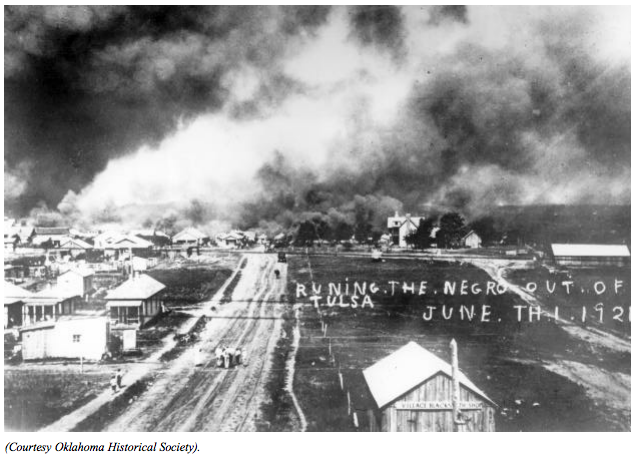
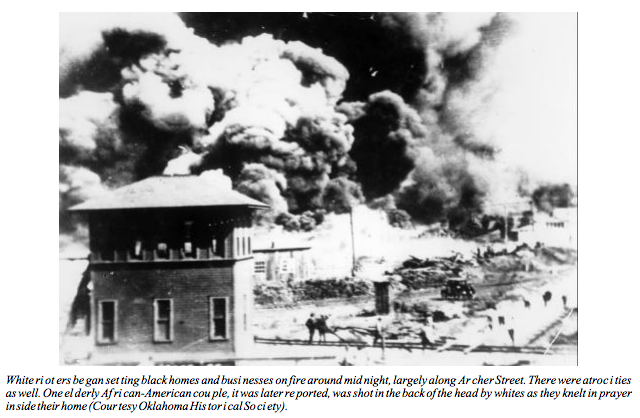
The white residents of Tulsa took to their cars, creating ad hoc lynch mobs. They shot blacks they came across on sight in drive-by murders. The sheriff’s department named “special deputies” to enforce law, reportedly encouraging them to “grab a gun and get a nigger”, providing what amounted to effective carte blanche license to murder whomever they wanted, without consequence, provided the victim was black. In an instant, the whites set their sight on the economic miracle that had provided upward mobility for these black families and made their way toward Greenwood, determined to destroy Black Wall Street. They were held off at the railroad tracks by a group of black men who tried to protect their property but managed to buy time for others to escape. When the final line of defense was broken, the white mob descended in rage, torching, destroying, and bombing everything they could find of value.
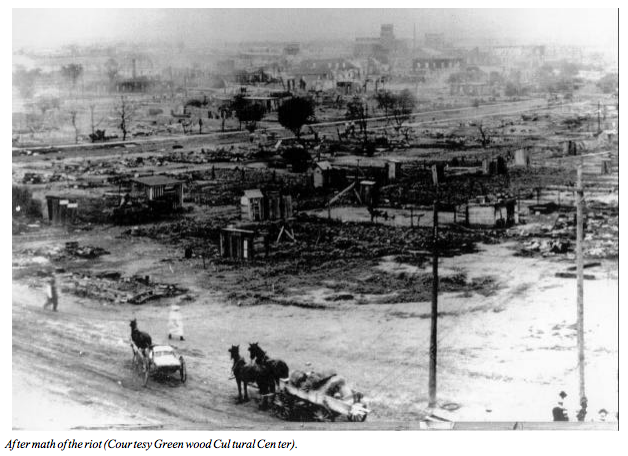
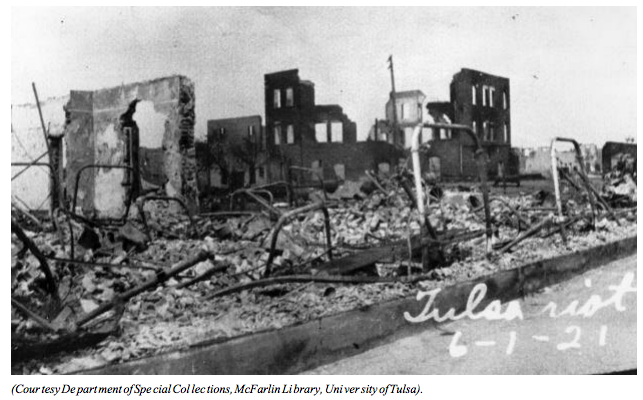
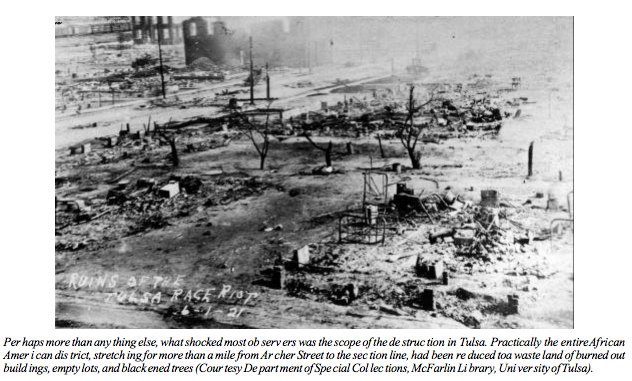
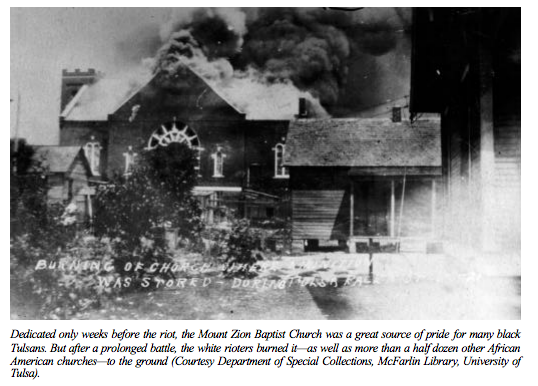
Roughly 10,000 black men, women, and children were left homeless. One of the best surgeons in the United States was shot in front of his home. Hospitals were razed. Schools, factories, an estimated 191 businesses, and banks were wiped off the face of the Earth. Old bomber planes from World War I took off from the nearby Curtiss-Southwest Field, patrolling the skies and shooting blacks on sight while simultaneously dropping explosives on any buildings that remained. It was all-out, unrestrained, brutal, demonic warfare.
The white lynch mobs went from home to home, looting like animals, killing and terrorizing those who remained to fight or were unable to flee. According to the Oklahoma Historical Society, one elderly black couple was executed at point-blank range as they knelt in their home, praying. White families were targeted, too, if they employed blacks or were thought to be sympathetic to their cause. Many lives were spared thanks to the bravery of other white business owners like the Zarrow family, who risked total ruination and death by deciding to hide black citizens in their grocery store during those sixteen hours of hell.
Martial law was declared and Tulsa became militarized as the Oklahoma National Guard secured the area, mass arresting blacks and detaining them in a handful of locations across the city. By the time it was all over, less than a day later, Black Wall Street was no more. Greenwood was destroyed, scores laid dead, entire self-made fortunes gone, never to be rebuilt, unjustly taken in one of the worst events in U.S. history.
Many of Greenwood’s founders and leaders were indicted for starting the riot, blamed for the actions of the white mob. J.B. Stradford, who had lost his hotel, rental properties, and other investments, skipped bail and fled to Chicago. A graduate of Oberlin College and Indiana Law School, he setup practice in Illinois and worked to recreate a life for himself and his wife. It wasn’t until 1996 – or “Seventy-five years after the fact and six decades after his death”, as The New York Times put it – was he cleared of all wrongdoing. The reality that after a long life of good decisions, he was a fugitive with all of his work taken from him caused him to be despondent until his death in 1935 at the age of 75.
Perhaps just as bad, Oklahoma offered little more than words in the way of apology. A couple of decades ago, the state commissioned an official investigation to get an accurate historical account of the events that surrounded the night Greenwood burned. The findings were released in 2001 – you can read it in PDF format here or by clicking on any of the pictures [backup copy here in PDF in case it ever gets taken down] – and the legislature refused to take up almost every single one of the proposed actions to make up for the events. Specific families had well-documented, clearly identifiable monetary losses that set them back decades. They weren’t compensated even though the grandchildren of those entrepreneurs would likely have been able to afford college with the present value of the investments they lost.
The official report released to the public includes images that had been provided by various sources, detailing the aftermath of what must have been unimaginable terror. Here are just a few of them:
I think it’s a useful exercise to try to work out what you would do if you lived in a hostile society where your business, home, and assets could be taken from you.
- How would you protect yourself, your family, and your net worth?
- How would you rebuild, if you had to rebuild?
- What would your response to the injustice be?
History has a way of repeating itself if you allow it. It can happen again. It was only 15 or 20 years later when Adolf Hitler and his regime began one of the largest systematic mass execution programs ever devised, targeting Jews, Romani, Slavs, the disabled, gays, and religious minorities as they were considered incompatible with Nazism. If I had been born in Germany, and I hadn’t had the foresight to flee, I’d have eventually lost all of my assets and been shipped off to a camp (and even if I managed to survive, people seem to forget that those who were branded with the Pink Triangle weren’t liberated in the same way other prisoners were as the Allies thought their imprisonment was justified, allowing the §175 convictions to stand. They generally agreed being gay was a criminal act but in a moment of “compassion”, allowed the years spent in the concentration camp to be deducted from the original Nazi prison sentence as time served. So deep was the prejudice, computer genius Alan Turing helped win the war against the Nazis and England rewarded him by convicting him for gross indecency upon discovering he was gay when investigating a burglary of his house. He was convicted, ordered to undergo hormone shots designed to destroy any physical desire he may feel while being subject to probation (the alternative was prison so he opted for the injections), and, as a result of the mistreatment, is largely believed to have committed suicide by eating a cyanide-laced apple.) This group handled it by going stealth, marrying a person of the opposite sex, and sacrificing personal happiness and fulfillment for the sake of never being discovered.
Asians were targeted in the United States at one point, rounded up and put in detention camps or prohibited from marrying outside of their race. When you look at the history of that civil rights movement, I think there’s a strong argument the turning point was the murder of Vincent Chin in 1982 when a plant superintendent for Chrysler, Ronald Ebens, along with his stepson, Michael Nitz, beat and killed the Chinese American. Chin was attending his bachelor party when the two men attacked him. They mistook him for Japanese, yelling, “It’s because of you little motherf*ckers that we’re out of work”. Despite their clear guilt – the murder was witnessed by two off-duty police officers – they were given a pathetic three year probation sentence as a symbolic slap-on-the-wrist. The resulting outrage is what caused political change. This group handled it by incredible levels of asset accumulation relative to income. At one point in the 1970’s or 1980’s, certain Asian American immigrants were something like 5x as likely to build a 7-figure net worth and it was far beyond stealth wealth; it was like Black Ops wealth. There were multiple generations of families living in tiny apartments over dry cleaners that looked broke from the outside but were among the most affluent people in town. Their defense was remaining totally hidden while accumulating resources. Other than economists and academics, nobody even knew this group had money.
Right now, it’s happening to Christians in North Korea. Some of the intelligence that is coming out of the country is heartbreaking. Merely professing faith is enough to get to you and your family sent off to a labor camp.
The thing that gets me when I reflect upon all of this is that it really wasn’t that long ago in the grand scheme of things. While Black Wall Street was burning, somewhere across the country in New York City, a 26-year-old named Benjamin Graham was learning the investment business. Unable to get a job on white Wall Street – the gentiles wouldn’t even hire Catholics so him being a Jew meant employment was out of the question at most of the partnerships – he ended up going into business for himself creating the Graham Newman Corporation. It was there that Warren Buffett got one of his first jobs, and learned the ins-and-outs of running what amounted to a hedge fund; that gave him the ability to go on and launch his own set of partnerships, which led him to taking over Berkshire Hathaway, which now ranks as one of the five most valuable corporations in the world. That’s how relatively recent these events are.
Graham is still my role model. You push through, outperform everyone, and go about your life as best you can. I think it’s the only intelligent way to behave unless you want to make yourself miserable all the time. He didn’t sit around and whine about the oppression, he just outsmarted everybody and gathered the resources to change it. Sometimes, though, like I told people almost two years ago before the trouble with Russia started, the most intelligent thing to do is emigrate. Move to greener pastures.
Reader Comments (33)
Comments are presented chronologically, with replies indented beneath the comments to which they respond.
Dividend Growth Investor
January 7, 2015
That's a very strong post. Unfortunately, we as humans are still animals at heart so I would not be surprised about anything. You might also want to study the fate of entrepreneurs and businessmen when the Soviets came to power 90 - 95 years ago; or when they occupied Eastern Europe after 1945. It is so interesting that a large part of success in life comes down to things outside out control - if you were born in Russia 100 year earlier than you were born in the US, and you had the types of business and investments you have there that you have now, you would not had been treated well ;-(
Adam
January 7, 2015
I lived in Tulsa for 4 years and I've never heard this story. That's an amazing tale and it's depressing how often human beings can callously attack their neighbors and do such horrible things in a mob. Our tribalism never seems to die.
Julia
January 7, 2015
These stories are heartbreaking. You say that "Graham is still my role model. You push through, outperform everyone, and go about your life as best you can." and from a personal standpoint, (woman, PhD in engineering) I agree. However, these stories show that not everyone is given the chance to go about their lives (the best they can, or otherwise). "The injustice of it angers me in a way few other events do because it violates every single moral value I hold dear; that there is an inherent fairness in a system like ours..." For me, at least part of the anger comes from not knowing how and what I can do to help. I appreciate you using your platform to build awareness about these events.
Zaphod
January 7, 2015
wtf, just horrendous. People should know about this, revisionist history only makes sure we have no tools to prevent similar problems.
innerscorecard
January 7, 2015
What a chilling reminder of indescribable injustices. The world really isn't fair at all. That's a fact that I've accepted more and more as I've gotten older. It really wasn't that long ago that horrific things happened in many places in the US. That's why when I think about retiring to a state in the Mountain West, Midwest and South of the US due to low taxes and cost of living, I always have to do that double-check in my mind - is there the possibility my spouse and I could be the target of a hate crime? I may not think this way...but it's always on the forefront of my family, and for good reason. Or some of my friends from a similar background.
And here I am right now in a city and country where only a few decades ago, students dragged their teachers to their deaths to show their revolutionary fervor, children betrayed their parents to the authorities, and people buried their neighbors alive. And yet life goes on and these things drift into some place in the subconscious where they go deeper and deeper as society heals but does not really forget.
Gilvus
January 7, 2015
Replying to innerscorecard
I like your new profile pic.
Ever since I learned about the internment of Japanese-Americans during WWII, I knew that if China-U.S. relations ever soured I'd need a way out. No one would care about my naturalization certificate or my U.S. passport; they'd see my face and see the enemy. Sadly, such a scenario is very possible within my lifetime.
innerscorecard
January 7, 2015
Replying to Gilvus
Thanks. Obviously it's crude because I did it myself. But it's my proprietary IP. Compared to last night, I'm liking the version on my blog compared to this square version more and more.
That's one way to think about it. Not sure that's likely enough to be worth thinking about to be honest. Sadly the US has purposely cracked down on having any kind of escape path, on purpose, due to FATCA, FinCen regulations and the like.
Gilvus
January 8, 2015
Replying to innerscorecard
Take pride in it. I look back on some of my earlier creative works and cringe, but goddammit even if it's a pile of shit, it's my pile of shit.
Considering how the countries are economically tethered, I see it as a remote possibility at present and I don't worry about it. At worst, it takes years and a series of crises to reach a tipping point - there will be plenty of time to count the red flags and emigrate. But I'm a big believer in the hegemonic stability theory, and I don't look forward to the day that China is economically, technologically, and militarily strong enough to throw its weight around.
Andrew
January 10, 2015
Replying to Gilvus
Aren't there Chinese soldiers in the U.S. now?
dave (nestle)
January 8, 2015
Replying to innerscorecard
Dude.
You have a blog?! I cant believe I missed that. I will be searching for it right now. It's always nice to find, what I would assume to be, a gem of intelligence.
All the best!
innerscorecard
January 8, 2015
Replying to dave (nestle)
It's relatively new. 🙂 Had to get the .co domain due to some jerk taking the .com.
Hopefully it'll be interesting to some people. I think writing from a disclosed position of incompleteness or lack of achievement (but hopefully being on the right road) could be interesting too. Of course nowhere near as good as writing from a place of tested experience, as on Joshua's blog. But maybe a funny supplement.
dave(nestle)
January 10, 2015
Replying to innerscorecard
Well then I wish to admit to you sir,
I clone also.
Steven
January 7, 2015
My gosh, such a horrible story..I've never heard anything about that before!
Was it really a Wall Street (i.e. was there a Stock Market of sorts?)
I think if something similar happened in Wall Street proper today, the equities that people associated with it held would survive unscathed. So as long as you survived you would still be wealthy.
My read on this particular story is that even the survivors were financially ruined, I think the lesson is don't rely on local investments for your wealth. Your McDonalds Franchise, Dry Cleaner, small hotel can be destroyed by evil.... Equity investments in large corporations would take more organized persecution than a riot to destroy.
FratMan
January 7, 2015
My dad grew up, and I briefly lived, in Ferguson, MO. I hear ya.
Aditya
January 7, 2015
Thanks for sharing. Posts like these are a reminder that it's important for all of us to remain connected to society at large and to steadily advocate what I believe is a major reason for all our successes: stability, freedom of an exchange of ideas, and social inclusion.
Like Gandalf's monologue in The Hobbit, I too believe that the world is not only held together but actively progressing to a better tomorrow through the good works and steady actions of the diligent and mindful.
Gilvus
January 7, 2015
Thanks for writing this, Joshua. It's profound and deeply moving on a personal level. Did you publish this article today because of relevant current events, or is it simply a coincidence?
Joshua Kennon
January 8, 2015
Replying to Gilvus
Coincidence. I woke up in the middle of the night and, for some reason, it was on my mind. I wrote it before the sun came up, went and got coffee, and came back to see the events in Paris on the news. Between this, the hostage situation at the Lindt cafe in Australia, and the horrors in that school in Pakistan recently - I still can hardly think about the depravity it takes a human mind, to be so far gone it can do something like that to children for daring to get an education - I think civilized society is going to have to make some uncomfortable decisions about how to deal with extremists sooner rather than later. No matter how many different ways I run scenarios, I think the only intelligent behavior, even if it leads to more death in the short-term, is the Reagan doctrine of absolute zero negotiation. There are certain values we will not violate even if it means suffering to protect them. You don't get to throw a fit, kill people, and demand societal change because you don't like how others use their freedoms.
Europe spent centuries, working very hard, to cast off the heresy laws of the church; to end the burning-at-the-stake spectacles, arrests, trials, and conflicts; the endless cycle of death and destruction as protestants and Catholics fought for thrones, trying to collect them all as if they were Pokemon. The Enlightenment gave birth to modern scientific discovery and our notion of human rights. I don't think those of us living off the trust fund of our ancestors are going to give it up so easily. I'd rather watch the whole country burn that go back to a culture in which freedom of speech were forbidden.
The idea that someone thinks they are have a right not to be offended to the point they can blow other peoples' heads off is so anathema to morality that each country is going to have to come up with some drastic measures to curb it, especially in places like Pakistan where a good portion of the citizens want to join the first world and build a great civilization that is part of the global community. It's still hard for me to read some of the articles about the victims because they were just kids. The extremists are so delusional they destroyed the human capital of their own country - people who were going to grow up and become doctors and business owners, politicians and writers, engineers and artists - for, what? What did they achieve?
The thing that I've never understood, whether it was Jews during the conquest of the holy land, Christians during the Crusades, Catholics and Protestants during the Reformation, different tribes fighting in the Amazon ... what makes no sense to me ... let's presume one of them was right. Let's say one of them did have a line directly to whomever, or whatever, created the universe. And this being ordered the mass destruction, death, suffering, and torture of children. Why would you ever want to worship such a malevolent force? Fear of self preservation? There is no other rational reason other than, as I've described in the past, the power differential. Yet, even here in the Bible belt, I've heard with my own two ears parents - reasonable, college educated parents who would die for the kids - tell their children that if God instructed them to murder them like he did Abraham to Isaac, they'd do it to prove their loyalty. It's madness. There is no difference between that line of thought and the ancient philistines sacrificing their infants to Moloch in the hopes of a better harvest because they don't understand the science of weather patterns. It's one of the few things that can make me despondent if I dwell upon it too long because it reveals man to be little more than a base animal reacting on impulse rather than the glory that he could be.
The nature of the problem differs by country. In Pakistan, the vast majority of good, decent, educated people have to live next to these nutcases. It's going to require a total inward battle where the modern day Muslims and secularists band together to conquer the hearts and minds of their druid counterparts. It's more akin with living next to the enemy a la the Ireland terrorists of a few generations ago. In France and Germany, the problem is much simpler due to the mathematical and logistical breakdowns involved provided you are willing to accept a little collateral injustice.
stegner
January 8, 2015
Replying to Joshua Kennon
Thanks for the post Joshua. RE: The Lindt Siege, the public reaction here has been heartening. See : http://www.bbc.com/news/blogs-trending-30479306 & https://www.youtube.com/watch?v=PMobJwjs0M4
'It's one of the few things that can make me despondent if I dwell upon it too long because it reveals man to be little more than a base animal reacting on impulse.'
For the first time in the history of humanity, we're starting to unravel how these base animal instincts work, specifically how they go awry. In 200-300 years time I expect we'll be a very different, far more settled and peaceful species. It's such a strange time to be alive, we're literally on the threshold of some massively transformative science.
stegner
January 8, 2015
Replying to stegner
Re-reading this, I sound like a new agey huckster.
innerscorecard
January 8, 2015
Replying to Joshua Kennon
I'd love to hear your thoughts on religion and God in general. I sense a sea change in the past few years in your views, and I feel I would learn a lot about the way you have thought about these issues of belief and faith in general. Of course, I know you probably won't be able to. It's you who has your face on this website and people you know read it. But hey, we already talk about money and politics on here, so we are uncouth barbarians already.
Gilvus
January 8, 2015
Replying to Joshua Kennon
Sadly, I agree with you wholeheartedly here. I used to think that our species was different because only we could raise shimmering metropolises from dust, build habitable structures in the dead vacuum of space, and invent mechanical and computational marvels to streamline our labor. But behind all the positive emotions associated with ingenuity, technological progress, and the pursuit of happiness, all our achievements boil down to an endless struggle against entropy, extinction, and oblivion.
...I'm getting existential again. I need to go to the animal shelter and hug some puppies. And maybe eat a large pizza. Topped with sausage, onions, and a second pizza.
Shouganai
January 8, 2015
Replying to Joshua Kennon
"Why would you ever want to worship such a malevolent force? Fear of self preservation? There is no other rational reason other than, as I've described in the past, the power differential."
The best defence of (potentially violent) religious authority that I've read is GK Chesterton's "The Suicide of Thought". He contends that unrestrained skepticism would result in the destruction of rationality itself:
"Religious authority has often, doubtless, been oppressive or unreasonable; just as every legal system (and especially our present one) has been callous and full of a cruel apathy. It is rational to attack the police; nay, it is glorious. But the modern critics of religious authority are like men who should attack the police without ever having heard of burglars. For there is a great and possible peril to the human mind: a peril as practical as burglary. Against it religious authority was reared, rightly or wrongly, as a barrier. And against it something certainly must be reared as a barrier, if our race is to avoid ruin.
That peril is that the human intellect is free to destroy itself. Just as one generation could prevent the very existence of the next generation, by all entering a monastery or jumping into the sea, so one set of thinkers can in some degree prevent further thinking by teaching the next generation that there is no validity in any human thought."
I don't know to what extent this argument has a historical basis, but I think it serves to demonstrate (to a rationalist audience) that even if evil is never an end in itself, it can easily be born of assumed necessity.
If you have aims that extend beyond the goodness of your own actions (as many people do) there will always be persuasive arguments to do evil.
30 Something Dude
January 8, 2015
I've heard this story before and also bought a book from Amazon detailing much of the horrors. Very impressed with how you've explained it on your blog, as well as your intelligent opinion of the surrounding circumstances - it shows a very high degree of intelligence, care and thought.
jerkstores
January 8, 2015
Wow. I didn't know about most of this stuff. Thanks for putting that all together.
dave (nestle)
January 8, 2015
Joshua,
I think that your post and all of the above replies sum up just about every thought and emotion I could have commented on, except that It frustrates me that I never even heard of those events.
I have been spending countless hours lately diving into and researching ideas from your past posts. Things like information assymetry, avoiding assumptions(haha), various mental models, the keys to happiness(ex. Wilkins Micawber) etc, etc. The topic of stealth wealth has been rather prevalent lately. I feel that maybe the idea of "stealth intelligence" is of equal importance. The responses in a prior post make me feel that way. It seems like giving people a window into either of those things can only inevitably lead to problems. The only way to "remove risk" would be to keep everything a secret and just blend into society. Just nod your head whenever you are out and about.
I don't think there is any solution to future evils like above. For example, the people who are reading about this story here are not the ones who really need the education. The potential perps will never see this blog post, and would only take a negative stance if they did. I hate to be a pessimist...
Why do you think it is that these topics have been on your mind lately? I am not trying to be funny either. Have you recently had time to reflect on your accomplishments and wealth and worry a bit? (To me, the more my personal assets grow, the more vulnerable I feel) Do you feel like you are sharing too many thoughts with the world?
Then again, when I think about how ridiculously smart you are, I wouldn't be surprised if your name isn't really Joshua Kennon.
One more question by the way, why do you not smile for your file photo here? When I bounce over to "About", you have a shit-eatin-grin on your face. Is their marketing person waiving a stuffed animal in front of you going "CHICKEN CHEESEBURGER"?
As usual, the greatest respect for what you share with us here!
Joshua Kennon
January 9, 2015
Replying to dave (nestle)
I'll try to get to the other stuff sometime but re: the About.com photo, you aren't far off from reality. It was back during the New York Time subsidiary days (when we had to write, "About.com, a division of The New York Times" on every single mention of the network which was, I think, probably appropriate given that we were helping to pay the bills in the midst of the death of old media. I still find it in random places, even on this blog, that require me to remove it now that we are owned by Ask.com) and it was taken during a real-world meet-up of guides in the brand new (at the time) New York Times building in New York City.
They brought in a professional photographer and everyone lined up who wanted to get their photograph updated. We waited our turn, were told to pose with giant smiles, and they ordered us around until they got the shot they wanted. They then cropped, photoshopped, and did whatever else their marketing people wanted done before replacing it. We are allowed to change it whenever we want but I've never bothered to go make an appointment with a photographer (they want high-resolution photos in professional settings). Maybe I'll do that at some point. Given that I'll turn 33 this year, a photograph of me shortly out of college roughly a decade ago isn't accurate. I don't think about it very often because I think the lowest resolution device I use to upload new content - and thus see it concurrently - is running at 2560 x 1440 pixels. It's teeny tiny to me; smaller than a single fingerprint.
dave (nestle)
January 9, 2015
Replying to Joshua Kennon
(fist bump) Respect. : )
Clint
January 8, 2015
I grew up in Oklahoma City, and went to school here. I work in Tulsa now, and I literally drove through the corner of Greenwood and Archer on my way to dinner this evening, and all I thought about was that the baseball field looked strange in the winter, because I had never heard about this tragedy that happened within walking distance of my home. It is outrageous that in this day, we could continue to teach such revisionist history. For reference, I do not remember where I was on September 11th, 2001 because I was too young. This isn't something that wasn't taught, it is something that still is not taught, or even mentioned in a footnote.
Thank you for bringing it to my attention. I believe I have an angry letter to the state board of education that requires my attention.
Breathaholic
January 8, 2015
Joshua,
Very Sad that it happened, almost more sad that it was washed off and forgotten.
If I ever had to give up internet completely, not reading your blog would be in the top 3 things I would have the hardest time to let go! Stay curious my friend:)
Virginia
January 10, 2015
Thank you for sharing this story. I can't believe I had never heard of this before. Incredible and sad.
Homunculus
January 12, 2015
As a Takei fan who recently heard him talk about the Japanese American internment camps, this really hits home. While the trajectory of progress is good, there have been plenty of atrocities acted out by Americans. Plenty of people to this day still maintain the same old hates. It's doubly disturbing since as an atheist there's a lot of people in this country that demonize those like me and call for terrible things. I think we make progress generationally, each new generation seems to be more free of old hatreds than the last.
Kisse Ellis
March 8, 2017
If the descendants of the people who were deprived of life, liberty and property where to sue the state for damages plus interest how many people would howl about that being "unfair" or "affirmative action" ......?
Jay Young
September 15, 2017
The new Tulsa, OK flag incorporates a red circle representing "the blood shed and lives lost during the 1921 Tulsa Race Massacre that destroyed Black Wall Street, the most prosperous African American community in the country" containing a beige star representing "Tulsa’s bright future. ... it shows that we heal from past wounds and continue to flourish as an icon of a uniquely American city."
http://www.tulsaflag.com/meaning/