

An interesting question from the perspective of a non-U.S. citizen …
Joshua,
I was pleased to see that around 1/3rd of the site readers are not from the United States. You have truly a global audience. As an American, what do you think is the biggest misconception non-U.S. people have about your country?
Ndebele
I think that those who haven’t been to the United States, and traveled through it, vastly underestimate the size, scope, and economic power of the American Empire.
We are a collection of 50 sovereign states, rich in natural resources, with one of the best educated populations on the planet. Each of these 50 states is ruled by a system of checks and balances, with representatives chosen from free elections. The economy of each state is a powerhouse in and of itself. The big advantage of this is that it makes it possible for innovations in one state that improve life for citizens to roll out to others. When something novel like limited liability companies come along, the states can work together to adopt it into each of their own laws. When a perfect solution such as the Uniform Gift to Minors model is developed, it can be copied and rubber-stamped in the other states for maximum efficiency. You can also “state shop” for certain solutions to your legal planning needs, as the laws of every state are different.
There is a fantastic piece in The Economist from a couple of years ago called If They Were Countries that underscores this point beautifully. It illustrates how big the economy of each of the 50 United States is and compares it to other nations in the world.
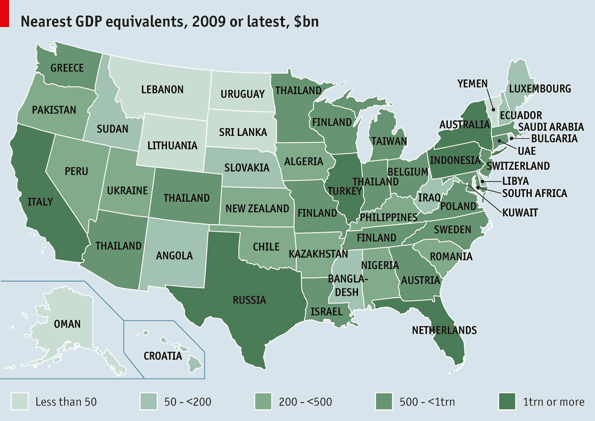
The Economist did a great job illustrating the GDP equivalent of each of the sovereign 50 states in the United States and comparing it to the nearest stand-alone country. Click the map to go to the article on The Economist website. Source: The Economist
Each of these “countries” (states) cedes a portion of its sovereignty to the Federal Government under the United States Constitution, which guarantees certain individual rights and freedoms to all citizens. If the Federal Government ever gets too out of control, the founders put in an emergency fail safe that allows 75% of the States to call for a new Constitutional Convention, which would re-write the entire Federal Government system. In more than 200 years, it’s never been used, but it still sits there under the “Break In Case of Emergency” glass.
[mainbodyad]It is this system of shared sovereignty – made possible by the fact that a significant majority of the 300+ million people living in these 50 states largely share the same language, culture, and socioeconomic values (e.g., you very rarely have ethnic strife, car bombings, and mob murders among various tribes because everyone thinks of themselves as “American” with a capital “A”, whether you are rich or poor, religious or atheist, black or white; conditions that are not possible in some other areas of the world, where neighbor kills neighbor because they happen to be of the wrong bloodline or a slightly different religion), you get a sort of exponential effect where the outcome is much greater than the sum of the parts. It’s why the single, shared currency we use as a country has the words “E pluribus unum” engraved on it, which means “Out of many, one”.
Part of this prosperity is the result of our geography. This country is enormous. And it’s not just big, it’s practically all valuable real estate. The breadbasket has some of the most fertile farmland on the planet. There are immensely large aggregations of assets including coal, natural gas, oil, gold, silver, iron, timber, limestone, and salt. There are a wide range of climates ranging from the desert sands of the Southwest, the warm waters of Coastal Southern California, and the swamps of Louisiana to the tundra of Alaska, the rolling hills of upstate New York, and the wide-open plains of Kansas. The fact that land invasion is impossible from two sides as we are bordered by the Atlantic and Pacific Oceans makes defense easier.
To give you an idea of the size comparison …

When I went to visit my grandmother this Sunday, that tiny journey you see on the map represented a 262 mile (422 kilometer) round trip. It barely covered part of my home state, Missouri, which by itself has a GDP equivalent to the entire nation of Finland.
See Texas, a few states down from mine? To give you an idea of the size comparison, here is it over a map of Europe.
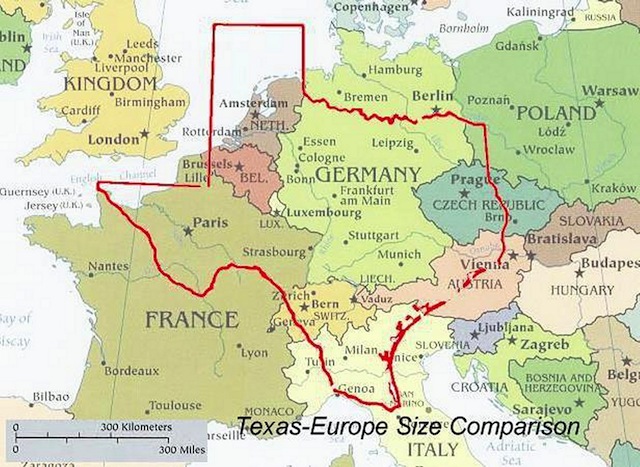
Texas, by itself, is larger than Germany, part of France, and a handful of other countries. It’s annual economic output is larger than that generated by the entire Russian empire.
A one-way trip from London to Paris is 284 miles (457 kilometers). A one-way trip from New York to Los Angeles is 2,790 miles (4,490 kilometers).
Let’s superimpose the Continental (lower 48 out of 50) states of the United States onto a map of Europe and the Middle East.
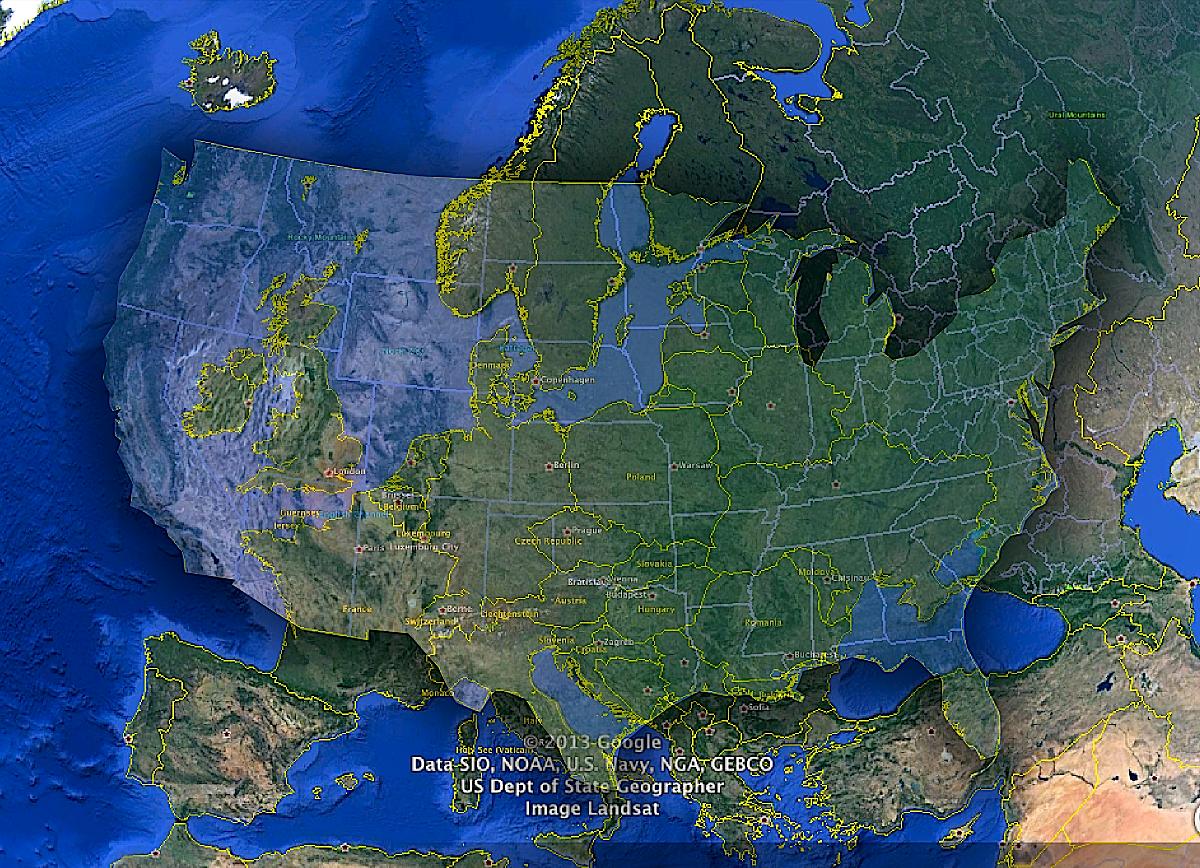
The lower 48 out of 50 United States size comparison to Europe …
And the craziness doesn’t stop there. Those are the just the lower 48 states (called the “Continental” United States or “lower 48” for short short . We also have two more states, Alaska and Hawaii. Alaska is twice the size of Texas. To compare it, by itself, to the continental U.S., look at this map:

Alaska, which the largest of the 50 states by geographic area and filled with oil and other natural resources, is almost as big as the middle of the country! Alaska alone is bigger than Germany, France, Austria, Poland, etc. combined.
To compare Alaska by itself to Europe, look at this map.

Our Minor Cities Are Bigger Than Some of the European Major Cities
It follows that our cities are this way, too. The population of the metro area of our minor cities rival the major European ones. In my home state, the metro area outside of St. Louis is larger than Rome, Italy. The population of Minneapolis-St. Paul up in Minnesota is akin to Berlin, Germany. In Washington, the population of the Seattle area is around that of Madrid, Spain. Right here in Kansas City, we are the size of Zurich, Switzerland. Houston, Texas has a population as large as Paris, France. Indianapolis, Indiana has a population around the same size as Stockholm, Sweden.
This partially explains what is perceived as American arrogance. It’s not that we don’t take the demands of other nations seriously, it’s that we tend to calibrate them to our own life experience. Politically, seeing the entire nation of Spain angry isn’t nearly as bad as seeing our one state of California upset as the latter dwarfs the economy of the former. Ticking off Iran, with only $514 billion of economic activity per year isn’t nearly as dangerous as angering the voters of the State of New York, which has $1.1 trillion in economic activity per year. Consider a person living here in Louisville, Kentucky. Her state has an economy roughly the size of the Philippines, and her hometown has a bigger population than Helsinki, Finland! My home state of Missouri, which is relatively unimportant on a national scale, has a population of 6,022,000 people, a GDP of $229.5 billion per annum, and 69,704 square miles of land. By itself, it is nearly equal to the entire country of Denmark, which has a population of 5,590,000 people, a GDP of $314.2 billion, and 16,639 square miles of land.
What We Consider “Poor” Would Be Rich or Middle Class in Other Nations
Then you get to personal prosperity. The median household income in the United States bounces between $50,000 and $52,000 per year. You are considered living in dire poverty if you are married, have two children, and earn less than $23,021 per year (17,060 EU, or £14,394, or 21,071 CHF). You can get all sorts of benefits for “the poor” up to 400% of this figure, meaning that you’re still considered struggling for certain things like food, housing assistance, tax credits, or other handouts up through as high an annual household income as $92,084 (or 68,240 EU, or £57,576, or 84,284 CHF) depending on a variety of factors, including the state or city in which you reside.
That’s why it’s almost funny to hear non-Americans talk about how the American economic model “failed” because we have such a big gap between the rich and the poor; they don’t realize that what we call our “poor” are among the richest 1% to 2% of people on the planet. They haven’t calibrated the absurdity of how spoiled we have become as prosperity is now considered a birthright. The typical family in the United States now has a 2,000 to 3,000 square foot home, two relatively new cars, central heating and air conditioning, and a life expectancy of 78-80 years. Things that were unthinkable only a few generations ago – widespread access to spices and salt, being an everyday example – would now be cause for riots if they were taken away. We scream hysterically over the price of gas, but when you adjust it for earning power, it’s cheaper here than virtually anywhere else on the globe.
[mainbodyad]Think about how many times I’ve made fun of the State of Mississippi on the blog. I do it lightheartedly, like you would tease a member of your own family, but there is some truth to my jokes; it is the biggest failure among the 50 states. It is the poorest, least educated, least healthy state in the Union. Yet, if Mississippi were a stand-alone country tomorrow, it would have a higher standard of living than most places in the world, including Russia! It would make the short list of countries under consideration if you were emigrating.
If that’s failure, give it to me all day. Any system that pumps out aggregate prosperity so excessive than our destitute outrank almost everyone else alive is the one I want. Perhaps Bill Gates put it best when he said (I’m paraphrasing), “If you are born poor, it’s not your mistake. But if you die poor, it’s your mistake.” In today’s world, and today’s economy, that is absolutely true.
I realize there have been a lot of superlatives used, but it’s the only mechanism to convey just how expansive the reality is. Counting the value of human capital, the World Bank most recent estimates (Source: Excel) show the world contains an equivalent of $707,726,307,170,996 in wealth. Yet, the United States, with only 5% of the population, owns $217,623,159,381,449 of it. And not only that, there is so much room, we have a fairly low population density; a mere fraction of what is normal in Europe, Asia, and some parts of Africa.*
This Explains a Tremendous Amount of the Culture and Attitudes of the United States
Knowing this helps make sense of why the United States is the way it is. People in the United States rarely travel to other countries because, other than Canada (which is extraordinarily similar in almost all important respects), and Mexico, which has some significant crime problems at the moment, there are no other foreign countries around us. We own it all. The entire continent.
If someone here in Kansas City wanted to go to London, a one-way trip would be 4,357 miles (7,012 kilometers). That is a greater distance that it would take someone in London to travel to New Delhi, India, which is only 4,164 miles (6,701 kilometers). If someone wanted a one-way ticket to Tokyo, Japan, it would require 6,256 miles (10,068 kilometers) of one-way travel.
If I wanted to go to Disneyland tomorrow, which is right here in the United States, it’s more than 1,600 miles (2,575 kilometers) one-way!
Summary: It’s bigger. The money. The food. The geographic distances. It’s all bigger. And it varies significantly from location to location and state to state. That’s why you can’t ever distill “America” into a single country. It’s not. It’s like 50 individual countries with streamlined laws and a shared cultural history. The farms of Vermont are as foreign to the beaches of California as the Arizona desert is from the water-nourished shores of the Missouri river in Kansas City. Working together, they have the authority to replace or overthrow the Federal Government that everyone associates with the United States, but is really just another part of it. The entire model is unique; a quirk of history that happened to work miraculously well.




* Footnote: You sometimes see me reference the $225 trillion wealth figure for global aggregate wealth, which refers solely to individual, private, household wealth of families. These numbers from the World Bank are the whole enchilada.
Reader Comments (29)
Comments are presented chronologically, with replies indented beneath the comments to which they respond.
Moniba
October 15, 2013
As a Canadian who lived in the USA for 4 years I would say most foreigners assume that the policies of the American government (especially foreign policy) represent the collective will of the American people. I found the vast majority of Americans to be welcoming and extremely charitable, but were generally clueless about geography and the world at large. Like all empires the USA will eventually decline.
Joshua Kennon
October 15, 2013
Replying to Moniba
That's so true. All of it. I laughed out loud when I read that most foreigners think our Federal government policies represent "the collective will of the American people". The 50 states are so different, it's absurd as an American to think anyone could believe it - imagine Georgia and California agreeing on anything! - but I can see how that would appear to be the case from outside of the country.
There's even a Tumblr blog now dedicated to things more popular than Congress.
When the American Empire declines, I imagine it will follow the British model. Our Federalist system would make it easy, somewhat, for a few of the strongest states to break-off and declare independence, which would then start their own empires. We say Great Britain declined but, really, it lives on in the U.S., Canada, Australia, etc. Often the transfer of economic prominence is so slow, it is inconsequential to any one living generation so I'm not particularly worried about it. Who knows? My great great grandchildren might be members of a moon colony that leads the solar system in financial services.
Anon
October 16, 2013
Replying to Moniba
I wouldn't be so sure about the USA declining like Great Britain. We live in different times and our system of government allows us calibrate every 2/4/6 years. We may have political/economic/social recessions and booms, but the trajectory is upwards at a good rate/speed.
Moniba
October 16, 2013
Replying to Anon
If history is any guide, then a decline is inevitable. This empire is no different than the others that came before it I suspect. Perhaps not in my lifetime, but current American politicians seem extremely eager to accelerate the process of decline. Your biggest asset which your founding fathers gave you has been turned into your biggest liability.
Anon
October 16, 2013
Replying to Moniba
Yes, I'm aware of history and the proverb that all good things come to an end. But, the USA is special. I believe it will grow much like a mutual fund, as opposed to a single share of stock with Great Britain or Rome that goes bust. I think we've got some Phoenix and rising from the ashes in us, if and when we get to that point.
On the other hand, if Iran gets a nuke, I pretty much completely disavow all my posts on this matter/subject.
I'm looking forward the country hitting a reset button on entitlements and the debt. It'll be painful, but we'll get back on track.
Scott McCarthy
October 15, 2013
"...there are no other foreign countries around us."
Gotta love manifest destiny.
Scott McCarthy
October 16, 2013
Replying to Scott McCarthy
Also, the fact that the federal government has had severe travel restrictions against the nearest non-land-border foreign country for half a century now probably doesn't help much, either.
Gilvus
October 16, 2013
Replying to Scott McCarthy
You and I should head out to the bar for a nice tall glass of FREEDOM.
Andrew
October 15, 2013
There's one aspect that stuck out for me when I worked in the US as a Canadian. People I met in the US just subconsciously didn't think about other countries when deciding on a course of action. They assumed someone in the US will have to do it, and it might as well be them. They aren't looking outwards for to someone else to solve their problems.
The closest thing I could compare it to would be working at the #1 company in an industry. For instance an employee at Google wouldn't be looking to Yahoo to decide how to improve search, they would just go ahead an improve search. In contrast to when I worked at a #2 market share company were everyone was constantly focused on the #1 market leader, copying everything they did and reacting to them.
Also I find the media is very US-centric even outside of the US. Here in Canada everyone was talking about the US election of Obama (bathroom stalls at school even were marked up with it). In contrast to when Steven Harper (our prime minister) was getting elected almost nobody cared or talked about it except the rare person interested in politics.
I personally think the other countries (Canada included) would work better if we focused on our own ideas and improving our situation rather than constantly worrying about what's happening in the US.
Richard Garand
October 15, 2013
Replying to Andrew
Even worse for Canadian politics, I've noticed a lot of discussions (even down to the municipal level) where people seem to associate a person or party with one side of the US political divide and then make their decision based on that. American politics seem to be at least a part of the NDP's big win in the last federal election even though I'm sure the policies have very few similarities (it's a shame the Liberals couldn't hitch a ride on the enthusiasm for Democrats instead). It can't be that long before there are newspaper reports investigating why we don't have Obamacare yet...
Odai
October 16, 2013
Replying to Andrew
That's something I find hard to understand, even as someone who has family overseas - why do people outside the U.S. care so much about U.S. politics?
My extended family lives in the Middle East, where U.S. foreign policy actually impacts day-to-day life, so I understand that at least. But for people in Australia, for example...
african son
October 16, 2013
The biggest misconception for me was how easy it is to make money in America? I literally thought money grew on trees!!!!I assume most people still think so in Africa, by the email I get asking me for money....While it's true that the standard of living here is higher than any other country, its definately harder to be poor because the cost of living is higher and honestly I don't think people compare themselves with other countries but their neighbours...So it really sucks when you leave in low income housing and drive one mile past a 1 million mansion. That said, I believe with all my heart that more than any other country in the word, the adage "if you want it, you can have it" is true in America..There is opportunity in America..think about it, with the average person making 50k and more than 90% employed how crazy do you have to be not to be at least average...The hardest part for me being in America has been and is dealing with the immigration system, I find the system hugely unfair and very slow( am talking mostly about legal immigration but I also think illigal immigration could be better)....There has to be a way to make it better....You definately don't want to be here without "papers"
Anon
October 16, 2013
Replying to african son
Trust me, compared to the rest of the world, money does grow on trees here in the USA.
Joshua Kennon
October 16, 2013
Replying to african son
I realize this is going to be an economic distinction, but it's an important one: The cost of living is not higher in the United States in the way most lay-people use it; you are buying a different product.
Consider the cost of water. If you walk into a kitchen and turn on the faucet, you are not paying for water by itself. You are paying for an advanced water purification system that makes sure you can't get sick or die from the water; the pipes that make it instantly on-demand through large metropolitan areas; practically unlimited supply regardless of rain levels; and sewage that takes away the waste or spilled water that you don't use.
The same thing goes for housing. The housing stock in an advanced country like the United States or Canada or Great Britain or Japan is of higher quality, with better insulation, internal climate control, earthquake modifications (in places like California), etc.
If you buy a house on the beach in Orange County, it is not more expensive than a house in Kansas. Yes, it costs more, but that's different. You bought a different product. You have the ability to walk out your door and see the ocean. You have better weather, with little to no humidity. You are less than a few hours from major cultural institutions, sporting arenas, concern venues, theme parks, and universities.
A technical point, but one of those things that drives the economist in me nuts. Perhaps it was because I had overzealous, passionate professors in university who wouldn't let things like that slide and it rubbed off on me.
african son
October 16, 2013
Replying to Joshua Kennon
Thank you, Joshua. I agree!
african son
October 17, 2013
Replying to Joshua Kennon
P.S This is the only blog where I bother reading the comments..Sometimes I learn even more from the comments than the articles...You were right, you must have some very very very intelligent people reading your blog..Regards.
TheLonelyHumanist
October 17, 2013
Replying to Joshua Kennon
I don't think that is a very important distinction. It's great to think about. Living in the State where people come to downsize their costs, I am constantly hearing about how "expensive" it is "up north."
jerkstores
October 16, 2013
Replying to african son
As the husband of a legal immigrant I agree illegal immigration could be "done better". George W Bush worked with both parties in Congress to get sort of a fix for it through, a guest worker program for people who wish to work here and I believe amnesty for those who've been here a while. Unfortunately the right wing of the Republican party threw a fit and the bill died.
It costs so many thousands of dollars to come here legally and then you have the interviews, medical tests, and TIME. It's not fair that others just come on in and we turn a blind eye, but at this point something needs to be done about those who are here.
Republicans, fearing the prospect of becoming the minority party Democrats have more or less been since the 1960s, are surely going to do whatever they can to block Obama's immigration reform efforts. It's too bad George W Bush's bill died.
African Son
October 17, 2013
Replying to jerkstores
Yeah, I agree! For all his short-comings George Bush was proactive about immigration reform. Unfortunately, like you said it's a political matter despite the fact that most of the American's understand that something needs to be done about immigration. Most people know that it makes economic sense...Right now the way it stands I believe America is loosing more than it gains by the current immigration system..Am not saying that you give people Amnesty, but rather that you look at the system and come up with the most efficient and beneficial system for the country as a whole. I strongly believe that immigration reform can boost America's economy if done correctly....That said let's keep letting our voices be heard, speak to your congressman and in your own way be understanding and supportive of immigrants, especially those that you feel embody your values. I wouldn't be here if not for the Help and Support, I have gotten from ,"good old kind Americans" both Republicans and Democrats. The government is too big to focus on individual cases, it's the one on one kind of reform that works....All the best......
mikecrosby
October 16, 2013
Just a wonderful article Joshua.
Imagine giving your average Somolian what someone here in US considers poverty: Air conditioning, cell phone, refrigerator, TV, and the most important, our system of laws. He would not believe his good fortune only to bitch a few months later, "where are my 17 virgins".
Not to say in US being poor is not difficult.
grendl
October 16, 2013
Excellent article, beautifully written - this is why I return to the site regularly -- thanks Joshua. You're dead-on regarding first-time visitors underestimating the size of the country -- we once had friends from Spain fly into NYC, rent a car, and expect to be in Florida in only a few hours drive time (granted, this was pre-Google Maps and a GPS in every pocket :-). (NB: You may have misspelt 'unum'.)
Joshua Kennon
October 16, 2013
Replying to grendl
Thanks for catching that; apparently the spell checker doesn't anticipate latin phrases very well, ha! I just fixed it and forced a cache refresh; it should be live within a minute or two.
joe pierson
October 17, 2013
Biggest point I always make is even though the income gap between the rich and working class is growing in the US, the lifestyle gap between the rich and working class continues to narrow.
Bill Gates may buy several 100K Lexus cars each year, but they are not that much better (in almost every practical sense like speed,safety, comfort, reliability etc) then a 10K used Camry.
This is true for almost everything mass produced, TV's, cell phones, wine, shoes, cloths, health care, food. True the rich may have access to more exotic foods and items, but it's exotic only because of its limited availability, not because it is better for you or tastier or more functional.
Joshua Kennon
October 17, 2013
Replying to joe pierson
There is a social theory, the name of which slips my mind at the moment, that I remember reading about 12 or 15 years ago. It was the idea that a lot of the great hope instilled in the American psyche for much of the 20th century came from the fact that everyone, from the President of the United States and the billionaires on their yachts, to the coal miner and the school teacher, got the exact same experience when they drank a Coca-Cola or enjoyed a Hershey bar; stuff like what you were talking about with the cars and cell phones. There was this great democratization of standards of living.
It makes me think of salt. It's so weird to think that for 99% of human history, salt was precious like gold. It was dangerous to extract. Salaries were paid it in (hence the root word "Salary" coming from the word for "salt"), rich Romans would keep it on their table and only the best guests were sitting above it (hence they were "above the salt") ... even the Christian Bible in Matthew 5:13 has Christ telling his followers, "you are the salt of the Earth".
Now, we walk into a store and throw it in a basket at a price so cheap even those below the poverty line can earn it within a few minutes of minimum wage work. It's inexpensive. It's common. It's a uniform experience for almost all people. And we just adjust our expectations accordingly.
clobber
October 17, 2013
This is the article I've been wanting to write for a few years now. Back to my free time! A few comments coming from an American who has lived in four countries (soon to be five) outside the U.S. I've also visited over 80 different countries:
I always got a kick out of hearing from Europeans how Americans don't travel and we have some abnormally small percentage of people with passports. For some reason Brits get "credit" for traveling when they take the 30 mile trip across the English channel to France, but Americans get no credit for flying from N.Y. to L.A. it just doesn't compute that we have beaches, deserts, snow capped mountains, etc in multiple locations. Generally speaking, Brits and Germans don't go to Spain to experience the culture. They want the beach and sun they don't have. Case in point, the top rated Spanish beaches (by Brits) are the ones with the best pub and pub food! I kept trying to explain the sheer size of the U.S. and that we literally have everything within our own borders. This is not a slam against Europeans, just an example of the disconnect. I will be using the overlay map in the future.
When I read the title of the article my mind immediately answered, "GUNS." Without fail, nearly everyone in the world thinks that all Americans.... All 350 million... are caring guns everywhere. Fully automatic. To school. To work. Everywhere. When I tell them I have never once carried a gun they can't believe it ( I have nothing against it). Just no need. In fact, I am in the middle East right now. Yesterday I told a man I was from Texas. He got a worried look because it is so dangerous there. Stated making pistol motions! I assure you this man's home is more dangerous than Texas. He told me his perception comes from movies of course.
Just food for thought.
Joshua Kennon
October 17, 2013
Replying to clobber
Oh that is a good one! The guns; I didn't think about that! A friend of ours had the same experience you did when he was teaching in Germany. He came back and, almost in disbelief, said the students kept asking to see his gun. He explained he had never held one in real life and they thought he was joking. He said they were convinced we all had them, and walked around with them everywhere ... like we have to grab our rifle before we head to the grocery store or something.
Laura Hewitt
January 19, 2017
https://uploads.disquscdn.com/images/9d33623df10a144f8b3cc58556003d940b7eef9eb4ea4d8309983cf1e01f6864.jpg
I must disagree, my friend: the numbers speak very differently on the sizes of both St. Louis and Rome (Italy). The Italian Capital seems to be about nine times larger in terms of city proper, and a time and a half larger when it comes to the metropolitan area. I lived in both cities and let me tell you: Rome makes St. Louis look like a small town in comparison.
ST. LOUIS ---
Population (2010) 319,294
Density
5,099.9/sq mi (1,969.1/km2)
Urban
2,150,706 (US: 20th)
Metro
2,811,588 (US: 20th)
CSA
2,916,477 (US:19th)
ROME ---
Population (2014) 2,869,461
Density
2,232/km2 (5,781/sq mi)
Metropolitan City
4,344,244
Joshua Kennon
January 19, 2017
Replying to Laura Hewitt
This post was written on October 15, 2013. On April 3, 2014, the Italian Parliament decided to break the country into 10 metropolitan areas, naming one of them Rome (or Roma). In doing so, it reclassified the Metropolitan area of Rome proper to include additional cities and territories. By literally redrawing the boundaries and changing the definition, the number shifted to an estimated 4,336,915 in population, accounting for the difference.
In other words: There is no disagreement, it's just an old post. Such is the nature of archived content in a dynamic world.
Gabriel Grace
July 26, 2023
Here 9 years later, I can safely say this article aged like the finest of wines. Also its nice to see an article that is written by someone who is from my home state of Missouri.