

Retirement Investing: A Married Couple Working for Wal-Mart Could Retire and Live Very Comfortably
From time to time, to gauge opportunities for the workforce in the marketplace, I look at retirement investing benefits and other benefits. This evening, I was thinking about Wal-Mart Stores, Inc. Here is how I approach these things at my desk.
Wal-Mart matches employee stock purchases by 15% on the first $1,800 worth of shares bought each year. If you work at the company and write a check to buy $1,800 worth of the stock, the company is going to give you another $270 to buy shares completely free. That results in an automatic 15% return before you’ve collected your first dividend. On top of that, the company matches 100% on the first 6% of salary contributed to a 401(k) plan.
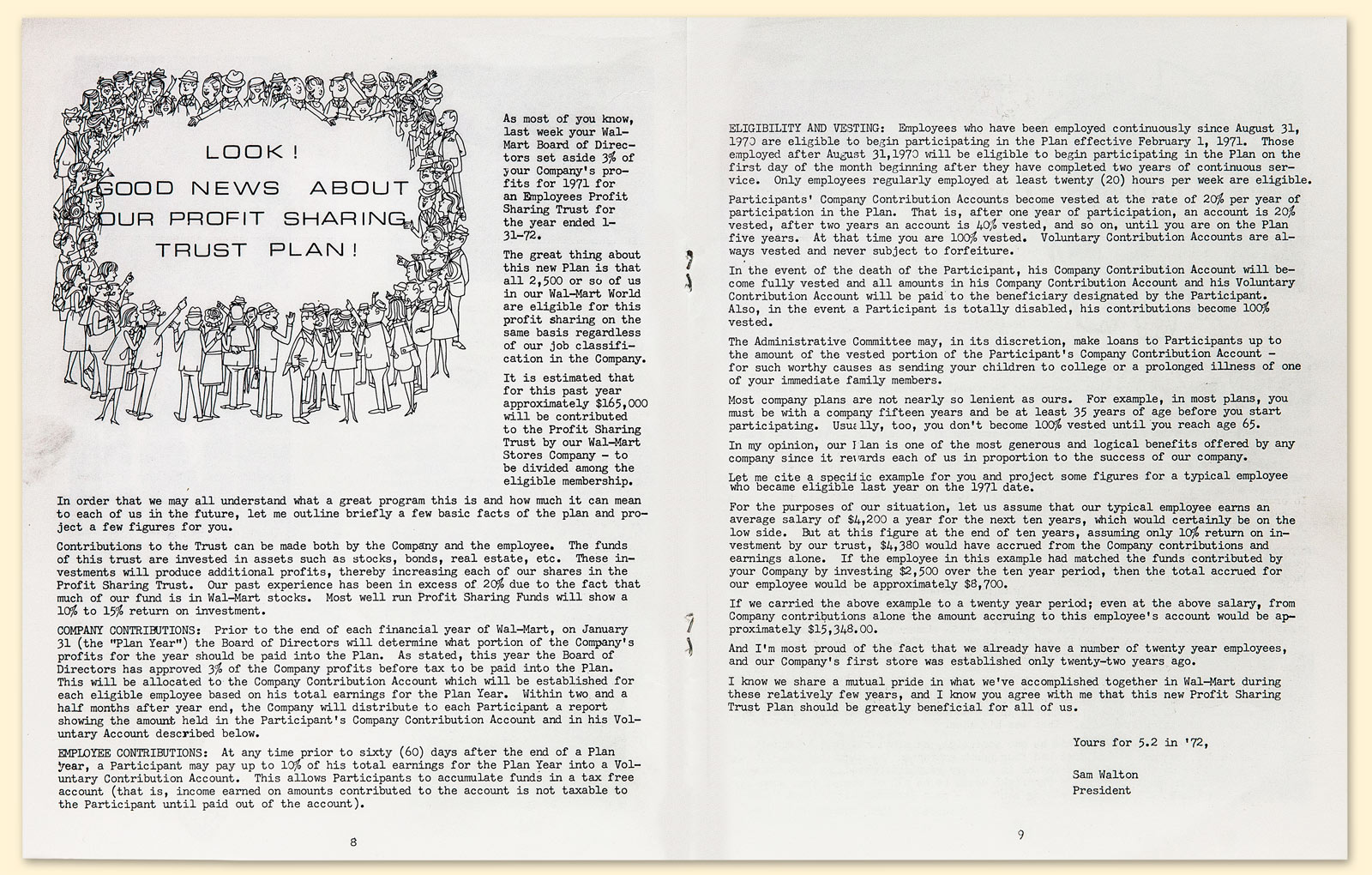
Wal-Mart Stores, Inc. is one of those businesses that has always had a particularly good profit sharing arrangement for employees who knew how to take advantage of it. Many of the early store managers and truck drivers, for example, retired multi-millionaires as a result of their ownership stake.
To put it into perspective: Imagine that you have a perfectly average American couple, John and Jane, who have 2.5 kids, drive a minivan, and live in the Midwest. They are both assistant managers at local Walmart stores, earning the average salary of $58,000 for their job, or $116,000 combined.
Every year, they both buy $1,800 worth of Wal-Mart Stores, Inc. common stock, having the money taken directly out of their paycheck. With the 15% match on the $3,600 they are saving between the two of them, they are able to buy $4,140 worth of shares in Walmart every year. They tell the company to reinvest the dividends on their stock.
In addition, both max out their 401(k) up to the point of the match (6% of salary). At $58,000 each, both John and Jane kick in $3,480 per year and receive a matching $3,480 from the company. That means that between the two of them, they are saving $6,960 per year but receiving a free $6,960 in matching funds, which is a 100% return on their money instantly, for a total of $13,920 annually. In the 25% bracket, they are going to receive $1,740 in tax credits for their part of the retirement contribution, putting extra cash in their pocket each year.
Between those two items alone, the couple is giving up $8,820 in cash out of pocket each year ($10,560 in out of pocket contributions less the $1,740 tax refund they will get back form the IRS as a result of their retirement savings) but putting $18,060 in money away for their future. The value of their investments would have to fall by more than 51.1% before they lost a single penny of their own net contribution money!
If that is all they did, never saving any other money elsewhere, and opting, instead, to spend their paychecks on nicer homes, newer cars, better furniture, longer and more upscale vacations, sending their kids to school, etc., they would not only get to enjoy their lives, but they’d retire with nearly $4.9 million in their investment account at average long-term rates of return. If inflation runs the same rate it did during the past century, that would be around $1.7 million in today’s dollars, which would generate $5,700 per month pre-tax without every touching the principal. Clearly, this is a simplification because you wouldn’t want to hold all of your net worth in Walmart stock if you also relied on the company as an employer, but the basic math is sound.
It’s not hard to do well in the United States. You just have to know a few things about economics, compounding, and tax rules.
Update: This post was restored on 05/15/2019 as part of my decision to re-open selected articles and essays from the private archives, particularly if I felt they had some sort of academic, educational, or entertainment value. The point, of course, was not Walmart and none of this was intended to be investment or career advice. Rather, the theme of the piece was that there are often all sorts of income and net worth enhancers available, sitting in plain site, that might seem small but that over time can drastically improve the quality of your life.
There was also an undercurrent that I felt was important. In those days, it wasn’t unusual for me to hear people complain about how families such as the Waltons were somehow magically endowed with wealth; a nonsensical notion. It struck me as strange when the source of this wealth – ownership of the retail stores – was plainly evident and, just as importantly, freely and democratically available to anyone who decided to buy the shares, which were available for purchase every trading day on the New York Stock Exchange. The shares didn’t care about your age, race, education, sexual orientation, political beliefs, religion, height, weight, eye color. The shares didn’t care if you were kind or cruel, beautiful or ugly, intelligent or intellectually handicapped. Once your name was engraved on the stock certificates, you enjoyed the same proportional earnings and dividends as the Walton family. You held the same type of common stock they did through their family holding company, Walton Enterprises LLC. Not only that, if you worked for Wal-Mart, the company would give you a discount when you wanted to collect more ownership!
Of course, Wal-Mart Stores could have failed just like any business can fail under the right circumstances. That is the reason, like the Waltons, you should diversify. Your 401(k) should have held ownership of many other enterprises, perhaps through a collection of index funds if that were the best option available to you and you couldn’t select the specific companies you wanted to own. There was nothing stopping you from saying, “You know, I think I want to own a little McDonald’s, too, so I get checks in the mail for my cut of the distributed profits.” You could have just as easily said, “I feel like buying a stake in Starbucks today. I see their stores keep doing better and better, revenue, sales, and dividends keep marching skyward. I want a cut of each cup of coffee they sell.” Think like a business owner. You are surrounded by productive assets that give people goods and services they want. Find those that do this at a profit while maintaining a decent “moat” to protect the operation from competitors then go through life collecting ownership! Yes, some of those business may go bust from time to time – who would have ever thought Sears would fade into oblivion when it had such a commanding lead over Amazon in the early days – but if you structure your life, career, and portfolio correctly, that doesn’t matter. It’s a cost of doing business and an inevitable part of the process of success.
Finally, let’s take a look at our hypothetical couple in this post. In the eight years since it was first published, the world has changed quite a bit but the spouses in our example should have done very well for themselves. Their profit sharing plans and 401(k) balances should have grown enormously, adding six-figures in additional net worth to their household and keeping them on track for the original goals laid out at the time of publication. Meanwhile, one would hope that nearly a decade would be sufficient time to get a promotion from assistant manager to manager. The typical Walmart manager now earns an average of $175,000 per annum; a fairly material upgrade from the $58,000 assistant manager salary in 2011. They may have even changed careers or moved to a competitor, such as Costco. You can’t control the future but you can tilt probabilities. Go through life collecting advantages and let those advantages reinforce each other. Time, and compounding, can do a lot of the heavy lifting once you kick start the cycle.
Reader Comments (12)
Comments are presented chronologically, with replies indented beneath the comments to which they respond.
DeyC3
December 12, 2011
The thing is, 116k is knocking on the 90th percentile for household income. The vast, vast majority of Wal Mart associates make a few dollars an hour. To rise that high in the hierarchy takes years of dedication and a lot of the right genes. Obviously it has to be done at least once at every store. But empirically speaking, 90% of couples don't make it to that income level.
Your post about being a millionaire on a minimum wage salary changed my life. I don't make minimum wage but I am just under the poverty line. You forced me to look at the opportunity cost of every penny I spend. Now, between my 401k and debt repayment, I save more than 10% of my income.
Joshua Kennon
December 12, 2011
Replying to DeyC3
Very true; very good point! The upside is, the percentage figures would still hold true for a Walmart associate on the bottom of the ladder who took advantage of the free matching money. They just couldn't take advantage of it to the degree a manager could but it would be there.
A lot of these big companies have programs like this if you dig into HR far enough. I've talked about several of my older relatives working for the phone company back in the mid to late 1960's to 1990's. Even then, they had a payroll stock purchase plan where you could buy shares at a 15% discount to the public market price as long as you agreed to hold it for a year or longer.
As for saving 10% of your income below the poverty line, that is a huge accomplishment! You should be incredibly proud of it.
P.S. I'm finally making my way through The Blank Slate when I get an hour or so here or there (and not playing Skyrim or working like crazy this time of year). It really is revolutionary; I understand why you said you liked it so much. The presupposition of its existence in different models of psychology and behavior are rampant. Take Carl Roger's "unconditional positive regard" approach, which is based upon the inherent belief that "all people have the internal resources for personal growth". It's just assumed as fact. It's everywhere ... the total and complete academic denial of the human nature that nearly everyone's grandparents knew existed.
DeyC3
December 13, 2011
Replying to Joshua Kennon
Thank you. I am proud. But I must thank you again for your illumination of the opportunity costs that woke me out of my resignation and gave me hope that no matter what happens during this downturn, if I can invest even a hundred dollars a month, one day I (or my children) will be wealthy. That was enough to fight for.
It took me a little over a year to finish the Blank Slate. Psychology is in an interesting place. For almost a century it was plagued by a seemingly unbridgeable chasm between reductionist science and healing art. Evolutionary logic has begun to inform what looks poised to become the first ever useful unifying theory of the human psyche.
Ron
August 12, 2013
Replying to DeyC3
Any possibility of a link for that article(RE millionaire on a minimum wage?) Is it still relevant in today's economy? I love finance and used to have aspirations of being a financial planner. I would love to read it.
FratMan
May 24, 2013
I went to Wal-Mart last night. They started carrying "Hecho in Mexico" Coca-Colas in glass bottles, and I am a complete sucker for the "real thing" (Eventually, I need to get a block of Coca-Cola stock where I treat the dividend income as my Mexican Coke allowance--i.e. buying "The Gentleman's 100 Shares" of Coca-Cola could get me about 20 glass bottle six packs per year, and I could regard the capital appreciation over time as the unintended icing on the cake).
Anyway, once I grabbed the six pack, I noticed there was only one line open. It was some time between 12:30 and 1:00 in the morning. Basically, you had one person working, and four different customers waiting with full carts. It would have been a thirty minute wait, easy. I put the Coke back and left. Obviously, me being me, I started to wonder what my behavior would look like extrapolated across an entire system.
On one hand, not too many people grab an item, proceed to the checkout, and then leave without making a purchase. But on the other hand, Wal-Mart has been quite understaffed at the checkout lines from my anecdotal experience, and I wonder if understaffed stores hurt profits in any kind of meaningful way.
Joshua Kennon
May 24, 2013
Replying to FratMan
It was so bad at our Walmart that we don't even bother anymore. I pay higher prices at a local grocery store where all of the checkout lines are open.
Eugene
November 6, 2013
Replying to Joshua Kennon
One thing I never understood: why have 35 checkout counters and only have 3 open? Walmart employs so many people and there is never an available associate on the floor. I think they could do a lot better and get more people if they just utilized their in-store resources properly.
Harold
November 12, 2013
Replying to Eugene
That's not a store level decision.
Zac G
November 26, 2013
Replying to Eugene
As Harold stated, it's not a store level decision. We have enough associates they don't schedule them and then ask people from other areas to help ring for a while. In some areas you cant just pull everyone otherwise that department would fail.
panjok2
January 29, 2015
Replying to Eugene
@joshuakennon:disqus @FratMan:disqus @disqus_PkUahBRbeW:disqus @disqus_3NviWwH68u:disqus
I know this is an old comment thread but I just had to respond
.
They have that many checkout lanes for the rush times. There are certain times of the day when we have all lanes staffed because the stores are filled with customers. But at late hours, it isn't unusual to have 20 minutes pass without one customer, but then all of a sudden, you have 5 people ready to checkout. Yes it is annoying to wait in line but, if people would look at things a little different, they might be happier. for example, be happy that a store like Walmart stays open 24 hours a day and 7 days a week. We even are open on Thanksgiving day. Although, I think we shouldn't be! Walmart employees have families too! I think people were happier when all stores closed on Thanksgiving and Christmas! Hell, if memory serves me correct, a lot of places were closed from Thursday-Sunday! It was like a vacation for the whole country! And hardly any stores were open past midnight! I think big business has created a society where everything is rush rush and if you have to wait 10 minutes, it feels like an eternity!
Personally (with lots of help from my wife whom has 2 masters degrees in psychology) I now try to look at things with a happy view instead of a pissed off one! My life seems more peaceful now. I hope you can try to do this as well. In the whole scope of things, waiting a few more minutes is not gonna kill anyone. Actually, you are paying less for the things you buy because they aren't paying for the extra workers. Ya see...there are many ways to look at these things! lol Ya never know, you might make a few friends while waiting in line or meet the girl of your dreams (if you haven't already-lol)? Have a great day
Joshua Kennon
February 10, 2015
Replying to panjok2
I really appreciated and enjoyed your comment. Thank you for taking the time to share them.
Serious question: Why bother, though, when it can be immediately rectified without any switching costs? If two nearby stores offer identical products, comparable prices, yet one is cleaner, brighter, with better traffic prediction analysis in lane management, why not just go to the one that runs smoothly and lets you get in and out in a matter of moments? Virtually all human progress and real standard of living gains have been caused by some level of discontentment, which is why regulated capitalism tends to be the most efficient means of achieving it as it allows individuals to "vote" on their utility by giving their custom to firms that provide what they want, either in terms of price, efficiency, or experience.
I can't say poor management or customer service has ever pissed me off. I just don't get angry or upset about a lot of things.
For me, what I experienced was something different. It's the rational frustration of being an owner, which I think might be unique to those who have an entrepreneurial background. For example, I have shares of Wal-Mart in my own brother and father's retirement plans. When my dad is too old to work, that stake in the business, along with his other holdings, will help put food on the table, buy medicine, and keep a roof over his head. This lane management problem coincided with a period that involved a bribery scandal in Mexico and a terribly executed inventory reduction policy that presumed everyone was willing to substitute comparable goods when nothing could be further from the truth. Over a period of several consecutive months, I left every single time from the store without at least half a dozen items I needed because the shelves were empty. Once, I went in and wanted to spend $300 or $400 buying one of every single variety of the McCormick & Company gourmet line to compare to another spice business. They were out of stock for at least 1/3rd or 1/4th of the spices. The slots were just void as if it were still opening day. It happened in nearly every department, without fail, all while people online were complaining and management was writing about their reduction methods in the SEC filings, seemingly oblivious to the fact it was making long-term, loyal customers hate them. Meanwhile, the stores were being repainted this terrible 1970's yellow color, the floors were always dirty, and everything just felt oppressive.
If I were to reach a zen-like peace about situations like that, accepting it as it were, it would be terrible for my net worth, especially in retail where complacency equals fiscal death. For my profession, it would be akin to telling a baseball player to not bother running to catch a pop fly as it would require too much effort. Most of what I do is the process of exclusion. I need to spot errors. I need to see flaws. I need to see openings where a business isn't living up to its potential. I need to rip apart assumptions. Otherwise, I wouldn't ever be comfortable enough risking hard-earned equity capital on an ownership stake. I have to be able to ask myself, "Are these problems correctable or intractable due to the nature of the enterprise?" "If they are correctable, who is to blame?" "Is the price cheap enough to overcome this mismanagement?"
Far from being a negative, it's given me practically everything I've ever wanted: Financial independence, total control over my time, a comfortable home, the ability to travel, and the capability to buy or donate whatever I want. It certainly hasn't caused any distress but I think I'm too much of an optimist. Even if I were standing somewhere irritated about something, my mind instantly begins envision how it could be made better; how sales could be improved, and customers made happier; profits grown and goodwill improved. Again, I think it's partially what makes entrepreneurs who they are. To be an entrepreneur, you have to possess this sort of eternal optimism that everything, even the bad, is an opportunity to make something better, more beautiful, more wonderful. Even if it's selling metal widgets, it's really, say, taking your kids to Disney World or helping your child pay for a college education.
Monty Saylor
July 23, 2016
Replying to panjok2
Love your comment.A lot of people take Walmart for granted,I could name them,but you did some for me.I've worked there for 14 yrs.and besides my wife and child.It has been the best.If I had it to do over I would have started out of HS.