

The Sum of Small Things: A Theory of the Aspirational Class
Elizabeth Currid-Halkett, the James Irvine Chair in Urban and Regional Planning and a professor of public policy at the University of Southern California, recently published a book called 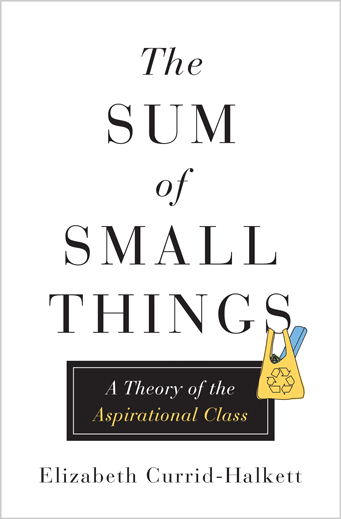 The Sum of Small Things: A Theory of the Aspirational Class
She describes, in real world data, the very things that Peter Drucker predicted a generation ago and about which Professor Charles Murray of Harvard University has been warning; that there is a “coming apart” of the social fabric of this country as the successful now devote their time, energy, and resources to behaviors and activities that make them, and their children, more likely to succeed in a winner-take-all economy. These positive decisions, which are now much more popular ways of displaying status as compared to things like sterling silver flatware and fine china, setoff feedback loops that create a sort of lollapalooza effect in areas encompassing, but not necessarily limited to, “education, health, parenting, and retirement”. As those who practice these behaviors and make these investments do better and better, they surround themselves with other people like them and ultimately have nothing in common with the rest of the population they’ve left behind.
This presents several major challenges. One of these challenges is that the forces described amplify one another in ways that cause upward mobility to become more difficult. As the author puts it, “The accrual of particular types of knowledge and the sharing of cultural capital means that the new elites use this information to buy particular things and act in particular ways to further solidify their position. Or, as [Shamus Kahn, sociologist at Columbia University] writes, ‘Culture is a resource used by elites to recognize one another and distribute opportunities on the basis of the display of appropriate attributes.'” The author has an excellent passage that relates to one of my favorite mental models, which I decided to call “signaling theory” and have talked about for the past few years as I am now convinced that it is subordinate largely to only social proof in terms of power of implications for day-to-day outcomes. This passage explores the role of a specific shade of nail polish worn by certain women in the uppermost classes of England and the United States; how, despite not being any more expensive than most other nail polishes, it gets picked up as a code, an acceptable way to present oneself. Whether consciously or subconsciously, those who do not display this behavior are recognized as outsiders. This pattern repeats itself in everything from the type of cookware one has in one’s kitchen to the way a child is parented. (One of the things that I find interesting, something that is on my “too hard” pile at the moment as it seems to intersect with some interesting findings in evolutionary biology worth exploring further whenever I have the time, is that not all, but nearly all, of the examples the author provides are a form of social dominance and conformity developed, and enforced, by women against other women. It’s not accurate to call it violence but it does seem to be some sort of coercion. There is a particularly enlightening passage about the social pressures women face regarding breast feeding their infant and how the discussion has now become detached from scientific evidence to the point that it’s almost a spiritual belief taken as a matter of faith and against which any counter-claim is immediately rejected on feeling alone; that it serves as a type of virtue signaling that says, “I am a better, more fit mother than you and thus rank higher in our social hierarchy”.) Children are exposed to these patterns of behavior earlier than many folks imagine as parents try to prepare them for success as best they know how. The author discusses the work of sociologist Annette Lareau and her famous book Unequal Childhoods. As Laraeu points out in that work (using Currid-Halkett’s summation), “…children of upper-middle-class families are encouraged to question authority, engage in constant negotiation with their parents and, through their various engagements, become socially adept. Contrast this type of parenting with ‘accomplishment of natural growth’, which Laraeu argues is the dominant style of parenting among poor and working-class parents. This type of parenting emphasizes respect for authority, more parental directives (i.e., ‘go wash your hands’ rather than extensive discussion on the origins of germ theory), and far less structured activity (e.g., fewer music classes, play dates, and gymnastics). These aspirational class children are reared to feel empowered, and tend to have larger vocabularies and greater social aptitude (but are criticized for being entitled) while the working-class kids, often more independent, learn the skills of following orders that are thought to be important in their future work in more rote jobs (but also limiting for upward mobility).”
Another of these challenges is that, often, due to the discipline, hard work, intellect, and all-around wiser life decisions the affluent and upper class group now makes, they become contemptuous or, at the very least dismissive, of those who don’t live up to their standards. In a lot of ways, it becomes harder to address structural inequality because there is no leisure class, anymore. Or, perhaps, it is more accurate to say not one of any size worth discussing in a serious analysis of economic resource allocation. In the United States, at least, gone are the days of inept inheritors living off of their parents’ life work being the embodiment of the upperclass. In fact, at this moment in time, the upper class is more likely than it has ever been at any point in human history to consist of a meritocracy in which largely self-made men and women accumulated their net worth. Furthermore, these self-made individuals then provide an “accumulation of advantages” to their children by undertaking a process of purposeful cultivation so their children have a wide range of knowledge, opportunities, experiences, and access. For example, intelligent, successful parents who accumulate a lot of net worth are likely to purposely arrange their lives so their children attend a good school. This, in turn, helps to maximize the probabilities of success in their children, creating a positive feedback loop. It also keeps property values elevated, improving the odds of further net worth accumulation. The author quotes Columbia University sociologist Shamus Kahn and NYU sociologist Colin Jerolmack in talking about how meritocracy is really “‘a rhetorical cover’ to make what is actually privilege.”: “It is those students from advantaged backgrounds who are most likely to succeed because throughout their lives, before even crossing the threshold of these spaces, they have developed the dispositions and cultural capital that give them an advantage over others. They feel at home within the institutions that reward them for exactly the type of behavior that is ‘native’ to them.” (On a related note, when Drucker addressed this decades ago, he pointed out that there were all sorts of potential responses, each with its own perils. One was that the disadvantaged group, ever more disenchanted, disenfranchised, and bitter, would call for confiscatory tax rates. This would be met with fierce resistance because the self-made would see it as an attack on their life’s work due to the enormous struggle and personal sacrifice they had to make in achieving what they did regardless of the advantages they received – the 15+ hour work days, the seemingly endless years at medical school, the decades spent building a successful accounting or legal practice, the tireless nights preparing a doctoral thesis, the hustling while trying to manage cash flow on a low-capital start-up. If the disadvantaged groups are successful, a blunt-force approach could drag society down into another socialistic or communistic hell; well intentioned but catastrophic in implementation and execution. Another was to implement some sort of universal basic income, or a citizen dividend, that entitled every member of a society to a poverty-level wage that at least guaranteed they wouldn’t go hungry. How humanity navigates this change will likely be as important, and potentially as violent, as the shift from an agrarian-based economy to an industrial-based economy. It most likely will not be smooth or easy.)
When Individual-Outcome and Group-Outcome Rationality Collide
I see this accumulation of advantages, and its perpetuation of its own exclusivity, in my own life and social circles. It arises, in part, because what makes sense on a microeconomic scale doesn’t make sense on a macroeconomic scale; that maximizing individual outcomes can result in fewer successful individuals but how this doesn’t matter because, the reality is, you aren’t as likely to care about a stranger’s kid, or society as a whole, as much as you do your own kid. It’s human nature. Something seemingly-magical happens to a substantial majority of people when they become a mother or father. An instinct arises that causes you to put the child ahead of not only your own self-interest but, at times, even the good of the community; that makes you instantly love this tiny person more than anything you could ever imagine to the point that, when push comes to shove, everyone else is secondary. One illustration: recently, Aaron and I were having lunch with some old friends we’ve known for most of our lives. One of them, a mother who definitely falls more toward the classical liberal side of the political spectrum, talked about how she and her husband, both well-educated, found themselves completely violating their principles when they were looking for a new home because they decided to base the decision around the quality of the school district and the socioeconomic characteristics of the community to maximize their children’s chance of success even though it was exacerbating the very inequality and divide she had so passionately fought against most of her life and career; that no matter how much they valued diversity and opportunity, at the end of the day, they wanted to do what they could for their offspring so they had the advantages necessary to give them the chance to build a great life for themselves.
What makes this particularly complex is that it is only half the story. Even if you were to somehow forcefully integrate the schools alongside socioeconomic lines, all sorts of other benefits would still accrue to the children of the wealthy and successful that their disadvantaged classmates wouldn’t enjoy. For example, if you really want to be shocked, look at the difference in vocabulary exposure by socioeconomic group before a child even enters kindergarten. A teacher cannot fill the role of a parent. If one student has great nutrition and a home life where they are secure and proactively engaged in activities that improve their skill set, they’re going to be able to excel far more easily than their peers. No amount of money thrown at this problem will solve it because advantage arises from both culture and structure. Historically, a counterbalance to this was that there existed center spheres of what you might call cultural indoctrination, such as as religious institutions, which provided a means of standardizing and solidifying behaviors that led to better success, even when those methods were seen by later generations as immoral (e.g., shaming couples to get married when a pregnancy occurred prior to matrimony). As a counterbalance, they sometimes led to a lot of injustice and misery on the microeconomic level but sometimes better macroeconomic or systematic consequences. (Here the specifics of the religious beliefs were important; e.g., contrast the Protestant work-ethic, which helped turn the United States into a global superpower even if it did result in us prioritizing things like GDP over well-being, with the practice of burning widows when their husbands died for an easy, if not extreme, comparison. One can hardly say the latter is worthy of respect.)
Related to this point is something that concerns me, and which the book largely sidesteps; a force that is potentially important to sociology, behavioral economics, and futurology. Namely, as we’ve discussed in the past, we are undergoing a type of eugenic experiment due to increased personal freedoms and assortative mating but the consequences of this are overlooked for fear of offending people. There can be absolutely no doubt, objectively looking at the scientific consensus and the available data, that raw intelligence is almost entirely genetically driven. You can make a smart person dumber by having them grow up in sub-optimal conditions, but you cannot make a dumb person smarter than their natural limits. In recent generations, there has been a staggering amount of so-called “brain drain” from smaller communities as the best and brightest students leave town to go off to university, never returning. At university, they tend to meet their spouse, also intelligent and educated, then move to communities surrounded by other people like them. On a population-level, if that goes on for an extended period of time, you could end up with entire groups of people who are “left behind” – again, individuals within the left behind group could very well be super-intelligent due to genetic variation even while the rate of those individuals arising declines within that same group – and totally unsuited for the full ramifications of the knowledge economy. Add to this the likelihood of gene editing in the future, and the financial barriers and social proof reinforcement that this behavior is desirable among those who can afford it, and you’re looking at near-permanent structural inequality (or, at least, the seeds being sewn). If this goes on for generations, the risk that poverty is viewed always as a moral choice, and thus deserving, skyrockets. A tremendous amount of human suffering can result from such ingrained beliefs; e.g., look at certain classical Buddhist societies where a widespread belief in reincarnation effectively justified structural stratification based upon the position of one’s birth.
This is not just a massive moral and ethical question, it is a pragmatic one, as well; one that must be answered before the condition grows too dire. What is the nature of justice? What do we owe our fellow man? As a civilization, we have a long way to go. Consider that somewhere around 1 in 12 people have an intellectual capacity – again, almost entirely genetically determined – that makes them non-suited to any sort of work involving more than basic, repetitive tasks that have been carefully designed for them. That is a not-insignificant percentage of souls. No matter how much training, or opportunity, they are given, this group is going to face a massive disadvantage in an ever more cognitive-based economic system, where ideas and execution are the source of value. As we’ve done away with jobs that could have provided them with a good standard of living, nothing has filled the void. To put the question bluntly, what do we do with these people? How should they spend their time everyday? They are actual men and women with hopes, dreams, desires, friendships; who feel love, fear, empathy. It’s dangerous to see them as “less than”. It is also dangerous to refuse to acknowledge the nature of the problem. For example, a substantial real risk is that the members of this group demand a form of hidden welfare through the subsidization of outdated or inefficient industries to the detriment of the rest of society. Consider coal. In the most recent election, workers in the coal industry who were voting to bring back coal jobs insisted they didn’t want a government handout but that is exactly what they were demanding – unearned, undesirable welfare based on tribalism. They just wanted the emotional delusion that by working in a mine all day; to be able to lie to themselves and say that they had somehow earned their keep when, in reality, they were taking from everyone else because they somehow felt entitled to earn a living from an activity that has a much-reduced role in the modern world.
Individual Identity vs. National Identity
Related to everything we’ve been discussing is the fact that upper middle class and upper class people are more likely to identify with those who are like them, regardless of nationality, than they are members of their own country who are not similar. In a highly mobile and interconnected world, when the well-educated and affluent travel, meet, and interact with other well-educated and affluent people, alliances and personal relationships form that can be deeper and more powerful than some nebulous concept of your generic fellow citizen to the point that I’ve heard borders referred to as “imaginary lines”. It’s not hard to understand, on the whole, how an upper middle class, university educated, software programer living in San Francisco or New York is likely to feel more connection to a similar upper middle class, university educated, software programmer living in London, Berlin, Vancouver, Paris, or Tokyo than he or she would a non-educated, lower class American living in a trailer park in a rural part of the country. In many cases, their interests and skill sets are aligned. Their economic incentives are aligned. Their standards of living are aligned. Their life goals and dreams are aligned. They probably read the same types of books, watch the same types of films, have friends with diverse backgrounds, and are used to problem solving and complexity. What are the long-term consequences of that? Economically? Politically? Militarily?
Other questions remain. What does all of this mean and where does it leave us? The book doesn’t really offer any solutions, nor did it promise it would. Rather, it serves as a sort of high-level overview of some of the areas and patterns in which successful individuals and families are entrenching their advantages; behaving rationally on a household level and, through largely (but not always) non-intended consequences, keeping everyone else outside of the gate. Given the top-shelf characteristics of the community, many of you will recognize yourself in the descriptions and behaviors; see things that you think are perfectly normal but that a large percentage of the country doesn’t even consider. For example, many of you likely own a musical instrument, play an instrument, or have your children enrolled in music lessons. As a group on an inflation-adjusted basis in 2015 dollars, the top 1% is spending slightly more on musical instruments than it did in 1996. For the bottom 89% of society that number has collapsed by a staggering percentage. What are the lifetime consequences of that? You look at all of the advantages playing a musical instrument offers, even in terms of seemingly non-related fields like mathematical ability, and that’s a somewhat terrifying thought. In the same inflation-adjusted dollars, the top 1% has increased its investment in education by 3.5x compared to 1996 with a major portion of this increase going to early childhood development, tutors, and other out-of-school sources of knowledge accumulation. When a parent decides to buy a musical instrument and invest in his or her child’s development, it’s like a signaling theory billboard. It tells you a tremendous amount about the parent, as well as the likelihood of how the kid is going to turn out in life. What makes it tricky is that it isn’t the instrument itself, it’s the interconnected manner in which the instrument finds its way into the child’s life and then becomes a part of it.
The Soft Bigotry of Low Expectations
My biggest criticism of the book is that I feel it often engages – without any sense of self-awareness – in something that Oprah Winfrey once called “the soft bigotry of low expectations”; a behavior pattern that seems to be most common in well-educated, affluent people who tend to have high empathy. While often motivated by kindness and good intentions, this deeply offensive way of thinking and behaving is not only demoralizing, but tends to exacerbate the very poverty and inequality they are trying to fight because it ignores how humans respond to attention and incentives. You see it in wealthy bleeding heart parents saying we shouldn’t criticize low income parents who smoke and give their children a diet entirely of “sweetened drinks and Doritos” because they can’t do any better. Which, of course, is really a patronizing way of saying, “You’re too dumb to take care of yourself and your family so we’re going to let you continue destroying your child’s life because we don’t want to hurt your feelings. Being agreeable is more important than fixing the issue.” You see it in school administrators lowering standards for black and hispanic students, demonstrating in action that no matter what they say, when push comes to shove, they don’t actually believe those students are as capable or as intelligent as their Caucasian or Asian peers. This is an insidious and hateful worldview that ends up permeating institutions and leads to both individual bias and structural discrimination. Consider just one consequence: I’ve personally had successful medical professionals – people I have otherwise never known to harbor prejudice or racism and who would have no problem marrying, or having their children marry, a person of another race – point-blank admit to me that they have to fight the initial professional bias that a black doctor is inferior to a doctor of any other race because they find themselves assuming, due to their own first-hand experience during their days as a student, that the doctor probably was admitted to medical school based upon lowered standards to meet a quota as part of a diversity effort. Yet, they also admit that if they were to try to address this, knowing they feel this way, it would be the end of their career. This results in the bias being taboo. It ends up doing tremendous damage, harming real people, but everyone is too scared to confront it so it is allowed to thrive. This isn’t limited to medicine, either. In the legal field, Supreme Court Justice Clarence Thomas famously has a 15¢ price tag attached to his Yale law degree because he found that, after graduating from one of the most prestigious universities in the world, “[m]any [potential employers] asked pointed questions unsubtly suggesting that they doubted I was as smart as my grades indicated”. It’s all one, big, interconnected mess. It gets into the Kantian Fairness mental model, the reciprocity mental model… The perverse outcome of all of this is that members of the majority group who happen to make it through to the point of success end up being more privileged, not less. This force, particularly the Cobra Effect mental model, happens a lot in nature. Well-meaning but idiotic political solutions such as rent control come to mind. Liberal and conservative economists are in near total agreement about the stupidity of politicians who vote for rent control because it ends up causing a city to become even more expensive, harming the poor and benefiting the rich, but people too often think only about solving the problem in front of them and not the second and third order consequences of their actions.
Equally as bad, this type of sugar-coated discrimination – the soft bigotry of low expectations – poses a very real danger of triggering a mental model known as Stereotype Threat, in which individuals who are part of a group viewed less-than-capable end up experiencing lower real-world performance whether or not they agree with the stereotype because being aware of it exerts a neurological influence. The exact mechanism still isn’t fully understood but it is powerful. Fascinatingly, the opposite is true in a mental model known as Stereotype Boost but, here again, the individual must be aware that the stereotype exists for the effect to manifest as it otherwise has no power.
This interconnects with some fascinating areas of behavioral economics – namely, the power of free will and how it influences personal opportunity cost decisions. At the risk of grossly oversimplifying the current state of the research, it is fair to say that a person who believes he or she is in control of his or her own destiny – that their decisions matter and the outcome of their life is determined by their own actions – ends up enjoying wildly superior life outcomes compared to a person who believes their life is the result of structural privilege or discrimination even if the latter does exist. In other words, having faith that you are in control of your life ends up drastically improving the probability that your life ends up materially better than it otherwise would have – that you have more money, that you complete more education, that you make good long-term decisions that result in better life expectancy. That faith is the key. There is some sort of power in it. Possessing, protecting, and growing that faith, even through adversity, changes life outcomes. It transforms the individual’s world in ways that are often hard to imagine. It shows up over and over again in all sorts of data sets but, strangely, it isn’t popular to say. In fact, people who lack this faith often grow angry or offended at the mere suggestion they have control over the outcome of their life (I suspect it is because it would make them responsible for their current situation). It’s far easier to blame your parents, your employer, your friends, your neighbors, your coworkers, your elected officials. Just as strangely, when someone has grown up in an environment hearing that everything is beyond their control, then they realize they have been taught a lie their entire life, it can ignite a spark that causes them to launch into an upward trajectory. Personal responsibility is empowering. It feels good. There is a wonderful freedom in knowing that your life is a reflection of your past choices; what you do with your time, how you invest your money, the people with whom you associate, the food you eat, the activity you engage in, your behavior towards others.
Signaling Theory, Immigrant Entrepreneurship, and Quality vs. Quantity
In any event, this goes way beyond the content of the book. It relates to some other things I’ve been studying. One of these is a powerful mental model that I’ve grouped under a heading that I have begun calling “signaling theory”. The name will need to change because, while it is related to the concept of “Signalling Theory” from evolutionary biology, as I see them they are distinct. Maybe Broadcast Theory? I don’t know. Regardless, when I’ve finally feel like I have a comprehensive grasp on the totality of the subject, I plan on writing about it. In summary, the premise of what I see as signaling theory is that each of us is constantly broadcasting tremendous amounts of data out into the world, almost always without realizing it; like a radio or television station sending signals out into the ether. These signals are encoded in different ways – how we speak, how we dress, the company we keep, the way we eat at a restaurant, the way we lace our shoes, the types of movies we watch, the type of coffee we drink. We respond to others based on these signals. One of the ways upward mobility has been restricted, both historically and today, is that people who grow up in environments of affluence and success are inculcated with these signals, or patterns, until they become a part of who they are. They then recognize others like them and due to a variety of other mental models, build networks that exclude those who are different. One countermeasure is a related concept called “code switching”, where a person who grew up in one community instantaneously adapts his or her language patterns and accent, body language, and topics of conversation based on who is in the room. Given the natural inclination of a lot of people to avoid feeling uncomfortable – a dangerous, stupid seduction that has cost countless men and women their dreams – this means staying where they feel they belong, not where the opportunities are.
The other is how we can use the experience of first-generation immigrants to the United States to understand capital formation, entrepreneurship, and cultural identity. On that front, one of the most useful books I’ve found, particularly as a nexus for further research, is called On My Own: Korean Businesses and Race Relations in America by In-Jin Yoon. Though the data is now out of date, it ties to the work of the late Dr. Thomas J. Stanley of The Millionaire Next Door fame, in examining why certain groups, particularly Korean American immigrants, were self-employed, and thus enjoyed higher net income and wealth accumulation, than other racial, ethnic, or social groups. More specifically, it looks at the role discrimination played, if any, in incentivizing self-employment, while tangentially touching on the outsized success of other highly successful identity groups; e.g., Russian, Israeli, and Palestinian immigrants. It goes through different theories from sociology to try and see if they fit the real-world conditions that can offer a framework for why this happened. This is then viewed through the lens of the race riots of the 1990s in which Korean Americans suffered catastrophic losses at the hands of black and hispanic looters rioting in response to the acquittal of four white police officers accused of beating a black man named Rodney King after King was said to have resisted arrest. It’s a fascinating journey. It looks at motivations for immigration, sources of resource accumulation and how those change over time as a family is able to build an economic engine (often the engine pays for the children to become well-educated and the children then go off to university, becoming white collar professionals rather than returning to the family business). That’s another post for another time.
Again, if you’re interested in reading the original book mentioned, it’s called The Sum of Small Things and it was written by Elizabeth Currid-Halkett. Don’t get me wrong – it is not a must-read for most of you. I found it useful because it was connected to several other intersecting topics, particularly in behavioral economics and sociology, that have been on my mind. To that extent, it was a bridge that helped bring a few things together in terms of understanding how cultural identity among the upper classes is shifting as the signals used to signify in-group behavior have changed; e.g., minimalism, breast feeding, learning to cook, migrating to high-opportunity urban areas, spending more on clothes. (The last one was uniquely interesting. In one material respect, America’s new elite behaves differently from the Millionaire Next Door-type families the late Dr. Thomas Stanley discovered a quarter-century ago when he began looking at prodigious accumulators of wealth. Namely, members of the aspirational class are now shoving far more money into their retirement accounts and pensions than they were in the past but they also became much more willing to spend a lot of money on high-quality clothing despite not holding its value. While we should be careful of using personal anecdotes to reach conclusions, even here, Aaron and I see a reflection of our own lives. Looking at our household expenditures in this category, I have a working theory it is because the quality of mass-produced merchandise declined by an extraordinary degree over the past ten or fifteen years, leading people to either go up or down the value chain as part of what has come to be known as “Consumer Hourglass Theory”; something we’ve discussed many times in the past. When we were younger, you could walk into a Banana Republic and spend $120 on a pair of pants that would last a decade, still looking as new as the day you bought them. The trade-off felt good as a consumer. Even the niche retailers, such as American Eagle, had great quality denim jeans. Today, everything seems significantly thinner and rips more easily. It even has a name: throw-away fashion. I can’t stand it. Aaron can’t stand it. The last time we needed to buy blue jeans, we had grown so irritated with the shoddy quality available at most apparel stores, we knew had to find a solution. That solution ended up being the Burberry Japanese denim, which cost $325 per pair but has been some of the best money we’ve ever spent in terms of quality, experience, and cost-per-wear. They’re just better. They feel right. The manufacturer didn’t cut any corners. There were no compromises. The original dye concentration was so high that we had to avoid sitting on white leather for months because it would bleed off onto the material. I’ll be shocked if these things don’t last the next ten years if we take care of them. Whether it’s power tools, appliances, cars, or blue jeans, we’d rather pay more upfront for things that last longer and do what we want them to do. This is now a defining ethos among America’s successful. I have no idea how many pairs of blue jeans we’ll end up saving by not having to replace them as often but it will likely be considerable.)
Reader Comments (47)
Comments are presented chronologically, with replies indented beneath the comments to which they respond.
Morgan von Zhou
September 4, 2017
"It’s not hard to understand, on the whole, how an upper middle class,
university educated, software programer living in San Francisco or New
York is likely to feel more connection to a similar upper middle class,
university educated, software programmer living in London, Berlin,
Vancouver, Paris, or Tokyo than he or she would a non-educated, lower
class American living in a trailer park in a rural part of the country"
I work at a software company and see this all the time. It is common for folks in my office to become friends with one another even if they are from widely different places (I myself am close with folks from a wide number of places like Croatia, Australia, China, Lebanon, etc). Almost everyone I know from work is very likely to say that they feel more of a kinship with other educated immigrants than with the average person from their home country.
Jared Peterson
September 4, 2017
Are you going to be consistently writing again?
You seem to be coming to the same conclusions as the rationalist community. SlateStarCodex has a great post that talks about some of the these same structural problems that we are facing as a nation. The community is also very concerned with IQ, and talks a lot about signaling.
http://slatestarcodex.com/2014/09/30/i-can-tolerate-anything-except-the-outgroup/
Dr. Jordan Peterson also has some interesting views about IQ. In one of his videos he makes the claim that about 10% of the population is not intelligent enough to hold a basic job, not even the military will hire them. And as AI starts doing basic jobs, that number should increase. He further makes the claim that this is partially what's driving the opioid epidemic. I don't know enough about the area to validate that claim.
However, I would like to point out that the research around Stereotype threat is a little controversial and may be another victim of the replication crises. Here's another SlateStarCodex post that talks about some of the areas that aren't replicating well. They all seem to have something in common.
http://slatestarcodex.com/2016/08/25/devoodooifying-psychology/
Lady Abbado
September 5, 2017
Replying to Jared Peterson
If you want academic material on IQ you need to do research on the so-called "g factor" of general intelligence. You can find on Google the webpage of Linda Gottfredson and especially her landmark paper "Why g matters? Not a mystery" (1997).
Thomas McInnis
September 4, 2017
It's good to have a piece of yours to wake up to!
Was it on this blog that I read about the signalling amongst British class groups? If not: there are specific place and event names that only those from he right schools and families knew how to pronounce, immediatedly exposing anyone who "read" their way to that level of society. Publicly pointing out these pronunciation mistakes to the offending "striver" during parties and gatherings was another social signalling device to self-identify with other true members of the class group.
Another piece I have found enlightening are some of the thoughts by Chris Arnade: https://medium.com/@Chris_arnade/divided-by-meaning-1ab510759ee7 is a good intro but his full articles in the Guardian are excellent. It has been quite eye-opening, and offers a clear warning to me here in Australia. The divide here is not so extreme, but that may be changing. I certainly do feel more connected to globally mobile professionals and entrepreneurs than I feel bound by a sense of connection to my nation.
Brendan
September 5, 2017
Replying to Thomas McInnis
As per Christopher Hitchens (with a nod to George Orwell), "all Englishmen are branded on the tongue from the moment they are born."
Joshua Kennon
September 5, 2017
Replying to Thomas McInnis
Thanks for the suggestion, I'll have to check out his work when I have a chance! The link you provided was a succinct, and, I believe, accurate summation of what is going on for people in the communities around where I live in Missouri.
On a related note, did you happen to see the top comment on that post? It is well-written and insightful; saying that one way the winners keep reminding the losers of how they are not valued in modern society is the role of ever-more pervasive marketing. It was written by someone named Charlie Sweatpants, who first quoted this passage in the piece: "Being called stupid, being told they can’t keep up, is why many of them feel and are stuck in their towns. Why many of them are humiliated and angry. Why many want revenge. Why many are ripe to follow a racist like Trump."
He then went on to say:
"An important and often overlooked way front row kids make back row kids lives feel meaningless is the overwhelming penetration of advertising into everyday life. Thirty years ago, you’d see ads on television or radio and then in newspapers and magazines. Now, and this is especially true for people whose primary access to the internet is through a mobile phone, the number of ads they see per day might be double what it once was. Get on a bus? Ads. Go to the movies or a store? Ads. Check Facebook? Ads ads ads.
Some of those are just going to be harmless stuff — sale on frozen pot pies this week, that sort of thing — but a lot of ads are what the industry calls “aspirational”, which means they’re selling you stuff they know you can only sort of afford. This might be cheap airfare, or a mid-level car, or teeth whitening or god knows what, but each one is a little psychological assault on your self confidence. If you’ve got a steady paycheck with a stable life and a promising future, brushing that stuff off is easy. If you’re living hand to mouth and your world is crumbling around you, that attractive people are flying off to have great vacations or driving cars with leather seats and touch screens can be a serious depressant.
To take a concrete example, the NFL is the most watched thing on television by a country mile, and some of the league’s biggest advertisers are investment firms. I only watched maybe half a game yesterday, and I saw ads for at least three different funds telling me they can help with my retirement planning. Well, most Americans have zero retirement savings and no extra income to save anyway. But everyone thinks or “knows” they should save more, so most of the people who see those ads — and it was tens of millions yesterday afternoon alone — not only know can’t afford what’s being sold, but get an extra dose of “you failed at life” because the ad is effectively telling them that they’re shitty people for not having more money.
Some hack in The New Republic or on Twitter calling Trump voters morons isn’t a good look, but basically no Trump voters are going to see it. The ads people see, however, are made by and for front row kids with the implicit message that This Is Not For You coming through loud and clear to the back row ones."
This is something I've wondered about, personally, for a few years because I have benefited in a material way, directly and indirectly, from online advertising income over the course of my career. I've seen the data indicating that a meaningful percentage of men and women who are falling behind don't get motivated by seeing other people do better but, instead, grow depressed and internalize their failure to keep up as an indictment of their worth; as people, members of the community, and citizens of the broader civilization.
The challenge: this is the state of the world. What are the successful supposed to do? It's not like we're talking about the top fraction of 1%, this is a huge swath of the general population. You look at the top 20%, in particular, and this is their life. They are usually married to one spouse and stay married. They both graduated from university. They are responsible and fund their 401(k)s and IRAs. They think about health insurance, life insurance, umbrella insurance. They save to help pay for their children's education. They often have multiple advisers, teachers, tudors, and professionals across different areas depending upon the specifics of their lives; accountants, attorneys, investment advisors, music teachers for their kids, etc. They smoke less, work out more, read more, are more knowledgable about politics; on and on it goes. Are they supposed to go into hiding? Are we supposed to ban marketing to this group - marketing for things that, in a lot of cases, will make their lives better - solely to make another group feel better about their failure to keep up? Even here, I have a hard time identifying with it because doing so wouldn't change reality, it would just change a certain segment's perception of reality. I don't need, nor do I desire, that kind of emotional salve so understanding why others do is sometimes difficult for me. Facts are facts. If anything, I prefer knowing because it makes it easier to measure the distance.
This is made worse because the "Front Row Kids", to use the terms the author of the original linked piece employs, are, by definition, vastly more productive than everyone else so they build more things, create more things. They are folks who move into an area, open a craft brewery or a niche coffee roaster, and transform the local community. They are the people who develop apps. They are the men and women who write books, pen screenplays, compose orchestral works. Of course they inherently have a bias for things built for, and by, people like them. That's basic human nature.
I recall a few years ago having a conversation somewhere about the angry comments left on an article in The New York Times because the person talked about how the entire paper seemed to be for wealthy folks. Yet, the paper's typical household makes something like $150,000 per year, which is triple the national figures. (I don't recall the specific numbers, but the gap is somewhere around that large.) Prior to the Internet, a person who was living in poverty hundreds of miles away would never have seen that paper. Now, they read the story and feel like the paper is out of touch when, in reality, the paper is reflecting the needs and concerns of its community. It can be painful to realize that you are not just failing, but way, way behind the starting line.
I'll need to reflect on this for awhile. It probably deserves its own post so I can better organize my thoughts. My day is booked (I'm eating breakfast and drinking my morning coffee at my desk) but if I didn't have a full task list, that would be how I spent the next few hours. Maybe I can work it in at some point in the future.
Eric Vaughn
September 5, 2017
Thanks for this. I ended up discussing signaling theory for the majority of the night. The "birds of a feather" idea is fascinating!
Joshua Kennon
September 5, 2017
Replying to Eric Vaughn
That group of topics has been an obsession of mine for the past few years. I still don't feel like I fully have the whole picture, and its inter-connectedness, grasped in my mind; how even in the tiniest of ways, it has massive ramifications for economics, romance, friendship, political capital, etc.
The problem is that I've taken to calling it in my internal notes "Signaling Theory" and, yet, there is already a mental model known as "Signalling Theory", the latter from evolutionary biology. They are related but not exactly the same thing (I'll make a note of that up above in the post text). I'm going to have to rename my working notes; maybe something like "Broadcast Theory". I'm not sure. Whatever it is, this batch of ideas - that we are radio or television stations beaming out huge amounts of data, a mere fraction of it through speech or text, the rest in subconscious clues, behaviors, and "tells" - really fascinates me, particularly how it could be used, for example, by authoritarian systems to increase compliance. Or marketers to increase sales conversion without the target even realizing it. It connects to everything. Viewed through the framework of this model - whatever I, or we, end up calling it - so many things make sense that otherwise seem like they are isolated.
Blair
September 5, 2017
Replying to Joshua Kennon
There is a line in "The Emperor of Scent": "There are no isolated facts, only complex systems."
Joshua Kennon
September 5, 2017
I think that's a wise way to behave. It not only keeps you in connection with your fellow citizens, it might be useful as you think about the nature of the business you own, allowing you to watch over it more closely. Often, things show up in-store long before they appear in the figures released to Wall Street.
Whenever Aaron and I find ourselves in a Wal-Mart, we end up talking about the divide. Lately, I've been thinking about a sociology theory I read awhile ago - I can't recall who wrote it or the details but I wish I could track it down - the gist of which was that one reason the divide seems more apparent today is because a culture of "non-judgment" took over in the 1960s through 1990s in which successful people feel they are behaving improperly by pointing out self-defeating behavior in others; that it became rude to address personal failings of people in a lower class than the one you occupied as people mistakingly began to believe that being agreeable was the same thing as being good. This meant that one of the most powerful forces society had at its disposal to correct maladaptive behavior - shame - was neutered. This was unfortunate because reason is not always effective as a motivator. Shame works on a lot of people, particularly if it is enforced by an entire community. Of course, irrationally applied shame led to some fairly devastating consequences for individuals and societies in the past. It's a double-edged sword.
The food thing is really interesting to me; what it says about who a person is. I'm still fascinated by the lessons learned from the blowback against Michelle Obama as it regards cafeteria food. Back in the 1980s, many public schools began transitioning away from traditional cafeterias where fresh food was prepared to packaged food reheating centers where a lot of stuff comes in by truck and gets warmed, reconstituted, and served. This was great for food company profits but, of course, you ended up in a situation where a child went his or her whole childhood eating pizza, french fries, tater tots, chicken tenders, hamburgers, etc. When Mrs. Obama ran the pilot program that put more fresh fruits and vegetables back on the menu, a lot of kids threw huge amounts of it away. Rural and undereducated voters went ballistic, saying this was an example of government waste. They felt this way because they didn't see nutrition as an investment, but an expense. They also didn't understand the First Lady's point that the goal was to change behavior, which would take time; that just because a kid wouldn't eat something because they had been given the wrong training up until that point doesn't mean you give in to their demands as being an adult, being a parent, meant choosing better for them even if it was inconvenient. This is an area where there should have been no political disagreement at all among liberals and conservatives. The Republican Party, though, which I no longer consider conservative as they've abandoned most conservative principles, thought this was somehow the end of the world; an example of the government failing. You cannot get through to that kind of madness so it's easier not to try.
In fact, you can almost, with near certainty, determine if a person is upper or lower class, well or poorly educated, based on how they responded to Michelle Obama's cafeteria food initiative.
The funny thing is, one simple observation came out of that whole experience that could radically improve nutrition and made the entire thing worth it. It turns out children naturally increase their consumption of fresh fruits and vegetables, by a meaningful amount, when the fresh fruits and vegetables are pre-cut into easy-to-eat shapes the same way packaged food is; e.g., carrot sticks are consumed in much higher rates than a carrot served whole, apple slices than an apple, etc. Like the toothpaste giants figuring out that increasing the size of the whole so more toothpaste comes out was the key to better sales, it seems so simple but it works.
Nicholas Archer
September 6, 2017
Replying to Joshua Kennon
Had a college professor mentor that argued, somewhat convincingly, that "diversity" is the cause of this not calling people out on stupid behaviors.
In a society where everyone is more similar, it is more common to reprimand other people's children publically, for instance. Growing up in a military family, we would go to a movie theatre on base with other military families. If kids acted up, there would be no hesitation on behalf of the adults to tell the strangers' kid to "hush." If I go to a movie in public nowadays and the kids behind me are kicking the seat, I'm afraid to say anything for fear of inciting a riot because I'm a racist or whatever they want to accuse me of today. Actually, that's a lie. I used to go to mixed demographics theatres. For the last few years I only go to "expensive" movie theatres where I'm completely insulated from this type of activity because the good theatres only cost two dollars more a ticket. What's an extra two dollars to guarantee a good experience to a man who doesn't drink?
Eugenics experiment. Scary stuff Mr. Kennon.
Joshua Myers
September 7, 2017
Replying to Joshua Kennon
"I can't recall who wrote it or the details but I wish I could track it down"
I think that this was from the end of "Coming Apart" by Charles Murray. He spends decent amount of the last section of the book talking about the way that the upper classes have abandoned this role in society.
James
September 15, 2017
Replying to Joshua Kennon
The Rush from Judgement, by Theodore Dalrymple. https://www.city-journal.org/html/rush-judgment-12282.html
Jeff
September 17, 2017
Replying to Joshua Kennon
" I can't recall who wrote it or the details but I wish I could track it down - the gist of which was that one reason the divide seems more apparent today is because a culture of "non-judgment" took over in the 1960s through 1990s in which successful people feel they are behaving improperly by pointing out self-defeating behavior in others; "
Were you thinking of this post by Tim?
http://theconservativeincomeinvestor.com/2016/02/05/what-false-impression-do-the-rich-create-for-the-aspiring-rich/
Two similar writings out there as well:
https://www.iwillteachyoutoberich.com/blog/being-weird-and-being-ok-with-it/
http://foundersatwork.posthaven.com/the-sound-of-silence
Steve Roberts
September 5, 2017
I read this article back in June and I've been chewing on it since then. Your essay is better. I don't buy it that someone is 'elite' because they have a subscription to The Economist (which I do). I shared it with a few people though and they agreed with the article and not me.
http://www.bbc.com/capital/story/20170614-the-new-subtle-ways-the-rich-signal-their-wealth
With the internet - Anyone can learn practically anything now. Elite Education is about the network and connections, but they can be made outside the halls of a University. I see so much opportunity...everywhere. You can get a good education and develop skills that society demand without it. It feels like jealously (just thinking out loud).
Instruments - I.....this one hurts. Both of my kids play......but less than 10% of their class does. Which probably means my neighborhood/school isn't as affluent as I want it to be.
High quality anything - This is an Engineer mentality. You've written about it much in the past. Don't look at the 'unit cost' of an item but the 'cost per use'. Though I feel uncomfortable going into stores like Burberry. Or Tiffany's. While I own Tiffany's stock, I still can't step foot inside the store. (Character flaw?) It feels uncomfortable. I feel embarrassed. (....totally off topic but I'm going to keep this here for now.....)
I know plenty of people who make $150-200k and aren't shoveling money into their 401k's, just the minimum required for a match. They consume all of their immediate wealth living a lifestyle that cannot be maintained. I find it odd you didn't mention stealth wealth at all. Maybe it doesn't apply here.
Brendan
September 6, 2017
Replying to Steve Roberts
"I know plenty of people who make $150-200k and aren't shoveling money into their 401k's". Oh I believe it, but I also think that 401k plans could benefit from a revised matching program which requires an employee to put in 10% before getting the full match or at least something like that.
While on the topic of financial priorities, I was talking with my dad recently, who works for a state housing authority, specifically managing foreclosures (either assisting people through a rough patch, or simply foreclosing when all options are exhausted). What my father noticed over the last few years is that back when he started in banking in the 1980's, people (my grandparent's generation) *always* paid their mortgage, even if it meant they had to turn off the heat or skip a few meals, whereas now, he routinely works with delinquent homeowners who somehow pay their cellphone, cable, and credit card bills, but just can't seem to cover the last few hundred bucks on their mortgage. We were jokingly agreeing that its mostly because the effects of not paying phone, cable or credit cards are felt immediately, whereas losing your home is a much longer process, and that maybe we ought to design the system where if you didn't make your full mortgage payment, your access to credit, phones, and cable TV were cut off (at least if you were participating in this particular Housing Authority's program).
Steve Roberts
September 6, 2017
Replying to Brendan
What if consumer culture never hit the middle class? What if everyone paid off their credit cards fully and didn't have a car loan and lived withing their means? Think of how much wealthier the middle class would be. And what's on the credit cards? How many meals out to eat? The worst thing about eating out is that you have nothing to show for it the next day. Yes your body needs daily nourishment, but it can almost always be obtained much cheaper than eating out.
I started work at 22, putting just 8% of my salary away in my 401k to get the company match. Never been anywhere close to the $18k 401k annual limit. With no other savings I'm looking at RMD that puts me in the top 1% for income, year after year, from 70 till death. Time (40+ years of investing), index funds (low expenses) and staying the course (not bailing in 01-02 and 08-09) did all the hard work. Even if I lose my job tomorrow and never save another penny, if I don't touch my 401k the RMD will put me in the top 2%.
Or the whole economy could collapse and war could break out. Everyone could be like me. Yet, few if any are.
I'm no JK when it comes to investing (not. even. close.) but the simple strategy works.
FratMan
September 5, 2017
In economies that feature limited borrowing, appearance and reality come close to matching. Observers can be largely confident that the people with expensive stuff actually have the means to adequately support the expenditures.
But what happens when you introduce the element of credit-fueled borrowings? Now, appearance is no longer guaranteed to match reality. You can acquire the badges of wealth without actually having the wealth. No one knows how Oz is funding the show behind the curtain.
Gilvus
October 15, 2017
Replying to FratMan
This strategy works well until the bill comes due. Then you're forced to sell your sports car, borrow against your mansion, and dispose of your diamond-encrusted yacht (the badges). Without batting an eye, you blame someone else for your own shortcomings - there are always market trends and unfair regulations and incompetent subordinates to blame - and use the non-financial capital (e.g. name recognition, connections, followers) you built during the "fake it 'til you make it" years to start anew. This strategy, while morally repugnant, is a viable one because you can build a reputation, attract a following, or find a spouse while using "other people's money" before the reckoning (i.e. accumulate non-financial capital using borrowed financial capital). Therefore, people will continue to use this strategy.
...unless, of course, you tried to maintain the appearance of success by running a Ponzi scheme. Then you either fake your own death and abscond with your leftover millions, or you go to jail.
Another possibility is that the "badges of success" change in response to an influx of fakers. Take physique (sexual/physical capital), for example. A long time ago, and in some parts of the world today (e.g. rural Mauritania), obesity was a "badge" of success because it meant you had the luxury of idleness while the peasants labored in the fields. And life expectancy back then was too short for the long-term effects of obesity to make an enormous impact like they do in the present day. In today's post-agrarian society, however, a muscular and defined physique is the "badge." I'll pull a quote that's attributed to Arnold Schwarzenegger here:
Today, there are already attempts to "borrow" that success, which works on a superficial level (i.e. until you go to the beach or bring someone home for sexytimes). But what if we invent a pill that transmutes fat into abs? What if this pill became widely available to everyone? Then the "badge" loses its luster, and people would start looking for some other exclusive mark of distinction.
As an aside, I find it interesting that what I'm describing is an "honest signal" as defined by signaling theory in the realm of evolutionary biology. Even though Josh tried to distance his "signaling theory" (new name pending) from the "signaling theory" of evo-bio, we ended up on the latter topic anyway.
Blair
September 5, 2017
Because my partner is a special ed. teacher, I think about what the world holds for her students quite often, concluding that "they are going to have a tough time in life . . ." and then, as my pattern of thought goes, ". . . according to me, with all my advantages, judged by my set of options, dreams, etc."
They might not be the most intelligent, or as able to navigate the worlds of academia, business, etc., but that doesn't seem like a sufficient reason to limit their contributions to and enjoyment of our massively abundant world. Like you said, Joshua, an individually rational decision--not hiring a slower worker in favor of a more productive one--can have awful consequences for the disadvantaged groups.
On one hand, I don't have any good answers. On the other hand, I don't think I can put the question of "What do we owe disadvantaged people?" into the "Too Hard" pile for very long.
I like to think that our capitalist system will become so productive, relentlessly driving down the cost of necessities, that taking care of disadvantaged people will become relatively cheap, and at the same time, open up types of work (taking care of the elderly? physical therapy? it's hard to predict the future!) that require a human touch, but not necessarily high intelligence or productivity.
Nicholas Archer
September 6, 2017
I stopped going to Walmart because I'm afraid I'll suffer damage to my car in the parking lot while trying to save a buck. The "f*** everyone else attitude you described keeps me away." At Whole Foods or Target I just park between two more expensive cars and feel relatively safe.
Brendan
September 6, 2017
Replying to Nicholas Archer
haha, yes that is certainly something to consider!
joe pierson
September 6, 2017
"Something seemingly-magical happens to a substantial majority of people when they become a mother or father. An instinct arises that causes you to put the child ahead of not only your own self-interest but, at times, even the good of the community"
The instinct to protect at all costs whoever has half your genes seems to prevent a lot of good in the world. I always think of Milton Hershey and the Milton Hershey School, would that school exist if he had children? Probably not.
Dan Fielding
September 7, 2017
Any reason why my other comment was marked as spam?
Mr.owenr
September 7, 2017
Well that is certainly a lot to think about, and (for once) I don't have an easy solution. Thank you for taking the time to write this.
Courtney Parks
September 8, 2017
This is a very interesting read and it mimics something that's been in line with your site and something I've been watching in my own daily life and it starts to become apparent where the class divides begin to start and a lot of it has to do do with how people were raised and what mindset was instilled into them and this also goes in accordance with your article "Habits of Successful Families" that you had up many years ago.
While stationed in the military, I noticed there were two kinds of people (there were a few more but for the sake of this story I'll just whittle it down to the two I saw). You had the people who got in and were using the military as a strategic piece and stepping stone to get where they wanted to. These were the people who would work a ten hour day shift and then immediately try to go take a class or two at the local college (we get something called Tuition Assistance where the classes are basically free) while also doing their absolute best to save their money. One guy I know was only a few years out of high school and had $40,000 saved up because he would pretty much eat at the chow hall and wouldn't really have time to spend money because he was always doing homework or doing something that would better himself. Last time I talked to him, he was telling me that he was about a year out for finishing his Masters (I forget the subject) but the Masters was pretty much paid for because he got the general classes out of the way while he was in the military. Then you had the other side:
The other side of the military were the guys who would come in and possibly because of social pressure, were completely different. They would buy some of the most expensive cars you'd ever see without saving much money and if you told them that they should take a class or two, or do something to better themselves, they would always give some weird reason to why they couldn't go. Usually it was because of some type of work limitation but the thing is, being able to go to school would only go to the people who fought tooth and nail to go. The people who wanted to go to school knew they were being cheated if they didn't go and so they fought.
Because the military has one of the biggest organizational cross sections, it was really telling because 1) As class divides continue to occur, the people who make good decisions early on will continue to become richer and wealthier while others get left behind and 2) The others that get left behind will continue to become more and more disgruntled with life, blaming the system for all of their problems when it really comes down to a maximization of ones time, resources, and knowledge that has a big effect on where you end up. (There was an article that you took down that someone wrote in making about $40,000 but claimed they were still broke. I liked the article because it really underscored an idea that people do not maximize their resources effectively which I believe is part of the reason everyone is so disgruntled these days.)
It's weird because as I do more and more research into how to live my best life, it becomes apparent to what sacrifices I need to make to have a better chance of myself and my family becoming successful individuals, yet I have friends all day who will blame the establishment to why they can't get ahead and it absolutely baffles me. I didn't want to join the military but because I was dumb and had no opportunities in the first place, I took that risk and now it's paying dividends and will probably continue to pay dividends for the rest of my life. But the question is, if everyone in this society is free to make their own choices, how do we help the people who can't keep up, because the only thing that will continue to happen is that they'll blame society and eventually revolt in ways that will aim to redistribute the wealth, but on the other side, if someone spent endless nights becoming a high level programmer or surgeon or writer, why should the person who did the bare minimum in life be rewarded economically just as much as the hardest/smartest workers? It's a touchy subject that people dance around.
One more thing (I had so much more to say on this subject but you'd be here reading all day) is how some of the mental models and behavioral models work in accordance with this. I've stopped giving advice on certain matters because I've realized, people rarely want to hear something that they disagree with because it means they can be wrong and that would damage the ego. They will generally hang with people they agree with and who are most like them. This is bad because social proof can play a HUGE role in where you end up. You can't tell people that you're not in debt and that your car is paid off because if they're struggling, it reflects badly on them, but it also means that they probably won't learn anything new because if they're only hanging out with others who are in debt and struggling, then it has to be "the system". This is something that's only gotten worse with the internet because you can be banned for holding a different opinion.
https://www.reddit.com/r/LateStageCapitalism/comments/6wr7tc/man_forced_to_choose_between_hospital_or/
That right there is a post about a man who had to choose between selling his jeep (one of the most anti-fuel efficient cars, being homeless, OR DYING. Now he's dead and guess what, he's still homeless and can't drive the jeep? Yet the people in the comments section are lauding this as some type of great injustice and when I dared to suggest a way this man could have kept his life and his jeep, I was immediately banned. People don't want to learn or do better I've realized. They just want the ability to keep a narrative to puts the burden onto others but the thing is, it only hurts them more in the long run.
On a side note, have you ever thought about opening a forum private or otherwise? This is one of the only places I know that allows me to discuss issues in a rational way without an over hinge of bias.
Mr.owenr
September 11, 2017
Replying to Courtney Parks
Courtney, I would very much like to read all day on what you have to say on the subject of mental and behavioral models. But such I'm somewhat limited with this being a comment section and not a forums section I'll narrow my focus down to one question and ask a small favor from you, that you would answer it.
Courtney, what solution would you provide to someone who sees what sacrifices they need to make to better themselves but are unwilling and unable to do so, partly because of the desire to not be wrong?
On a side note I'm 2/3 of the way through a related book you might be interested in. It is called "Mistakes Were Made-But Not by Me." The central theme is that most actions that people make are made with the purpose of justifying that their original conclusions are correct.
Courtney Parks
September 12, 2017
Replying to Mr.owenr
Good evening Mr. Owenr, I hope you're having a fine day, and I'll try to answer your question.
Something I've realized in my 23 years (24 as of tomorrow. 😀 ) is that for all intents purposes, that inner drive has to come from within. Now I'm not sure what can cause the spark as I believe each person is different. But for myself, going through a parental divorce and foreclosure on our house made me really try harder to understand money better so I could control my own reality and not have others dictate what happens to myself. That led me to eventually reading Dr. Thomas Stanely's "The Millionaire Mind and the Millionaire Next door" in college which helped me realized that what you see isn't what you get. Just because someone is driving a BMW doesn't mean they have a bigger net worth than the Janitor who clips coupons (this helped me in a time when I didn't have a car and all of my friends did because I realized that I actually had more disposable income because most of my money wasn't going towards vehicle costs.
I also ended up watching a few videos on Warren Buffet where he gave his quote when a girl asked him how to be wealthy in this day in time. His reply was, "Figure out how to be 20 paces ahead (have capital) when the gun goes off instead of 20 paces behind (in debt). After that I started looking up how to invest which led me to the about.com investment site for beginners which led me to this site which helped me to figure out a better life plan.
To answer your question though, you can't see it as a sacrifice. I don't see any of this as sacrificing, I really see it as 'becoming more efficient'. Little stuff like brewing coffee at home, choosing to live closer to work to cut down on vehicle costs and spending more money up front to buy a product that will last longer than a cheaper product are all things that are tiny sacrifices that will add up over time. Even for myself, the military wasn't necessarily a sacrifice as I got to see Japan and met some amazing people and it beat the alternative of working at McDonalds and living at my moms house. You have to weight your options. The alternative has to scare you. That's what works for me. I still have dreams of seeing England and Australia and that isn't going to happen unless I make it happen. That's why personal responsibility is so important. You have to think ahead a bit and realize that a decision made today will have an effect next year that can be good or bad. That's why it's important to not be quick to make knee jerk reactions based on emotion. Sometimes good can come from it but most of them time, it can lead to ruin and a mediocre existence if you aren't careful.
You also have to be realistic with yourself and your own temperament. But you also need to hang around people who won't lie to you just to protect your feelings. That means hanging around with people who are going to call you on your bullshit when you're slacking because something I've noticed in my years here: The people who only hang around people that agree with them and crucify those that don't end up forming an inaccurate representation of themselves and reality and that spells disaster when the going gets tough because it forms this weird confirmation bias that's based on a false reality. I had a friend when I was in college that wanted to be "thug". She would go around saying that she would beat people up if they messed with any of their friends and quite frankly, she tried to project this image that she was tougher than she really was. Then someone hit her in the face and she ended up in a back room crying saying, "Why did she hit me? Why did she hit me?" Truth of the matter is, if you enter a game without an accurate representation of what's actually going on, you're doing nothing but setting yourself up for failure. How many kids enter college each year trying to become an engineer because all their life they've heard that they're "smart" even though they have no study discipline or the temperament for college. That's why I respect this blog so much because it'll delve deeper into the issue that people will try to skirt around.
On being wrong. Dude, I have a Ph.D in fucking up. Like seriously, I've been wrong so many times that I could write a book on it. Yet right now I'm in a better position than most of the people my age and I only expect that divide to grow deeper as I get older. The key is to learn something from whatever you were wrong about. That's where many people mess up and why everything that I've typed above is extremely important. You're going to be wrong and make mistakes. You have to own it, keep it moving, and try to avoid making the same mistake twice. Listen to others when they give you advice. Be willing to alter your worldview when it counts because the game goes to the person who can adapt the best. Don't be closed minded. I'll try to give one more example from personal experience. I had a friend whos mother was deep in debt, lived paycheck to paycheck and generally very limited by her past choices. Her son (my friend) was helping her out with bills and such but he wanted to bring his girlfriend over because he's in his early 20's. Well the mother didn't like that and told him that he had to move out if he didn't stop bringing his girlfriend over even though it was extremely beneficial for her to have him stay yet she was so focused on that one part that she's making a decision that will ultimately make her life worse off than if she just showed a little flexibility with the situation. Now he hasn't been kicked out yet but that's what I've noticed. People would rather be right than rich. Don't be like that. That isn't a rational way to live. Being wrong isn't the worst thing in the world. At most, you only lose a bit of time and money but that's about it. That's how I see it at least.
Mr.owenr
September 18, 2017
Replying to Courtney Parks
Courtney Parks,
Your stunning response reveals a beautiful mind. I wish people who thought like you existed in my life, but they are apparently migrating to high opportunity urban areas. I liked the part where you said people would rather be right than be rich. I had come to the same conclusion about myself a few weeks ago while listening to the l̶o̶s̶e̶r̶s̶ unique individuals that call to the Dave Ramsey show.
In short all I can really say is thank you. After thinking about it for a week I'm going to try to shoulder more responsibility and less narrative.
joe pierson
September 11, 2017
Replying to Courtney Parks
I think what you are describing are the negative effects of freedom. Unless your talented, better then most, freedom is a negative isn't it? It puts the whole blame of failure on oneself if one dares to be introspective. But most don't dare, so they join a group who blames others, to be free of responsibility.
Caro Beltran
October 14, 2017
Replying to Courtney Parks
Thank you for your reply and thoughtful answer to his post. I admit I had to reread a couple lines since you use "and" a bit, but you make a good point. I've seen that split happen - it's almost like you can feel it, it's visceral - in different workplaces, in different social circles. Even growing up here, and even having what could be attributed back then as advantages due to certain physical characteristics, I felt it often.
Now I might get feedback, but I feel that this forum is unique and distinct, so I am willing to disclose a few facts about my own life.
I'm at a unique standpoint that I feel a slight advantage on time spent analyzing this behaviour. But that at times in my life, as well as you notice in the military, to bear witness to these differences. I grew up in a household to be considered "disadvantaged", and for stereotypical reasons.
1. My parents were not born in the United States, but BOTH are considered 'American'. And not because of a need to gain citizenship, although only one ever needed to do so.
2. I was born and raised in the states, as my other family members affectionately called it, so I did not have a cultural shift as a child or teenager. At least I didn't feel that way...not personally; although the disadvantage of having two parents who needed to learn how society worked here gave me a distinctive view my fellow classmates could not share. Only if their parents went through the same would they ever understand at all; even so, I still often felt somehow separate socially from those that grew up elsewhere.
3. My immediate family members -
my siblings- looks mixed, and we're all genetically from the same parents. This caused me to question every comment we received as children, more and more often, as my young malleable mind tried to fathom what the speaker was TRULY trying to tell me.
All that said, {phew, I could go on} I have such a strange, wonderful mix of friends and associates. And I've learned to be understanding, not trying to bite my tongue at real injustices but rather implied, and continue to grow as a person by reading all I can.
Does that make sense? What are your thoughts?
Emmett Truth
September 10, 2017
Sigh. You're so disgustingly wrong about coal. Like so much else I've brought up in the past. Obama was regulating the coal industry to death and voters wanted to undo the regulations. There are a bazillion customers out there for the coal. End of story.
Hadilly
September 11, 2017
I haven't read many posts on this site, so forgive me if this book has been referenced before, but have you read Neal Stephenson's The Diamond Age? Such a great book and a really fun take on deliberate cultural group formation.
I found this article thought provoking: https://www.nytimes.com/2017/08/15/opinion/poverty-family-independence-initiative.html
It mentions how social signaling can be used to create positive outcomes for member of low income communities. Very inspiring!
Diracwinsagain
September 17, 2017
Great post as always, but regarding the claim that 1 in 12 people are unsuited to any but repetitive work. That may or may not be true, but you further go on to claim that as automation continues these people will have nothing to do all day. I'd argue that comparative advantage says otherwise. Even if you're smarter at literally everything than I, it still makes sense to trade with dumber me because you can then use your limited time more effectively. Thus the top 92% still have good reason to employ the bottom 8%.
Further reason to be optimistic. The factors you suggest seem to imply that the top 10% of society should be getting smarter while the bottom 10% languishes. This is the opposite of what's happening. The Flynn effect shows that the average IQ of Americans has grown for generations (The test is renormalized upward). This isn't because smart people are getting smarter but because the dumb are catching up! That 1/12 might be unsuited today but maybe not tomorrow!
Austin from TX
September 17, 2017
I've almost been feeling guilty the past 2 years for my increase in consumer spending- most notably on clothing, shoes and a briefcase. I don't know when it happened, but I just got sick of the ill fitting, cheaply made junk out there. I wear lululemon's evolution polos nearly every day with their shorts or a pair of tailored jeans. I don't really like spending $88 on a shirt with a $5 COGS, but A) I sacrifice time, money, and a lot of simple-carb-foods to look like I do- if these shirts highlight that better than others, then I'm all for it B) signaling- the logos are small, and not in your face, but, like the nail polish, people that know, know C) the only quality issue I had with a product was replaced immediately, no questions asked. There is not a more expensive article of clothing than one on sale that you don't wear.
Mr.owenr
September 19, 2017
Kapitalust,
I respect you greatly and appreciate your words freely offered with no other intent then to help me out.
The response I am about to offer is honest and off the cuff, perhaps not worthy of your attention. Which I am happy to have received a little bit of when you responded. But I'm going to leave the response there anyways.
Thank you again for helping me more clearly define my life.
So you see, as an intellectual exercise I have read that the rich people believe they are allowed to choose things such as what is in their life or who is in their life.
But honestly I don't believe in that at all, nor the underlying assumption that what you do makes a difference.
Is it because of training in school where you can't choose who you do projects with or who your classmates are? Could it be from church where nothing you do can change God's plan? Is it training from work where you have to put up with people you hate in order to sell your time for money? Could it be because I'm trying to justify myself, my upbringing, or something that I'm doing? Is there an evolutionary advantage to having an external locus of control? Could a lalapalooza be conspiring against me!?
I don't know.
What I'm seeing is that things are not proceeding according to the way I believed the natural order of things go. For example I believed my guidance counselor when they tell me that no matter what if you graduate college you will be given a good job. I am still waiting on my college to call me up and give me that job because I can't not believe. I believed my mentor when they told me to just act like myself and my soulmate will naturally show up. However more and more I am noticing that these people in success stories did not succeed because that is simply the way things go. These people still had to work their butt off to get what they wanted. It is confusing and doesn't make sense. How can that fit in with what I've learned and who I am?
So with regards to focusing on what you do not want out of life, I mean like when is that not the case? Performing tasks assigned to you that you do not want to do is the form and substance of life. But I think I see what you're saying, for example if I don't want a heart attack I need to figure out how to eat right and exercise often. If I don't want to work I need to figure out how to amass enough power and capital to get others to work for me. This is good advice, and I think you again for it. I've bought myself some yellow paper pads yesterday, and I'm going to sit down and figure out this what I don't want thing out. I apologize if my answer seemed too honest, and I think you again for your response. Yes I think I'm going to leave this in.
Kapitalust
September 19, 2017
Replying to Mr.owenr
Thank you for such an honest and straightforward comment.
I will also try to be concise and straightforward in my reply, please do not confuse the brevity with any malice or wrong intentions.
1) Your guidance counselor was wrong.
2) Your college doesn't owe you anything.
3) Your mentor was wrong.
4) It is true that successful people work their asses off, put in more time, more effort, and endure more pain and sacrifice.
Now in more depth on those 4 points:
(1) I too once believed my high school guidance counselor. She was partly right that going into a skilled trade was going to have a higher probability of a better economic outcome than going to college, although she didn't put it that way - she said something along the lines of "my neighbor is an electrician and makes way more money than me, someone who has a Masters degree in psychology from college." I was too young and stupid to realize at the time what that comment meant. Right after she said that, my guidance counselor still recommended that I go to college and study what I liked (history and politics).
(2) I also once believed that going to college was going to guarantee me a job. Finishing college and stepping into the real world quickly told me otherwise. In that moment when the expectations I had were being shattered by reality, I had to either assess this new information and re-calibrate my perception of reality and figure out the next productive steps, or push away this discomforting evidence and wallow in my own self-pity, blaming everyone but myself for how unfair the world was.
(3) Your mentor was/is wrong. Your soulmate does not just show up because you are being yourself. A soulmate is someone who you are very compatible with (when I say you, I am generalizing, not specifically referring to you). To find someone who you are very compatible with, you need to meet a lot of people to see whether they jive with you, as many won't. You would need to go on lots of dates, go to a lot of social events, meet lots of new friends. You would basically need to cast your net as wide as possible. And when you do find someone who is very compatible with you - but don't mistake compatible with "perfect" as there is no such thing - you need to work very hard at developing and maintaining that relationship. I say that as someone who has been with a partner who I would call my literal soulmate for over 10 years. We are so compatible it scares both of us. However, we are also very, very different people with different interests, different empathy levels, different intelligences, etc. I work very hard to please her, to be good for her, and to improve areas of myself that are shortcomings, which are many and I imagine will be a work in progress for all of my life. Some people get lucky and find someone who they are very compatible with early on, and some people get unlucky and never find someone who they are a super tight fit with. That's just how life goes. It can be very random and very unforgiving. However, if it is something that is very important to you, you work away at it and try. What else is there to do but try or give up and wallow around in our own self pity?
(4) Yes one needs to work hard to gain success. It is rare to come across success with minimal work. I don't think this one needs much explanation?
It can absolutely be painful to accept reality for what it is. When an idea you hold about the world comes face-to-face with reality and reality curb stomps that idea, that is a big signal that the idea you were holding was flat out false. If it was an especially cherished idea or an idea that gave you lots of comfort, it can be really destabilizing to accept that your thinking was wrong all this time. We are creatures geared towards pain aversion, so it isn't surprising that we don't often want to accept cold, hard, discomforting reality. It hurts to have our cherished beliefs and ideas crushed and broken.
However, the ones who succeed the most are the ones who see reality as clearly as possible, discomfort and all.
This is why I think working backwards and inverting can *lead* you to where you want to generally be heading in life. I don't think inversion will *show* you where to go or what you want or who you want or what you want to become - those are really tough questions to answer precisely, which is why if you do not know the precise answers to those questions, the next best thing would be to move away from the things you do want, where you do not want to go, who you don't want as a friend and partner, who you do not want to become, etc. Answering those will start moving you in the right general direction, and as you start moving in the right general direction, you can further hone and try to answer more precisely what it is you want out of this life.
Hope this helped.
Mr.owenr
September 21, 2017
Replying to Kapitalust
Kapitalust,
Yeah I get that these people responsible for my life were wrong, even if I don't feel that way. That's why I go around to sites like Joshua Kennon seeking out more of these authority figures to step in and fix my life. I've been so lost ever since school ended, I really don't know what is expected of me. I feel like the character Muzet in tales of Xilla who screams aloud to the universe after Maxwell quits talking to her "JUST TELL ME WHAT TO DO!"
and umm, well, thanks for taking the time to comment with me. I guess that's what that's called. You see I've got this to do list now because of something I heard while listening to Brian Tracy. Tonight I'm going to go home and imagine what I don't want and I"m going to invert a bunch of stuff, which will most likely increase my to do list in unexpected ways, prompting me to move to a better place in life. That's exactly how this exchange has helped me. Thank you.
By the way as an aside I once read that the people who succeed in life are the fittest, and that seeing reality as clearly as possible makes you less fit for survival. It was such a convincing argument...if I find it I'll let you know.
Kapitalust
September 21, 2017
Replying to Mr.owenr
I'll offer a personal example in my life right now on this whole topic we are talking about.
Over half a decade ago, I graduated college and had student loans half way to a hundred thousand dollars. It was a number that was stunning to me, as I had never had that much money in my pockets nor had ever made that much in my entire life up to that point. After a long period of job searching, with a sprinkle of luck, I managed to find a job that, while mentally unfulfilling, paid well. I worked hard and extended what was a summer contract into a part time position, then into a full time position two years later.
Every single year at this job, I put aside roughly half of my take home pay to pay off my student loans. By year three and a half, I was able to repay the full amount back. Since then, I have had zero debt obligations. Once I had no debt payments to make, I shifted that habit of setting aside roughly half of my take home pay to building my family's financial assets. I've gone from a glaring negative net worth that was half way to a hundred thousand dollars to a net worth beyond a quarter of a million dollars, almost all in stocks, bonds, reits, and cash today. I'm not saying this to brag, but to illustrate the progress that can be made.
Since I found my job mentally unfulfilling, and since I realized that I needed to teach myself about budgeting, finances, accounting, and investing, I started self-teaching myself around the same time I started my career. That self-study, which started with books, blogs (like this one), forums, YouTube, and various other media sources culminated this year when I took a certificate program for financial valuation through NYU. For me, it was a challenging course as I didn't come from a strong background in statistics, financial modelling, and finance in general. I slogged through and learned a lot. While it was a tough five months to commit on top of a full time job and full time life, it was satisfying, to as Joshua frequently mentions, "level up".
Now, I'm at a point where I could stop learning, stop pursuing anything that takes effort or stress, soak in maximum leisure, and just go on cruise control with my job and I project that after around ten to fifteen years of doing this, my spouse and I would be in a fairly comfortable place, financially speaking.
However, I don't find that path particularly satisfying. I want to accomplish more than what I am currently doing. There is a project my spouse and I are starting, which we believe has big potential as we do not see the niche being fulfilled by any other businesses. It's so glaringly obvious that we have a hard time figuring out why no one else sees it (well actually, we do see why no one sees it: because it involves seniors/old people). For this project to be successful, I personally will have to self-teach myself, to a high level, operations of various media devices and media editing software, which I will be devoting most of my after-work free time to. There will also have to be initial equipment purchases that could run to around ten thousand dollars, so we will have to take some money out of our savings/investments to "seed" the business. It's going to take a lot of hard work. It's going to mean that we are consciously allocating a lot of our after-work time to this, time we could be using to watch Netflix, go to movies, play video games, and generally just do things that don't involve a huge amount of stress and effort. I know there are going to be times where I will want to throw my computer against the wall in frustration and be tempted to give up. I don't know if this will be as successful as we imagine it can be. But we're attempting it anyways. We believe in the idea, we believe there is value, and we believe that consumers will want to pay lots of money for it.
Since we aren't sure about the financial viability of the business idea, we will be keeping our day jobs and look to transition when the business starts to bring in enough money for it to make sense to transition. This will mean, like I've noted, a lot of time is going to be spent on a combination of day job and project, and this doesn't include hobbies, friends, and family that we will still want to allocate time to. It's going to be a busy and tough year ahead.
Like I mentioned, we don't have to do this. We could go on cruise control, work our 8 hours a day at our day jobs and then do whatever leisurely activities we want after that involving minimal stress, effort, and work.
You have to make sacrifices and work hard if you want to achieve your goals in life. Sacrificing and working hard does not guarantee success. However, not sacrificing and not working hard will inevitably lead to failure. You have to try. You have to take smart, calculated risks.
We don't know if this project is going to be "the love of our lives". However, we do know that going on cruise control at our current day jobs forever without trying something else is something we will regret later in life. So, while we do not know what it is we exactly want, we do know what we do not want and knowing what we do not want, we are actively doing something about it (attempting this project), which we came to via the process of inversion.
While I've never known exactly what my "dream job" or "dream career" or "dream anything" was, or still is, with any precision, I've always known that I didn't want to stagnate. That is something I absolutely did not want in life. This is my example of knowing something I did not want in life. So whenever I've felt it in my gut that I'm not progressing, that I'm starting to stagnate, I've actively sought to remedy that. I think that has generally pointed me in the correct direction in life.
Caro Beltran
October 14, 2017
Replying to Kapitalust
Thank you! I greatly appreciated your contribution. I couldn't stop reading and what you said. Makes sense. Feels like my biggest problems have been not addressing what I do not want. And satisfying too many 'now' needs/wants.
joe pierson
September 23, 2017
>I honestly just find peoples' behaviors so bizarre.
Mostly we are hard wired to eat junk food for it's high calorie content and remain sedentary as long as we can to preserve the precious calories we just ate. Nothing to do with brainwashing, everything to do with survival.
Connelly Barnes
October 26, 2017
Replying to joe pierson
It seems to me that people are hard-wired to eat berries, meats, and veggies. Junk food does not really exist in hunter-gatherer environments. But your point is a good one, because junk food may stimulate so many circuits in the brain that it may be hard to resist for many.
However, on the flip side, if I eat a bunch of junk food and then remain sedentary then I would feel absolutely terrible and sick to my stomach. So although one may survive in these cases, it may not be a state of survival that also has great feelings or beneficial health. From that perspective then, it does to me feel that something is not going so well.
Eric Vaughn
September 25, 2017
Most people just don't have that much discipline. Behavior has very little to do with intelligence, it has to do with actions taken in the face of instincts constantly persuading us to do the easy, comfortable thing. Sounds like you're skilled at using your mind to overcome those lazy persuasions. Keep it up, it's very admirable.
Clint
September 28, 2017
Josh,
The 2016 survey of consumer finances has been released, and I've been pouring through it the last couple of days. Any chance we'll see your analysis here? I remember reading your article on the last one three years ago, and it was an inspiration for me as I began to learn about the wonderful world of economics! Hope to hear more from you soon!
SonicTraveller
September 30, 2017
It looks like structural inequality is here to stay, and possibly get worse in future:
1. 'Cultural transfer' of behaviors and benefits that people inherit from their family and environment
2. The material (and, worryingly, long-term genetic) implications of assortative mating
3. AI which can increasingly replace workers in jobs requiring limited abstract thought or complex social skill (self-driving cars, automated checkouts, automated warehouses seem right around the corner), raising the threshold below which human labor is no longer in demand.
Then again, when it comes to automation of jobs, freeing up labor is a net positive for society as a whole. Replacing a retail cashier with an electronic order counter means (in theory) that same retail employee could be staying at home all day reading, spending time with family and enjoying life while earning the same pay- and society continues to get the same benefit (in practice, the current system rewards the capital owner and the marketers of the new technology, and this is fine since there is still work available for the displaced employee, particularly if she is willing to relocate to a new area or retrain new skills).
Given that it has been in the news recently I think the tax system could do more to help address the imbalance- in particular, there needs to be more focus on taxing capital and taxing consumption, and less focus on taxing labor.
For example it's great to incentivize people to save for retirement, but does it really make sense to let folks set aside $50k/year to accumulate tax free, eventually resulting in a large pool of tax free capital, well beyond what's needed to comfortably support someone in old age? Although such programs provide a ladder for people to elevate their lives, the contribution levels still ought to be limited to something reasonable. Other tax/spending quirks such as mortgage interest deduction, agriculture subsidies, carried interest loophole disproportionately help capital owners.
Ultimately you need to raise funds for the government, but an improved system could use a sales tax on consumption, higher capital gain/dividend/corporate tax rates to tax capital, with corresponding reductions in the tax on labor.
I'm hopeful we're headed for a future world which is so prosperous with AI and technology that it's possible to provide a minimum income to people who can't otherwise find work which would be such that someone could still afford a quality of life in terms of shelter, food, entertainment which would make millionaires in the early 1900's jealous- and all that while not having to work. The amount of such income is probably already much lower than people realize (I imagine somewhere in the $16,000 range). Unfortunately such a program is still prohibitively expensive but maybe by the time the above changes take place we'll be there.
joe pierson
October 1, 2017
Replying to SonicTraveller
>all that while not having to work
But that isn't what makes people happy, succeeding at difficult tasks is what brings happiness to most people, not staying at home spending time with the family "enjoying life", as you put it. You end up like retired folks who just watch cable TV all day and get madder and madder at the world. Idle time is an extremely destructive force to society.
Clint
October 2, 2017
Replying to joe pierson
As far as excessive idle time being destructive, I believe that is only true in the US due to our culture and viewpoints around how much one is expected to work. Many other places in the world work far less hours and report being far happier than people in the US. Meanwhile Americans don't even use our paltry amount of vacation given to us.
At some point, the US will almost certainly have to change it's cultural viewpoints around work in order to share the ever smaller demand for labor among a growing population. While it is true that a UBI implemented without this culture change will make some people feel unsatisfied, it doesn't have to be that way. Take a look at Germany and Norway as a good example of how less hours worked can be better for the population as a whole.