

Warning: This is the working essay I promised to release earlier tonight. It deals with certain common cult beliefs that arise throughout human history and civilizations. It contains mature themes, images, and concepts. It was written for myself as a way to process and understand these recurring patterns. Due to the length of the essay, I have removed the sidebar to make reading the essay easier. Given the nature of the discussion, reader discretion is advised. This is not a piece that has anything to do with you, your beliefs, your society, or your culture. This is a working document, a tool, that I use myself to understand how the world fits together and what is driving human behavior. It is meant to show you how I work through these problems, not actually discuss the particular topic mentioned in the essay. It is a sample. Nothing more. The final version, which may take years to complete, will look very different. None of this was originally intended for public viewing.
Throughout my life, I’ve read more history, philosophy, religion, and sociological texts than almost anyone I’ve ever met. There has been a pattern that I’ve been studying for several years that has bothered me. Seven consistent themes continue to arise throughout most civilizations, races, societies, and continents. I’ve taken to calling them “the 7 Great Cult Beliefs”. Perhaps there are more, but for now, these are the most prevalent and the cause for much human suffering and poor cognition. I’m purposely excluding the core cult belief – that the followers are somehow chosen for a special purpose – because it is the fundamental foundation upon which all irrational beliefs flow. Therefore, discussing it when it is already well understood is not worthy of the time it would take to do it justice; particularly as I am already intimately familiar with it through past study and writings.
Each cult belief addresses a fundamental emotional or physical need deeply rooted in human psychology. I’m working on them to create a sub-set of mental models to add to my collection of tools. When you recognize them, you will begin to see them everywhere.
These seven great cult beliefs are:
- The Fertility Cult
- The Death Cult
- The Prosperity Cult
- The Blood Cult
- The Self-Denial Cult
- The Unknown Object or Process Cult
- The Personality Cult
Each cult belief has its own unique ingredients, causes, and weaknesses (the chief among these weaknesses is rationality – none stand up to a rational mind using critical thinking and the scientific process; this is why a good education is absolutely vital and, I would argue, a fundamental human right).
I need to study these cult beliefs, and understand them, because they are one of the few things that make me feel physically ill, and cause me to grieve on a deeply emotional level for mankind. I understand why they evolved. I understand the role they play. But just as Samuel Barber’s Adagio for Strings or Michelangelo’s David, carved from marble and imagined from nothing, make me think that humanity can someday reach the stars and become truly great, elevated above the animals and into something beyond flesh and bone, the fact that so many people believe these superstitious cult ideas makes me feel as if we are nothing but mindless animals crawling around in the mud. It depresses me that humans can be so foolish as to be caught in these primitive beliefs. It makes me feel as if I’m watching people get sucked down into a great abyss of ignorance and I can’t throw enough ropes to people fast enough to save them. And, yet, there is a small glimmer in the back of my mind that makes me think, “If they can’t make the journey, I’ll do my part for them. Maybe they won’t benefit, but their children will.”

1. The Fertility Cult
In the fertility cult, everything is about reproduction for the sake of reproduction. It is the highest priority, endowed with all sorts of metaphysical and spiritual characteristics. Anything that hinders reproduction, in any manner, is seen as a grave moral sin. Fertility cults often have complicated, and intense, rules, regulations, and teachings about sex, sexuality, plant reproduction, animal husbandry, and the role of women in society. The fertility cult is successful because it leads to behavior that propagate genes and increase population levels.
Fertility cults have been around since the beginning of known time, from savages in huts carving fertility goddesses to a modern woman invoking St. Anne to help her conceive. It is caused by a drive that is wired into the very deepest part of human DNA – to pass on genetic material as a mechanism for survival after the death of the parent organism.
Some derivations of the fertility cult lead to enormously positive societal outcomes (e.g., the Catholic Church’s teaching about the importance of marriage before procreation and the responsibilities of both parents to care for the child or the Mormon Church’s teaching about the importance of having a lot of children and being able to provide for them through self-sufficiency), which result in greater stability and economic development due to a higher investment in subsequent generations, causing lower crime, better education, and longer lifespans. Although these beliefs can become problematic – what makes them successful is non-examined adherence to their absolute truth in absence of the evidence, which can cause a lot of personal suffering for anyone who doesn’t conform to expectations (e.g., look at the suicide rate among Mormon households; it is far above average) – they, overall, produce significant societal net positives.
Some derivations of the fertility cult lead to terrible societal outcomes and increased pain (e.g., the ancient pagan ritualized prostitution), which lessen the individual commitment to offspring and encourages the spread of bacterial and viral diseases. These rarely last because they contain within themselves the seeds of their own demise. For example, a fertility cult that required wanton promiscuity would eventually be wiped out by a single sexually transmitted virus of sufficient lethality.
The biggest weakness of fertility cults is the rise of modern reproductive science. We now know that a human is conceived when sperm and egg merge to begin a chemical process that begets life. We now can do this in a laboratory and then implant the embryo in a uterus to carry to term. Fertility cults are acts of desperation for those who have no other mechanism to have a child and, because of a mental model called action bias, feel as if they need to do something to remedy the situation. They offer hope.
2. The Death Cult
In the death cult, this world is fallen, evil, and forsaken. Only through death can it be redeemed, true happiness found, and peace with god, gods, or the universe made manifest. Like the fertility cult, it has been around almost since the beginning of recorded time, and has taken on many forms.
The death cult is almost always most popular among the lower economic classes and the poorly educated. It spikes during times of severe economic crisis, displacement, or oppression. To put it bluntly, one can almost perfectly project the rise of such beliefs based on declines in income stability among the lower classes.
The death cult tends to focus obsessively on eschatology, with followers believing that we are living in the last days. They believe the world will end in their lifetime and everything has been previously foreseen by a great oracle, prophet, or holy book. More importantly, they believe that only a few select among them will be saved from the coming destruction, and that they are part of that special class of people. Of course, the millennia continue to roll onward, yet this doesn’t stop the death cult. “This time,” the followers insist, “is different”.
The death cult requires enormous levels of cognitive dissonance, denial, and brain washing. To maintain its stronghold, it often relies on sanctification bias, fear, anxiety, and what I call “the meme of the false prophet”. Without these tools, it crumbles as the beliefs are so absurd, they cannot be taken seriously. Many death cults are built upon a foundation of sand so instable, the members insist that the believer should cut his or her family off from the world and shun anyone who begins to express any doubt.
The death cult believer has a siege mentality. He or she believes down to the deepest core that the world is at war with them, that they are party to some sort of cosmic battle, and the best thing they can do is get off this planet to a better future elsewhere. The death cult believer often has an extreme anxiety about the world, cultural changes that are happening, and the fact they are largely irrelevant, causing them to find solace in the teachings he or she studies.
The death cult tends to attract a disproportionate number of mentally ill, as well. You see people who are undiagnosed schizophrenics (they see or hear demons, angels, spirits, thinking they are real), for whom the death cult is a rational way for their brain to attempt to make sense of the things they are experiencing. In an ironic way, they are rational in their irrationality; they simply do not realize they are suffering from a sickness that can be treated. You see psychopaths and sociopaths. You sometimes see those who have suffered from brain-altering strokes or had near death experiences.
The underlying connection between death cults is that the believers have a deep seated anxiety about the world. It is an anxiety so overwhelming, and so terrifying, that they only time they feel at peace is when they are wholly absorbed in whatever god, gods, or scripture they believe will save them. That is why they cannot tolerate open discussion, or ideas that they consider heresy. The two things they want more than anything in the world is certainty and purpose.
The four largest present day manifestations of the death cult North America are:
- UFO cults that believe aliens will take the person away from the Earth if they commit suicide when an astroid passes, planets align, or another cosmic event occurs
- A minority strain of a radical version of Islam that teaches one should die in the service of punishing unbelievers to be rewarded in paradise with 40 virgins and life everlasting.
- The Jehovah’s Witness movement in the United States, which has been predicting for 99 years now that we are in “the last days” and that all world religions other than theirs are “the Great Babylon” harlot seen in the Book of Revelation. There is an interesting graphic going around the Internet that illustrates the depths of the delusion and how, prediction after prediction fails, yet they keep on believing.

- A radical, minority strain of evangelical Christianity found in the Southern United States that builds upon the teachings of a rich farmer named William Miller who, in the late 1800’s, became convinced that the Book of Revelation had been incorrectly interpreted for more than 1,600 years. (The Book of Revelation was eventually added to canon scripture in 397 A.D. by a vote at the Council of Carthage. Some early Church fathers believed it was nothing more than the ravings of a lunatic madman or a hoax as it has no known author, draws from things in the Book of Adam and Eve which was not considered inspired by God (and hence, removed from the Bible), and were furious, approaching apoplectic, that it was included, while other books, such as the Book of Enoch, which many of them believed were inspired by God, were removed because they were considered too frightening for the new believer and might scare them away from salvation. Miller used his money to preach that the Book of Revelation was true, and that he had been given special insight into it. He taught that what was really going to happen was that there would a guy called the anti-Christ who would come to Earth, take it over, true believers in Christ would disappear overnight in an event called ‘the rapture’, and then God would come back to destroy this anti-Christ figure as those who rejected Christ suffered on Earth.
It was a radical, fringe belief at the time, but it eventually lead to the founding of a group called the Seventh Day Adventist, who set to work convincing Americans that it was the right interpretation and that they had been wrong for all these centuries. They waited in a field and, when God didn’t come back, they decided that they just needed to believe harder (that is another mental model that should be apparent to anyone who studies them). They continued to spread the word and it took until the 1970’s for it to catch on with a specific minority group of poor, undereducated, mostly white Southerns, who began writing books about last day prophecies.
Like all death cults, it fell out of favor when the economy was good, but following the 10-years of economic pain we experienced recently in the United States, came roaring back with a vengeance in parts of Texas, Oklahoma, Missouri, Kansas, Arkansas, Georgia, Alabama, Mississippi, and Louisiana. Interestingly, these believers have used their collective savings to send missionaries to Africa, so there is now a significant stronghold of comparable beliefs in certain nations, such as Uganda.
There are some death cults with comparable beliefs in both Judaism and Islam. Rehashing them here is not necessary since I am already familiar with them and an abundance of examples has already been given.
The death cult very rarely takes hold with the rich or educated (individual exceptions exist, but generally it is true), because it requires a combination of ignorance, gullibility, economic instability, and anxiety.
What is remarkable about the death cults in the United States is how out of touch the adherents are with real world facts. As I mentioned the other day, by all accounts, “we are standing at a point in time when abortions are at historical lows, murder rates are at historical lows, standards of living are at historical highs, famine is at historical lows, lifespans are at historical highs, violent rapes and muggings are at historical lows … the list is endless.” There has never been a better time to be alive. There has never been a moment in history where the average person had it so good. Yet, they don’t believe it. They are so deluded they have lost all touch with facts and all ability to examine objective criteria.
The biggest protection against a death cult is a society where the lower, under-educated worker is constantly experiencing an increase in living standards, as well as an education based on critical thinking. We also need to reintroduce mental health facilities in the United States to provide treatment options for those who have auditory and visual hallucinations.
3. The Prosperity Cult
Prosperity itself is good, and the goal of almost all moral civilizations is to increase per capita standards of living in real terms generation after generation so that the average person is able to live more comfortably, with less pain, and greater freedom than his or her parents enjoyed. What differentiates a prosperity cult from the general drive toward prosperity that good people desire is that prosperity cults are almost always behavior driven “if / then” incentive patterns that have no basis in rationality and are often merely schemes to enrich a handful of people at the top of what amounts of a ponzi scheme.
When societies were agrarian, prosperity cults were almost always based on crop patterns and rain cycles. The most dangerous prosperity cults of all times involved infant sacrifices to gods in exchange for a good harvest. The harmless or near harmless involved prayers and rain dances. The middle of the road involved “first fruit” transactions, such as the ancient Jews taking the first 10% of their fields and giving them to the temple. In the modern world, when society switched to fiat currency, the prosperity cults changed their focus to greenbacks. The most positive were things such as the “third year of the tithe” law in ancient Judaism that required the people of Israel to give ten percent of their income to the poor, the widows, and the orphans, lessining the suffering in society.
Prosperity cults rely on economic ignorance. Though a few exceptions exist, they tend to only work on the poor and lower middle class, those with no college education, those of below average intelligence, and those who have zero understanding of money or economics. You’re talking about people whom you can try to get to do intelligent things, but who will sell their stocks or bonds the first chance they get, liquidate their retirement accounts, and incur enormous penalties to do it, while still writing checks to a ministry. They are the “fools” in the host of proverbs about fools and their money.
The United States has become ground zero for prosperity cults over the past twenty five years. This is done by using a bait-and-switch term called “sewing and reaping”, which was originally used in scripture to tell the Jews, almost all of whom were farmers, that if they didn’t sew (plant seed in the ground in spring), there would be nothing to reap (harvest in the autumn), so they’d go hungry. It was Newtonian cause-and-effect. It’s been bastardized and twisted to prey on the ignorant. In a non-agrarian society, the equivalent would be investing or advancing in your career. “If you don’t put money to work today, you won’t have any compounding tomorrow” or for a bakery owner, “If you don’t wake up early and turn on the ovens, you won’t have anything to sell”.
You have millions of devoutly religious families living below the median household income of $52,000 per year. Instead of following scripture and setting up trust funds for their children and grandchildren (Proverbs 13:22), amassing capital for their own needs (Proverbs 14:24), and accumulating the nicer things in life by virtue of their own hard work (Proverbs 15:6), (Proverbs 21:20), they live in rented homes, have disposable furniture, very little savings in the bank, and then go and write a check for ten percent of their earnings to a religious organization that provides no disclosure, no accountability, and no audit trail. When the ministry’s finances do come to light, they almost inevitably show that the cash has been used to “hire” family members and friends, who are now earning massive salaries despite very few qualifications. The abuses are almost incomprehensible in scope, yet these folks are so brainwashed they have no idea they are being systematically plundered like chickens in a henhouse.
This is evil and stupid. If you are giving money to a man or woman who oversees a multi-hundred million dollar ministry and your own children have nothing in their college fund, you are guilty of the very same transgression spelled out in Proverbs 22:16 – “showering gifts on the rich will end in poverty”.
The people who buy into the prosperity cult are told to “have faith”, not realizing they are being robbed blind. The fact they lack mathematical acuity makes it impossible for them to realize that if giving 10% of your income as you make it were likely to lead to greater prosperity, a significant portion of the Forbes list would be made up of tithers. Instead, they are under represented. There is a negative correlation between tithing and amassing wealth. If you want to give money, give money, but you’re an idiot if you think it is going to have any influence on your own ultimate net worth because we can look at data. Very few of the world’s rich give 10% of their money away. Period. Far more of the world’s poor do. There is a correlation. We can see it. There is no opinion involved. It is a fact.
I have people in my own family who earn way below the American median income, who have nothing in the bank, very little in retirement savings, and yet have given more than $100,000 in their lifetime (which is, to them, a lot of money) to various prosperity churches and ministries, convinced that it is going to help make them rich. They’ve provided nothing for their children in terms of college savings, they still have credit card debt. It is insanity to me. Yet, when I offer to help them, they say, “That’s not for me. I know you and everyone you know has money but my system is better than yours; I know this will work. Stop telling me I have to do it your way.” What they fail to understand is that there is no “my” way. There are simply two formulas: “Cash In – Cash Out = Surplus” and “Surplus Invested x Rate of Compounding = Investment Income”. That’s it. There is no rocket science involved. There are no metaphysical forces or spiritual laws at work. It’s mathematics – the basis of the universe. The law that governs all other laws.
The prosperity cult is a con game. You know how you can be absolutely certain? As already mentioned, the same scriptures that insist on tithing also insist that every 3rd year, the tithe was not to go to God, but to be used to help widows and orphans. I’ve never heard a single ministry tell people, “Don’t give us anything this year. Go down to the local food bank and pay for new refrigerators. Go to the local homeless shelter and buy winter coats.”
Here is the best part: The prosperity cult can work if – and this is a big if – it convinces the person who believes it to go out and take action that he or she would otherwise be too scared to do for fear of failure, convinced that “God is on my side”. Thus, it’s ultimate influence on society and individual happiness is nebulous.
4. The Blood Cult
Before modern medicine revealed how the human body worked, the mere association mental model resulted in people recognizing that blood had something to do with life. They didn’t understand how red blood cells carried oxygen, or how white blood cells killed disease – they didn’t even know germs existed. This lead to some bizarre, violent, and unsanitary practices involving blood that took on religious connotations. Blood became both holy and evil; capable of carrying both blessing and curses.
Some blood cult beliefs are beneficial and promote life based on the harm principal of morality – think of the vegetarianism in India or protecting the life of a cow.
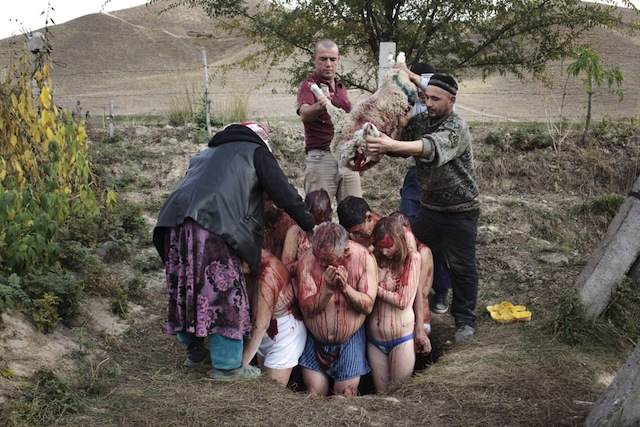
Most blood cult beliefs are superstitious and stupid – think of the ancient desert religions believing that the “blood of the goat” or the “blood of the lamb” would somehow wash away their iniquities and transgressions. They would literally stand in a pit and get washed with the blood of these animals like this (see picture). This still goes on throughout the world today. It’s a staggering thought. Stop and truly contemplate that. There are humans alive on the planet today who still get washed in the blood of the lamb, thinking it somehow does something. They take a lamb, slice open its throat, stand in a pit, and cover themselves in the bodily fluids from the murder. It’s deranged.

As insane as it sounds, the superstitious blood ceremonies of being “washed in the blood of the lamb”, or sometimes goat, still go on in the world today. Source: Reddit.com
It’s so ingrained in people’s subconscious, and goes unexamined, that the practice has even carried over into the analogies used in modern day Christianity here in the United States! Take a look at this famous hymn, called “There Is Power (Wonder Working Power) in the Blood of the Lamb”. This is what they are singing about! The modern American sitting in a pew has absolutely no idea what the meanings behind their beliefs are! It fascinates me and repulses me at the same time.
(As a music major in college, I realize the actual underlying meaning of some of these hymns are horribly macabre, but I still love the tunes. The gospel genre is one of the greatest things to ever come out of the United States.)
To appreciate this connection, you need to hear the music. Listen to the words, then scroll above and look at the image of the blood ceremony. That is what what the origin of the words are. You’re looking at it.
Or how about “Are You Washed in the Blood of the Lamb?” …
Or how about “There is a Fountain (filled with Blood)” …
The key component that makes a blood cult work is the belief that the blood has some sort of power to remove a real or perceived transgression so that the person is able to redeem themselves socially, with fellow men, or eternally, with a supernatural deity. In some cases, blood offers protection from a threat, such as physical harm, or from a malevolent spirit or devil.
Bood sacrifices are still going on all over the world, even today. We’ve already talked about Christianity and Judaism, but the same thing goes on in certain minority strains of Islam (e.g., the Shiite ritual to show mourning for the murder of Husayn, even though such acts of self-abuse are forbidden by the Qur’aan and rightly denounced by mainstream Muslims).
I don’t feel comfortable showing large images of the rituals because they are so horrific, but a quick click on a Google image search will take you to all the imagines you could ever want to see. The most disgusting are the ones where innocent babies are being cut, drenched in their own blood. This is barbaric. The idea that it should be tolerated under the notion of cultural diversity is misguided, harmful, and dangerous. It’s animalistic and primitive. It is a good thing that most mainline Muslims condemn this behavior.

Examples of blood rituals of mourning that still happen in the world today.
5. The Self-Denial Cult
The people who fall into the self-denial cult are so twisted and damaged, they believe that all pleasure, which is one of the motivating goods in the harm principal of morality, is fundamentally evil, suspect, or forbidden. From physical luxuries such as silks, cashmere, and fine linen, to basic necessities such as a comfortable bed or indoor plumbing, the self-denial crowd rejects the things of this world under the subconscious belief that this world is somehow imperfect. In this regard, it is closely related to the death cults, with an eye always on the hereafter, while real pain and suffering is occurring in the here and now.
The irony of the self-denial cult is that self-denial is a virtue, when taken in moderation and not slavishly enforced. Just like too much water can kill a person, too much self-denial can kill the joy in life. Still, self-denial applied solely to the practitioner and not forced on the rest of society, though irrational, is no great harm.
6. The Unknown Object or Process Cult
Whenever an unknown object or process is encountered by a primitive culture, it is often worshipped, considered holy, or demonic. This is especially true when it seems to harness the power of life and death. Early sun cults are an excellent example of this phenomenon. Correctly surmising that sunlight was necessary for plants and animals to survive, and without it, almost all life as we know it would cease, early humans bowed down to the sun, built temples to it, and considered it a deity, going so far as to personify it.
(On a related note, for further study, the best example of an intersection between the unknown object or process cult and the death cult are the Cargo Cults, especially of the Millennialist movement variety.)
Even today, basic scientific concepts are misunderstood by the masses. Several years ago, Bill Nye the Science Guy was boo’d in Waco, Texas at one of his presentations when he was discussing the moon. He pointed out that the moon isn’t actually a light – it produces no light of its own because there is no nuclear activity, heat, friction, or other source of energy, but rather, the moon reflects the sun. That is it. The moon is just a giant ball of dust and rock. It just so happens that sun is so powerful, we can see its light bouncing off the moon.
The people of Waco thought he was being blasphemous and irreverent! Everything he said was factually accurate, yet they were “visibly angry” according to the early Waco newspaper report that has since been pulled (presumably due to embarrassment over the issue). Why? Because Genesis 1:16 says, “God made two great lights – the greater light to govern the day and the lesser light to govern the night. He also made the stars.” Confronted with the sudden realization that the scripture was factually inaccurate after hearing Nye’s presentation on the moon and how it influences our planet – and forced to confront the implications of what that meant given that this audience believed in a literal interpretation of scripture – rage was released on Nye.
This could never have happened if the people were aware of how the sun and moon work. Thus, the cure for this type of cult belief is specific, functional, working knowledge of basic forces such as gravity, light, time, physics, lift, etc.
Side note: The fertility cult is really a sub-set of the unknown process cult, but given its primacy and role in societies over time, deserves to be elevated to the first, and most basic, of all cult beliefs.
7. The Personality Cult
Of all the cult beliefs, the personality cult is the easiest to understand because its development can be explained by evolutionary adaptation. Going back to a primitive society, a weaker villager who worshipped a stronger one would have gained access to food, shelter, reproductive opportunities, and protection. In some cases, the perception of eternal salvation would also be part of the mix of benefits. The most famous personality cult in the world right now is North Korea.
The key weapon against personality cults is a critical thinking education. You should never trust anyone’s word unconditionally, but rather rely upon your own understanding of the facts or, if they are beyond your range of experience or abilities, a consensus from trusted advisors whom have a good track record based upon a rational framework.
The Ethical and Moral Questions That Still Need To Be Answered
Here are the ethical and moral questions that must be considered:
- If a parent insists upon bringing up a child in a belief system that we know to be factually inaccurate, do the human rights favor the the parent’s right to raise their child or the child’s right to an accurate education? We would never permit a parent beating a kid, yet we will allow them to bind their mind, damaging them for life, due to their own stupidity and misunderstandings, sometimes well-intentioned. Germany, for example, has forbidden home schooling due to religious extremists using it as a method to indoctrinate children and ignore scientific facts. Is that an appropriate response?
- If the rights of the child take precedence over the rights of the parent, how can we ensure, as a civilization, that the same irrationality or misinformation isn’t spread through a school system that is now controlled by a group of bureaucrats?
- What is the appropriate social response when in a group of people and a person insists something that is factually inaccurate but based upon one of these seven cult beliefs? I have some extended, non-direct family members who are bordering on fanatical in their insistence that the world is going to end, that President Obama is secretly in league with the anti-Christ, and that the entire world is going to unite its currency (apparently, they have missed the memo on the spectacular failure of the Euro).
- Other than the assault to intelligence, is there any demonstrable harm by allowing people to believe irrational things if it eases their anxiety through a placebo effect? Does having people cover themselves in lambs blood justify attempting to show them the foolishness of their primitive behavior? Is there a moral imperative to act here? Should we just let them be?
- How should society deal with a group that practices one or more of these cult beliefs gaining political power, and attempting to deprive others of their rights?
- How can one attempt to improve the thinking of others when so many of these beliefs are tied to being lower class, having less education, or possessing sub-par cognitive abilities? If a person feels attacked, or that you are judging them, they are not likely to listen even though you are trying to help them live a better life. No one wants to hear they are stupid, even if they know they are stupid. It’s human nature.
- For most people, is the underlying primary motivation simply an attempt to deal with the anxiety of life without meaning or death without purpose?
Reader Comments (36)
Comments are presented chronologically, with replies indented beneath the comments to which they respond.
FratMan
May 20, 2013
Great post. A lot of it made sense to me.
Question: How do you approach charitable giving before reaching financial independence? On one hand, you have Jesus praising the woman who gave a penny (or drachma or whatever it was) because He likely appreciated the fact she was willing to help others and set aside her own self interest. I appreciate that logic.
Yet, when I sit back and think about it philosophically, the conclusion I reach is that I should first get my own house in order and try to make sure that I will never be a charity case, so that I can help others out down the line (by using the money not donated to invest and add a margin of safety to my own household balance sheet so that I could do even more good to help others) while simultaneously decreasing the odds that I will need help from others.
However, I have serious doubts about that conclusion I reach. I don't want to be on the wrong side of God.
I think it was Socrates or someone who said a good litmus test to determine whether behavior is good or not is to ask yourself if you would like it if everyone else acted that way. Since most Americans never reach financial independence, they would not ever give to charity in their lifetimes under my prescription. That doesn't seem settling either. But then again, I've been the exception to the rule in certain areas of my life, so maybe my approach shouldn't be extrapolated to "the average American" like that.
I think you have written before that you always donated x% regardless of your economic situation at the time (if I overstepped my boundaries, feel free to remove what I wrote), and I know it is personal, but I was wondering if you could share your approach to the philosophy side of giving ( i.e. do you break it into the two camps of pre and post financial independence?). Even though I have a general idea about the conclusions you reach, I'm curious about your thought process.
Obviously, we're dealing with different skill sets. When you have a good idea, you can turn a couple thousand dollars into something that would generate the median American's salary within a year or two (I apologize if you can do it faster than that and I'm insulting you). With my skill set, it's more like I could buy 100 shares of BP, Wells Fargo, or 200 shares of General Electric and see if it turns into something 20+ years from now...
But maybe I am thinking too much about the intersection of financial independence and charity, and I shouldn't link them together.
I like the idea of high impact charitable giving (i.e. instead of donating $1000 today, I could donate $100,000 twenty years from now due to wise investment), but then again, it doesn't cause me any hardship to take that approach. I think it's great that Buffett is giving nearly all of it away to charity, but on the other hand, he never has to make the sacrifice of doing with less. Would it be more noble if he donated 99.9% of his assets to charity right now and lived out his final days as a pedestrian millionaire with only $5-$10 million? That would be giving in a way that would cause real personal sacrifice. I guess that is my corollary question: Should donating/giving cause pain or discomfort to the giver?
Adam
May 20, 2013
Replying to FratMan
Hey Fratman. You are a very regular commenter, and make very interested and helpful comments. Just wondering... are you a private investor, too? If yes, you should do a guest post on www.joshuakennon.com sometime.
Harsh Master
May 20, 2013
Replying to FratMan
Fratman, there doesn't seem to be a standard of giving if you're looking at Biblical guidelines. Jesus gave the parable of the talents, which seems like the most direct approval of investing you have. Skip forward a bit, and you see Paul commending the church in Macedonia, for giving generously despite being within poverty (2 Cor. 8).
You made an interesting point regarding high-impact giving - you said you don't sacrifice anything now by going that route. What if you "gave" sacrificially to a retirement account that you would later spend your older years growing and giving away? In that case you are sacrificing the wants you may desire now, while at the same time creating a vehicle that could have a large impact in the future, if you are so blessed to able to see it later in life.
Joshua Kennon
May 20, 2013
Replying to FratMan
For most of my life, I gave away more than 10% of my gross, pre-tax income. However, maybe five or seven years ago, I grew irritated with the irrationality of the approach and analyzed what would result in the best possible outcome by 1.) increasing the amount I could give, 2.) increasing the impact of what I was giving, 3.) reducing the cash drain on my income statement, and 4.) harnessing the tax code to benefit myself in the process.
It might seem like those are conflicting priorities with mutually exclusive ends but I found a way to make it work. My approach involved using the Kennon & Green Foundation. Whenever I have a large gain I want to offset, or whenever the stock market is collapsing, I'll make a gift of cash or securities to the KGF in exchange for a tax write-off. The money then sits in the now-tax sheltered foundation, where I can use it to buy domestic and international blue chip stocks. The capital gains and dividends on these holdings are tax-free. When I find something good, I can distribute a grant from the foundation itself.
This means I :
1. Make gifts when they are most advantageous to me
2. Let the money compound tax-free, holding on during market bottoms and selling as prices appreciate
3. Have the freedom to wait until I find a project I truly believe in and want to help
In the past 24 months, for example, I've given away tens of thousands of dollars but my personal tax filings would only show $500 or so in gifts because back in 2008-2009, I made a large cash donation to the foundation when stocks were collapsing. I let the shares sit there, and now the Dow has doubled, dividend yields are up, and there is a lot more cash waiting to be deployed. I've been making donations through the foundation, using the past principal (and now capital gains and dividends). I gave less than I needed to, I lowered my own taxes, the foundation generated investment profits to become self-funding within, and the ultimate beneficiaries got more cash than they would. It's a win / win / win.
As for the question of pain: You have to decide what the purpose of your giving is.
Specifically: Are you giving to help others, and minimize human suffering, or are you giving to make yourself feel better and somehow attain holiness?
If the answer is the former, you should maximize the amount of net positive benefit you can. That might mean giving now, it might mean compounding for the future. It depends on the circumstances, but compounding is going to win most of the time. On the other hand, if you want to feel good about yourself, or feel as if you are depriving yourself, giving as much as you can now is the way to go.
In other words, is it about you, the giver, or is it about them, the people or cause you are trying to help? You are the only one who can answer that question.
For me, it's not a hard choice.
Charitable giving has been a source of some ... contention ... within my own family in the past. An example: I tried to convince my poorer relatives to setup a Charitable Remainder Trust that would benefit the ministry of their choice, while naming some of our older relatives as the beneficiaries until their death. That way, they would still be able to give 10% to the church, get a tax write-off, the ministry would get the money at some point, but it would help our older relatives get a pension-like check every month to help them pay their bills. Like Jesus with loaves and fishes, it multiplies the impact of the giving. We help the church, we help the poor, we help our own elders, and we still get to lower our taxes. What's not to love?
The conversation went something like this:
Them: "That's not what tithing is. I'm supposed to give it to the preacher."
Me: "No, you're supposed to give it to ministry in general and every third year, give to the widows and the orphans. However, leaving aside that we don't have a Levitical priesthood anymore, there are some significant questions as to whether or not it is even applicable in this day and age. It seems patently ridiculous to assert that the old Levitical codes on food prohibitions or crop plantings don't count today but the demand to fund the priesthood does. Nevertheless, the church can still get the money, we just structure it a bit differently and we can dramatically increase who benefits from it, while helping our own family. Honoring your elders is also a commandment."
Them: Are you sure you just don't care about money?
Me: I give more, both absolutely and as a percentage, than you ever have or will. The better I do, the more society gets.
Them: I don't care how the church uses it. God just says I'm supposed to give it. They could buy a private jet for all I care.
Me: That's immoral. You are supposed to "give an account of thy stewardship". Those who didn't are called "wicked" by Jesus Christ in the parable of the talents. How can you be so naive about scripture, yet slavishly adhere to what you are being told you should do with your money?
Them: That's different. If I have faith and don't ask questions, God will bless me. This is what God wants me to do. I know it. I can feel it.
Me: God will never tell you to do anything stupid and this is beyond stupid. This is idiotic.
Them: You're wrong. I don't know why you have to be so intelligent. I think it's leading you away from God. You shouldn't read so much. It's dangerous.
Me: ...
Me: ... I'm going to let that one go and stay on topic. So you'll give your very limited resources to help someone with a $100 million ministry buy another jet that they don't need, instead of giving it to that same ministry over time so they can still get the jet (which I think is an utterly stupid use of funds when you have people getting kicked out their homes here in your own town, whom you could help buy groceries, school supplies, whatever), while simultaneously providing income that can help your elderly relatives survive and not worry about affording groceries, and yet you won't do it because that will mean God won't make you rich? That is what this about, right? You think God will make you rich?
Them: Yes. That's what God wants. He will make me rich. He wants me to be rich. And the only way to get rich is to give all of your money to Him, which means the church.
Me: It is righteous and just that you are poor. It makes me feel good about the world we live in because this kind of irrationality gets what it deserves. Talking to you all reminds me of Genesis 8:22, "As long as the earth remains, seedtime and harvest, cold and heat, summer and winter, day and night will never cease." You have no seed. You have nothing planted. You abort and rip up every tree you put in the ground, then wonder why you don't have fruit come autumn.
Them: Whatever, you just don't get it. Don't you want to be rich?
Me: I AM RICH! You have no savings, live in a rented apartment, owe credit card debt, student loan debt, and car debt, and have blown through your investments. Do you really not get the disconnect here? How absurd this conversation is? Do you not understand that I am trying to help you because you are being deceived?
Them: You could be richer. You just need to listen to us.
I gave up.
FratMan
May 20, 2013
Replying to Joshua Kennon
Adam, haha sure, I'm a private investor. However, compared to Joshua, I'm a flickering candle next to his megawatt
lightbulb. I'm not entirely sure there is anything I know that Joshua does not. Maybe there are some meaningless anecdotes I know that he does not (i.e. whenever Ty Cobb would get mad at his wife, kids, people around him, etc., his coping mechanism was to call his broker and buy more Coca-Cola stock). But in terms of anything meaningful, I doubt I have anything to add.
Harsh Master, I like your train of thought. You mentioned: "What if you "gave" sacrificially to a retirement account that you would later spend your older years growing and giving away?" The problem is that I would still have access to it. When I give something away, it's gone. Poof. I cannot claim it. If I gave "sacrificially" to an account and needed the money later in life (to pay bills, send children to school, whatever), I guarantee you I would raid that account. Is it really charity if I know I would later use the money in case my life's financial journey fell substantially short of expectations?
Joshua, you wrote one line I could really relate to: "So you'll give your very limited resources to help someone with a $100 million ministry buy another jet that they don't need, instead of giving it to that same ministry over time so they can still get the jet (which I think is an utterly stupid use of funds when you have people getting kicked out their homes here in your own town, whom you could help buy groceries, school supplies, whatever)." When I was little, my dad decided to stop giving to our Catholic parish. He inquired into how the money was being allocated, and he was regarded suspiciously "for asking too many questions" and was regarded as an enemy fairly quickly.
Later on, I learned how hard that was on my dad. He stopped giving to the Catholic Church altogether (except to the basket on Easter and Christmas, I believe) and instead, he would take me to the local McDonalds as a kid, hand the cashier $100, and say that it should cover the next $100 worth of orders, and instructed the cashier to not mention the person doing the donating. Then, he would take me to the back of the restaurant, and we'd "people watch" as people got their free meals. My dad liked that kind of charity because it has a 100% effective rate, and although he did not phrase it this way, it generated some utility for him to see the unexpected happiness it brought to others. Was it life changing charity? No, but it's the kind of thing that can "make someone's day." My dad's approach leaves an impression on me to this day.
You mentioned: "You're wrong. I don't know why you have to be so intelligent. I think it's leading you away from God. You shouldn't read so much. It's dangerous." Although I am not as intelligent as you, I have gotten the same thing, often being told "I think about things too much." If there is any truth to that, I prefer it vastly to the alternative.
Ian Francis
May 20, 2013
Replying to Joshua Kennon
You are arguing logic with illogical people. There is this notion in your brain (and the brains of most people who live based on logic) that if you just make your point clear enough, provide enough evidence, people will become aware of their illogical ways and change. As much as I want people to be made aware of logic and reason, I think many people are beyond hope. Putting in the effort to argue your point with the illogical is a waste of your time that could be better spent on other endeavors. Obviously family is another matter, but there has to be a point where you say, "I tried, I failed, it is their life, they can live it how they want." This is of course complicated when there are children involved, who are getting harmed by their parent's actions, but you are only one man. You can only do so much.
Gilvus
May 20, 2013
Replying to Ian Francis
I share this cynicism.
Joshua Kennon
May 21, 2013
Replying to Ian Francis
You're right. Somewhere, in the back of my mind, rationality is so difficult to ignore that I can't accept that some people simply do not have the capacity to appreciate it. Yet, even if the failure rate is 90%, it's a moral cause because it leads to better outcomes so I still must try. Some things in life are difficult. That makes it interesting.
In a perfect world, I want to be all like ... "Facts" + POW! "Logic" + BAM! ... *whisper* science ... raise an eyebrow, put on my glasses, and blow their mind. Then make my getaway just like this ...
Ian Francis
May 21, 2013
Replying to Joshua Kennon
On a different topic: how'd you get the animated GIF in your post? I tried and it looked fine while writing it, but when I posted it, the pic was gone.
Joshua Kennon
May 21, 2013
Replying to Ian Francis
It doesn't seem to work if you attach the file, or if you simply put in the URL. However, if you surround text with an 'a href' html instruction, it seems to insert the image and animate it. You often have to submit the comment, and then refresh the page to see whatever everyone else does. (I laughed out loud when I clicked this gif you left earlier about Bill Nye.)
Ian Francis
May 21, 2013
Replying to Joshua Kennon
Thanks
Odai
May 21, 2013
Replying to Joshua Kennon
There's something I've noticed when discussing religion, but it can apply to any deeply held belief about the way that the world works. There's probably a name for it (cognitive dissonance refusal?), but I don't know what it is.
We all have an internal model of the way the world works. This model helps us quickly make the hundreds of decisions we must make every day. We wear a seat belt, brush our teeth, and stop at red lights because our worldview says we should, not because we've carefully considered the pros and cons of each option.
We need our worldview. So when somebody comes along and completely shatters what we think is true, no matter how correct they are, we simply refuse to believe it. Our minds go into a sort-of defensive, "no new ideas" mode until we feel the danger has passed.
It would be akin to dropping an English-only Californian into a Chinese town, no money, and expecting him to continue functioning. He couldn't do it. But, he could do it if he was slowly introduced to the lifestyle, given a chance to adjust and learn bit-by-bit - and that's the same way we change our worldview.
An example would be when I went from believing that morality came only from a literal interpretation of religious texts, to believing that morality can (and should) be derived through reason and empathy. When I first encountered the idea online, I saw it as amoral and blasphemous, but as I considered the idea over the following months, I slowly began to see the wisdom in it. I was like a kid slowly inching into a cold pool.
For your relatives to ever accept your ideas on charity (and finances in general), they need time to adjust and accept. Gently explain what you believe and why, without saying that their beliefs are wrong (this often causes the brain to go into "defense mode"). With any luck, they'll begin to question their own ideas, and that's when you can break out the facts and figures to really convince them.
Joshua Kennon
May 23, 2013
Replying to Odai
Excellent points. Your journey sounds a lot like my own.
Joe Pierson
May 22, 2013
Replying to Joshua Kennon
On the topic of debating/influencing people I’m guided by this quote
“the opinions and belief of men depend not on their own will, but follow involuntarily the evidence proposed to their minds;” Thomas Jefferson
What Jefferson is saying is our beliefs and conclusions are not really our choice; they emerged from the evidence presented to us. A brilliant genus only exposed to left wing evidence will be a left wing nut (same with right wing). A US native who is fundamental Christian if born in Iraq would most likely have been a fundamental Muslim due only to the different evidence presented to him. Jefferson’s comment is a fundamental truth, at least for the majority of people (of course everyone is going to exempt themselves, but that is another topic).
So to have a chance at influencing someone you must first determine the amount of evidence the person has been exposed too and therefore how much counter evidence is needed to override it. Personally I discreetly vet someone out first, is their evidence balanced? This will determine if I am going to have a real debate with a winner and loser, or just some meaningless sparring where everyone rigidly maintains their status quo. It saves me a lot of frustration.
Odai
May 23, 2013
Replying to Joe Pierson
You make a good point. I've wondered in the past why religion is considered a protected class akin to race, when it's a matter of choice rather than birth. But for most people, religious belief is a matter of birth and is deeply tied to their ethnicity as well.
An interesting corollary - do we have a protected right to our opinion in other matters? I know one of Joshua's recent posts addressed this, but that was a strictly legal interpretation, not ethical.
What moral obligation do we have to help others see their own mistakes? What if their erroneous belief makes them happy? I've met with the problem of unintentionally making someone feel stupid by disproving too many of their ideas - I usually back off to spare their feelings, but am I doing them a disservice? These questions will be the subject of my next caffeine-fueled pondering, I'm sure.
Phyllis
May 20, 2013
It's a good list, but what about honor cults?
Joshua Kennon
May 20, 2013
Replying to Phyllis
Do you have any historic examples in mind?
Joe Pierson
May 20, 2013
A friend of mine once commented that the ideal future culture is where all cults are freely available for anyone to practice, without constraint or persecution, and everyone is an Atheist.
Joshua Kennon
May 20, 2013
Replying to Joe Pierson
That's funny; and clever.
The difference in human behavior under stressed conditions is one of the biggest lessons people can learn; I think it's up there with compounding. A great example I've been meaning to write about on the site for 2 or 3 years now: The National Academy of Sciences examined the difference in behavior of men on two sinking ships - one, the RMS Titanic, which took hours to sink, and another, the RMS Lusitania, which took 18 minutes to sink.
When they had time to stop, reflect, and think, the men of the Titanic aided people into lifeboats, the elderly, infirm, and children were permitted to board first, and men were expected to wait, if they were permitted to board at all. In contrast, when the Lusitania sank, panic set in and men used their natural athletic and speed advantages to race to the boats, untie them, throw people out of the way, including women and children, and cast off into the ocean. In the study, the conclusion was that short, stressed time periods lead to the survival instincts of the brain to kick in and save yourself at all costs.
Does Lord of the Flies support that conclusion? Maybe. Isn't the bigger point that the characters were children and, thus, had not yet had the benefit of a comprehensive, rational education? Sure, the process had begun, but they were still malleable. That is one of the things that makes the allegory so terrifying - we are always one generation away from losing all social evolution and progress that has been achieved through civilization advancements over thousands of years. We are always one generation away from reverting the savages we once were.
For me, that's one of the big horrors constantly lurking in the background if humanity isn't careful. The most potent example of how quickly it could come is the German Außerordentliche Befriedungsaktion. In order to crush Poland during World War II, the German government systematically executed the intellectuals, academics, artists, priests, judges, politicians, and the upper class (those who had a good education and / or broad exposure to the world) with the sole purpose of changing the school system so that, within 12 to 18 years, all Polish children would be taught that they were subservient to the master German race, limiting education to basic reading and writing skills.
Joe Pierson
May 20, 2013
Replying to Joshua Kennon
The point of the Lord of Flies was 1) children become savages when they try to govern themselves, 2) the disgusted British Naval Officer (supposedly the most civilized culture in the world) who saves the British children at the end is completely unaware of his savagery in the ongoing adult war caused by the inability of the adults to govern themselves.
Basically we have the same brain as cavemen had 100,000 years ago, so it's not surprising we degrade so quickly.
Joshua Kennon
May 21, 2013
Replying to Joe Pierson
Sometimes I think we are headed for Wall-E. Once everyone has stopped walking and begun using mobility scooters, we'll just release the next version - new and improved with underwater action.
Ian Francis
May 20, 2013
When I read the part about the people of Waco, TX reacting to Bill Nye, this was my reaction:
http://gendertrender.files.wordpress.com/2013/01/943451_o.gif
Surprisingly, there are even people who are otherwise intelligent, rational people, who have illogical ideas lodged in their head, simply because they either don't have a good grasp of the topic, or they learned something as a child that they have never bothered to go back and rethink.
Specifically, there is a member of my family I was talking to a number of years ago about an upcoming lunar eclipse. I was forced to explain that there is a difference between the normal lunar cycle (waxing/waning) and a lunar eclipse. They thought the lunar cycle was caused by the Earth's shadow being cast over the moon, not that we were observing part of the dark/light sides of the moon because of our relative position to the sun and moon. When you really think about it, it is obvious that the Earth's shadow cannot be constantly cast over the moon, save for once every 28 days. However, this rational, intelligent person thought a lunar eclipse and the lunar cycle were the same thing.
We are all capable of being illogical. It is a matter of being persistent in your quest for knowledge, and never taking something you were told, especially when you were a child, at face value.
Joy Host
May 20, 2013
While I understand that it is based on the archaic Jewish practice of sacrificing animals at the temple--a blood cult--my understanding of the gospel music and the songs you mentioned is that they refer to the sacrifice of Christ, which according to evangelical Christianity, does not refer to the glorious wonder of bathing in the blood of an actual lamb. Rather, it refers figuratively to the belief of Christ's death as able to cleanse one from sin, since they believe he chose to die and that his death, since he was perfect, "paid" the figurative debt of sin put forth in that religion. It still places it under the umbrella of a blood cult, but does alter the meaning of the words as you presented them, for what it's worth.
Saurav Jalan
May 21, 2013
Dear Joshua,
This is Saurav from India. Although, you might have read many books on varied subjects but there is one book which I would like to suggest you, which can answer all the questions which you have in your mind till now, in as much depth as your intellect can absorb.
This book is based on the principle of universal religion irrespective of any race, origin, colour, creed etc. That universal religion is the religion of the soul which is applicable to all living entities and is eternal. All the other religions, beliefs or philosophies which the world have witnessed from time to time have developed according to time, circumstances, capacity of the subjects to absorb it etc... Many of such cults, beliefs, philosophies have been propagated by people who lacked true spiritual knowledge and were ignorant.
I am 100% sure that if you read this book with an open mind, sincerity, clarity of thought, humility and depth many of your questions will be answered. Still, one requires a guidance and blessings of a Teacher or a Spiritual Guru to absorb this text fully.
The name of the great text is " Bhagavad Gita As it is by Srila Prabhupada ". You can purchase the book from any Hare Krsna temple in the United States or can order online also. The link of the website is http://www.asitis.com/. The online version is also there in this website but I would suggest you to get a physical copy.
This "Ocean of Wisdom" has helped everyone who have approached it with sincerity and I am sure it would open a whole new world to your thought process about life. This is not a Hindu text as many ignorant persons might tell you. This book is eternal and universal applicable to every soul right from an ant to the inhabitants of Heavenly Planets. It is based on Sanatan Dharma which is as relevant to a Christian in the United States as to a Hindu in India.
Your concerns and questions about charity, moral conduct, rationality, human behaviour, intelligence, knowledge, wisdom, ignorance, types of living entities, types of food, various types of belief systems, universe, destiny, free will, pleasure, sorrow, happiness, attachment, detachment, wealth, renunciation, liberation, bondage, duty, concern, sins, pious deeds everything is there in this "Great Text".
Considering you are a voracious reader I don't know whether you have already read it or not, but if you have read it and have understood it in some depth, then you would present your thoughts in a totally different way from what you have presented in the above article.
Good luck and God bless.
Saurav Jalan
India
Joshua Kennon
May 21, 2013
You're correct. It went without saying.
(See disclaimer - this was my own personal memo; having grown up in the Bible belt, a devout member of extremely conservative churches during my youth - Southern Baptist on one side, evangelical in my direct line, and Pentecostal / Assemblies of God / Kingdom something-or-other on the other, and at one point even attending a conservative religious private school, that wouldn't have been a distinction I needed to make for myself, which is why I didn't sidetrack into the nature of the belief. That's why I tried to head a lot of it off with the opening sentences in italics. Had this been a piece for the blog, I would have broken it up into 6 or 7 different posts, each getting much simpler treatment.)
What is interesting is that the allegory is still used in art and music. There is still an underlying belief that the blood is somehow necessary; it has just been shifted, through cultural evolution from the animal to a representation of the animal as people became less comfortable slaughtering sheep.
scott
May 21, 2013
Joshua,
I always appreciate reading your articles, however responding to them is somewhat time consuming:), my time is worth more than responding to online posts but I felt the urge to say a few things. I disagree somewhat with your blanket brush that you can put everyone into a box and summarize their entire belief system. A cult by definition is a
religion devoted to a certain figure or object, it is totally plausible to have certain beliefs that align with a cult and yet they cannot be defined as a cult
because of a devotion to another. Equating songs about the blood of the lamb, which is symbolic to the death of Christ too modern acts of physically pouring blood on themselves is trite at best on malicious at worst. Systematically painting the extremes of a cult and then backhandedly tying modern Christians to them is as incorrect as
saying that all rape of young boys are done by gay males and so gay males are the problem.
In your titled Death Cult, I do find some irony in the fact that you can mock those who say the world will someday end, when we are surround by death and every day we live is one day closer to our demise. In my mind those who try to predict the exact hour and day are complete morons and deserve the chastisement that they receive. The Bible speaks
vividly of the end times coming as a thief in the night…except for bob he saw this one coming for years. Does anyone know much about their great-great-great grandfather… the one that left you the trust fund. Not hardly, and yet there is still a desire among people to have relevance and have a legacy and be remembered. Reality check is… three
generations from now almost no one will know anything about you or who you were. The desire to live for something greater than this world and this life is natural.
In your titled Prosperity Cult, I have more commonality with you. The Health and Wealth Gospel is a bastardization of the Gospel and is the devils way of taking the focus off of God and the work of Jesus Christ and making it entirely
man centered. The entire gospel points too and is the coming, crucifixion and substitution of Christ. The Bible is rife with examples of the struggles of the Christian life 2 Tim. 3:12 states that “In fact, everyone who wants to live a godly life in Christ Jesus will be persecuted, 13 while evildoers and impostors will go from bad to worse, deceiving and being deceived.” The entirety of psalm 73 speaks of the prosperity of the wicked and the struggles through life of the unbeliever. It is in trials and suffering that the Christian experiences a closeness and oneness with God. I believe that the Lord has sent the Holy Spirit to help Christians make
wise choices and giving a substantial portion of your personal well is not be a good steward of your money. Again I don’t think Biblical charity is a salvation issue that has equal weight to the Ten
Commandments. The giving of money should
be an act of thankfulness for the grace of God bestowed on us.
In your blood cult I can only speak to how the death of Jesus Christ is a propitiation of God’s wrath on us as mankind. This death has given us an opportunity for salvation and the sacrificing of animals was merely a representation and a symbol done in Old Testament times, the reality that this still continues is incredibly sad. From your pictures of tasty burgers and steaks I found it interesting that you used the term murder when describing the death of an animal.
I would like to submit a couple additional cults to you, the first being the cult of pleasure (please pardon any video game references). Like
anything in life when an individual has reasoned and explained away God and the need to follow a set of morals, the gods of pleasure are the natural
culmination. Once achieved this gives the individual carte blanche to do whatever feels good and taken to the extreme has no desire to the physical and emotional well being of those around them. The cult of pleasure is the foundation of those who elevate self above all else. An investigation into the Greco-Roman era reveals what happens when all morals and God are thrown out the window. Society had gotten to a place where unless you were roman you could potentially be taken as a prostitute or sex
slave. Boys and girls as young as 12 were forced into the roles of prostitutes. When the pendulum of pleasure which starts to move under the guise of
subjective tolerance (we tolerant everything except your ability to disagree with us) will culminate into a culture that doesn’t care for the well being of
others and believes everyone’s purpose in this life is to accommodate my pleasure. The cult of pleasure results in a culture that continually falls away
from morals and ends up imploding on itself.
I do agree that some Christians take extreme positions and are naïve at best. It is interesting to note however that the scientific community which by
definition abhors faith in the unseen or unproven, can agree that evolution is a fact when the odds of cells and dna aligning to form life are worse than, the
very room you sit in having all oxygen molecules fly to one corner, and you die from asphyxiation. The odds are also great that you loaded a c-130 up with nails paint, lumber and kicked the entire contents out at 60,000 feet and you would end up with a perfectly built house on Main Street.
Again I appreciate the discussion and I had a couple questions for you Joshua, Do you believe there is a God? If so do your actions in this life have any relevance to God?
Joshua Kennon
May 21, 2013
Replying to scott
For some reason your comment was filled with random line breaks, sometimes putting one word on a single paragraph, so I edited it remove them and make it readable. (I did not change or modify any of the content; it still should read exactly as you wrote it.)
I worried people would read too much into this. I'm working on another essay right now about the hierarchal system and efficiency of honey bees, but it isn't ready. I should have just waited and released it, instead.
The phrase "cult" is a loaded term. Since this was an internal working document not meant for public consumption, I was using Merriam-Webster definition 5, sub-definition "A": "Great devotion to a person, idea, object, movement, or work (as a film or book)." Those seven central ideas continually manifest throughout time, with very few changes and, thus, fit within that category. It was a technicality I never would have used had I been writing content for the blog for the purpose of public consumption.
Again, since this was originally an internal working document that was released solely to show process, not specifics, it is going to be extremely easy to misinterpret or take out of context. I was tying it to what I saw around me in the world today in a way that connected the string of history together to illustrate that we, in the modern world, are no exception. We still behave exactly like our ancestors in many regards. It was a mechanism to remove bias, and my own upbringing. Given that I live in the Midwest in 2013, that means Christianity, Judaism, and Islam are the most relatable examples and received a disproportionate amount of the attention. None of those three are exceptional in this; I could have just as easily referenced the Cult of Apis in Ancient Egypt, the worshipers of Santeri or Orisa, the ancient Aztecs, or the Minoan societies.
To try and extrapolate my own religious beliefs, my feeling towards any particular religion, or my thoughts on the role of religion in society would be impossible. To think that there was any misunderstanding, or even worse, malice, in referencing the modern manifestation in the redemption power of blood to old hymns, for example, would be inaccurate. (In fact, I've spent the past day going around singing "There Is Power (Wonder Working Power in the Blood of the Lamb)" since posting this as it was one of my favorite songs growing up in church.
That's what I meant when I said people shouldn't read into what was written, nor even really focus on the content as it was, and remains, a working essay that is subject to change until I feel I've identified the few "big themes" that run through belief systems regardless of continent, race, or millennia.
As to the personal questions, I'll answer them directly by sending you an email. I try to focus more on ideas and concepts, rather than myself, when discussing religion, politics, or philosophy as I want people to come to their own conclusions rather than look to me and influence their thought process by triggering the mere association mental model.
FratMan
May 21, 2013
Joshua, most of your writings point to free will and the short-sighted/ignorant exercise of it as the primary culprit of bad consequences. That makes me wonder: Do you believe in the existence of anything akin to the devil or a nefarious force of that nature?
Joshua Kennon
May 23, 2013
Replying to FratMan
I think virtually all major evils throughout all of human history have been perpetuated by human choice and human nature. It does not take a devil, demon, or spirit to get one man to hack off another man's head in the middle of a busy street. Humans have an innate capacity to do harm, just as we have an innate capacity to show empathy and do good. What makes us human is how we deal with those choices. What makes us moral is choosing the good.
The interesting part is, even in the scriptural traditions of Christianity, Judaism, and Islam, the character of Satan himself had no power except to the extent that he could convince humans to do evil with their free will. (The only exception is a man named Job. In his story, the oldest in the Bible, the entity humanity refers to as the devil had to ask God's permission to harm Job and his family for the sake of what amounted to a cosmic bet. After God agreed, Satan used a tornado to kill 10 people.)*
As for the existence of a specific entity that embodies evil, here's is a thought experiment that occurred to me several years ago that still sits among my working pile: "Wouldn't anything of a sufficient power differential be imperceptibly synonymous with what humanity considers a god or the devil, the distinction depending upon whether the actions of the entity were benevolent or malevolent?" I then followed that up later, after studying multi-verse theory, with a sub-question: "Will humanity change the language if multi-verse theory is ever proven correct?".
Throughout history, the word "supernatural" was simply used to describe something for which we lacked an explanation. The idea of man flying in a metal box weighing several tons would have been considered magic only a couple of centuries ago. Today, we shrug our shoulders and say, "The law of lift can exceed the force of gravity under the right conditions." Hence, no one tries to perform an exorcism on a Boeing 747 because we understand it.
To better understand this point, let's use a hypothetical to illustrate the concept and make the question clearer. Imagine the current evidence for multi-verse theory in physics turns out to be true. We are here, in this universe, but there are also parallel universes running side by side with us. In one of them, you are a law student. In another, you are a doctor. In another, you died in childhood. In another, you became an airline pilot. In one you are a billionaire executive. You have different spouses in each. You die different deaths in each. Over there, you are serving a life prison sentence for a hit and run. In one, you are even a renowned, singing, dancing, mad scientist living in a castle as you do genetics research and insist upon some unconventional wardrobe choices.
Now imagine in one of these parallel universes, or, perhaps, in one of the 12+ dimensions we now know exists on top of the 4 dimensions in which we reside, there is a race of sentient beings who are violent, destructive, and cruel. They are also technologically advanced. If they were to find a way to cross over, or short of that, project, into our universe, wouldn't their very existence be considered demonic? How would they appear to us? Ghosts? Aliens? UFOs? Evil spirits? We can't seem to figure out how to kill them. They want to harm us. They have "powers" we can't explain. If this happened in the past, wouldn't our ancestors have written about them, warned about them, and put in place procedures to protect against them, even if such wards of protection were merely superstitious due to the action bias mental model?
Imagine you are an American Indian on the Midwestern plains. Suddenly, you are confronted with this, at which point the figure begins to resemble a skull face beginning around the 3:05 mark and later. Of course you are going to think it is supernatural. You have no basis of reference for something this powerful. You have no defense against it. You have no way to halting its advance, nor understand its causes. You do whatever you can to try and battle or appease the spirit, and if you survive, you think it somehow had something to do with stopping it. If you actually made it inside such a thing and survived, your conviction would only be deepened.
--------------------
* Footnote 1: One could argue another exception is found in the four gospels, which includes many references to "evil spirits". The conditions for which these "spirits" were blamed are now so laughably absurd that modern Bible translators finally gave in and changed the text a few years ago - for example, the child in the New Testament that would foam at the mouth, convulse, et cetera - was clearly an epileptic, not demon possessed as the original scripture said. The ancient Israelites had no idea what the brain did, or what epilepsy was. Pick up a Bible today and the scriptures talk about Christ healing "epilepsy" - which of course, did not exist in these people's world and is a modern concept - in Matthew 17:14-20, Matthew 4:24, and Luke 9:42. Go back a couple of decades and find a Bible from 1940, 1950 and it isn't mentioned because the original scroll had nothing about epilepsy in it - how could it? They didn't know what it was! The publishing and translation industry is a business. It is constantly modifying passages to fit with what we know about the world by tweaking here and there.
FG
May 22, 2013
"The biggest weakness of fertility cults is the rise of modern
reproductive science. We now know that a human is conceived when sperm
and egg merge to begin a chemical process that begets life. We now can
do this in a laboratory and then implant the embryo in a uterus to carry
to term. Fertility cults are acts of desperation for those who have no
other mechanism to have a child and, because of a mental model called
action bias, feel as if they need to do something to remedy the
situation. They offer hope."
Just a quibble, but embryos are transferred not implanted; science has no way of making an embryo implant in the uterine lining; that is still up to pure chance. During IVF, the embryo is transferred and implantation takes place if you're lucky... and IVF, while greatly improving the odds in many cases, is still not a completely successful process. (saying this as someone that has been through the process without success)
David Tolman
May 22, 2013
Such interesting ideas here.
I have a question that I've been chewing on lately, and I suppose I better turn it loose: As a person becomes more critically oriented, and shrugs off elements of irrationality that they've carried with them, they (generally) will begin to see flaws in their religion. I wonder, if they do enough of this, does God "die"? Or in other words, can a rational person still believe in deity? Or do we simply have so much evidence to the contrary that belief in God becomes apparently irrational? It is kind of a sad thought. I think the concept of life after death is beautiful and perhaps a little bit of me would die inside if I arrived at a place where I fully understood that God is an abstraction and tradition. I love the idea of being able to associate with loved ones in the "beyond". 80-100 years seems a relatively short amount of time to keep these associations which bring so much joy. Ideally, I would like to arrive at a place where I can be intellectually honest with myself and still fully believe in some of the concepts of resurrection/eternal life and whatnot.
I realize that these concepts aren't necessarily universal. Meaning, my definition of God and afterlife is pretty limited to a certain brand of Christianity. But without getting too picky, I wonder if there are any others who hope this same thing and more importantly, see it as being possible? Is belief in something greater irrational?
Joe Pierson
May 22, 2013
Replying to David Tolman
I would so no. Rationally turns religions into mythology. Religious faith dies. But God doesn't. Rational logic doesn't prove or disprove God, just religions. If God dropped out of the sky tomorrow, science wouldn't fold their arms together in defiance and say, nope, you still don't exist, they would say, where you been all this time?
Joshua Kennon
May 23, 2013
Replying to David Tolman
I just sat down at my desk with a cup of honey-infused Irish Breakfast Tea, and saw your question. This may come off as rambling; I'm going to think out loud on my break and just write down what occurs to me as it does ... as if you were sitting across from me right now and I were working through the problem on my own, off the cuff ...
Rationality is based upon evidence and logic. As commentator Joe Pierson mentioned in this thread, if God were to drop "out of the sky tomorrow", scientists and rationalists would not disbelieve. That is the hallmark of rationality! You immediately adjust your working parameters for the best information you have using logic, deduction, and reasoning to understand the world free from your own bias. As Richard Dawkins said, his first question would be, "Which one are you?". That would certainly be fair as humans have believed in somewhere between 5,000 and 6,000 gods over the course of history.
Were such an event to occur, the biggest question for me, logically, would be, "How can we be certain that you are, in fact, "God" in the sense that man traditionally thinks of God, and not simply an entity with a power differential so vast that we, as humans, cannot make the distinction?". In other words, is Dr. Who going to show up and warn us that you are really an inter-dimensional time beast about to snack on our planet as you lull us into a false sense of security?
While there is considerable, overwhelming evidence that many of the world's primitive cultures created complex mythologies, now evolved into religions, that can be easily disproven as false based on even elementary knowledge of science, physics, biology, chemistry, et cetera, there is nothing in the scientific evidence at present that conclusively disproves, or precludes the possibility of, the existence of God. It would be arrogant to state, as fact, "There is no God". One could, however, state, "There is no irrefutable evidence for God, such as there is for gravity, therefore I choose to proceed as if there were no God until I encounter sufficient data to support a claim to the contrary." Nuanced? Yes. Irrational? Not necessarily, unless you think Pascal's risk/reward trade-off was the right idea based on self-preservation.
To give an example of a potential scientific explanation for the theoretical existence of God, take the theory extrapolated in the paper Constraints on the Universe as a Numerical Simulation turns out to be true (the link will take you the abstract at Cornell University's library; click on "PDF" near the right side of the screen to download the entire document), then this universe is actually a grand computer simulation. (You can read a layman's explanation of what the math means to get the thirty-second overview.)
A simulation, by its very definition, exists in an alternate reality and had to be created by someone or something. A simulation exists as a model to study something. This would certainly, in my opinion, skew the evidence highly in favor of what would be, from the perspective of man, a supreme creator running the system with the ability to intervene and modify our consciousness. In such a system, everything from evolution to abiogenesis would be part of the source code executing, therefore still not negating the existence of a creator. In such a system, we would never be capable of understanding his form, true nature, or source of power. He would be omnipotent with the capability of changing the source code at whim. For all we know, "He" could really be a 3-mile wide blob of genderless, purple, strawberry-flavored jelly playing what amounts to his version of "The Sims". The notable absence of supernatural manifestations over the past couple thousand years could be because he's away at university.
This is not a pie-in-the-sky scenario as we may soon find ourselves on the other end of the table. There has been considerable discussion in some areas of science and human rights disciplines about the possibility of artificial intelligence, when it arises, being given all the legal rights humans are entitled to right now. Otherwise, you could have a teenager program an artificial universe on his personal computer, and then torture, destroy, and obliterate the inhabitants solely for his sick, twisted pleasure. Those inhabitants, even though digital, would be suffering with the same self-awareness and pain that one would have if they were subjected to it here in the physical world. What protections can we put in place to forbid that kind of tyranny? It is, to borrow a phrase, a brave new world. This is no longer future science fiction, we will see it within a generation or three.
Right now, the existence of a creator requires faith. Faith may seem irrational on its own, but it can be rational in that it drives humanity to discover things. It took faith to dare to believe the world was not flat, and that one would not sail off the end of it. Had it not been for that faith, which turned out to be backed up by fact, none of us would be here in North America now as the entire course of history would have been changed. We currently cannot explain abiogenesis, so insisting that one of the theories is absolutely correct requires faith.
That's what makes science great - it keeps going until faith is no longer necessary; there are simply facts. Some people mistakenly think rationalists are anti-God. They are not. They are pro-evidence.
(I'll send you a more personal message that is not so abstractly philosophical, if you write me a short note in the contact form with your email address so I can respond.)
Joshua Kennon
May 22, 2013
Great point! Thanks for that note.
Caleb
September 27, 2013
Is faith illogical?
Joshua Kennon
September 27, 2013
Replying to Caleb
It's a bit of a nuanced question because faith has multiple definitions. Life requires faith. It took faith for Christopher Columbus to sail off into the sunset without thinking he was going to fall off the end of the world. It took faith for Milton Hershey to start his business, which after six years, failed, only to turn around and try again, ultimately creating one of the world's biggest chocolate empires. The entire global banking system is built on faith that other people will behave how they should and that institutions will be protected in the event of a catastrophe. Without faith, civilization and progress could not exist. Without faith, humanity can't have people like Einstein, Edison, Tesla, Ford, or Disney.
On the other hand, if you are going to assert that sprinkling yourself with pigeon's blood or reading tea leaves is going to cure a certain disease because your parents were told by their parents who were told by their parents that a supernatural deity or prophet said so, and there is no difference in the actual cure rate of people subjected to your "treatment", then, yes, I would consider it highly illogical, and, in many cases, actively harmful. This is not faith, though it may have the veneer of it. Rather, it is mindless superstition that lowers man to an animal and strips him of his crowning glory.
If you are using faith as a synonym for theism, the belief in a supernatural creator, I've purposely avoided addressing that in most cases, so I'll politely say that is something that you need to answer for yourself.
I will add a few general thoughts without tipping my own, personal hand: From a purely rational perspective, I would not necessarily consider it illogical as there seems to be at least a modest probability from the current scientific consensus that this universe is merely a simulation, which would require, by definition, an external developer or assembler. (For example, were I to create a virtual world, coding it myself, and then the people inside of it develop sentience, they would be fundamentally incapable of understanding who I was, or how I did the things I did, as I existed external of the program itself. Me writing an upgrade to the code would appear as supernatural from within the program itself.) Likewise, some physicists involved in quantum mechanics subscribe to the theory that our universe is a hologram, which would also introduce the possibility. Then you run into the contrast principle: Any being of sufficient power differential between itself and mankind would be perceived as a God from the perspective of humanity. We would have no way to tell the difference; it would be beyond our capability.
So, no, I wouldn't consider that illogical. I would consider it highly illogical to insist that you were absolutely certain that not only did said God exist, but that He had spoken directly to you, and wanted you to, say, murder a woman who committed adultery by burying her up to her neck and throwing heavy rocks on her until her head was crushed and her brains splattered in the dirt. The simultaneous arrogance and stupidity for this sort of behavior to come to fruition is staggering. Yet, this sort of foolishness happens all the time, somewhere in the world.