

We woke up in Atlanta, Georgia this morning and decided to go to one of the most sacred spots in the entire Western Hemisphere: The World of Coca-Cola. What might appear as a mere beverage to some is practically a cult in the South. Coke reigns over this city like royalty thanks to the fact its shares are stuffed in trust funds that have been handed down for generations among wealthy families; are sitting on the balance sheets of non-profits, hospitals, and universities; are pumping out cash dividends for insurance companies and index fund investors. It is arguably the best long-term performing asset in the history of human civilization.
[mainbodyad]Our detour should not be a surprise to any of you. It is no secret that I’m nuts about The Coca-Cola Company. We woke up to its virtues as a business several years ago and now even decorate our home at Christmas in a Coca-Cola theme. Back in 2012, we looked at the 50-year historical investing results. For families that pass shares down through inheritance, a single share bought in 1919 at the IPO for $40 (a share which subsequently crashed to $19 shortly thereafter, by the way), is now worth more than $10,000,000 with dividends reinvested. We’ve talked about how it made Quincy, Florida the richest per capita city at one point thanks to the huge Coca-Cola fortunes built up after the local banker, Pat Munroe, convinced everyone of the merits of the company, going so far to underwrite conservative loans to facilitate the acquisition of shares for qualified borrowers. We’ve done a case study on how Thomas and Whitehead bought the bottling rights for $1 and, through synthetic equity, became incredibly wealthy. We’ve watched a video showing the behind-the-scenes look at the new, top-of-the-line automated factories. You know how we used the company’s DRIP plan to gift shares to my youngest sister since childhood so that she had a nice bonus of stock upon reaching the age of 21 when the UTMA is scheduled to end. (In fact, as of the last time I checked, she had just shy of $12,000 sitting there from the pocket change everyone contributed over the years. If she holds onto those shares, saves $50 a month for the rest of her life expectancy, and Coke performs perfectly average over that time period, she will be sitting on around $5,475,000 worth of the stock by the time she dies. If inflation runs around 3%, it would be equal to purchasing power of $930,000 or so today. Small amounts, in good assets, over long stretches of time, result in crazy outcomes relative to effort. Compounding is a force with which to be reckoned.) I even once laid out a plan for her to supercharge that and get to $250,000 by the time she was 35 years old.
We’ve talked about some of the controversies surrounding Coca-Cola. You know I load up on the cane sugar Mexican variety of Coca-Cola whenever I get a chance at my local Costco. You’ve shared my horror when my niece, whom I love with all of my heart, announced her betrayal, siding with her late grandfather when she proclaimed that Pepsi is better than Coke. We’ve examined the nine lessons you can learn from one of Coke’s famous CEO’s, Roberto Goizueta. We’ve talked about Berkshire Hathaway, which many of us own, having a huge stake in the business.
In other words, you know the drill. So imagine our excitement when we stepped foot upon this hallowed ground … (note, all of the pictures should enlarge if you click them) …
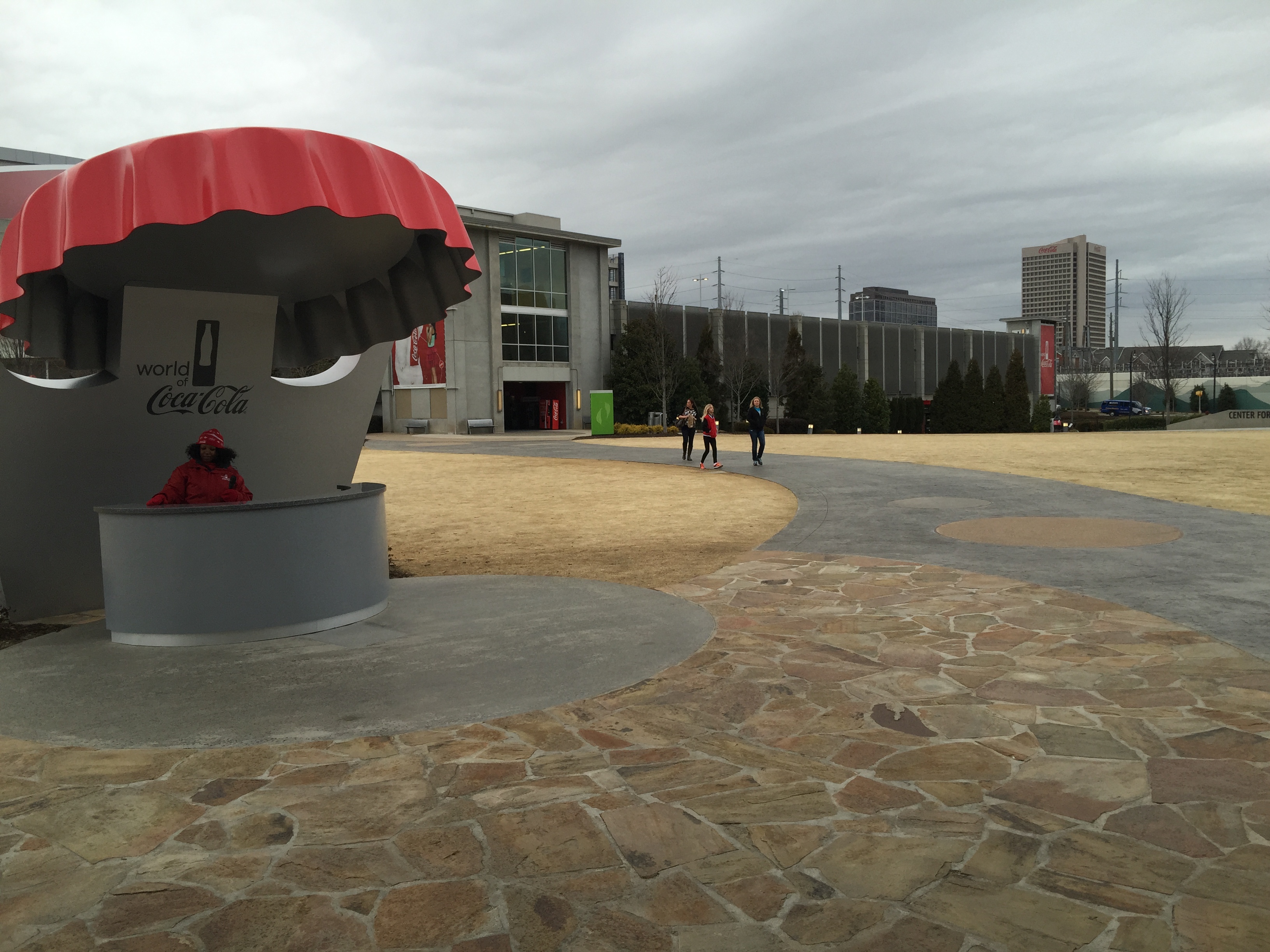
Some people want to go to the Vatican. Some people want to see Mecca. These capitalists, however, want to visit a truly holy site: The World of Coca-Cola in Atlanta, Georgia. It’s a huge exhibit with historical archives from the company’s past. Over in the distance, you can see corporate headquarters. It makes me want to buy obscene amounts of the stock and put it in trust for our children and grandchildren. This is the place where all that money goes to be counted before getting shipped out to the shareholders as a cash dividend.
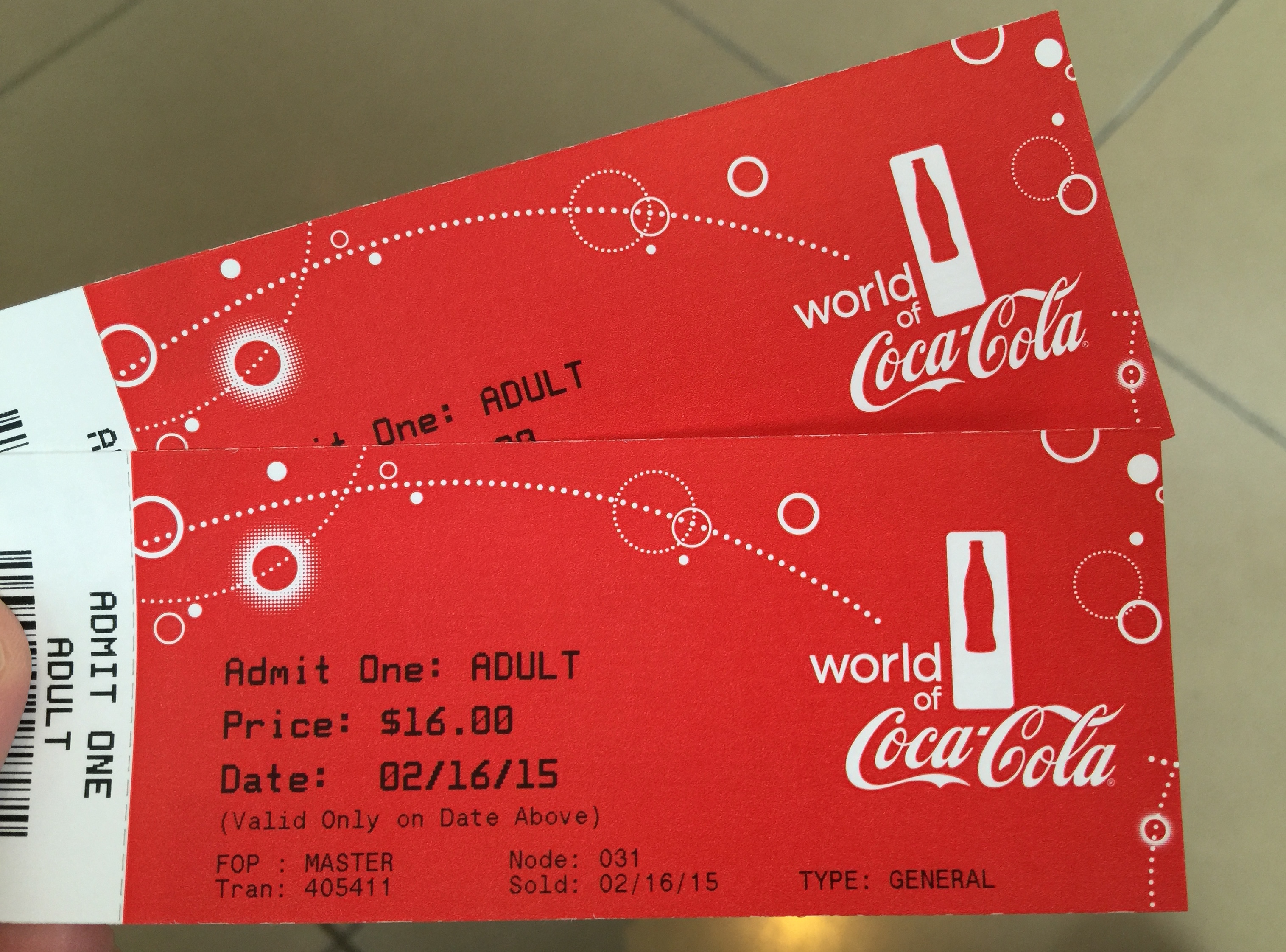
We parked across the street, ran over to the ticket kiosk, and bought two general admission tickets to The World of Coca-Cola.
Aunt Donna likes to see us every once in awhile. Hello Aunt Donna!
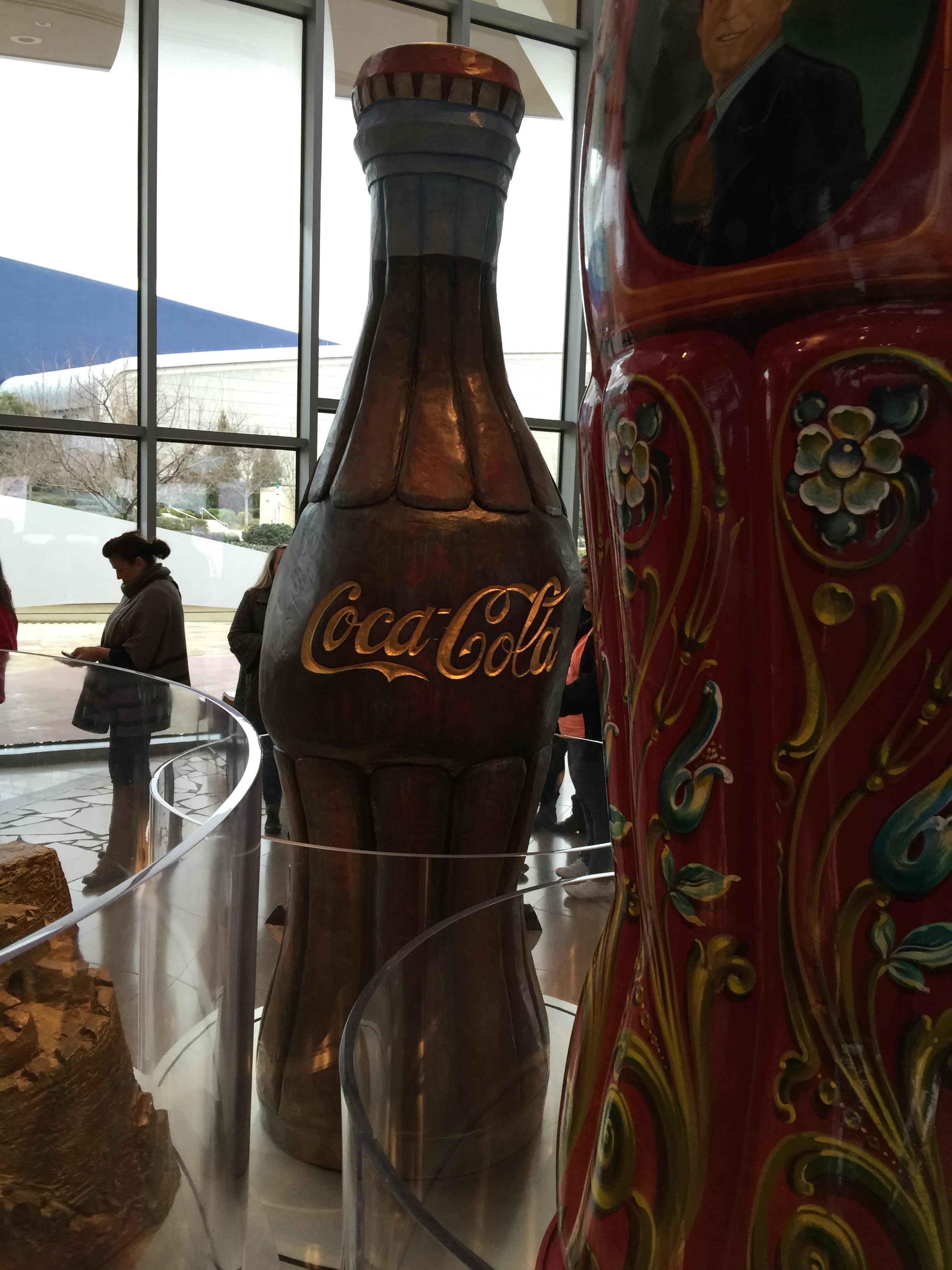
We waited in this atrium until the tour began. I liked the gold leaf Coca-Cola carved into the wooden bottle.
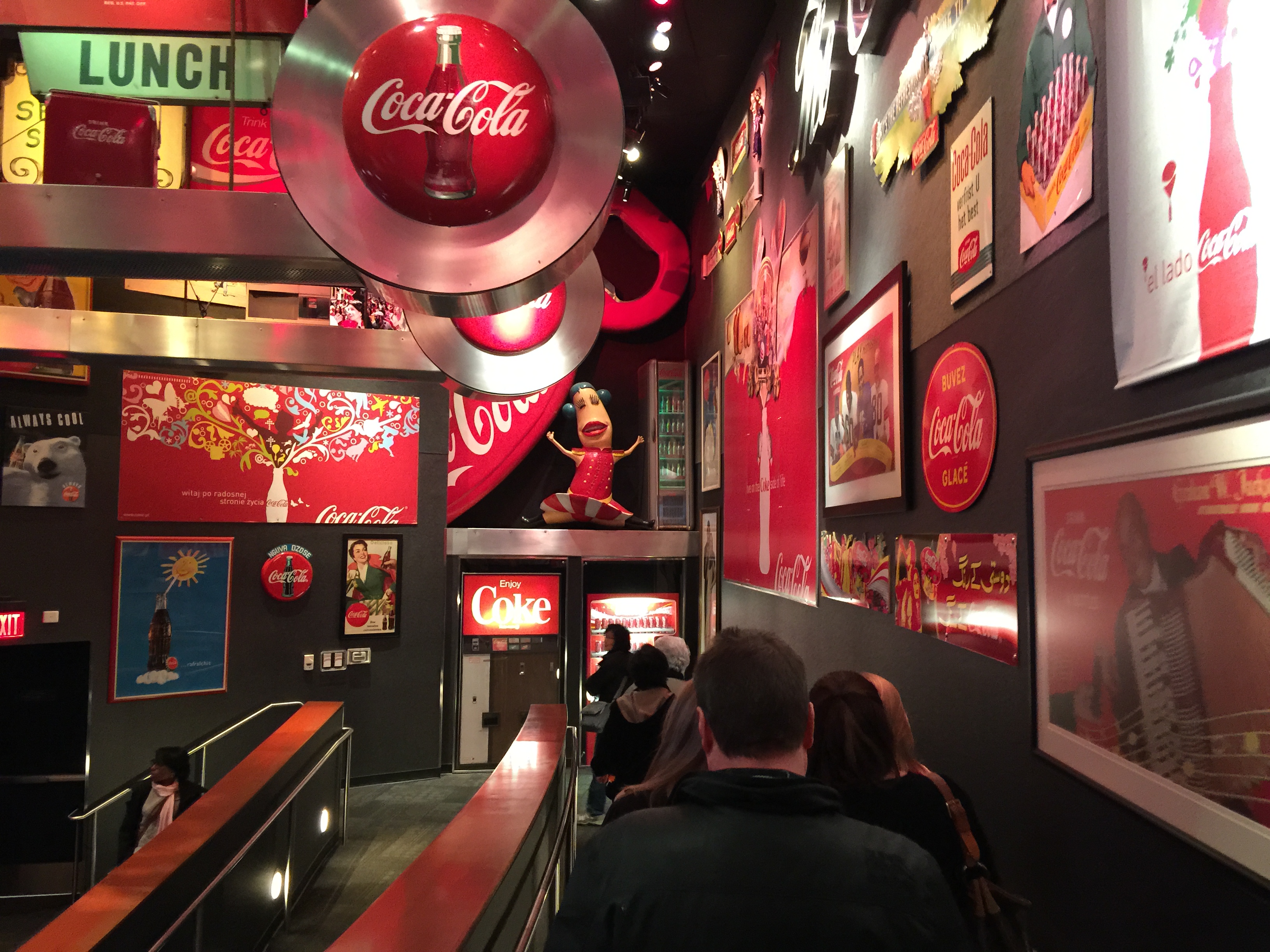
Once the tour started, you were taken into this Coca-Cola memorabilia room. You later learned that all of the things in there were taken from around the world. The giant Coca-Cola lettering on the wall at the top right, for example, was the original corporate logo that emblazoned the building for nearly three-quarters of a century until they built their current corporate headquarters in downtown Atlanta. There were Coke ads from Pakistan and China; South Korea and Germany; Columbia and Canada.
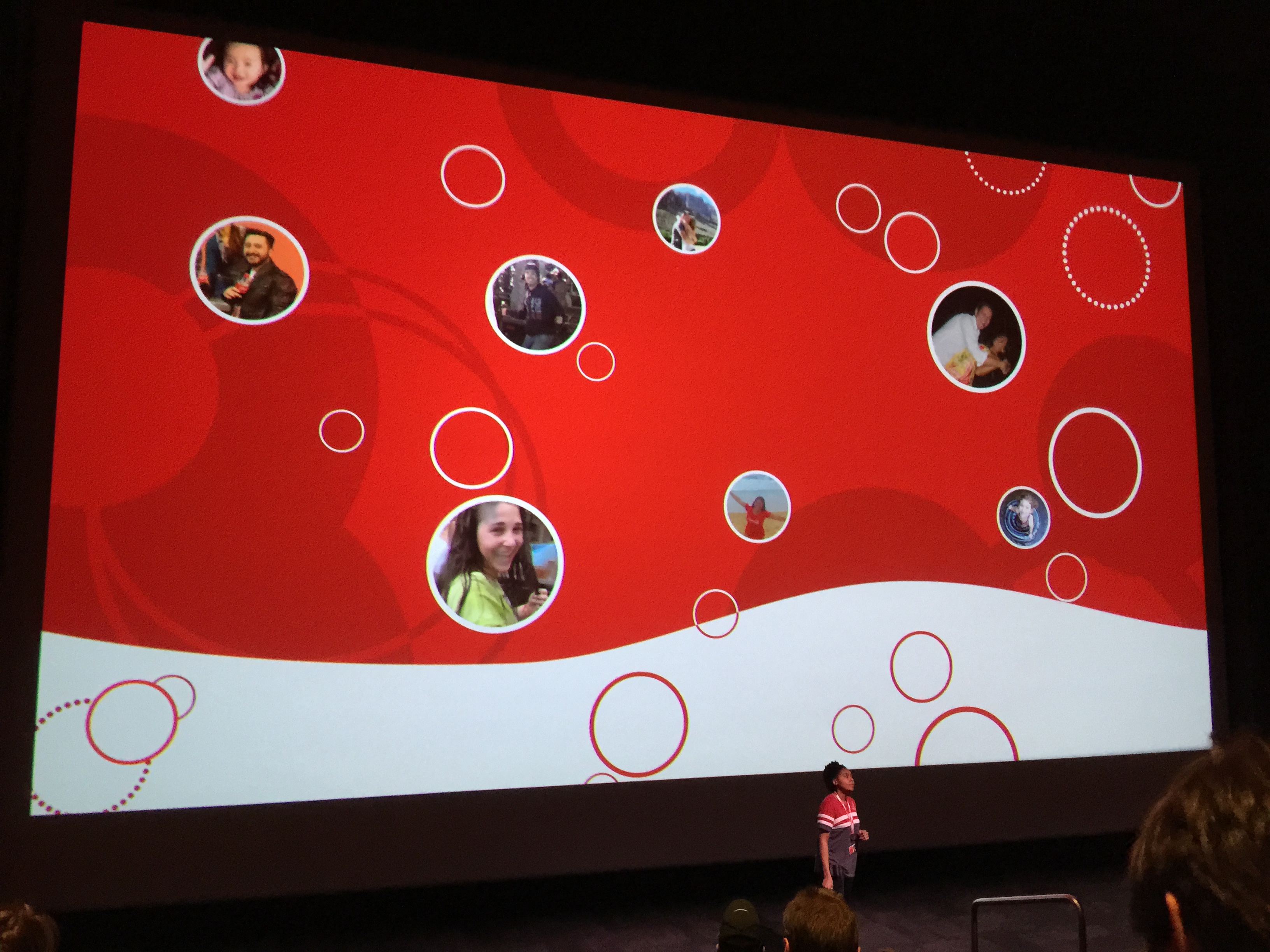
Once that part of the tour was completed, we were taken into a private movie theater to watch a film about moments of happiness. Aaron was laughing about it because he said, “I expected a corporate video on the history of Coca-Cola. That was six minutes of propaganda.” It was fantastic.
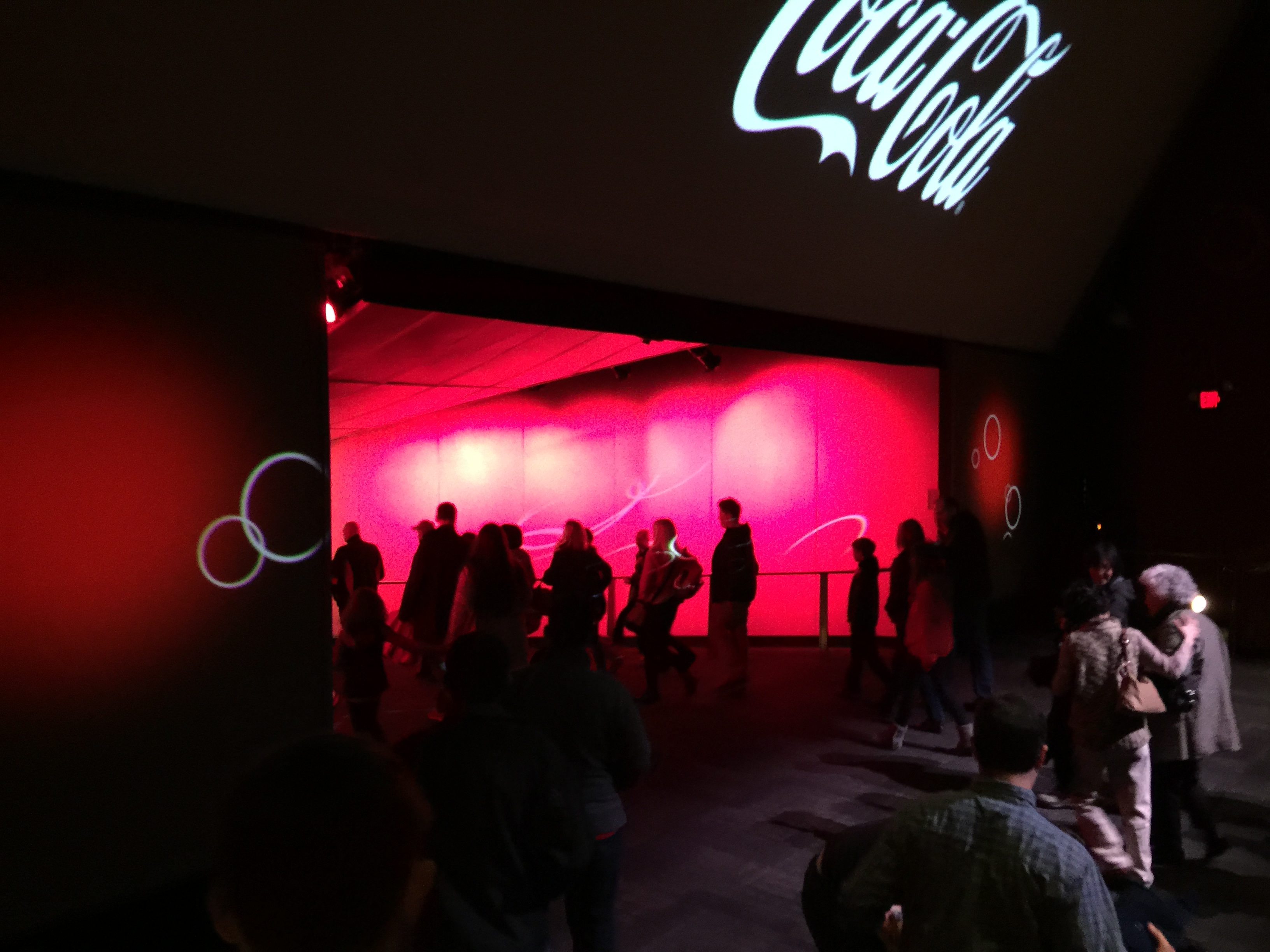
When the film was done, the screen rose and the Coca-Cola logo appeared as you were taken into a colorful tunnel. It was very Willy Wonka-ish.
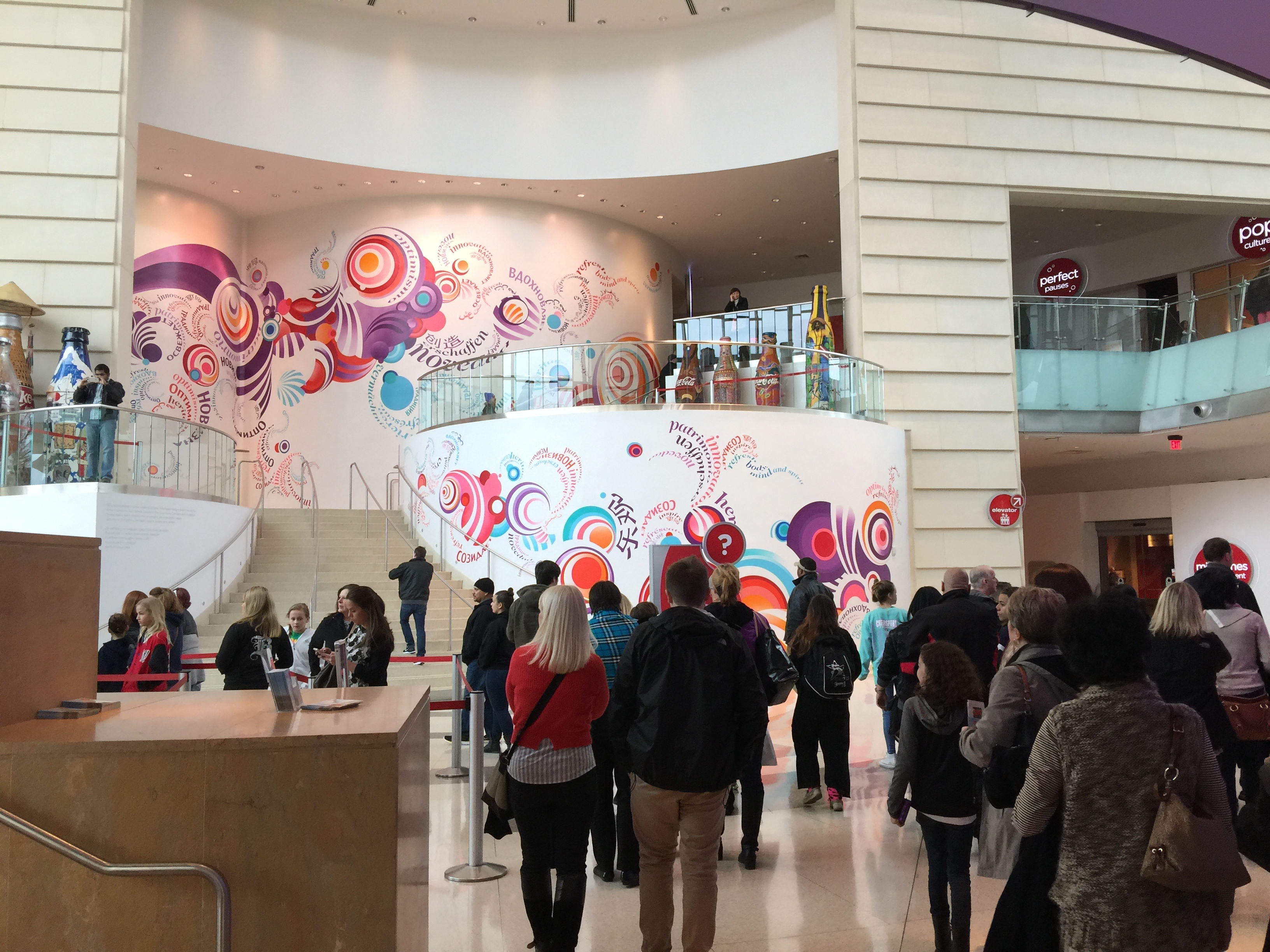
You emerged into a giant World of Coke atrium with two floors.
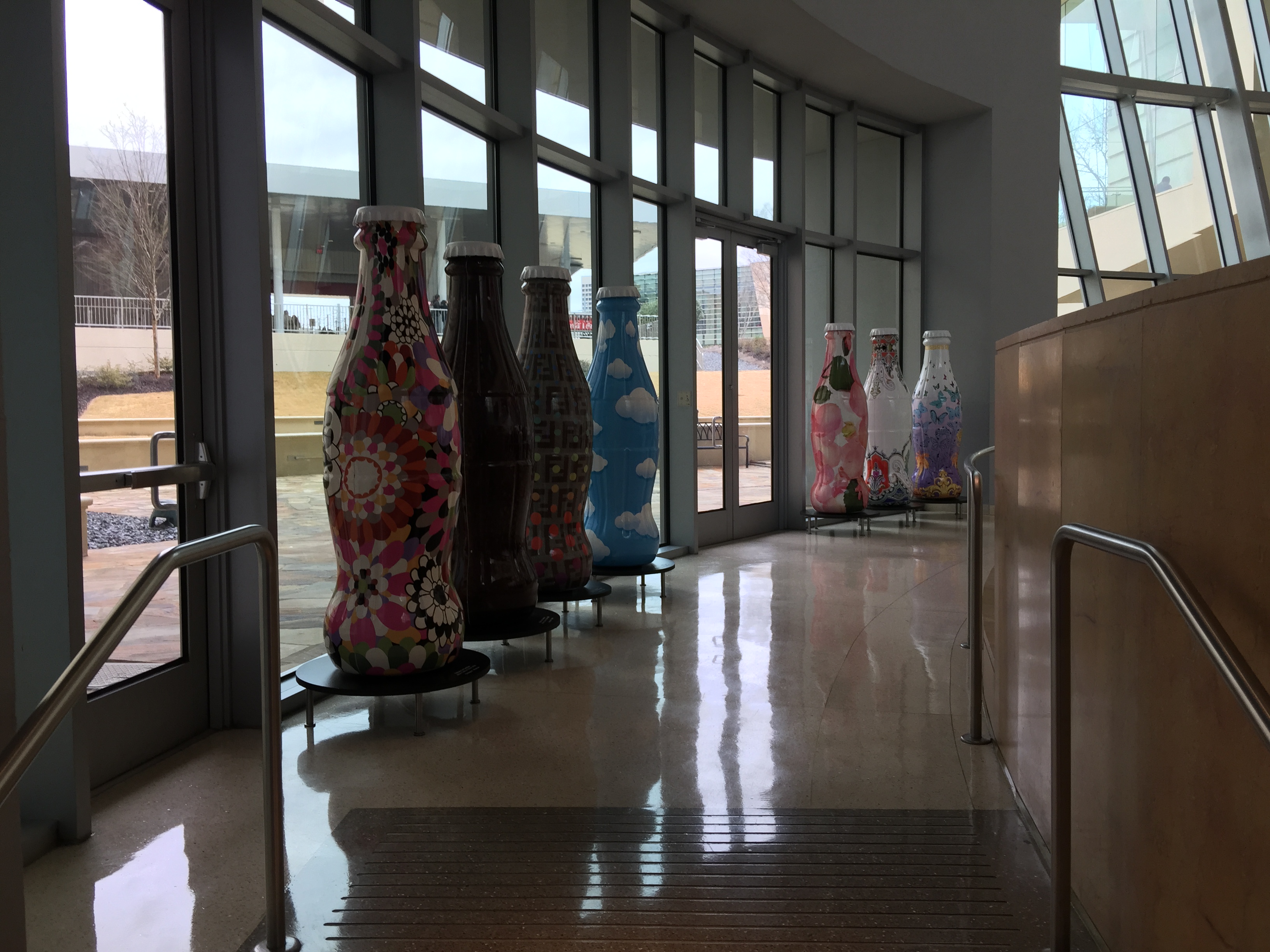
To the left were Coca-Cola art bottles …
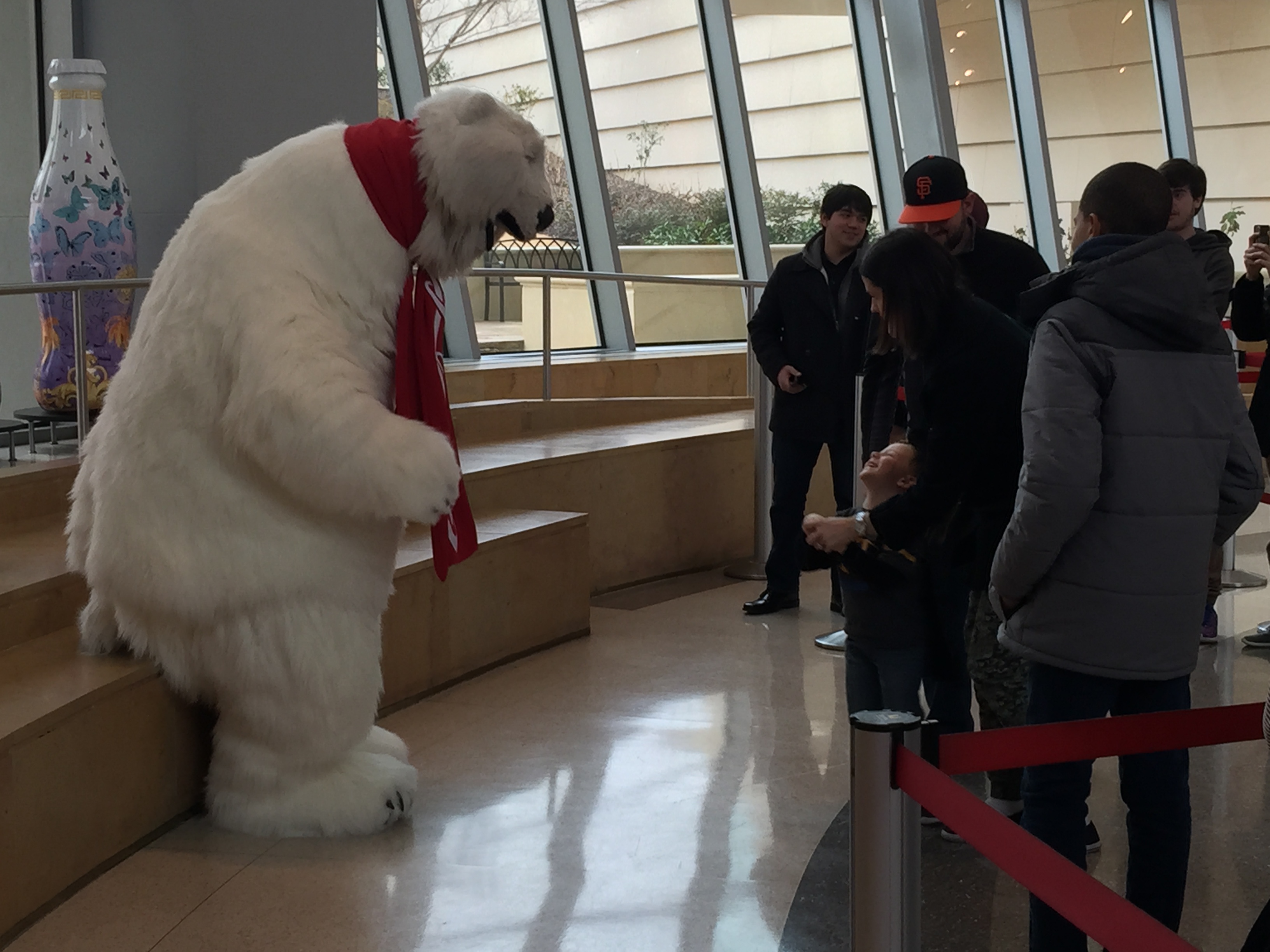
… and the Coca-Cola polar bear greeting children.
Everyone else made a direct run for The Coca-Cola Vault containing the secret formula. Instead, we went to the history wing first to see some of the archived documents.
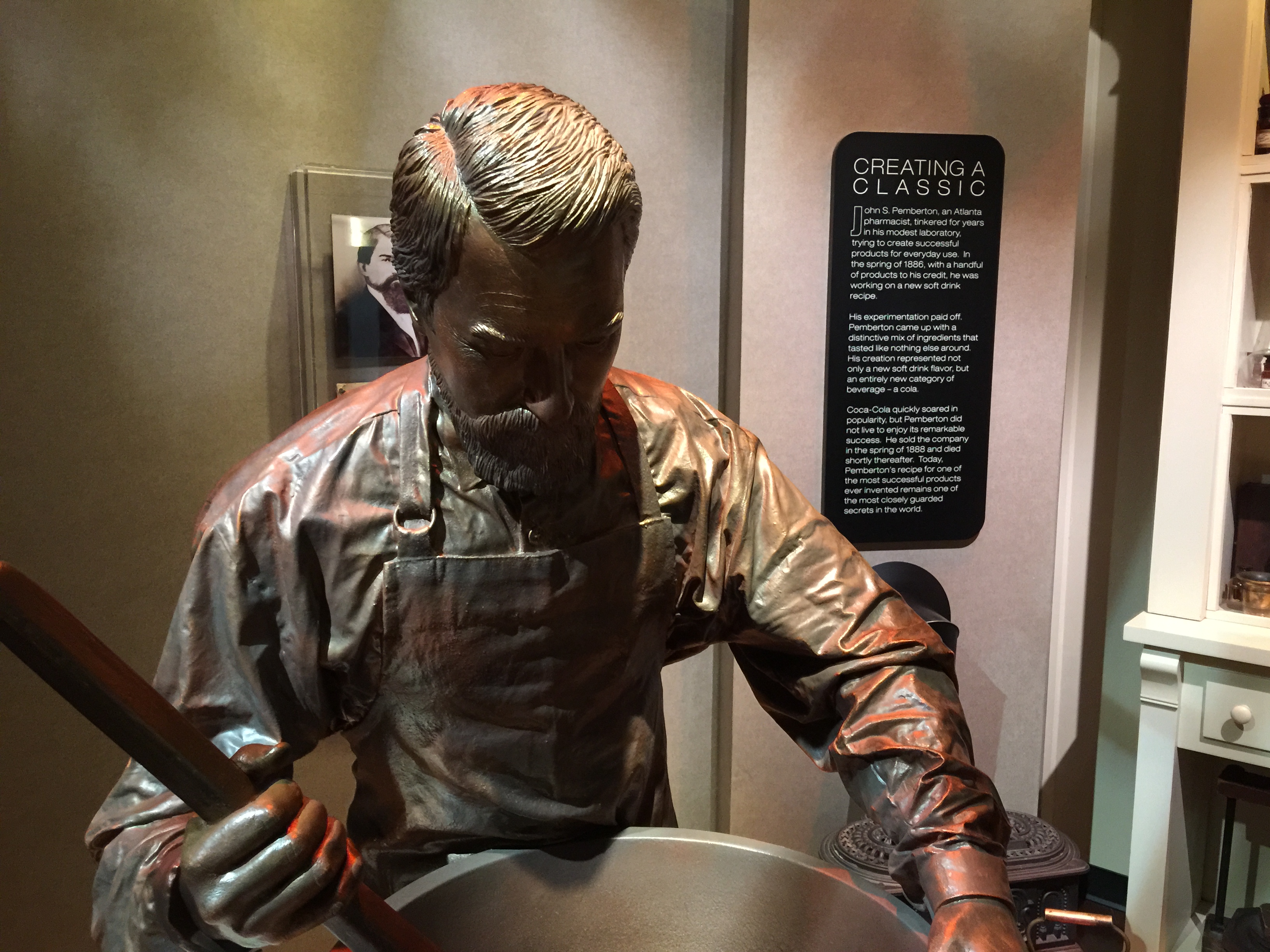
Pemberton, a pharmacist, invented Coca-Cola. He sold it to drug stores, which would serve it over the counter. He wasn’t a very good businessman, though, and in the first year, he generated $50 in revenue and $75 in costs.
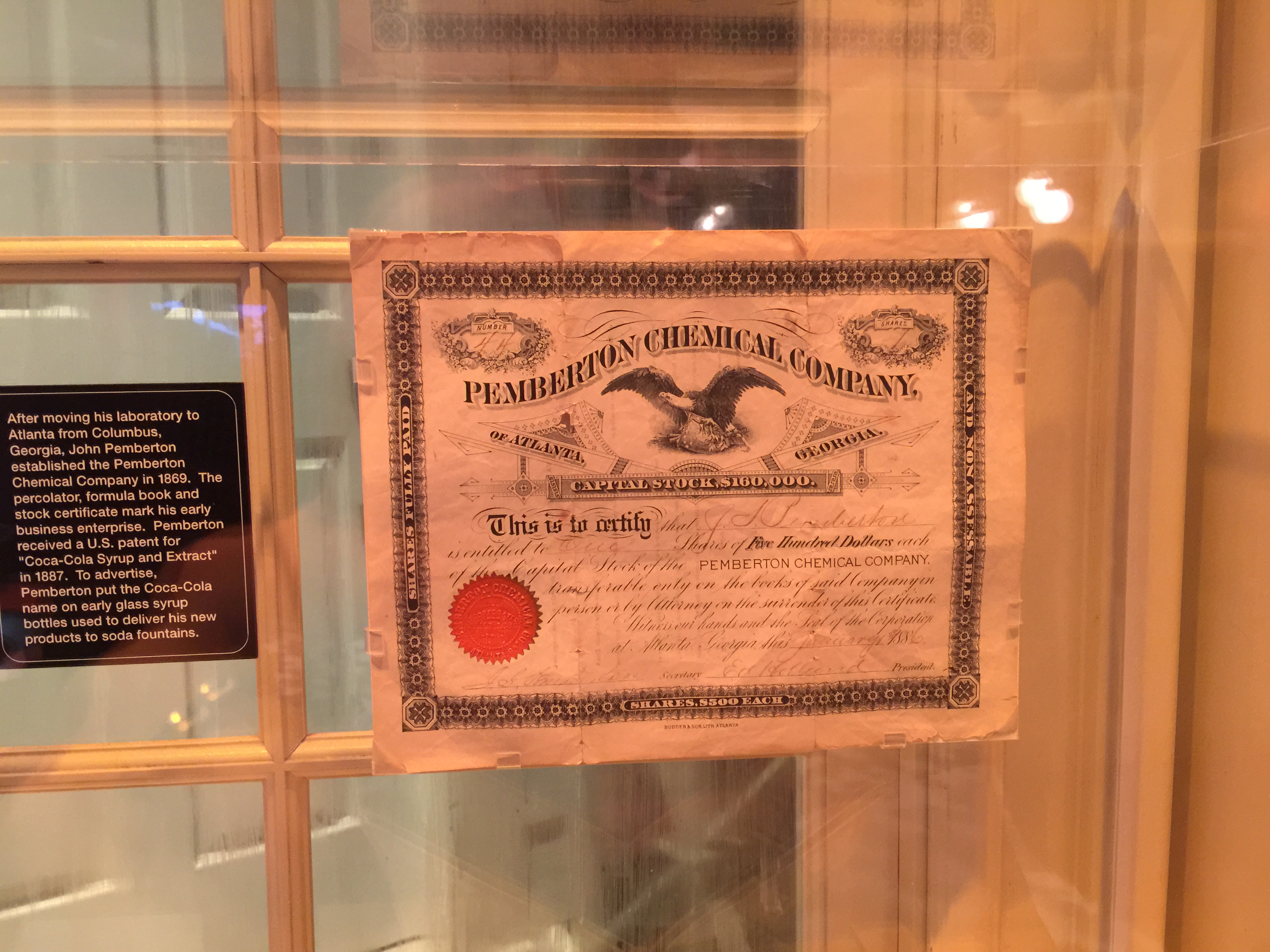
He issued stock in the Pemberton Chemical Company, raising funds by selling off ownership to outside investors. This is one of his original stock certificates.
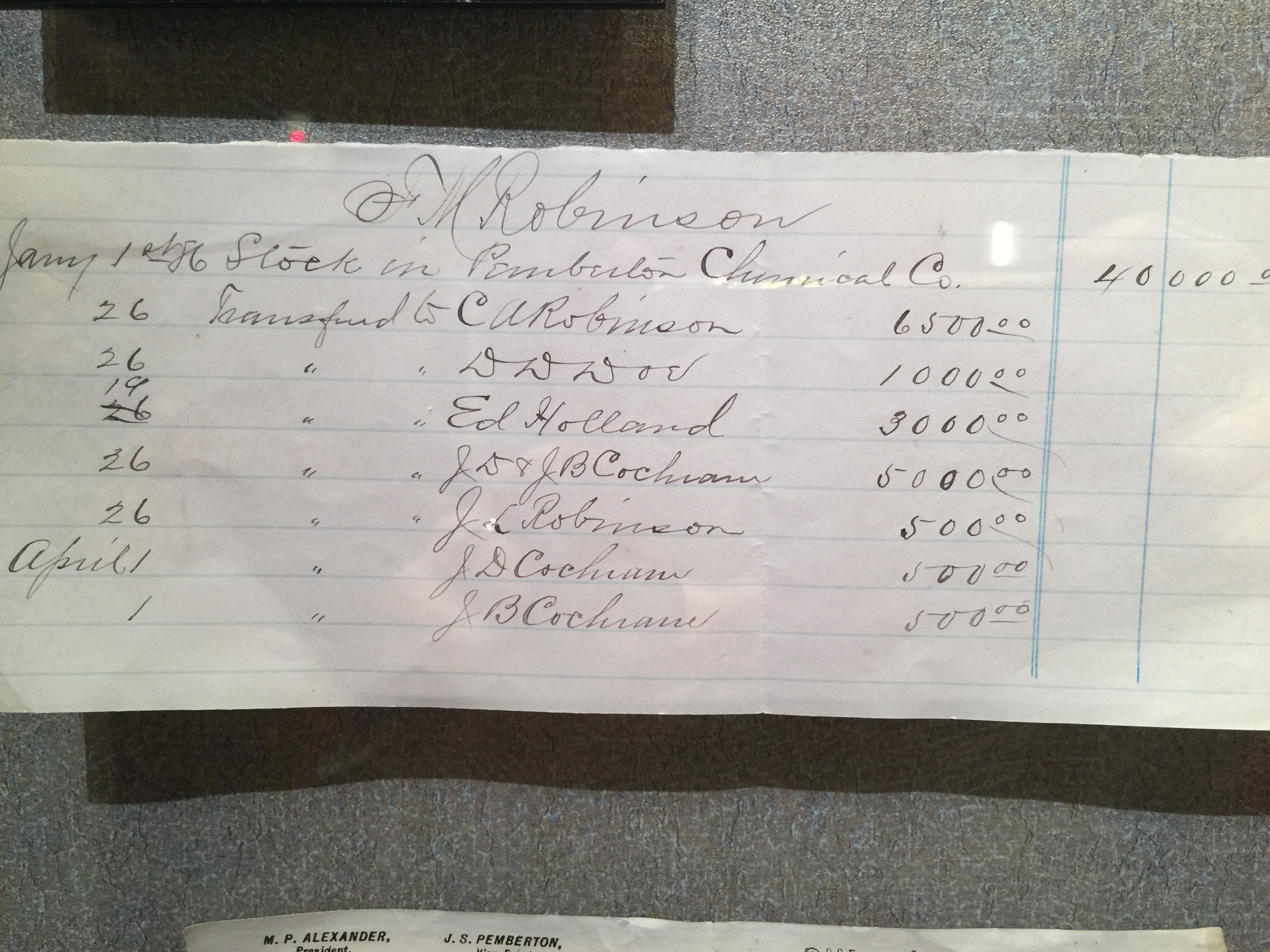
Here is the investor roster of the Pemberton Chemical Company, which owned the rights to Coca-Cola. These people had no idea what they had in their hands.
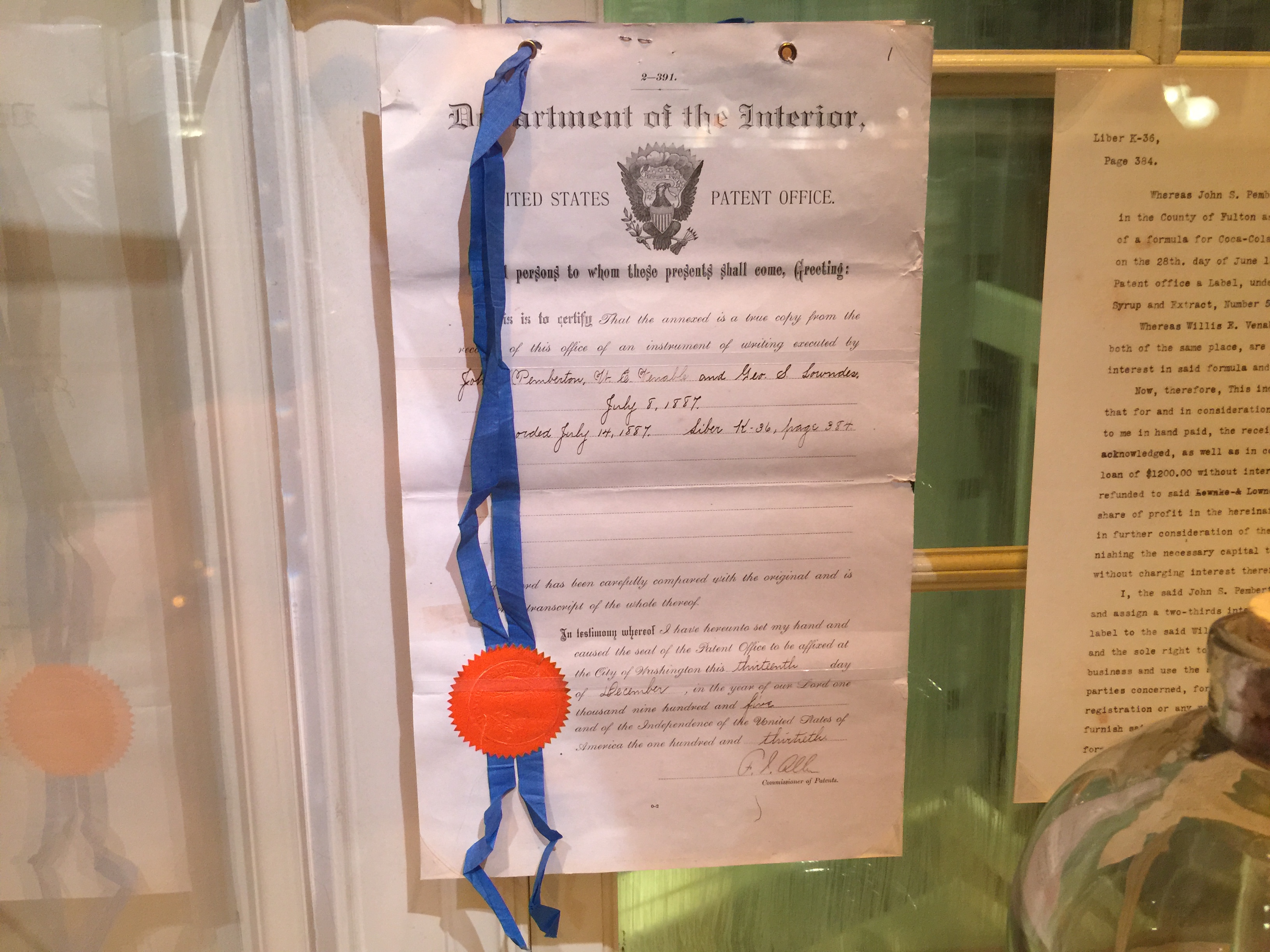
The Pemberton Chemical Company was awarded a patent on Coca-Cola. It was the prime asset of the company.
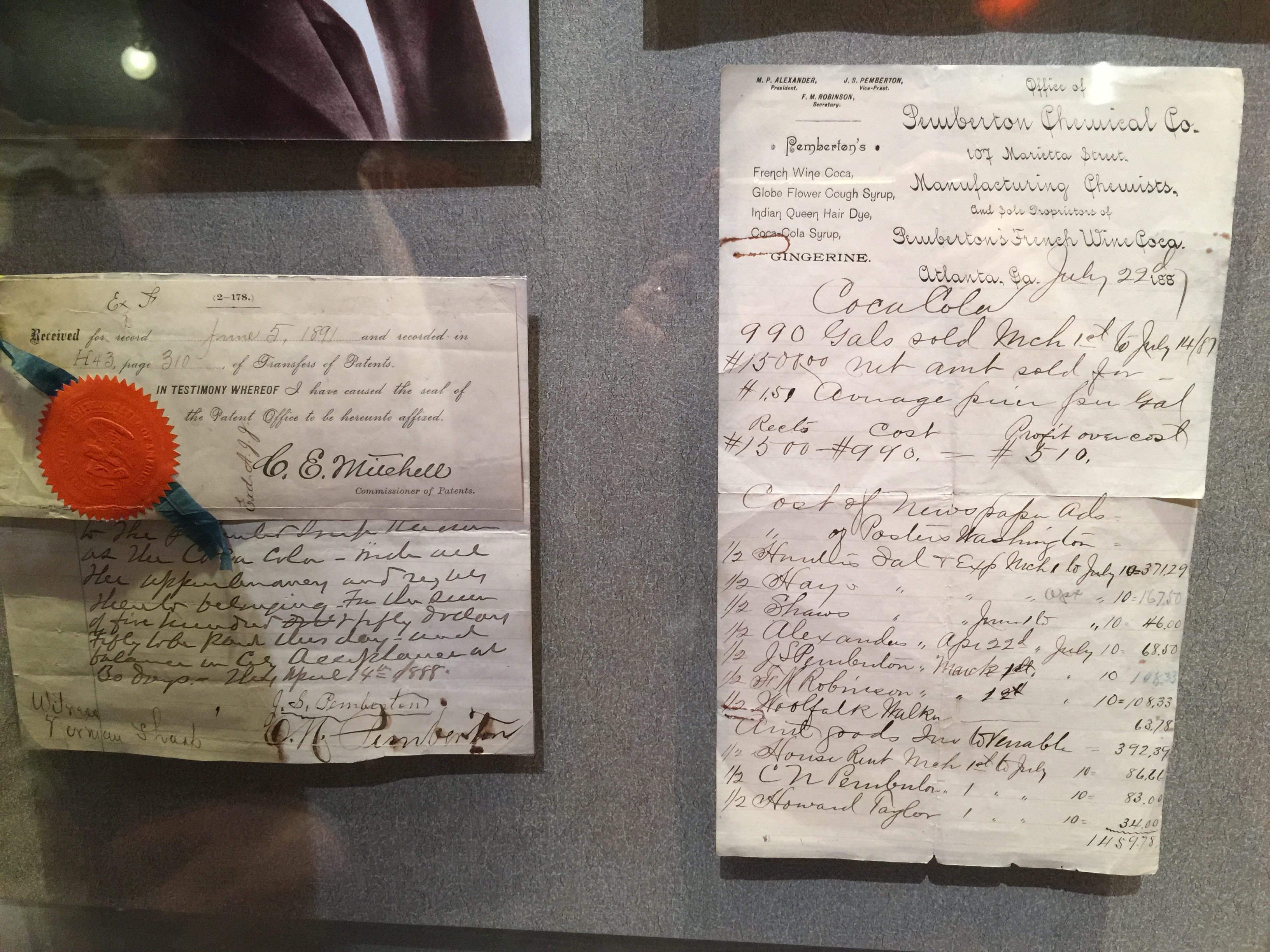
Operations grew and the paperwork was kept by hand …
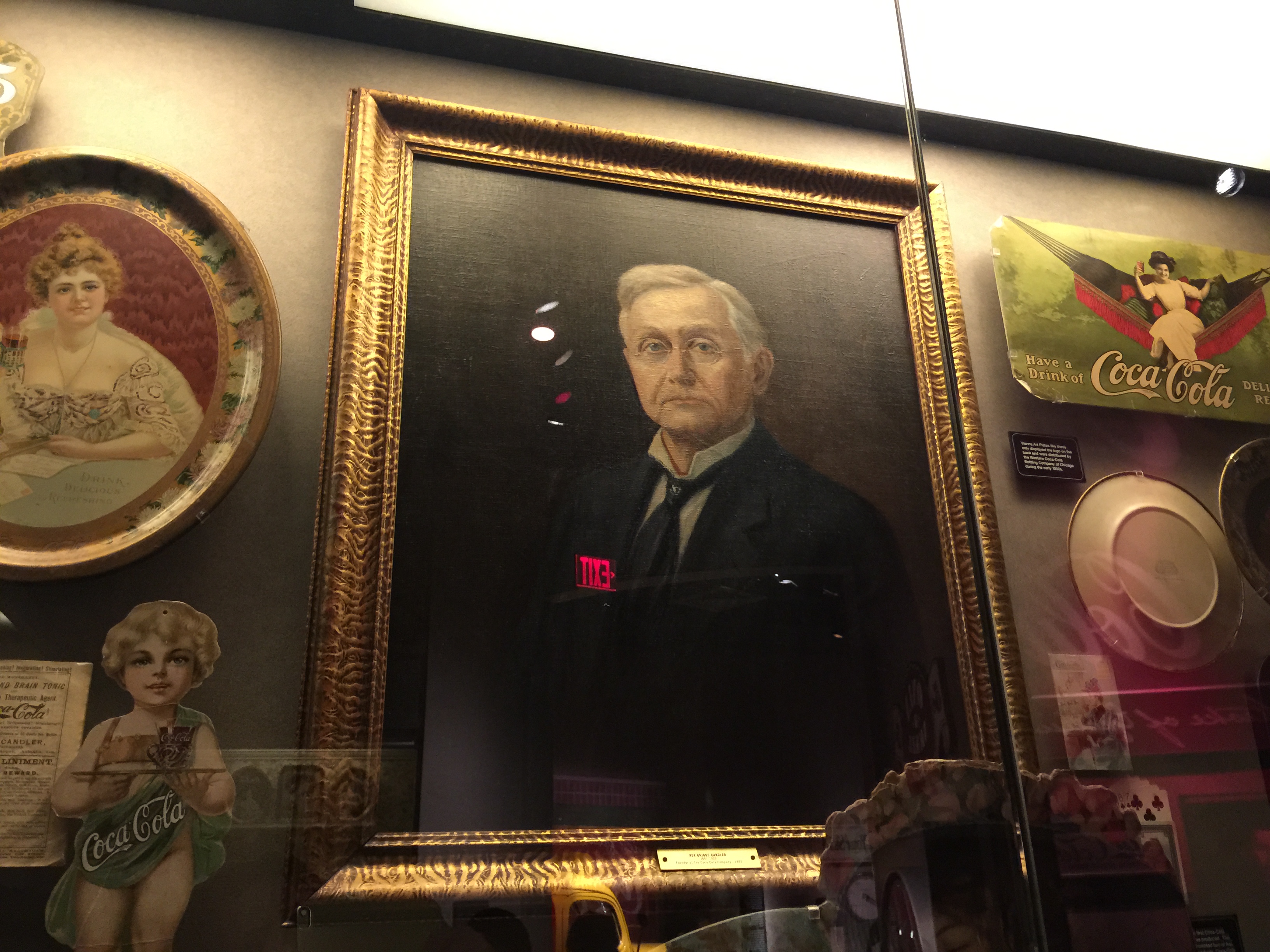
Asa Candler, who came to Atlanta virtually penniless (he was the black sheep “failure” of sorts of a well-connected, wealthy family), tried his first Coca-Cola and tracked down the inventor. The business he controlled, Walker, Candler & Company, bought the 1/3rd share owned by the founder and inventory, John Pemberton, paying $550 for it in April of 1888. According to the company archives, 72 hours later, he bought a 50% interest held by two investors, Wollfork Walker and his sister, Mrs. M.C. Dozier, paying $750. On August 30th, 1888, he effectively completed his acquisition by paying Walker and Dozier $1,000 plus interest for the remainder of their stock, giving him the entire company. The total cost came to $2,300 plus the interest he paid. On December 29th, 1891, the company records show he petitioned “the Fulton County Superior Court to incorporate The Coca-Cola Company as a Georgia corporation”. The first stockholder meeting was held on February 22nd, 1892. Candler handled day-to-day management himself and began branding everything he could find with the Coca-Cola name and logo. Over the next 27 years, he became one of the richest men in the United States as the firm prospered and he showered himself with cash dividends on his common stock. In 1919, having retired from daily management and entered a career in politics, he sold out to a group of investors for $25,000,000. Warren Buffett has called that series of events, “probably the greatest investment ever made in all of human history”. It dwarfs every other investment success story you’ve ever heard. Perhaps just as impressive: A single share of Coca-Cola bought for $40 in 1919 at the company’s IPO when the investors went public is now worth north of $10,000,000 with dividends reinvested.
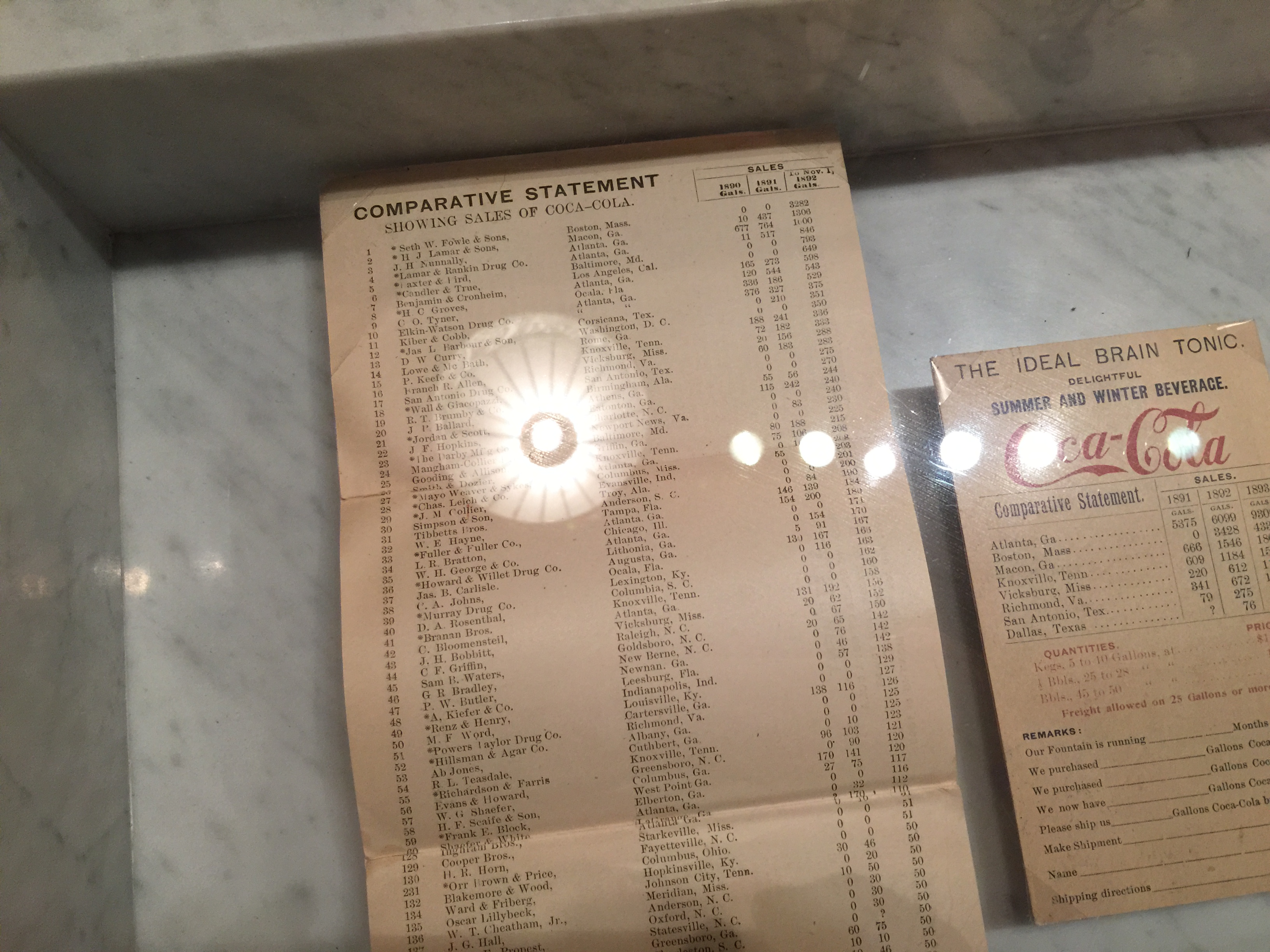
You can tell Candler was serious. The sales reports weren’t hand-written, he wanted precision. It was a very different game from what Pemberton was playing.
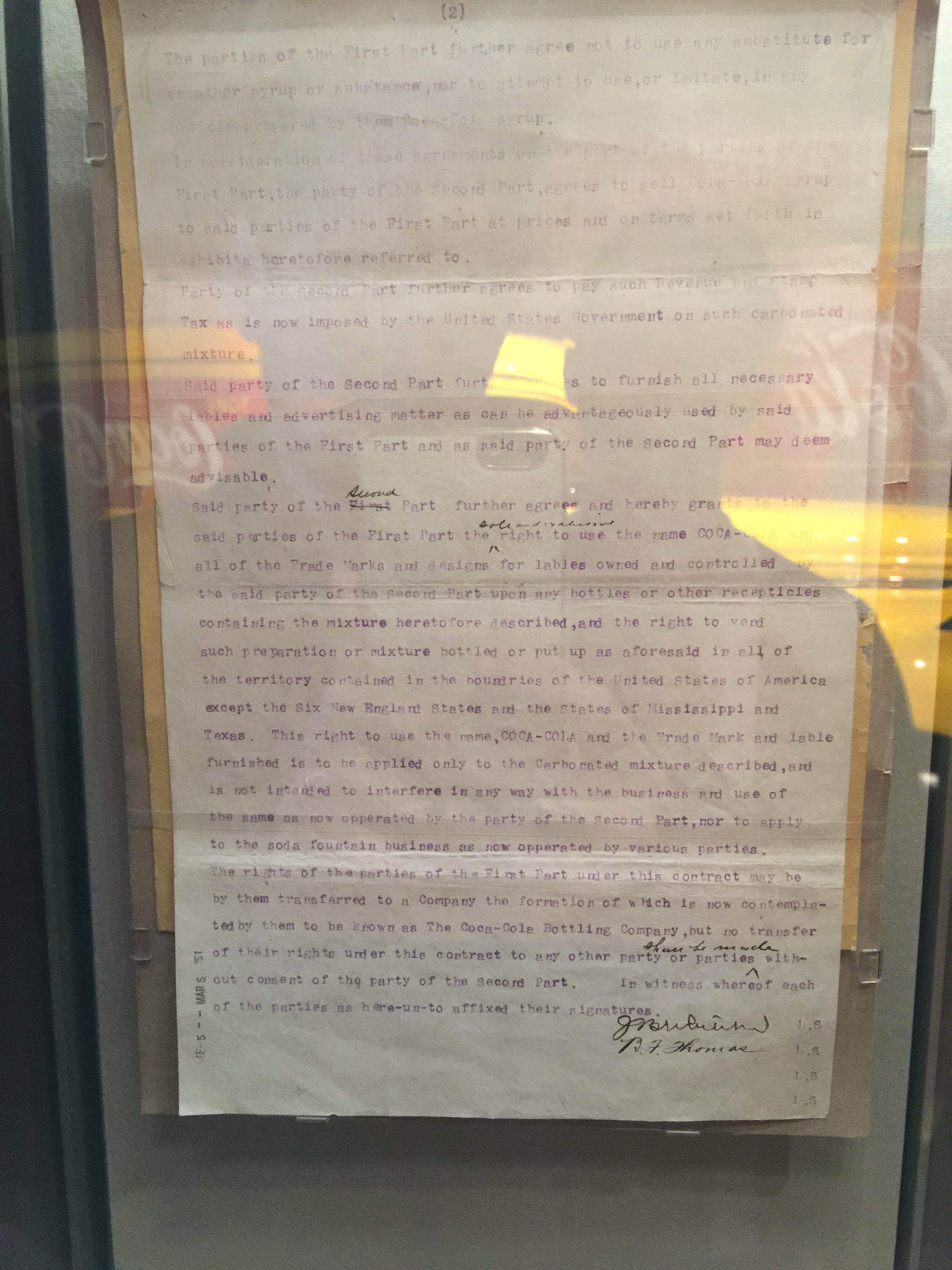
Remember that post I wrote years ago about how Thomas and Whitehead used synthetic equity to build one of the biggest fortunes in America? Here is the contract. You’re looking at it. It was one of the single biggest mistakes Asa Candler ever made. It haunted The Coca-Cola Company for more than 100 years. It gave away the franchise rights to almost the entire country for $1. Worse, it set the price of the syrup without inflation adjustments. There are families in this country who are still able to buy the syrup for next-to-nothing and sell it at retail, turning it into a license to print money at stockholders’ expense. Yet, Coke was such a fundamentally superior enterprise, it still became one of the most profitable businesses in the world.
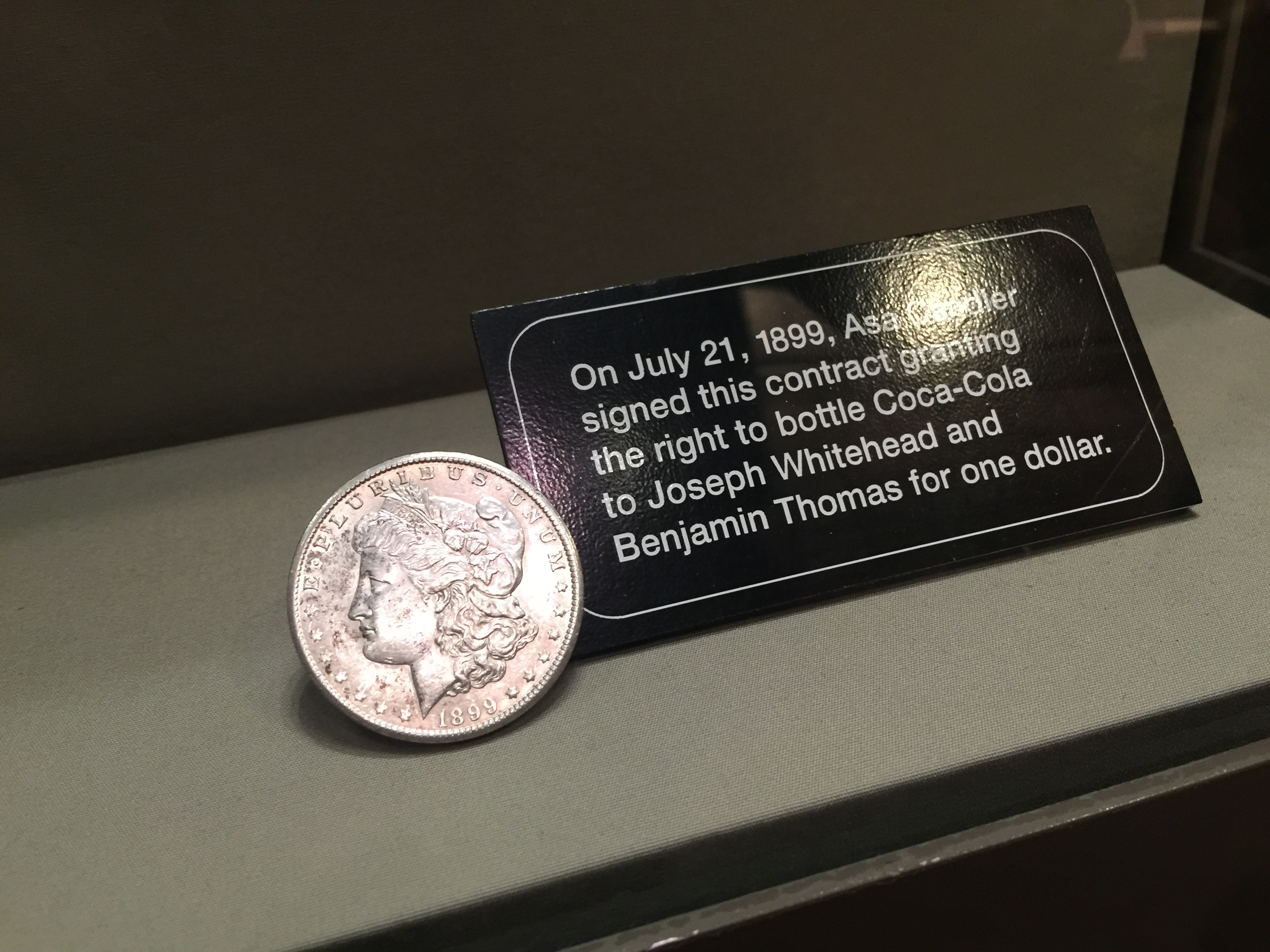
Incredible. It’s just incredible. There are so many lessons in this contract a person can apply to his or her career.
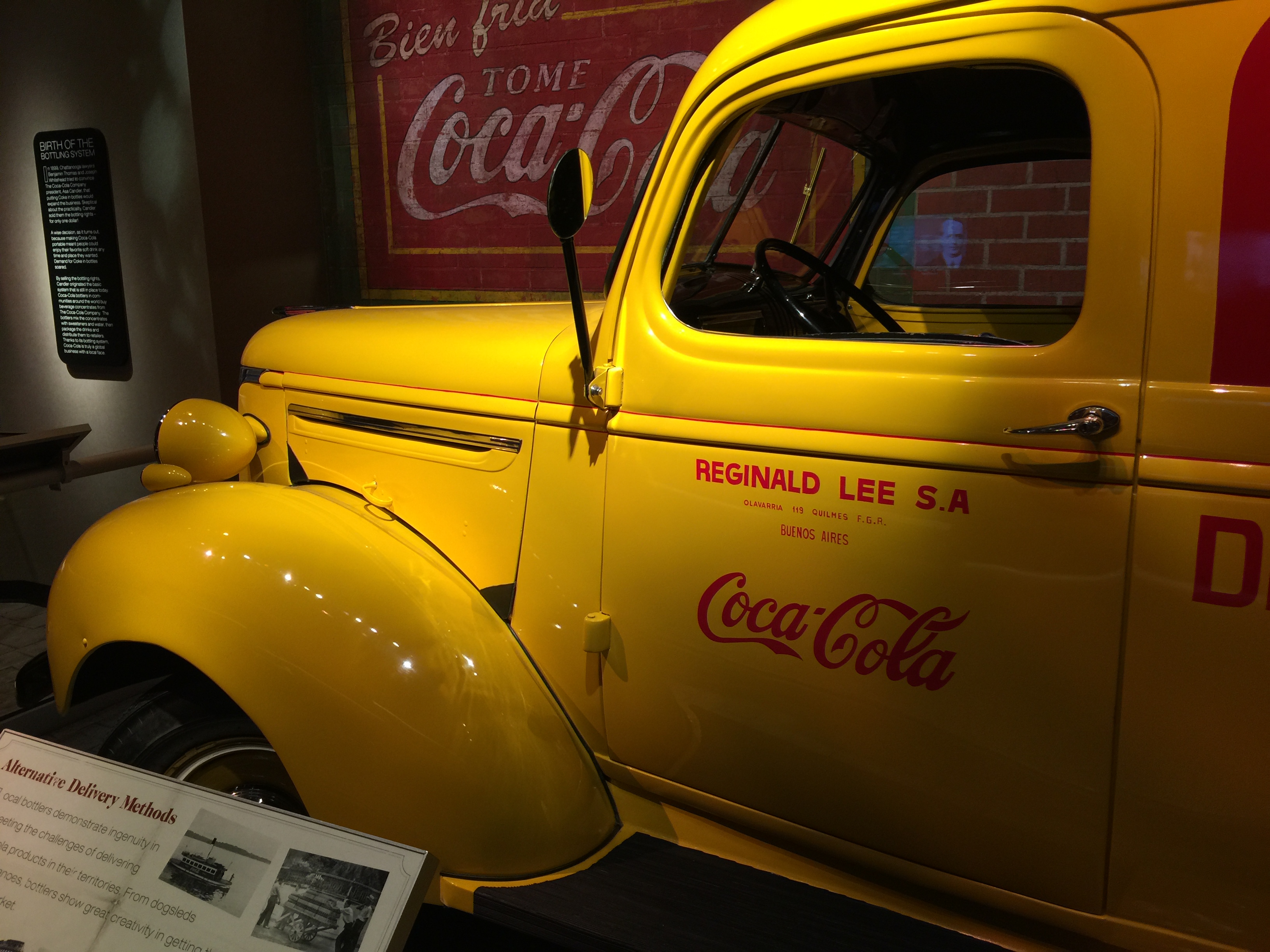
The original Coke delivery trucks were yellow, not red.
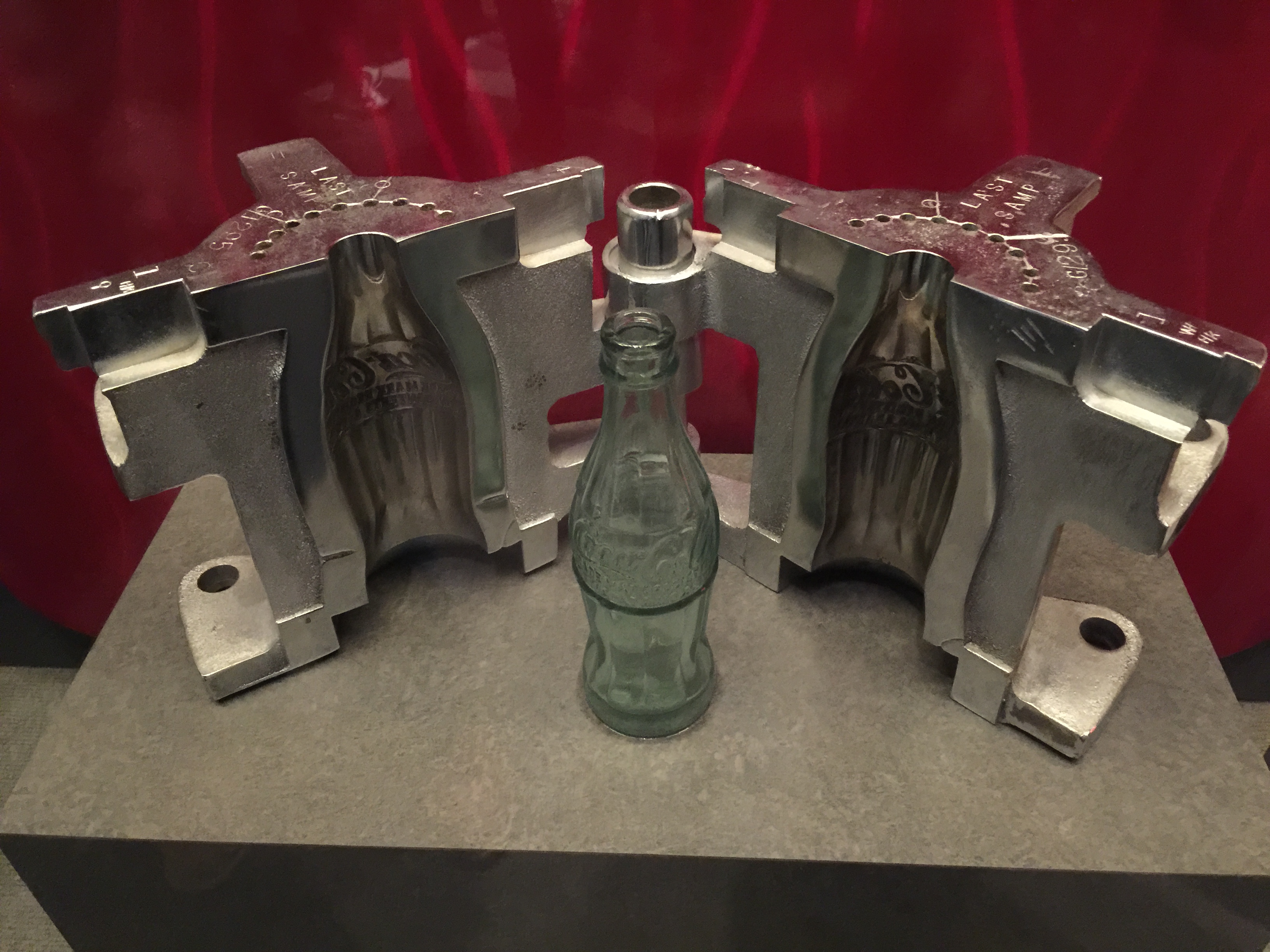
An old Coca-Cola bottle mold …
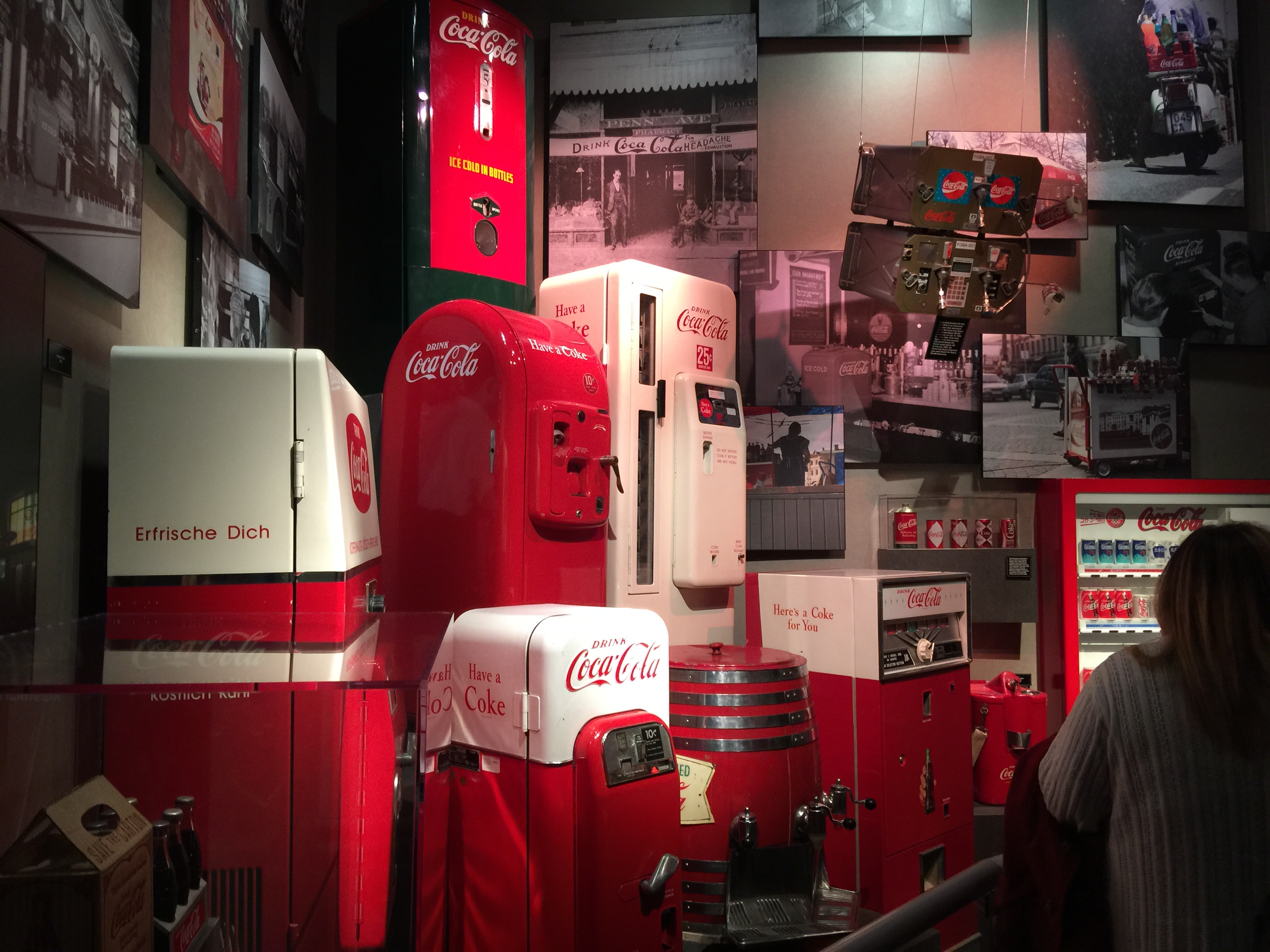
The vintage Coca-Cola vending machines! I love stuff like this.
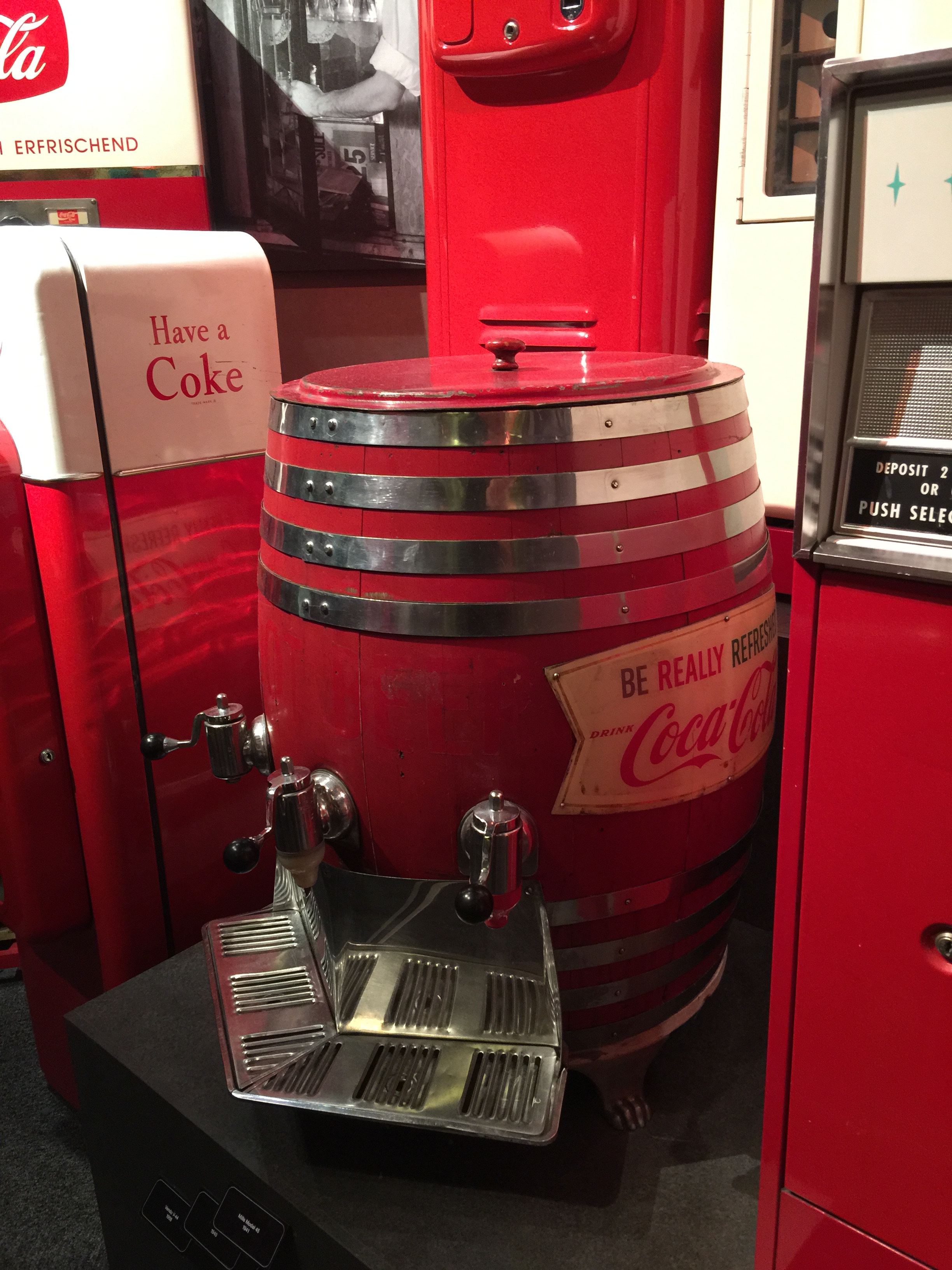
I have to have one of these Coca-Cola red barrels. This is awesome.
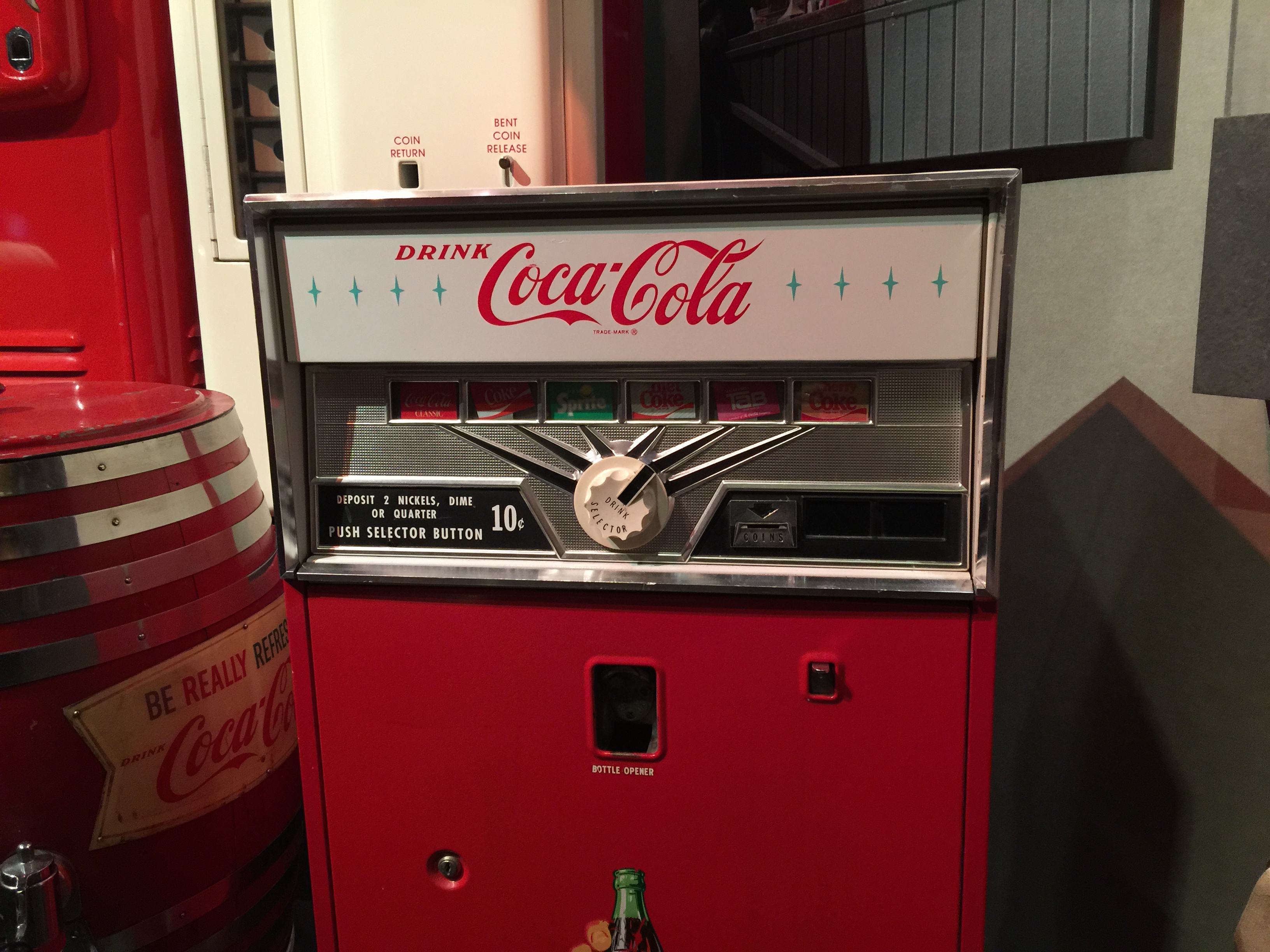
Aaron was saying how weird it was that we were alive when some of these were in service. I remember, in the 1980’s, machines like this that were then a few decades old, still operating in the small town grocery stores. Heck, I remember when cigarette machines looked sort of like this, had no one watching them, and you put coins into them, pulled a lever, and a packet of cigarettes fell out. Even though I never smoked, I had some extended relatives who did and as an elementary school kid, they’d have me go pick up a pack for them.
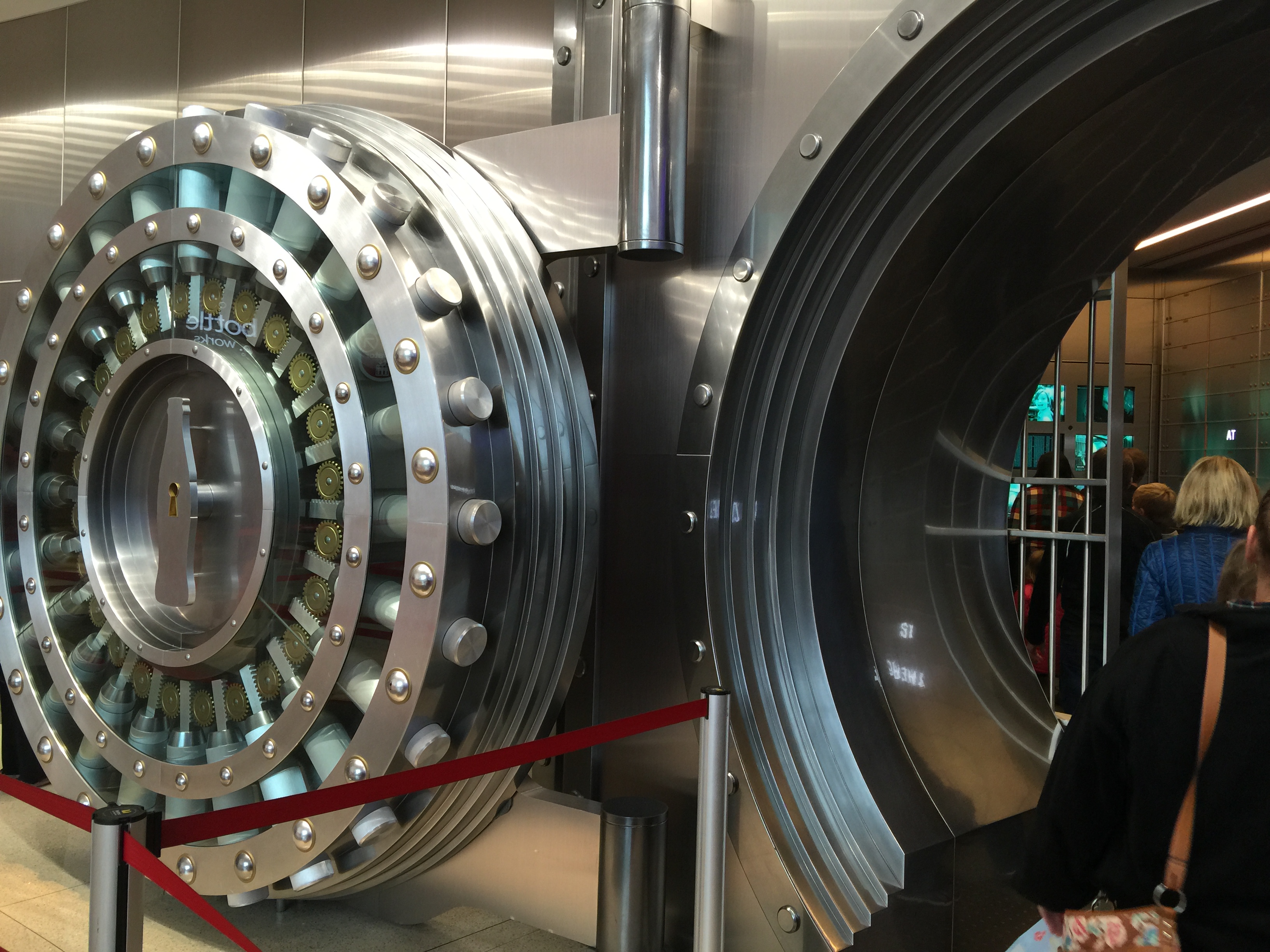
The Coca-Cola vault … For 86 years prior to its move here, it was kept safe in the Sun Trust Bank vault in Atlanta, Georgia. It was also temporarily held in New York City when it was used as collateral on a bank loan, the bankers requiring physical possession in exchange for extending funds.
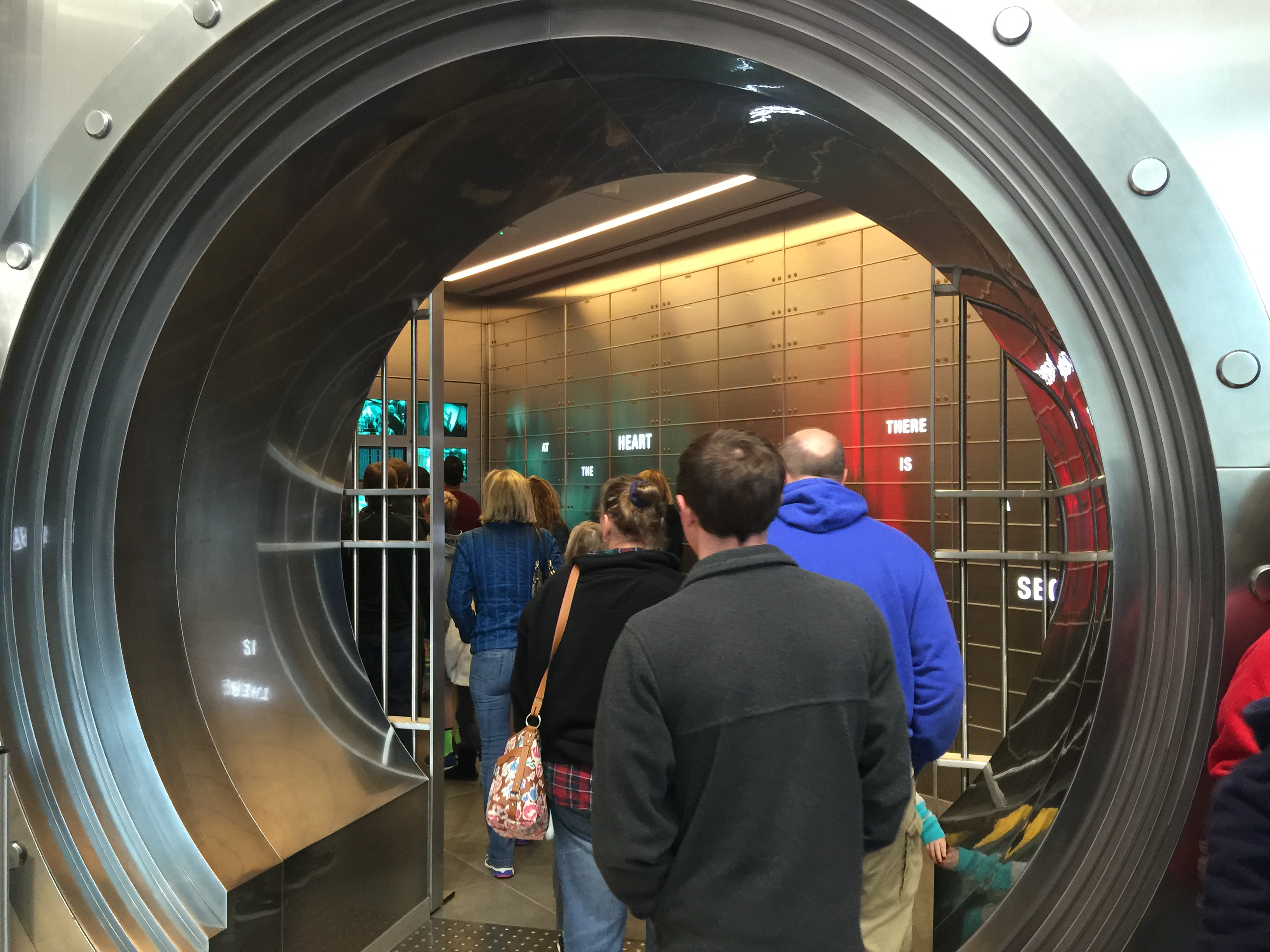
This is cool but somehow, I think I’d rather see the Sun Trust Bank safe where the actual original recipe was kept for nearly a century. I should try to visit that bank if I get a chance on the way back through town …
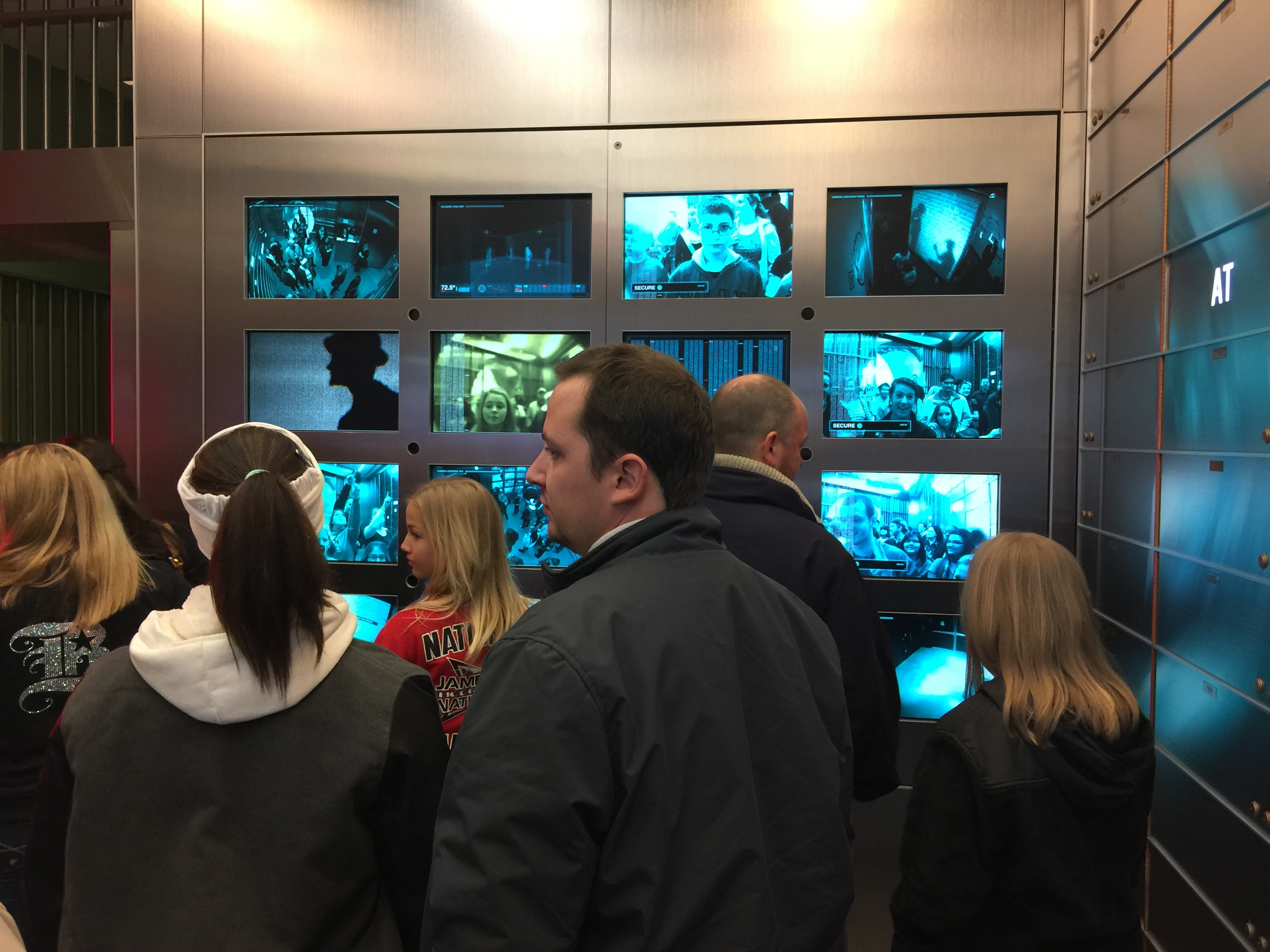
Oooo … their graphic designer did a really good job on the special effects of the faux security system.
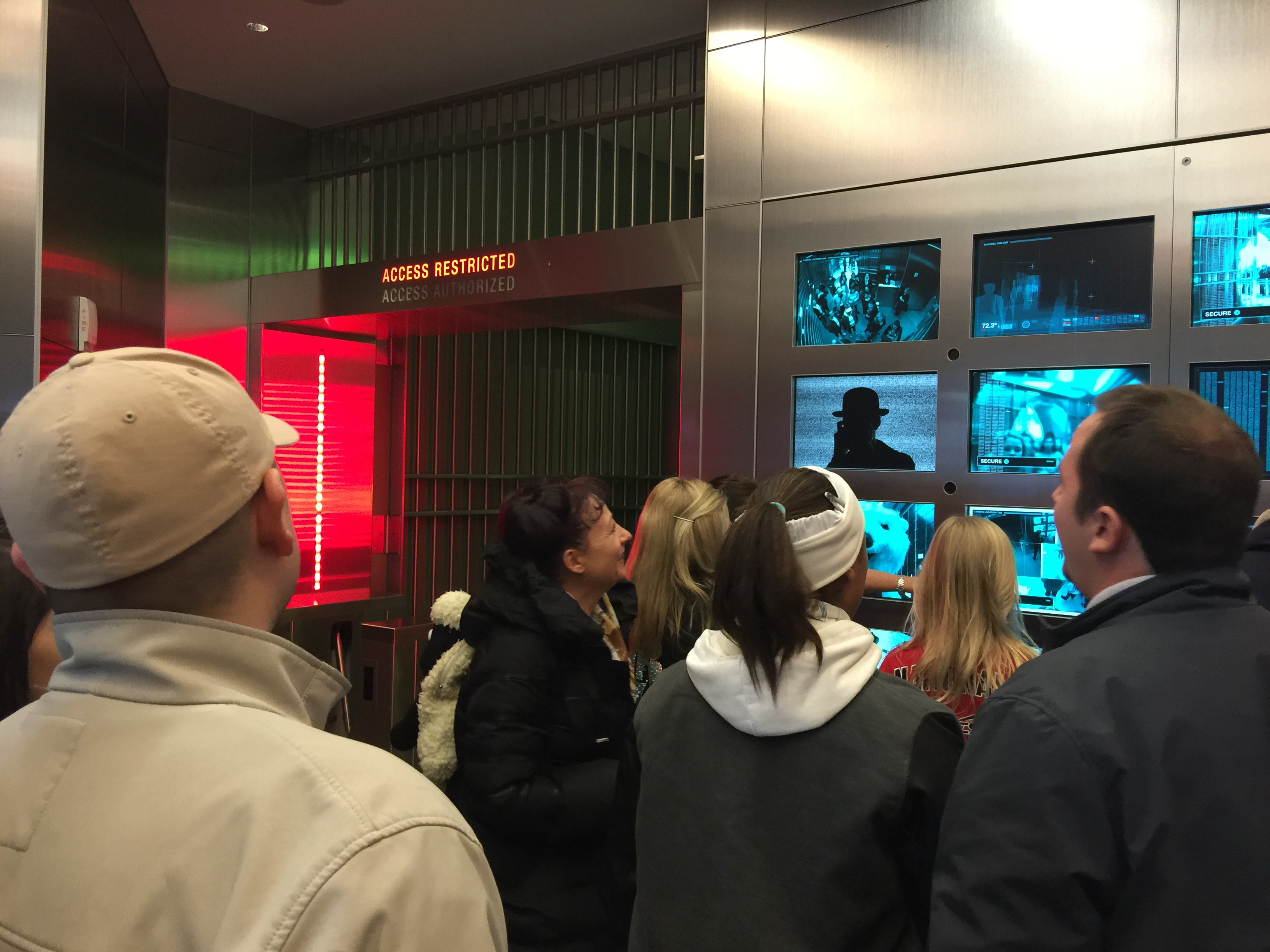
Here we go …
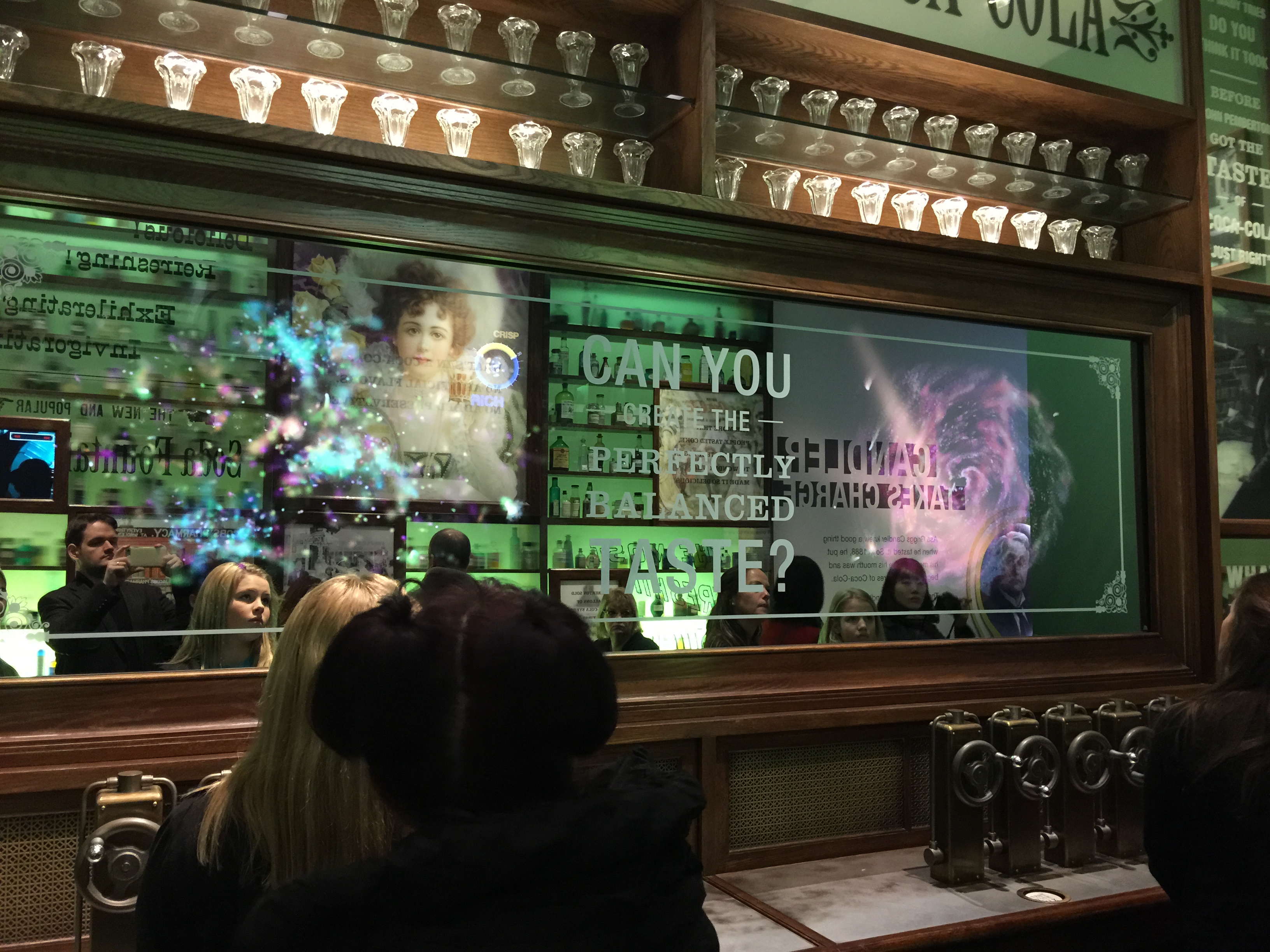
As we make our way through the Coca-Cola vault, there is all sorts of information on Pemberton’s process, the formula, the flavor profile. You can spot my reflection in the magic glass if you look closely. (The special effects were cool. Some of the glass and mirrored surfaces were distorted so that they appeared 3D, or animated, or would change as your shifted your position. It was Walt Disney quality.)
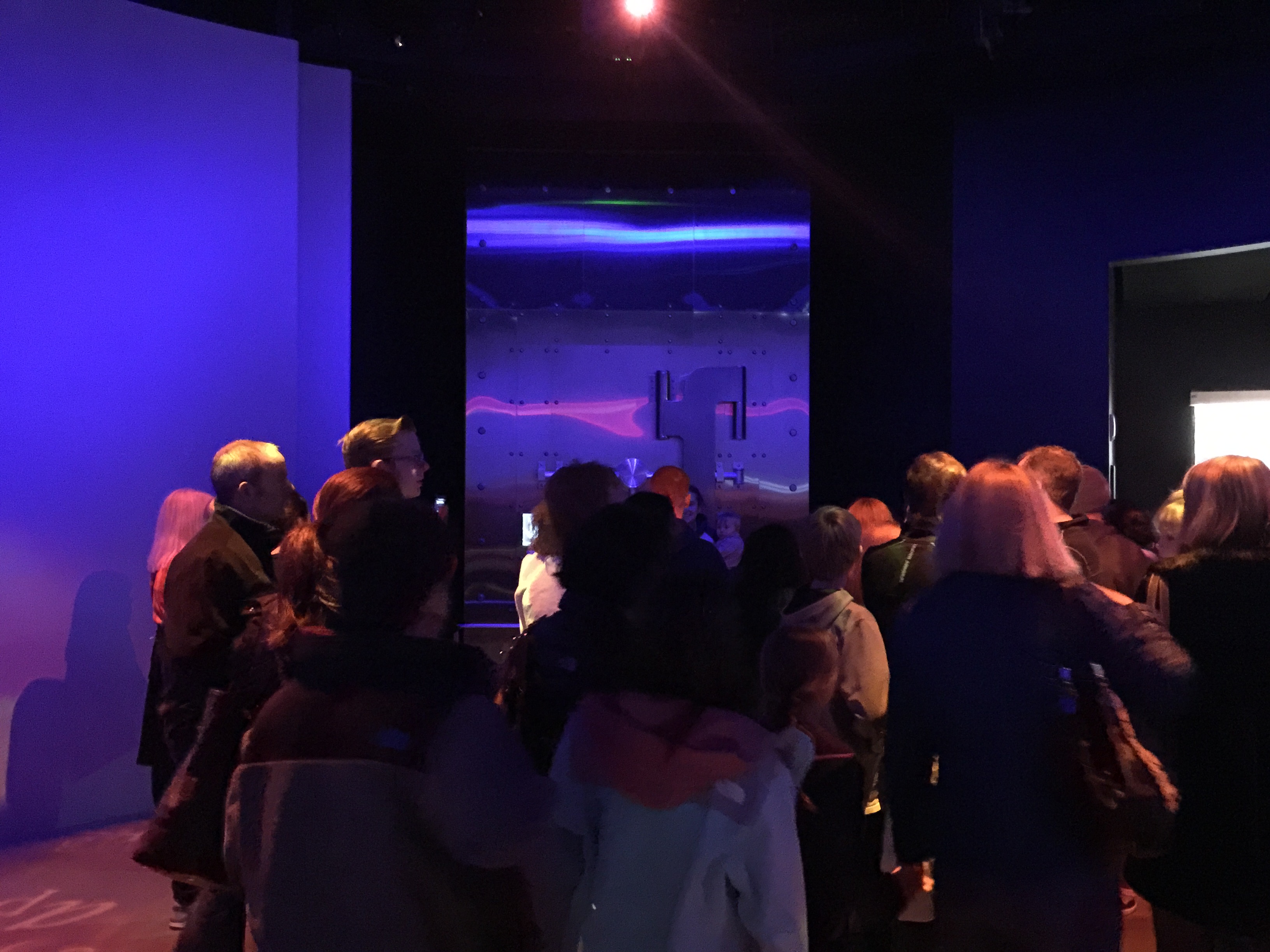
The vault itself, which supposedly contains the original secret Coca-Cola recipe. It’s great for mystique but, technically, science is advanced enough today reverse engineering it isn’t a problem. It has vanilla, lime, orange oil, lemon oil, coriander oil, cinnamon oil, nutmeg oil, and a few other ingredients. It’s the patent and trademark that do the protecting these days, not secrecy. Though the concentrate manufacturing locations – where the real stuff that is sent to the bottlers to mix with carbonated water and sugar – are largely unknown.
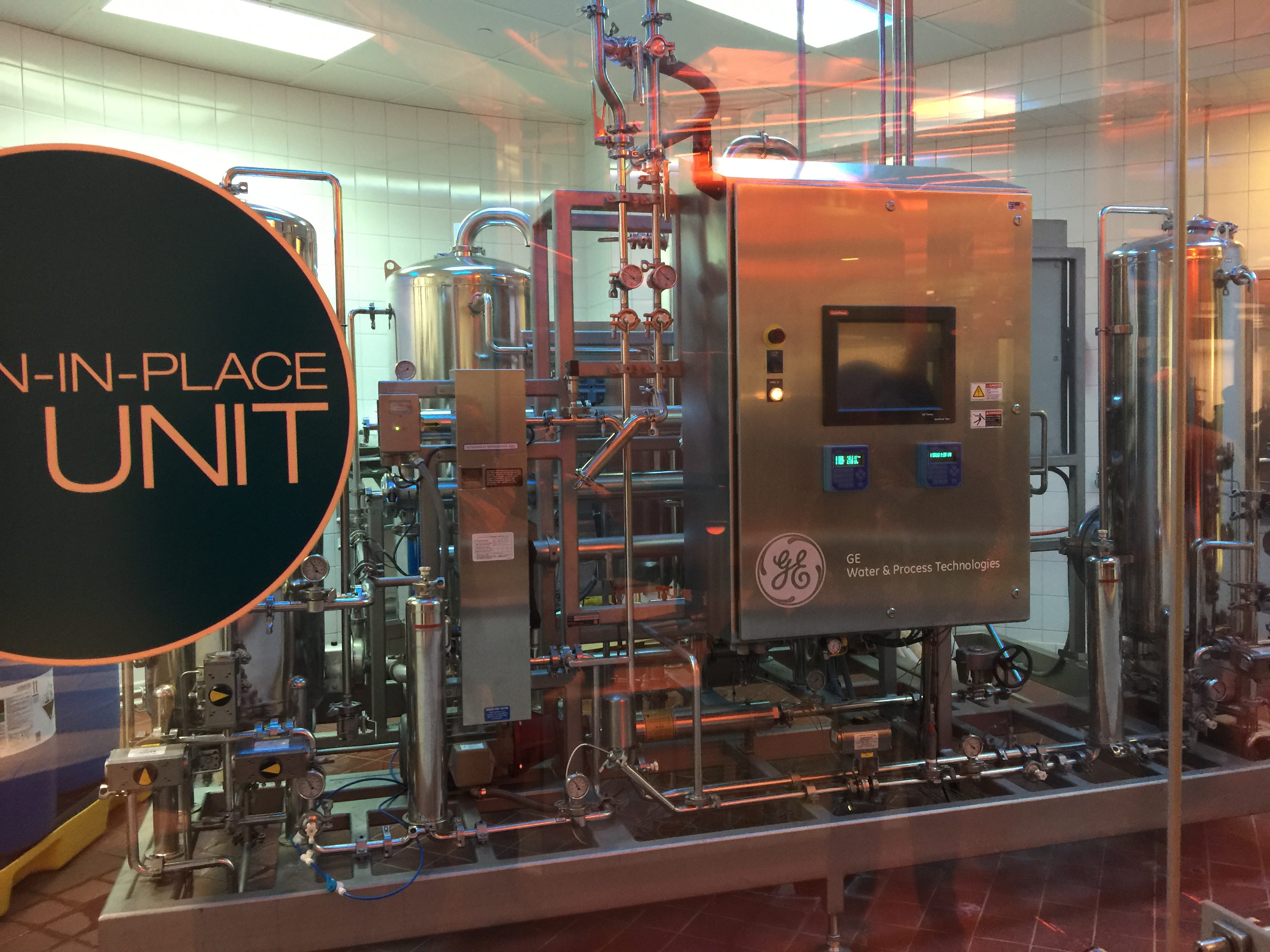
That was a beautiful sight to behold … We were touring the bottling plant section and it began with a General Electric water treatment setup.
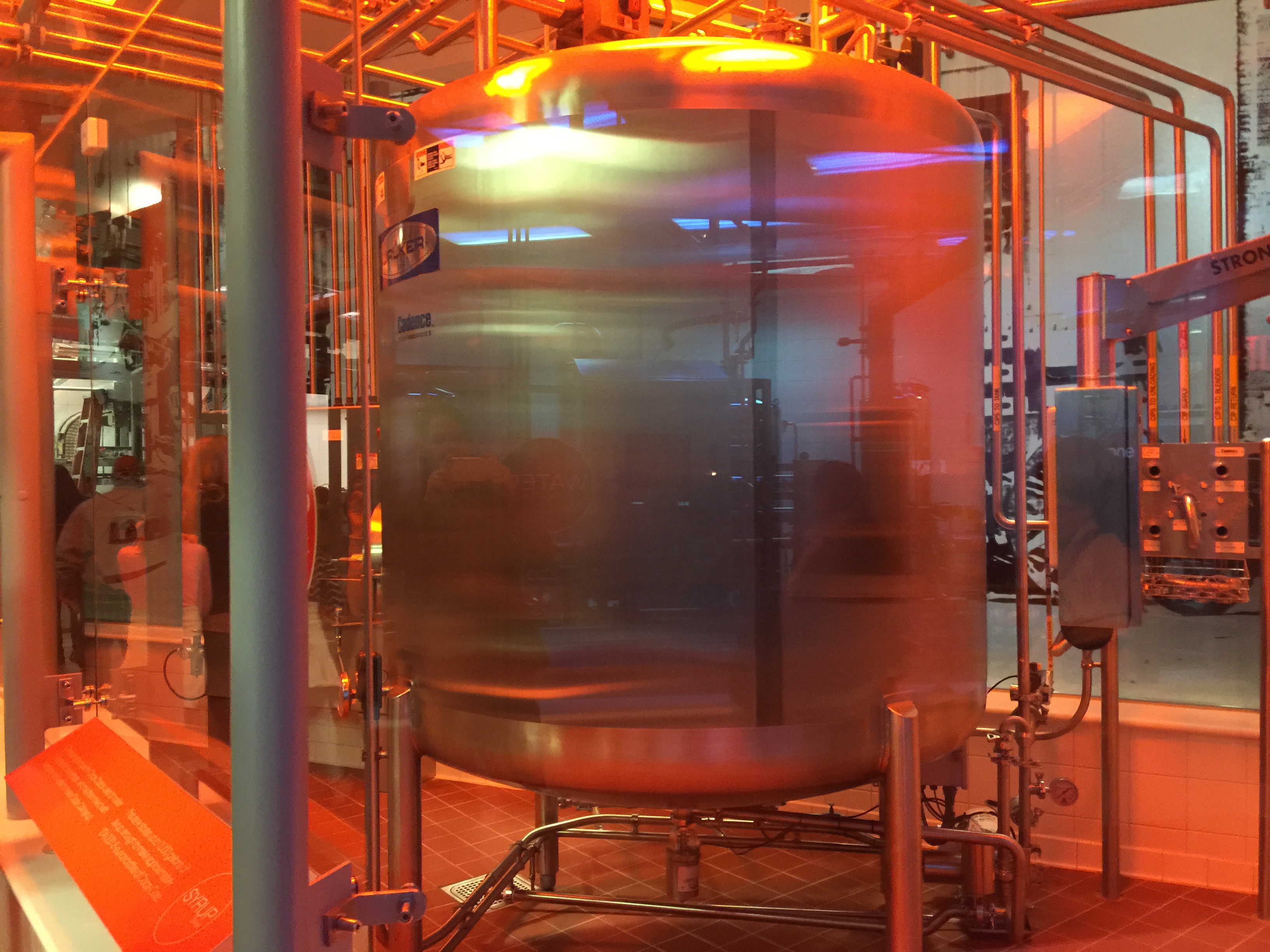
This is what the Coca-Cola Company actually does. It manufactures the syrup concentrate it sells to its franchisees, the bottlers. Though, these days, they own most of the bottlers in North America thanks to a mega-deal that went through in recent years when they bought out their former partners.
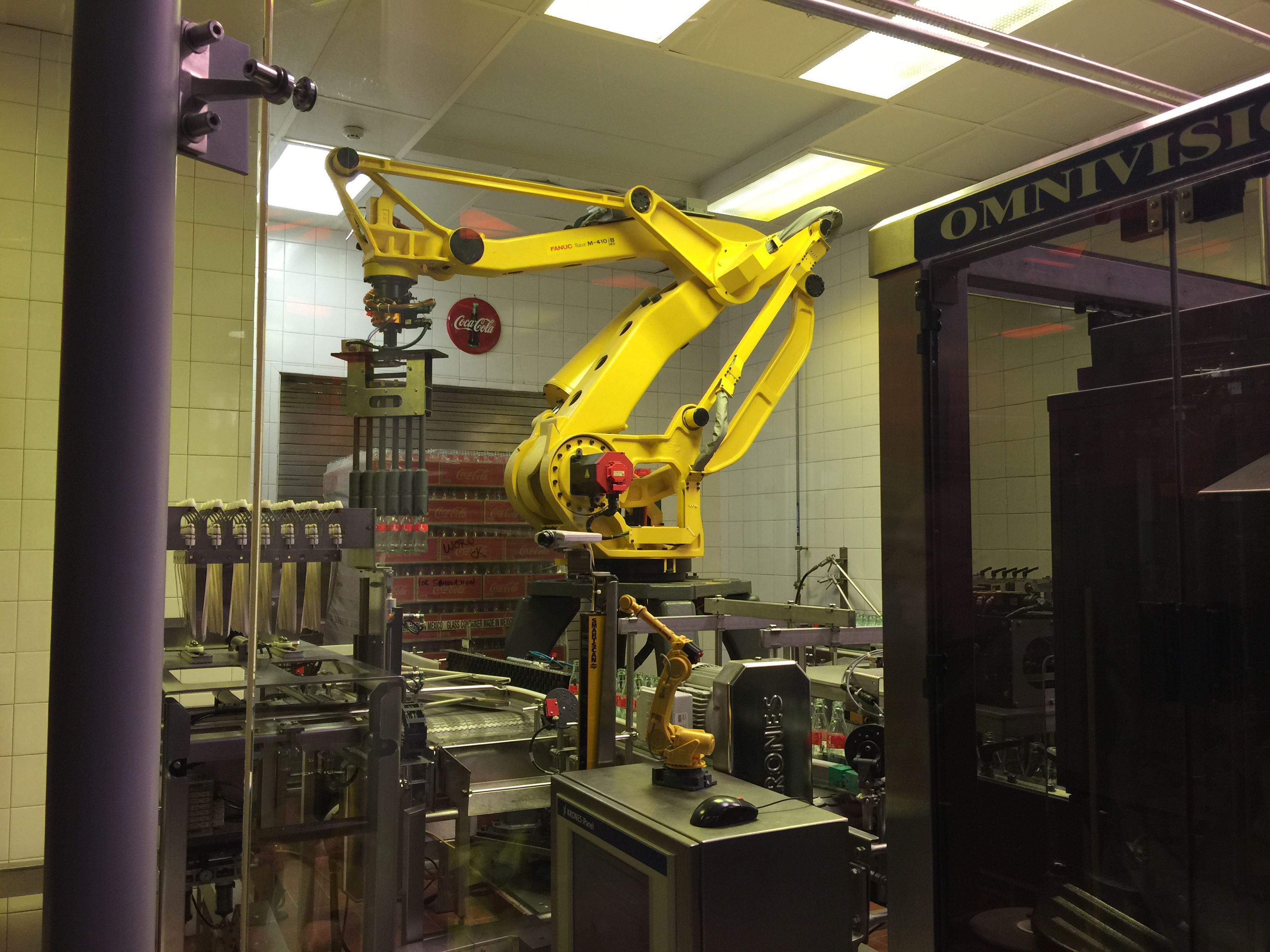
The automation was incredible. Everything was slowed down for us. This mini-plant made 20 bottles per minutes so we could see the process with the human eye. Some plants run at a rate of 2,200+ bottles a minute.
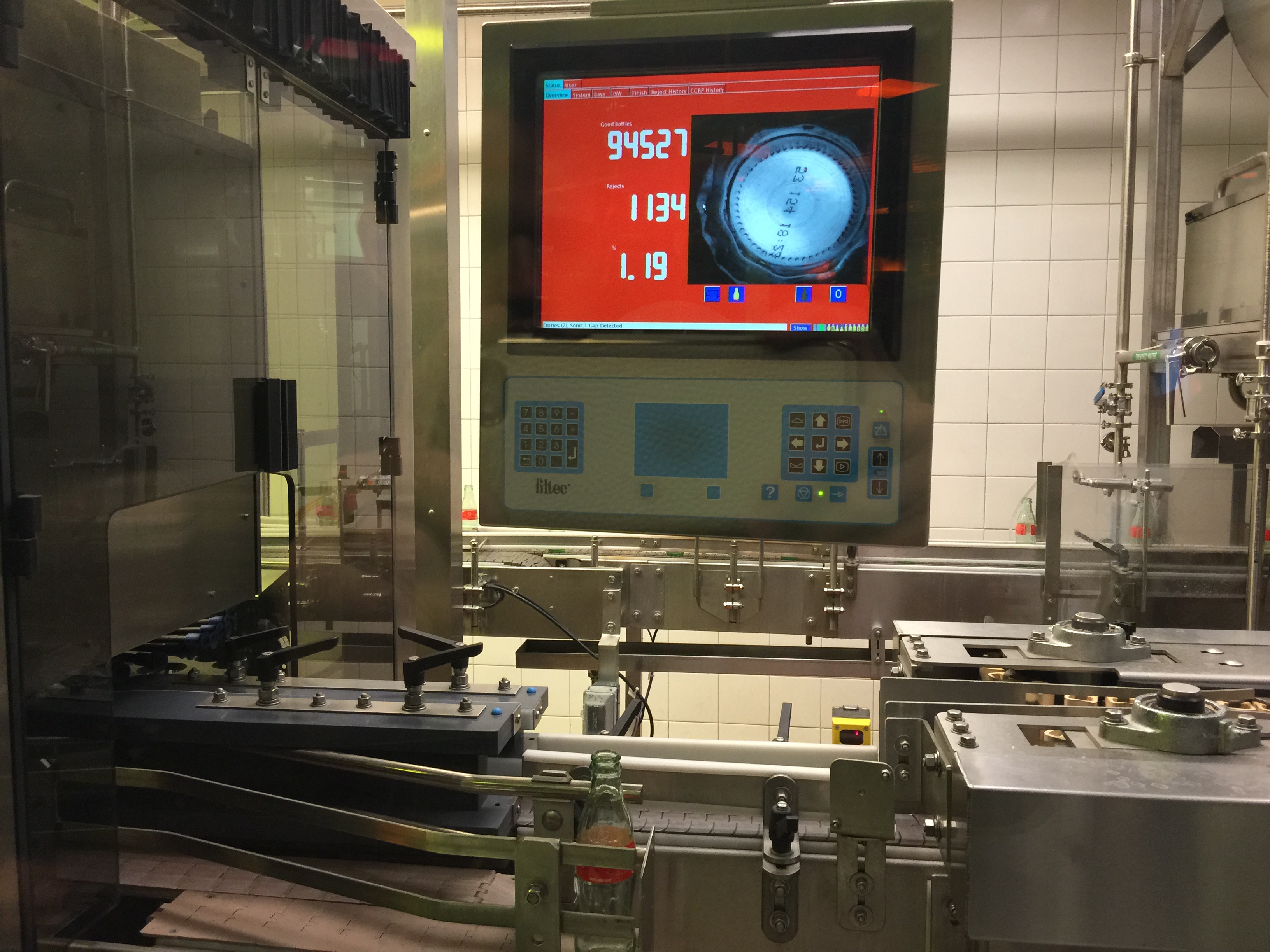
A machine automatically checks the integrity and shape of each bottle, rejecting those that aren’t up to par.
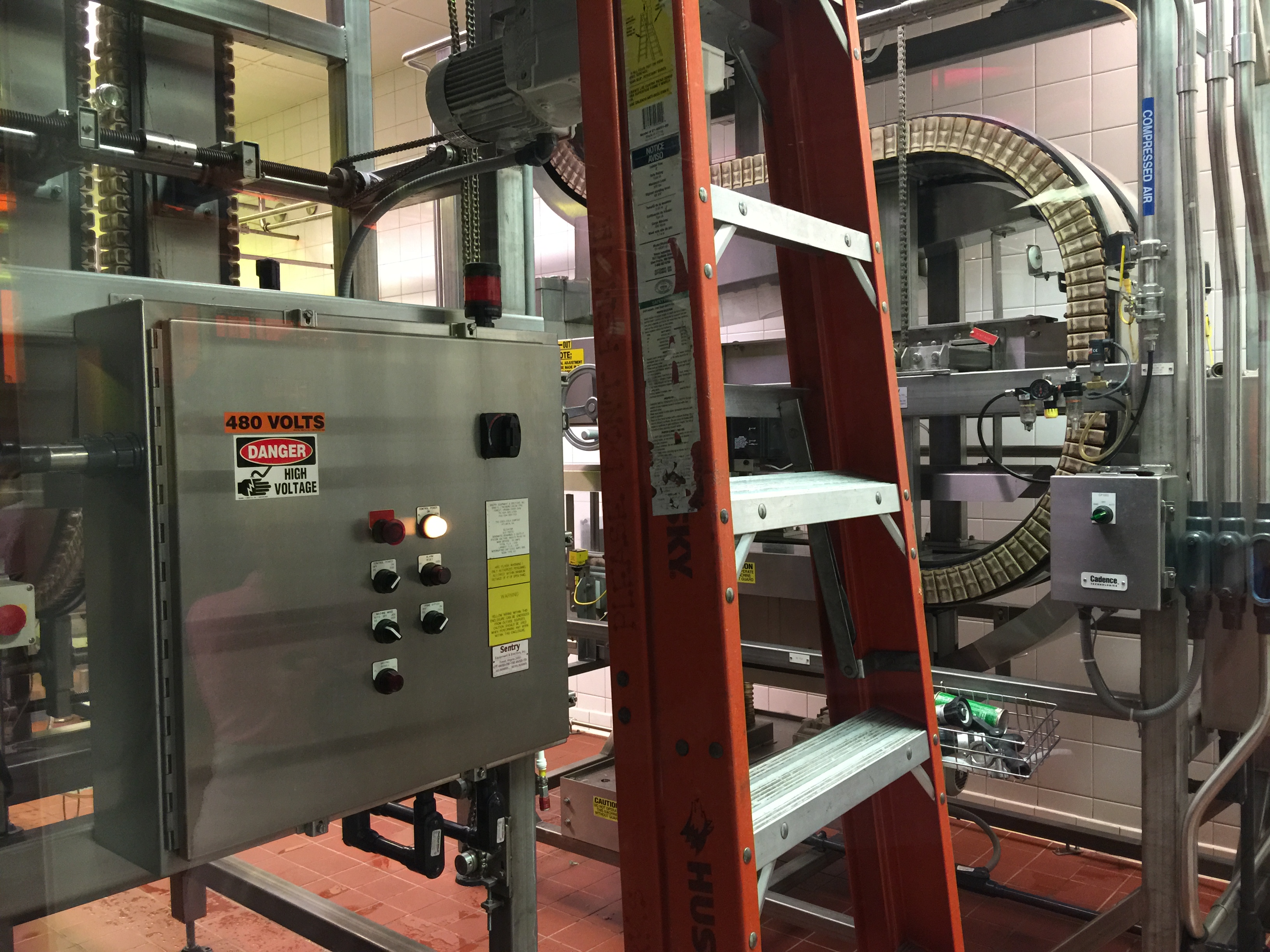
I like machines. I like machines a lot. Until, at least, they become sentient and try to take over the world.
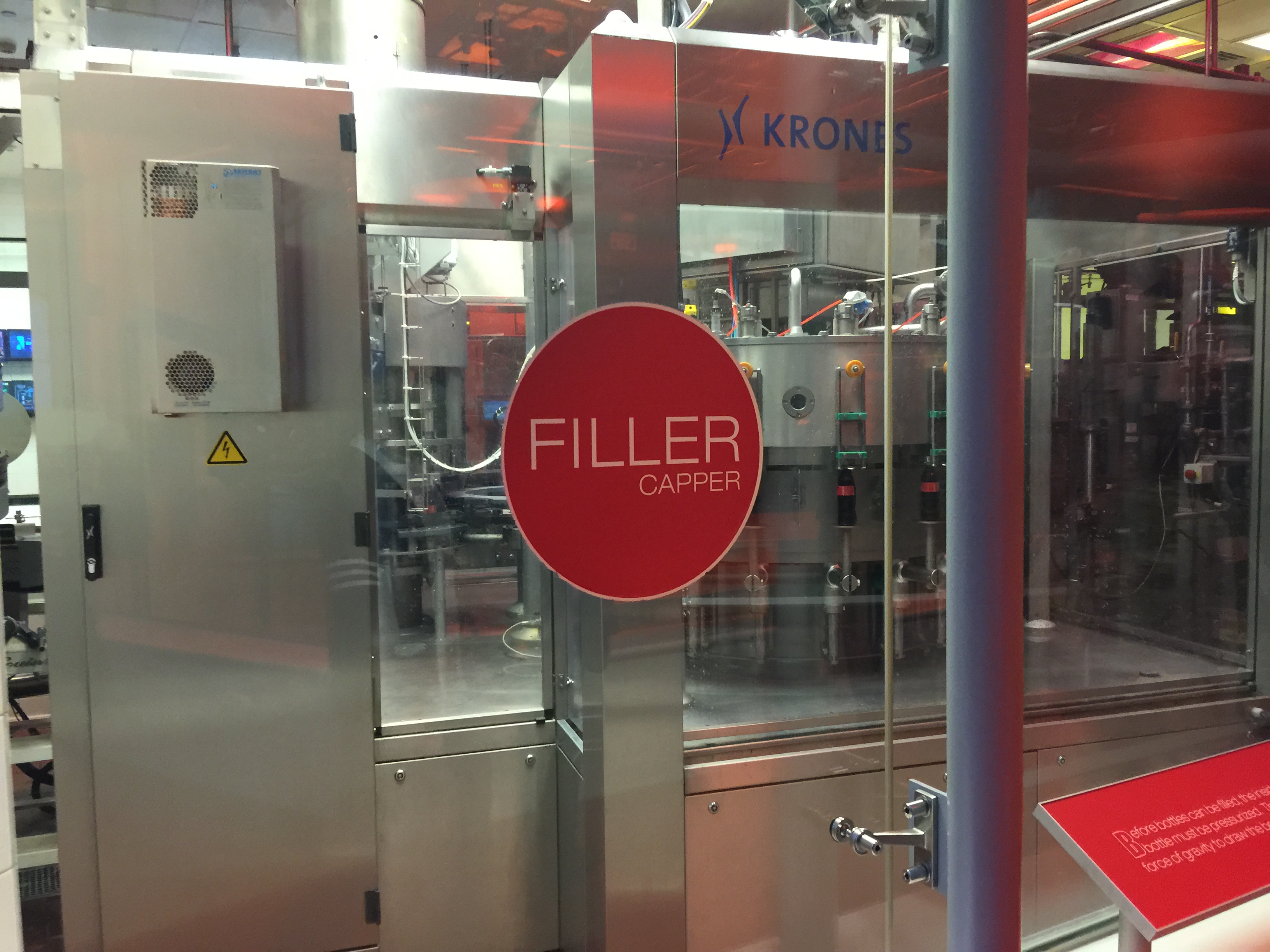
Automation really has changed the world. This would have required an army of factory workers at one point but now it’s almost completely self-running.
Case in point … look at one of the original carbonated bottling machines from another exhibit:
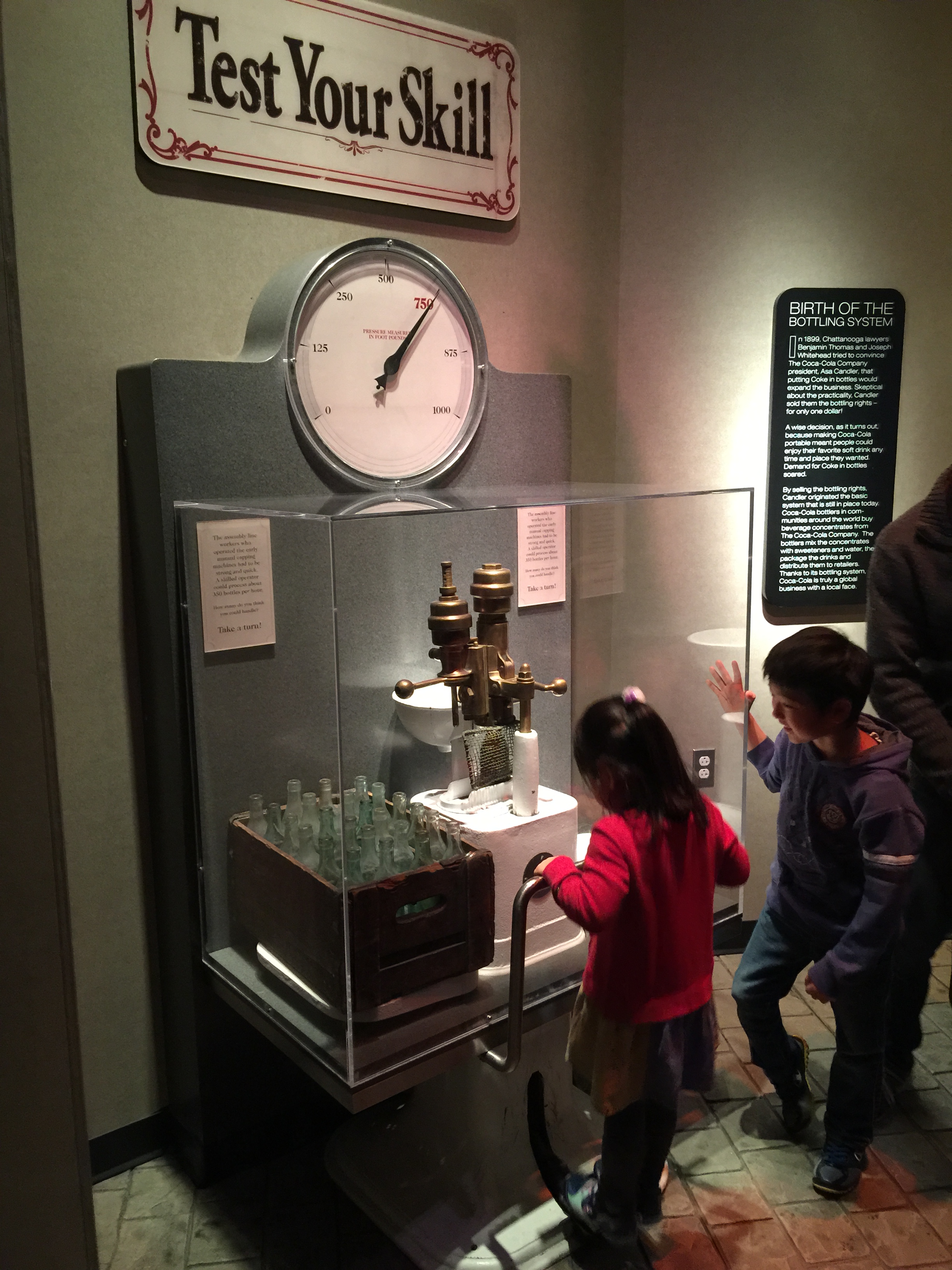
You had to fill the original Coke bottles and get the pressure just right with a foot pedal.
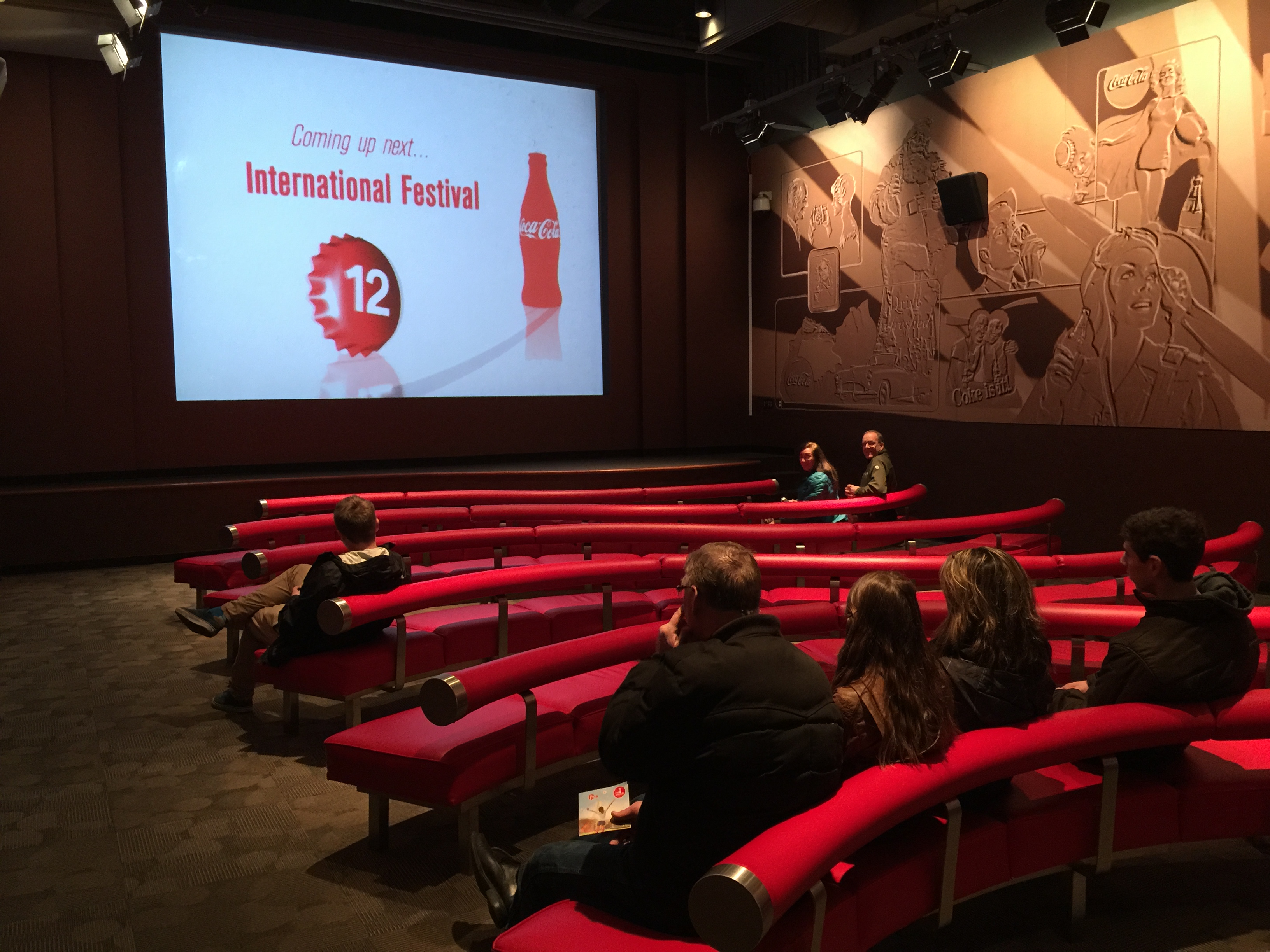
They had a theater where you could watch advertisements from the company’s 125 year history from around the world.
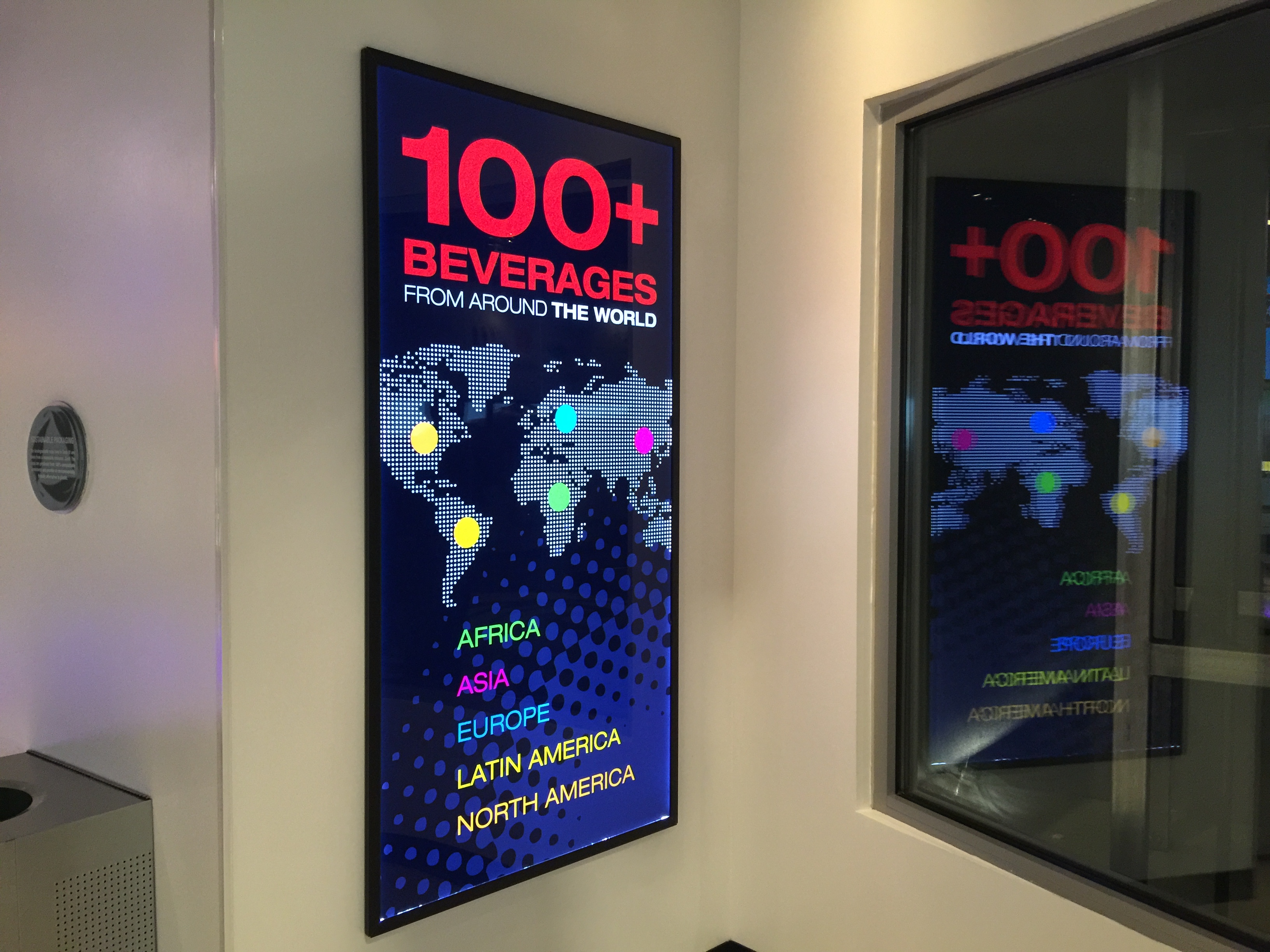
We couldn’t wait any longer so we headed for the Taste It exhibit, which features 100 different Coca-Cola products from around the world.
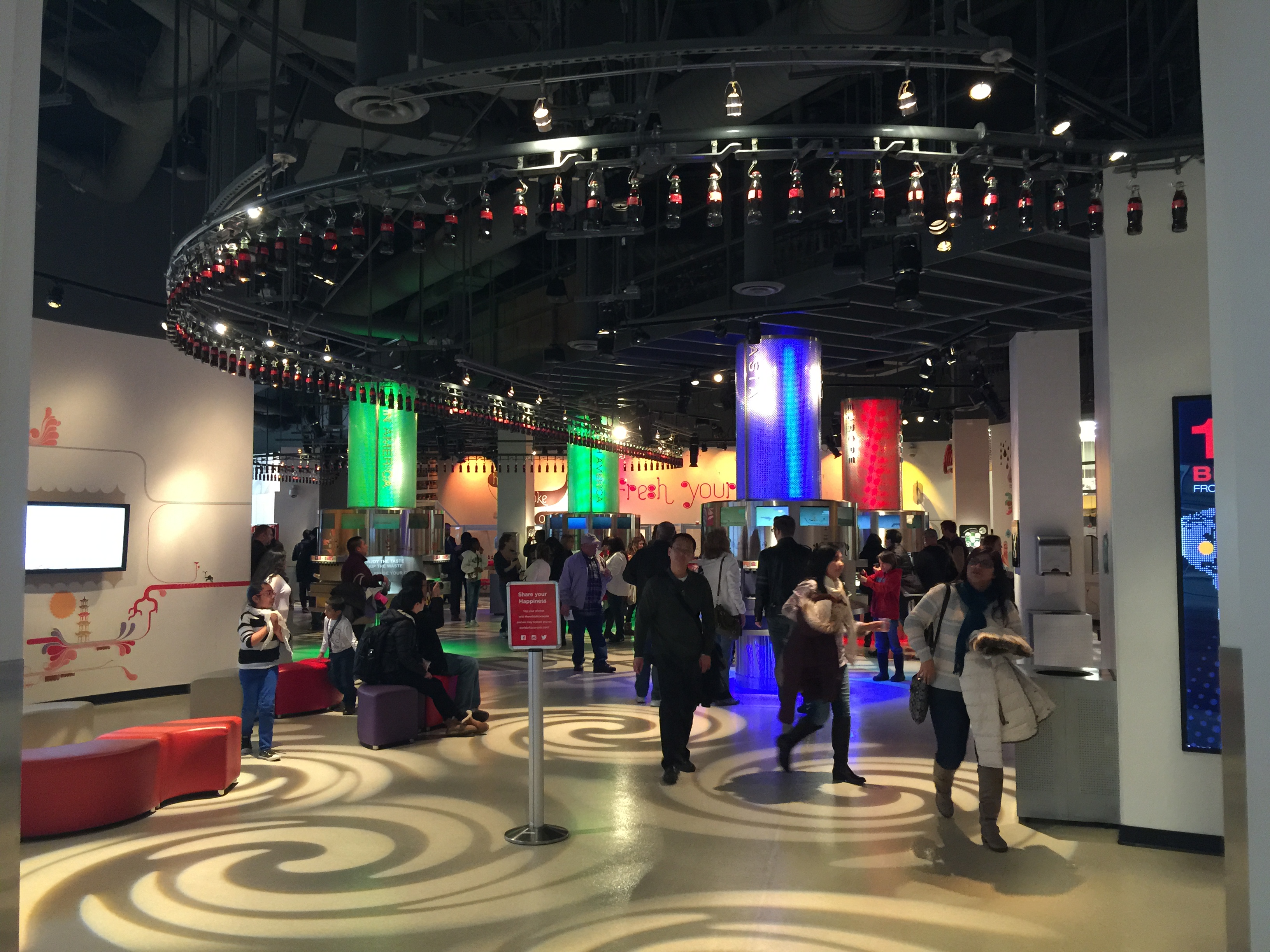
Each of those pillars coming down from the ceiling represents a different continent. They are surrounded by soda fountains featuring beverages Coke sells in nations on that continent. Including tap water, Coke now has 3.5% market share of all beverages consumed by humans in any given day. Notice the bottles coming from overhead. They were from the bottling room we saw earlier and you’ll get to take one before you leave.
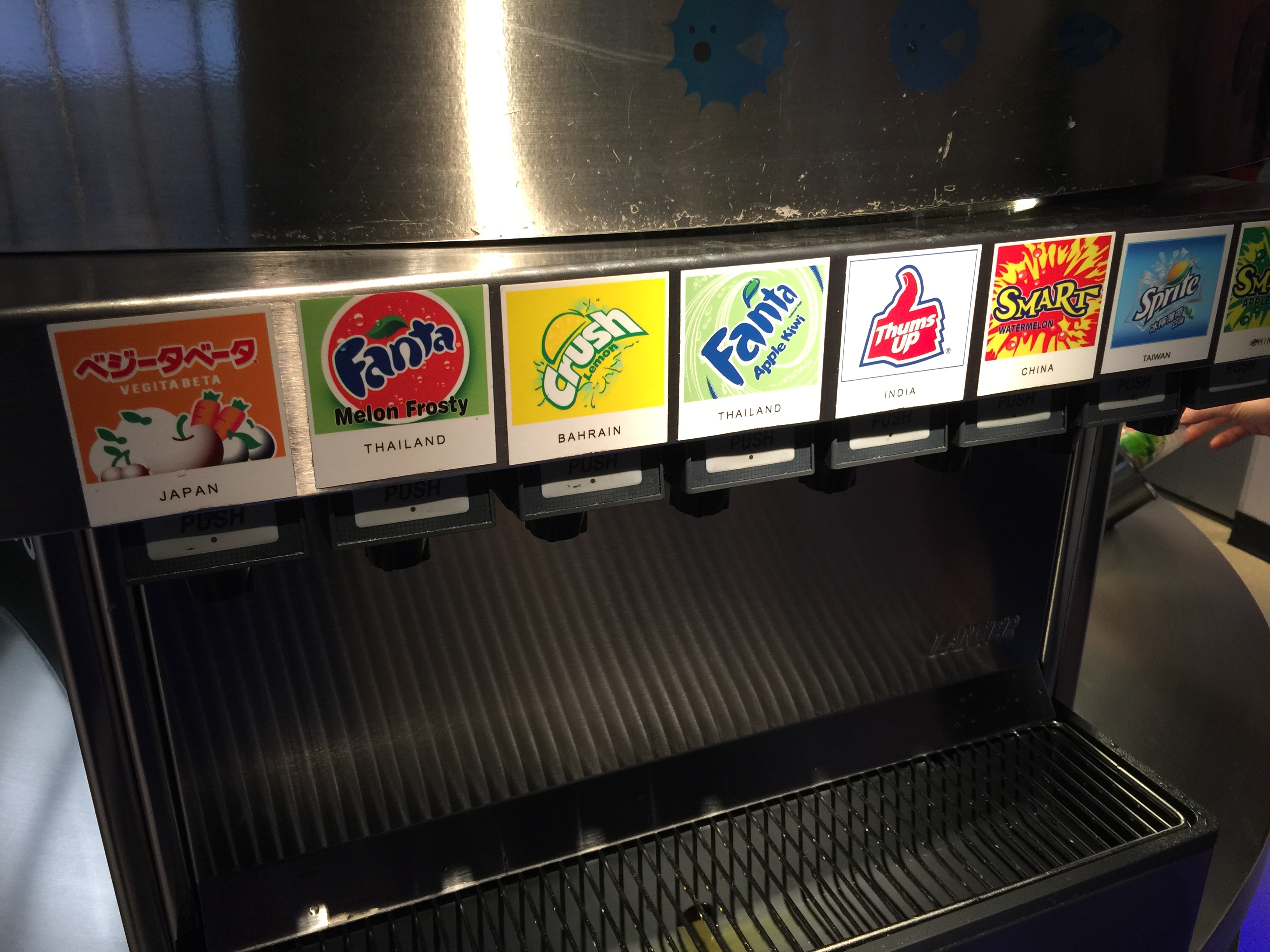
The Asian Coca-Cola brands were probably our favorite. I really like the Japanese Vegitabeta and the Fanta Melon Frosty from Thailand. The Thumbs Up from India was weirdly spiced. I’ve never had anything quite like it.
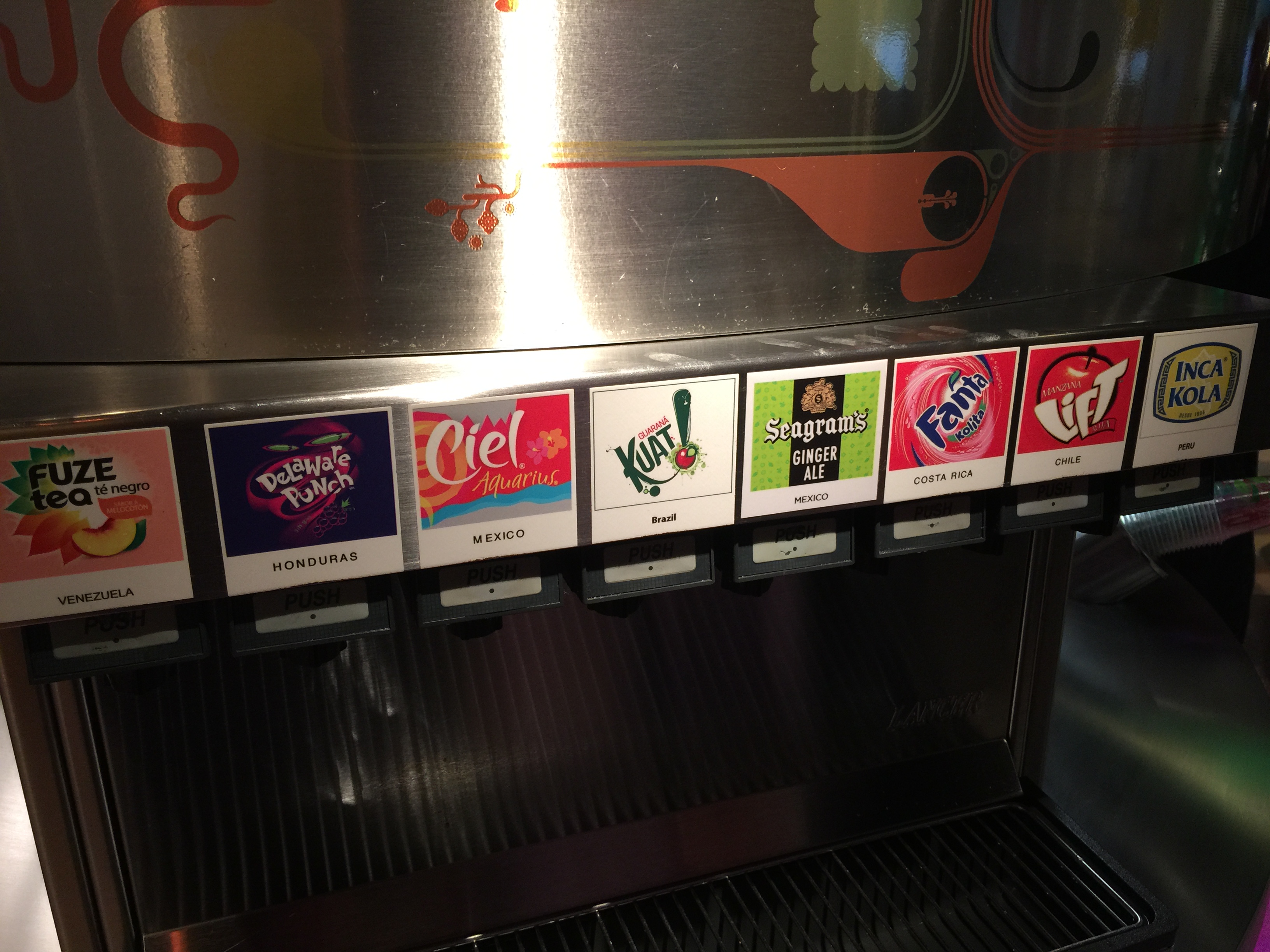
The Latin American flavors were okay but there were a few standouts. I really liked the Fuze Tea from Venezuela. Though, at this point, it’s not like the sales are doing Coke any good. Chavez destroyed the country’s economic so completely and thoroughly, corporate America has basically written the currency off as worthless. It’s crazy the same script plays out time after time. A socialist comes to power, confiscates private property under the theory it should be collectively owned, and then the laws of economics kick in and they lose it all. Time after time. Without exception. Why can’t they just copy the Nordic model of private market capitalism combined with regulation and tax policies that prioritize investment in human capital? Steve Jobs is always going to be able to run a company like Apple better than some government bureaucrat can. Walt Disney is always going to be better at the startup game than some intern appointed because of his family’s political connection. It’s the nature of the universe. You ignore it at your own peril.
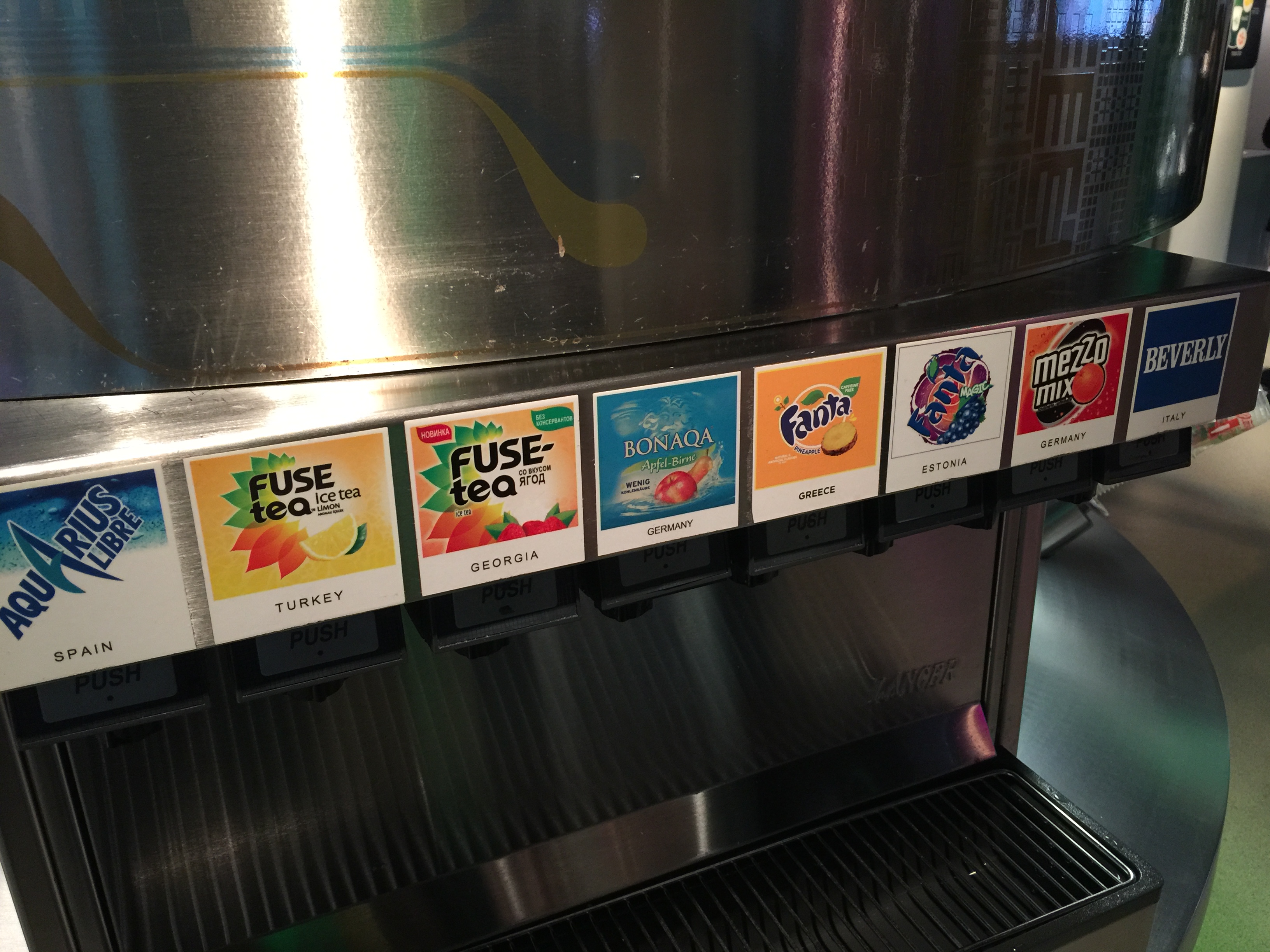
Europe … you crazy. Especially Italy. I had it before at the world of Coke in Walt Disney World Epcot but the Beverly beverage? No. You must have a masochistic streak to enjoy that assault on the tongue.
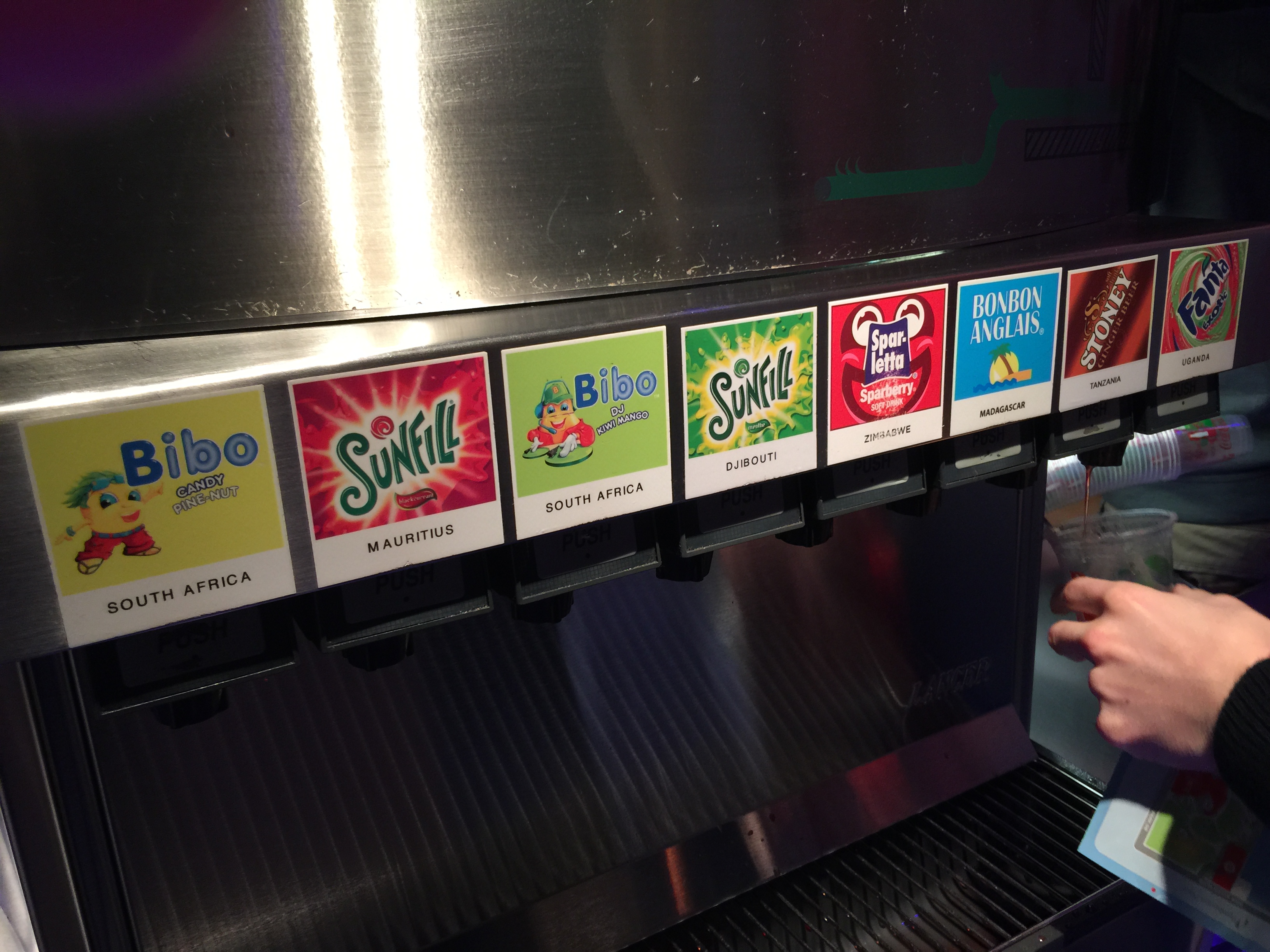
Africa was so sweet! I kind of like Bibo Candy from South Africa. It was like a sugar overload. It wouldn’t be something I could have very often but it was akin to a liquid pixie stix.
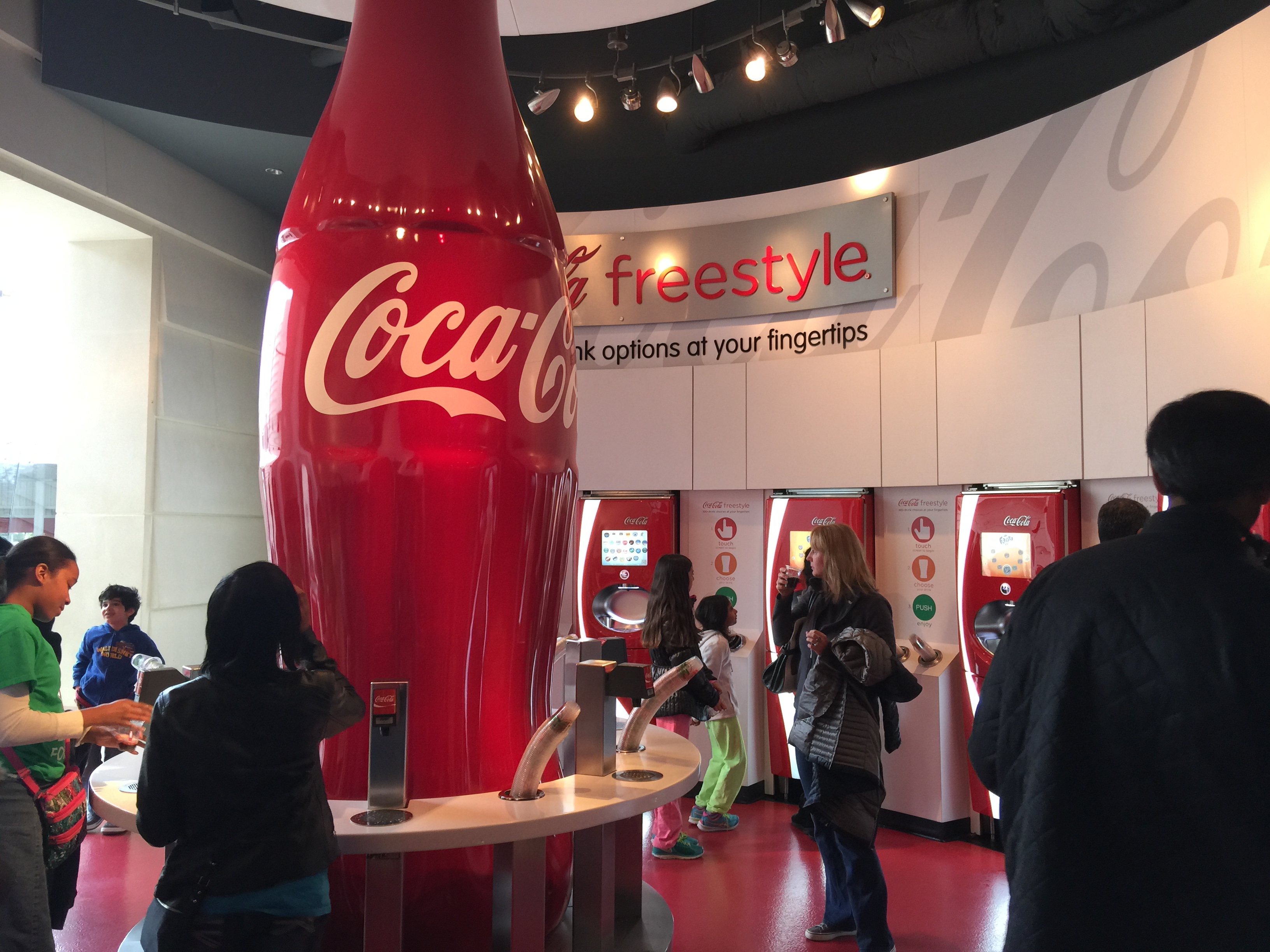
There was a Coca-Cola freestyle area, too, with plain Coke dispensers in the center. I like the original best, myself.
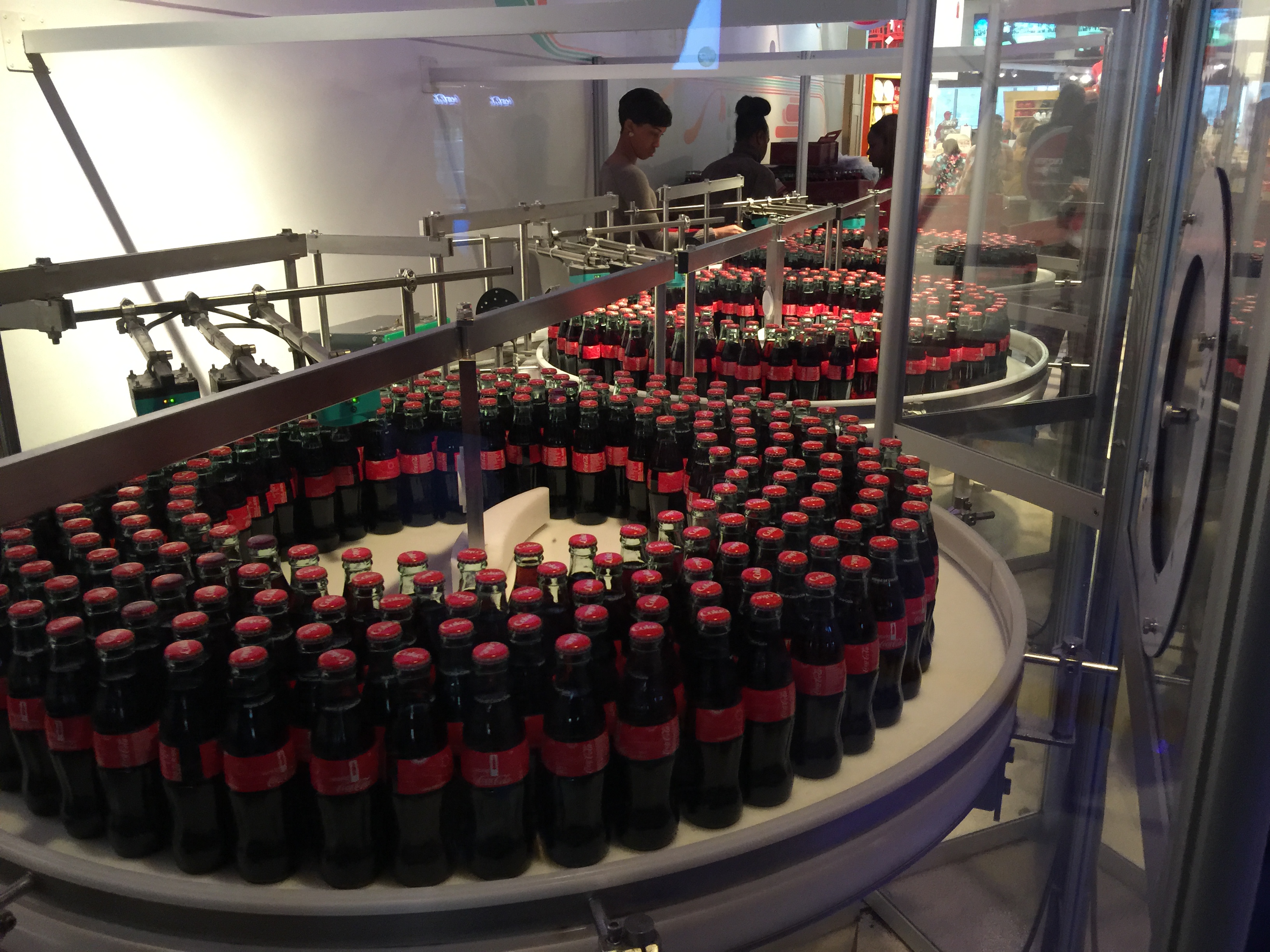
Later, at the end of the tour, after the tasting room, you see the efforts of the bottling operation and get to take one with you. The bottles were coming out overhead, circling around the tasting floor.
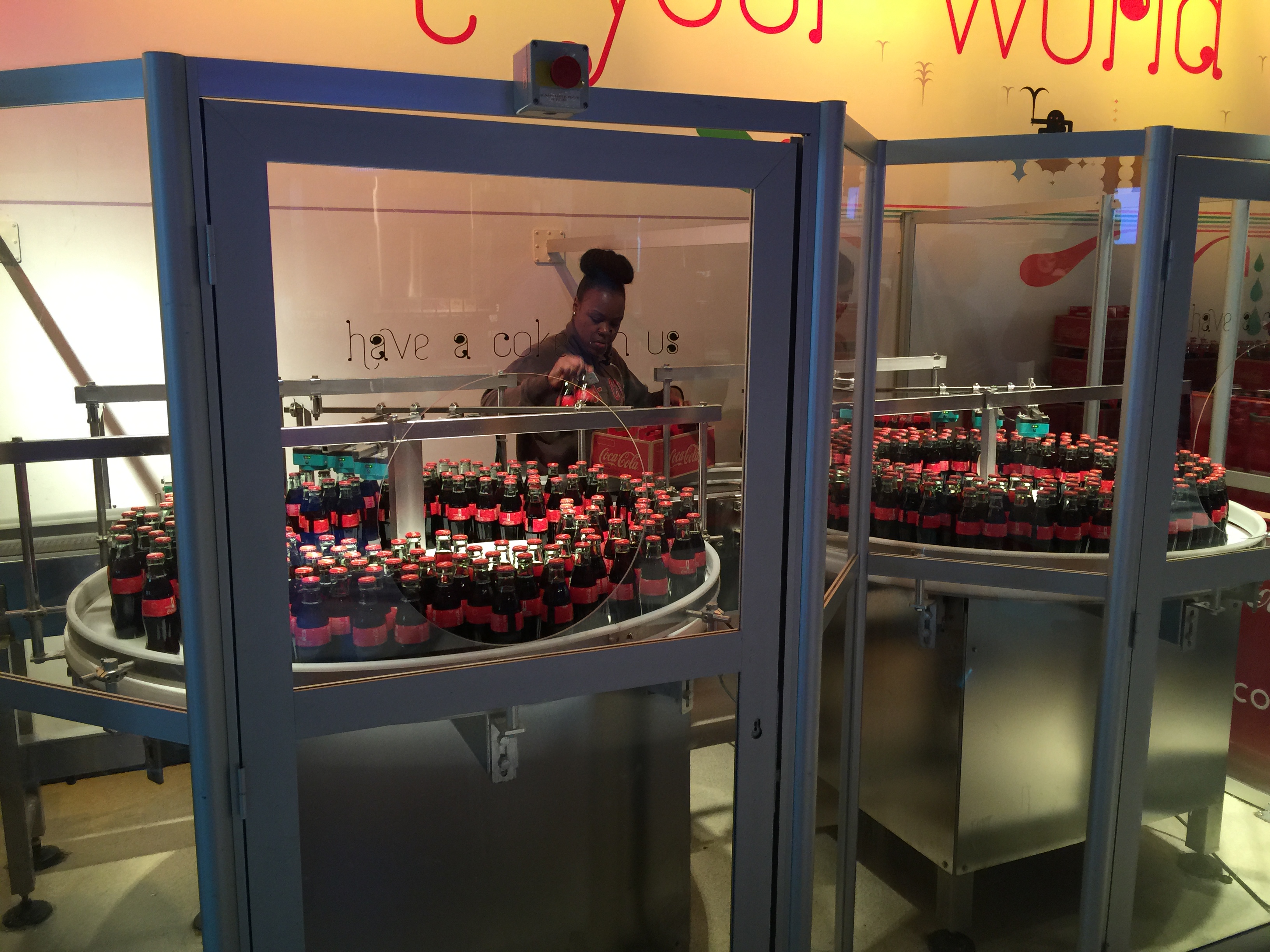
Go ahead and take one … you paid for it with your price of admission.
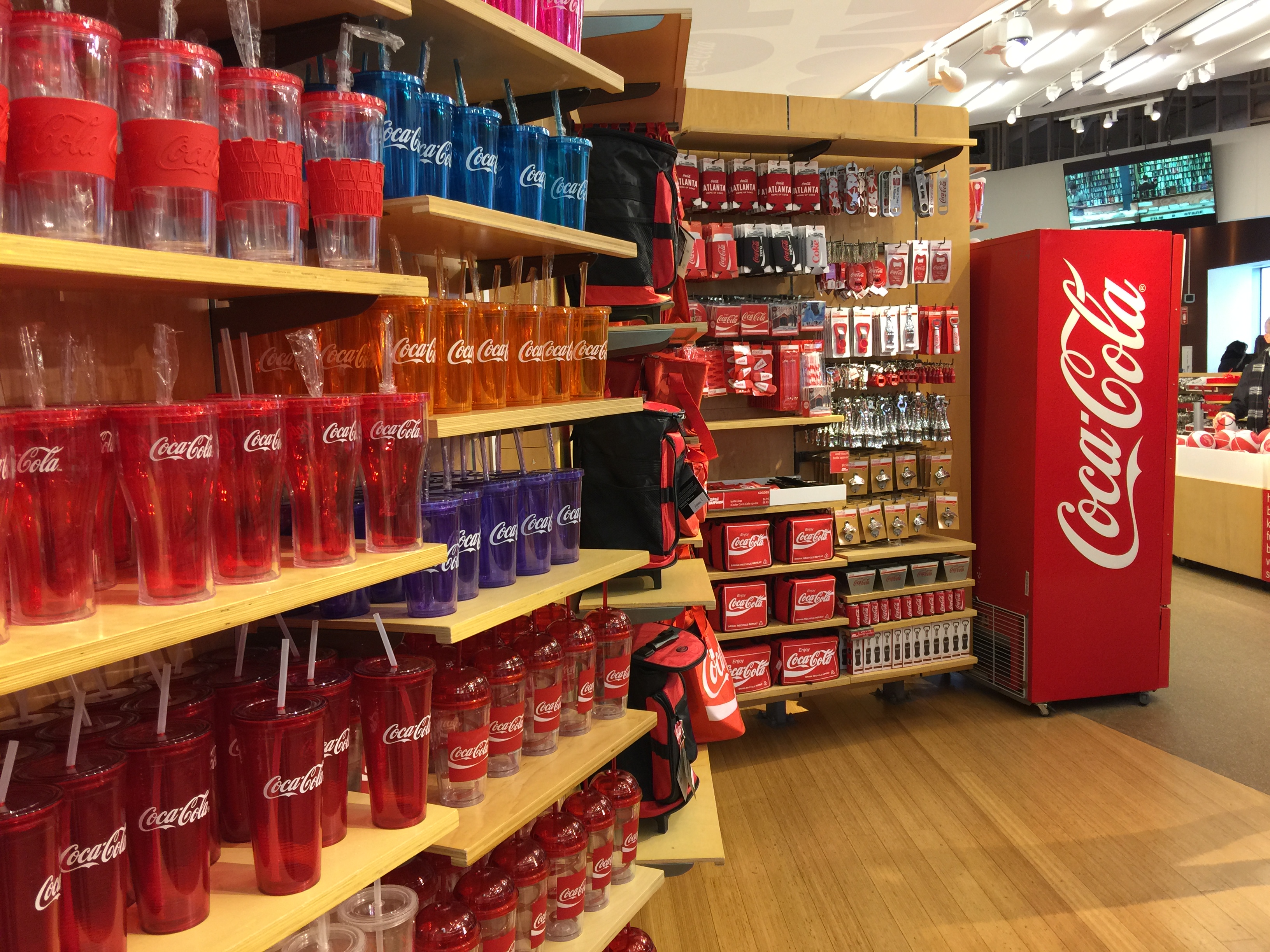
When you leave the exhibit, you enter the giant World of Coca-Cola retail store, which has a huge selection of everything from bottle openers to picnic supplies, board games to collectibles, clothing to glassware. It’s magnificent.
These were my favorite. We are picking up a bunch on our way back home when we come through Atlanta, again … or we might order them online, instead, to avoid having to carry them with us.
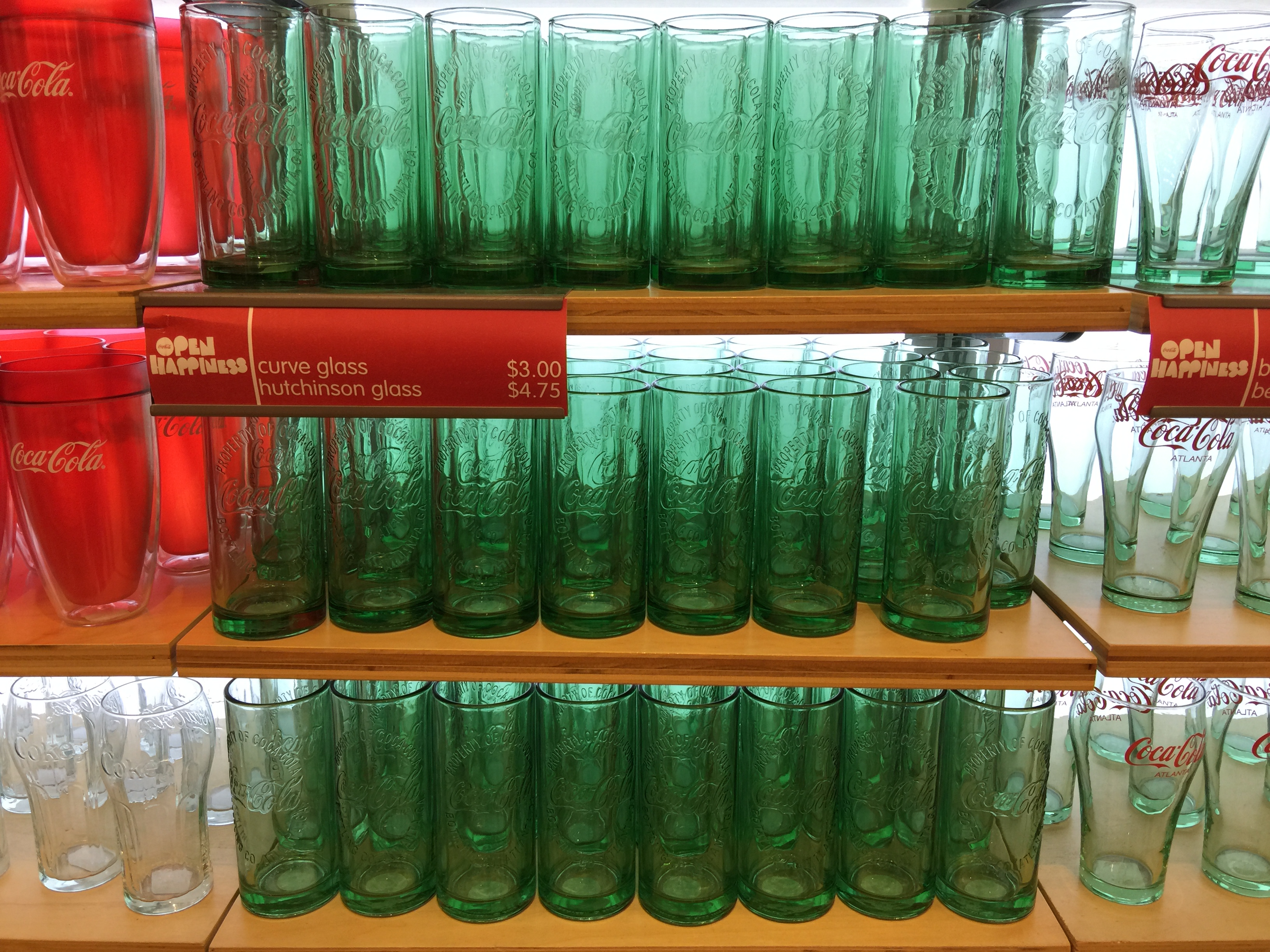
The Coca-Cola Hutchinson glasses were our favorites. These things are heavy, wonderfully weighted, and an awesome old-school color. They’ll be great chilled in the refrigerator and used to serve ice cold Coca-Cola.
I can’t ever imagine wanting to work for someone else but being the CEO of The Coca-Cola Company is one of the few exceptions to that rule. I love the business so much, and feel like it is such an important part of history, that it would be almost akin to being a trustee of a great cultural artifact.
[mainbodyad]
Reader Comments (20)
Comments are presented chronologically, with replies indented beneath the comments to which they respond.
Steve
February 17, 2015
I'm not ashamed to admit I've been checking into the blog a few times each day since the last post to see if a new one was up, like an addict, and this has satisfied the cravings - thanks Joshua!
Alex
February 17, 2015
Replying to Steve
^ Seconded
P.S. if you're still in Atlanta you should stop by the Georgia Aquarium. As the world's largest aquarium it is definitely a site to see. I'm sure you would also get a kick out of the Atlanta Botanical Garden.
Joshua Kennon
February 28, 2015
Replying to Alex
Oh man! We were right next to it! I didn't realize it was the biggest in the world and I really liked the Denver aquarium when we visited it. I'll have to go back now ...
Roundball
February 17, 2015
In case you had never heard, This American Life had a podcast from 2011 about the formula for Coca Cola
http://www.thisamericanlife.org/radio-archives/episode/427/original-recipe
Adam
February 17, 2015
Awesome photos. I'll have to put that on my list.
Stegner
February 18, 2015
Oh my gosh. I was in India in 06, I had totally forgotten about Thums Up. I remember drinking it at roadside stalls from glass bottles. The vendors wouldn't let you walk away with it, you had to drink it right there and then hand the bottle back so it could be recycled/refilled. I remember spending a week in a tiny village in Rajastjan; no electricity, one hand operated water pump for the whole village; stone mill to grind grain and yet they STILL had a stall selling coke, sprite etc.. Even though I was totally financially illiterate at the time, I remember marvelling at the penetration of Coke.
Wow. What a rush. Thanks for triggering the memory and thanks for the post, as usual.
PS. Pepsico's Lays chips had some crazy flavours in India too, if my memory serves me correctly.
Joshua Kennon
February 28, 2015
Replying to Stegner
No problem! I hadn't seen the different potato chips. Personally, for me, Nestle makes all these weird Kit Kat flavors in Asia I want to try so badly (I'm hoping to if we do end up going to Seoul or thereabouts in the next year or two). I mean, look at them! There are so many different varieties ...
innerscorecard
March 2, 2015
Replying to Joshua Kennon
You should see all the Oreo flavors here.
dave (nestle)
February 18, 2015
Hey guys!
If you just keep driving north a bit, I will treat you to a nice lunch. (we have plenty of ice for your beverages of choice also)
Joshua (or anyone), do you happen to know off the top of your head what a Coke share in 1919 (at $40) had for it's earnings yield? What was the historical 'absolutely safe' investment alternative back then, and what was it yielding?
Thanks!
FratMan
February 18, 2015
Replying to dave (nestle)
Dave,
Coke had a $30 million market cap while making $9.9 million in annual profits so we are talking about a P/E ratio of around 3.
My source is this Motley Fool article: http://www.fool.com/investing/general/2014/02/25/heres-what-you-dont-know-about-coke-todays-best-do.aspx
The U.S. Treasury yield was somewhere around 5% or 5.5% or so.
My source is this Credit Suisse picture which was used in a Wall Street Journal Article.
http://s.wsj.net/public/resources/images/OB-SJ272_RealIn_K_20120326151517.jpg
I did not double check any of these sources, so caveat emptor (err, caveat lector).
U.S. bonds issued by (guess the country) were probably the safest investment, given its victory in WWI and relatively strong position compared to its Allies and emergingly robust economic and military might. That said, old ideas die hard and there is a small segment of historians that believe Britain didn't hand over the torch to the United States until post-WWII, given that Britain had centuries of colonial domination on its side, strong laws regarding property rights, and a highly favorable treaty settlement with Germany after the war.
Here is a chart of British interest rates, which were also around 5% at that time, but keep in mind the real interest rate was much lower.
http://www.economicshelp.org/wp-content/uploads/blog-uploads/2012/10/real-1920s-interes-rate-500x365.png
I suspect a sense of hopelessness would set in after seeing such an excellent enterprise trading at 3x earnings, realizing that we may only get to see Coca-Cola on sale at quadruple that valuation a few times in our lifetime.
But keep this in mind: Pay attention to that part of Joshua's post where he talked about a self-running factory compared to the olden days with armies of people that used to work at a Coca-Cola factory. This makes life more difficult for the common man, for sure. But it says something about a higher earnings quality for the company: Coca-Cola can extract much more cash from its business and return them to shareholders in the coming years than would be the case otherwise.
The fact that Coca-Cola has been transitioning from "best investment in human civilization" to "investment likely to beat the S&P 500 by 1-3 points over very long periods of time" is not a great hardship if (1) you have a high savings rate, and (2) appreciate the fact that Coca-Cola's wipeout risk is now virtually nil, whereas the company had less entrenchment in 1920 and thus carried less certainty.
Also, Joshua, very nice post. I wonder how many people visit the World of Coca-Cola and have no idea that you can go to Loyal3 or Computershare and start easily becoming an owner with glorified pocket change? In the case of Loyal3, I think you can start with $10, so quite literally pocket change. The tools for success are at our disposal; the start of Lent is as good a time as any to kick off a run of acting intelligent and disciplined.
dave (nestle)
February 18, 2015
Replying to FratMan
Hey thanks man!
I wasn't sure of when exactly the treasury bill of today(as we know it) became what it is. War bonds versus treasuries, etc. That P/E of Coke would then have dropped below 2 if the shares were cut in half to $19.(profits remaining constant?)
Crazy times back then, I guess. Most people probably didn't have alot of financial capital, but the bargains (due to the upcoming decades of American expansion) were outrageous.
Oh give me just one more 2008/9 cutdown in the equity markets. Then I will be in peace.
Joshua Kennon
February 28, 2015
Replying to dave (nestle)
I'm sorry I missed your message! When I saw it we were already on our way down to Florida and I didn't think about it on the way back until I was already home. Maybe someday we'll meet in real life! I appreciate the invite, anyway. We'll take a rain check, haha!
innerscorecard
February 18, 2015
Love that world drinks fountain!
Young Professional
February 18, 2015
Joshua,
I began reading your blog after a friend introduced me to it - it is amazingly informative and fun to read, too! I I wanted to ask a question that will hopefully give me and many other young professionals reading this blog some advice. I am in my early 20's and I am working in NYC in finance. I began investing two years ago with advice from my parents financial advisor into two mutual funds with money I had saved from birthday gifts, lemonade stands, and my personal favorite: finding and selling golf balls. I also recently found about 30 shares of KO that my grandparents bought for me about 20 years ago when I was very young. I have about 15K total and am looking for advice in terms of which way I should look to invest for the long-term as a young professional. This blog has given me a ton of insight into the beauty of investing smart and young. I'm just looking for ways to do so!
Thanks!
Heath
February 18, 2015
These pictures look familiar. Oh yes, I was there 24 hrs earlier on the 15th! ...I'm with you on the Beverly.
Connelly Barnes
February 18, 2015
The only soft drink I've had in the last many years is Kvass (a Russian soft drink). Generally I don't drink soft drinks, but I am happy to see Joshua and everyone else excited about soft drink companies, and to learn about the great economics of these companies.
tawcan
February 19, 2015
Very cool tour. The only time I went to Atlanta was because our flight out of Raleigh got canceled due to snow storm and we just wanted to get home. Didn't get a chance to tour around Atalanta at all. Would love to check out Coca Cola plant one day.
Steven
February 19, 2015
Thanks for the post! What an interesting place to visit.
Looking at those robots I do have to wonder about one thing though. I generally buy cokes in a liter bottle from the grocery store, and they are not filled to the same level in each bottle...what is the deal with that? Seems with all their automation the outputs would be identical.
JB
February 22, 2015
Joshua, thank you very much for posting the pictures and sharing your tour with us. I just might have to make a trip to Atlanta one of these days.
SM
March 7, 2016
Hi Joshua,
Could you please clarify if the Coca-Cola recipe is actually a trade secret or has it been patented? From all the online information I could gather that it was once patented in 1893 but then the patent was never renewed again after its expiration and the proportion of its integredients still remain a trade secret but your article says it is th patent which still protects the recipe. Could you please confirm? Your inputs would help settle a long term argument with my friends 😉 !!